Preliminary Report on Foraminifera from the
Habitat of Nautilus off the Southeast Coast of
Viti Levu, Fiji
著者
OKI Kimihiko
journal or
publication title
南方海域調査研究報告=Occasional Papers
volume
4
page range
84-92
URL
http://hdl.handle.net/10232/15864
Kagoshima Univ. Res. Center S. Pac., Occasional Papers, No. 4, p.84-92, 1985
9. Preliminary Report on Foraminifera from
the Habitat of Nautilus off the Southeast
Coast of Viti Levu, Fiji
by
Kimihiko OKI"
The field study on the habitat of Nautilus off the southeast coast of Viti Levu Island, Fiji was carried out during the period from 26 th August to 30 th September, 1983 in comparison with that in the Philippines (Hayasaka et al., 1982: Hayasaka ed., 1983). During the field work, bottom samples for the ecological study on foraminifera were collected from ten stations off Suva (SV-1, SV-3, SV-4, SV-5, SV-7, SV-8, SV-9, SV-10, SV-11 and SV-12) and three stations off Pacific Harbor (PH-1, PH-3 and PH-5). Because the identification of foraminifera has not been complet ed, here the writer wishes to describe the general features of the foraminiferal assemblages in the
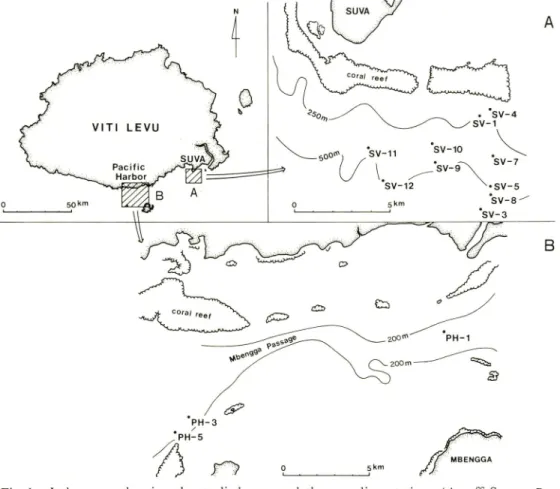
Fig. 1. Index map showing the studied area and the sampling stations (A : off Suva, B : off Pacific Harbor).
studied areas to give a basic information for future ecological studies.
Oceanographic Background of the Area Studied
Hayasaka el al. (1985) described in detail the results of the field studies on the environmen
tal background of the habitat of Nautilus. Based on their description, here the writer outlines the oceanographic environment of the present area (Fig. 1).
The samples of foraminifera studied by the writer are collected from the two separate areas,
offSuva (A) and off Pacific Harbor (B), both on the southeast coast of Viti Levu, Fiji. Submarine
topographic features of the two areas are contrasted with each other. Namely, in the area A, the submarine topography is characterized by a steep slope with a few submarine canyons abruptly deepening from the outer margin of the barrier reefto the deep ocean bottom, while the area B is a narrow channel (Mbengga Passage) between the barrier reefs off Viti Levu Island and surround ing Mbengga Island.
In spite of the difference in topography, thevertical distribution patterns of water temperature
in the two areas are similar to each other. The temperature of water shallower than 100 m seems to be rather constant (24.40-25.42°C) and gradually lowers from 100 m (about 24.5°C) to 600 m (about 7°C) in depth. The same may be said of the changes of salinity with depth. Salinity of waters shallower than 100 m ranges from 34.2 to 34.4 %0, and that of water deeper than 100 m gradually changes from 34.0 to 32.0 %0. DO values of waters shallower than 600 m range from
5.7 to 8.4.
According to the result of mechanical analysis (Hayasaka et al., 1985), the median
diameters (Md <f>) of bottom sediments collected from the area deeper than 180 m are all plotted
within a narrow range, from 5.18-6.41 (Mean : 5.91, Standard deviation : 0.40). This suggests that both areas deeper than 180m off Suva and off Pacific Harbor are under the condition of silt deposition irrespective of water depth. The bottom samples from the five stations (SV-9F, SV-1 IL, PH-IL, PH-2L and PH-4F), of which grain-size compositions fall within the field of sandy silt in
the Shepard's triangle, show bimodal grain-size distribution with the peaks around 6 <f> and 3 <j>
and negative skewnesses (a </>). The peak around 3 (f> recognized in the grain-size distribution of
these bottom sediments implies that the sediments were supplied to the site of deposition not by
the everlasting bottom current but by some accidental power of transportation, e. g. submarine sliding originated from the shallower bottom. This may be endorsed by the fact that the tests of shallow water benthonic foraminifera are abundantly comprised in these sediments.
Materials and Methods
The bottom samples used for this study were collected at ten stations off Suva and three stations off Pacific Harbor with a small dredge connected to the trap for Nautilus (Fig. 6 in Plate 1). All samples were preserved in buffered formaline (5 %) and the surface part of each sample was stained with Rose Bengal for discriminating the living foraminifera.
In the laboratory, each bottom sample was washed through a 200-mesh (0.074 mm openings) sieve and oven-dried. Dry samples were split with a microsplitter to yield an aliquot containing
Table I. Composition of foraminifera in the bottom sediments obtained from the 14 stations off Suva (SV-1-4 and SV-7-12) and off Pacific Harbor (PH-1. 3 and 5). Fiji. Station Number SV-1 SV-3 SV-4 SV-5 SV-7 SV-8 SV-9 SV-10 SV-11 SV-12 PH-1 PH-3 PH-5 Depth (m) 275 640 180 460 365 550 460 330 420 460 330 460 420 Volume of Sediment Sample (cc) 15.4 13.3 16.1 21 2 24.6 20.4 23.3 20.4 26.7 28.7 25.0 20.0 20.4 Benthonic Population in 10CC of sediment actually counted 17330 417 5678 236 209 6158 204 8846 340 28737 ">">9 21864 199 54714 436 31065 324 10615 238 37581 367 20288 317 9004 574 Agglutinated Foraminifera (%) 4.8 16.5 6.2 15.2 21.5 14.0 16.6 5.5 15.7 15.1 7.4 30.3 25.1 Calcareous Porcelaneous Foraminifera (%) 12.7 3.8 16.7 8.3 6.8 7.4 9.0 11.7 11.1 12.6 12.5 11.0 9.9 Calcareous Hyaline Foraminifera (%) 82.5 79.7 77.0 76.5 71.8 78.6 74.4 82.8 73.1 72.3 80.1 58.7 65.0 in 10 cc of sediment 6234 5991 5406 7215 4813 33506 21425 41035 20231 14584 7782 4288 1192 Planktonic Population actually counted PI. /PI. +Ben.(%) 150 26.5 249 51.3 34 14.0 239 54.0 185 35.2 267 53.8 195 49.5 327 42.9 211 39.4 327 57.9 76 17.2 67 17.4 76 11.7 PI. /PI. -FRads. (%) 94.3 87.7 87.2 94.1 93.0 95.0 96.1 97.6 90.2 96.2 97.4 82.7 80.9 PI.: Planktonic Foraminifera ; Ben.: Benthonic Foraminifera ; Rads.: Radiolaria
aoo*"- \v^pH_1
200 m Calcareous Hyaline Foraminifera B >50 40-50 30-40 20-30 10-20 -5-10£
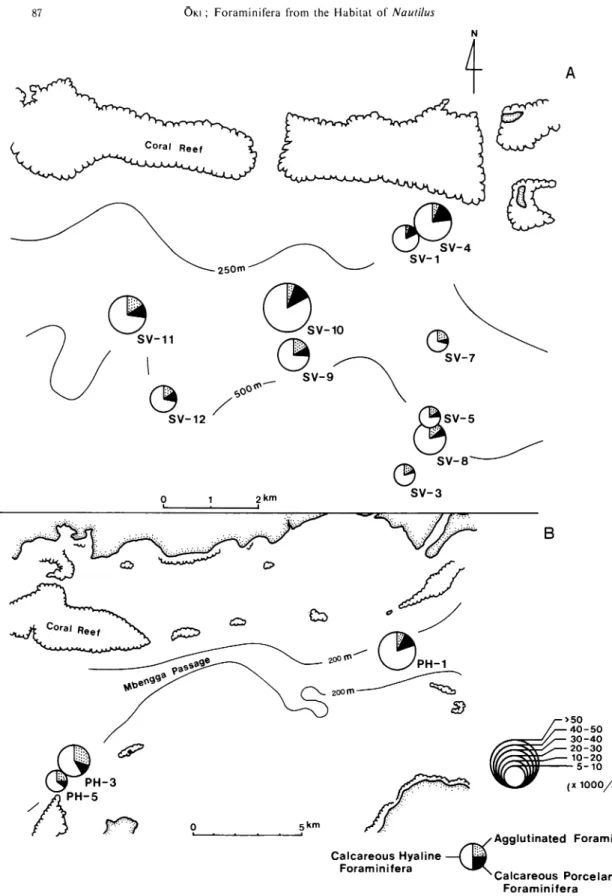
(xiooo/10cc) Agglutinated Foraminifera Calcareous Porcelaneous ForaminiferaFig. 2. Map showing the composition and the total number of benthonic foraminifera in
Kagoshima Univ. Res. Center S. Pac. Occasional Papers, No. 4, 1985 88
more than 200 specimens, and all specimens contained were picked from the aliquot. Aliquots
containing less than 200 individuals of benthonic foraminifera were supplemented by additional splits.
Remarks on Foraminifera
The total number of benthonic and planktonic foraminifera in each sample, and respective ratio of agglutinated, porcelaneous and hyaline benthonic foraminifera to the total benthonic foraminifera, planktonic to the total foraminifera and of planktonic foraminifera to the total number of planktonic foraminifera plus radiolaria are given in Table 1. Through the analysis mentioned above, the following several points were made clear.
1) The total number of benthonic foraminifera ranging from 5678 to 54714 in 10cc of
Calcareous Hyaline Foraminifera SV-4 SV.-1 / ^PH-1 V.SV-10
/
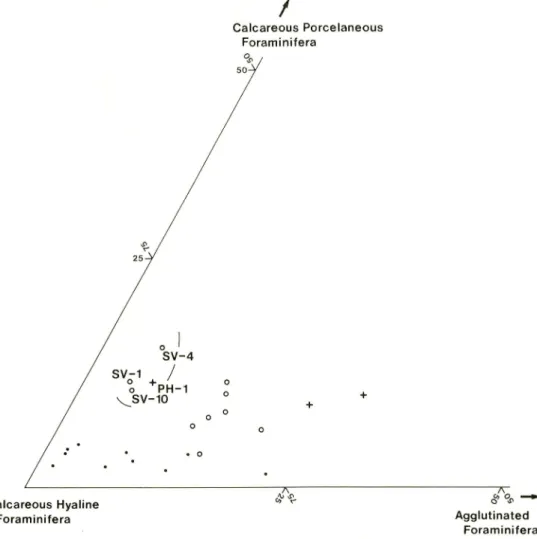
Calcareous Porcelaneous Foraminifera % 5 0 -~ 7 \ — A) & Agglutinated ForaminiferaFig. 3. Triangular diagram of the ratios of the three kinds of benthonic foraminiferal tests in
each sample (o : stations off Suva, + : stations off Pacific Harbor, • : stations in Tafion
0 1 2km
Benthonic -• h Planktonic
Foraminifera ^ ^
.-€>•
ForaminiferaSV-3
Fig. 4. Map showing the frequencies of planktonic and benthonic foraminifera in the bottom sediments collected from each station off the southeast coast of Viti Levu Island, Fiji.
Kagoshima Univ. Res. Center S. Pac. Occasional Papers, No. 4, 1985 90
sediment never represents the correlation with the water depth. The same may be said of the total number of planktonic foraminifera and radiolaria in 10 cc of sediment (Table 1).
2) The composition of benthonic foraminifera contained in the bottom sediments off the
southeast coast of Viti Levu, Fiji are given in Figs. 2 and 3. The ratios of the agglutinated and
calcareous porcelaneous foraminifera to the total number of benthonic foraminifera are higher
than those (less than 5.0%) recognized in the samples from Tafion Strait, the Philippines (Oki,
1983). At the stations PH-3 and PH-5, frequency of agglutinated foraminifera is characteristically more than 25.1 %, and that of calcareous hyaline foraminifera is less than 65 %.
The assemblages of benthonic foraminifera contained in the bottom sediments are divided
into two groups by the ratio of the calcareous porcelaneous and the agglutinated foraminifera. One group (SV-1, SV-4, SV-10 and PH-1) is characterized by the frequencies of agglutinated foraminifera less than 7.4% and those of calcareous porcelaneous foraminifera ranging from 11. 7 to 16.7%. Another group (SV-3, SV-5, SV-7, SV-8, SV-9, SV-11, SV-12, PH-3 and PH-5) is characterized by the frequencies of agglutinated foraminifera more than 14% and those of calcareous porcelaneous foraminifera less than 12.6%. The former is recognized in the sediments from the bottom shallower than 330 m and the latter deeper than 365 m.
3) The ratio of planktonic foraminifera to the total foraminifera offSuva increases with depth (Fig. 4). From the figure showing the correlation between the frequency of planktonic fo raminifera and the depth of water, it is recognized that each point plotted against the two parameters mentioned above is on or near a parabola (Fig. 5). The ratio of planktonic fo raminifera to the total foraminifera at every depth is about 40 %less than that in the cace of Tafion Strait, the Philippines. The ratio of planktonic foraminifera to the total foraminifera off Pacific
a
a
pi. Pl. + Be.
Fig. 5. The correlation between the frequency of planktonic foraminifera in the bottom sediments and the water depth off the southeast coast of Viti Levu Island (PI. : planktonic fo-ramimifera, Be.: benthonic foraminifera, O : off Suva, + : off Pacific Harbor) and in Tafion Strait, the Philippines( •).
^A Cor*l Reef Nv czz>
*^ WpH-1
•€»•'
Radiolaria-fl h Planktonic
Foraminifera
Fig. 6. Map showing the frequency of planktonic foraminifera and radiolaria in the bottom
sediments collected from each station off the southeast coast of Viti Levu Island(A : off Suva,
Kagoshima Univ. Res. Center S. Pac. Occasional Papers, No. 4, 1985 92
Harbor is less than 17.4%.
4) At every station, the ratio of number of individuals of planktonic foraminifera to the total number of planktonic foraminifera and radiolaria is more than 87.2 %except for the two stations
(PH-3 and PH-5) (Fig. 6).
The writer wishes to work out the detailed taxonomic study of foraminifera and to make the comparative study of them with those from the other waters taking geologic, biological and oceanographic data into consideration.
Acknowledgements
The writer wishes to express his gratitude to Professor Shozo Hayasaka of Kagoshima University, for his encouragement and reading the manuscript and also to Professor Uday Raj, Director of the Institute of Marine Resources, the University of the South Pacific, for his help in field operation.
References
Hayasaka. S., Saisho, T., Kakinuma, Y., Shinomiya, A., Oki, K., Hamada, T., Tanabe, K.,
Kanie, Y., Hattori, M, Vande Vusse, F., Alcala, L., Cordero, P. A. Jr., Cabrera, J. J.
and Garcia, R. G., 1982 : Field study on the Nautilus in the environs of Cebu and Negros Islands, the Philippines. Mem. Kagoshima. Univ. Res. Center S. Pac, 3 (1), 67 - 115. Hayasaka, S. ed., 1983 : Studies on Nautilus pompilius and its associated fauna from Tafion
Strait, the Philippines. Kagoshima Univ. Res. Center S. Pac, Occasional Papers, 1, 1-54.
Hayasaka, S., Oki, K. and Saisho, T., 1985, Environmental background of the habitat of
Nautilus off the southeast coast of Viti Levu, Fiji (In Hayasaka, S. ed., 1985). Kagoshima Univ. Res. Center S. Pac, Occasional Papers, 4, 18-30.
Oki, K., 1983, Preliminary report on foraminifera from the southern part of Tafion Strait, between Cebu and Negros Islands, the Philippines (In Hayasaka, S. ed., 1983). Kagoshima Univ.
Foraminiferal tests in the bottom sediments at the eight stations off the southeast coast of
Viti Levu, Fiji. Off Suva:
Fig. 1. Station SV-4 (Depth 180 m). Fig. 2. Station SV-1 (Depth 275 m). Fig. 3. Station SV-7 (Depth 365 m). Fig. 4. Station SV-11 (Depth 420 m). Fig. 5. Station SV-8 (Depth 550 m). Fig. 6. Station SV-3 (Depth 640 m). Off Pacific Harbor:
Fig. 7. Station PH-1 (Depth 330 m). Fig. 8. Station PH-3 (Depth 460 m).
Oki : Foraminifera from the Habitat of Nautilus Plate 29 • r **;• mtm