Development of broiler integration in Peru
著者
Shimizu Tatsuya
権利
Copyrights 日本貿易振興機構(ジェトロ)アジア
経済研究所 / Institute of Developing
Economies, Japan External Trade Organization
(IDE-JETRO) http://www.ide.go.jp
journal or
publication title
IDE Discussion Paper
volume
298
year
2011-04-01
INSTITUTE OF DEVELOPING ECONOMIES
IDE Discussion Papers are preliminary materials circulated to stimulate discussions and critical comments
Keywords: broiler, integration, contract, Peru JEL classification: L14, Q12, Q13, N16
IDE DISCUSSION PAPER No. 298
Development of Broiler Integration
in Peru
Tatsuya SHIMIZU*
April 2011
Abstract
Production and consumption of broiler meat has expanded rapidly in Peru since the 1990s. This rapid expansion was possible due to technological changes in production as well as integration of various stages of production, such as breeding farms, hatcheries, feed mills and grow-out farms by so-called broiler integrators. However, there are some distinguishing characteristics in Peruvian broiler integration that differ from those in developed countries. One is the truncated scope of integration, in which the slaughtering and processing stages are not integrated. The other is that not slaughtering and processing companies, but grow-out farms have become the principal broiler integrators. This paper analyzes the factors associated with these characteristics.
* Researcher, Latin American Studies Group, Area Studies Center, IDE ([email protected])
The Institute of Developing Economies (IDE) is a semigovernmental, nonpartisan, nonprofit research institute, founded in 1958. The Institute
merged with the Japan External Trade Organization (JETRO) on July 1, 1998.
The Institute conducts basic and comprehensive studies on economic and related affairs in all developing countries and regions, including Asia, the Middle East, Africa, Latin America, Oceania, and Eastern Europe.
The views expressed in this publication are those of the author(s). Publication does not imply endorsement by the Institute of Developing Economies of any of the views expressed within.
INSTITUTE OF DEVELOPING ECONOMIES (IDE), JETRO 3-2-2, WAKABA,MIHAMA-KU,CHIBA-SHI
CHIBA 261-8545, JAPAN
©2011 by Institute of Developing Economies, JETRO
No part of this publication may be reproduced without the prior permission of the IDE-JETRO.
Introduction
The broiler industry is the most important sector within the agriculture in Peru. It accounted for 17% of gross production of agriculture in 2007. While beef and pork production has not changed significantly since the 1970s, chicken production has continued to increase, from 580,000 tons in 1970 to 779,000 tons in 2007 (Figure 1).
0 100 200 300 400 500 600 700 800 900 197 0 197 2 197 4 197 6 197 8 198 0 198 2 198 4 198 6 198 8 199 0 199 2 199 4 199 6 199 8 200 0 200 2 200 4 200 6 (1,000 t) Figure 1: Meat production in Peru Source: MINAG (1996) and (2007). Poultry Beef Pork
The increase in chicken production was fueled by the growth of consumption. Annual chicken consumption per capita in Peru increased from 4.4 kilograms in 1970 to 27.1 kilograms in 2007. Compared with beef and pork consumption, which shifted from 9.3 to 5.8 kilograms and 3.5 to 4.0 kilograms, respectively, in the same period, the growth in the consumption of chicken is striking. Chicken consumption even exceeded that of fish, which grew from 8.2 to 15.2 kilograms in the same period.
The main factor in the rapid growth of chicken consumption has been its low price. Not only has the price of chicken been lower than that of beef and pork, but also its price relative to other kinds of meat has been dropping over the years. According to the consumer price survey by the National Statistics Institute, the price of pork, which
was 34% higher than that of chicken in 1981, was 64% higher in 2006. In the case of beef, the price was 90% to 146% higher in 1981, and was 140% to 280% higher in 2006. In addition, the price of chicken dropped as low as that of mackerel for a short period, one of the popular fish among people in Lima (Shimizu 2008).
The large supply of cheap chicken meat became available because of the introduction of new technology and the integration of different stages within the broiler
industry.1 First, by introducing new technology in breeds, nutrition, medicine, buildings
and equipment, the productivity of broiler meat production increased significantly. Second, by integrating different stages of production and distribution in the broiler industry, the supply chain for chicken became highly efficient.
Introduction of new technology and integration of different stages within the broiler industry were first advanced in developed countries such as the Unites States, Europe and Japan. Then, these changes were adapted in developing countries. In Peru as well, new technology in broiler production was introduced by the end of the 1970s, and the integration within the industry progressed after the 1980s. However, the development of the broiler industry in Peru has two distinguishing characteristics that differentiate it from developed countries.
One is the truncated scope of integration in the industry. In developed countries and in some of the developing countries like Brazil, almost all broilers are slaughtered and processed before they are distributed to wholesalers. In Peru, around 80% of broilers are distributed alive to wholesalers.
The other characteristic is the origin of the integrators in the broiler industry. In countries such as the United States, Japan and Brazil, processors are the integrators in
1
The word integration refers not only to vertical integration through ownership, but also to close coordination among actors within the same supply chain through marketing and production contracts. Those who coordinate integration of the chicken supply chain are called integrators.
the industry. They own feed mills, breeding farms, slaughtering and processing plants, and coordinate production with grow-out farms through production contracts (Martinez 2002, Hamaguchi 1988, Ueki 2007, Yoshida 1974, Kyushu Keizai Chosakai 1997). In Peru, integrators are large-scale producers. They expanded their business from grow-out farms to feed mills and hatchery plants, then to slaughtering and processing plants.
The object of this paper is to analyze why broiler integration in Peru has these characteristics which differ from those of other countries, with reference to existing studies on broiler integration in the United States and Japan.
Existing studies on the broiler industry in Peru are few. At the end of the 1970s, Tume Torres did comprehensive studies on the industry, covering the process from maize production to the chicken meat market. He focused on the principal companies in the industry, with domestic and/or foreign capital, and their characteristics of integration. (Tume Torres 1978, 1981). This was the only study focused on individual companies. Beside the above-mentioned studies, the reports on the broiler industry prepared by the Ministry of Agriculture are the only source of information (MINAG 1996, 1999). In addition, the ministry compiled statistical data on the sector (MINAG 2000, 2001, 2007, 2008). With these data, it is possible to understand the trend of production and consumption. However, with these data only, it is difficult to understand how the broiler industry and its principal integrators have been developing in the past years, and why their development displays different characteristics from that in developed countries.
The structure of this paper is as follows. In the first section, existing studies on the integration of the broiler industry in the United States and Japan are reviewed. The second section reviews the formation of broiler integration in Peru. The third section explains two characteristics of broiler integration in Peru and analyzes factors that give rise to these characteristics. The conclusion summarizes the findings of this paper.
I. Integration in the Broiler Industry
The supply chain of the broiler industry consists of different stages of production and distribution, such as feed mills, breeding farms, hatchery plants, grow-out farms, slaughtering plants, processing plants, distributors, food services and retailers (Figure 2). In developed countries like the United States and Japan, all of these stages are integrated, and distribution of live birds hardly exists. Also in these countries, the processors are the integrators in the supply chain. Existing studies on broiler integration in the United States and Japan explain motives and forms of integration.
Figure 2 Supply chain in broiler industry breeding farms (great grand parent) breeding farms (grand parent) breeding farms (parent) Hatchery plants grow‐out farms slaughter plants further processing plants consumers wholesalers retail stores feed grains feed mills supplement medicine food service Source: Elaborated by the author.
1. Integration in the United States
In the United States, financial constraints and risk sharing were the principal motives for broiler integration when it started in the 1950s (Martinez 1999). With the introduction of new technology in breeds, nutrition, buildings, and equipment, the
amount of capital for input as well as infrastructure increased. In order to ease financial constraints on grow-out farms, feed companies started to offer the farms marketing contracts. Under these contracts, the companies sold the farms inputs on credit provided that the farms would hand over all birds to the companies. The companies sold the birds to slaughter plants and paid the farmers after discounting inputs cost.
As flock size increased, the volatile price of broilers became a serious problem for grow-out farms. Therefore, large feed companies, or integrators, started to offer grow-out farms marketing contracts with a guaranteed price for broilers. With these contracts, the price fluctuation risk was shifted to the integrators.
The principal motive of feed companies was to sell compound feed to grow-out farms, and they understand little about the demand for broilers. This led to an oversupply of broilers, and their price dropped sharply at the end of the 1950s, which resulted in large losses for feed companies. In place of feed companies, slaughtering and processing plants started to integrate the broiler supply chain.
The motive of the slaughtering and processing companies was different from that of feed companies. Their facilities are capital intensive, and so it is important for them to operate at their full capacity constantly to make the best use of their investment. As integrators, slaughtering and processing companies try to assure a stable supply of broilers of good quality by offering grow-out farms production contracts instead of marketing contracts. Under production contracts, integrators provide all the inputs to grow-out farms. Grow-out farms provide housing, labor, inputs like water and electricity, and growing service for integrators. When the broilers are grown, integrators collect them from the grow-out farms to be processed in their plants. There is no buying or selling transaction. Instead, integrators pay grow-out farms fees for the growing
service.2 In this way, integrators assume the risks associated with price fluctuations in input and output to assure a stable supply of broilers.
The production contracts first started with flat-fee contracts, in which integrators paid farms a fixed fee for a certain weight of broilers. Then, in order to draw efforts to improve productivity by grow-out farms, other forms of production contracts emerged, such as profit sharing between integrators and grow-out farms, fees based on the productivity measured by the feed conversion ratio, and combinations of these forms. Today, many contracts are based on the relative productivity of grow-out farms compared with similar farms in the same area (tournament method). This form of contract is considered to save transaction costs between the two parties (Knoeber 1989).
In the United States, the contracts have been the dominant forms of integration in broiler production since the mid-1950s. The proportion of broilers produced under contracts has been around 90% since the 1960s. The vertical integration, or production in integrators’ own farms, is a little over 10% (Marinez 2002, MacDonald et al. 2004, MacDonald and Korb 2008). The presence of a large number of grow-out farms, combined with contracts that draw out grow-out farms’ efforts to increase productivity, is the principal reason for the dominance of integration by contracts (Knoeber 1989). 2. Integration in Japan
In addition to financial constraints, risk sharing, improvement of efficiency and minimization of transaction cost, existing studies on broiler integration in Japan explain that relocation of principal production areas and changes in broiler meat distribution prompted integration of the broiler industry. A study by Yoshida explains this process in three stages: live birds, carcasses and cutups distribution (Figure 3).
2
In the United States, forms of production contracts that can improve the efficiency of broiler production have been intensively studied. For details, see Lasley (1983), Knoeber (1988), Peterson et al. (2001), Martinez (2002) and MacDonald et al. (2004).
Feed mills Farmers Consumers Intermediaries Poultry meat retailers
Figure 3 Development of broiler integration in Japan
Cutups Slaughter Live birds Farmers Consumers Slaughtering plants Poultry meat retailers Cutups Carcass Slaughter Chicks & feed Capital Farmers Consumers Slaughtering plants
Meat retailers & supermarkets Cutups Live birds Slaughter & cutting up Chicks &
feed Feed mills Breeders and hatcheries Grow-out farms Slaughtering & processing plants Supermarkets Consumers Slaughter, cutting up & processing Cutups & processed products Peasants production in outskirts of cities Traditional productions zones Emerging productions zones (by contract) Emerging productions zones (by vertical integration) Integrators Payment Payment
(Source) Elaborated by the author based on Yoshida (1974) and (1980).
<Live birds distribution> <Carcass distribution> <Cutups distribution>
Cutting up Live
birds
Live birds
Before broilers were introduced in Japan in the 1960s, chickens were raised on the outskirts of cities where a large number of consumers were located. The chickens were collected by intermediaries and sold as live birds to retailers specializing in chicken meat. These retailers slaughtered broilers and prepared cutups for consumers. We refer to this as live-bird distribution.
With the introduction of broiler breeds from abroad in the 1960s, the scale of production increased, and the principal production areas were relocated away from cities to seek production factors. Local feed mills and hatchery plants started to integrate grow-out farms and became local integrators. Because the volume of broilers raised in one production area increased, it became convenient for the integrators to establish slaughtering plants in the production area to take advantage of economies of scale. Instead of live birds, they shipped carcasses to cities, and it was the retailers who
prepared cutups for consumers. The initial development of the cold chain boosted this trend. We refer to this as carcass distribution.
Starting in the 1970s, broiler production moved further away from major cities and relocated to rural areas in the southern Kyushu and northern Tohoku areas. The growth was due to availability of more favorable production factors, such as land and labor, improved access to markets by highways, and further development of cold chains. By the middle of the 1980s, these two areas became the most important broiler production areas in Japan because of the development of nearby ports, namely Shibushi in southern Kyushu and Hachinohe in northern Tohoku. In these ports, large-scale port elevators for feed grain imports were constructed at the beginning of the 1980s, and Panamax-class freighter ships brought feed grains directly from the United States. Because of this, both the southern Kyushu and the northern Tohoku areas obtained a cost advantage in feed over other production areas in Japan (Nagasaka 1993).
In addition to local integrators who started to integrate grow-out farms through contracts, some large-scale trading companies built their own farms and slaughtering and processing plants near their farms in the production areas. They are called national integrators. This was vertical integration through ownership. National integrators slaughtered and processed birds from their own farms as well as from outside grow-out farms. They prepared cutups and shipped to supermarkets in major cities around the country. We refer to this as cutup distribution. In addition to cutups, broilers are processed further into value-added products such as sausages, meatballs, and frozen fried chicken nuggets, etc.
This study shows that when production areas were relocated further away from consumption areas, it was necessary to change the form of transportation of broilers to avoid loss and to retain freshness. Integrators adapted this change by integrating
grow-out farms through production contracts or internalizing grow-out farms, and by building slaughtering and processing plants in the production areas.
Compared with the integrators in the United States, the percentage of production through contract is low in Japan. A survey by the Ministry of Agriculture, Forestry and Fisheries in 1988 shows that 56.1% of broiler production was by contracts with grow-out farms, while 13.4% was by corporate farms (Chuou Chikusan Kai 1999).
II. Formation of Broiler Integration in Peru
In Peru, broiler breeds were first introduced by the end of the 1940s. Commercial production of broilers, though small in scale, started in the 1950s. By the end of the 1960s, broiler production expanded due to the government’s promotion policies for the broiler industry and investment of foreign capital in breeding farms, hatchery plants and feed mills. Shortly afterwards, in the 1970s, integration in the broiler industry started. The evolution of broiler integration in Peru can be divided into the following three periods.
The first period saw the introduction of technology from abroad. By the beginning of the 1970s, major broiler breeds were introduced in Peru. Arbor Acres of the United States founded a subsidiary in Peru. Other companies like Ross Poultry of England, Shaver Poultry Breeding of Canada, Hubbard Farm and Cobb of the United States had their distributors with breeding farms in Peru. In 1976, out of 80 breeding farms in the country, 8 principal farms that associated with foreign companies claimed around 70% to 80% of market share (Fernández-Baca el al. 1983).
With the introduction of broiler breeds and expansion of flock size, imported maize from the United States and Argentina became an important raw material for feed.
Large-scale feed mills in Peru started to prepare compound feed based on grains imported by international grain traders such as Cargill and Bunge y Born. Out of eight large-scale feed mills, three were foreign-owned companies. One of them was Purina Peru, a subsidiary of Ralston Purina of the United States. It was the pioneer of broiler integration in Peru, operating not only feed mills, but also breeding farms, hatchery plants, and slaughtering plants (Fernández-Baca el al. 1983, Tume Torres 1981).
The second period was the era of formation of broiler integration in the 1970s and 1980s. While a small number of companies controlled an important portion of the breeding farms and feed mills at that time, there were many independent small-scale grow-out farmers which numbered around 3,000 in the mid-1970s (Tume Torres 1981). However, the steep rise of grain prices in the international market in the mid-1970s, together with negative economic growth in Peru at the end of the 1980s, had a serious negative impact on the broiler industry. Breeding farms, feed mills and grow-out farms tried to survive by expanding their scale and scope in order to lower costs and increase the value added. For example, Nicollini Hermanos, the largest feed mill at that time, absorbed grow-out farms that could not pay their debt. Similarly, Molinos Takagaki, another important feed mill, absorbed breeding farms, hatchery plants and slaughtering plants. San Fernando built a slaughtering plant and started to sell chicken meat directly to consumers. It also invested in feed mills and breeding farms. Soon, they became the most important integrators in broiler industry in the country.
The third period, ongoing since the 1990s, has seen the concentration of integrators. As a consequence of economic liberalization and fluctuations in the national and international economies, independent grow-out farms rapidly disappeared, and the concentration of broiler integrators progressed because of the following factors. First, independent grow-out farms lost government subsidies for imported feed grains. Second,
when the Peruvian economy recorded high growth during the first half of the 1990s, many farms invested to expand their growing capacity in expectation of demand growth. However, the economy subsequently slowed down, and demand for chicken meat decreased. Not only did the price of broilers drop, but also they could not fully utilize their growing capacity. Third, the surge of feed grain prices in 1996 and 1997 was a hard blow to these grow-out farms; they could not pay their debts, and many of them withdrew from broiler production. The number of grow-out farms decreased from 3,000 in the 1970s to 695 in 2000.
For some large-scale integrators, this was a good opportunity to expand their scale of production. Deregulation of feed imports allowed them to reduce feed cost by importing in large quantities directly from the international market. Also, the debt problem of independent grow-out farms enabled integrators to expand their growing capacity. For example in 1995, San Fernando absorbed four important grow-out farms and doubled its production capacity and market share in chicken meat sales from 32% in 1994 to 48% in 2000 (Miyashiro 2007). Avícola Atahuampa, which had merged with feed mills and grow-out farms owned by the same owner, founded Redondos in 1996. Ganadera Santa Elena, an important tannery that owned a cattle farm and feed mill, started to grow broilers in 1997; it is renting chicken housing abandoned by independent grow-out farms. A subsidiary of Continental Grain group acquired the majority share of Molinos Takagaki and changed its name to Avinka in 1996. It invested in the first modern processing plant in the country.
Besides these integrators in the Lima metropolitan area, some broiler integrators appeared in principal cities in the north and south of the country, such as Rico Pollo in Arequipa and El Rocio in Trujillo.
Basically, these integrators have breeding farms of parent stocks, hatchery
plants, feed mills, grow-out farms and slaughtering plants. San Fernando and El Rocio have breeding farms for grandparent stocks of Cobb and Ross breeds, respectively.
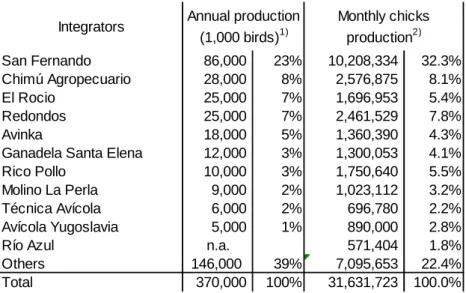
Table 1 shows the production scale of the principal broiler integrators in Peru. San Fernando and its group company, Chimú Agropecuario, produce around 30% of the broilers. Besides them, five principal integrators produce more than 10 million birds annually. Integrators San Fernando 86,000 23% 10,208,334 32.3% Chimú Agropecuario 28,000 8% 2,576,875 8.1% El Rocio 25,000 7% 1,696,953 5.4% Redondos 25,000 7% 2,461,529 7.8% Avinka 18,000 5% 1,360,390 4.3% Ganadela Santa Elena 12,000 3% 1,300,053 4.1% Rico Pollo 10,000 3% 1,750,640 5.5% Molino La Perla 9,000 2% 1,023,112 3.2% Técnica Avícola 6,000 2% 696,780 2.2% Avícola Yugoslavia 5,000 1% 890,000 2.8% Río Azul n.a. 571,404 1.8% Others 146,000 39% 7,095,653 22.4% Total 370,000 100% 31,631,723 100.0%
Table 1: Principal broiler integrators in Peru
Sources: 1) Insustria Avícola , enero 2008, 2) As of May 2007, by Peruvian poultry association (APA).
Annual production (1,000 birds)1)
Monthly chicks production2)
Large-scale integrators can procure broilers in three ways: from their own grow-out farms, from rented farms and from outside farms under production contracts. In the coastal area of Peru, you can find chicken housing that has not been used since the mid-1990s. It is common among Peruvian integrators to rent such housing, install the necessary fittings, and grow broilers with their own inputs and labor force. Compared with the integrators in the United States, which procure more than 90% of their broilers from outside grow-out farms, Peruvian integrators tend to procure either from their own grow-out farms or from rental farms. For example, San Fernando
procures about 40% of its broilers from its own farms and 60% from outside grow-out farmers with production contracts. Redondos procures 60% from its own farms and 40% from rental farms. In the case of Avinka, 3% comes from its own farms, and of the rest, 60% comes from rented farms and 40% comes from outside grow-out farmers. In the case of Ganadera Santa Elena, which does not have a slaughtering plant, they collect broilers from 21 farms, among which one is its own farm, 10 are rented farms and 10
are outside grow-out farms.3
III. Characteristics of Broiler Integration in Peru
Thanks to the introduction of technology from abroad and the development of integration in the broiler industry, the productivity of broiler production has increased over the years. For example, the growth of boilers accelerated rapidly. In 1960, it took 70 days for a broiler to reach a weight of 2 kilograms; this was shortened to 38 days in
1999. The feed conversion ratio4 at large-scale grow-out farms is as low as 2.0, which is
the same as the ratio in developed countries.
These technological and organizational characteristics were transferred to Peru from developed countries. However, there are two important characteristics of broiler integration in Peru that differ from those in developed countries like the United States and Japan. One is the scope of integration, and the other is the origin of the integrators. In this section, these two characteristics and the factors causing them are analyzed.
3
The figures regarding the proportion of broilers from various sources are obtained through interviews during July and August in 2007 and 2008.
4
The feed conversion ratio is the amount of feed required to obtain one unit (usually one kilogram) of meat. A smaller ratio indicates higher productivity.
1. Truncated scope of integration
The first characteristic is the truncated scope of integration in the broiler industry in Peru. In developed countries, the integration includes input supply, production, processing and distribution of broilers. Almost all broilers are slaughtered and processed in integrators’ plants and distributed to wholesalers and retailers. However in Peru, the integrators distribute around 80% of broilers as live birds.
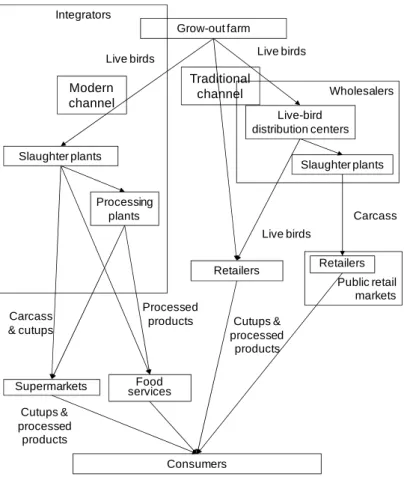
Figure 4 shows the distribution channels of broilers in Peru. Live birds from grow-out farms travel through one of two distinct distribution channels: traditional or modern. In the traditional channel, broilers are delivered alive from grow-out farms to live-bird distribution centers or retailers. In regional cities where there are no live-bird distribution center, broilers are delivered alive to wholesale markets. In the modern channel, live birds are slaughtered in plants operated by integrators and delivered to retailers and the food service industry. According to statistics from the Ministry of Agriculture, only 18% of broilers are processed at integrators’ slaughtering plants, while 82% are processed at live-bird distribution centers in the Lima Metropolitan area. Nationwide, the proportion is 22% and 78%, respectively (MINAG 2008, Figure 5). This means that even principal integrators with their own slaughtering plants distribute the majority of their broilers through the traditional channel.
Integrators
Figure 4: Distribution channels of broiler meat in Peru
Grow-out farm Live-bird distribution centers Public retail markets Slaughter plants Consumers Retailers
Supermarkets servicesFood Slaughter plants Processing plants Retailers Wholesalers Live birds Carcass Live birds Processed
products Cutups & processed
products
Source: Elaborated by the author. Carcass & cutups Cutups & processed products Modern channel Traditional channel Live birds Figure 5: Distributed volume by channels (2007) National supply of broiler meat 704,847t Lima metropolitan area 478,501t Other areas 226,346t Slaughter plants 84,364t Live birds distribution centers 394,137t Slaughter plants 70,515t Wholesale markets (live) 155,831t 68% 32% 18% 82% 69% 31% Live birds 549,968t 78% Carcass 154,879t 22% Source: Elaborated by the author based on MINAG (2008). 17
In the traditional distribution channel, live birds are slaughtered in the facilities within live-bird distribution centers or in other slaughter facilities owned by wholesalers. In these facilities, birds are manually slaughtered, blooded, and plucked. One facility with 10 workers can process a few thousand birds a day. Carcasses with head, feet and viscera are delivered to retailers in public retail markets. You can often find these carcasses hung at stores in public retail markets. It is the retailers’ work to remove head, feet and viscera. Retailers sell whole, half or quarter chickens, or prepare cutups of legs and breasts upon request by customers. In some cases, integrators deliver live birds directly to retail stores in town. In these cases, birds are slaughtered manually in the backyards of retail stores.
Commercial transactions in the traditional channel are different from those in the spot market. There is no auction in the live-bird distribution centers. Integrators and wholesalers reach a verbal agreement to buy and sell. Wholesalers normally procure broilers from the same integrators for a certain period, though they often obtain quotes from other integrators and sometimes switch providers depending on prices offered. Transactions between integrators and wholesalers are settled in cash.
In the modern distribution channel, broilers that reach integrators’ plants go through semi-automated processing lines that include killing, blooding, plucking, and removing head, feet and viscera. These lines can process several thousand birds per hour. The integrators ship broilers in one of three forms: carcasses, cutups or additionally processed products. Most parts of broilers are shipped as carcasses to supermarkets; in Peru, major supermarket chains prepare cutups from carcasses in each store. The integrators also ship carcasses to chicken barbeque (pollo a la brasa) restaurant chains. Cutups are shipped to restaurant chains for fried chicken, though the amount is not very large compared with other products. Finally, some integrators have plants for additional
processing in which products such as nuggets and sausages are prepared. These products are shipped to fast-food restaurant chains and supermarket stores.
Commercial transactions in the modern channel are more stable than those in the traditional channel. In the case of supermarkets and chicken barbeque restaurant chains, transactions are not based on contracts but on verbal agreements between two parties on price and quantity. Because the number of major integrators is limited in Peru, buyers usually buy from the same integrators for a certain period of time. In the case of additionally processed products such as frozen chicken nuggets, the transaction is usually based on formal contracts between integrators and food service companies.
Although the modern distribution channel is growing, the majority of broilers in Peru are still distributed through the traditional channel as live birds, and the scope of integration is truncated. This dominance of live-bird distribution can be attributed to three factors: geographical distribution of production and consumption areas, loose sanitary control over meat distribution, and social conditions such as infrastructure and consumer preference.
Geographical distribution
One of the unique characteristics of the Peruvian broiler industry is the geographical proximity of its production and consumption areas. In countries like the United States and Japan, as urban areas grew with industrialization, the principal broiler production areas were relocated away from urban areas to where there were favorable production factors such as land and labor. In the new production areas, integrators built large-scale slaughtering and processing plants to take advantage of economies of scale and the relatively lower wages of the local labor force. As a result, the distance between production and consumption areas steadily expanded. In order to avoid weight loss in
birds due to transporting alive and to take advantage of the efficiency of large-scale plants, integrators switched the transportation of broilers first from live birds to carcasses, and then to cutups and processed products. The integrators distributed these broiler products through a refrigerated distribution system called a cold chain.
In the case of Peru, even though the scale of production has increased rapidly since the 1990s, the principal production areas have not relocated as in developed countries. The majority of broiler production is still taking place close to cities where most consumers are concentrated, such as Lima, Trujillo (the capital of the La Libertad region) and Arequipa (the capital of the Arequipa region). According to the census on stockbreeding conducted by the Ministry of Agriculture in 2001, there were 695 broiler grow-out farms in the country, of which 204 are located in the region of Lima, 82 in La Libertad and 52 in Ica, which neighbors Lima (Table 2). The number of birds in these farms accounts for around 88% of the national total, and the average size of farms in these regions is larger than the national average.
integrated farms Share Lima 204 167 18,963,526 60% 3,454,590 16,934 La Libertad 82 49 5,929,256 19% 1,031,246 12,576 Ica 52 16 3,003,747 9% 531,668 10,224 Arequipa Highland 24 8 949,888 3% 295,790 12,325 Loreto 111 0 574,560 2% 158,023 1,424 San Martin 80 14 629,689 2% 125,709 1,571 Others 142 9 1,758,155 5% 498,187 3,508 Total 695 263 31,808,821 100% 6,095,213 8,770
Source: Elaborated by the author based on MINAG (2001). Coast
Tropical low land
Tabel 2: Distribution of broiler farms in Peru
Region Area Number of farms Number of birds Area of farms(m2) Average size of farms (m2)
Figure 6 shows the locations of broiler industry facilities around Lima. Most facilities of principal broiler integrators such as breeding farms, hatchery plants, feed mills, grow-out farms, slaughtering plants and processing plants are located along the
Pan-American Highway between Barranca city, 190 km north of Lima, and Ica city, 300 km south of Lima. Feed grains are imported through the Port of Callao or the Port of Pisco, both of which are located in this area. Through this double-lane highway, birds are transported alive to live-bird distribution centers in Lima within one to three hours.
Figure 6: Principle installations of broiler industry around Lima metropolitan area ●Huaral, 80km SF: G, B; RD: I ●Barranca, 190km RD: G ●Chancay, 82km SF: I, M, G; AV: G, B, P ●Huacho, 147km RD: I, M, G, B ●Lima , SF: P; Live‐bird distribution centers ●Lurin, 35km SF: M; SE: G ●Cañete, 144km ●Chinca Alta, 200km SF: I, G, B, P ●Ica, 303km SE: I Pan American Highway (double lines indicates double lanes) Pacific Ocean ●City, distance from Lima (km) <Name of companies> SF San Fernando AV Avinka RD Redondos SE Ganadera Santa Elena <Installations> R Breeder farms I Hatchery plants M Feed mills G Grow‐out farms B Slaughter plants P Processing plants ●Paracas, 245km SE: R ●Chilca, 64km SE: G SF: R; RD: R, M RD: R SF: I, G Ica Region Lima Region Ancash Region Port of Callao Sources: Elaborated by the author based on interviews and web page information. Port of Pisco
Why does broiler production take place close to large cities such as Lima and Trujillo? The reason is because these cities are surrounded by a desert with a unique climate that is suited to broiler production but not to other uses. Even though the desert
receives little precipitation, its temperature is mild and stable throughout the year5
because of clouds generated by the Humboldt Current, which is a cold ocean current that flows off the coast of Peru. These conditions are very favorable for broiler production because chicken housing can be low-cost and simple with little heating and
5
The average monthly maximum temperature in coastal cities such as Lima and Trujillo is around 25 degrees Celsius, and the minimum is around 15 degrees.
cooling equipment. In addition, the desert is suited for broiler production from the viewpoint of animal health because it is isolated from other animals that can transmit disease.
Due to this, the distance between the production and consumption areas has remained relatively close in the coastal region of Peru. Therefore, transport loss of live birds is not a serious concern for the integrators, and live-bird distribution is still dominant.
Loose sanitary control
Another important factor contributing to the dominance of live-bird distribution
is loose sanitary control over livestock and its products. In Peru, there have been regulations for distribution of broilers since the 1970s. However, the lack of an effective means of implementing these regulations has abetted live-bird distribution.
When broiler production increased in the 1970s, the Ministry of Food prescribed the “Regulation for Slaughter and Distribution of Birds for Human
Consumption,”6 and tried to modernize its distribution in three steps: (1) Establishment
of live-bird distribution centers, (2) modernization of slaughter facilities in public retail markets, and (3) prohibition of live-bird distribution. Even though the first step was completed and nine live-bird distribution centers were established in Lima city, the rest of the steps were never completed because of lack of government initiative and economic difficulties during the 1980s. At the beginning of the 1990s, when the Peruvian economy began to revive and supply and demand for chicken meat increased, there was an attempt to levy a sales tax on it. This pushed many small-scale slaughtering
6
Reglamento para el Beneficio y Comercialización de Aves para Consumo, Resolución Ministerial No. 0359-77AL.
facilities into informal operation, making sanitary control over broiler distribution more difficult and hampering government control.
Faced with the outbreak of avian influenza in neighboring countries at the beginning of the 2000s, the National Agriculture Sanitation Service (Servicio Nacional de Sanidad Agraria (SENASA)) finally started to tighten its control over broiler
distribution, creating a new regulation.7 However, its priority is to prevent outbreaks of
diseases rather than to control broiler distribution, and it does not have enough resources to control live-bird distribution.
Now, with efforts by the association of operators of live-birds distribution centers, the association of broiler industry and government agencies, the slaughter facilities attached to live-bird distribution centers have been improved. However, live-bird distribution is not yet prohibited as originally planned in the 1970s.
Social conditions
Besides the supply-side factors explained above, there are some important
demand-side factors based on social conditions which explain the dominance of live-bird distribution in Peru. First, many consumers, especially those with lower incomes, are still accustomed to buying at local public retail markets rather than at modern supermarkets. Second, they buy whole, half or quarter chickens rather than cutups. Third, they prefer fresh meat rather than refrigerated or frozen meat.
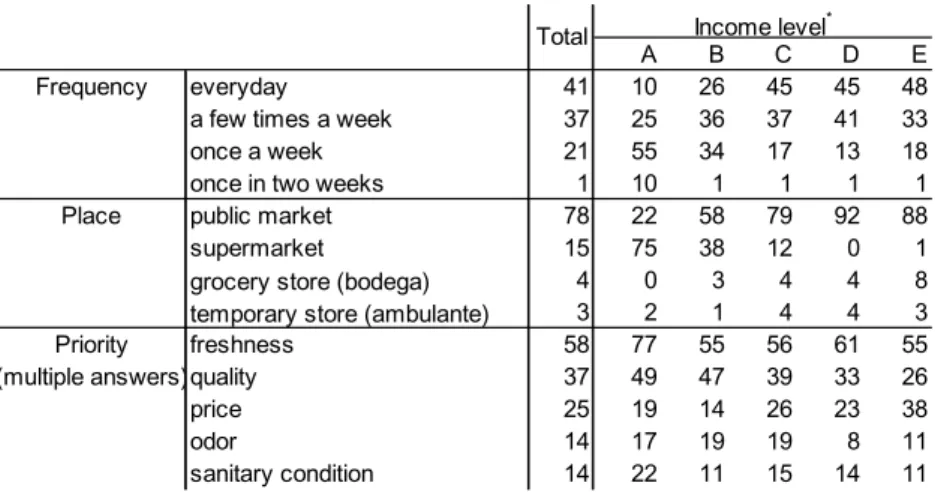
A consumer survey on the purchasing behavior for beef and chicken in Lima shows an interesting result (Table 3). The average consumer buys beef or chicken everyday, or a few times a week, at local public retail markets. In particular, consumers
7
Reglamento Sanitario Para el Acopio y Beneficio de Aves para Consumo, Decreto Suprimo No. 019-2003AG.
with lower income levels tend to buy more frequently at public retail markets. The proportion of consumers who buy at supermarkets is still low, except for those with high income levels.
Table 3 Survey on purchasing beef and chicken in Lima (2006, %)
A B C D Frequency everyday 41 10 26 45 45 48
a few times a week 37 25 36 37 41 33 once a week 21 55 34 17 13 1 once in two weeks 1 10 1 1 1 1 Place public market 78 22 58 79 92 88
supermarket 15 75 38 12 0 E
8
1 grocery store (bodega) 4 0 3 4 4 8 temporary store (ambulante) 3 2 1 4 4 3 Priority freshness 58 77 55 56 61 55 (multiple answers)quality 37 49 47 39 33 2
price 25 19 14 26 23 3 odor 14 17 19 19 8 11 sanitary condition 14 22 11 15 14 11 * Income levels are divided into five. A is the highest and E is the lowest.
Total Income level*
Source: Apo
6 8
yo Opinión y Mercado (2006), surveys on 566 housewives in Lima
In stores at public retail markets in Lima, you can find broiler carcasses slaughtered that morning. Many retailers do not have refrigerated cases, and they sell only in the morning or early afternoon, until all the chickens they bought from wholesalers are sold out. As mentioned above, retailers separate the head, feet and viscera, and sell whole, half or quarter chickens by weight. They further cut them into smaller pieces if customers wish at no extra cost. Also, they prepare cutups such as breasts and legs, which are priced higher. In general, housewives (or domestic workers in case of families with higher income levels) go to local public retail markets almost every day to buy food for that day. They buy whole chickens, not cutups, because it is cheaper. After removing the meat, the bones are used to prepare soup stock.
In addition, fresh chicken, which means chicken slaughtered that morning and sold without refrigeration, is preferred in Peru because many consumers think that frozen chicken is dry and tasteless. During the 1980s when there was a supply shortage,
chicken was imported. At that time, freezing technology was poor, and the quality of meat deteriorated badly during the freezing and defrosting processes. With today’s freezing technology, meat quality does not deteriorate like before; however, many consumers have not changed their perception toward frozen chicken. For them, frozen or even refrigerated chicken would indicate that it is leftover from the previous day. In
addition, many households in Peru still do not have refrigerators8 and cannot keep
refrigerated or frozen products at home.
2. Integration by producers
Observing the development of the broiler industry in other countries, we notice that companies which take part in upstream and/or downstream processes often integrate the industry. In the United State and Japan, first it was feed mills which integrated broiler production. In order to sell feed to farmers, they organized independent grow-out farms and helped them to sell broilers to slaughtering plants. Later, slaughtering and processing companies, which have more information on the demand side, took over the position as integrators. They have procured most of their broilers from outside grow-out farms, first through marketing contracts and later through production contracts. Procurement through production contract has become the dominant form for slaughtering and processing plants to secure a stable supply of broilers.
However, in the case of Peru, today’s principal broiler integrators procure a large portion of their broilers from their own grow-out farms, and the percentage procured from outside grow-out farms is limited. This difference comes from the fact
8
The percentage of households with a refrigerator is 58% in the Lima region and 32% nationwide according to the 2007 census.
that, in Peru, the principal integrators are at the same time the principal grow-out farms of broilers. They started their operations as grow-out farms, and as they have grown, they have integrated upstream processes (breeding farms, hatcheries and feed mills) and downstream processes (slaughtering and processing). For example, San Fernando started as a grow-out farm; in their process of expansion, they integrated feed mills, slaughtering plants, retail outlets, breeding farms, and processing plants, etc. In the case of Redondos, even though they started as breeding farms, they expanded their operation as grow-out farms, and later withdrew from grandparent breeding farms.
So the question is why grow-out farmers, not other actors like feed mills and slaughtering plants, achieved the status of broiler integrators in Peru. Two factors are at play here. One is the small presence of others sectors such as the feed mill, slaughtering and processing sectors in Peru, and the other is the low costs of grow-out operations in the coastal region.
Small presence of other sectors
In the initial stage of broiler integration in Peru, it was feed mills like Nicolini Hermanos and Molinos Takagaki that organized grow-out farms. However, they did not grow as principal integrators for a few reasons. One is that in the initial stage of the development of broiler industry in Peru, the control over feed grains by feed mills was limited. In the case of Japan, feed mills exercised strong control over broiler farmers because very little feed grain was produced and available in the local market; the supply mainly came from abroad. Grow-out farms had no option but to buy compound feed from feed mills. In case of Peru, while the scale of production is relatively small, many grow-out farms procured feed grains locally and prepared compound feed in their own
mills. Only 40% of corn for feed was imported during the 1980s.9 In addition, the government established public enterprises to intervene in import and distribution of agricultural inputs in order to help farmers obtain cheap products. This intervention prevented private feed mill companies from gaining control over grow-out farms.
Slaughtering and processing companies are often integrators of broiler production in other countries. In the case of Peru, 80% of broilers are still distributed as live birds, as discussed above. Slaughtering is often done by wholesalers, and further preparations are carried out either by retailers or final consumers. Therefore, the market for cutups and additionally processed products is still small, and there has been little opportunity for integrators’ business to grow in this field. As a consequence, instead of slaughtering and processing companies integrating grow-out farms through production contracts, large-scale grow-out farms started to integrate the slaughtering and processing stages in the supply chain.
Low-cost grow-out operations
In developed countries, establishment of grow-out farms requires a large amount of capital. In order to improve productivity and to save labor cost, modern chicken housing must have equipment to control the environment (light, temperature and humidity) and to automate the feed and water supply. In addition, farms need to have treatment facilities for excrement. Farms should be located far from residential areas and must be large so that odors and flies do not bother local residents and so that broilers are isolated from animals that transmit diseases. Thus, it is very costly and difficult for farmers to expand their operation.
9
With the rapid growth of the broiler industry, dependency on imported corn for feed increased to 60% in the 1990s.
In the case of Peru, especially in the coastal region, the cost of establishing broiler farms is relatively low. As mentioned above, the main broiler production areas are located in the desert along the Pan-American Highway. Since there is little use for desert land, it can be rented at very low cost. Because it has low precipitation and mild temperatures and there is an abundant supply of low-cost labor from the Andean mountain area, chicken housing in this area can be very simple. The buildings consist of a wooden frame structure with a roof; plastic sheets are used as walls. The temperature is adjusted manually by raising or lowering the plastic sheets. Feed is supplied manually a few times a day. Only the water is supplied automatically from water tanks through pipes and nipple drinkers.
Besides building new chicken housing, it is possible to expand the scale of broiler production by renting chicken housing that is not in use, as explained above. In this way, some grow-out farms expanded their operations and later started to integrate other stages of production and processing, eventually becoming principal integrators in the broiler industry.
Conclusion
After explaining the development of the broiler industry in Peru, this paper analyzed the factors contributing to two distinguishing characteristics of broiler integration. The first characteristic is that the scope of integration in the broiler industry is truncated. In Peru, 80% of broilers are distributed as live birds in wholesale markets, and except for a small portion of their production, integrators do not integrate the slaughtering and processing stages. This is due to the geographic distribution of the production and consumption areas. The fact that production areas are located relatively
close to consumption areas allows live-bird transportation and distribution without much loss in the birds’ weight. In addition, other factors such as the loose sanitary control in the distribution of livestock and its products, shopping and cooking habits and the consumer preference for fresh meat have reinforced the dominance of live-bird distribution.
The second characteristic is that the principal integrators are the producers in Peru, rather than the slaughtering and processing companies as in the United States and Japan. This is because the market for slaughtered and processed products is still small in this country, and it has been difficult to grow in this field. Because the cost of building chicken housing is relatively low, farmers first expanded their grow-out farms, and then they started to integrate the upstream and downstream stages of production and distribution to become principal broiler integrators.
This paper emphasized the differences between Peruvian broiler integration and that in developed countries such as the United States and Japan. However, this may change rapidly. With the increase in income level in Lima and other major cities, the demand for chickens shipped through modern distribution channels such as supermarkets and food services is increasing rapidly. As seen in the cases in the United States and Japan, integration in the broiler industry can improve efficiency not only in the production stages, which has been accomplished in Peru as well, but also in the processing and distribution stages. In addition, with the increasing problem of avian influenza in the world, the distribution of live birds will be controlled more tightly. These changes in supply and demand might encourage broiler integrators to slaughter and process more broilers within their own plants rather than selling live birds in distribution centers.
Reference
Apoyo Opinión y Mercado (2006) Perfil del ama de casa 2006, Lima: Cuánto.
Chuou chikusan kai (1999) Chikusan gyouseishi (The history of politics involving livestock, in Japanese), Tokyo: Chuou chikusan kai.
Fernández-Baca, Jorge, Carlos Parodi Zevallos y Fabían Tume Torres (1983)
Agroindustria y transnacionales en el Perú, Lima: DESCO.
Hamaguchi, Nobuaki (1988) “Buraziru no buroira sangyou (The broiler industry in Brazil, in Japanese),” Azia Keizai, Vol. 29, No. 9, pp. 56-66.
Knoeber, Charles R. (1988) “A Real Game of Chicken: Contracts, Tournaments, and the Production of Broilers,” Journal of Law, Economics and Organization, Vol. 5, No. 2, pp. 271-292.
Kyushu Keizai Chosakai (1997) “Broira sangyou no jittaito shourai tenbou (The actual status and future prospects of the broiler industry, in Japanese),” Fukuoka: Kyushu Economic Research Center.
Lasley, Floyd A. (1983) “The U.S. Poultry Industry: Changing Economics and Structure,” Agricultural Economic Report No. 502, United States Department of Agriculture, Economic Research Service.
MacDonald, James, et al. (2004) “Contracts, Markets, and Prices: Organizing the Production and Use of Agricultural Commodities,” Agricultural Economic Report No. 837, United States Department of Agriculture, Economic Research Service.
MacDonald, James and Penni Korb (2008) “Agricultural Contracting Update, 2005,” Economic Information Bulletin No. 35, United States Department of Agriculture, Economic Research Service.
Martinez, Steve W. (2002) “Vertical Coordination of Marketing Systems: Lessons From the Poultry, Egg, and Pork Industries,” Agricultural Economic Report No. 807, United States Department of Agriculture, Economic Research Service.
MINAG (Ministerio de Agricultura) (1996) Industria avícola y desafíos para el
quinquenio 1996-2000. Lima: MINAG.
――― (1999) Industria avícola 2000, Lima: MINAG.
――― (2000) Producción Pecuaria e industria avícola 1999, Lima: MINAG.
――― (2001) Censo nacional de unidades especializadas de producción pecuaria
intensiva (UEPPI) 2000, Lima: MINAG.
――― (2007) Perú: Compendio estadístico agrario 1994-2005. Lima: MINAG. ――― (2008) Producción pecuaria e industria avícola 2007, Lima: MINAG.
Miyashiro, Isabel (2007) Nikkeijin Kigyo: A study on a Japanese Descendant Company, doctoral thesis, Graduate School of Business Administration, Kobe University.
Nagasaka, Masanogu (1993) Aguribusinesu no chiiki tenkai (The regional development of agribusiness, in Japanese), Tokyo: Kokon shoin.
Peterson, H. Christopher, Allen Wyscoki and Stephen B. Harsh (2001) “Strategic choice along the vertical coordination continuum,” International Food and
Agribusiness Management Review, No. 4, pp. 149 – 166.
Shimizu, Tatsuya (2008) “Peru no youkei integureishon (Broiler integration in Peru, in Japanese)” in T. Hoshino ed. Raten America no youkei integraishon (Broiler integration in Latin America), Interim report, Chiba: Institute of Developing Economies.
Tume Torres, Fabián (1978) El desarrollo de la industria avícola en el Perú y sus
implicancias económicas y sociales 1972-1976, Lima: Ministerio de
32
Agricultura y Alimentación.
――― (1981) “El complejo sectorial avícola.” En F. González Vigil, C. Parodi Zevallos, F. Tume Torres editores, Alimentos y transnacionales, Segunda edición, Lima: DESCO.
Ueki, Yasushi (2007) “Braziru youkei sangyou no seichou to chiriteki tenkai (The Brazilian broiler industry and its geographical expansion, in Japanese),” in T. Hosnino ed. Raten America ichijisanpin yushutsu keizairon (The rise of new primary export economies in Latin America), Chiba: Institute of Developing Economies.
Yoshida, Chu (1974) Chikusan keizai no ryutsu kozo (Distribution structure of livestock economies, in Japanese), Kyoto: Minerva shobo.
――― (1980) “Buroira integraishon ni okeru chiiki nougyou to nougyou keiei (Regional agriculture and agricultural management in broiler integration, in Japanese),” in C. Yoshida ed. Chiki nougyou to nougyou keiei (Regional agriculture and agricultural management), Tokyo: Meibun shobo.