INCOME MODELS FOR OPEN ACCESS
:
AN OVERVIEW OF CURRENT PRACTICE
Raym Crow
Senior Consultant
SPARC Consulting Group
INCOME MODELS FOR OPEN ACCESS
:
AN OVERVIEW OF CURRENT PRACTICEBy Raym Crow
Version 1.0, September 2009.
Available for free download at http://www.arl.org/sparc
Parts of this overview were originally developed as elements of the Open Society Institute’s business planning guides for open-access journals prepared by Raym Crow and Howard Goldstein
(http://www.soros.org/openaccess/oajguides/index.shtml).
SPARC and the author thank the Open Society Institute and Melissa Hagemann, Program Manager for the OSI Information Program, for permission to modify, update, and expand elements of those earlier works.
© 2009 Scholarly Publishing & Academic Resources Coalition 21 Dupont Circle, Washington, D.C. 20036
This work is published under a Creative Commons Attribution-Noncommercial-No Derivative Works 3.0 United States License.
The author permits others to copy, distribute, display, and perform the work. In return, licensees must give the original author credit. In addition, the author permits others to copy, distribute, display and perform only unaltered copies of the work—not derivative works based on it.
INCOME MODELS FOR OPEN ACCESS: AN OVERVIEW OF CURRENT PRACTICE PREFACE... 1 PART I: INTRODUCTION 1. Introduction ... 2 1.1 Overview ... 2 1.2 Frame of Reference... 3 1.2.1 Scalability... 3
1.2.2 Reforming the Economic Basis of Scholarly Publishing ... 3
1.3 Costs ... 4
1.4 New & Converting Journals... 5
1.5 About Business Models ... 5
1.6 Demand- and Supply-Side Models... 8
PART II: INCOME MODEL DESCRIPTIONS 2. Supply-Side Models ... 10
2.1 Article Processing Fees ... 10
2.1.1 Suitability... 11
2.1.2 Discretionary Open Access ... 11
2.1.3 Transitioning from a Subscription Model to Article Processing Fees... 12
2.1.4 Article Processing Fee Examples ... 14
2.2 Advertising ... 16
2.2.1 Suitability... 16
2.2.2 Marketing an Advertising Program ... 18
2.2.3 Advertising Networks ... 19 2.2.4 Advertising Examples... 20 2.3 Sponsorships ... 20 2.3.1 Sponsorship Examples ... 21 2.4 Internal Subsidies ... 21 2.4.1 Dues Surcharge... 22
2.4.2 Dues Surcharge Examples... 22
2.4.3 Cross Subsidies ... 22
2.5 External Subsidies... 23
2.5.1 Foundation Grants & Corporate Funding... 23
2.5.2 Grant Examples ... 24
2.5.3 Institutional Grants & Subsidies ... 24
2.5.4 Institutional Subsidy Examples ... 25
2.5.5 Government Funding ... 25
2.5.6 Government Funding Examples ... 25
2.6 Donations & Fundraising... 26
2.6.1 Donations from Individuals ... 27
2.6.3 Donation & Fundraising Examples... 28 2.7 Endowments ... 29 2.7.1 Endowment Examples ... 29 2.8 In-Kind Support ... 29 2.9 Partnerships ... 30 2.9.1 Partnership Examples ... 31
III. Demand-Side Models...32
3.1 Demand-Side Models & Free Ridership... 32
3.2 Versioning... 32
3.2.1 Offline Media... 33
3.2.2 Offline Media Examples... 33
3.3 Use-Triggered Fees ... 34
3.3.1 Selective Benefit... 35
3.3.2 Social Network ... 35
3.3.3 Use-Triggered Fee Examples ... 36
3.4 Convenience-Format License ... 36
3.3.1 Convenience-Format License Examples ... 36
3.5 Value-Added Fee-Based Services ... 36
3.5.1 Value-Added Service Examples ... 37
3.6 Contextual E-Commerce ... 37
3.6.1 Contextual E-Commerce Examples ... 38
1V. Appendices ...39
Appendix A: Publishing Services for Open Access Journals ... 39
Appendix B: Computing Article Processing Fees ... 40
Appendix C: Financial Forecasting Template for Transitioning to Discretionary Article Fees .. 41
Appendix D: Journal Sponsorship Guidelines... 44
Appendix E: Resources for Grant Seeking & Fundraising ... 47
Appendix F: Use-Triggered Licensing, Implementation Steps ... 48
About the Author ... 50
ALSO FROM SPARC PUBLICATIONS
Visit the SPARC Web site at http://www.arl.org/sparc/publications for detail
Campus-based publishing partnerships: A guide to critical issues
Campus-based publishing partnerships offer the academy greater control over the intellectual products that it helps create. To fully realize this potential, such partnerships will need to evolve from informal working alliances to long-term, programmatic
collaborations. SPARC’s Campus-based Publishing Partnerships: A Guide to Critical Issues addresses issues relevant to building sound and balanced partnerships, including: Establishing governance and administrative structures; Identifying funding models that accommodate the objectives of both libraries and presses; Defining a partnership’s objectives to align the missions of the library and the press; Determining what services to provide; and Demonstrating the value of the collaboration.
OPEN DOORS AND OPEN MINDS: What faculty authors can do to ensure open access to their work through their institution - A SPARC/Science Commons white paper Inspired by the example set by the Harvard faculty, this White Paper is addressed to the faculty and administrators of academic institutions who support equitable access to scholarly research and knowledge, and who believe that the institution can play an important role as steward of the scholarly literature produced by its faculty. This paper discusses both the motivation and the process for establishing a binding institutional policy that automatically grants a copyright license from each faculty member to permit deposit of his or her peer-reviewed scholarly articles in institutional repositories, from which the works become available for others to read and cite.
Publishing Cooperatives: An Alternative for Society Publishers - A SPARC Discussion Paper
This SPARC discussion paper proposes a federation of discipline-specific publishing cooperatives as an alternative operating model for society publishers. Publishing cooperatives would be owned, capitalized, and controlled by nonprofit publishers as users, with publishers sharing risks and benefits proportional to their use of the
cooperative. Such publishing cooperatives can provide a scaleable publishing model that aligns well with the values of the academy while providing a practical financial framework capable of sustaining society publishing programs and supporting their transition to non-subscription funding models.
Sponsorships for Nonprofit Scholarly & Scientific Journals: A Guide to Defining & Negotiating Successful Sponsorships
This guide describes how nonprofit publishers can evaluate whether a corporate
sponsorship program might be appropriate for their journal and, if appropriate, develop a sponsorship program as a component of the journal’s income stream.
PREFACE
Since its inception, SPARC has been a consistent advocate for initiatives that increase access to the results of scientific and scholarly research and, in particular, to the peer reviewed literature. It has endorsed the concept of Open Access, a model for the dissemination of scholarly literature that ensures rapid, free access over the Internet to those works that scholars have traditionally produced without expectation for payment. At the same time, SPARC has explicitly recognized that these initiatives have practical financial implications for society and other nonprofit publishers.
It remains to be seen whether the social and economic limitations of the current market – and models – for distributing research literature will lead to a comprehensive, systemic change in funding for scholarship and research, or to a multiplicity of new, alternative business models. Whatever the future, SPARC recognizes the immediate need to support nonprofit publishers in their transition to new economic models. By providing this comprehensive overview of income models currently in use for supporting Open Access to scholarly and scientific journals, SPARC continues its commitment to providing that support. Greater understanding of options available to support the broadest possible reach of scholarship, along with critical assessment of their relative strengths and weaknesses, is an essential step in moving towards a system of scholarly communication that better balances the needs of all stakeholders.
Heather Joseph Executive Director SPARC
I. INTRODUCTION
1.1 OverviewDeveloping a sound business model is a critical concern of publishers considering open-access distribution. Selecting the model(s) appropriate to a particular journal will depend not only on the expense hurdle that must be cleared, but also on the publisher’s mission objectives, size, business management resources, risk tolerance, tax status, and
institutional or corporate affiliation.
This guide provides an overview of income models currently being used to support the open-access distribution of peer-reviewed scholarly and scientific journals.1 It is intended
for any publisher that seeks to launch an open-access journal or to convert an existing journal to open-access distribution. Such publishers include independent, single-title operations, operated by a founding editor with volunteer support; society publishers of all sizes, including single- and multiple-title publishing programs; and conventional
publishers, both commercial and nonprofit. It is important to remember this broad range of publisher types when reviewing the income models described here. Some of the models require management and marketing resources beyond those available to small or informal operations. Conversely, some models might prove incongruous or ineffective if applied by a large commercial publisher.
A publisher might explore open-access alternatives to a subscription model for a variety of reasons. These include:
• to increase access to its published research by lowering or eliminating market barriers to the content;
• to maximize market reach and support a new journal launch when the market will not support a traditional subscription model; or
• to implement a supply-side model (discussed below) in response to funder-mandated content deposit policies.
A publisher may be motivated to adopt an open- access income model out of sympathy with arguments that Open Access increases the effectiveness of scientific, social scientific, and humanistic research; increases social and political equity between researchers in the two hemispheres; and better aligns with the gift culture of the academy. Or a publisher may simply be seeking the most effective business model to respond to rapidly evolving market expectations.
This guide describes income models capable of sustaining Open Access as typically defined; that is, as free and immediate online access to peer-reviewed journal literature.2
1 Open-access is a distribution model, not an income model. However, to avoid cumbersome references to “income models
capable of supporting open-access distribution,” this guide refers to “open-access income models.” Generally, we use “income model” to refer to the business logic that generates a specific income stream—for example, article processing fees or
sponsorships—and use “business model” to refer to the combination of income models that a journal uses to sustain itself. 2 For a widely accepted definition of Open Access, see http://www.earlham.edu/~peters/fos/bethesda.htm.
Therefore, we have not discussed content embargoes and other techniques which might increase access, but that do not provide full Open Access.
1.2 Frame of Reference
Two principal criticisms are leveled at the alternative income models used to support open-access journals. One criticism (often voiced by journal publishers currently using a subscription model) is that a given model lacks universal applicability to all journals regardless of type or discipline. Another (often voiced by Open Access proponents) is that a particular model maintains a publication’s current cost basis, without restructuring the underlying economics of publishing.
While each of these criticisms may be true of a given model—and may be relevant from the perspective of those advancing them—their frame of reference is the transformation of the entire economic system of scholarly publishing. As such, they will typically be irrelevant, in practice, to an individual journal publisher seeking an income model capable of sustaining a particular open-access journal.
1.2.1 Scalability
For a small publisher, the appeal of a universal solution can be explained by the
publisher’s lack of resources to design, implement, and maintain a new business model. Where subscription agents and aggregators serve a journal’s well-established subscription base, maintaining the current subscription model often requires little active effort on the part of a publisher. In such cases, a change of business model might require a small publisher to deploy resources that it does not possess or to incur risks it is unable to assess fully.
However understandable this concern, an income model does not need to reform the entire system of scholarly publication to be worthwhile to a specific journal. In the absence of a comprehensive, systemic change in the manner in which peer-reviewed journals are funded, publishers will continue to apply a variety of income models to support open-access distribution. In this context, an income model should be judged on its effectiveness to support any given journal—or to support a specific class of journals— rather than on its universal applicability to support journals across all disciplines and markets. Where necessary, society publishers will need to apply other solutions, including collective action, to address their resource issues.3
1.2.2 Reforming the Economic Basis of Scholarly Publishing
Some may criticize an income model because it does not directly lower journal publishing costs. In this view, online distribution should reduce the overall cost of publication, and publishers should not be able to capture excessive profits under the guise of Open Access. While a compelling and legitimate case can be made for restructuring the economics of scholarly publishing—a case advocated forcefully by SPARC, the sponsor of this guide—
3 See, for example, Raym Crow. Publishing Cooperatives: An Alternative for Society Publishers. (Washington, DC: SPARC
such a reformation frames the change in terms of philosophical principles and political imperatives. Income models, however, are indifferent business mechanisms. Their market implications are driven by the financial and mission motivations of the individual
publishers that implement them, not by the intrinsic nature of the model itself.
Although the library market reaction to escalating serials prices was a significant impetus to the open-access movement, it is useful to separate the philosophical and social
arguments for Open Access from arguments based on immediate, local economic relief for libraries. The most compelling argument for Open Access is that improves the efficiency, effectiveness, and equity of the research process, delivering greater social and economic benefits as a result. Greater social utility, however, does not necessarily translate into reduced costs from a local library procurement perspective.
That an income model does not necessarily restructure the underlying cost of the publication it supports should not disqualify it for supporting an open-access journal. A commercial publisher’s article processing fee for a discretionary open-access option may be several times higher than the fees for comparable society journals, but that does not delegitimize the article processing fee model itself.4 Further, some income models
introduce market dynamics that can, on a system level, have a moderating effect on prices.5 For example, as economists Mark McCabe and Christopher Snyder have
demonstrated, over time, authors will assess the relative value of article processing fees offered by competing journals, giving a competitive advantage to a journal with a lower processing fee over a journal of equal impact with a higher fee.6
Innovative business models continue to emerge, and a model may evolve that elegantly reconciles the social promise of Open Access with the practical need for financial sustainability on an individual journal level. As no single model has yet emerged to support open-access distribution universally, the need for experimentation and testing remains. In this exploratory environment, libraries can actively accelerate the adoption of successful open-access income models by remaining flexible and pragmatic in their evaluation of new models.
1.3 Costs
Publishing expenses vary widely from one journal to the next. Journal publishers—both nonprofit and commercial—range from single-title, founder-editor operations to multinational organizations publishing hundreds of journals. Some publishers have in-house professional staffs to provide editorial, production, sales, marketing, and
administrative support. Others outsource some, or all, of these functions to volunteers, part-time staff, independent contractors, or publishing service providers. While there are
4 An insistence on lowering system-wide costs also discounts the effect of open access distribution on the use of the content. By
increasing access to the content, open access distribution would be preferable to gated models, even without reducing overall publication costs. Greater access, even at the same cost, represents a net system-wide gain.
5 Subscription models, of course, are also constrained by market forces. However, in the case of peer-reviewed journals, the
market demand mechanism for institutional subscribers—the largest revenue stream for most journals—is impaired by insulating end users from the effects of the a journal’s price.
6 Mark McCabe and Christopher Snyder. “The Economics of Open-Access Journals.” Working paper, May 2006.
some economies of scale in journal publishing, larger organizations tend to bear greater overhead costs than smaller organizations. Obviously, a high cost structure imposes a steeper hurdle for a business model to clear, while a low cost structure allows the publisher greater flexibility in selecting a model.7
1.4 New & Converting Journals
Whether an existing journal is being converted to Open Access or a new journal is being launched as Open Access may also affect the suitability of a given business model. A new journal—Open Access or otherwise—confronts an interrelated set of market entry barriers that includes the journal’s need to demonstrate quality and reputation, audience reach, and the ability to attract author submissions. On the positive side, a new journal may be able to operate on a lower cost basis than an existing publishing operation.8
Lower costs reduce the financial yield required from the journal’s business model, giving a publisher more latitude in selecting income streams.
An existing journal, while perhaps operating under a higher cost structure, will have already demonstrated its value to authors, readers, and institutional markets. This makes it possible to test the feasibility of various alternative income models based on historical data. This established value may also provide a publisher with leverage in implementing a new business model, allowing the publisher to make a journal’s conversion to Open Access contingent on demonstrating the viability of the new model.9
1.5 About Business Models
A business model describes the economic logic that sustains an enterprise. For the
publisher of a peer-reviewed journal, it describes the journal’s audiences, the unique value that the journal delivers to each of those audiences, the activities and resources required to create and deliver that value, and the market mechanisms by which the journal translates the value it delivers into income to sustain itself. (See Figure 1.)
Although business models may have many components,10 the critical elements for a
peer-reviewed journal include a publication’s:
A udience or client segm ents—the various audiences that derive value from the
journal.
To develop an effective business model, a publisher needs to identify a journal’s distinct client segments, each with its specific characteristics and value requirements. For a peer-reviewed journal, client segments will typically include authors, readers, libraries, and
7 Transparency regarding a journal’s operating costs may encourage support for some types of income models, including
individual donations and sponsorships.
8 The journal’s author and reader markets will determine whether the journal sacrifices any of its value in exchange for a low cost
structure.
9 Although a new journal might also make open access distribution contingent on the viability of an open access income model, a
new journal will have far less market leverage to secure commitment to the model.
10 Besides those discussed here, other business model components include client relations, partnerships and alliances, and supplier
advertisers or sponsors. Each of these segments needs to be evaluated in terms of the value perceived, its ability to pay, and the communications and marketing channels that will be used to reach it.
V alue proposition—the collection of content and services that serves the needs of each
client segment.
A journal’s value proposition represents that part of its offering for which a specific client segment is willing to pay. In the context of peer-reviewed journals, this payment is not confined to a cash fee for access to the journal. It also comprises an author’s choosing to publish in the journal and a researcher’s attention in reading the journal.
Thus the business model for an open-access journal addresses a three-sided market in which readers pay with their attention, funders (whether donors, user proxies, or advertisers/sponsors) pay for access to the target audience’s attention, and authors pay (with their content and, sometimes, with article fees) for the audience reach, research impact, and professional prestige that the journal delivers. The business model translates the author’s content and the reader’s attention into revenue to support the journal. A business model may comprise one or more value propositions for each of its target client segments. The relative strength of this value proposition—its power to generate income, capture researcher attention, and/or attract content submissions—depends on the extent to which it is unique; that is, the extent to which it delivers something of value—including content quality, content quantity, research impact, professional reputation, or audience reach—that no other journal delivers.
The financial potential and stability of any funding model, whether based on generating earned revenue or securing subsidies, are functions of how tightly the value delivered is aligned with the markets that benefit from it. While intuitively obvious, this point is sometimes ignored—especially when publishers seek subsidies for a journal—resulting in weak, poorly targeted funding models.
C ore activities and resources—the set of activities that a publisher undertakes to
produce the journal, and to support the income model itself, as well as the resources required for the activities.
The resources required to sustain a journal constitute its cost structure and represent the income hurdle that the journal’s funding model needs to clear. These include traditional resources, such as editorial staff and publishing costs, as well as intangible assets, such as the journal’s reputation or brand equity.
As far as possible, these activities, and the cost of the resources to support them, need to be aligned with the value proposition and income stream for each client segment. This alignment helps ensure that a publisher focuses on the most critical activities and allocates resources efficiently across the journal’s activities.
D istribution channels—the channels through which the journal reaches its audiences
and delivers its value.
These channels may include print and online distribution channels (including
subscription agents, journal aggregators, society memberships, etc.) and other channels. Distribution channels can also affect a publisher’s cost structure for a service (for example, commissions to sales agents and aggregators). They may also influence which revenue models might work: for example, a journal that includes online advertising will require a distribution channel capable of supporting it.
Distribution channels also entail communication and marketing. The value that an open-access journal delivers must be communicated clearly and explicitly to the client segment expected to pay for it. This is true for grants and other subsidies, as well as for earned revenue models, and it is especially true of funding models that shift responsibility to beneficiaries (such as authors) that may have been shielded from direct payment in the past.
Incom e stream s—the channels through which the journal actually generates income—
including, potentially, both earned revenue and subsidies—from the client segments to which the journal delivers value.11
11 In a supply-side model, authors and their proxies (for example, research funders) generate a separate income stream. In a
demand-side model, although authors represent a distinct audience for journals, requiring their own sets of services, incentives, and marketing, they would typically be considered part of the publisher’s critical activities and partnerships in producing the journal, rather than an end-market that directly generates income.
For open-access journals, income streams can assume the form of article processing fees, voluntary use fees, subsidies, grants and donations, advertising, sponsorships, secondary licensing fees, endowment interest, and other approaches described in this guide. A journal may require multiple income streams to sustain itself. These together comprise its business model.
1.6 Demand-& Supply-Side Models
The manner in which a given publisher selects, implements, and combines various income components will reflect its organizational, philosophical, cultural, technical, and disciplinary context. There may be no logical limit to the combinations and permutations of income models possible, although in practice some components are more
complementary than others.
Income models are dynamic, and new models, variations on existing models, and hybrid combinations of models occur frequently. Although a best effort has been made to be thorough, the overview provided below makes no claims to being either comprehensive or definitive.
The income model typology summarized in Table 1 characterizes open-access income models as either:
• demand-side models, funded primarily by consumers of the content or by proxies that pay on their behalf; or
• supply-side models, funded primarily by producers of the content or by proxies that pay on their behalf.
In many cases, supply- and demand-side income models can be combined to maximize the income sources available to support a journal.
Each type of model has its own advantages and limitations when applied in support of open-access distribution. Demand-side open-access models are susceptible to free ridership—where beneficiaries of an open-access journal do not shoulder a share of the cost of providing it—and demand-side models need to be designed and implemented to overcome this tendency (see below).
A supply-side model that relies exclusively on subsidies risks insulating the journal from constructive market forces. Such insulation could result in a journal producing content of a type or quantity out of line with reader demand.12 Publishers can take steps to mitigate
this risk. For example, publishers can empanel advisory boards, including members from libraries and the research community, to serve as proxies for market demand.
12 In practice, a foundation or sponsor would have little incentive to subsidize overproduction, as the excess production would
Table 1: Demand- & Supply-side Models
Demand-Side Models Supply-Side Models
Versioning Input Fees
Offline media editions Article processing fees Convenience-format licenses Discretionary Open Access
Value-added Services Affinity Relationships
Voluntary Fees Advertising
Use-triggered licenses Sponsorships Donations & Fundraising Internal Subsidies
Society dues surcharge Partnerships
Grants
Institutional Grants & Subsidies Government Funding
Endowments
In-Kind Support Partnerships
PART II: INCOME MODEL DESCRIPTIONS
2. Supply-Side Models2.1 Article Processing Fees
Article processing fees or publication charges—charging contributing authors or (more typically) their proxies fees to subsidize processing and publishing costs—are among the most frequently discussed supply-side business model components for open-access journals. Article processing fees are based on the premise that authors and their host institutions are direct beneficiaries of publication in a scholarly journal. Article fees thus distribute a journal’s publication costs across those individuals and institutions that benefit most directly from a paper’s publication.
About half of open-access journals levy publication fees, which can include submission charges, page charges, illustration fees, and surcharges for color,13 and such fees represent
about 30% of the revenue generated by open-access journals.14
In the digital environment, where document length and color illustration have a minimal effect on costs, author charges tend to be flat-rate fees reflecting article processing costs.15
Some publishers levy charges on all articles submitted, while others apply them only to articles accepted for publication.16 As both rejected and accepted articles incur costs
(some publishers report that rejected articles cost more to process than accepted ones), charging submission fees at the outset may reduce the number of inappropriate submissions that a journal must handle.
The level at which a publisher sets such fees will typically reflect a combination of its pre-press processing costs, its policies as to which submissions will incur a charge, the number of submissions, and the extent to which the publication charges offset actual expenses (in some instances, the publication charge may be intended to completely cover the cost of processing; in others, the charge may only partially defray costs). The latter will depend both on the publisher’s cost structure (and hence the level of the fee) and on the receptivity to such fees in the journal’s field.
According to one survey, article processing fees are wholly or partially subsidized, either by a research grant (34%), a foundation grant (5%), or by the author’s host department (8%) or institutional library (27%).17 The payment of such fees out of an author’s
personal funds appears relatively low—about 5% across all open access journals.18 Most
13 See Kaufman-Wills Group. The Facts About Open Access: A Study of the Financial and Non-financial Effects of Alternative Business
Models for Scholarly Journals. (Worthing, UK: Association of Learned and Professional Society Publishers, 2005), 44, Table 30.
14 The proportion is lower (approximately 9%) if one excludes journals published by BioMed Central. See Kaufman-Wills (2005),
45.
15 For a table showing article processing fees for multiple publishers, see http://www.biomedcentral.com/info/authors/
apccomparison/.
16 The majority of open access journals that charge a submission fee are published by BioMed Central. Less than 1% if
non-BioMed Central journal charge such fees. Kaufman-Wills (2005), 44.
17 Kaufman-Wills (2005), 45. 18 Kaufman-Wills (2005), 45.
publishers using the model make allowances for special situations (for example,
individuals without a host institution or from less developed countries), assessing lower fees or waiving fees altogether when no institutional subsidy exists. Society publishers often discount article publication fees for members, or waive them entirely. The effect of these policies on fee revenue must be taken into account when calculating article
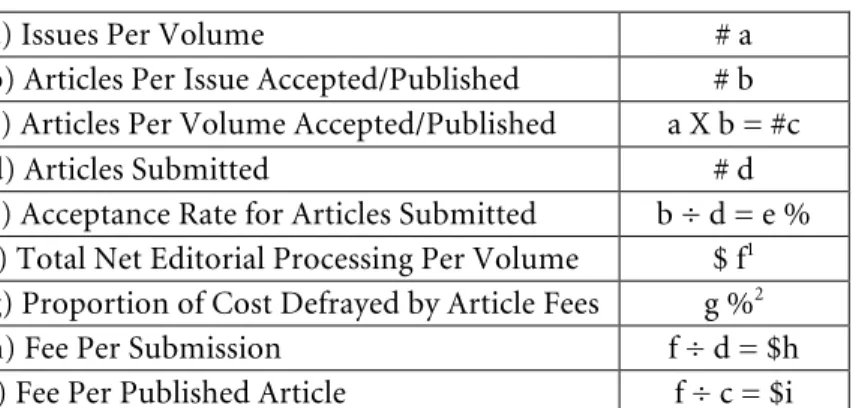
processing fees. Appendix B describes a simple method for computing article processing fees for either submitted or accepted articles.
Several research funding agencies have policies supporting the payment of article fees,19
and a growing number of academic institutions have established funds to cover all or part of the article processing fee for articles submitted by affiliated authors to open-access publications.20, 21
2.1.1 Suitability
For journals in disciplines for which they have been a long-standing practice, article processing charges provide a logical model to support open-access dissemination. However, authors in disciplines without an established page-charge tradition (the case in much of the humanities and social sciences) may be expected to resist the practice. As noted above, article processing fees seek to recover publication costs from the individuals and institutions that benefit most directly from a paper’s publication. While this is one of the advantages of such charges, it is also one of the principal objections to them when they are paid by the individual author seeking professional advancement. If a publisher attempts to transplant the model to a discipline without a tradition of page charges, positioning the charges as being paid by academic institutions, funding agencies, and other sponsors might prove less objectionable. Relying on such author proxies might allay author objections and dispel the perception of vanity publishing. This would also require encouraging sponsors of social scientific and humanistic research to implement policies to fund open-access publication that are similar to those in place for many scientific research funders.
2.1.2 Discretionary Open Access
Another variation on article processing charges makes payment of an article processing fee—and the availability of the article via Open Access—subject to the author’s discretion. Besides opening access to some of a journal’s content, this approach might provide a transition strategy, potentially even for disciplines in which article fees are not customary.22 Under this model, articles by non-participating authors may remain
19 For a list of funding agencies that allow grant monies to be used to cover article processing fees, see
http://www.biomedcentral.com/info/authors/apcfaq/#grants.
20 For a list, see the Open Access Directory wiki, “OA Journal Business Models,” http://oad.simmons.edu/oadwiki/
OA_journal_business_models.
21 The Research Information Network and Universities UK have published a guide for universities and other research institutions,
publishers, research funders, and authors on open access article processing fees. See http://www.rin.ac.uk/openaccess-payment-fees.
22 One society introduced a discretionary article processing charge that provided authors with electronic PDF “reprints” as an
available only to subscribers or may be made available free online after an embargo period.
Some publishers realize substantial revenue from reprint sales to corporate buyers. Rather than assuming that such revenues would be lost under an open-access model, publishers that currently enjoy these revenues may want to reposition reprint fees as corporate sponsorships to support Open Access. Corporate purchasers may be willing to continue paying a fee where the publisher provides the reprint in a format that associates the sponsor with the publication’s identity and reputation.
2.1.3 Transitioning from a Subscription Model to Article Processing Fees
Subscription-based journals that wish to transition to open-access distribution funded by article processing fees may find themselves at an impasse: while they require a
compensating income stream to offset the print journal cancellations that might result from open-access availability of the journal, some of their contributing authors may not have access to the funds necessary to pay for publication charges, and levying an article processing fee puts the journal at a competitive disadvantage. The severity of this problem may vary by discipline, depending on the policies of funders in a given field and by the practices of comparable journals.
An individual journal acting unilaterally to implement article processing fees might put itself at a competitive disadvantage in attracting author submissions.23 To mitigate this
risk, a group of comparable journals—for example, society journals in a particular field or subfield, might transition to the new model in concert. The extent of this collective action might be limited to coordinating the timing of the transition, or it could include
coordinated planning and marketing of the new approach.
In addition to coordinated action with similar journals, the discretionary publication charge approach described below can help subscription-supported academic journals overcome these issues and manage financial risk in order to transition to open-access distribution funded largely or entirely by article processing fees.24
In a transition to a discretionary model, a journal would lower its subscription price over time as the proportion of authors electing to pay the publication fee increases. In this way, a journal would be able to gain new revenue to support a transition to Open Access at a rate commensurate with the acceptance of publication charges by the journal’s author community. The transition period afforded by the model would also provide the time and context necessary to:
• Demonstrate the benefits to authors—including greater visibility, accelerated citation, and higher impact—of Open Access. At the same time, authors who cannot (or choose not) to pay publication charges can continue to publish in the journal.
Scientist. Vol. 86, No. 5 (1998) and “Two Societies Show How to Profit By Providing Free Access.” Learned Publishing. Vol. 15,
No. 4 (2002), pp. 279-284.
23 After the Second World War, commercial STM journals arose, in part, to provide an alternative to society publication fees. 24 Thomas J. Walker, personal communication, February 1, 2003 and David C. Prosser, “From here to there: a proposed
• Allow researchers to begin to build publication charges into their research funding proposals, and for granting agencies to implement publication charge policies to fund publication of the research that they support.
• Assess the effect of the model on other journal income streams. Some of these, such as offprint and permissions income, might be expected to decrease. Whether other income streams, such as advertising, increase or decrease will depend on the manner in which they are implemented in an online environment.
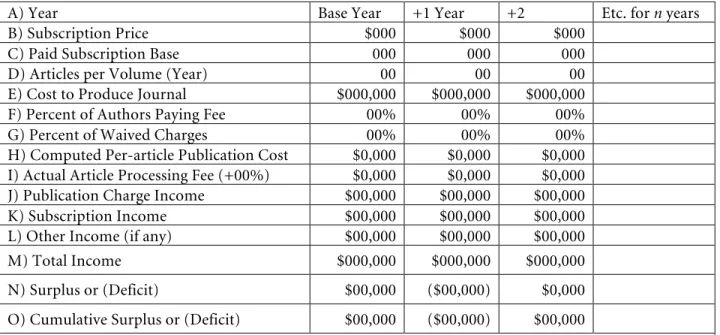
Appendix C provides a financial forecasting template for introducing discretionary article processing fees and illustrates how discretionary fees might be implemented over time. The financial forecasting model takes into account the issues that need to be considered when planning such a transition; namely:
• Journals with relatively high publication costs will typically require higher publication charges. The point at which the article publication fee becomes a barrier to author submissions will depend on both the discipline (that is, the extent to which authors are accustomed to such fees) and the journal’s reputation (that is, the value authors perceive in publishing in a particular journal).
Of course, other income sources may allow a journal to set its publication charges at a lower level. Conversely, where possible, setting the publication charge slightly higher than the actual per-article cost can provide an operating surplus to offset years in which the journal incurs an income shortfall due to the timing of subscription cancellations and/or lower than anticipated author participation.
• Most publishers will find it difficult to project with confidence the rate at which authors will opt to pay publication charges. This suggests that a market study of the journal’s author community, supported by an effective promotional program, will help improve author participation, increase predictability, and lower risk.
• Where author participation rates are low, slow to grow, or fluctuate considerably from one year to the next, a journal may face short- and mid-term operating losses. For example, were author participation in the discretionary article fee program to drop from the previous year, the lowered journal subscription price might not generate sufficient income to cover the journal’s expenses. In many instances, it would be difficult to increase the subscription price sufficiently from year-to-year to cover sharp fluctuations. To reflect this, a journal might impose a cap (for example, 10%) on year-to-year price fluctuations.
• There may be a tipping point for cancellations of paid subscriptions that precedes the journal’s ability to support itself through publication charges. In come cases this could be addressed by setting the publication fee higher from the outset of the transition. As long as the initial publication fee is not so high as to discourage author participation, this could generate a surplus reserve that could be applied to subsidize the journal through years when it incurs an operating loss. Again, a journal should
assess its risk by analyzing its author community thoroughly before undertaking the transition.
While such a transition strategy is not without risk, the risk can be anticipated and mitigated, especially by established journals in disciplines with a strong tradition of publication or page charges.
2.1.4 Article Processing Fee Examples
Prominent examples of publishers relying entirely on article processing fees include: • BioMed Central (http://www.biomedcentral.com)
• Hindawi Publishing Corporation (http://www.hindawi.com), located in Egypt, leverages a low cost base to provide economically viable, labor-intensive publishing services. Hindawi publishes over 150 open-access titles.25
• Journal of Medical Internet Research charges a non-refundable submission fee for regular articles. It also allows authors to pay an additional fee to accelerate the publication process. (http://www.jmir.org/cms/view/
Instructions_for_Authors:Instructions_for_Authors_of_JMIR#Open_Access) • MedKnow Publications, of Mumbai, India, publishes over 80 open-access journals.
(http://www.medknow.com)
• Molecular Diversity Preservation International (MDPI) journals, while headquartered in Basel, Switzerland, operates in China (http://www.mdpi.com). MDPI journals include Molecules (launched in 1996), the International Journal of Molecular Sciences (launched in 2000), and Sensors (launched in 2001).
• Optics Express, published by the Optical Society of America, sets article publication fees based on the length of the article
(http://www.opticsinfobase.org/oe/submit/review/pub_charge.cfm#opex ) • Public Library of Science (http://www.plos.org)
The SHERPA/RoMEO site (http://www.sherpa.ac.uk/romeo/PaidOA.html) provides a list of publishers that offer optional paid Open Access. Selected examples are listed below. Peter Suber and Caroline Sutton have also analyzed society open-access journals, including those using article processing fees.26
D iscretionary O pen A ccess E xam ples
• Examples of author-discretionary models from society publishers include: • The American Physical Society, “Free to Read” option
(http://publish.aps.org/FREETOREAD_FAQ.html).
• American Society of Limnology and Oceanography, the “Free Access Publication” program allows authors to make an article freely available immediately upon payment of a fee that supplements the journal’s page and color charges.
(http://www.aslo.org/lo/information/freeaccess.html)
• Mineralogical Society of America, charges on a per-page basis (http://www.minsocam.org/MSA/ammin/e-pub_policy.htm).
25 For a description of how Hindawi’s low-cost structure enables its open-access distribution, see Paul Peters. “Going All the Way:
How Hindawi Became an Open Access Publisher.” Learned Publishing 20.3 (July 2007): 191-195.
26 See Peter Suber and Caroline Sutton. “Society Publishers with Open Access Journals.” SPARC Open Access Newsletter, No. 115
• Royal Society of Chemistry, “Open Science”
(http://www.rsc.org/Publishing/Journals/OpenScience/FAQ.asp) • Royal Society, “EXiS (Excellence in Science) Open Choice”
(http://royalsocietypublishing.org/site/authors/EXiS.xhtml) From university presses:
• Cambridge University Press, “Cambridge Open Option”
(http://journals.cambridge.org/action/stream?pageId=4088&level=2#4092) • Oxford University Press, “Oxford Open”
(http://www.oxfordjournals.org/oxfordopen/) From commercial publishers:
• BMJ Publishing Group, “BMJ Journals Unlocked” (http://adc.bmj.com/info/unlocked.dtl)
• Nature Publishing Group (http://www.nature.com/press_releases/greengold.html) • Springer Open Choice
(http://www.springer.com/open+choice?SGWID=0-40359-0-0-0) • iOpenAccess, Taylor & Francis
(http://www.informaworld.com/smpp/authors_journals_iopenaccess_about~db=all) • World Scientific Publishing, “WorldSciNet Open Access”
(http://www.worldscinet.com/authors/openaccess.shtml)
Several publishers have instituted models that package article processing fees in an
institutional subscription: in some instances, a fixed fee covers all manuscript submissions from researchers at the subscribing institution; in other cases, the institutional
membership fee is based on the number of article submissions.
• BioMed Central offers both volume-driven and fixed-discount programs with pre-payment and pre-payment in arrears options, with additional discounts for pre-pre-payment (http://www.biomedcentral.com/info/instmembership.asp)
• Hindawi Publishing Corporation uses a flat rate (http://www.hindawi.com/memberships.html) • Journal of Medical Internet Research
(http://www.jmir.org/cms/view/Support_%2526amp%253B_Membership) • Public Library of Science (http://www.plos.org/support/instmembership.html) • The ScientificWorldJournal
(http://www.thescientificworld.com/TSW/main/Static.asp?menuid=246&jid=141# ) Some publishers allow an institution’s subscription fees to cover discretionary open-access article publication charges for articles from authors affiliated with the institution. Examples of this approach include:
• National Academy of Sciences, discounts publication fees for articles from authors at subscribing institutions (http://www.pnas.org/site/subscriptions/open-access.shtml). • Oxford University Press discounts optional article processing fees for authors from
institutions that subscribe to the journal.
(http://www.oxfordjournals.org/oxfordopen/charges.html)
• Springer waives the article fee for optional Open Access for some institutions and consortia, including the Dutch library consortium (Universiteitsbibliotheken en de
Koninklijke Bibliotheek); the University of Göttingen; and the University of California system.
Some society journals waive article processing fees for members of the society; for example:
• Plant Physiology, published by the American Society of Plant Biology, does not charge publication fees to ASPB members (http://www.plantphysiol.org/misc/ifora.shtml) 2.2 Advertising
As the volume of research information continues to grow, a journal’s reputation and the ability to attract the attention of readers are becoming increasingly scarce. This scarcity can provide a source of income, as long as these assets can be monetized via a business model. Affinity-based models, such as advertising and sponsorships, typically offer the most straightforward approaches for converting journal reputation into revenue. Web-based advertising extends the traditional broadcast media model. In the case of an open- access journal, the Web site can provide free access to valuable content in
combination with advertising messages. A publisher can sell its advertising capacity on its own—or, given sufficient demand, through a broker—to advertisers who wish to target the audience served by the Web site. Alternatively, a publisher can participate in an online advertising network, such as the affiliate programs offered by Google, Amazon, and others (described below).
2.2.1 Suitability
Advertising provides a viable income model where an online journal either draws a substantial volume of visitors, allowing the advertiser to reach a large audience, or where the journal’s audience is highly specialized, providing an efficient marketing channel for an advertiser targeting that particular audience. While online journals seldom experience enormous traffic volumes compared with more general Web sites, they typically reach highly specialized audiences. Many print journals have sold advertising for years, and there is no logical reason why such ads should not translate to the online version of the journal. This point can also be made to those who might object to online advertising for aesthetic or philosophical reasons.
There are several approaches to setting Web advertising rates. One method is based on the volume of ad “impressions”—that is, the number of site visitors who view Web pages displaying the ads. Impressions are typically measured and sold based on the cost per each thousand visitors (CPM).27 CPM rates are out of favor with some advertisers, who find it
difficult to quantify the financial return of passive advertising. However, they can still prove useful to small market advertisers targeting highly specialized audiences.
A second common ad rate uses a pay-for-performance model (sometimes referred to as a CPA or cost-per-(customer) acquisition model). Using a CPA model, the advertiser pays
27 The price paid in a CPM arrangement is calculated by multiplying the CPM rate by the number of CPM units. For example,
100,000 impressions at $25 CPM equals a $2,500 total price. The amount paid per impression is calculated by dividing the CPM by 1,000. For example, a $25 CPM equals $0.025 per impression.
the publisher for each visitor that actually responds to the ad in some manner, typically by “clicking-through” the ad and responding to an offer (for example, by making a purchase or by registering for more product information, etc.).
Advertisers often prefer pay-for-performance models as they can predict their advertising return on investment and better manage their advertising spending. From the publisher’s perspective, however, CPM rates better accommodate the particular use patterns of academic researchers, who—engaged in the research task at hand—are less likely to interact with ads. Further, CPM rate-based ad sales typically offer more predictability of income. From a practical perspective, for existing journals with established print advertising programs, both the journal’s and the advertisers’ rate expectations will often be indexed to existing print advertising rates.
Web-based advertising raises a number of issues that open-access publishers should bear in mind:
• User receptivity: While few users of any service in any medium will profess that they actually like advertising, academic users should have few objections to Web
advertising that is relevant to the their interests (for example, lab equipment or scholarly monographs) and graphically unobtrusive.
• Dual media ad packages: A journal published in both print and electronic formats might sell ad packages for both formats. This can be as simple as a bundled dual media price that entices advertisers to try web-based ads for the first time.
• Ad sales capacity: Advertising needs to be sold and traffic managed, which requires the time and resources to do so. For a publisher with little or no staff support, operating its own advertising program might not be cost-effective unless it can leverage the effort with an existing ad sales program or out-source most of the effort to a broker (who will typically be paid only for results, on a commission basis). Alternatively, a publisher might participate in a networked advertising program (described below).
• Site traffic reporting: If advertising is sold on a CPM basis, the advertiser will require accurate reports of a journal’s online traffic. While third-party online audience measurement services exist that monitor this type of traffic, they are too expensive for most nonprofit journal publishers. However, for targeted advertising markets, a publisher should be able to reach an accommodation with its advertisers to supply data from server logs to validate traffic figures.
The problem in converting print advertising revenue into online advertising revenue is that advertisers do not yet consider online visitors as valuable as print readers, and the CPM for online readers remains a fraction of that for print. This discrepancy results, in large part, from the greater competition for advertising revenues online. Advertising works well when relatively few entities rely on it, but—driven by supply and demand— less well when it needs to sustain many. A peer-reviewed journal in print has relatively few
competitors in its specific field. Online, however, the journal’s advertising competes in a vastly larger market, not just against other peer-reviewed journals.
Print advertising typically represents a modest percentage of a journal’s revenue.
Similarly, for open-access journal publishers, advertising will likely contribute a relatively modest income stream—perhaps 5% to 20% of total revenue.
2.2.2 Marketing an Advertising Program
When marketing to advertisers, a publisher needs to emphasize the strengths of its journal and the demographics it reaches. For example, a publisher should provide the following information, together with advertising rates, to formulate a rate card and media kit (resources to help prospective ad buyers evaluate advertising opportunities):28
• Readership/Circulation/Impressions: A publisher should indicate the approximate number of registered subscribers (in this case, those who have registered to receive the journal) and/or the number of page impressions that the journal generates. The former approach requires that a journal capture information on its subscribers, either by requiring registration to use the site and/or through user surveys. (Of course, any registration system should conform to the publishing organization’s user privacy and disclosure policy.)
Whether a publisher presents one or both of these figures will depend on a variety of factors, including how long the journal has been available online (for example, until the journal has been online long enough to build up traffic, the publisher may choose to emphasize the projected online readership based on the journal’s print subscription base). • Cost effectiveness: If a significant proportion of a journal’s audience represents a
particular demographic, in addition to the specific discipline the journal represents (for example, researchers in a particular geographic region, researchers in the private sector, etc.), a publisher may want to adduce user statistics that demonstrate that advertising placements in the journal can reduce costs for advertisers who want to reach that audience.
• Quality of readership: A publisher should provide a profile of the readers of its journal—for example, describing reader demographics, reader interests, etc.—both online and offline (when such data are available). These assertions will be
strengthened when they are supported by detailed user registration information. • Other leading advertisers: Where possible, indicating prominent past advertisers in
the journal may generate interest by increasing the credibility of the journal as an effective media outlet and by enticing companies to respond to their competitors’ advertising.
28 Media kits typically contain information about rates, ad sizes and formats, audience profiles and targeting options (where
applicable), and contact information, along with any other information that will help advertising buyers make informed decisions and encourage them to advertise in a journal. For an example of a rate card and media kit for a peer-reviewed, open access publication, see those developed by BioMed Central (http://www.biomedcentral.com/info/ advertising.asp).
Some journals may be unwilling to accept certain types of advertising, for example, that which may be viewed as distasteful or not directly pertinent to the audience. While most journals would be unlikely media targets for such types of advertising, it is best to establish an explicit policy beforehand that identify any restrictions.
2.2.3 Advertising Networks
Context-sensitive Web advertising networks provide a simple way for publications to generate online advertising revenue. Although the amount of revenue generated will depend largely on the volume of the publication’s Web traffic, many of the networks target niche markets and thus encourage participation by smaller sites. The publisher is typically compensated on a per-click or a per-impression basis.
Publishers allow an advertising network to display context-sensitive ads—including text links, images, banners, pop-unders, dynamic highlighting, and/or video ads, depending on the provider—on the site by enrolling in the advertising programs and placing some JavaScript code on their web pages. Most networks serve the advertisements based on the content of the publisher’s web site, the geographic location of the user, and a variety of other factors. Most ad networks allow a publisher some control over which ads will appear on its site (such as excluding competitor ads and objectionable material), and some allow the publisher to select specific ads.
Besides Google AdSense (by far the largest network), online advertising networks include AdBrite (adbrite.com), AdToll (adtoll.com), Bidvertiser (bidvertiser.com), Casale Media (casalemedia.com), Chitika (chitika.com), Cliksor (cliksor.com), Kontera (kontera.com), ValueClick (valueclick.com), and Yahoo Publisher Network (publisher.yahoo.com). The Amazon Associates program29 and the Barnes and Noble Affiliate program30 can
provide an advertising revenue stream in a manner that some journals will find more attractive. The programs allow Web sites to create links to specific products, which could include books and other products relevant to a journal’s field or discipline. Additionally, Amazon offers an “aStore” Associates program that allows a journal to embed or link to an online bookstore on its site without any programming requirements. This approach also allows a publisher to focus on particular product categories, although not specific books.
These programs pay referral fees that can range from 4.0% to 8.5% of the product sales price. Assuming an average book price of $25, a referral fee rate of 6%, and site traffic of 100,000 unique visitors per year, approximately 3% of a journal’s visitors would need to make a purchase to generate $5,000 in referral fees for the journal.
29 https://affiliate-program.amazon.com/gp/associates/join/landing/main.html 30 http://www.barnesandnoble.com/affiliate/index.asp
2.2.4 Advertising Examples
Examples of self-administered advertising programs include:
• BioMed Central (http://www.biomedcentral.com/info/ advertising.asp) • Other Voices, provides an example of a media kit for an open- access journal of
cultural criticism from the University of Pennsylvania (http://www.othervoices.org/advertising.php)
• Oxford University Press offers a full range of advertising media for the scholarly journals it publishes (http://www.oxfordjournals.org/corporate_services/ advertising.html)
For examples of peer-reviewed journals using Google Adsense, see: • Open Government Journal, from the University of Alberta
(http:www.opengovjournal.org)
• Priory Medical Journals (http://www.priory.com/)
• Contemporary Management Research, from the Academy of Taiwan Information Systems Research (http://www.cmr-journal.org/)
• Journal of Medical Internet Research (http://www.jmir.org/)
• Neurology, Clinical Neurophysiology and Neuroscience, sponsored by the American Academy of Clinical Neurophysiology (http://www.neurojournal.com/).
For an example of Amazon Associates program, see:
• Online Journal (http://www.onlinejournal.com/) provides a link to an Amazon Associates aStore.
2.3 Sponsorships
Sponsorships are similar to advertisements, except that they are typically sold based on time, rather than on the number of impressions. A sponsorship program relies on one or more institutional or corporate sponsors to subsidize some or all of a journal’s operating expenses in exchange for recognition on the Web site and, sometimes, in other forms of public communication.31
While similar in appearance to online advertising—the sponsorship recognition often takes the form of a banner graphic or display of a logo and brief message—sponsorships differ from advertising in several respects:
• Greater funding potential: Sponsoring a journal can deliver greater marketing value than advertising, as the sponsor benefits more directly from the reputation, values, and goodwill of the open-access journal. Thus, a journal may be able to realize more revenue via a corporate sponsorship than the market value of a commensurate amount of advertising. Although difficult to quantify, this concept is well understood by experienced corporate sponsors.
31 For a fuller discussion of sponsorships for journals, see Raym Crow. Sponsorships for Nonprofit Scholarly & Scientific Journals: A
Guide to Defining & Negotiating Successful Sponsorships. (Washington: SPARC Publications, 2005).
• Less labor intensive: Once sponsorship guidelines have been established, maintaining corporate sponsorships can be less resource intensive than a self-managed advertising program. First, a journal would often only have one or two corporate sponsors; more would dilute the sponsorship’s appeal to potential funders. Second, the length of a sponsorship commitment is typically longer than that for an advertising contract. • Existing prospects: A publisher may already have an established group of potential
sponsors available for its journal. For a learned society, for example, this might include corporate members, conference sponsors, and the like.32 Existing affinity
relationships should be explored for potential expansion to journal and site sponsorships (within the parameters of the journal’s sponsorship guidelines, discussed below).
With the exception of advertising, corporate sponsorships should combine well with many of the other business model components catalogued here.33 For example, a
corporate sponsor might fund a program that provides grants to authors who lack institutional funding to cover article processing fees. Or a sponsor might underwrite a particular section or feature of a journal. Whatever the sponsorship format, an existing journal with a strong brand and market position might prove appealing to potential sponsors.
2.3.1 Sponsorship Examples
• CERN Courier (http://cerncourier.com/cws/latest/cern)
• The Directory of Open Access Journals (DOAJ), sponsored by the National Library of Sweden, INASP, the Swedish Library Association, and Lund University, launched a membership program in 2007 to help fund the continuing operation and
development of DOAJ. DOAJ currently has 13 individuals, 80 libraries, universities and research centers, 10 library consortia and 2 aggregators as members.
(http://www.doaj.org/doaj?func=membership)
• Journal of Electronic Publishing (http://www.journalofelectronicpublishing.org/) • Palaeontologia Electronica, sponsored by several scientific societies, including the
Paleontological Society, the Palaeontological Association, the Society of Vertebrate Paleontology, the Cushman Foundation for Foraminiferal Research, the Sociedad Española de Paleontología, The Micropalaeontological Society, Canadian Association of Palynologists, and Geoscience Australia (http://palaeo-electronica.org/owner.htm) 2.4 Internal Subsidies
In addition to, or in lieu of, the revenue-generating models described above, a publisher may rely on external and/or internal subsidies—either as cash or in-kind contributions— to sustain a journal. A journal’s business plan may prudently incorporate subsidies as along as the subsidies are formally recognized, fully accounted for, and carefully managed to ensure their continuity.
32 A society could implement a sponsorship program by introducing a new level of membership that includes sponsor benefits. 33 Sponsors may demand exclusivity or near-exclusivity, which may be incompatible with a simultaneous advertising program.
2.4.1 Dues Surcharge
Subsidies may be available from within the publishing organization itself. Especially in nonprofit and membership organizations, subventions to support open-access
distribution may take the form of cross-subsidies from other programs or from member dues. Many societies already allocate a portion of member dues income to support their publishing programs.34 A dues surcharge—or a reallocation of member dues to cover a
larger proportion of total publication costs—rests on the logic that open-access distribution supports a society’s core mission.
Many learned societies began as voluntary associations to support publishing and research-related activities. In some cases, the publishing programs of these organizations were originally intended to serve individual members, with supplemental income streams in the form of institutional subscriptions coming later. For many organizations, therefore, extending member support to subsidize the entire journal may represent a return to the organization’s original publishing mission.
A dues surcharge raises membership cancellation and free-rider issues: that is, members could drop out of an organization and take advantage of a publication’s Open Access availability. The success of open-access proposals in membership organizations rests largely on the assumption that membership in the society provides other benefits—both tangible (such as conference participation) and intangible (such as a desire to belong to a discipline’s guild)—beyond the publication itself. A society with a relatively weak member benefit proposition might have to effect collateral policy changes—for example, requiring membership for conference participation or raising various participation fees for non-members—to overcome free-rider behavior.
If imposing a dues surcharge on all members is untenable, a society might solicit voluntary contributions from individual, institutional, and corporate members. This approach is described in greater detail in the sections on Sponsorships (see above) and Gifts and Fundraising (see below).
2.4.2 Dues Surcharge Examples
• BioMed Central’s membership program allows societies to offer the right to publish without article processing fees as a member benefit. In this case, the society pays the publisher’s charge, in full or in part, out of membership dues.
2.4.3 Cross Subsidies
Some society publishers subsidize the operation of one or more open-access journals from the surplus generated by the society’s subscription-based journals. Although this approach would not support migrating all of an organization’s journals to Open Access— that would require cross-subsidies from other types of society programs—it would increase the society’s open-access content overall.
34 The Wills survey suggests that 25-30% of societies allocate member dues to offset publishing costs. See
Several aggregators of peer-reviewed journal content—including BioOne in biology and Euclid in mathematics—have provisions for hosting open-access content alongside gated content. In these cases, the aggregators provide online hosting services as part of their mission and as a quid pro quo for the journal’s open-access content. Integrating relevant open-access content increases the convenience and overall value of the aggregation, thus providing a benefit to the gated journals in the collection by enhancing its appeal to subscribers. As the value added by the open-access content—for example, in attracting subscribers—may not fully offset the associated costs, the viability of this approach will sometimes rely on the mission of the organization(s) offering the aggregation.
2.5 External Subsidies
2.5.1 Foundation Grants & Corporate Funding
Grants from foundations and other philanthropic organizations can cover one-time costs that may attend the transformation of a subscription-based journal to Open Access. Grants typically support development projects and specify a finite grant amount for a set period of time. Although less common, some foundations will also fund ongoing journal operating costs. 35 Depending on the grantor, a publisher might seek a grant to mitigate
the financial risk that a journal might incur during conversion to a new business model capable of supporting Open Access. The financial risk of such a conversion can be quantified and limited to a specific time period, and the social return on the granting agency’s investment can be clearly articulated.
Possible grant sources include:
• Private foundations: Private foundations are nonprofit, non-governmental
organizations with an endowment (typically donated from a single source) and grant-giving program managed by trustees or directors. Such foundations are established to aid educational, social, religious, or other charitable activities. Obviously, the most important criterion is that a foundation has a philanthropic mission that supports scholarly communications initiatives in the same subject area as the journal.
• Corporate funders: Corporate funding can come from corporate foundations or from corporate giving programs. A corporate foundation is a private, company-sponsored foundation that obtains its assets from a for-profit enterprise. While a corporate foundation is an independent entity, with its own endowment and organization, it may maintain close ties with the company that created it. Corporate giving programs are grant-making programs administered from within a for-profit business. Some companies make charitable contributions through both types of programs. When dealing with corporate foundations or corporate giving programs, a publication should develop and apply underwriting policies (such as those described above for
35 Operating support from foundations is relatively rare (less than 3%) for society-sponsored journals, but more common
(approximately 15%) for the open access journals listed in the Directory of Open Access Journals. See Kaufman-Wills Group (2005), 43, Table 29.