John Dos Passos’s Corporeal Experimentations
through 1920’s Theater
MISUGI Keiko
ジョン・ドス・パソスの身体的実験 ― 1920年代の演劇をとおして ― 三 杉 圭 子 神戸女学院大学 文学部 総合文化学科 教授 連絡先:三杉圭子 [email protected]Abstract
As a modernist writer, John Dos Passos associated himself with a wide variety of avant-garde art during the 1920s. While his 1925 novel Manhattan Transfer received critical acclaim, his vast travels and inclination toward leftist ideology led him to become deeply involved with experimental theater. While in Europe, he immersed himself in plays and the performing arts overall, while in New York City, he promoted theater as a playwright and director for the New Playwrights Theatre.
This article focuses on Dos Passos’s theatrical involvement as an effort to express corporeality beyond print or the literary text. He drew inspiration and techniques from modernist experimental theater and integrated them in his U.S.A. Trilogy. The 42nd Parallel (1930), the first volume that was republished in 1938 as part of the trilogy, displays an ingenious combination of innovative narrative devices such as in “Newsreel” and “Camera Eye,” along with a series of biographical sketches of public figures and stories of fictional characters. I first discuss the attraction of theater to Dos Passos as an embodiment of his passion for corporeal expression in art and then survey his oeuvre from his position as both playwright and director for the New Playwrights Theatre. Next, I investigate Dos Passos’s other encounters with theater and the performing arts: namely, collage and montage that he embraced after his exposure to theater overseas. Though Dos Passos’s attempts as a playwright and theater director failed, these experiences inspired his daring spirit and the innovative narrative devices to flourish in the U.S.A. Trilogy.
Keywords: John Dos Passos, corporeality, theater
要 旨 1920年代、ジョン・ドス・パソスはモダニズム作家として多様な前衛芸術に関わった。彼はヨー ロッパでは実験的な演劇や舞台芸術に触れ、ニューヨークでは戯曲家、そして劇団ニュー・プレイラ イツ・シアターの監督として活動した。本論文ではこのドス・パソスの演劇との関わりを身体的芸術 表現の一環として考察する。彼は当時の前衛演劇から多くのインスピレーションを得、様々な技法を 学んだ。のちの代表作『U.S.A.』三部作で、「ニューズリール」、「カメラ・アイ」、歴史上の人物の 伝記的スケッチ、そして虚構の登場人物の物語、といった異なる語りの話法を巧みに組み合わせたの はその成果である。本論文ではドス・パソスにおける身体的芸術表現としての演劇の重要性を確認 し、戯曲家および劇団の監督としての彼の仕事を検証する。さらに、ドス・パソスがヨーロッパの前 衛的な演劇や舞台芸術をとおしてコラージュおよびモンタージュ技法と遭遇したこととその意義を考 察する。戯曲家、監督としてのドス・パソスの試みは失敗に終わったものの、前衛演劇との関わりは、 彼の文学上の実験を推し進め、三部作において斬新な語りの技法を成功させる原動力となったのであ る。 キーワード:ジョン・ドス・パソス、身体性、演劇
The 1920s was a time of action, engagement, and experimentation for John Dos Passos. He met critical success with his 1925 publication of Manhattan Transfer after earlier attempts at two war novels, One Man’s Initiation (1921) and Three Soldiers (1922), and another drawn from his literary college days, Streets of Night (1923). By the end of the 1920s, he started working on his first volume of the U.S.A. Trilogy, The 42nd Parallel, published in 1930. Beyond his literary efforts, he committed himself to leftist ideology and protested the shattering of democracy with the wrongful execution of Italian men in the notorious Sacco-Vanzetti case. Meanwhile, he travelled widely in the Middle East, across Europe, and to Russia for the first time in 1928. While in Europe, he earnestly began to associate himself with plays and the performing arts as well as promoted theater as playwright and director for the New Playwrights Theatre in New York City.
While Dos Passos worked in a variety of media in the 1920s, this article focuses on his theatrical involvement as an expression of his aspiration for corporeality beyond printed literature. He drew inspiration and techniques from modern experimental theater, integrating these elements in the U.S.A. Trilogy. He crafted ingenious combinations of innovative narrative, such as “Newsreel” and “Camera Eye,” with biographical sketches of historical figures and stories of fictive characters. First, I discuss Dos Passos’s attraction to theater as an embodiment of his passion for corporeal expression in art. Next, I survey the writer’s oeuvre from the dual positions of playwright and director for the New Playwrights Theatre. Finally, this article investigates his foreign encounters with theater and the performing arts: namely, through collage and montage. Though his attempts as a playwright and theater director ultimately failed, what survived inspired his daring spirit and the innovative narrative devices that flourish in the U.S.A. Trilogy.
I. Aspirations for Corporeality through Theater
The feature of theater in greatest contrast to printed literature is the engagement of corporeal sensations. In other words, theater is a composite of the voice and bodily movements of a particular cast of actors, combined with the visual impact of stage sets, costume, and sound. Christian Biet and Christophe Triau define theater as “a spectacle, an oral genre, a fleeting performance, delivered by actors and intended for spectators”; “[i]t is a work of the body, a vocal and gestural exercise addressed to an audience, most often in a specific location and with a unique decor” (Biet and Triau 1). Theatrical artists make use not only of the power of words, but also of the nuances that sight, sound, and a sense of space elicit. With his acute interest beyond text in the visual arts and music, it seems natural that Dos Passos sought out the theater to stimulate his imagination and explore other expressive forms. Accordingly, Dos Passos also incorporated his keen interest in his theatrical activities back into his writing. As I have discussed elsewhere, Dos Passos’s novel Manhattan Transfer depicts a budding writer’s yearning for corporeal experience to enable him to
become a real artist.1Toward the end of the novel, the character Jimmy Herf aspires for expression in the form of painting. Dos Passos himself who was a fairly accomplished painter. In 1923 his work was on exhibition at New York’s Whitney Studio Club (“Chronology” 846); he also used his own drawings and paintings in his publications (Pizer, et al. Fig. 14, 20b, 23). For the theater, he designed stage sets for Processional, a dramatic work by friend Jack Howard Lawson in 1925, his own first play The Moon Is a Gong in the same year, Paul Sifton’s The Belt in 1927, and again for Lawson’s International in 1928.
Theater also involves the immediacy of an audience, another attraction which offers a different experience for a writer whose relationship to the reader is removed from both time and space. The heat or chill of the stage is transmitted to the audience physically. Dos Passos aligned himself most closely with political radicalism from the mid-1920s. Besides writing for progressive magazines such as The Nation and New Masses, the theater clearly became a desirable channel, enabling him to interact firsthand with an audience. As a composite art, theater offered a corporeal experience to the audience through the convergence of linguistic, visual, and aural dimensions, and at the same time, suited Dos Passos’s versatile interest in art and politics beyond the frame of print. Dos Passos wrote three plays in his career which were published as a single volume in 1934. His first play The Moon Is a Gong, considered to be the most interesting of the three, was performed by the Harvard Dramatic Club in Cambridge and Boston in May 1925 (“Chronology” 847) and later under the revised title The Garbage Man in March 1926 at the Cherry Lane Playhouse in Greenwich Village (Dos Passos, Three Plays 75). In the play, Death appears in various guises and finally as a garbage man on the streets of New York. The man signals human mortality by clanging a gong that is compared to the moon in the sky. The experimental piece combines the seriousness of a play portraying human pressures of modern industrial life with a musical show incorporating the sounds of jazz. Biographer Virginia Carr documents the initial excitement the performance brought to the Harvard audience:
On May 12, 1925, the little auditorium in Brattle Hall on the Harvard University campus fairly rocked with the play’s blaring syncopations of jazz and broken dialogue, the cacophony of shouting voices, horns, and grinding machines resounding against a backdrop Dos Passos had designed for the scene at Union Square, which caught the pulse of the city at night——all in an extravagant, expressionistic staging that combined burlesque and vaudeville with romantic lyricism and tragedy. A TALL FEATHER FOR THE CAP OF HARVARD PLAYERS, announced the headline in the Boston Evening Transcript’s theater section the day after its premiere.... The play ran again on May 15 in a Boston theater. Its genteel audience was less appreciative than Harvard A portion of this article was originally presented at the American Literary Association’s 30thAnnual Conference
in Boston on June 25, 2019 and was generously supported by JSPS KAKENHI Grant Number JP17K02574. 1 See Misugi, “Jimmy Herf’s Yearning for Corporeality in Manhattan Transfer.”
viewers had been of such avant-garde efforts, but it was considered a success in Boston as well. (Carr 207)
In New York where alternative expression could find a home, the production lasted for only 18 performances. Another biographer Townsend Ludington rather bluntly wrote, “Vaudeville and social protest...did not mix well” (Ludington 243). Even as the production combined dramatic theater with the appeal of jazz precisely to underscore pressures of modern life, it did not manage to reach a wider audience.
Dos Passos’s second play Airways, Inc. was performed by the New Playwrights Theatre in February 1929 for four weeks. The play portrays a struggling working-class family torn between the daughter’s growing sympathy for the labor movement and the brothers’ involvement in capitalistic development of a newly formed aviation company. The heroine, whose lover is a labor organizer and is unjustly executed, laments how America has become a place she does not recognize. Meanwhile, the aviation business brings the family material comforts at the expense of the brother’s eventual injury in his chosen field. Though the daughter serves as the medium to connect the twin plots, Carr sums up contemporary reviews that “[m]ost critics attacked the play for its lack of unity, the failure of its two narratives to converge successfully, and for having as many themes ‘as flies in a sugar bowl,’ as Mike Gold described it” (Carr 251). Given the strong leftist message criticizing America in the wake of the Sacco-Vanzetti executions, the production was explicitly alternative. Dos Passos notes that it employed a stationary set adaptable to various scenes, instead of picture frames for each scene (Three Plays 158). A spotlight would illuminate the section of the stage where the action was taking place, and the audience could detect the small alterations made to the set between acts. While the set’s apron protruded over the orchestra pit in order to foster more immediacy for the audience, the play failed nevertheless to engage them.
Dos Passos’s third and final play, Fortune Heights, was written in 1933 (Three Plays 161) and staged by the Trades Unions Theatre in Moscow and the Alexandrinsky Theatre in Leningrad in 1934, and in that same year, by the Workers Theatre, an amateur group in Chicago (Carr 323). It featured a host of characters tossed about by the wheel of fortune over the 1929 market crash. The protagonist, a gas station attendant, is down trodden, yet grows determined with his family to endure hardship. A real estate agent who dreams of the success of a lot he develops as “Fortune Heights” similarly endures, turning toward New Deal politics to rebuild people’s lives. The play lacked, however, any cutting edge in either characterization or dramatic action to evoke empathy or to form a coherent whole. Lawson commended its concept, but argued that “its canvas was not broad enough for a true representation of mass events, nor were the characters sufficiently rounded to enable the theater goer or reader to see the predicament through their eyes” (Carr 328). As Ludington decries, it was “an eminently forgettable play” (Ludington 326), and with that, Dos Passos ended his career as a dramatist.
as a playwright. Ludington assesses the volume as “a landmark only in the sense that it signals the end of Dos Passos’s attempts to write dramas, a decision that few challenged. The plays simply were not superior theater; caricatures and dialogue overladen with social messages hurt their dramatic impact” (Ludington 323-24).
Dos Passos’s career as a playwright, however, is only a part of his involvement with theater. In order to evaluate his theatrical experiments in the 1920’s, we must explore further how he dealt with his position as a director of the New Playwrights Theatre. New Playwrights Theatre was an experimental theater group launched by John Howard Lawson, Mike Gold, Francis Faragoh, and Em Jo Basshe, and funded by Otto Kahn, a German-born New York banker and patron of the arts. The theater operated over three seasons from spring of 1927 to 1929, and Dos Passos was asked by Lawson to join the group as one of the directors. Donald Pizer writes that “Lawson was attempting to reinvent American drama as a mix of radical political themes, Expressionistic theatrical devices, and a heavy influx of popular arts, especially vaudeville and jazz” (Pizer, et al. 14). They inaugurated their approach with a social political farce Loud Speaker by John Howard Lawson, followed by Em Jo Basshe’s Earth. The next season the theater ran four plays: The Belt by Paul Sifton, The Centuries by Em Jo Basshe, The International by Lawson, and Hoboken Blues by Mike Gold. In 1929, the third season launched with Upton Sinclair’s Singing Jailbirds and Dos Passos’s own Airways, Inc., ultimately closing the theater down and causing Dos Passos to step away from his position.
The theater’s closing seems to have been a combination of poor attendance, negative reviews, disorganization, and insufficient financial backing. Incongruities between the producers and the audience were evident. Proponents of the New Playwrights Theatre, or at least Dos Passos, acted as if they were on a self-ordained crusade to awaken degenerate American audiences to the ills of capitalistic industrial society. Dos Passos complained of an unwillingness of American audiences and critics alike to open up their minds to a new form of experimental art in which their own theater sought to respond to industrial life. As of December 1927, he advocated for revolutionary theater in the United States to involve “an active working audience,” “the conscious sections of the industrial and white collar working classes which are out to get control of the great flabby mass of capitalist society and mould it to their own purpose” (Dos Passos “Towards a Revolutionary Theatre” 20). During his visit to Russia in 1928, he was awed by the enthusiasm of the audience for a theater that held so much power over them. Looking back as late as 1934, Dos Passos wrote, “[i]n a world of collectives, the theatre, which has always been a mass art, is one of the most simple and obvious organs of contact between the mass and the individual member of the crowd” (Three Plays xx). He further called for theater as a public institution to instigate revolutionary action:
A really national or municipal theatre will be a social service, not a business. Such a theatre can play an important part in creating the new myth that has got to replace the imperialist prosperity myth if the machinery of American life is ever to be gotten under
social control. If the theatre doesn’t become a transformer for the deep high tension currents of history, it’s deader than cockfighting. (Three Plays xxi-xxii)
Indeed, Dos Passos conveys a fervent belief in the mission of theater to reform society.
The reality of American audiences, however, was quite different from the writer’s expectations. Dos Passos deplored in 1928 that the American mind was adulterated by superficial entertainment and ostentatious displays of capitalistic hegemony, which he characterized as “smothered in wisecracks, in five and ten-cent store Ritziness and in the rising imaginary billions of oil-prosperity” (“They Want Ritzy Art” 8). Although that was the very reason for Dos Passos to extend a means for salvation through revolutionary theater, neither New Playwrights Theatre nor his plays could convey this message to American audiences. Alan Downer quotes a German expressionist director to illustrate this failure of the New Playwrights: “‘[a] revolutionary theater without its living element, the revolutionary public, is a contradiction which has no meaning’” (Downer 506). He proceeded to deliver a verdict that “[t]hey made the fatal mistake of positing an audience that simply did not exist” (Downer 506). As Knox and Stahl point out: “In the last three years of the precrash decade, the New Playwrights faced an impassive façade of ennui, complacency, and whoopee from the outside” (13). American audiences evidently did not share the urgency Dos Passos felt to resist a capitalistic America that was oppressing their lives.
Another question that surfaced was the writer’s aesthetic distance. As a producer, the staging of Airways, Inc. in February 1929 caused great stress for him. Em Jo Basshe, who became a more domineering force in the group, irked Dos Passos (Ludington 275). While he trusted his friend Ed Massey as a director for Airways, Dos Passos was annoyed when Basshe suddenly discharged Massey. When reflecting on the demise of the group later that year, Dos Passos wrote the essay “Did the New Playwrights Theatre Fail?” claiming failure “because authors are largely too preoccupied with their own works to make good producers” (13). Moreover, Dos Passos harbored an unresolved attitude toward theater as art. There is no question that this period marked the strongest leftist period in the writer’s career. As I noted, his zeal to move American audiences toward keener revolutionary awareness emerges in the same essay as above by defining “revolutionary theatre...to justify the ways of politics (mass action) to the individual-in-the-mass much the way the Greek theatre justified the ways of the priestinterpreted [sic] gods to the citizens of the cityrepublics [sic]” (13). If social advocacy to promote leftist ideology got the better of artistry, however, no drama could reach the minds of the spectators at whom a play aims.
Fueled by his passion for revolutionary ideology, such a political attitude seems to have betrayed his artistic credo. In his 1968 essay “What Makes a Novelist,” Dos Passos asserts that “[a]rtistic works to be of lasting value must be both engaged and disengaged” (32). Here he defines objectivity as a necessary quality of an ideal work. Artists must be conscious of “the obsessions of the hour,” and yet at the same time, inclusive of “the whole range of the human spirit” (32). Dos Passos elaborates, “[f]or the novelist...work is an endless struggle between his passions and
prejudices and his need to turn them to good purpose in the objective description of the life around him” (32).2
Yet with his theatrical experimentations, Dos Passos betrayed himself by putting aside the aesthetic distance with which he stated best serves an artist. Just as appropriate time and space between himself and his war experience was necessary to distill this raw material into a work of art, he would have functioned better, if he could disengage himself from the radical ideology, his subject matter, more properly. He lacked the necessary removal from his subject matter, in order to imaginatively sublimate it to a piece of art.3
Dos Passos’s involvement as playwright and director for the sake of revolutionary theater, however, was not altogether futile. Immersion in experimental theater allowed him to test expressionistic forms in a subjective, often exaggerated manner.4
Expressionistic sets captured cunning moments of the Jazz Age in vivid color. In “Jazz Funeral,” distorted figures dance to the emptiness of a boisterous life and eventually to death [fig. 1]. The backdrop for another scene set in Union Square shows commercial signs flooding a public space, showing how capitalism saturates urban life by leaving no room for human exchange [fig. 2]. The bold colors and simple but dynamic forms converge to convey Dos Passos’s spontaneous and highly subjective perceptions of modern life surrounding him. Such visual statements are widely recognizable in his other theater-related designs for Lawson’s The International and Sifton’s The Belt [fig. 3]. Dos Passos’s outlook eventually finds a channel for expression in the Trilogy, where the stream-of-consciousness 2 On the necessary tension between being both “engaged and disengaged” to produce a work of art of lasting value, I have made a similar argument in my discussion of Three Soldiers in “John Dos Passos’s Early War Novels and the Question of ‘Manliness.’”
3 Ludington’s interview with Lawson in 1974 reveals further insight into Dos Passos’s personal tendencies for a more quiet, independent life than the Greenwich Village theater crowd would enjoy. Lawson later asserts, “as Francis Faragoh commented, Dos Passos saw the experience [with the left-wing theater] as ‘a sort of slumming’” against “his fundamental desire to work alone as a writer” (277).
4 Knox and Herbert evaluate the audacity of the New Playwrights Theatre highly despite their apparent unpopularity: “Although most of the plays were considered box-office failures, the attempt was brave enough. The combination of expressionism with vaudeville, jazz with revue, and satire of one hundred per cent Americanism with Marxist doctrine created effective theatrical moments as well as confusion” (15). The assessment seems mostly applicable to Dos Passos’s theatrical achievements as well, however limited they may be.
narrative “Camera Eye” gives an unapologetically subjective, fragmented, free-association account of the narrator’s experiences. For instance, the opening section of “Camera Eye” in the Trilogy’s first volume The 42nd Parallel, that he was working on during his last days at the New Playwrights Theatre, represents the narrator’s earliest childhood memory of a time during World War I in some unspecified European village, without any punctuation marks or clear syntax [fig. 4]:
when you walk along the street you have to step carefully always on the cobbles so as not to step on the bright anxious grassblades easier if you hold Mother’s hand and hang on it that way you can kick up your toes but walking fast you have to tread on too many grassblades the poor hurt green tongues shrink under your feet maybe thats why those people are so angry and follow us shaking their fists (13)
Trying to cling to his mother, the boy feels sympathetic toward trodden blades of grass along the cobble street, while the clamor of adults hover above his head. Subjectivity is foregrounded as the narrative focuses upon his corporeal
sensations: his footsteps on the cobblestones and grass, toes kicking, hands clinging to his mother’s, and eyes catching angry people’s fists. It is probably his imagination that he and his mother are being followed by a violent mob, but he seems to identify himself with the grass to confess his commiseration for those who have been trampled upon. In short, the expressionistic techniques Dos Passos used for his theater designs seek to capture the emotional responses to be imbued by the corporeal.
Such theatrical experimentation offered the writer fecund ground for these innovations to be fully developed in the text of the Trilogy. In the 1929 essay above, Dos
Passos establishes the need for acquiring fig. 4 fig. 3
these “new tools” for a revolutionary theater:
It seems to me that the theatre still has enough vitality even in America to carve out an empire for itself if it can show enough flexibility to use the tools that are being discarded by dying circuses and vaudeville shows. It’s nip and tuck and the theatre director must have the means to use each living instrument at hand and discard everything that shows the slightest taint of death and decay. (“Did the New Playwrights Theatre Fail?” 13) He suggests that the theater can make use of the elements of popular entertainment to create a new form of art. Just as he tried to combine serious drama with the farcical notes of jazz and dance in The Garbage Man, he tested an inventive reworking of familiar forms toward a new artistic purpose. This involvement in revolutionary theater nurtured his appetite for creative bricolage which would later burgeon in the Trilogy.
II. Theatrical Inspirations
Besides his careers as playwright and theater director, Dos Passos’s enthusiasm for theater led to further inspiration that he rolled into his novels. His oft-discussed narrative techniques of collage and montage are generally attributed to cinematic influences, especially those of Soviet filmmaker Sergei Eisenstein. Dos Passos appropriated these techniques not only through cinema but also through his association with theater. The term “collage” is associated with a two-dimensional work that has the potential to expand into three-dimensions. Technically speaking, “montage” refers to a film editing technique that arranges separate frames. Applicable to Dos Passos is František Deák’s deployment of the term “montage” to denote “any combination of disparate elements that form a united whole” (42).
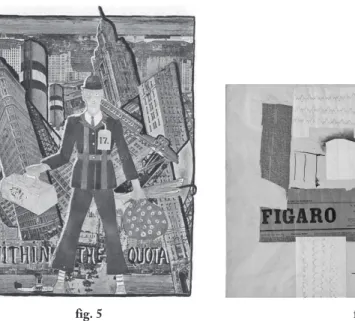
Among the theatrical influences that Dos Passos embraced during the 1920s, Within the Quota, a 1923 ballet set to a score composed by Cole Porter, made a significant impact on the writer. It was Gerald Murphy, friend of Dos Passos’s and son of Patrick Murphy who established New York luxury leather-goods store Mark Cross, that took charge of costume and stage designs for the piece.5Gerald and Sara Murphy were a wealthy American couple living in France from 1921 to 1933. They shared a profound interest in art, literature, and music. Gerald Murphy took painting seriously for about a decade with considerable accomplishment, and his mentor Natalia Goncharova, costume and stage set designer for the Ballet Russ of Sergei Diaghilev, introduced the couple to European avant-garde artists. Their Paris apartment and a house in Antibes called “the Villa America” welcomed many European and expatriate American artists. Pablo Picasso, Fernand Léger, and Igor Stravinsky often visited them as were Scott and Zelda Fitzgerald, Ernest Hemingway, and Archibald MacLeish among their guests.
By way of Léger, Murphy was commissioned by a Swedish ballet company to create a piece on an American theme and recommended Cole Porter, his Yale friend, to write the score (Tomkins
41). He subsequently wrote the scenes and designed the costumes and sets for the ballet, which became Within the Quota. The piece was written in the spirit of celebrating American democracy in response to the Restrictive Immigration Act of 1921, which precedes the infamous act of 1924 that marked surging xenophobia in the United States. In the play, a Swedish immigrant ventures around New York City, while becoming mixed up with various urban characters who embody America’s cultural diversity.
Dos Passos saw the work which premiered in Paris on October 25, 1923 at the Théâtre des Champs-Elysées. The souvenir program Murphy designed is a collage work. It features cut-outs of landmark buildings in New York City and the upper portion of an ocean liner, which presumably brought him from Europe, against a Manhattan skyline and a painting of the play’s protagonist in the center [fig. 5]. While the initial impact of Cubism had subsided by the time Murphy arrived in France, the assemblage of various materials in a single work exemplified the crashing repercussions of a modern metropolis.
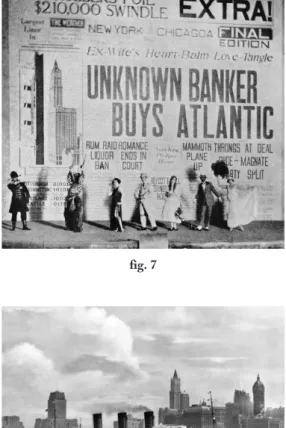
Above all, Dos Passos was impressed by a different backdrop design that mimics a yellow journalism frontpage. A newspaper page, by definition, is a collage of news items. Newspaper clippings too were often adopted by Cubists to set up juxtapositions in their paintings. Art critic William Rubin even concluded that “all newspaper layout is inherently Cubist” (29) [fig. 6]. Murphy acknowledged that his design was “not Cubism, but its composition was inspired by Cubism” (Rubin 29). Nonetheless, it was a stroke of genius to manifest a similar feeling in a theater backdrop.
While not directly connected to the storyline, the backdrop’s motifs capture the histrionics of American society in the 1920’s [fig. 7]. On the left a composite image of the skyscraping
Woolworth Building and French ocean liner SS Paris stacked up against each other vertically symbolizes the towering aspirations of American capitalism. Since 1913 the Woolworth Building, financed by the five-and-dime millionaire, was the tallest building in the world next only to the Eiffel Tower until the construction of the Chrysler building in 1930.6
Likewise, SS Paris was one of the largest and most luxurious ocean liners in the period that carried thousands of passengers across the Atlantic Ocean. Together these monuments invoked the lofty aspirations for prosperity in the United States [fig. 8].
The headlines are mostly nonsensical hyperboles, caricatures of yellow journalism. Apparently, Murphy enjoyed conjuring them: “Rum Raid Liquor Ban,” “Romance Ends in Court,” “Mammoth Plane up,” “Throngs at deal shoe-magnate dirty split” ——and if we read it horizontally, it would make these lines read alternatively, “Rum Raid Romance” and “Mammoth Throngs at Deal” which further inflate the chaos captured by these lines. The most striking one is the line in bold: “Unknown Banker Buys Atlantic.” The mock caption cites an impossible fact, but the hubris alluded to here whereby American money can buy anything, even an ocean, must have struck a timely chord.
These elements resemble those in Dos Passos’s experimental novels, Manhattan Transfer and the U.S.A. Trilogy, as Ludington observes (226). And as the Rubin noted, Murphy “tongue in cheek, told gullible reporters, it was ‘a composition of 250 American newspapers that I have studied... The object is to get the quintessence of Americanism out of its newspapers’” (Rubin 29). Indeed, that is exactly what Dos Passos did for the Trilogy: he inserted headlines culled from countless newspapers to set the scene for his American chronicle. The first “Newsreel” section of The 42nd Parallel is composed of several excerpts from various news articles set in different 6 The New York Times reported the Chrysler Building’s opening on April 24, 1913 and the New York Historical Society celebrated the building’s 100thanniversary in 2013.
fig. 8 fig. 7
typefaces [fig. 9]. This section represents turn-of-the-century America, whereby the first several lines in verse glorify US soldiers in Cuba fighting the Spanish-American War; the next line all in capital letters announces the end of the 19th century for New York City; and the next few paragraphs give more detailed war-correspondence equally celebrating the valor of soldiers, followed again by verse and news of political scandal. The total effect of juxtaposing different sources was exaltation of the war coupled with the end of one era, inevitably leading to the opening of a new century. It captures the “quintessence” of America on the verge of the Twentieth Century, as Murphy’s backdrop did for the Jazz Age.
If Murphy brought Cubism to ballet,
Dos Passos did the same for literature. While sources other than this backdrop can be attributed as inspiration for Dos Passos’s narrative innovations, Gerald Murphy, as one of the brilliant modernist painters, deserves credit for the formation of the Newsreel section of the Trilogy.
“Living Newspaper,” a genre of Soviet revolutionary theater that began in 1919 as a platform to act out pro-Soviet news for illiterate soldiers, is another theatrical inspiration Dos Passos embraced while in Moscow in 1928. Ludington writes:
while films had been what he had seen most of, he admired the popular theaters, located in workers’ clubs and unions. There the workers themselves half-improvised short plays, calling them Living Newspapers. The acting was always good, and the plays were intriguing (Ludington 270).7
Mikhail Pustynin, a poet and theater director, started the Terevsat, Theatre of Revolutionary Satire, to advocate revolutionary ideas through dramatization (Casson 108). The Terevsat performed in Moscow in 1920 and other troupes organized similar performances. A company called “Blue Blouse” formed, featuring actors in blue blouses to display their solidarity with factory workers, causing a domino effect of groups across the Soviet Union [fig. 10].8
Blue Blouse’s Living 7 “Chronology” also notes: “impressed by ‘Living Newspaper,’ improvisational plays performed in workers’ clubs and unions” (849).
8 See “Soviet Agitprop Theater Blue Blouse” for stage photos.
Newspapers developed an amalgamated theatrical formula, which Soviet futurist poet Vladimir Mayakovski, theater director Vladimir Meyerhold, and Sergei Eisenstein, a then theater director and later filmmaker, were behind.
During the 1920s, “Living Newspaper” gained enormous popularity as agitprop theater (Casson 108).9
In 1921 Mayakovski wrote his own Living Newspaper that was performed in Moscow. Meyerhold, too, wrote the play Give Us Europe in 1925 in the manner of Living Newspaper (Stourac and McCreery 15). The filmmaker Eisenstein who became a part of the Proletkult Theatre, the Theatre of the People, in 1920 and soon became its co-director, and was one of Meyerhold’s assistants around 1922. Stourac and McCreery assess what Eisenstein gained from the experience as a fundamental inspiration for his later achievement: “The brief period in which he worked in the theatre coincided with...the return to the popular arts of circus and music hall. Most productions were adaptations of novels, scenarios or a conglomerate of a number of texts, coming close to literary montage” (21). In 1923 Eisenstein directed The Wise Man and was praised by a Blue Blouse official magazine: “[t]he talented Eisenstein, one of the first, gave an example of theatricized living newspaper with the so-called ‘montage of attractions’ in his agit-buffonade The Wise Man” (Blue Blouse, 1925; quoted by Stourac and McCreery 21).10
Richard Stourac and Kathleen McCreery further analyze the director’s feat:
The Wise Man represented a breakthrough in the development of the dramatic montage technique, however rudimentary when compared to Eisenstein’s later achievement in film. Among those influenced by it were the Blue Blouse who took the approach to montage as a model for their own work. (Stourac and McCreery 22)
It is Russia’s Living Newspaper theater that served as a generative matrix for the montage technique which would later evolve in filmmaking. The impact on Dos Passos from his exposure in Moscow theaters, therefore, should not be underestimated, even as the montage technique in film is often discussed as a major influence on Dos Passos’s own montage/collage narrative techniques.11
9 Mike Gold visited Moscow in 1925 and writes on the Russian revolutionary theater for The Nation magazine with much enthusiasm, which Dos Passos seemed to share a few years later: “These theaters have broken up the stiffness, the drawing-room stuffiness, the parliamentary talkiness of the old stage. Acrobatic actors race up and down a dozen planes of action. The drawing-room play has been thrown on the junk-pile of history. Things happen ——broad, bold, physical things, as in the workers’ lives. There are danger and the feel of elementals. Music and dancing and the circus have been brought ack on the stage” (536).
10 The term “montage” is used here as a synonym of “collage,” signifying an assemblage of various materials.
Since Living Newspaper theater was a direct descendent of Eisenstein’s montage-like theater production, we can fairly assess Living Newspaper as one of the driving forces behind the novelist’s innovative narrative techniques.
Besides its overwhelming popularity and predominance in Russia that Dos Passos so coveted, Living Newspaper demonstrated an attractive mixture of popular performance, such as vaudeville, the circus, musical shows, with a serious social message,
which Dos Passos himself experimented with in his plays [fig. 11]. Deák summarizes the writer’s characteristic mode: his plays were “mainly based on actual socio-political events presented in a manner designed to interest and amuse a large audience. The performance...opened with a parade in which the whole company was presented on stage, and the parade was followed, at a brisk tempo, by a montage of ten to fifteen different numbers (attractions) using various forms and techniques...such as dramatic forms, film, dance and gymnastics” (37-38). With such a variety of elements pieced together, the enormous popularity and achievement of these performances no doubt impressed Dos Passos, whose own attempt to combine a social message with jazz tunes in The Garbage Man saw only limited success before a small audience.
The accomplishments of Living Newspaper, I argue, affected Dos Passos like Murphy’s backdrop by further enhancing his experimentation with montage/collage in The Garbage Man and Manhattan Transfer, for the Trilogy. After Dos Passos’s stay in Moscow, he returned to the United States at the end of 1928, only to witness the failure of his play, Airways, Inc., and announce his resignation from New Playwrights Theatre. His enthusiasm for the montage technique, however, survived the fiasco, by helping him develop his innovative style in The 42nd Parallel and through the entirety of the U.S.A. Trilogy. If Murphy’s collage inspired the “Newsreel” section of the Trilogy, synthesis of the various modes of theater in Living Newspaper encouraged the intermixture of different narrative techniques throughout. “Newsreel” would mingle serious news 11 Eisenstein’s cinematic influence is often highlighted. For example, Ludington writes: while in Moscow “[w]ith Eisenstein he talked about the technique of montage much on his mind then as he struggled to incorporate it into his new novel” (Ludington 270). Iain Colley further quotes Dos Passos’s recollection that “[he] got interested in Eisenstein’s montage wile [he] was working on Manhattan Transfer” (Colley 62). Lisa Nanney as well as Michael Spindler, however, argue that Dos Passos cannot have seen any Eisenstein film during 1923 and 1924 when he was writing Manhattan Transfer, as it was only first released in 1925, and never was shown in America (Nanney 142). Therefore, while it is not clear exactly when Dos Passos acquainted himself with Eisenstein’s films, the impact of Russian revolutionary theater on Dos Passos in Moscow in 1928 marks a distinctive moment in the evolution of his narrative techniques.
with popular culture: fragments of headings in capital letters, passages from news stories, and lines from popular songs. Moreover, The 42nd Parallel is composed of four different narrative types [fig. 12]: “Newsreel” and “The Camera Eye,” are both numbered, though are in different styles; narratives about imagined characters bear their fictive names, such as in “MAC” or “JANEY”; and short biographies are distinctive for their typographical play, using italicized capital letters, as in “LOVER OF MANKIND” for the labor organizer and social leader Eugene Debs, or “THE PLANT WIZARD” for Luther Burbank, plant breeder and pioneer in agricultural science. While Living Newspaper aimed to attract a wide audience by integrating political propaganda and entertainment, Dos Passos attempted to recreate a comprehensive view of American society in the early twentieth century through a parade of variously constructed segments. Such a multi-dimensional narrative functions as mis-en-scène, enabling readers to reconstruct scenes with their imaginations almost like a corporeal experience in the theater.
When Dos Passos returns home from Moscow in 1928 and bids farewell to the New Playwrights Theatre soon after, there is no turning back for him. His leftist ardor gradually softened, enabling the writer to attain an appropriate aesthetic distance from his subject matter. Despite his yearning for corporeal expression of his imagination, it seems he had little interest in the casts of actors and whatever passion he had for an immediate audience could not surpass his aspiration as a novelist, whose solitary work he preferred to collective theater. In 1930 he published The 42nd Parallel to critical acclaim. Even as Three Plays was still to be published, his journey into revolutionary theater had all but ended. Yet, what survived of his flirtations with theater suffuses the U.S.A. Trilogy. The collage and montage techniques, and above all, Dos Passos’s audacious spirit to rebel against the traditional narrative form attest to his artistic mastery.
List of Figures
Figure 1. John Dos Passos, “Jazz Funeral,” Stage design for The Garbage Man. (Pizer, et al, Figure 31.) Figure 2. John Dos Passos, “Union Square,” Stage design for The Garbage Man. (Pizer, et al, Figure 33.) Figure 3. John Dos Passos, Stage design for Paul Sifton’s The Belt. (Pizer, et al, Figure 36.)
Figure 4. John Dos Passos, Opening text of “Camera Eye (1),” The 42nd Parallel, p. 13.
Figure 5. Gerald Murphy, Cover of souvenir program for Cole Porter’s Within the Quota. (Rubin, p. 26.) Figure 6. Pablo Picasso, “Bottle of Vieux Marc, Glass, Guitar and Newspaper,” 1913, collage, pen and ink
on blue paper, 46.7 × 62.5 cm. Tate, London. (https://www.tate.org.uk/art/artworks/picasso-bottle-of-vieux-marc-glass-guitar-and-newspaper-t00414. Accessed May 15, 2019.)
Figure 7. Gerald Murphy, Backdrop for Cole Porter’s Within the Quota. (Rubin, p. 28.)
Figure 8. Arthur Vitols, “French Line, S.S. ‘Paris’ Passing the Battery,” Oct. 5, 1938. Byron Company, New York. Museum of the City of New York Collections, 93.1.3.213.
(https://collections.mcny.org/Collection/ [French Line, S.S. \"Paris\" Passing the Battery.]-2F3XC58ZREUT.html. Accessed May 15, 2019.)
Figure 9. John Dos Passos, Opening text of “Newsreel I,” The 42nd Parallel, p. 11. Figure 10. “Propaganda and Agitation Team Blue Blouse.” Soviet Art: USSR Culture.
(https://soviet-art.ru/soviet-agitprop-theater-blue-blouse/propaganda-and-agitation-team-blue-blouse/. Accessed Sept. 25, 2019.)
Figure 11. “A Scene from the Performance of the Soviet Agitprop Theater Blue Blouse, 1927.” Soviet Art: USSR Culture. (https://soviet-art.ru/soviet-agitprop-theater-blue-blouse/. Accessed Sept. 25, 2019.) Figure 12. John Dos Passos, “Table of Contents,” The 42nd Parallel, p. 7.
Works Cited
Biet, Christian and Christophe Triau. What Is Theatre? 2006. Trans. Jason Allen-Paisant, et al. Routledge, 2019.
Carr, Virginia Spencer. Dos Passos: A Life. Doubleday, 1984.
Casson, John W. “Living Newspaper: Theatre and Therapy.” The Drama Review, vol. 44, no. 2, Summer 2000, pp. 107-22. Rpt. with photographs, pp. 1-21.
“Chronology.” Dos Passos, Novels 1920-1925, pp. 841-58.
Colley, Iain. Dos Passos and the Fiction of Despair. Macmillan, 1978.
Deák, František. “Blue Blouse, 1923-1928.” The Drama Review, vol. 17, no. 1, 1973, pp. 35-46. Dos Passos, John. “Did the New Playwrights Theatre Fail?” New Masses, Aug. 1929, p. 13. ――. The 42nd Parallel. Dos Passos. U.S.A., pp. 5-356.
――. Manhattan Transfer. Dos Passos, Novels 1920-1925, pp. 477-837. ――. Novels 1920-1925, Library of America, 2003.
――. One Man’s Initiation. 1920. Dos Passos, Novels 1920-1925, pp. 1-85. ――. “They Want Ritzy Art.” New Masses. June 1928, p. 8.
――. Streets of Night. Doran, 1923. Popular Library, 1962.
――. Three Soldiers. 1921. Dos Passos, Novels 1920-1925, pp. 87-476.
――. Three Plays. Harcourt, 1934. Rept. of The Works of John Dos Passos. Hon-no Tomosha, vol. 17, 1991. ――. “Towards a Revolutionary Theatre.” New Masses. Dec. 1927, p. 20.
――. “What Makes a Novelist.” National Review, Jan. 16, 1968, pp. 29-32.
Downer, Alan. S. “Book Review: Dos Passos and ‘The Revolting Playwrights’” by George A. Knox and Herbert M. Stahl, Arden, 1964. American Literature, vol. 37, no. 4, Jan. 1966, pp. 505-06.
“55-Story Building Opens on a Flash; Woolworth Skyscraper Lights Up and Big Dinner Starts on Signal from White House.” The New York Times. Apr. 25, 1913, p. 2.
https://www.nytimes.com/1913/04/25/archives/55story-building-opens-on-a-flash-woolworth-skyscraper-lights-up.html?searchResultPosition=174. Accessed Sept. 15, 2019.
Gold, Michael. “Theater and Revolution.” The Nation, Nov. 11, 1925, pp. 536-37. “Happy 100th Anniversary, Woolworth Building!” New York Historical Society.
http://blog.nyhistory.org/100th-anniversary-woolworth-building/. Accessed Sept. 15, 2019.
Knox, George A. and Herbert M. Stahl. Dos Passos and “The Revolting Playwrights.” Essays and Studies on American Language and Literature. Ed. By S. B. Liljegren. 1964. Arden, 1979.
Ludington, Townsend. John Dos Passos: A Twentieth-Century Odyssey. Carroll, 1998. Mally, Lynn. Revolutionary Act. Cornell UP, 2016.
Misugi, Keiko. “Jimmy Herf’s Yearning for Corporeality in Manhattan Transfer.” Kobe College Studies, vol. 65, no. 2, 2018, pp. 25-40.
――. “John Dos Passos’s Early War Novels and the Question of ‘Manliness.’” Kobe College Studies, vol. 60, no. 1, 2013, pp. 125-40.
Nanney, Lisa. John Dos Passos Revisited. Twayne, 1998.
Pizer, Donald, et al., eds. The Paintings and Drawings of John Dos Passos: A Collection and Study. Clemson UP, 2016.
Rubin, William. The Paintings of Gerald Murphy. The Museum of Modern Art, 1974. “Soviet Agitprop Theater Blue Blouse.” Soviet Art: USSR Culture.
https://soviet-art.ru/soviet-agitprop-theater-blue-blouse/" \t "_blank. Accessed Sept. 25, 2019.
Spindler, Michael. “John Dos Passos and the Visual Arts.” Journal of American Studies, vol. 15, no. 3, 1981, pp. 391-405.
Stourac, Richard and Kathleen McCreery. Theatre as a Weapon: Workers’ Theatre in the Soviet Union, Germany
and Britain, 1917-1934. Routledge, 1986.
Tomkins, Calvin. Living Well Is the Best Revenge. 1971. The Museum of Modern Art, 2013.