1)神戸常盤大学保健科学部医療検査学科(ライフサイエンス研究センター) 2)神戸大学医学部附属病院医療情報部 3)神戸大学人文科学研究科 4)新潟大学工学部福祉人間工学科 5)神戸大学大学院医学研究科外科系講座形成外科学分野 6)神戸大学大学院医学研究科外科系講座麻酔科学分野 7)神戸大学医学部附属病院漢方内科 §)Corresponding author
*These authors contributed equally to this work.
Summary
In this study we developed learning material of acupuncture - acupoints and meridians - for visually impaired people. For this learning material, we used ontology to construct the relations between the concepts in the acupuncture and moxibustion field which also enables tactical understanding similarly as visual understanding. We then used our learning material in the acupuncture lecture for visually impaired students, and quantitatively analyzed its efficacy to compare the results with the group which did not use the learning material. As a result, the students, who used our learning material, scored significantly higher in the examination than the students of non-use group (P < 0.001), suggesting that our learning material was effective for learning of acupuncture theory.
Key words : visually impaired people, ontology, Braille, acupuncture and moxibustion
要 旨
我々は視覚障害者向けの鍼灸、特に経絡と経穴に関する教育材料の研究に取り組んだ。この教材では、鍼灸 分野における概念間の関係の体系的な理解を可能にすべく、オントロジーを用いた。オントロジーの概念図に
原著
Effectiveness of ontology-based learning material of
acupuncture and moxibustion for visually impaired people
Aki SUGANO
1),2)*, Tsuyoshi ODA
2)*, Mika OHTA
1),2), Minoru KUMAOKA
1),2),
Shinichi KITA
3), Tetsuya WATANABE
4), Akihiro ICHINOSE
5), Yumiko TAKAO
6),
Eiichi MAEDA
2), Takashi NISHIMOTO
7), and Yutaka TAKAOKA
1),2),§視覚障害者への鍼灸教育におけるオントロジーベース教材
の有効性
菅野 亜紀
1),2)*小田 剛
2)*大田 美香
1),2)熊岡 穣
1),2)喜多 伸一
3)渡辺 哲也
4)一瀬 晃洋
5)高雄由美子
6)1. Introduction
Acupuncture and moxibustion have long been a career for the independence of visually impaired people and it has been a part of public policy in Japan since 17th century1). In fact, vocational education to acquire qualification of practitioner in acupuncture and moxibustion, massage practitioner and acupressure therapist2) is carried out for the visually impaired (completely blind or partially-sighted) people in such educational facilities as special schools for congenital blind people and the National Rehabilitation Centers for Persons with Disabilities for people who acquired vision loss in their lives. In these facilities teachers consider the visual handicaps when providing education and attempt to develop more effective methods. However they only use the learning material for the sighted students which is then translated in Braille, in the lessons of Oriental medicine theory. In the standard textbooks of Oriental medicine theory to educate visually impaired people in Japan, we can only find text, namely braille for visually impaired people3)4). This situation makes it difficult for the students with visual impairment to understand the theory of Oriental medicine, because it requires logical and systematic comprehension.
Most of the previous studies on education for acupuncture and moxibustion field discussed clinical training of acupuncture manipulation techniques and procedures, or focused on the educational system. In addition, those studies usually intended the sighted students as learners. Some studies intended visually impaired students, but they were survey studies5)~7) or reports of the use and the efficacy of tactile graphics or physical simulation model to understand physical ones such as microorganisms and human body and its vital signs8)9). There is no study for teaching methodology or learning material for visually impaired students that would assist logical and systematic comprehension.
Ontology is a fundamental method of knowledge processing to formalize and systematize concepts and background information, and the relations between them10). Ontology describes concepts in a specific domain by means of the relation between their meanings and other concepts. The concepts are formulated by adding specific instances, properties, hyponymy relations, and part-whole relations to the corresponding terms. The ontology is then constructed by using is-a relations and/or part-of relations of the concepts. Is-a relations represent super-sub relations as in the example “a dog is a mammal.” Part-of relations represent part-whole relations such as “fingers are part of a hand.” The ontology thus describes, in a systematic fashion, the information known about the domain to which the concepts belong11). Ontologies in various fields have been reported. For example, the REA (Resource-Event-Agent) よりオントロジー教材を作成し、これを鍼灸の講義で使用した群とオントロジー教材未使用群とで経絡・経穴 の試験の結果を比較し、その有効性を解析した。その結果、オントロジー教材を使用した学生の経絡・経穴の 試験の得点は、オントロジー教材未使用群の学生の得点よりも有意(P < 0.001)に高く、経絡と経穴の学習 にオントロジー教材が有効である事が明らかになった。この結果は、オントロジーの視覚障害者教育への利用 が視覚障害者の鍼灸理論の学習へも有効であることを示唆している。 キーワード:視覚障害者、オントロジー、点字、鍼灸
Enterprise Ontology for economic phenomena12), the W3C Food Ontology for food descriptions13) and the Gene Ontology for gene function14). In the field of education, K-12 educational ontology15), ontology for profession theory, and Smarties educational scenario authoring tool in OMNIBUS project16) have been reported. In medicine, Medical Ontology has been reported17). In the field of Oriental medicine, Japan Society of Oriental Medicine started to construct an ontology of Kampo domain including crude drugs of Chinese herbs and a Unified Traditional Chinese Medical Language System (UTCMLS)18) is being developed in China.
Ontology describes concepts and the relations between them by using tree diagram. We then hypothesized that ontology-based learning materials could be useful for learning the theory that requires logical and systematic comprehension and that it could be adapted for acupuncture and moxibustion theory. In this study we constructed ontology for the domain of acupuncture and moxibustion and developed a material for visually impaired people to learn its theory. We especially focused on acupoints and meridians, that requires systematic comprehension and therefore is difficult subject to learn for them and examined the efficacy of our method to make such materials. The aim of study is to clarify the usefulness of ontology-based learning materials for logical and systematic comprehension.
2. Methods
2.1 Methodology for ontology construction
From among the three methodologies available for ontology construction - TOVE, Enterprise Model Approach, and METHONTOLOGY - we chose METHONTOLOGY for developing our Kampo ontology because it is appropriate for academic use and is easy to modify or implement after construction19). Specifically, we constructed the ontology in the following order: (i) specification, (ii) conceptualization, (iii) formalization, (iv) integration, and (v) implementation.
2.2 Specification and Conceptualization of terminology of acupuncture and moxibustion
First, we extracted terms of acupuncture and moxibustion from textbooks of acupuncture and moxibustion that are used in National Kobe Rehabilitation Center for the Visually Disabled: “Basic theory of acupuncture and physical therapy I (fundamental theory of Oriental medicine)”3) and “Basic theory of acupuncture and physical therapy II (Outline of acupoints and meridians)”4).
After we extracted the terms, we manually determined the corresponding concepts, which are the meanings of the terms, by using the texts in the source books from which the terms were extracted. We assigned the same concept to synonyms, which are different terms with an identical meaning. We prepared multiple concepts for a single polysemic term.
2.3. Definition sentences for concepts and assignment of attributes (Formalization)
After determination of the concepts, we prepared a definition sentence for each concept. We built the definition sentences and assigned the attributes to the concepts on the basis of the texts in the source
books. Attributes are constituent elements of a concept that conceptualize the nature of the concept10). Attributes are inherited according to hyponym relations between concepts, and a specific value is set at the hyponym. For example, the concept “meridian vessel” has attributes such as relevant viscera and bowels and anatomical sites where the meridian runs along the human body. Its hyponym “lung meridian” has “lung” as a value for viscera and bowels and “anterolateral of the arm” as a value for anatomical sites. For relations of the concepts, we used the is-a relation and the part-of relation for hyponymy relations and part-whole relations, respectively.
2.4 Integration and implementation of ontology
After specification, conceptualization and formalization, we constructed ontology which consists of 22 education items according to the Guideline for Education of Acupuncture and Moxibustion which is issued by the Ministry of Health, Labour and Welfare, Japan. Our ontology was implemented on a PC (Intel Core 2 Duo, 2.5 GHz, Windows XP Professional Edition SP3, 4 GB RAM, 250 GB HDD) by using Hozo ontology editor20).
2.5 Development and use of ontology-based learning material of acupuncture and moxibustion for visually impaired people
We developed learning materials from our ontology as follows: Four education items - Classification of meridians, four confluence points and lower sea points of the six bowels, eight meeting points and confluence points of the eight vessels, and alarm points and transport points - were selected from our ontology for the learning materials in the scheduled lecture in National Kobe Rehabilitation Center for the Visually Disabled. Then the selected parts of the ontology were printed out in tactile Braille and in embossed figures so that the visually impaired students could gain the same comprehension as visual comprehension by tactile perception (Figure 1) by using special paper and a tactile graphics embosser (YMT-1, Chiyoda denki kogyo Co., Ltd., Nagano, Japan). We also printed ordinary characters or Kana and Chinese characters on the same sheets for the students who wished to read by using residual vision.
Figure 1. Our ontology-based learning material.
2.6 Lectures of acupoints and meridians by using ontology-based learning material
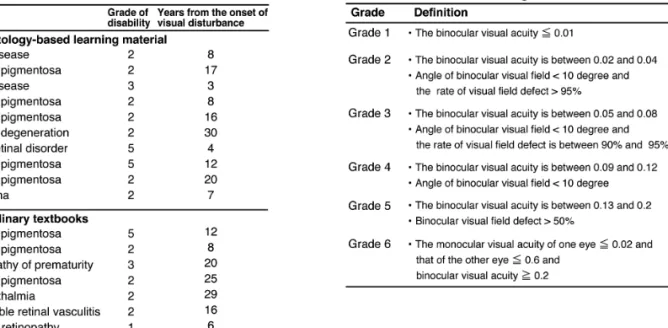
We then used this learning material in the lectures of acupoints and meridians in order to examine its efficacy. Total of 17 students of National Kobe Rehabilitation Center for the Visually Disabled (15
males and 2 females; age 38.71±12.92 years; range 19-59) were enrolled in our experiment (Table 1, 2). First, these students were grouped into two groups according to everyday class at school: 10 students using ontology-based learning material for a certain period of time and 7 students using only ordinary textbooks in Braille.
Lectures and total 4 examinations were carried out in the time course as shown in Figure 2. The style of each lecture of total 45 minutes was repetitive learning, which consisted of the first 25 minutes and the last 20 minutes for the same contents in the
f i r s t h a l f . E a c h e x a m i n a t i o n c o n s i s t e d o f 20 questions. Students were asked to select the correct name of meridian or acupuncture point from 4 choices in each question (Table 3). Question sets were different for every examination. In the lectures before the first, second and 3rd examinations, we used only the ordinary textbooks for both groups to a n a l y z e t h e d i f f e r e n c e o f t h e b a s i c a c a d e m i c achievement between the two groups. After the 3rd examination, we used our ontology-based material in the total 8 lectures in consecutive 4 weeks for the group with ontology-based learning material as follows: ordinary textbooks in the first 25 minutes and our learning material in the last 20 minutes for the same contents in the first half. As for the other group, we continued the same repetitive lecture using the ordinary textbooks only.
We then compared the scores of total 4 examinations for both groups to analyze the students’ proficiency
Table 1. Condition of the students Table 2. Definition of the grade of visual disturbance
Figure 2. Lectures and examinations carried out in this study.
of acupoints and meridians and the effect of ontology-based learning material by statistical analysis. We also analyzed the effect of ontology-based learning material by the questionnaire for the change of learning motivation of the students and the relative change of the time for independent learning during our experiment.
Students in the group with ontology-based learning material were announced after the 3rd examination that they would use ontology-based learning material for 4 weeks and the take the 4th examination. The other group was not announced about ontology-based learning material during the experiment. In addition, both groups were not announced that they would use different materials until the last examination was finished. This study was performed according to the Basic Act for Persons with Disabilities (Japan Ministry of Health, Labor and Welfare). All students who participated in this study were given informed consent for inclusion in the study. The students' personal information was kept confidential to prevent any potential difficulties.
2.7 Statistical analysis
Statistical analyses were performed with the R software21). Differences in the test scores were tested by ANOVA with Tukey post-hoc tests. Data are presented as the mean ± s.d. A p value <0.05 was regarded as significant.
3. Results
3.1 Extraction of terms for theoretical knowledge, determination of concepts, and formulation of definition sentences
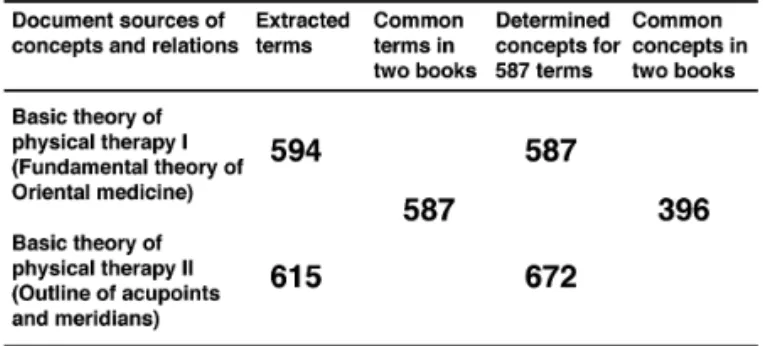
For the ontology construction, we extracted 594 terms from “Basic theory of acupuncture and physical therapy I (fundamental theory of Oriental medicine)” and 615 terms from “Basic theory of acupuncture and physical therapy II (Outline of acupoints and meridians)”. We then selected 587 terms and determined corresponding 587 concepts from ”Basic theory of acupuncture and physical therapy I (fundamental theory of Oriental medicine)” and 672 concepts from “Basic theory of physical therapy II (Outline of acupoints and meridians)” (Table 4). We then created definition sentences and attributes of the concepts that were based on these source books. As a result, we found no contradiction in the definition sentences between the two source books. We then constructed the ontology by using 396 concepts that are common in both books.
Table 4. Document sources, number of extracted terms, and number of determined concepts.
3.2 Characteristics of our ontology
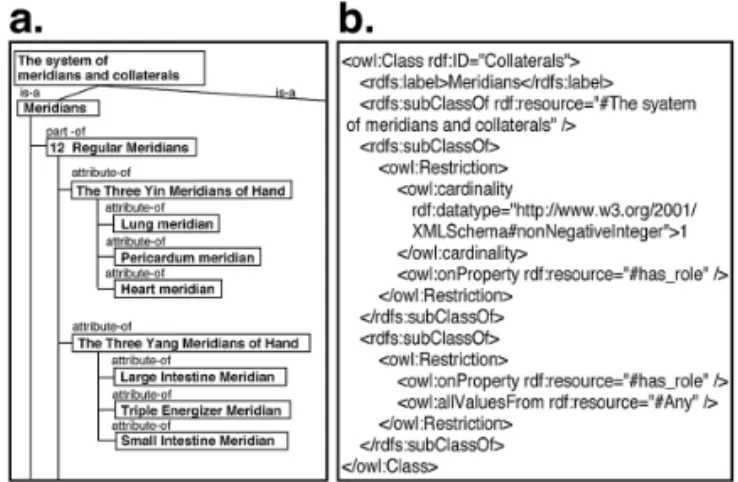
Figure 3 shows our ontology. Since the two source books are based on the Guideline for Education of Acupuncture and Moxibustion, our ontology has 22 subtrees which correspond to the 22 education items in the Guideline: 14 items of acupoints according to location on the body surface and 8 items according to meridians in which acupoints are grouped based on Oriental Medicine theory (Table 5).
T h e a t t r i b u t e s w h i c h w e a d d e d t o t h e concepts are as follows: meridians, classification of acupoints into five phase points and/or five transport points, and acupoint locations. Each concept of acupoints was defined as constituent o f m e r i d i a n s a n d w a s d e s c r i b e d a s p a r t - o f relations.
3.3 Effect of ontology-based learning material on learning achievement in acupoints and meridians
We compared the scores of the 4 examinations on acupuncture and meridians. As a result, no significant differences in the scores were observed between the two groups in each examination from the first to 3rd one, but in the 4th examination, before which we introduced our ontology-based learning material in the lectures, the group of students with our learning material scored significantly higher than the group with only ordinary textbooks (Figure 4) (P < 0.001). Comparisons among the 4 examinations in each group were as follows: in the group with our ontology-based learning material, the scores of the 4th examination were significantly higher than the scores of the first and 3rd examinations (P < 0.05 and P < 0.01, respectively) and the scores of the second examination was significantly higher than that of the 3rd one (P < 0.05) (Figure 4). No other significant differences of the scores were observed among the examinations. In the group with ordinary textbook, there were no significant differences among the examinations except the scores of the 4th examination which were significantly lower than that of the second examination (P < 0.01, data not shown).
Table 5. Classification of acupoints and meridians in the source books.
Figure 3. Part of tree view (a) and OWL representation of our ontology (b).
Figure 4. Learning effect of ontology-based learning material.
4. Discussion
In this study, we developed ontology-based learning material for the visually impaired people to clarify the effectiveness to utilize ontology in the education of acupuncture and moxibustion. Indeed our ontology-based material was introduced in the lecture of acupoints and meridians for visually impaired students and evaluated for its learning effects. As a result, no significant differences of the scores were observed between the two groups until the 3rd examination before which all the students studied with ordinary textbooks. However in the 4th examination, the scores of the group with ontology-based learning material was significantly higher than that of the other group. This significant difference may not be only based on the 4th lecture with the ontology-based learning material, but also the three consecutive lectures with the ordinary textbook. It may suggest that the students have learnt and memorized the terms for acupuncture and moxibustion first with the ordinary textbooks and then could understand the relations or hierarchical structure of the terms with the ontology-based learning material. Whatever the case, the result suggests that the addition of ontology-based learning material enhanced learning of acupuncture and moxibustion for the visually impaired students.
We then compared the scores among the 4 examinations in each group. The result showed some changes of the scores in each group (Figure 4). These changes may be caused by the different question sets among the examinations and therefore the degree of difficulty of each examination may have changed.
In our analysis of the examination scores that we compared the 3rd and 4th examination of acupuncture and meridians, we found that 6 out of 17 students gained their scores by more than 20 points. What the 6 students have in common was that they used our ontology-based learning material and commented in our questionnaire that they were motivated by our ontology-based material and so willing to learn independently. There was a significant difference in the increase of the scores of the 4th examination between the 6 students with 20 points up (24.1±8.0) and the other 4 students (5.0±10.8) out
of total 10 students in the group with our ontology-based learning material (P < 0.05, data not shown). The undeniable possibility is that the increases of their independent learning time could be one of the reasons why the 6 students had the score improvements. We investigated the relative increases of such time in 5 levels in comparisons between before and after the use of the ontology-based learning material: the levels are learned “very much” for 5 and “a little”, “not so much”, “no”, “not at all” in descending order. The result of our questionnaire showed that 7 out of 10 students in our ontology-based learning material group, which includes the 6 students, stated that their independent learning time was relatively increased in the level 5 and 2 students stated the level 4. The 10th student stated the level 3 that means the independent learning time was not so much changed. However, in the comparison between the 3rd and 4th examination, one out of the 7 students with the level 5 scored 10 points lower, that is from 100 to 90 points and the one student with the level 3 scored 10 points higher, that is from 90 to 100 points. Although their answers are subjective and the data are not the specific number of hours, this result of our questionnaire suggest that the significant difference of the scores in the 4th examination between the ontology-based learning group and the ordinary textbook group is not simply due to the increased independent learning time, but the fact that our ontology-based learning material developed more detailed understanding of the students toward acupoints and meridians. The limitation of our experiment was the bias that may have caused by the teacher because the teacher inevitably knew the use of our ontology-based learning material.
Our questionnaire also asked free comments on our ontology-based learning material to the students of both two groups. The group with ordinary textbook was given the materials after the 4th examination to touch and asked the impression on the materials. All of the students commented favourably except 3 students who commented nothing in particular. Specifically, the students with ontology-based learning material stated that the novel learning material with tree diagram of ontology was the reason for the improvement of learning motivation (Table 6). This suggests that the academic development can be caused by the change of learning method from memorization-only study to the ones that allow understanding of a logical system as a structure. Our method to use ontology-based material seemed to work effectively because it used Braille and tactile diagrams to achieve tactile understanding as well as visual understanding.
Table 6. Comments from the students
our material. Indeed Sashima reported the relation between suitable contrast of learning materials for the visually impaired people and learning efficiency. They report that the lower contrast sensitivity of the visually impaired people decreases their eyesight and leaning efficiency22). This points out improvement point of our learning material. There was another comment from a student that ontology-based learning material could be applied to other subjects such as anatomy. Some students in National Kobe Rehabilitation Center for the Visually Disabled engaged voluntarily in the development of other ontology-based learning material after our experiments.
In conclusion, our ontology-based leaning material of acupuncture and moxibustion was demonstrated to be effective for the education of visually impaired people. We would like to offer optimal learning materials for people with acquired vision loss according to their symptoms and severity of defect in vision, and continue to develop effective learning materials.
Acknowledgments
The authors thank the visually impaired students in National Kobe Rehabilitation Center for the Visually Disabled for their cooperation of the evaluation of our learning material. The authors also thank Professor Hitoshi Yamashita, L.Ac., Ph.D. (Morinomiya University of Medical Sciences, Osaka 559-8611, Japan) for his helpful comments. This work was partly supported by the Strategic Information and Communications R&D Promotion Programme (SCOPE) (No. 101707012) of the Ministry of Internal Affairs and Communications, Japan, a Grant-in-Aid for Encouragement of Scientists (grant number 23911026), a Grant-in-Aid for Scientific Research (C) (grant number 21592692), a Grant-in-Aid for Scientific Research (C) (grant number 23593135), and a Grant-in-Aid for Encouragement of Scientists (grant number 20921005) from the Japan Society for the Promotion of Science; and a Grant-in-Aid for Young Scientists (B) (grant number 21790497) from the Japan Ministry of Education, Culture, Sports, Science and Technology.
References
1) Kato, Y. Research on social history of the visually disabled in Japan, 2nd edition, Mirai-sha publishers, Tokyo, 1974, pp.455-465. (In Japanese)
2) Kagawa, K.; Inohira, M.; Oouchi, S; Mutaguchi, T. Introduction of Education for children with visual impairments, ed. Kagawa, K., Keio University Press, Tokyo, 2005, pp.234-239. (In Japanese) 3) Oriens research society: Basic theory of acupuncture and physical therapy I (Fundamental theory of
Oriental medicine), ed. Editing committee for textbooks of acupuncture and physical therapy for school for visually impaired, Okayama Lighthouse, Okayama, 1993. (In Japanese)
4) Osaka city special support school for visually disabled: Basic theory of acupuncture and physical therapy II (Outline of acupoints and meridians), ed. Editing committee for textbooks of acupuncture and physical therapy for school for visually impaired, Nippon Lighthouse, Osaka, 2002. (In Japanese) 5) Kuroiwa, S.; Sashima, T. Status and tasks for the development of the self-made model and
three-dimensional teaching materials for the education of acupuncture and moxibustion in special schools for visually impaired people. Physical therapy research, 2009, Vol.31, No.1, pp.19-27. (In Japanese) 6) Kuroiwa, S. Survey on plans for research lesson and learning guidance for the education of
acupuncture and moxibustion in special schools for visually impaired people and our teaching practice of acupuncture and physical therapy. Physical therapy research, 2009, Vol.31, No.1, pp.61-73. (In Japanese)
7) Masuko, T. Current state of education of acupuncture and moxibustion in special schools for visually impaired people. Japanese Journal of Oriental Medicine, 2013, Vol.64 Suppl., No.4, pp.286. (In Japanese)
8) Ichiman, Y.; Tanitsu, T.; Ikemune, S. Microbiology education for visually impaired students by using the Photography. Journal of the Japan Society of Acupuncture and Moxibustion, 2011, Vol.61, No.3, pp.268. (In Japanese)
9) Ikemune, S.; Narushima, T.; Tojo, M.; Ohkoshi, N. Effect of training using a physical examination simulator on students with visual impairment. National University Corporation Tsukuba University of Technology Techno Report, 2013, Vol.20, No.2, pp.7-12. (In Japanese)
10) Mizoguchi, R. Introduction to ontological engineering. New generation computing, 2003, Vol.21, No.4, pp.365-384.
11) Baclawski, K.; Niu, T. Ontologies for Bioinformatics. The MIT Press, Cambridge, MA, 2005.
12) McCarthy, W.E.; Geerts, G. The ontological foundation of REA enterprise ontology. In Technical report, Michigan State University, 2000.
13) The World Wide Web Consortium. “W3C Food Ontology”. World Wide Web Consortium (W3C). http://www.w3.org/TR/2004/REC-owl-guide-20040210/food.rdf (9.5.2015)
14) Ashburner, M.; Ball, C.A.; Blake, J.A.; Botstein, D.; Butler, H.; Cherry, J.M.; Davis, A.P.; Dolinski, K.; Dwight, S.S.; Eppig, J.T.; Harris, M.A.; Hill, D.P.; Issel-Tarver, L.; Kasarskis, A.; Lewis, S.; Matese, J.C.; Richardson, J.E.; Ringwald, M.; Rubin, G.M.; Sherlock, G. Gene ontology: tool for the unification of biology. Nat Genet 2000, Vol. 25, pp. 25-29.
15) Askar, P.; Altun, A.; Kalinyazgan, K.; Pekince, S.S. “Using Ontology for Personalized E-learning in K-12 Education.” Handbook of Research on Human Performance and Instructional Technology, eds. Song, H. and Kidd, T.T. Information Science Publishing, Pennsylvania, 2010, pp.301-309.
16) Hayashi, Y.; Bourdeau, J.; Mizoguchi, R. Standard-compliant Scenario Building with Theoretical Justification in a Theory-aware Authoring Tool. in proceedings of The 13th International Conference on Artificial Intelligence in Education (AIED 2007), 2007, pp. 37-44.
17) Kozaki, K.; Kou, H.; Zhou, J.; Imai, T.; Ohe, K.; Mizoguchi, R. The Basic Ideas for Development of a Medical Ontology. The Japanese Society for Artificial Intelligence SIG-SWO-A802-09, 2008, pp.1-7. 18) Zhou, X.; Wu, Z.; Yin, A.; Wu, L.; Fan, W.; Zhang, R. Ontology development for unified traditional
Chinese medical language system. Artificial Intelligence in Medicine, 2004, Vol.32, No.1, pp.15-27. 19) Fernandez, M.; Gomez-Perez, A.; Juristo, N. “METHONTOLOGY: from ontological art towards
ontological engineering.” In AAAI97 Spring Symposium Series on Ontological Engineering, Stanford, CA, 1997, pp. 33-40.
20) Kozaki, K.; Kitamura, Y.; Ikeda, M.; Mizoguchi, R. An ontology editor in Hozo-Treatment of “role” and “relationship”. in proceedings of Pacific Asian Conference on Intelligent Systems 2001(PAIS2001), 2001, pp.256-264.
21) R Core Team: R: a language and environment for statistical computing. R Foundation for Statistical Computing, Vienna, 2013.
22) Sashima, T. Influence of illumination on read efficiency of children with reduced vision. Visual impairment education and mental research, 1987, Vol.5, No. 1-2, pp. 21-25. (In Japanese)