
Robust Spatial Subtraction Array with Independent Component Analysis for Speech Enhancement
4
0
0
全文
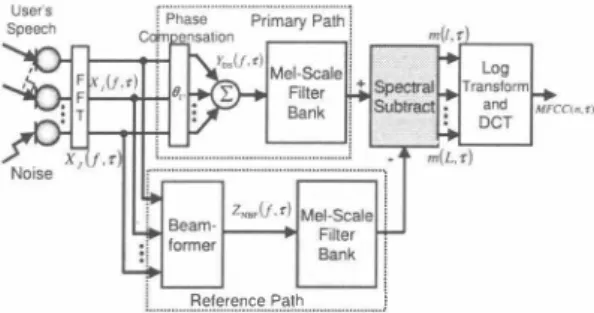
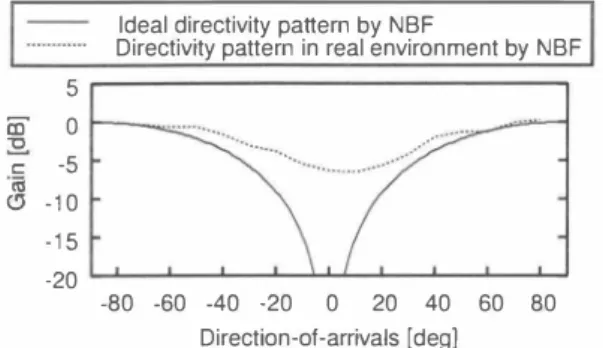
(2) /. where J is the number of microphones, is the仕equency bin and T is the frame number. Also, X(f, T) can be rewritten as X(f, T)=A(f) (S(f, T) + N(f, T)),. (2 ). S(f, T) = [0,...,0, S u(f, T), 0, ..., O]T,. (3). 、ーー、�. 、ーー、..--'. K-U. U-l. N(f, T) = [N1(f,T),..句NιJJ,T),0, NU+1 (f, T),..吟NKぴ: T)]T ,. = Wbs(f)A(f)Sぴ,吟+ Wbs(刀A(刀Nぴふ Wos(f) = [W�. os. o V),...,W; 釘(f)]T,. wfsトj以p(一阿/M)/sdj叫/c),. c. dj. (6). (7) M. 2.3. Noise estimation in reference path. In the reference path, we estimate the noise signal by using NBF. This procedure is given as ZNBF(f, T) WNBF(f). a(f,θ) aj(f,(}). W�BF (f)X(f,T),. T {[I,O]・[a(f,(}o), a(f,(}U)tl ,. (8) (9). [al (f,(}),...,aJ(f,(})]T,. (10). E叩. (11). (伽(f /M)λdj sin θ/c) ,. where ZNBF(f, T) is the estimated noise by NBF, WNBF(f) is a NBF-白It巴r coe飴cient vector which steers出e directional null in the direction of the DOA of the target speech, (}u, and steers unit g出n in the arbitrary direction (}o(* (}u). a(f,(}) is a steering vec tor which expresses phase information of the sound source arriv ing from the direction (}. Besides, M + denotes Moore-Penrose pseudo inverse matrix of M. This processing can suppress the target speech arriving from (}u, which is equal to an extraction of noises from sound mixtures if we take into account affec・ tions of sensor eπors and reverberations. Thus we can esti mate the noise signals by NBF under ideal conditions. Note that ZNBF(f, T) is the function of the frame number T, unlike the constant noise prototype estimated in the traditional spectral subtraction method [5]. Therefore, SSA can deal with a nonstatlOnary nOIse 2.4. Mel-scale fiIter bank岨alysis. SSA includes mel-scale filter bank analysis,加d outputs mel・ 合equency cepstrum coefficient (MFCC) [6] . The triangular win dow W mel (k;1) (1 = 1,"',L) to perform mel-scale filter bank analysis is designat巴d as follows:. 一点。(1) ( /一一一 |一 一一 (I)ーん(1) !c J Wmel(f,I)= ん(1) :_ f i| 一一一 一T, l ん(1) - !c(l). 切。(1)三/5.!c(l)), (Jc(l)三/5.ん(1)),. (12). where五0(1), /c(l), and ん(1) are the lower, center, and higher fre quency bins of each triangle window, respectively. They satisfy the relation among adjacent windows as !c(l) =ん(1-1)=ん(1 + 1).. !c(ハfs 1 (. - - - 51011 MelJC\' - --0 山 ,_, ハ) = 259 "、 <\ 1_ + 一二�� 700・MJ. (14). In SSA, noise reduction is c制百ed out by subtracting the estト mated noise power spec汀um仕om the partly enhanced target speech power spec町um in the mel-scale filter bank domain as. エ. m(l,T) =. (13). 1=1斤5ο(/). エ. (5). where Yos(/, T) is a primary-path output which slightly e凶ances the target speech, Wos(f) is a filter coe節cient vector of DS, is the DFT size, is sampling frequency, is a microphone伊 sition, and is sound velocity. Besides, (}u is a known direction of-arrival (DOA) of the target speech. In Eq目(5),the second term in the right-hand side expresses the rem釦ning noise in the output of the primary path.. /s. MeIJdl). 2.5. Noise reduction processing. (4). where Aげ) is a mixing matrix, S(f, T) is a target speech signal vector, N(f, T) is a noise signal vector, U expresses the target sþeech number, and K is the number of sound sources. Next, the target speech signal is partly enhanc巴d in advance by DS. This procedure can be given as YDS(f,T) = Wbs(刀X(f, T). Moreover, !c(ηis町anged in regular intervals on mel-frequency domain. Mel-scale frequency for !c(l) is calculated as. 1=11,ο(。. 肌W 凡mel(υ f川川川; 1刈川 刈) ){jY1 ( iげf IY1九'os(げ/,T竹寸)12. 一αa(l) • β.IZIゐNB肝F(f,T竹)12 主 0 ),. W仇凡m耐elιU仇;刈刈η川{付γ |陥YOω T川)1川|リ)(似o飢仙t山he問附1 則. (15) where m(l, T) is出e output from the mel-scale filter bank. The system switches in two equations depending on出e conditions in Eq. (15). m(l, T) is a function of the over-subtraction parameter βand the parameterα(1) which is determined during a speech break so that the resultant output m(l, T) is zero. On the other hand, if the power spectrum takes a negative value, m(l, T) is obtained by using f100ring processing, where y is the自ooring coefficient Since a common speech recognition is not so sensitive to phase information, SSA which is perfo口ning subtraction pro cessing in the power domain is more applicable to the speech recognition. Moreover, in general, the order of也e fiIter bank 1 is set to 24, and consequently SSA optiπl.Ìzes only 24 param 巴ters. On the other hand, GJ requires the adaptive leaming of FIR-filters of thousands or millions of taps. Finally, w巴perforrn mel-scale filter bank組alysis, log仕組sforrn and discrete cosin巴 transform to obtain恥1FCC for speech recognizer. 3. PROPOSED METHOD 3.1. Error robustness analysis for noise estimation by NBF. In this s氏tion, we discuss the problem of th巴 conventional SSA The NBF-based noise estimator is used in the conventional SSA, but NBF suffers from the adverse 巴ffect of the microphone el ement e汀or and the room reverberation. NBF is a technique to suppress an mt巴rf,巴rence source signal by g巴nerating a null against the direction of the interference source signal. If the in terference source signal arrives from the same direction as the null, we can suppress the interference source signal perfectly 1n a reverberant environment, however, the interference source signal arrives from not only the null's direction but also outside of the direction. Therefore, in the reverberant room, we can not suppress the interference source signal suffi ciently. In ad dition, a microphone element usually involves gain and phase E汀ors. NBF is designed under the ideal assumption that all el ements have the same characteristics. In the real environment, however, the characteristics of each element are di仔'erent. From the above-mentioned fact, the dir巴ctivity pattem shaped by NBF in the ideal environment is apa口from that of in the r巴al env汀on ment Figure 2 illustrates dir巴ctivity pattems which are shaped by two-element NBF in the ideal (solid line) and the real (dotted line) environment where the reverberation time is 200 ms. In this fig町e,白e n凶1 directio日is set to zero degree. We can see that the depth of the null in the real environment which cont創ns the element e汀or and the reverberation shallows. Therefore, we can not suppress the interference source signal completely in the real environment by using NBF. Indeed, in SSA, we perfoロn nOlse estimation via NBF which steers null against the target speech signal, but we c釦not suppress the t紅get speech signal suffi ciently. In fact, NBF cannot estimate noise signal completely. ハU 円〆白 円〆臼.
(3) : : : : 千 lF再. Ideal directivity pa世ern by NBF Directivity pattern in real environment by NBF 5 éiì u <:. 0 -5. 3-10. LO σ3. -15. -20. ‘ Microohones (Height: 1.5 m)。。. -80 -60 -40 -20 0 20 40 60 80 Direction-of-arrivals [deg]. Fig. 2. Directivity pattems shaped by NBF in ideal environment. and real environment which contains element 巴πor and reverber atlOn.. Fig. 4. Layout of reverberant room used in our experiment.. where μis the step-size paramete仁[p] is used to express the value of the p-th step in the iterations. and 1 is an identity ma trix. Besides. 0, denotes a time-averaging operator. MH de notes conjugate transpose of matrix M. and φ(・) is the appropri ate nonlinear vector function [1]. In the reference path. the t訂p get signal is not required because we want to estimate only the noise component. Accordingly w巴 remove the separated spe巴ch component Ou(j. r) from ICA outputs O(j. r). and construct the . following “noise-only vector. . Q(f. r);. Q(f.r) = [01抗r). ...• OU-I (f. r). O. OU+I (f. r). ...• O,(f.の]T. (19). Reference Path. Next. we apply th巴 pr句ection back (PB) [8] method to remove the ambiguity of amplitude. This procedure can be written as. Fig. 3. Block diagram of proposed method.. E(f. r). Thus the improvement of robustness in the noise estimator p紅t is a problem demanding prompt attention.. (20). Q(j. r ) is composed of only noise components. Therefore. E(j. r) is a good estimation of the received noise signals at the. We propose an improved SSA which includes ICA-based noise estimator instead of NBF-based noise estimator to address the problems which are discussed in the pr巴vious section. In the pro posed method. the primary path and noise r巴duction processing are the same as the conventional SSA. As for the reference path. we newly introduce ICA as a robust noise estimator for adapting the filters to the element error and the reverberation (see Fig. 3). In ICA. an unmixing matrix is optimized so that output signals become mutually independent only using observed signals. and a priori information about the sensors and the room acoustics is not required. Therefore the proposed method can reduce these adverse e仔"ects because ICA can estimate noise signals which in volve whole characteristics of the microphone elements and the reverberation. D巴tailed signal processing is shown below.. microphone positions;. E(f. r) "" A(j)N(j. r). Finally. we obtain the estimated noise signal forming DS as follows:. (21 ). ZICA(f. r) by per. ZICA(f. r) = WÒs(f)E(f. r) "" WÒs(f)A(f)N(f. r).. (22). Equation (22) is expected to be equal to the noise term ofEq. (5) in the primary path. Of course. Eq. (22) cont副ns estimation er rors to some extent. Even though th巴 level of the noise estimation E汀or is not negligible. we can still enhance the target speech via over-subtraction [5] in the power spectrum domain. 4. EXPERIMENTS AND RESULT. 3.3. ICA・based noise estimation in reference path. 4.1. Experimental setup. The proposed method includes ICA-based noise estimation. In ICA part. we perform signal separation using the complex valued unmixing matrix WrcA(j). so that the output signals O(j. r) = [01 (j. r). . . . .0,(f. rW become mutually independent; this pro cedure can be represented by. 4. Figure shows a layout of the reverberant room used in our ex periments. We use the following 16 kHz sampled signals as test data; the original speech convoluted with the impuls巴 responses recorded in the real environment. and added with a cleaner noise which was recored in th巴 real environment. The cleaner noise is not a point source but consists of several non-stationary noises emitted from. e.g., a motor. air duct and nozzle. Moreover the cleaner noise includes background nois巴 The input signaトto noise ratio (SNR) is set to 5. 10. or 15 dB at the array. A four 巴lement array with the int巴relement spacing of 2 cm is used. and DFT size is 512. Over-subtraction parameterβis 1.4 and fioor ing coe筒cient y is 0.2.. (16) (17). where P(f) is a permutation matrix and W(j) is a new unmixing matrix which resolves the permutation problem. The permuta tion matrix P(f) is determined by look.ing at null directions in the directivity pattem which is shaped by W1CA(f) [1]. so that the U-th output Ou(f. r) is set to the target speech signal. The optimal W1CA(f) is obtained by the following iterative updating equation [7]:. 4.2. Accuracy of estimated noise signal. First. we analyze the directivity pattem shaped by ICA in the real environment. Figure 5 depicts the directivity pattem of ICA (broken line) in the real environment. From this result, we can confirrn that the null shaped by ICA becomes deep compared with that of the NBF-based conventional SSA. Therefore, it is. WELll(刀=μ [1ー〈φ (O(f. r)) OH(f. r)>,1 W:広げ) +W:広(f).. W+(j)Q(f. r).. Here.. 3.2. Strategy of proposed method. 。(f. r) = W(f)X(f. r). W(j) = P(j)W1CA(j).. =. (18). 内/“ つ臼.
(4) Ideal directivity pattern by NBF Directivity pattern in real environment by NBF Directivity pa口ern in real environment by ICA. ,F 〆 A a A / ノ / ,, , 、 \ \ 、、 、、. 5 0 iiì -5 。 -10 -15 -20 て3 c: 冊. -80・60・40 -20 0 20 40 60 80. 1rable 1. Conditions for speech re∞gmtlOn. Task Acoustic model. I. Number of回ining speakers for a∞ustic model Decoder. I I I. 図DS. Fig. 5. Directivity pattems shaped by NBF and ICA in ideal. 。. 0. Frequency [Hz]. 10 dB. 15 dB. Fig. 7. Results of word accuracy in each method.. ------ Estimated noise by ICA. 6000. 5 dB. Input SNR. ー一一- Noise in primary path 一一ー- Estimated noise by NBF. 4000. .Pr叩osed Method. 70 邑60 宮50 40 〈 5t3 30 E5z 20 10. environment and real environment which contains element error and reverberation. 2000. I. n可AS [9), 306 speakers (150 Sente明ces I 1 speaker) 20 k newspap町dictation phonetic tied rnixture (PTM) [9), clean model 260 speakers (150 sentences I 1 speaker) n九町S [9) v巴r 3.5.1. 図Unprocessed口Conventional SSA. Direction-of-arrivals [deg]. 10 0 -10 iiì -20 モー30 2-40 止ー50 rJ -60 -70 -80 0. I. Database. 5. CONCLUSIONS. 8000. Fig. 6. Accuracy o f estimated noise signal by NBF and ICA. expected that the target speech suppression performance of ICA (equals the accuracy of the noise estimation) outperforms that of NBF. Next, we compare the conventional SSA and the proposed method in the accuracy of the estimated noise signal. Figure 6 shows the long-term-averaged power sp巴ctra of the estimated noise signals by NBF and ICA. The black solid line indicates the power spectrum of th巴 noise signal in the primary pa出,and this power spectrum is needed to be estimated. The gray solid line represents the power spectrum of the estimated noise signal by NBF, and the dotted line shows the power spectrum of the es timated noise signal by ICA. We can see that the power spec回m of the estimated nois巴 signal by NBF is not accurate. This is due to that the t訂g巴t sp巴巴ch component still r巴m釦ns in the output of NBF because the null shaped by NBF is shallow. On the other hand, we can see that the power spec汀um of the estimated noise signal by ICA is a good estimation b巴cause the d巴pth of the null shaped by ICA is enough for suppressing the target speech. This result points out that ICA-based noise estimator is a more accu rate noise estimator than NBF-based one. This gives propriety in which we us巴ICA as a noise estimator 4.3. Results of speech recog凶tion performance. We compar巴 DS, the conventional SSA, and the proposed method on the basis of word accuracy scores. Table 1 describes the con ditions for speech recognition, and we use 46 speak巴rs (200 sen tences) as original speech. Figure 7 shows the word accuracy in each method. Here, “Unprocessed " refers to the result without any noise reduction processing. From this result, we can see that the word accuracy of the proposed method is obviously supe rior to those of the conventional methods. This is a prornising evidence that the proposed method has an applicability to noise robust speech recognition rather than the conventional SSA. In this pap巴r, we proposed a new SSA which involves ICA-based noise estimation to realize a robust hands-f民e speech r巴cogni tion in noisy environments. First, we pointed out NBF suffers from the adverse effect of the element e汀or and the reverber ation in th巴 real environment. S巴condly, based on the above mentioned fact, we proposed a new SSA structur巴 which re places NBF-based noise estimator in the conventional SSA with ICA-based noise estimator. Finally, it was confinned也at白E word accuracy of the proposed method overtook that of the con ventional SSA in the experiment. 6. REFERENCES. [1) H. Saruwatari, et a1., “Blind source separation com bining independent component analysis and beamfomト ing, " EURASIP J. Applied Signal Proc., vo1.2003, no.11, pp. l 1 35-1146, 2003 [2) L. J. Griffi白, and C. W. Jim, “An altemative approach to lin 巴arly constrained adaptive beamfoIDÙng," IEEE Trans. An tennas Propagation, vo1.30,no.1, pp.27-34,1982 [3) Y. Ohashi, et a1.,“Noise robust speech recognition based on spatial subtraction a汀ay, " Proc. NSIP, pp.324-327, 2005. [4) P. Comon, “Independent component analysis, a new con cept?, " Signal Processing, vo1.36, pp.287-3 1 4, 1994. [5) S. F. Boll, “Suppression of acoustic noise in speech using spec汀al subtraction," IEEE Trans. Acoustics, Speech, Signal Proc, voI.ASSP-27, no.2, pp.1 1 3-120, 1979. [6) S. B. Davis, et al., “Comparison of parametric represen tations for monosyllabic word recognition in continuously spoken sentences, " IEEE Trans. Acoustics, Speech, Signal Proc., voI.ASSP-28, no.4, pp.357-366, 1 982. [7) P. Smaragdis, “Blind separation of convoluted rnixtures in the frequ巴ncy domain, " Neurocomputing, vo1.22, pp.21-34, 1998. [8) S. Ikeda and N. Murata, “'A method of ICA in the frequency domain, " Proc. lnte円wtionall-\ゐrkshop on ICA and BSS, pp.365-371, 1999. [9) A. Lee, 巴t al., "Julius - an open source real-time large vocab ulary recognition engine," Proc. EUROSPEECH, pp.l691 1 694, 2001. つ臼 円〆臼 円〆臼.
(5)
図

関連したドキュメント
Theorem 4.8 shows that the addition of the nonlocal term to local diffusion pro- duces similar early pattern results when compared to the pure local case considered in [33].. Lemma
The damped eigen- functions are either whispering modes (see Figure 6(a)) or they are oriented towards the damping region as in Figure 6(c), whereas the undamped eigenfunctions
Since the data measurement work in the Lamb wave-based damage detection is not time consuming, it is reasonable that the density function should be estimated by using robust
We present sufficient conditions for the existence of solutions to Neu- mann and periodic boundary-value problems for some class of quasilinear ordinary differential equations.. We
The commutative case is treated in chapter I, where we recall the notions of a privileged exponent of a polynomial or a power series with respect to a convenient ordering,
Then it follows immediately from a suitable version of “Hensel’s Lemma” [cf., e.g., the argument of [4], Lemma 2.1] that S may be obtained, as the notation suggests, as the m A
Classical Sturm oscillation theory states that the number of oscillations of the fundamental solutions of a regular Sturm-Liouville equation at energy E and over a (possibly
For instance, we show that for the case of random noise, the regularization parameter can be found by minimizing a parameter choice functional over a subinterval of the spectrum
