1
Preparation of Silica-Gel Film with pH Indicators by
the Sol-Gel Method
Yoshiyuki Kowada* and Toru Ozeki
Hyogo University of Teacher Education, 942-1 Shimokume, Yashirocho, Kato-gun, Hyogo 673-1494
Tsutomu Minami
Osaka Prefecture University, 1-1 Gakuen-cho, Sakai, Osaka, Japan 599-8531
Abstract. Gel films with various pH indicators were prepared by the sol-gel method without catalysts. The obtained gel films showed good response for various pH solutions as optical pH sensors and no leaching of the indicators was observed. The feature of absorption spectra of the indicators in the gel films was almost the same as that in the aqueous solutions. pKa of the indicators in the gel films was shifted with the increase of the TMOS content in the starting solutions. These results suggest that the pH indicators in the gel films were trapped in similar environment as in the solutions.
KEY WORDS: Sol-Gel method, optical pH sensors, organic-inorganic hybrid materials,
2 1. Introduction
The pH sensing technology attracts much attention because of its application to environmental sciences, such as acid rain, water pollution of lakes, rivers and seas, etc. Among them the acid rain is one of the most difficult problems. In the case of measuring pH of rainwater, the pack test is the popular method in Japan because of its simple and easy process to measure pH. In this method a few kinds of pH indicators are used to detect pH of several ml of rainwater. However, the addition of the indicators to sample probably causes the change of pH of the sample water since pH indicators are very weak acid. The amount of each pH indicator in the pack test is sometimes too large to measure pH at about 7.0. Of course the pH meter is another method to detect pH for such a purpose. The pH meter has, however, certain errors especially in measuring for dilute acid solutions. Then, we have to adjust the pH meter very carefully, not only by 4 points adjustment but also by a specific profile of the meter. In such situation, if we can keep very small amount of pH indicators in thin solid films and the pH indicators can still sense the change of pH of the dipping water, this kind of films are very useful for determination of pH of very dilute acid solution like acid rain. Furthermore we can obtain universal pH measuring thin films if we could prepare the thin films with several kinds of pH indicators, which have different pKa values.
One of the most popular methods to prepare thin films with pH indicators is the sol-gel method. There are several studies about preparation of gel films with common pH indicators, such as bromophenol blue [1-5]. In these studies, however, the leaching problem of pH indicators from gel films could not be solved, when the films were soaked in various pH solutions. In order to avoid the leaching problem, physically immobilized pH indicators were attempted by pre-leaching treatment of the gel films in acid solutions; considerably large amounts of indicators were leached out beforehand
[6-3 8]. The pre-leaching treatment has also several problems in applications because there are so much losses of pH indicators and we cannot control properly the concentration of pH indicators in the gel films. Cross-linked polymer-silica gel copolymer films were developed and reported they could avoid the leaching of pH indicators from the films [9].
In the present study, we have tried to prepare the pH sensitive gel films containing various general pH indicators by the sol-gel method and found a very simple and interesting preparation method of the gel films containing pH indicators; the films were prepared from common silicon alkoxides, and contained pH indicators. The films obtained by this method showed very fast response. No leaching of pH indicators from the films was observed. Ultra violet-visible (UVV) absorption spectra of the obtained gel films were measured to discuss the sensitivity of the films for pH of the soaking solutions.
2. Experimental
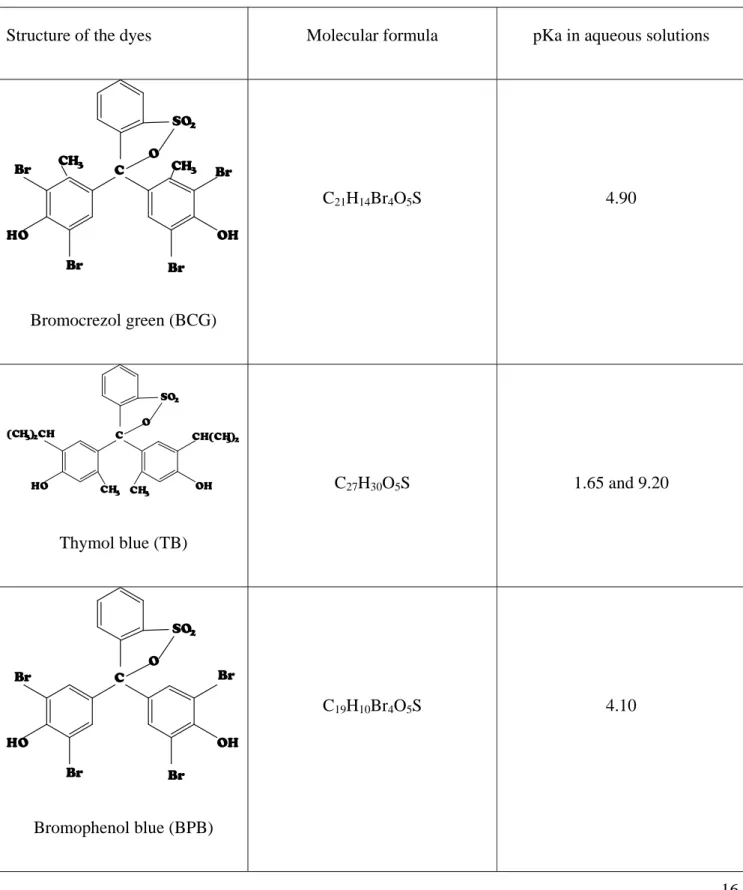
Tetramethoxysilane ( TMOS ) and methyltrimethoxysilane ( MTMS ) were used as raw materials. First, TMOS and MTMS were mixed with H2O and C2H5OH for 10 min. The molar ratio of silicon alkoxide, H2O and C2H5OH was 1:2:5. No catalysts such as HCl and NH4OH etc. were used in this work. This is important to prepare the gel films containing pH indicators for their non-leaching. Several kinds of pH indicators such as bromocrezol green (BCG), thymol blue (TB), and bromophenol blue (BPB) were used. The molecular formula and pKa of these dyes are shown in Table 1. The addition of indicators was 0.1 mol% to total of alkoxides. The contents of xTMOS•(1-x)MTMS were varied from x = 0 to 1. After mixing for 2 hr at room temperature, coating films were prepared by the dipping-withdrawing manner. Films were coated under a constant withdrawing rate of 4.4 mm/s which gave films with 0.7 - 1.2 µm thick after drying and heat treatment. Wet gel films were dried for 1 day at room temperature, and for 1 hr at 50°C. Heat treatment was achieved at 150 °C for 5 min. The
4 UVV absorption spectra of silica-gel films dipped in various pH solutions were measured by a Shimazu UV-1600PC spectrometer. We also measured the response of the gel films soaked in buffer solutions as the pH sensors by absorption spectra.
3. Results and discussion
In the present study, the composition of alkoxides have been varied in x = 0, 0.1, 0.3, 0.5, 0.8, 0.9, and 1. Unfortunately all kinds of pH indicators were leached out in x = 0.9 and 1. Furthermore no response was observed in x = 0 for all kinds of pH indicators and additionally in x = 0.1 for BCG. Then UVV absorption spectra were measured only in the compositions of x = 0.3, 0.5, and 0.8 containing BCG and x = 0.1, 0.3, 0.5, and 0.8 containing TB and BPB.
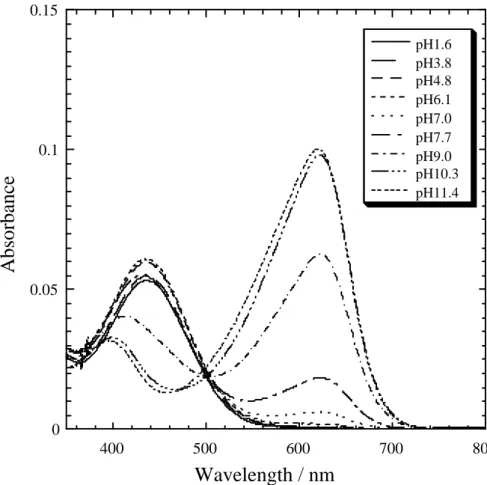
Figs. 1 (a)-(c) show absorption spectra of the silica gel films with 0.1 mol% of BCG, after dipped in the various pH solutions. pH of the solutions was varied from pH = 1.6 to 11.4. In Fig. 1 (a), the spectrum for pH = 1.6 has a specific peak by the acidic species at around 440 nm. The feature of this spectrum is almost the same for all the acidic solutions. No significant changes are observed until pH = 7.0. The absorbance of the peak at 440 nm is decreased with an increase of pH above 7.7 and another peak appears at around 620 nm. This peak originates from the basic species of BCG. The intensity of the peak at 620 nm is increased with an increase in pH of the solutions. The spectrum for pH = 11.4 is the same as that of BCG in the basic solutions.
Fig. 1 (b) shows the change of UVV spectra of the gel films of x = 0.5. In the solution of pH = 1.6, there is only a peak around 440 nm. The profile of spectrum does not change until pH = 6.1. Above pH = 7.0, another peak near 620 nm is observed and the intensity increases with increasing pH of the soaking solutions. The change of the spectrum with the increase in pH is very similar to that of the gel films of x = 0.3 except the peak at 620 nm which appears at lower pH.
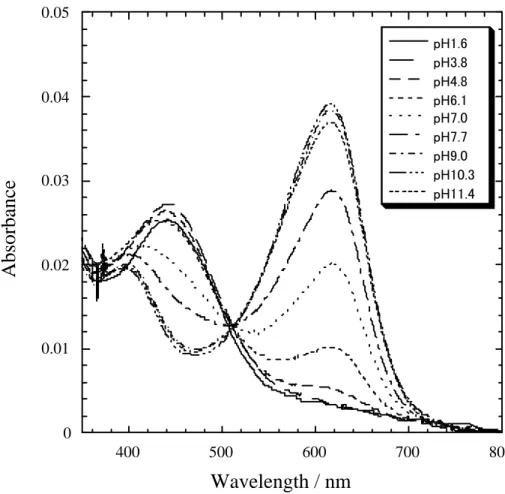
5 The spectra of x = 0.8 are shown in Fig. 1 (c). The spectrum for pH = 1.6 has a peak at 440 nm similar to Figs. 1 (a) and (b). The intensity of the peak is smaller than that observed in the gel films of x = 0.3 and 0.5, since the film thickness was smaller in this composition. The peak intensity at 440 nm is decreased above pH = 4.8 and another peak at 620 nm appears. This change of peak intensity is very similar to x = 0.3 and 0.5. The peak at 620 nm, however, is observed at lower pH than that in the case of x = 0.3 and 0.5. The peak absorbances of the films were different each other, since the film of x=0.8 was much thinner than that of the film of x=0.3, which was due to the larger contents of the TMOS.
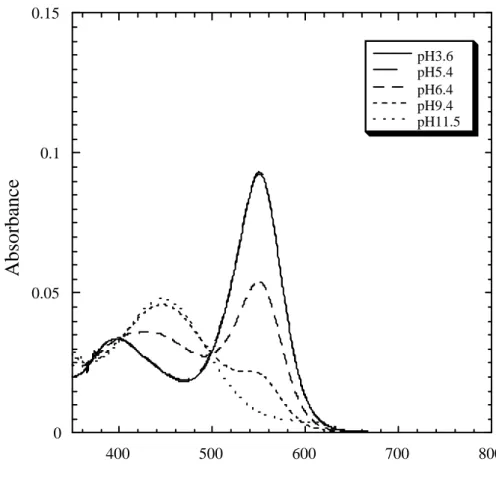
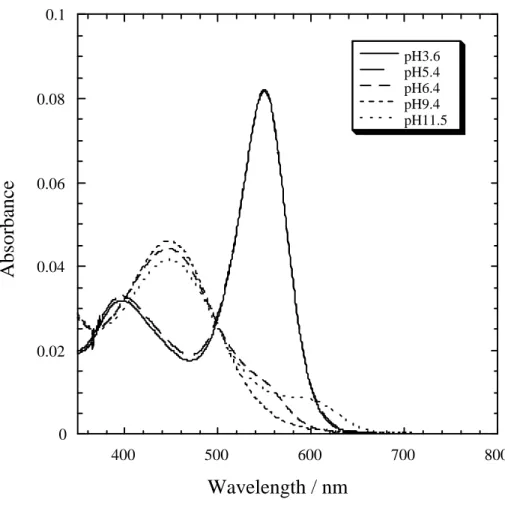
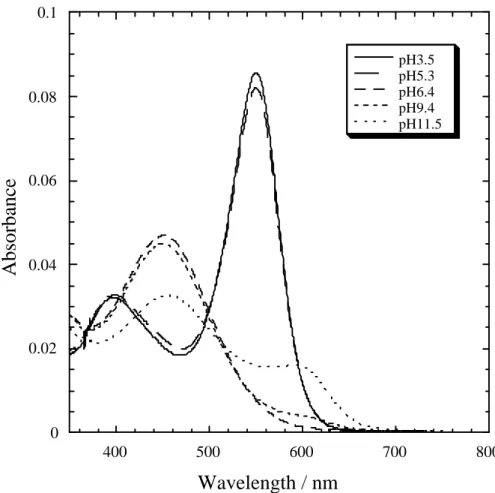
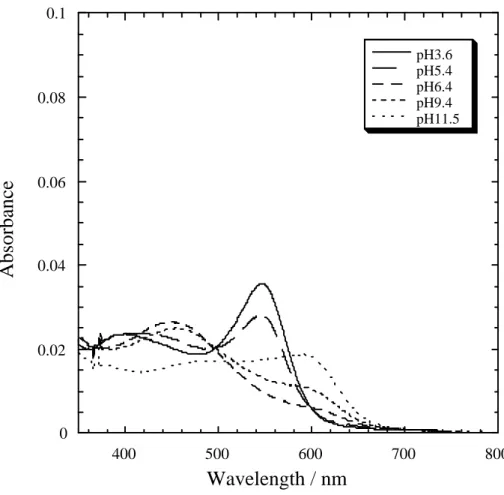
UVV spectra of the gel films with TB are shown in Figs. 2 (a)-(d). Fig. 2 (a) shows the spectrum for the composition of x = 0.1. In acidic solutions of pH=3.6 and 5.4, there is one significant peak at about 550 nm and another weak peak at 400 nm. The peak intensity at 550 nm is decreased with an increase in pH and the other peak at 450 nm is observed in the solution of pH=6.4. In Fig. 2 (b) which shows the result of x=0.3, almost the same changes of spectra with the variation of pH are observed. The peak intensity at 550 nm is decreased and the peak almost disappears for pH=6.4. In Fig. 2 (c), another peak appears at around 600 nm for pH = 11.5. This peak should be assigned to another basic species, since TB shows another dissociation reaction, pKa=9.20, in the aqueous solutions.
Similar change of the absorption with pH of the soaking solutions to the other compositions is observed in the spectrum of x = 0.8 shown in Fig. 2 (d). In this composition, the intensity of the peaks is smaller than those of the other compositions. This is caused by the thinner film thickness of this composition.
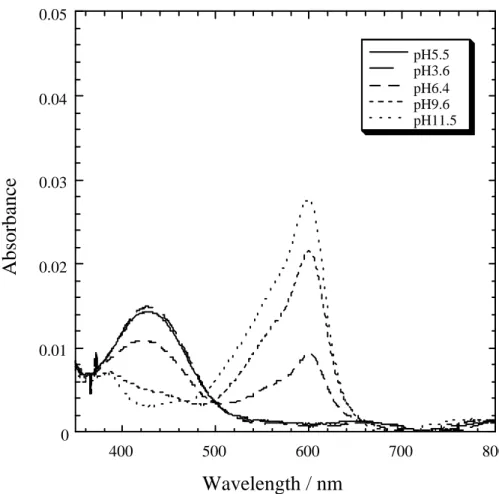
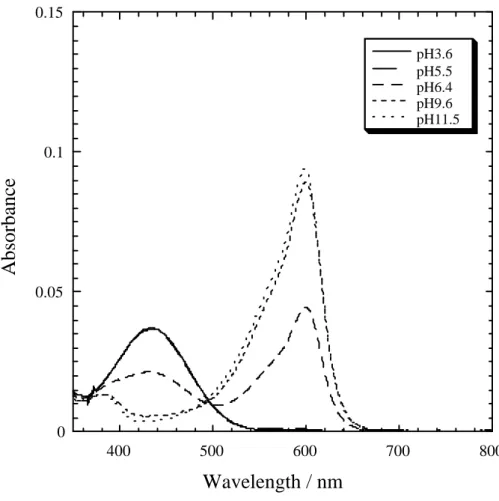
Figs. 3 (a)-(d) show the results for BPB. In the case of this indicator, there are characteristic peaks at around 430 nm in acidic solutions and at around 600 nm in basic solutions. The intensity of the peak at 430 nm is decreased and that at 600 nm is increased with an increase of pH above pH=6.4 in all the compositions. In the composition of x = 0.5 and 0.8 shown in Figs. 3 (c) and (d), the intensity of the peak at 600 nm is decreased for pH = 11.5. Since no leaching of BPB from the gel films were observed, this change should be caused by another species of BPB because the relative peak intensity at around 560 nm becomes larger.
6 In order to apply the gel films containing pH indicators to optical pH sensors, it is necessary to add more than two kinds of indicators to the films for the measurement of wide pH regions. Then, gel films containing two kinds of pH indicators were prepared. Fig. 4 shows UVV spectra of gel films containing both BCG and TB. The results for x = 0.5 and 0.8 were shown in Figs. 4 (a) and (b), respectively. In Fig. 4 (a), there are two peaks at around 440 and 550 nm for pH = 3.2. The peak at around 440 nm is assigned to acidic species of both BCG and TB. Another peak at 550 nm is assigned to only TB. The intensity of the peak at 440 nm is decreased for pH = 8.6 and the other peak appears at 620 nm. This peak is caused by the basic species both BCG and TB. The absorption is slightly different from the individual spectrum of BCG and TB at x = 0.5. Since the total concentration of pH indicators is 0.2 mol% in this film, the reaction of indicators with soaking solutions should somewhat change. It might be caused by the difference of solvent effects of the gel matrices between two kinds of dyes. In the case of x = 0.8 shown in Fig. 4 (b), the peak at around 440 nm, which is assigned to both BCG and TB, is observed for pH = 3.2. In this pH, the peak intensity at around 550 nm is weaker than that at x = 0.5. Furthermore, the increase of peak intensity at around 620 nm for pH = 8.6 is much larger than that at x = 0.5. The profile of the spectra, however, is similar to the summation of the individual spectrum of BCG and TB for x = 0.8. This result also suggests that the stabilizing effect of MTMS is different in each pH indicator. As shown in Fig. 1 (b) and Fig. 2 (c), the transition interval of BCG for x = 0.5 is located between pH = 6.1 and 9.0 and that of TB is between pH = 5.3 and 6.4. The gel films containing both BCG and TB work as the pH sensors for the wider pH range compared with the gel film, which contains each indicator. That is, the gel films with several kinds of pH indicators, which have different transition intervals, can be applied as universal pH measuring sensors.
As described above, the pH indicators in gel films showed different pKa from those in aqueous solutions. pKa of pH indicators in gel films can be obtained from the normalized fraction obtained from the normalized absorption of the peak of the acidic and the basic species. The normalized absorption means the absorption at a certain wavelength normalized in the range from 0 to1 as the following equation.
7
An = (A − Amin) /(Amax− Amin)
An: the normalized absorption Amax: the maximum absorption in the observed pH range
A: the observed absorption at a certain wavelength Amin: the minimum absorption in the observed pH range
Figs. 5 (a) -(c) show the normalized fractions of both the acidic and the basic species of BCG with various pH. In the case of BCG, the normalized fraction of the acidic species of BCG is gradually decreased and that of the basic species is increased above about pH =7.0 at x = 0.3, pH = 6.1 at x = 0.5, and pH = 4.8 at x = 0.8. We can estimate pKa of BCG in the silica gel films from the change of normalized fractions of the acidic and basic spices of BCG. In the ideal condition, there is only the acidic species in the acidic solutions and the fraction of the acidic species is decreased with an increase in pH of the solutions within the transition interval of the indicator. At the same time, the basic species of BCG is increased with an increase in pH and the normalized fractions of both the acidic and the basic species become 0.5 when pH of the solutions is equal to pKa of BCG as the following equations.
H A H+ + A
-Ka = [H +][A-]/[HA], [H +] = Ka[HA]/[A -]
pH = -log[H +] = -log{Ka[HA]/[A-]} = -logKa-log{[HA]/[A-]} = pKa-log{[HA]/[A-]}
when [HA] = [A -], pH = pKa
Then we have calculated pKa of BCG in the gel films of the compositions at x = 0.3, 0.5 and 0.8. The result is shown in Fig. 6. pKa at x = 0.3 is 8.9, which is much larger than that of BCG in aqueous solutions. pKa becomes smaller in the larger content of TMOS, that is, pKa = 8.0 at x = 0.5 and 7.2 at x = 0.8. The smallest value of pKa at x = 0.8, however, is still larger than that in aqueous solutions,
8 pKa = 4.9. These larger values should be caused by the solvent effect of gel matrices.
Fig. 7 shows a schematic diagram of the estimated environment around pH indicators in gel films. The pH indicators contain hydrophobic part such as benzene rings and hydrophilic part such as -OH and -SO3- groups. In the gel films with x = 0, pH indicators should be mostly surrounded by -CH3 groups derived from MTMS and located within a strongly hydrophobic condition. The dye molecules were stabilized by the surrounding hydrophobic groups in the gel films, since the dyes have hydrophobic groups. That might be the reason that no response was observed in x = 0, in which the dye molecules were too much stabilized by the hydrophobic groups. In the compositions larger than x =0, the indicators are surrounded by both -CH3 and -OH groups and the concentration of -OH are increased with an increase in the TMOS content. Thus, the environment around the indicators becomes more hydrophilic with an increase in the TMOS content. Furthermore, the hydrophobic -CH3 groups might play a role of the stabilization of the pH indicators in the gel films, since the leaching of all kinds of pH indicators was observed in the composition range from x= 0.9 to 1. Usually pKa of pH indicators is changed by the solvent effect. The pH indicators change their absorption by dissociation of AH.
HA H+ + A
In the hydrophobic solvent, this reaction is shifted to the left hand side by the solvent effect and on the other hand pH indicators prefer to become ionic state in the hydrophilic environment. That is, the reaction is shifted to the right hand side in the hydrophilic solvent.
pKa of BCG shown in Fig. 6 was shifted to lower values with an increase in the TMOS content. This result shows that the environment around BCG molecules in the gel films became more hydrophilic with larger TMOS content. Since the absolute value of pKa of BCG in gel films at x = 0.8 is still larger than that in the aqueous solutions, BCG molecules are still surrounded by certain amounts of -CH3 groups in this composition. The results suggest that MTMS contributes to the stabilization of the pH indicators in the gel films and the increase of the MTMS content makes pH indicators more
9 stable in the gel films. Then BCG in the MTMS film is too stable to response to the pH of the solutions. On the other hand, the pH response of the gel films is influenced by the TMOS content in exchange for the unstableness of the indicators. As a result, BCG in the TMOS film was leached out with dipping in the solutions.
The fast response for pH of soaking solutions is one of the most important properties for the application as optical pH sensors. Then we have measured the change of absorption of the gel films with time in various pH solutions. Figs. 8 (a)-(c) show the time dependence of absorption at 620 nm of the gel film containing BCG for the compositions x=0.3, 0.5, and 0.8. We have prepared buffer solution of pH=8.0 with K2HPO4 and KOH. The measurement started at t = 0, when the films were dipped in the buffer solutions.
For the composition x=0.3 in Fig. 8 (a), the absorption at 620 nm is gradually increased with time and saturated at t=3000 min. The response of the gel films is incredibly fastened in the composition of x=0.5 ( Fig. 8 (b) ). The absorption at 620 nm of the gel films is increased and after 180 min the absorption becomes constant.
The response of the gel film becomes much faster in x = 0.8 as shown in Fig. 8 (c). The absorbance is increased and saturated in 5 min. The composition dependence of the response time seems to correspond to the stabilization of the pH indicators in gel films. As mentioned above, MTMS should work for stabilizing pH indicators in gel films. Then in the composition with larger content of MTMS, pH indicators in the gel films were strongly stabilized by MTMS and lost the responsibility to pH of the dipping solutions. When the content of TMOS was increased, the stabilization of pH indicators was loosened and the response was improved. That is, the film shows good reactivity to pH of the dipping solutions.
Another important property of optical pH sensors is the stabilization of pH indicators in gel films for repeated measurements. Figs. 9 (a)-(c) show absorption of BCG containing gel films at around 440 and 620 nm for the compositions of x=0.3, 0.5, and 0.8. Each absorption was measured after dipping the gel film for 30 min. At x = 0.3 in Fig. 9 (a), the absorbance changes from 0.08 at 432 nm for pH =
10 3.0 at the first run and is decreased for pH = 9.0. At the second run the absorbance becomes slightly smaller, 0.075, for pH = 3.0. The change of absorbance with pH of solutions is very similar in each run.
In the case of the absorbance at around 620 nm, no absorption is observed for pH = 3.8 and the peak intensity is increased with the increase in pH. The absorbance for pH = 9.0 is decreased at the second run of the gel film and after that the absorbance does not change anymore.
Fig. 9 (b) is the result of absorption for the composition of x = 0.5. The absorbance at 440 nm is 0.07 for pH = 3.0 and decreased to 0.03 for pH = 9.0. The absorption at the first run is slightly larger than that of the second run. After the second run, there are no changes in the absorption. The change of the absorbance at 440 nm is larger than that for x = 0.3. Furthermore, the variation of absorbance at 620 nm changes drastically and becomes nearly 0 for pH = 3.0 and 0.08 for pH = 9.0. For this composition, the absorption observed at the first run is also somewhat larger than that after the second run. In the case of x = 0.8, the absorbance at both 440 and 620 nm clearly changes and the difference between the first and the other runs is much smaller than that for x = 0.3 and 0.5. This result suggests that few pH indicators contained at the surface might be leached out at the first dipping in a solution and after that the indicators are no longer leached out from the gel films for x = 0.3 and 0.5.
4. Conclusions
Gel films with various pH indicators were prepared by the sol-gel method. We have improved the preparation method by a simple way, that is, using no catalysts. The obtained films showed good response to various pH solutions and no leaching of indicators from the gel films was observed. pKa of pH indicators was shifted to lower side with an increase in the TMOS content. This result suggests that the indicators in the gel films were stabilized by -CH3 and -OH groups and showed solvent effect of the gel matrices. The obtained gel films showed possibility of the applications to the optical pH measurement apparatus.
12 References
(1) Zusman, R.; Rottman, C.; Ottolenghi, M.; Avnir D. J. Non-Cryst. Solids, 122, 107(1990).
(2) Lacan, P.; Gall, P. L.; Rigola, J.; Lurin, C.; Wettling, D.; Guizard, C.; Cot, L. Proc. SPIE 1758,
464 (1992).
(3) Kraus, S. C.; Czolk, R.; Reichert, J.; Ache, H. J. Sensors and Actuators B 15-16, 199 (1993).
(4) Butler, T. M.; MacCraith, B. D.; McDonagh, C. M. Proc. SPIE 2508, 168 (1995).
(5) Noire, M. H.; Bouzon, C.; Couston, L.; Gontier, J.; Marty, P.; Pouyat, D. Sensors and Actuators B
51, 214 (1998).
(6) Lobnik, A.; Wolfbeis, O. S. Sensors and Actuators B 51, 203 (1998).
(7) Butler, T. M.; MacCraith, B. D.; McDonagh, C. J. Non-Cryst. Solids 224, 249 (1998).
13 (9) Cjlakovic, M.; Lobnik, A.; Werner, T. Anal. Chim. Acta, 455, 207 (2002).
14 Figure captions
Fig. 1 Absorption spectra of the gel films containing BCG (a) x = 0.3, (b) x = 0.5, (c) x = 0.8.
Fig. 2 Absorption spectra of the gel films containing TB (a) x = 0.1, (b) x = 0.3, (c) x = 0.5, (d) x = 0.8.
Fig. 3 Absorption spectra of the gel films containing BPB (a) x = 0.1, (b) x = 0.3, (c) x = 0.5, (d) x = 0.8.
Fig. 4 Absorption spectra of the gel films containing both BCG and TB (a) x = 0.5, (b) x = 0.8.
Fig. 5 Normalized intensities of the peaks at around 440 and 620 nm observed in the absorption spectra of the gel films containing BCG (a) x = 0.3, (b) x = 0.5, and (c) x = 0.8.
Fig. 6 Composition dependence of pKa of BCG in the gel films.
Fig. 7 Schematic diagram of environment around pH indicators in the gel films.
Fig. 8 Absorbance variation with time for the gel films containing BCG (a) x = 0.3, (b) x = 0.5, and (c) x = 0.8.
15 Fig. 9 Reproducibility of the gel films containing BCG (a) x = 0.3, (b) x = 0.5 and (c) x = 0.8.
16 Table
Table 1 Structure and property of bromocrezol green (BCG), thymol blue (TB), and bromophenol blue (BPB).
Structure of the dyes Molecular formula pKa in aqueous solutions
C SO2 OH HO O Br Br Br CH3 CH3 Br Bromocrezol green (BCG) C21H14Br4O5S 4.90 C SO2 OH HO O CH3 CH3 (CH3)2CH CH(CH3)2 Thymol blue (TB) C27H30O5S 1.65 and 9.20 C SO2 OH HO O Br Br Br Br Bromophenol blue (BPB) C19H10Br4O5S 4.10
17 0 0.05 0.1 0.15 400 500 600 700 800 pH1.6 pH3.8 pH4.8 pH6.1 pH7.0 pH7.7 pH9.0 pH10.3 pH11.4
Absorbance
Wavelength / nm
18 0 0.02 0.04 0.06 0.08 0.1 400 500 600 700 800 pH1.6 pH3.8 pH4.8 pH6.1 pH7.0 pH7.7 pH9.0 pH10.3 pH11.4
Absorbance
Wavelength / nm
19 0 0.01 0.02 0.03 0.04 0.05 400 500 600 700 800 pH1.6 pH3.8 pH4.8 pH6.1 pH7.0 pH7.7 pH9.0 pH10.3 pH11.4
Absorbance
Wavelength / nm
20 0 0.05 0.1 0.15 400 500 600 700 800 pH3.6 pH5.4 pH6.4 pH9.4 pH11.5
Absorbance
Wavelength / nm
21 0 0.02 0.04 0.06 0.08 0.1 400 500 600 700 800 pH3.6 pH5.4 pH6.4 pH9.4 pH11.5
Absorbance
Wavelength / nm
22 0 0.02 0.04 0.06 0.08 0.1 400 500 600 700 800 pH3.5 pH5.3 pH6.4 pH9.4 pH11.5
Absorbance
Wavelength / nm
23 0 0.02 0.04 0.06 0.08 0.1 400 500 600 700 800 pH3.6 pH5.4 pH6.4 pH9.4 pH11.5
Absorbance
Wavelength / nm
24 0 0.01 0.02 0.03 0.04 0.05 400 500 600 700 800 pH5.5 pH3.6 pH6.4 pH9.6 pH11.5
Absorbance
Wavelength / nm
25 0 0.05 0.1 0.15 400 500 600 700 800 pH3.6 pH5.5 pH6.4 pH9.6 pH11.5
Absorbance
Wavelength / nm
26 0 0.05 0.1 0.15 0.2 400 500 600 700 800 pH3.6 pH5.5 pH6.4 pH9.6 pH11.5
Absorbance
Wavelnegth / nm
27 0 0.05 0.1 0.15 400 500 600 700 800 pH3.6 pH5.5 pH6.4 pH9.6 pH11.5
Absorbance
Wavelength / nm
28 0 0.05 0.1 0.15 400 500 600 700 800 pH3.2 pH5.9 pH8.6
Absorbance
Wavelength / nm
29 0 0.05 0.1 0.15 400 500 600 700 800 pH3.2 pH5.9 pH8.6
Absorbance
Wavelength / nm
30 0 0.2 0.4 0.6 0.8 1 1.2 0 2 4 6 8 10 12 435.5nm 621nm
Normalized fraction
pH
31 0 0.2 0.4 0.6 0.8 1 1.2 0 2 4 6 8 10 12 439.5nm 620nm
Normalized fraction
pH
32 0 0.2 0.4 0.6 0.8 1 1.2 0 2 4 6 8 10 12 442nm 616nm
Normalized fraction
pH
33 6 6.5 7 7.5 8 8.5 9 9.5 10 0.2 0.3 0.4 0.5 0.6 0.7 0.8 0.9
pKa
x
34
Si
Si
Si
Si
O
O
CH
3OH
Si
Si
O
pH
indicators
CH
3OH
CH
3CH
3CH
3CH
3CH
3Si
Si
O
CH
3CH
3OH
Si
Si
O
OH
OH
Si
Si
O
OH
OH
OH
OH
35 0 0.005 0.01 0.015 0.02 0.025 0.03 0.035 0.04 0 1000 2000 3000 4000 5000 6000
Absorbance at 621.5nm
Time / min.
36 0 0.02 0.04 0.06 0.08 0.1 0 500 1000 1500 2000 2500 3000
Absorbance at 621.5nm
Time / min.
37 0.01 0.02 0.03 0.04 0.05 0.06 0.07 0.08 0.09 0 500 1000 1500 2000 2500 3000
Absorbance at 621nm
Time / min.
38 0 0.02 0.04 0.06 0.08 0.1 0.12 0.14 pH3 pH6 pH9 pH6 pH3 First at 432 nm Second at 432 nm Third at 432 nm First at 622 nm Second at 621.5 nm Third at 623 nm
Absorbance
pH
39 0 0.02 0.04 0.06 0.08 0.1 0.12 0.14 pH3 pH6 pH9 pH6 pH3 First at 440.5 nm Second at 440.5 nm Third at 442.5 nm First at 621 nm Second at 621.5 nm Third at 621.5 nm
Absorbance
pH
40 0 0.02 0.04 0.06 0.08 0.1 0.12 pH3 pH6 pH9 pH6 pH3 First at 440.5 nm Second at 441 nm Third at 439 nm First at 622 nm Second at 621 nm Third at 620 nm