Some evidence from Saudi Arabian banking
sector
By
BINTAWIM Samar Saud S. (52109007)
Presented to the faculty of graduate school of
Ritsumeikan Asia Pacific University (APU)
In Partial Fulfillment of the
Requirements for the Degree of
Master of Business Administration
(MBA Program)
January 2011
Performance analysis of Islamic banking:
Some evidence from Saudi Arabian banking sector
By
BINTAWIM Samar Saud S. (52109007)
Supervisor:
Prof. CORTEZ Michael A.
Thesis committee:
Prof. ASGARI Behrooz
Prof. SUZUKI Koji
Abstract
Saudi Arabian banking sector has the largest assets of both Islamic and conventional banks among GCCs and a better level among Arab countries. Conventional and Islamic banks are operating side by side in the market. However, the rapid growth of Islamic banking system in Saudi Arabia creates intensive competitions in the industry. Each bank tries to be more financially feasible than others by increasing activities and innovating some products to gain higher market share. Therefore, there is an urgent need to make comprehensive analysis of Saudi Arabian banks’ performance. The objective of this paper is to provide performance analysis comparison of Saudi banks as well as to examine the impact of banks’ internal characteristics indicators on financial performance. A total of eleven banks are financially analyzed between 2005 and 2009. The methodology is used including ratio analysis and panel data regression to test the research hypothesis. The results show that large banks performance has reached the mature growth unlike medium-size banks. They are growing to compete against large banks. Meanwhile, small-size banks are facing some difficulties to achieve a better growth. The results indicate all Saudi banks are doing well to maintain the stability of banking sector. In addition, regression results show that banks’ size has a negative impact on financial performance, while asset utilization has a positive impact on Saudi banks profitability. Moreover, increasing banks operating expenses leads to increase the net special commission and decrease ROA and ROE.
Acknowledgement
First of all, I thank the Almighty Allah, the most gracious, and the most merciful, for his helping, blessing and guidance for accomplishing this task.
I would love to take the advantage to thank my supervisor Professor. CORTEZ Michael for his guidance and full support. His advices made this research an easy task led to the accomplishment of my thesis. Also I would love to thank all of my thesis committee members Prof. ASGARI Behrooz, Prof. SUZUKI Koji, and prof. ZHANG Wei-Bin for their invaluable feedbacks and comments. This thesis would not have been possible without the guidance and the help of several individuals who in one way or another contributed and extended their invaluable assistance in the preparation and completion of this study.
My sincere thanks and deep appreciation to;
• My parents for their inseparable support and prayers.
• My beloved husband and kids for their support and understanding during my study. • My siblings for being caring and supportive.
• My classmates and stuff working in the academic office.
Finally, special thanks and gratitude to Saudi Arabian Government for giving me this opportunity to continue my higher education in such great country like Japan.
Table of Contents
Abstract ... III Acknowledgement ... IV List of tables ... VII List of graphs ... VIII List of Abbreviations ... IX
Chapter1- Introduction ... 1
Background of the study ... 1
Problem statement ... 2 Objective ... 3 General objective ... 3 Specific objectives ... 3 Theoretical framework ... 4 Conceptual framework ... 6 Operational framework ... 8 Profitability ratios ... 8 Liquidity ratios ... 9
Leverage ratio/ Capital structure ratio ... 10
Efficiency ratio ... 11
Research Hypothesis ... 12
Limitations of this paper ... 12
Structure of the study ... 13
Chapter2: Literature Review ... 15
Literature review on Islamic banking: ... 15
What is Islamic banking system? ... 15
History and growth of Islamic finance ... 15
Core concept of Islamic banking and its principles ... 18
Lending models of Islamic banking ... 20
Literature review on Kingdom of Saudi Arabia (KSA) ... 23
Economic background ... 23
Development of Saudi Arabian banking sector ... 24
Islamic banking in Saudi Arabia ... 28
Literature review on banks’ profitability: ... 32
Profitability of conventional banks ... 32
Profitability of Islamic banking ... 34
Performance of Saudi banking industry ... 36
Research design ... 38
Population and respondents ... 39
Sampling design ... 41
Measurement and Instruments ... 41
Data Procedures ... 41
Methodology ... 48
Chapter 4-Data presentation and descriptive analysis ... 49
Data presentation ... 49
1) National Commercial Bank (NCB) ... 49
2) RIYAD Bank (RIBL) ... 51
3) AL-RAJHI Bank (RJHJ) ... 53
4) AL-JAZIRA Bank (BJAZ) ... 55
5) Saudi Arabian Investment Bank (SAIB) ... 56
6) Saudi Hollandi Bank (SHB) ... 57
7) Banque Saudi Fransi (BSFR) ... 59
8) Saudi Arabian British Bank (SABB) ... 60
9) Arab National Bank (ANB) ... 62
10) Samba Financial Group (SAMBA) ... 63
11) Bank Al-Bilad (ALBI) ... 65
Descriptive analysis ... 67
Total Assets (TA) ... 67
Total Shareholders’ Equity (TE) ... 69
Structure Ratio (EQTA) ... 70
Profitability ratios ... 71
Efficiency ratio ... 75
Liquidity ratio ... 76
Chapter 5 -Findings and Discussions ... 78
Empirical results: ... 78
Result of Entire Saudi Banking Industry ... 79
Results of individual Saudi banks: ... 83
Chapter 6- Conclusion ... 95
References ... 97
Appendix A ... 102
List of tables
Table
Title
Page
Table 2-1 Growth of Saudi Banking System 27
Table 2-2 Islamic Products of Saudi banks at the end of 2009 29
Table 2-3 Islamic Products Used by Saudi Banks 31
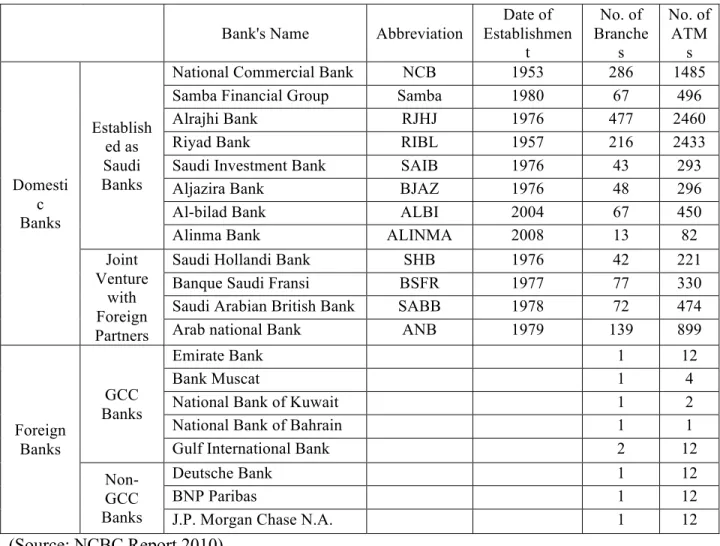
Table 3-1 Saudi Banks, and network of branches and ATMs (2009) 40 Table 4-1 Financial Highlight at National Commercial Bank NCB (2005-09) 51 Table 4-2 Financial Highlight of Riyad Bank RIBL (2005-09) 53 Table 4-3 Financial Highlight at Al-Rajhi Bank RJHJ (2005-09) 54 Table 4-4 Financial Highlight at AL-JAZIRA Bank BJAZ (2005-09) 56 Table 4-5 Financial Highlight at Saudi Arabian Investment Bank SAIB
(2005-09)
57 Table 4-6 Financial Highlight at Saudi Hollandi Bank SHB (2005-09) 59 Table 4-7 Financial Highlight at Banque Saudi Fransi BSFR (2005-09) 60 Table 4-8 Financial Highlight at Saudi Arabian British Bank SABB (2005-09) 62 Table 4-9 Financial Highlight at Arab National Bank ANB (2005-09) 63
Table 4-10 Financial Highlight at Samba (2005-09) 65
Table 4-11 Financial Highlight at Bank Al-Bilad ALBI (2005-09) 66 Table 4-12 Ranking of Saudi Banks Based on Assets Size through 2005 to 2009 68 Table 4-13 Ranking of Saudi Banks Based on Equity Size through 2005 to 2009 69
Table 5-1 Determinants of ROA 79
Table 5-2 Determinants of ROE 81
Table 5-3 Determinants of NSC 82
Table 5-4 Determinants of Profitability at Riyad Bank (RIBL) 84 Table 5-5 Determinants of Profitability at Al-Rajhi Bank (RJHJ) 85 Table 5-6 Determinants of Profitability at Jazira Bank’s (BJAZ) 87 Table 5-7 Determinants of Profitability at Saudi Investment Bank’s (SAIB) 88 Table 5-8 Determinants of Profitability at Saudi Hollandi Bank’s (SHB) 89 Table 5-8 Determinants of Profitability at Banque Saudi Fransi (BSFR) 90 Table 5-9 Determinants of Profitability at Saudi Arabian British Bank (SABB) 91 Table 5-10 Determinants of Profitability at Arab National Bank (ANB) 92 Table 5-11 Determinants of Profitability at Samba Financial Group (Samba) 93 Table 5-12 Determinants of Profitability at Al-bilad Bank (ALBI) 94
List of graphs
Graphs
Title
Page
Graph1-1 Conceptual framework of comparative performance analysis 6 Graph1-2 Conceptual framework of determinants of bank’s profitability 8
Graph 2-1 The Growth of Islamic Banking Industry 17
Graph 2-2 Proportions of Financial Contracts in Islamic Banks in Middle East 22
Graph 2-3 GDP growth of Saudi Arabia 24
Graph 2-4 The Growth of Islamic Instruments Total Loans and Advances in Saudi Banking Sector
29
Graph 3-1 Expected Outputs of Research Hypothesis 48
Graph 4-1 Assets’ Growth of Saudi Banks through (2005-09) 68 Graph 4-2 Capital Structure of Saudi Banks over the period (2005-09) 71 Graph 4-3 Net Special Commissions of Saudi Banks (2005-09) 72 Graph 4-4 Return on Equity (ROE) of Saudi Banks through 2005 to 2009 74 Graph 4-5 Return on Assets (ROA) of Saudi Banks through 2005 to 2009 75 Graph 4-6 Cost to Income Ratio (COTIN) of Saudi banks through 2005 to 2009 76 Graph 4-7 Liquidity Ratio of Saudi banks through 2005 to 2009 77
List of Abbreviations
ALBI Al-Bilad Bank BJAZ Jazira Bank COTIN Cost to Income DTA Deposits to Assets EQTA Equity to Total Assets KSA Kingdom of Saudi Arabia LTA Loan to Assets Ratio LTD Loan to Deposit Ratio NCB National Commercial Bank NSC Net Special Commissions
OPEXTA Operating Expenses to Total Assets OPINTA Operating Income to Total Assets
OPEXTNSC Operating Expenses to Net Special Commissions PLS Profit Loss Sharing System
RJHJ Al-Rajhi Bank
RIBL Riyad Bank
ROA Return on Assets ROE Return on Equity SAIB Saudi Investment Bank
SAMA Saudi Arabian Monetary Agency Samba Samba Financial Group
Background of the study
Islamic banking system has been expanding so rapidly over the past few years. In addition, it has been developing significantly around the world including Middle Eastern countries, Southeast Asian countries, European countries and even in North American countries. The existing of Islamic banks is to attract the customers who seek to avoid interest. Since interest is prohibited in Islam, Islamic banks have to avoid dealing with interest in any form. For that reason, Islamic banks came up with Profit-Loss Sharing System (PLS) and other sales contracts (will be explained later in this chapter). Above of that, Islamic banking system has to be operating with accordance to Islamic rules and principles.
On the other hand, counterparts are operating on the interest’s basis. They receive interest from the borrowers, and pay interest to the lenders. The difference between them is profit earned by the bank. This is the mechanism used by conventional banks to finance most of businesses.
There is no doubt that banking sector generally is playing a major role in developing and enhancing the economic condition via funding most of companies, if it is not all. In Kingdom of Saudi Arabia (KSA) without exception, banking sector has a significant weight in the Middle East. Furthermore, Saudi Arabia has the largest assets of both Islamic and conventional banks among Gulf Cooperation Council Countries (GCCs) according to Alkassim (2005), and better level among Arab Countries. Conventional and Islamic banks are operating side by side in Saudi Arabian industry for the sake of profit maximization. Many studies show that the assessment of
Islamic banks’ performance through a number of ratios produces satisfactory results. General speaking, Islamic banks are well chaptalized, stable and profitable (Iqbal and Molyneux, 2005). Besides, Saudi people – 99 per cent of population are Muslims- are concerned with Islamic rules and principles, and seek to avoid dealing with these banks of which provide interest. Thus, many conventional banks in the kingdom have adopted, if not converted to, Islamic banking system by providing Islamic windows to achieve higher market share. The common assumption, which emphasizes much of the financial performance research and discussions, is that increasing financial performance will lead to improved functions and activities of the organizations (Tarawneh, 2006). Consequently, consolidated competition, effective resources allocation, producing innovative products for saving money, and developing a new technology for evolving the quality have been focal points among banks in Saudi Arabian banking sector, not only locally, but also worldwide. Therefore, there is an urgent need to make comprehensive analysis of Saudi Arabian banks’ performance.
This research will study and analyze the financial performance of selected Saudi banks by using a number of key ratios such as; profitability ratio, liquidity ratio, efficiency ratio, and capital structure /leverage ratio. In addition, the paper will examine the impact of financial ratios with respect to bank’s size, operational efficiency, and assets management on the Saudi banks financial performance.
Problem statement
Due to Islamic banking expansion, an intensive competition among Saudi banks has arisen by providing innovative Islamic products, and efficient management in resources allocation and saving money. It is a well-known fact that is an effective and efficient banking system is important for long-term growth and crucial for economy development (Al Khathlan, Gaddam
and Malik, 2009). Thus, each bank tries to be unique than the others to achieve higher market share. However, this paper is conducted to answer several questions:
How does Saudi banking system work?
What are the strengths and weaknesses of each bank?
Which bank is more financially feasible than the others?
Which are the unique characteristics of these banks?
What are the factors that influence or impact on Saudi bank’s profitability?
What is the impact of internal indicators of banks on financial performance?
Objective
The objective is divided into two parts in this paper:
General objective
The paper aims to give stakeholders insight into how Saudi banks work by analyzing the financial performance of the selected banks through 2005 to 2009, and examining the impact of each bank’s characteristics on financial performance, with respect to bank’s size, operational efficiency, and assets management.
Specific objectives
1) To introduce Islamic banking system and its role in Saudi Arabian banking sector;
2) To classify Saudi bank’s size based on total assets and total equity over the period (2005-2009)
3) To measure and analyze the financial performance of each bank between 2005 and 2009 by using two approaches of ratio analysis:
• By using trend analysis, this approach will examine the impact of each bank’s growth over the sector, and how each bank improves and develops over the selected period. It will cover some key financial indicators such as; assets, equities, loans and advances, investments, net income, in addition to return on assets (ROA) and return on Equity (ROE).
• By using inter-firm analysis, this approach is aimed to compare each bank with competitors by measuring some ratios such as capital structure/ leverage ratio, profitability ratios, efficiency ratio and liquidity ratio.
4) To examine the influence of asset management on Saudi banks’ financial performance by adopting some financial indicators, namely loan and advances to assets, equity to assets, deposits to assets, and operating income to total assets;
5) To examine the impact of operational efficiency on financial performance of Saudi banks by adopting some financial indicators, namely operating expenses to net special commission, operating expenses to operating income, and operating expenses to total assets;
6) To examine the impact size of bank, measured by total assets, on financial performance of Saudi banks.
Theoretical framework
The theory applied in this paper, to achieve the aforementioned objectives, is financial management theory. Specifically, financial statement analysis theory since it aids to financial analysis. Analysis of financial statements is a tool that widely used among interested parties such
as investors, creditors, and mangers to evaluate and assess the historical and current financial condition as well as to predict the financial performance of the bank in coming years. Khan and Jain (2007) define the analysis of financial statements as a process of evaluating the relationship between component parts of financial statements to obtain a better understanding of the firm’s position and performance. Briefly, it could be said that financial analysis is the process or correlation and evaluation. Ratio analysis is a more practical tool for financial statements, it could link between risk and return regardless company’s size in any industry. Bhatawdkar (2010) defines ratio analysis as the systematic use of ratio to interpret the financial statements so that the strength and weaknesses of a firm as well as historical performance and current financial condition can be determined. Furthermore, Ratio analysis makes related information comparable and it helps to identify the deficiencies and then take the actions to improve it. The importance of financial ratios underpins the truth that it illustrates the facts of a bank’s performance on comparative basis and enables the drawing of inferences regarding the performance.
There are three types of comparison that are generally involved; 1) Trend analysis which involves comparison of the firm over the period. In other words, it compares current position of the firm with its past performance, usually from a year to five years. Second type is Inter-firm analysis that involves comparison of the firm with others in the same line of business or in the entire industry. Last but not least, comparison with standards or industry average (Khan and Jain, 2007).
By adopting financial ratios analysis, it enables us to answer research questions and achieve the objectives.
Conceptual framework
Conceptual framework will describe the relationship between the specific variables identified in this paper. Two types of diagram will be drawn in this section to smooth understanding of conceptual framework. In the first diagram below, it displays the first overall objective of this paper, which is about providing insight of Saudi banks performance for stakeholders. The dependent variable is analyzing the performance of Saudi banks. However, the analysis will rely heavily on financial performance (independent variables) by examining financial statements of each bank over the selected period (2005-2009). Thus, ratio analysis will be used to achieve the specific objective including identifying banks’ strengths and weaknesses, examining the financial position of each bank and which bank does have more feasible financial position than the others. Financial performance will be measured by list of ratios:
1) Profitability Ratios including Return on Assets (ROA), Return on Equity (ROE), and Net Special Commissions (NSC)
2) Liquidity Ratio: Loans and advances To customer Deposit (LTD) 3) Capital Structure/ Leverage Ratio: Equity to Assets (EQTA) 4) Efficiency Ratio: Cost To Income ratio (COTIN)
Graph1- 1: Conceptual framework of comparative performance analysis:
Saudi Banks Analysis Profitability ratio Liquidity Ratio
Capital Structure Ratio
Efficiency Ratio
ROA, ROE, NSC
LTD
EQTA
By contrast, the study will have another purpose including examination the relationship between financial performance and management or/and activity that is applied by Saudi banks through ratio analysis theory. Two different purposes will be studied via applying the same theory, but it serves to achieve the aforementioned objectives.
Graph (1-2) illustrates the variables including in this part. The dependent variable will be financial performance of Saudi banks. Since profit maximization is the ultimate goal that all businesses seek to attain, the financial performance therefore will be measured by profitability ratios, ROA, ROE, and NSC. On the other side, the independent variables will be subject to Saudi banks’ asset management, operational efficiency, and banks’ size. We need to examine the impact of Saudi banks management on its performance. Therefore, the activity and/or the ratio, that leads to profit maximization, will be determined. And then we can recognize which activity makes a bank unique from others. The ratios used for asset management are Loan To Asset ratio (LTA), Equity To Assets (EQTA), Customer Deposit To total Assets ratio (DTA), Operating Income to Total Asset Ratio (OPINTA). While the ratios used for efficiency, Cost to Income ratio (COTIN), Operating Expenses To Net Special Commissions ratio (OPEXTNSC), and Operating Expense To Assets ratio (OPEXTA). Last but not least, bank’s size will be determined based on Total Assets (TA).
Graph 1- 2: Conceptual framework of determinants of bank’s profitability:
Bank’s Size
ROA, ROE, NSC Asset Management
Operational Efficiency
TA
LTA, EQTA, DTA, OPINTA COTIN, OPEXTNSC,
Operational framework
Operational framework introduces the calculation of selected variables of this research.
However, the definition of these variables will be explained later on in this paper. The following lines describe variables’ calculation:
Profitability ratios
1) Return on Equity (ROE) is calculated by dividing net income before tax and zakat to total equity
2) Return on Assets (ROA) is divided by net income before tax and zakat to total assets.
3) Net Special Commissions (NSC) is calculated by subtracting special commission income from special commission expenses over total assets.
Net income before Tax and Zakat
ROE = X100 Total equity
Net income before Tax and Zakat
ROA = X100 Total Assets
Special Commission income – Special Commission Expenses NSC = X100
The net income used in calculating ROA and ROE is net income before tax and zakat1 since
the Saudi government doesn’t impose the residents and national businesses to pay taxes. Rather, paying zakat is a mandatory task, which is deducted from shareholders’ dividends. Therefore,
zakat is not charged to the consolidated financial statement of income but is deducted from the
gross dividend paid to the shareholders or charged to retained earnings as an appropriation of net income if no dividend has been distributed (NCB financial Statements 2009). By contrast, joint ventures with foreign banks have to pay both zakat and taxes with unidentifiable tax expense (SABB special report, 2003). Therefore, to make precise comparison among Saudi banks, I consider the net income before zakat and tax.
Liquidity ratios
Liquidity ratio is measuring the ability of a firm to meet its short-term obligations and reflects the short- term financial strengths/solvency of a firm (Khan and Jain, 2008). The liquidity ratios used in this paper are;
1) Loan To Deposit Ratio (LTD) is calculating by dividing bank’s total loans by total deposits. It the ratio is extremely high, it means the bank might not have sufficient liquidity to cover unpredicted requirements. However, if the ratio is sharply low, the bank is not generating as much as it could be.
1 Zakat is a religious levy or almsgiving as required in the Holy Qur’an and is one of the five pillars of Islam
according to Hassan and Lewis (2007)
Loans and advances
LTD = X100 Customer Deposits
2) Loans to Assets Ratio (LTA) is calculating by dividing bank’s total loans by assets. The higher this ratio, the riskier the bank will be, and the liquidity will be low
Leverage ratio/ Capital structure ratio
Leverage ratio is used to recognize the bank’s ability to meet its long term obligations according to Ahmed (2009).
1) Equity to Assets Ratio (EQTA) is total assets financed by shareholders’ equity.
2) Deposits to Assets ratio (DTA) is a result of dividing customer deposits by total assets.
Loans and advances
LTA = X100 Total Assets Shareholders’ Equity EQTA = X100 Total Assets Total Deposit DTA = X100 Total Assets
Efficiency ratio
Efficiency ratios are to measure the efficiency in assets management; it is also called assets utilization or activity ratios (Khan and Jain, 2008). The following ratios are used in this paper:
1) Cost to Income Ratio (COTIN) is total operating expense divided by total operating income.
2) Operating Expenses to Total Assets (OPEXTA)
3) Operating expenses to NSC ratio (OPEXNSC) is calculating by dividing total operating expenses to NSC
4) Operating Income to assets ratio (OPINTA) is calculated by dividing total operating income to assets
Total Operating Expenses
COTIN = X100 Total Operating Income
Total Operating Expenses
OPEXTA = X100 Total Assets
Total Operating Expenses
OPEXTNSC = X100 Net Special Commissions
Total Operating Income
Research Hypothesis
The hypothesis will examine the impact of operational efficiency, bank’s size and assets management on bank’s performance. The variable used to test the hypothesis were introduced earlier in the second graph (1-2).
H1: there’s a positive and significant impact of operational efficiency, bank’s size and assets management on return on assets (ROA).
H2: there’s a positive and significant impact of operational efficiency, bank’s size and assets management on return on equity (ROE).
H3: there’s a positive and significant impact of operational efficiency, bank’s size and assets management on net special commissions (NSC).
Limitations of this paper
The paper does not face any major obstacles. However, some banks have no financial reports prior to 2007. Thus, the source of collecting data varies between banks’ official websites, Saudi Arabian Monetary Agency (SAMA) website, Saudi Arabian Stock Exchange (Tadawul) website, and Islamic Finance Information Service (IFIS) website. Moreover, Islamic banks, namely Al-rajhi Bank and Al-bilad Bank, adopt different accounting conventions than other banks. Consequently, loans and financing accounts are adjusted to comply with the others for comparison purpose. In panel data regression analysis, some variables have high p-value, which means they are not significant with dependent variables.
Another limitation is that some variables are not included to test bank’s performance such as economic indicators. Some studies (introduced in chapter 2) included GDP and Inflation such
as Bashir and Hassan (2004). However, most of these researches study the financial performance over several countries not in a single country. Therefore, I exclude the economic indicators since all banks are operating under a unified system and economy.
Structure of the study
The thesis will be structured into six chapters including chapter one. Chapter one gives a briefs introduction about Islamic banking system and the nature of Saudi banking sector. Moreover, the chapter introduces the problem statements and the objectives of this paper. After that, it covers the theoretical, conceptual, and operational framework. Finally, the chapter concludes with the research hypothesis and limitations of this paper.
Second chapter (Literature Review) will provide literature review on Islamic banking including definition of Islamic banking system, history, rules and principles, and concluding with lending models. Then, literature review on Saudi banking sector will be introduced including introduction of Saudi Arabian economy, banking sector development, the role of Islamic banking in the kingdom as well as providing some papers regarding the performance of Saudi banks. Finally, the chapter reintroduces some papers that cover financial performance of Islamic banks as well as conventional banks in different countries.
Third chapter (Data and Methodology) will begin with the design of this paper. Then, it will present the data of Saudi banks chosen and how the sample is designed. After that, the selected variables will be defined more deeply. Finally, the instrument used in this paper will be also introduced.
Fourth chapter (Data Presentation and Descriptive Analysis) will give a brief introduction of selected Saudi banks with respect to its establishments, objectives, activities, and
financial highlights. Then, comparative performance of Saudi banks will be analyzed in this chapter with respect to aforementioned ratios.
Fifth chapter (Findings and Discussions) will provide the outputs of regression test in entire sector, and then individually. The regression analysis will introduce the impact of selected variables on financial performance of Saudi banks.
Sixth chapter (Conclusion) will conclude with summary of this paper and results obtained. The chapter also will include the references and the appendix.
Chapter2: Literature Review
Literature review on Islamic banking:
Islamic banking system is thirty years old and is considered a part of banking industry. Islamic banking is also known as interest-free banking or profit-loss sharing (Alkassim 2005). Thus, it is a necessary to provide firstly a brief explanation of what Islamic banking is. Then, the section introduces history of Islamic banking and how it evolves, core concept and principles that Islamic banking should follow, and finally some examples of Islamic lending models.
What is Islamic banking system?
Islamic Banking System is defined as those banks that claim to follow Shari’a (Islamic law) in their business transactions, Shari’a requires these transactions to be in lawful (Halal) form and prohibits transactions that involving interest (Riba) (Maali, Casson, and Napier, 2006). In appendix A, a comparison between conventional and Islamic banking system is provided to highlight the major differences between them. There are fundamental rules that Islamic banks should apply; it will be explained in more details after introducing the development of Islamic finance.
History and growth of Islamic finance
Pre 1950s, Muslims were able to establish a system without interest for mobilizing resources to finance productive activities and consumer needs, but Islamic finance remained dormant
(Molyneux and Iqbal, 2005). When commercial banking emerged, very large majority of
Shari’a2 scholars objected banks mechanism due to reliance on interest rate.
From 1950s to 1960s, initial theoretical work in Islamic economics began. Islamic economists offered the first description of non-interest bank that is based on two-tire Mudarabah (profit-loss sharing contracts) or Wakalah (unrestricted investment account in which the Islamic bank earns a flat fee). Egypt and Malaysia took the initiatives to build non-interest financial institutions that really comply with Islamic economic principles (Greuning and Iqbal, 2008).
In 1970s, during oil revenues phase, Middle East saw a much rooming of small commercial banks competing for surplus funds. At the same time, the idea of non-interest theory grew to take a place. The first commercial bank was established in United Arab Emirates (UAE) in 1974 on private initiative, followed by Islamic Development Bank (IDB) establishment as an international financial institution in 1975 held in Jeddah, Saudi Arabia (Greuning and Iqbal, 2008).
In 1980s, this stage proved to be the beginning of rapid growth of Islamic finance industry. The major development was establishment of Islamic and Training Institute by IDB to continue research at the conceptual and theoretical level. Many countries such as Bahrain and Malaysia promote Islamic banking. In addition, banking systems were converted to be non- interest institutions in Iran, Pakistan, and Sudan. Above of that, western commercial banks helped Islamic banks to take a place by providing commodity and resell them at a markup amount. Consequently, these banks started offering Islamic Products through Islamic windows (Greuning and Iqbal, 2008).
2 Shari’a is Islamic religious law derived from the Holy Qur’an and the Sunna. While Sunna is a source of
information concerning the practices of the Prophet Muhammad and his Companions, and is the second most authoritative source of Islamic law (Lewis and Hassan 2007)
The growth became steady in 1990s; the market attracted the attention of public lawmakers and institution interested in introducing innovative products. Accounting and Auditing Organization for Islamic Financial institution (AAOIFI) was established in Bahrain to highlight the special regulatory needs of Islamic financial institutions. Islamic insurance (Takaful) is introduced, Islamic equity Funds are also established (Greuning and Iqbal, 2008).
In the millennium, the Islamic financial services institution is formed to oversee corporate governance issues and make the regulations of the Islamic financial market. The banking industry has witnessed intensive competition in the market by offering innovative products and unique services. As a result, Islamic assets have grown between 15 per cent to 20 per cent annually for the past five years, which makes Islamic banking one of fastest- growing sector in the global financial services industry (Booz & Company 2008). The following graph illustrates the growth of Islamic banking industry, by the end of 2008, it is estimated the total assets could reach US$ 500 billion.
Graph 2-1: The Growth of Islamic Banking Industry:
(Source: Booz & Company 2008)
260 295 360 413 487 0 100 200 300 400 500 600 2004 2005 2006 2007 2008 E
Core concept of Islamic banking and its principles
The core concept of Islamic banking is to provide services to its customers free from interest, and the giving and taking of interest (riba) is prohibited in all transactions (Lewis and Algaoud, 2001). Prohibition of interest (riba) makes Islamic banking system differ from conventional banking system. In other words, the main difference between Islamic and conventional banks is the use of money. In conventional banks, money is used as a commodity that is bought and sold through the interest’s usage according to Alkassim (2005).
Rejection of interest’s usage raises the question of the alternatives of interest mechanism adopted in Islamic system. If dealing with interest rate is prohibited, how Islamic banking works? Here Profit-Loss Sharing System (PLS) takes the place as a method of resource allocation; it will be explained deeply in the following section. Beside the absence of interest in all financial transactions, there are religious rules or principles3 should each Islamic financial institution applies in investment behavior to achieve Islamic norms. The following lines summarize these principles:
a. Interest (Riba) is prohibited in all transactions: free- interest is required in all investment as it is mentioned clearly in the Holy Qur’an. Accordingly, any predetermined payment above or over the actual amount of principle is prohibited legitimately. Therefore, the only loan that Islam accepts is Qard al-hasan (literally good loan) whereby the lender doesn’t charge any interest or additional amount above the money lent (Kettell, 2007).
b. As it is mentioned earlier, money must be treated as a medium of exchange, a way of determining value of things, not making money from money. Accordingly,
Islamic finance will offer tangible physical assets that money will be granted. In Islam, money is considered to be potential capital not capital itself, meaning that money become capital only when it is invested in business (Ariff, 1988).
c. Risk sharing: since fixed interest is prohibited, suppliers of funds become investors instead of lenders; the provider of financial capital will share business risks in return for gaining profits.
d. Transparency in all transactions: a sale is invalid if the purchaser is not fully aware of products’ quantity or quality. Thus, Islam has stressed that business transactions must be written to eliminate any ambiguity and reduce any potential might happen in future disagreement (Ismail, 2001).
e. Maiser (gambling) is also prohibited and transaction should be free of Ghrar (speculation or uncertainty) In business terms, gharar means to undertake a venture blindly without sufficient knowledge or to undertake an excessively risky transaction, although minor uncertainties can be permitted when there is some necessity (Lewis and Hassan, 2007).
f. All investments should be complied with legal products, meaning that all products should be useful not harmful as it is defined in Holy Qur’an (Lewis, 2001). For example, dealing with alcohol is not Islamically acceptable and should not be financed.
g. Levy (Zakat) should be paid by the banks to benefit society (Lewis and Hassan 2007).
Lending models of Islamic banking
As it is known, the objective of banking system is to finance the society. Thus, both Islamic and conventional banks have to fund people to generate profit and stay in business. However, interests forbidden in Islam as it is stated, by contrast, trade and profit motive is encouraged. In this respect, we need to distinguish between the two expressions “rate of interest” and “rate of return”. We need to understand in trading there is always a risk of loss or low return. Therefore, people are able to earn money only by subjecting themselves to the risk involved in PLS. Thus, Islamic banks are expected to undertake operations only on the basis of PLS arrangements and other acceptable financing moods (Lewis and Hassan, 2007). According to Alkassim (2005), in Islamic banks, there have been sixteen different lending contracts or sales contracts, some of them will be explained in this section.
1. Profit –Loss sharing system (PLS):
• Musharkah (Joint Venture contract) is an equity participation contract, whereby two or more partners contribute with funds to carry out an investment according to Lewis and Hassan (2007). Returns as well as risks will be shared among investors. For example, if an investor has 50 per cent of capital for project X and he needs the remaining amount to continue, then the bank will provide the other 50 per cent with profit-loss sharing agreement at a predetermined return. Traditionally, this type of contract has been used for financing fixed assets and working capital of medium and long-term duration (Greuning and Iqbal, 2008).
• Mudarabah (A trustee financing contract) is profit- sharing agreement, where one party, the financier, entrusts funds to the other party, the entrepreneur, for undertaking an activity, the profit will be predetermined and risk will be liable only to the financier.
However, the entrepreneur is liable only to his efforts (Zaher and Hassan, 2001). It takes two forms: one tier and two-tier. The one tier Mudarabah is contract between the bank and the money borrower. On the other hand, the two-tier Mudarabah is operating as joint stock Company, whereby the bank, with shareholders, invests in the fund for the purpose of lending it out to the entrepreneurs (Alkassim, 2005).
2. Other financing models:
• Murabaha (Trade with markup or cost-plus sale) is one of the most widely used instruments for the short-term duration in Islamic banks. According to Iqbal (1997), 75per cent of Islamic financial transactions are Murabaha contracts. It is resale with a stated profit; for example the bank purchases a certain asset and sells it to the client, and markup will be predetermined. There are two contracts in Murabaha: the first one is between the client and the bank, while the second one is between the bank and the supplier. For example, if the customer needs to buy a car but no fund; in this case, the bank will buy it and resell it at higher cost. Then, the client can make monthly payment or lump sum payment to avoid interest (Alkassim 2005).
• Tawarruq (Monetization) is widely used in Islamic banks after Murabaha. It does also consider a type of Murabaha’s contracts. It is defined as a contract between the bank and the client. The bank will buy goods and will resale it with a stated profit. Then, the clients will resale it to the market immediately to obtain liquid money (Alshalhoob).
• Ijara (Leasing) is a contract under which a bank buys and leases out an asset or equipment required by its client for a rental fee according to Iqbal and Abbas (2007). The client has the option to keep the asset or to give it back to the bank when the full payment
received. It is also a popular instrument counted around 10 per cent used in Islamic banks.
• Sales Contracts; one of sale contracts is Deferred payment sale (Bay Mu'ajjal), involves a credit sale of commodity in deferred payment basis according to Iqbal and Abbas (2007). Second sale contracts is advance purchase (Bay' Salam) where the full payment for a good is paid in advance but the delivery is made at a greed future date according to Alkassim (2005). Commissioned manufacture (Bay' Istisna) is a contract of manufacturing for a greed price and delivery date. It is comprised of two contracts; the first contract is between the bank and client, while the second one is between the bank and the manufacturer (Alkassim, 2005).
On the other side, each Islamic bank assigns Shari’a board to monitor and regulates internal operations with Islamic rules and principles. Finally the following chart shows these contracts that have been used in Middle East in a sample of 10 banks.
Graph 2-2: Proportions of Financial Contracts in Islamic Banks in Middle East:
(Source: Alkassim’s paper, 2005)
Murabaha 66% Musharaka 10% Mudarabah 8% Ijarah 4% others 12%
Literature review on Kingdom of Saudi Arabia (KSA)
Kingdom of Saudi Arabia (KSA) is the largest Arab country in the Middle East. Saudi Arabia has played a major role over centuries as an ancient trade center and as a birthplace of Islam. In 1932, civilization and modernization of KSA was established by King Abdulaziz Al-Saud. The population of Saudi Arabia is 27 million, including eight million foreign residents (2010 census), Islam is the main religion in Saudi Arabia. The kingdom is wealthy country in natural resources, oil, which is the important good around the world. Oil was discovered in 1939 in the aftermath of World War II. Saudi Arabia relies heavily on oil exports since it is considered the world’s largest producers. The objective of this part is to give a glance on Saudi Arabian economy and development of Saudi banking sector.
Economic background
Petroleum is an essential part of Saudi Arabian economy. However, the government is trying to reduce the dependence on oil retailing by creating various economic structures through local investments such as agricultural and manufacturing. The private sector is playing an increasingly larger role in the Saudi economy – it now accounts for 48 percent of the gross domestic product (GDP). The sector is expected to continue growing, especially as Saudi Arabia opens its doors further to foreign investment. The following graph illustrates the growth of GDP over the period (1980-2009), and it shows a good improvement of Saudi economy.
(Source: World Development Indicators)
Development of Saudi Arabian banking sector
Saudi banking system is governed by the Saudi Arabian Monetary Agency (SAMA), which is independent autonomous governmental agency. It is directly subject to the instructions of the Council of Ministers of whom the Ministry of Finance and National economy is in charge for all SAMA matters (Rolf, M. 1995). In brief, the Saudi central bank is laid down and governed by SAMA law. This part will address the development of banking sector in Saudi Arabia and Islamic banking system in the kingdom.
1) The Birth of banking system in 1960s:
Banking activities were limited to a few foreign trading houses in its early age. Their main business was to provide financial services to locals and pilgrims. No commercial banks existed at that time; the only more formal bank emerged after oil exploration was Dutch bank (now is Saudi Hollandi Bank SHB) in Jeddah. Saudi Arabian Monetary Agency (SAMA) was established in 1952 with primary responsibility for monetary stability. At that time, Saudi Arabia did not have a national currency; it was dealing with Silver Riyals and Sovereigns. In 1960,
‐15 ‐10 ‐5 0 5 10 15 1980 1981 1982 1983 1984 1985 1986 1987 1988 1989 1990 1991 1992 1993 1994 1995 1996 1997 1998 1999 2000 2001 2002 2003 2004 2005 2006 2007 2008 2009 GDP Growth %
SAMA could successfully introduce the Saudi national currency, called Riyal. SAMA was (and continues to be) responsible for issuing and preserving the value of Saudi Riyal, and for supervising and setting regulations governing the banking sector (Iqbal & Molyneux, 2005). By the creation of SAMA, the Saudi government used Al-Kaki and Bin Mahfouz Money Changer as its financial agent. This agent was allowed to transform into a formal bank known as the National Commercial Bank (NCB). It was the first Saudi bank established in 1953.
By 1960, the Saudi banking system witnessed opening of an additional three foreign banks and two domestic banks. However, the newly two established Saudi banks, namely the Riyadh Bank and Al-Watani Bank that started operating in 1957 and 1959 respectively, faced financial difficulties due to various liquidity problems. These were mainly caused by poor governance as board members of the two banks borrowed heavily, exposing the banks to various default problems. Being unable to meet depositors’ claims, Al-Watani Bank became insolvent and was liquidated and merged with the Riyadh Bank (AlSuhaimi, 2001). In 1966, SAMA was provided by a banking law with broader supervisory powers that made banks subject to different liquidity, capital adequacy, lending, and reserve requirements (Iqbal & Molyneux, 2005).
2) Bank Industry Consolidation in 1970s:
The 1970s were the rapid expansion of the banking system in Saudi Arabia, several banks were attracted to access this sector due to economic booming, which was resulting from increasing of oil revenues. There were 12 commercial banks in operation and total number of bank branches had risen to 247 and covered almost the entire country (Al-Suhaimi, 2001). However, most of these banks were foreign banks, which encouraged the Saudi authorities to convert them into publicly traded companies with the participation of Saudi nationals. The ownership of foreign
banks was held up to 50 per cent in order to maintain the performance and stability of banking sector. Above of that, it was allowed to them to include the name of their origins in the bank title such as Saudi British Bank and Saudi American Bank. Saudi government had also established five major specialized lending institutions to fund specific sectors which were; Saudi Credit Bank, Saudi Agriculture Bank, Public Investment Funds, Saudi Industrial Development Fund, and the Real Estate Fund (Iqbal & Molyneux, 2005).
3) Problems and Incidents of 1980s:
The1980s were a testing period for Saudi banking system. The Saudi economy faced two major events. The first one was the sharp increasing of oil prices during 1979-1981 due to Iran-Iraq war, and the second event was the sever decline in oil prices1982-1986. These events made a negative impact on Saudi banking system due to lending extension. During oil prices decline, many banks faced difficulties in loans recovering that had been done without sufficient assessments and monitoring procedures. Consequently, Banks’ profits suffered significantly and loan loss provisions and loan write-offs mounted. As a result, these incidents helped discipline banks’ lending activities with average loan provisions increasing to more than 12 percent of total lending (Iqbal & Molyneux, 2005).
During 1980s, various other national banks were established, including Al-Rajhi Banking and Investment Corporation (the largest money exchanger licensed as a full commercial bank), Saudi Investment Bank (authorized as a full commercial bank with foreign ownership reduced to 25 per cent and remaining shares sold to the public), and the United Saudi Bank (formed after the take-over of three foreign banks). These banks contributed to the restructuring of the Saudi banking Sector. Meanwhile, SAMA encouraged banks to strengthen their capital positions so as to improve the soundness of the system (Iqbal & Molyneux, 2005). Another major improvement
at that time was government bond introduction that helped to support banks’ investment portfolio. Moreover, automated teller machines (ATMs) and debit and credit card services became widely available to improve banks’ services quality.
4) The growth of banking sector in 1990s:
Saudi banking system faced another troublesome due to Iraqi invasion of Kuwait. Deposit withdrawals increased by 11 per cent of banking total sector deposits and these were exchanged to foreign currencies. Therefore, SAMA provided liquidity in Saudi Riyal and foreign currencies helped those banks to maintain the stability of a healthy banking system during that time. In the other hand, Saudi banking system witnessed another evolution aspect was the merger between the United Bank and the Saudi American Bank (Iqbal & Molyneux, 2005).
Despite oil market fluctuation, Saudi banking system could overcome the turbulent successfully. Domestic loans and advances increased by 90 per cent, and profitability ratios continued to show constant improvement. Table one illustrates the growth of Saudi banking system in that time. Moreover, Saudi banking system continued to develop its operations by investing in such a new technology (i.e. electronic funds transfer system).
Table 2-1: Growth of Saudi banking system:
1980 1990 1998
Assets (in US$ billion) 21 69 109
Number of banks 10 12 11
Concentration (share of top five banks) 80 76 75
Number of staff (in thousands) 11 25 22
Branches 247 1,011 1,236
Return on assets (%) 1.9 1.4 1.7
Simple capital ratio 6.1 7.2 10.4
5) The New Millennium:
Due to long-term growth and development, Saudi banking system has been supported by a strong and comprehensive system of banking supervision. SAMA has been a regulator for licensing banks, approving their activities and take corrective actions when require. It has the authority to issue rules, regulations and guidelines of all banks, including capital adequacy, liquidity, lending limits, and credit and market risk. It has a dual role of providing central payment and settlement services to banks and controlling these systems. It also acts as a regulator of stock market. With these broad supervisory powers, SAMA has used them efficiently and effectively over the years to ensure that the Saudi banking system has a high reputation of stability and soundness in the international financial markets (Al-Suhaimi, 2001).
Islamic banking in Saudi Arabia
Saudi Arabian banking sector has the largest market of Islamic finance in terms of assets’ size. The largest Islamic bank in the world, Al-Rajhi Banking and Investment Corporation, is based in Saudi Arabia (Melatybt, 2008).
Most of Saudi banks emerging conventional business with Shari’a-compliant business, which makes it hard to realize how much Shari’a-compliant business banks are doing. All Saudi banks reporting results at the end of 2009, four banks (namely Rajhi Bank, Aljazira Bank, Al-bilad Bank and Alinma Bank) represent that all their operations are conducted with compliance of Islamic principles. Thus, loans and advances of these banks (termed to financing or investments) are based on Islamic principles. The other banks are including a note regarding the size of Islamic product provided as a part of loans and advances note on the balance sheet. Table two displays the portion of Shari’a-compliant products of total loans and advances at the end of
2009. Graph four shows the growth of Islamic products to total loans over the period (2005-2009).
Table2-2: Islamic products of Saudi banks at the end of 2009
Loans & Advances (SR Million) Shari'a-Compliant products (SR Million) Shari'a -Compliant Facilities to Loans %
National Commercial Bank 112,158 64,172 57
Riyad Bank 106,515 44,672 42
Alrajhi Bank 145,819 145,819 100
Aljazira Bank 15,504 15,504 100
Saudi Investment Bank 29,785 9451 32
Saudi Hollandi Bank 36,023 11446 32
Banque Saudi Fransi 78,315 30,468 39
Saudi Arabian British Bank 76,382 38,568 50
Arab national Bank 66,811 33,500 50
Samba Financial Group 84,147 23,069 27
Al-bilad Bank 11,014 11,014 100
Al-Inma Bank 1,126 1,126 100
Total 762,473 427,683 56
Graph 2-4: The Growth of Islamic Instruments to Total Loans and Advances in Saudi Banking Sector
37
45 46
51 56
2005 2006 2007 2008 2009
Furthermore, most of Saudi Banks disclose the type of Islamic moods as it’s displayed in the table below. Natioanl Commercial Bank uses Murabaha, Ijara, Tawarruq, and Musharaka . Riyad Bank uses Murabaha, Ijara, Tawarruq, and Istisna’a. Al-Rajhi Bank uses Murabaha,
Trading, Installment, and Istisna’a contracts. Jazira bank uses Murabaha, Tawarruq, and Istisna’a contracts. Saudi Investment bank uses Murabaha, Ijara and Istisna’a contracts, while
Bnque Saudi Fransi uses Murabaha, Ijara, Tawarruq in addition to PLS (Musharaka and
Mudarabah). Samba uses Murabaha, Ijara, Tawarruq, and Mudarabah . Al-bilad bank uses
most of these contracts; by contrast Alinma uses only one contract (Murabaha). However, Saudi Hollandi Bank, Saudi Arabian British Bank, and Arab National Bank do not disclose which type of instruments are using.
Table 2-3: Islamic products used by Saudi banks
Murabaha Trading Bei
ajal Installment Istisna΄a Ijara Tawarruq Musharaka Mudarabah
National Commercial Bank x x x x
Riyad Bank x x x x
Alrajhi Bank x x x x
Aljazira Bank x x x
Saudi Investment Bank x x x
Saudi Hollandi Bank
Banque Saudi Fransi x x x x x
Saudi Arabian British Bank Arab national Bank
Samba Financial Group x x x x
Al-bilad Bank x x x x x
Al-Inma Bank x
As it is known in accounting literature, there is a limitation of using financial ratios. In this paper, however, some ratios are used to measure the financial performance among Saudi banks. The study of bank’s performance is a critical tool to assess banks’ operations and determine management planning and strategic analysis (Alkassim, 2005). Many studies have examined bank’s internal characteristics on financial performance in different countries. This section introduces literature review of commercial banks’ profitability as well as profitability of Islamic banks in different countries. Then this part will conclude with some research on Saudi banks performance.
Profitability of conventional banks
Spathis, Kosmidou, and Doumpos (2002) studied the profitability determinants in Greek banking systems. The paper measures the effectiveness and efficiency based on banks’ size (small and large banks) in Greece by using several ratios of profitability such as return on assets (ROA), return on equity (ROE), and Net Interest Margin (MARG). The study covered seven banks as large and sixteen banks as small banks over the period (1990-1999) by using panel data. The method used in their paper is Multicretieria decision based on UTilite’s Additive DIScriminative (UTSDIS) to examine Greek banks’ performance. Moreover, the study incudes ratios to assess banks’ performance such as current asset to loans (CA/TL) to measure short-term investment, loans to deposits (L/D) to measure liquidity, and total assets to total equity (TA/TE) to measure capital adequacy. The evidence indicates that the large banks are more efficient than small banks. However, small banks are characterized by high capital yield (ROE), high interest rate yield (MARG), high financial leverage (TA/TE), and high capital adequacy (TE/TA). On the other
hand, large banks are characterized by high assets yield (ROA), and low capital and interest rate yield (Spathis, Kosmidou, and Doumpos 2002).
Ben Naceur (2003) examined the impacts of banks characteristics, financial structure, and macroeconomic indicators on banks’ net interest margins and profitability of Tunisian banking industry through1980 to 2000 period. The study includes the main ten deposits banks in Tunisia. He used internal indicators including capital ratio, overhead, loan and liquidity ratios. Meanwhile, macro-economic measures such as GDP growth, Inflation and financial structures indicators are used as external indicators. Result indicates that net interest margin has a negative relationship with bank’s size, which means that large banks tend to have lower interest margin. Moreover, high net interest margins tend to be associated with banks that hold large capital and have large overhead expenses. At the same time, macro-economic indicators do not have any influnce on banks profitability for Tunisian banks. On the other hand, financial structure such as concentration is less beneficial for banking industry, but stock market development has positive impacts on profitability (Ben Naceur 2003).
Tarawneh (2006) studied the financial performance of Omani commercial banks. He used a sample data total of five Omani banks with more than 260 branches through 1999-2003. First, The paper ranks these banks based on five variables, namely total deposits, total credits, total assets, shareholders’ equity, return on equity (ROE), return on assets (ROA), and return on deposits (ROD). Further more, the paper also used simple regression to examine the impact of assets management, operation efficiency, and bank’s size (total assets) on financial performance. The variable used to measure the assets management is assets utilization ratio (operational income divided by total assets), whilst operational efficiency measured by operating efficiency
financial performance of the banks is strongly and positively influenced by the operational efficiency, assets management, and banks’ size. However, the bank with higher total capital, deposits, credits, or total assets does not always mean that has better profitability performance (Tarawneh 2006).
Flamini, McDonald, and Schumacher (2009) studied the profitability determinants of commercial banks in Sub-Saharan Africa (SSA). The paper used a sample of 398 banks in 41 SSA counties. The study used ROA as a profitability measure. Meanwhile, internal indicators used in their paper are bank’s size (total assets), capital, credit risk, cost management, activity mix, market power and ownership. By contrast, the external indicators used, regarding macroeconomic, are wealth (GDP), inflation, and regulation. Findings show that higher ROA are associated with large bank size, activity diversification, and private ownership. Low inflation and favorable economic condition will lead to high profitability (Flamini, McDonald, and Schumacher 2009)
Profitability of Islamic banking
Bashir (2003) studied the determinants of eighteen Islamic banks performance across eight Middle Eastern countries- namely Egypt, Bahrain, Jordan, Kuwait, Qatar, Sudan, Turkey and United Arab Emirates- from 1993 through 1998. The study used four measures of performance net non-interest margin (NIM), before tax profit to total assets (BTP/TA), ROE, and ROA. Meanwhile, seven bank’s characteristics are used as internal determinants of performance which are equity to assets ratio, loan to assets ratio, non-interest earning assets to total assets ratio, short-term funding to total assets, overhead to total asset ratio, total liabilities to total assets, and ownership in addition to bank’s size. Moreover, the study used external variables such as macroeconomic environment, regulation and financial markets. The regression analysis shows
that there is a positive relationship between Islamic banks performance and capital to assets and loan to assets ratios. The higher the ratio, the more profitable the bank will be. The results also indicate the foreign-owned banks are more profitable than their domestic counterparts. Taxes effect negatively on bank’s performance, while favorable macroeconomic condition impact bank’s profitability positively. Furthermore, the results also indicate that stock markets and banks are complementary to each other (Bashir 2003).
Brown (2003) studied the efficiency of Islamic banks across countries. He measures the performance of Islamic over the period 1998-2001. The methodology employed includes Data Envelopment Analysis (DEA) cost efficiency and ratio analysis. There are 19 countries analyzed descriptively from Asia, the Middle East and North Africa. Findings indicate that largest market based on assets size include Saudi Arabia, Iran, and Kuwait. Very high equity level is reported for Saudi Arabia, while the fully cost efficient market in Iran has the low equity levels. Profitability, which measured by ROAA and ROAE, vary among countries for each year. The most liquid market, measured by liquid assets divided by customer and sort term funding, is in the Bahamas. Finally, when the cost efficiency scores are compared with the standard ratio cost efficiency measurement, cost to income, the correlations are not significant (Brown 2003).
Hassan and Bashir (2004) studied the determinants of Islamic banking profitability for 21 countries over the period (1994-2000). The paper used internal as well as external banks characteristics to determine the profitability of banks, such as equity to total assets (EQTA), Loan to assets (LOANTA), equity to GDP, overhead, overhead to GDP, and others, in addition to economic measures (Inflation and GDP), financial structure variables and country variables (Tax, bank to GDP, total asset, and others). ROE, ROA, NIM, and Profit Before Tax to total assets are used as profitability measures. The paper took 43 Islamic banks as a sample. Results
were similar to Bashir (2000) results, indicate that high capital and loan to assets lead to higher profitability. The regression results show that implicit and explicit taxes affect the bank performance measures negatively. However, favorable macroeconomic situations affect the performance positively. Moreover, the result indicates that there is a positive correlation between profitability and overhead (Hassan and Bashir, 2004).
Alkassim (2005) studied the profitability of sixteen Islamic and eighteen conventional banks in GCCs over the period 1997-2004 by using multiple regression. The paper used nine variables; three of them are used as profitability measures return on equity (ROE), return on assets (ROA), and net interest margin (NIM), and six variables are used as bank’s characteristics; bank’s size, total equity to total assets (TE/TA), total loans to total assets (TL/TA), deposits to total assets, total expenses to total asset, and non-interest expense to total expense. Results show that, first, bank’s size react negatively with conventional banks’ profitability, but positively with Islamic banks. Second, total equity has a positive relationship with Islamic banks performance, but a negative relationship with conventional banks. Third, total loans have positive relationship with both banks. Forth, deposits have a positive relationship with conventional banks, but negative relationship with Islamic banks. Fifth, Total Expenses for conventional banks impact profitability negatively whereas Total Expenses for Islamic banks help profitability. Finally, Non-Interest Expense (overhead) assists both Islamic and conventional banking profitability (Alkassim 2005).
Performance of Saudi banking industry
Al-Khathlan (2010) studied the efficiency of Saudi banks by using Data Envelopment Analysis (DEA) models like; Charnes–Cooper–Rhodes (CCR) and Banker–Charnes–Cooper (BCR). The paper covered 10 out of 12 operating banks in Saudi industry from 2003 through 2008. The
empirical results show that most of Saudi banks do efficiently financial resources by 86.17 per cent and 93.97 per cent as per CCR and BCR approach respectively (AlKhathlan 2010).
Gaddam, AlKhathlan, and Abdul Malik (2009) studied the financial performance analysis of Saudi banks for the selected period (2003-2007) by using simple regression analysis. The sample of their study contains six commercial banks. Financial performance, measured by ROA and NIM, is considered to be the dependent variables. The independent variables used in their paper such as assets utilization, operational efficiency, and bank’s size were measured to examine their impacts on financial performance. Results show that there are positive correlation between financial performance and asset size, asset utilization and operational efficiency. Further, the regression analysis also confirmed that the financial performance of the banks is greatly influenced by the operational efficiency, asset utilization and asset size (Gaddam, AlKhathlan, and Abdul Malik 2009). This study did not show the ratios used to calculate the assets utilization and operational efficiency. It is shown only the correlation between financial performance (ROA and NIM) and assets size, assets utilization, and operational efficiency.
Based on the above literature review revealed above, there is no much research done deeply and comprehensively about Saudi banking sector. Rather, most of Islamic banking literature review took only one Saudi bank (Al-Rajhi bank) as a representative of Islamic banking in Saudi Arabia. Thus, this paper is attempting to study the Saudi banking sector in more details by covering most of Saudi banks by examining the financial performance. Hint, most of ratio used in this paper are acquiring from previous studies of literature review.