DEIM Forum 2016 C4-6
Query Suggestion for Helping Struggling Search
Zebang CHEN
†, Takehiro YAMAMOTO
†, and Katsumi TANAKA
††
Graduate School of Informatics, Kyoto University
36-1 Yoshida-Honmachi, Sakyo-ku, Kyoto, 606-8501 Japan
E-mail:
†{
chenzb,tyamamot,tanaka
}
@dl.kuis.kyoto-u.ac.jp
Abstract Search engine users often struggle to find the relevant information for their information need by reformulating their queries many times. Since many queries during struggling search are failed and sparse, the existing query suggestion methods often fail to generate effective query suggestions for struggling search. In this paper, we propose a method to gen-erate effective query suggestions aiming to help struggling search. The core is identifying struggling component of on-going struggling session and mining the effective representations of it. The struggling component is the semantic unit of informa-tion need for which the user struggled to find an effective representainforma-tion during the struggling session. The proposed method first identifies the struggling component of given on-going struggling session and mines the sessions containing the identified struggling component from a query log to build a struggling flow graph. The struggling flow graph records the struggling reformulation behaviors of multiple users for the given struggling component. The experimental results demonstrate that the proposed method outperforms the existing algorithm in terms of MRR@10 and nDCG@10.
Key words query suggestion, information retrieval, struggling search
1.
Introduction
Search engines have been widely used to find information and solutions to problems. However, many users often struggle to lo-cate relevant information to their problem [1]. This search process is referred to as struggling search. In struggling search, the user struggles to reformulate query many times for the information. For example, Table 1(a) shows a struggling session in which a user at-tempted to find information about what sports came from Australia. Unfortunately, although the user attempted to reformulate his/her query many times, he/she could not locate the required information and gave up. Hassan et al. reported that, among long search ses-sions, 36% are struggling sessions and many users fail to locate the required information [1]. Therefore, it is important for search en-gines to help users in struggling search effectively.
Query suggestion is an effective way to help a user formulate query. Many query suggestion methods have been proposed and proven very useful. However, existing query suggestion methods have limitations when addressing struggling search. One problem is that most queries in struggling sessions are failed queries with few clicks, which means that existing methods that rely on query terms and clicked documents are likely to generate ineffective sug-gestions and may lead to another failed trial. Another problem is that the information needs of many struggling sessions are long-tail information need, which means that no user or few users have searched for these information previously, thus, there are no effec-tive related queries in the query log.
In this paper, we propose a query suggestion method aiming to help struggling search. The core idea of our method is
identi-Table 1: Examples of struggling sessions (terms in italics are the struggling phrase of the query)
Query
Sport Australia history <failed> Sport of Australia <failed> Sport from Australia <failed> Sport came from Australia <failed>
(a)
Query
the donut came from where <failed> history of the donut <failed>
origin of donut <successful>
(b)
fying the struggling component of an on-going struggling session and mining effective representations of the struggling component to generate query suggestions. The struggling component is a se-mantic component of the information need in which a user needs to struggle to find its effective representation (See Section 3). For ex-ample, there are three semantic components in the information need of the session shown in Table 1(a): sport, came from, and Australia. Among these components, user struggled to find effective represen-tations for came from. The same struggling component may occur in search sessions for different information needs. As shown in Ta-ble 1(b), another user attempted to find out where did donut come
from. This user also struggled to find an effective representation
for came from, similar to the user in Table 1(a). However, this user finally obtained an effective representation for the struggling com-ponent: origin, which can also enable the user in Table 1(a) to locate relevant information using query: ”sport origin Australia”.
Given an on-going struggling session, we first identify its strug-gling component and retrieve all sessions with the same strugstrug-gling component from a query log. We then build a struggling flow graph
by aggregating the struggling reformulation behaviors in the re-trieved sesions. Further we can mine effective representations of the struggling component to generate effective query suggestions for the on-going struggling session.
The contributions of this paper can be summarized as follows.
• We propose a query suggestion method to help struggling
search. To the best of our knowledge, this is the first query suggestion algorithm designed to help struggling search.
• We introduce the concept and a method to identify the
strug-gling component of a strugstrug-gling session, which enables us to understand which part that a user is struggling at.
• We introduce the struggling flow graph, which is a graph that
records multiple users’ struggling reformulation behaviors for the same struggling component.
The remainder of this paper is organized as follows. In Section 2, we explain related work including query suggestion, struggling search, and long-tailed search. In Section 3, we introduce and de-fine the key concepts used in this paper. In Sections 4 and 5, we describe how we identify the struggling component and generate effective query suggestions, respectively. In Section 6, we explain our experiment and analyze the results. The paper is concluded in Section 7.
2.
Related Work
Query Suggestion.One main approach to query suggestion is min-ing click-through data. Beeferman and Berger [2] built a bipartite graph based on click-through data and clustered queries with the same clicked documents because they are likely to have the same search intent. Baeza-Yates et al. [3] clustered queries based on their term-weight vector calculated from queries as well as their clicked documents. The queries in the same cluster are ranked and con-sidered possible query suggestions. Mei et al. [4] ranked queries using the hitting time on the bipartite graph to ensure semantic con-sistency between the original query and query suggestions. Cao et
al. [5] summarized queries and mapped sessions to concepts based
on click-through data to build a concept sequence suffix tree, which is used to obtain the context of the current search in order to generate context-aware query suggestions. Another main approach to query suggestion is mining query reformulations of search sessions. Boldi
et al. [6] used the query flow graph [7] to generate query
sugges-tions. Each node in a query flow graph represents a query and each edge between two nodes means that they are consecutive in at least one session. The short random walk is then applied to the graph to generate query suggestions. Jones et al. [8] proposed a model to generate a set of query substitutions by replacing the whole query or parts of the query with related phrases.
Struggling Search.Struggling search was first formally introduced by Hassan et al. [1]. They analyzed the characteristics of struggling session and proposed a model to distinguish struggling sessions and exploratory sessions [9]. Task difficulty is a main factor that leads to struggling search. Carmel et al. [10] investigated what makes a query difficult, by capturing and analyzing the relationships among
the main components of a topic: the textual expression (the query or queries), the set of documents relevant to the topic, and the entire collection of documents. Aula et al. [11] studied behavioral signals when a user has difficulty with a search task. They found that, when finding relevant information is difficult, users attempt to formulate more diverse queries, use advanced operators more frequently, and spend more time on viewing search results pages. Liu et al. [12] explored the effect of task difficulty on search behavior for users with different levels of domain knowledge. Although many stud-ies have been done on understanding task difficulty and how users behave when experiencing difficulty, few studies have attempted to find ways to assist struggling search. Liu et al. [13] used a learning-to-rank approach to rank query suggestions generated using a pre-viously proposed method [5] for difficult search, that depends on effective click-through data. Odijk et al. [14] studied the charac-teristics of search tasks where users struggle and proposed ways to predict future actions and their anticipated impact on search out-comes.
Long-tail Search. Yao et al. [15] conducted an empirical study of user behavior with rare queries using a large-scale query log and proved significant differences among many features, including query length and search results. To generate query suggestions for long-tail queries, Bonchi et al. [16] [17] built a center-piece sub-graph containing term nodes and query nodes with two types of connections: term-query and query-query connections. A random walker starts with the terms in a given query to generate query sug-gestions even if the query has not occurred previously. To extend the reach of query suggestion for long-tail queries, Szpektor et al. [18] introduced a query template and an enhanced query flow graph [7] with query templates, through which suggestions are available even for the long-tail queries that do not have succeeding query.
3.
Preliminaries
In this section, we first explain the conceptes of query log, ses-sion, and struggling session used in this paper. We then introduce the key concepts for modeling struggling search in order to clarify our approach to generating query suggestions.
Query log: A query log is a log that records user search queries and document clicks with their timestamps. A typical format for a record in a query log is <user id, query, clicked document,
timestamp>. In this paper, we use the AOL query log, which
con-tains the search behaviors of approximately 650,000 users over 3 months, as our primary dataset. Note that the proposed method is not specific to the AOL query log, but is applicable to other query logs.
Session: A session represents a topically coherent session during which a user’s information need does not change. One well-known way to extract sessions from a query log is to use a predefined time threshold, e.g., 30 min of inactivity [19], which may contain search queries and document clicks for different information needs in the same session [20]. To ensure that sessions are topically coherent, we used the settings in [1] with a small adjustment: two
consecu-tive queries are topically coherent if they are no longer than 10 min apart and they must share at least one non-stopword term. In the rest parts of this paper, we simply use session to represent a
topically-coherent session.
Struggling session: A struggling session is a session in which a user experiences difficulty locating information that is relevant to their information need. Typical user search behaviors in a strug-gling session are reformulating query many times and spending sig-nificant time on the search process [1]. Several examples are shown in Table 1.
Here, we introduce key concepts for modeling struggling search. Information need:An information need is the need to locate infor-mation in order to satisfy a user’s requirement. Example informa-tion needs are as follows: what sports came from Australia, where
did donut come from, and gas mileage of 2000 4runner.
Component: A component is a semantic unit that corresponds to things in the real world, such as concepts, objects, actions, and rela-tions. In this work, we model that an information need comprises a set of components. For example, the information need what sports
came from Australia comprises three components, sport, came from,
and Australia, and the information need gas mileage of 2000
4run-ner comprises gas mileage and 2000 4run4run-ner.
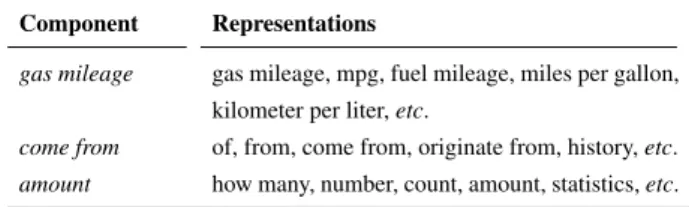
Each component has a set of representations, which are used by users to describe the component in their queries. For example, to describe the component 2000 4runner, users may use 2000 4runner,
4runner, toyota 4runner, toyota 2000 4runner, etc. More examples
are shown in Table 2.
During a session, users choose a representation for each compo-nent of their information need based on their own knowledge and experience to formulate a query, which means that each term in the query is an input that describes the corresponding component of their information need. If the returned results do not satisfy the information need, users may reformulate the query by changing, adding/or removing term(s) in order to locate relevant information, as shown in Table 3.
Struggling component:In a struggling session, we define a
strug-gling component as a component for which user has difficulty to find
an effective representation. For example, for the session shown in Table 1(a), the information need of the session is what sports came
from Australia, which has three components, sport, came from, and Australia. During the session, the user frequently reformulated the
representation of the came from component, which may mean that the user had difficulty finding an effective representation of this component. Thus, came from is the struggling component in this session.
Struggling phrase:Given a query in a struggling session, the
strug-gling phrase of the query is defined as the set of terms in the query
that represent the struggling component of the session. Note that the struggling phrase of a query may be empty. Table 1 shows exam-ples of struggling phrases in a struggling session. For example, the struggling phrases of the four queries in Table 1(a) are{history},
{of}, {from}, and {came, from}.
Table 2: Example components. Component Representations
gas mileage gas mileage, mpg, fuel mileage, miles per gallon, kilometer per liter, etc.
come from of, from, come from, originate from, history, etc.
amount how many, number, count, amount, statistics, etc.
Table 3: Example struggling session for information need where
does donut come from, with components: donut, came from. Terms
between () are input for representing donut, terms between [] are input for representing came from.
Query Division based on components the donut came from where (the donut) [came from where] history of the donut [history of] (the donut) origin of donut [origin of] (donut)
Figure 1: Example of struggling phrase classifier.
4.
Identifying Struggling Phrase
In this section, we explain how we identify the struggling phrases of a struggling session.
4. 1 Problem statement
Given a struggling session with a sequence of queries, our objec-tive is to distinguish the struggling phrase in each query. To this end, we take a machine learning approach and build a struggling phrase classifier. Specifically, for each term in a query of a struggling ses-sion, we classify it into one of two classes, struggling phrase (SP) and non-struggling phrase (NSP), as shown in Figure 1.
4. 2 Features
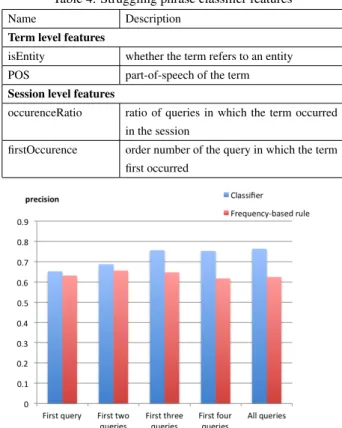
To build the struggling phrase classifier, we designed features for identifying struggling phrases in a struggling session, as shown in Table 4. There are two types of features, i.e., term-level features and session-level features.
• Term-level features: These features describe the
characteris-tics of a term. A term with many alternatives has higher prob-ability to be classified as a struggling phrase because a user may struggle to find an effective representation from these al-ternatives. For example, a term that refers to an entity typically has fewer alternatives. In addition, the part-of-speech of a term may indicate whether it has many (or few) alternatives to a cer-tain degree.
• Session-level features: These features describe the
relation-ships of a term and the session. A term that the user gives up on quickly has high probability of being classified as a strug-gling phrase, and a term that the user keeps in all queries in
Table 4: Struggling phrase classifier features Name Description
Term level features
isEntity whether the term refers to an entity POS part-of-speech of the term Session level features
occurenceRatio ratio of queries in which the term occurred in the session
firstOccurence order number of the query in which the term first occurred
Figure 2: Precision of struggling phrase classifier. the session has high probability of being classified as a non-struggling phrase.
4. 3 Experimental setup
Data.We manually extracted 146 struggling sessions from the AOL query log, which resulted in 540 queries. For each query, we manu-ally labeled terms as a struggling phrase or a non-struggling phrase by checking the query, the search results, and the context of the ssion, assuming we were the searcher with an information need es-timated by the search behavior. We trained the classifier with these labeled data to distinguish struggling phrases and non-struggling phrases of a query for a struggling session.
Baseline.For the baseline, we used the frequency-based method to identify the struggling phrase of a query. This method classifies a term as a non-struggling phrase only when all queries in the session contain the term; otherwise, the term is was classified as a strug-gling phrase.
Setting.We used the support vector machine with a linear kernel to train the classifier. 10-fold cross-validation was used for this exper-iment. Note that the performance of the proposed method depends on the number of queries in a session. To investigate the effect of the number of queries available for the classifier on classification performance, we experimented with several cases by changing the number of queries in a session (e.g., the first query, the first two queries, the first three queries . . ., all queries).
4. 4 Experimental results
Figure 2 shows the precision of the classification obtained by the proposed method and the frequency-based method. The x-axis is the number of queries used by each method to classify a term.
Table 5: Example struggling sessions. Query
2007 lincoln mkz mileage <failed> 2007 lincoln mkz fuel <failed> 2007 mkz fuel per mile <failed> lincoln mkz mpg <successful>
(a)
Query
Honda civic fuel efficiency <failed> Honda civic mileage <failed> Honda civic gas mileage <successful>
(b)
As can be seem, the classifier outperformed the frequency-based method in terms of precision. The precision of the classifier in-creased with an inin-creased number of queries. The precision reached 0.76 when the proposed method used all queries in a session. In contrast, the precision of the frequency-based method did not im-prove with an increased number of queries. One reason for this is that a user slightly modified the terms of non-struggling phrase later in the session.
5.
Generating Effective Query Suggestion
In this section, we first explain how we extract sessions that have the same struggling component as the on-going struggling session. We then introduce the struggling flow graph, how to build the graph, and mine effective representations for the struggling component in order to generate effective query suggestions.5. 1 Mining sessions with the same struggling component As introduced in Section 3, the struggling component is a compo-nent of an information need for which user experiences difficulty to find an effective representation of the component. The same strug-gling component may occur in sessions with different information needs. We have hypothesized that sessions with the same struggling component have similar struggling phrases, and share the same ef-fective representations for the struggling component. Two examples have been shown in Table 1(a) and Table 1(b), in which the first user searched for what sport came from Australia and the second user searched for where does donut came from, wherein both struggled to represent the struggling component came from effectively. Fur-ther examples are shown in Table 5(a) and Table 5(b), where the first user searched for the gas mileage of 2007 lincoln mkz and the second user searched for the gas mileage of Honda civic, and both struggled to represent the struggling component gas mileage effec-tively.
Figure 3 illustrates how we mine sessions with the same strug-gling component from the query log. Given an on-going strugstrug-gling session, we hope to obtain all sessions with the same struggling component as the given session from the query log. Specifically, given an on-going struggling session, we first identify its struggling phrases and retrieve the struggling sessions with the same struggling phrases in their queries from the query log. Then, we again extract the struggling phrases of each retrieved session to obtain more ses-sions with same struggling phrases in a breadth-first-search manner.
5. 2 Struggling flow graph
com-Figure 3: Mining sessions with the same struggling component from query log.
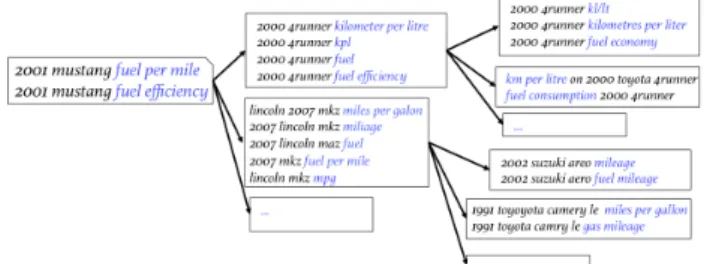
Figure 4: Example of struggling flow graph.
ponent, we then build a struggling flow graph to find the effec-tive representation of the struggling component. The purpose of the struggling flow graph is to aggregate multiple users’ reformu-lation behaviors for the terms of a struggling component and mine the effective representations for the given struggling component. A struggling flow graph extendsthe query flow graph [6]. In the strug-gling flow graph, each node represents a strugstrug-gling phrase of the struggling component. In addition, an edge in the struggling flow graph means that two struggling phrases are consecutive in at least one struggling session.
Here, s0 denote an on-going struggling session for which we
want to provide query suggestions, S = {s1, . . . , sn} denote the
set of sessions mined by the method described in Section 5. 1 , and
V ={v1, . . . , vm} denote the unique set of struggling phrases
ob-tained from S by using the classifier described in Section 4. Formally, the struggling flow graph for sessions S is represented as weighted directed graph GS= (V, E, ω).
• V is the set of nodes in the graph. Each node corresponds to a
struggling phrase.
• E ⊂=V × V is the set of directed edges. If there is at least one
session where two struggling phrases viand vjappear
consec-utively in S, there is a directed edge from vito vj. In addition,
for every vi∈ V there is a self-transitive edge from vito vi. • ω : E → (0..1] is a weighting function that assigns a weight
ω(vi, vj) to each pair of struggling phrases (vi, vj)∈ E. 5. 3 Finding effective representation using struggling flow
graph
Here, we describe how we find the effective representation of the struggling component using the Struggling flow graph. As ex-plained previously, the struggling flow graph is an extension of the query flow graph. In the query flow graph, each node represents a query q and the weight of an edge between two queries qiand qj
is determined by the probability that the user who issued query qi
and reformulate it as query qjin a topically coherent session. To
generate query suggestions for a given query(ies) q, a random walk is applied to the query flow graph with the random walker starting with query(ies) q. We can extract query suggestions according to the value of the stationary distribution of each query.
We follow the idea of the query flow graph, except for the follow-ing differences.
• The struggling flow graph represents a struggling phrase as a
node.
• The struggling flow graph incorporates information about
whether a query appears to be successful or a failure into the graph.
For the former point, differing from the query flow graph, which aggregates all sessions in the query log into a single graph, the struggling flow graph aggregates only the reformulation behaviors of terms rather than queries. This allows us to understand the term-level reformulation behaviors of users, which may address the prob-lem of long-tailed queries.
For the latter point, the failure rate in struggling search is high, which increases the probability of failed query suggestions by the random walk in the graph. To address this problem, we incorporate information about whether a query appears successful or a failure into the graph. Suppose we can predict the effectiveness of each struggling phrase in the graph. Our idea is to add high self-transition probability to the effective struggling phrases. Since a node with high self-transition probability is likely to obtain a high random walk score in the stationary distribution, we expect that adding a high self-transition probability to effective struggling phrases will allow us to find effective struggling phrases for the struggling com-ponent by applying a random walk to the graph.
5. 4 Preparing transition probabilities
In this subsection, we describe how we compute the transition probabilities among the nodes in the struggling flow graph. The assumption behind mining effective struggling phrases is that if one struggling phrase is effective, most users who input it will stop searching as it is effective in helping the users find relevant pages with the information they require. Similarly, if one struggling phrase is ineffective, most users who input it will continue searching as it fails to help the users find the relevant pages. The actual tran-sition probabilities are computed based on the following method. Here, e(vi) represents the number of sessions that end with
strug-gling phrase vi with effective clicks and N (vi, vj) represents the
number of sessions where viand vjoccur consecutively. The flow
information of struggling phrases that occur only a few times are not trustworthy because they are biased due to sparsity. We define the degree of trustworthiness of a struggling phrase to evaluate how trustworthy the flow information of the struggling phrase is, which is represented as td(vi). As a struggling phrase occurs more times,
td(vi) = e(vi) ∑ vj ∈VN (vj,si), if e(si) < threshold 1.0, if e(vi) >= threshold .
The self-transition probability of a node is set as follows.
ω(vi, vi) = td(vi)
e(vi) ∑
vk∈VN (vj, vi) .
For the rejected self-transition probability due to low trustable de-gree, we averagely distribute them to all struggling phrases in the struggling flow graph as random jump probability rj(vi).
rj(vi) = (1− td(vi))
e(vi) ∑
vj∈V N (vj, vi) .
The weight between different struggling phrases viand vj(i |= j)
is as follows:
ω(vi, vj) = (1− ω(vi, vi)− rj(vi))∑ r(vi, vj)
vj∈Vr(vi, vk)
+rj(vi)
|V | .
Note that the weights calculated based on above weighting func-tions w(·) are already normalized such that their values represent the transition probability among nodes. In addition, note that, the struggling flow graph uses uniform random jump rather than biased random jump, as is the case of the query flow graph, because our struggling flow graph consists of only related sessions, i.e., sessions with the same struggling component.
5. 5 Generating query suggestions
Here, we describe the overall method to generate query sug-gestions for a given on-going session. Given an on-going session
s0={q1, . . . , qn}, where n represents the number of queries in the
session, we first identify the struggling phrases of the session using the method described in Section 4. We then mine the set of sessions
S using the method described in Section 5. 1 and build the
strug-gling flow graph GS. Then, we apply a random walk to the graph
and extract the top k nodes according to their random walk values in stationary distribution. Finally, we generate the query suggestions by replacing the struggling phrases of the last query in the on-going sessions with the top k struggling phrases.
6.
Experiment
In this section, we introduce an experiment conducted to evaluate the effectiveness of the query suggestions generated by the proposed method.
6. 1 Baseline
For the baseline, we used the query flow graph proposed by Boldi
et al. [7]. The query flow graph is a directed graph that aggregates
a query log and has been proven very useful for query suggestions and user behavior analysis. Here, we refer to the baseline method as query flow graph method and the proposed method with the strug-gling flow graph method.
6. 2 Evaluated sessions
To evaluate the effectiveness of the proposed method with diverse struggling sessions, we first manually prepared eight types of strug-gling components by scanning the strugstrug-gling sessions sampled from
Table 6: Examples sessions. Strugglig component Example session
gas mileage of car
q1: 2001 mustang fuel per mile
q2: 2001 mustang fuel efficiency
q3: 2001 mustang gasoline miles
origin of something
q1: where does the name bonnaroo come from
q2: bonnaroo hisotry
q3: bonnaroo history
best of something
q1: top 25 children hospital
q2: top 25 children’s hospital
q3: number one children’s hospital
the AOL query log. For each struggling component, we manually extracted as many struggling sessions with the struggling compo-nent as possible from the AOL query log. Finally, for each strug-gling component, we randomly sampled 10 strugstrug-gling sessions from the extracted sessions and used them in the experiment(80 sessions in total). Table 6 shows examples of struggling components and their corresponding session.
6. 3 Ground truth
We defined a query suggestion that enables a user to locate rele-vant pages as an effective suggestion. To create ground truth query data, for each session described in the previous subsection, we first simulated the session user and attempted to understand the user’s search intent as best as possible. For each of the top 10 query sug-gestions generated by a method, we issued the suggestion to a com-mercial search engine and examined whether there were relevant pages for the user’s information need in the first page of the search results. If there was at least one relevant document in the search results page, the suggestion was considered effective; otherwise the suggestion was considered ineffective.
6. 4 Evaluation metrics
The following metrics were employed to measure the perfor-mance of query suggestions.
• Support rate: The ratio of sessions for which at least one
query suggestion could be offered.
• Effective support rate@10: The ratio of sessions in which
one or more effective query suggestions were offered in the top 10 query suggestions.
• MRR@10: Mean reciprocal rank (MRR) of the top 10 query
suggestions.
• nDCG@10: Normalized discounted cumulative gain (nDCG)
of the top 10 query suggestions. Here, we used binary rele-vance for the evaluation. An effective query suggestion had relevance of 1, while an ineffective query suggestion had rele-vance of 0.
6. 5 Setting
We used all the prepared labeled struggling sessions prepared (Section 4.2) to train the struggling phrase classifier, which was used to detect struggling phrases of a session. In addition, as with the ex-periment explained in Section 4. 3, we exex-perimented with several cases by changing the number of available queries in a session.
Figure 5: Mean support rate
Figure 6: Mean effective support rate@10
Figure 7: MRR@10
Figure 8: Mean nDCG@10 6. 6 Results
Figure 5 shows the mean support rate obtained by the baseline method and the proposed method. As can be seen, the performance to generate query suggestions for struggling sessions improved as the number of available queries increased for both the query flow graph and the struggling flow graph. However, the query flow graph could not generate any query suggestion for 69% of the struggling
Table 7: Example struggling sessions Query
q1: average mileage for ford mustang
q2: 99 mustang mileage
(a)
Query
q1: history of baseball
q2: country and origin of baseball
(b)
Table 8: Query suggestions for struggling session in Table 7(a). Suggestions
Not available.
(a) Suggestion by baseline.
Suggestions
1st: 99 mustang gas mileage 2nd: 99 mustang mileage rate 3rd: 99 mustang fuel mileage 4th: 99 mustang distance 5th: 99 mustang mileage deduction (b) Suggestion by proposed method. sessions even when it could use all queries in the session. This was primarily because information needs for many struggling ses-sions are long-tailed; thus, the queries in struggling search are also long-tailed queries, which may never occur in the query log. On the other hand, the struggling flow graph could generate query sugges-tions for significantly more sessions than the query flow graph. This shows that considering struggling phrases in a session rather than the queries themselves allows us to address the problem of long-tailed queries. Figures 6, 7, and 8 summarize the mean effective support rate@10, MRR@10 and mean nDCG@10, respectively. From Figure 6, we can observe that the effective support rate@10 is much lower than the support rate for both the query flow graph and the struggling flow graph, which means that only a portion of the sessions were provided effective query suggestions among the ses-sions for which the given method could provide query suggestions. Similar to the support rate, the struggling flow graph outperformed the query flow graph significantly relative to generating effective query suggestions. The struggling flow graph generated effective query suggestions for 35% of the sessions, and the query flow graph generated effective query suggestions for only 7.5% of the sessions, even when it used all queries of the sessions. From Figures 7 and 8, we can see that the ranking performance increased with an increas-ing number of available queries for both the query flow graph and the struggling flow graph. The struggling flow graph also outper-formed the query flow graph in terms of the ranking performance of effective query suggestions. When using all queries in the session, the proposed method achieved MRR@10 of 0.113 and nDCG@10 of 0.166, and the baseline method achieved MRR@10 of 0.043 and nDCG@10 of 0.058.
Two detailed examples of struggling sessions used in the experi-ment are shown in Table 7(a) and Table 7(b). For the struggling ses-sion shown in Table 7(a), the user struggled to find the gas mileage
of ford 99 mastang. The query suggestions generated by query flow
graph are shown in Table 8(a), and those generated by the struggling flow graph are shown in Table 8(b). As can be seen, no query sug-gestion was generated by the query flow graph because the queries
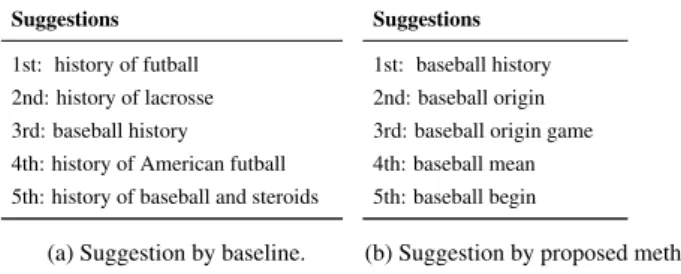
Table 9: Query suggestions for struggling session in Table 7(b). Suggestions
1st: history of futball 2nd: history of lacrosse 3rd: baseball history 4th: history of American futball 5th: history of baseball and steroids
(a) Suggestion by baseline.
Suggestions
1st: baseball history 2nd: baseball origin 3rd: baseball origin game 4th: baseball mean 5th: baseball begin
(b) Suggestion by proposed method. in the session shown in Table 7(a) never occurred in the query log because the information need of the session was a long-tailed infor-mation need. For the struggling flow graph method, we first distin-guish the struggling component of the session and then mine the ef-fective struggling phrases to generate query suggestions, that maybe effective for the user’s information need.
Another example struggling session is shown in Table 7(b), where the user struggled to find information about the origin of baseball. The query suggestions generated by the query flow graph are shown in Table 9(a), and the query suggestions generated by the struggling flow graph are shown in Table 9(b). Several query suggestions were generated by the query flow graph; however, none were effective because they were either failed queries for the same information need or a query for another information need. As noted previously, most queries in a struggling session are failed queries and the query flow graph aggregates all information from a query log and does not guarantee consistency of the information need. The struggling flow graph method only retrieved sessions that with potentially the same struggling component, which guarantees consistency to some degree and helps to generate several query suggestions that may sat-isfy the user’s information need.
7.
Conclusion
In this paper, we proposed a query suggestion method to help struggling search based on identifying the struggling component of a struggling session and mine effective representations using a struggling flow graph. We conducted an experiment to investigate the effectiveness of the proposed method compared to a baseline. The experimental results show that the proposed method outper-formed the baseline method in terms of support rate, effective sup-port rate@10, MRR@10, and nDCG@10. In the future, we plan to improve the model for identifying the struggling phrase and ex-amine methods to improve the prediction of the user’s information need.
Acknowledgement This work was supported in part by KAK-ENHI (#15H01718).
References
[1] Ahmed Hassan, Ryen W White, Susan T Dumais, and Yi-Min Wang. Struggling or exploring?: disambiguating long search sessions. In
WSDM’14, pages 53–62, 2014.
[2] Doug Beeferman and Adam Berger. Agglomerative clustering of a search engine query log. In KDD’00, pages 407–416, 2000. [3] Ricardo Baeza-Yates, Carlos Hurtado, and Marcelo Mendoza. Query
recommendation using query logs in search engines. In Current
Trends in Database Technology-EDBT 2004 Workshops, pages 588–
596, 2005.
[4] Qiaozhu Mei, Dengyong Zhou, and Kenneth Church. Query sugges-tion using hitting time. In CIKM’08, pages 469–478, 2008. [5] Huanhuan Cao, Daxin Jiang, Jian Pei, Qi He, Zhen Liao, Enhong
Chen, and Hang Li. Context-aware query suggestion by mining click-through and session data. In KDD’08, pages 875–883, 2008. [6] Paolo Boldi, Francesco Bonchi, Carlos Castillo, Debora Donato, and
Sebastiano Vigna. Query suggestions using query-flow graphs. In
Workshop on Web Search Click Data, pages 56–63, 2009.
[7] Paolo Boldi, Francesco Bonchi, Carlos Castillo, Debora Donato, Aristides Gionis, and Sebastiano Vigna. The query-flow graph: model and applications. In CIKM’08, pages 609–618, 2008. [8] Rosie Jones, Benjamin Rey, Omid Madani, and Wiley Greiner.
Gen-erating query substitutions. In WWW’06, pages 387–396, 2006. [9] Gary Marchionini. Exploratory search: from finding to
understand-ing. Communications of the ACM, 49(4):41–46, 2006.
[10] David Carmel, Elad Yom-Tov, Adam Darlow, and Dan Pelleg. What makes a query difficult? In SIGIR’06, pages 390–397, 2006. [11] Anne Aula, Rehan M Khan, and Zhiwei Guan. How does search
be-havior change as search becomes more difficult? In CHI’10, pages 35–44, 2010.
[12] Chang Liu, Jingjing Liu, Michael Cole, Nicholas J Belkin, and Xi-angmin Zhang. Task difficulty and domain knowledge effects on in-formation search behaviors. In ASIST’12, 49(1):1–10, 2012. [13] Yang Liu, Ruihua Song, Yu Chen, Jian-Yun Nie, and Ji-Rong Wen.
Adaptive query suggestion for difficult queries. In SIGIR’12, pages 15–24, 2012.
[14] Daan Odijk, Ryen W. White, Ahmed Hassan Awadallah, and Su-san T. Dumais. Struggling and success in web search. In Proceedings
of the 24th ACM International on Conference on Information and Knowledge Management, CIKM ’15, pages 1551–1560, New York,
NY, USA, 2015. ACM.
[15] Ting Yao, Min Zhang, Yiqun Liu, Shaoping Ma, and Liyun Ru. Em-pirical study on rare query characteristics. In WI’11, pages 7–14, 2011.
[16] Francesco Bonchi, Raffaele Perego, Fabrizio Silvestri, Hossein Va-habi, and Rossano Venturini. Recommendations for the long tail by term-query graph. In WWW’11, pages 15–16, 2011.
[17] Francesco Bonchi, Raffaele Perego, Fabrizio Silvestri, Hossein Va-habi, and Rossano Venturini. Efficient query recommendations in the long tail via center-piece subgraphs. In SIGIR’12, pages 345– 354, 2012.
[18] Idan Szpektor, Aristides Gionis, and Yoelle Maarek. Improving rec-ommendation for long-tail queries via templates. In WWW’11, pages 47–56, 2011.
[19] Ryen W White and Susan T Dumais. Characterizing and predicting search engine switching behavior. In CIKM’09, pages 87–96, 2009. [20] Rosie Jones and Kristina Lisa Klinkner. Beyond the session timeout:
automatic hierarchical segmentation of search topics in query logs. In CIKM’08, pages 699–708, 2008.