西 南 交 通 大 学 学 报
第 55 卷第 5 期
2020 年 10 月
JOURNAL OF SOUTHWEST JIAOTONG UNIVERSITY
Vol. 55 No. 5
Oct. 2020
ISSN: 0258-2724 DOI:10.35741/issn.0258-2724.55.5.10
Research article
Arts and Humanities and Electronic Engineering
EFL
L
EARNERS
’
P
ERCEPTIONS ABOUT THE
U
SE OF
M
OBILE
L
EARNING DURING
COVID-19
EFL 學習者對 COVID-19 期間使用移動學習的看法
Mohammed Mahib ur Rahman, Ph.D.
Department of English Language and Translation, College of Arabic Language and Social Studies Qassim University, Qassim, K.S.A., [email protected], [email protected]
Received: June 16, 2020 ▪ Review: September 23, 2020 ▪ Accepted: October 6, 2020
This article is an open-access article distributed under the terms and conditions of the Creative Commons Attribution License (http://creativecommons.org/licenses/by/4.0)
Abstract
Mobile learning has recently emerged as a powerful and frequently used tool in the teaching-learning curriculum. Besides, it also attracted the attention of EFL teachers and learners across the globe. Its acceptance in EFL learning is mainly because of the two fundamental functions, i.e., anytime and anywhere. As a result, the pioneers and scholars who work in second or foreign language learning have largely recognized its impact and importance. Furthermore, since the outbreak of the COVID-19 pandemic, the regular traditional classes have been severely affected, and teaching has been carried out by online method. As a result, mobiles and tablets have primarily been used along with other electronic gadgets. Therefore, this paper aims to examine EFL learners' perceptions about m-learning for their learning activities during COVID-19 at Qassim University, Saudi Arabia. A questionnaire has been prepared by keeping the use of the mobile device in view that can benefit Saudi EFL learners, and distributed among 50 EFL male and female students. Later, a quantitative analysis of the responses has been done by using SPSS 26. The study identified healthy and positive perceptions of m-learning. The significant findings will be valuable for the teachers and administrators concerning m-learning in language teaching.
Keywords: EFL Learning, EFL Learners’ Perception, Mobile Learning, Mobile Device.
摘要 移動學習最近已成為教學課程中 一 種功能強大且經常使用的工具。此外,它還吸引了全球 EFL 師生的關注。它在 EFL 學習中的接受主要是由於兩個基本功能,即隨時隨地。結果,從事第 二語言或外語學習的開拓者和學者已在很大程度上認識到它的影響和重要性。此外,自 COVID-19 大流行爆發以來,常規的傳統課堂受到嚴重影響,並且已經通過在線方法進行了教學。結果, 手機和平板電腦已主要與其他電子產品一起使用。因此,本文旨在考察 EFL 學習者在沙特阿拉伯 Qassim 大學舉行的 COVID-19 期間對他們的學習活動進行移動學習的看法。考慮到可以使沙特 EFL 學習者受益的原因,通過使用移動設備來準備一份調查表,並在 50 名 EFL 男女學生中分發
。後來,通過使用 SPSS 26 對響應進行了定量分析。該研究確定了對 m 學習的健康和積極認識。 這些重大發現對於教師和管理人員進行語言教學中的移動學習非常有價值。
关键词: EFL 學習,EFL 學習者的感知,移動學習,移動設備
I. I
NTRODUCTIONRapid technological development has transformed human life in every possible way, including its inevitable use in the education sector. The researcher believes that its incorporation in education has two significant impacts; it connects the target audience or learners in a single tap globally. On the other hand, it made the education cheaper and affordable with the ease of anywhere and anytime accessibility. Technological advancement in education aims to teach-learning tasks that occur along with traveling, working, socializing, etc. Notably, the importance of learning through technology becomes more pertinent and essential in the situation like COVID-19.
We live in the 21st century, which is known for the technological wave that directly impacts human life. People are too addicted to technological stuff to perform several activities related to lifestyle, social interaction, knowledge, etc. through several electronic gadgets like laptops, mobiles, tablets, etc. Such devices are also used to learn EFL globally. A better implementation of technology for teaching-learning activities may redefine the way people earlier use to do. The technology is proven to be the only support system that made teaching-learning tasks possible when the world has seen overnight migration of physical classrooms into online classrooms due to COVID-19 spread. Therefore, the author sees the mobile device's role as a useful and much needed tool to deliver teaching material to the students.
Further, teachers and learners make use of technology for educational purposes over time. The first technological discovery is a computer that has largely been employed for teaching (CALL). Later, mobile devices have come into the market and revolutionize the world (MALL). Moreover, teachers started using it for classroom teaching or distant learning program. Further, this is also considered that the mobile device has surpassed the number of laptop users. Therefore, the mobile learning approach is going to dominate the education sector in the near future. Currently, global users of the mobile device are 3.5 billion, and this has been estimated that by 2021 this will hit 3.8 billion marks. India, China, and the USA hold significant shares worldwide.
Due to the deep penetration of m-learning in our day to day life, every country aims to provide access to the required information to its whole population in the coming days. Meanwhile, the growing demand for technology has pushed it to adopt for teaching-learning curriculum more quickly to establish better interaction between the teachers and students. This will undoubtedly bring a positive change in the research curriculum and higher education system that will last in the future too. This adoption is centrally based on the two principles, i.e., anywhere and anytime learning access and further to support individual learning or self-learning. All such goals can better be achieved with the use of a mobile device for learning English.
This paper aims to shed light on ESL learners' perceptions of using the m-learning approach for ESL learning at Qassim University, Saudi Arabia. The total number of participants was 49, out of which 25 males and 24 females.
II. L
ITERATURER
EVIEWAmidst lockdown, the researcher has deeply engaged in conducting studies on several studies, including the education sector. A handful of researchers have also been conducted on the learning activities, especially from the COVID-19 perspective. Similarly, Fansury et al. [1] conducted a study on the millennial EFL learners and their perception about digital content. Overall, the study finds it useful during COVID-19.
Significantly, the impact of m-learning is quite significant and demanding, too, for teaching-learning activities. Further, they argued for detailed investigation from different teaching perspectives and advocated integrating m-learning techniques for teaching-learning activities. Furthermore, Ozdamli and Cavus [2] unearth the qualities that justify its increasing acceptance among teachers and students: ubiquitous, portable, blended, private, interactive, collaborative, and instant. Based on the fact that m-learning is seen as portable because it provides students with anytime and anywhere access [3] ubiquitous in nature because it is seen as a modern technique that supports anywhere anytime learning in contrast to traditional classrooms [3], [4], and treated as blended
3
because it offers instructors to blend it along with the traditional technique [5], and that helps to increase the opportunity to face to face interaction [6]; it is also interactive based on the reality that it gives more interactive learning environment [7]; collaborative since it enables learners to participate in more collaborative learning activities with instructors, classmates, and peers [8]; instant too, as this also provides the facility/features through which learning material and teaching instruction can be downloaded, seen, or browsed instantly [9].
III. S
TUDYO
BJECTIVESThis study offers a descriptive account of investigation about the perception of EFL learners to the use of m-learning for EFL learning. This study determines students' actual perception, and resulting feedback will help the instructor design the digital material according to the learners' needs and requirements. Further, the genders and educational level (graduate and post-graduate) have taken into consideration to understand the specific issues and challenges, which will also help the instructor, consider the customized material based on individual preferences. Lastly, the study further expands items like the prior experience of m-learning, hours spent on m-learning, most useful educational learning apps, etc. to offer a better understanding of the acceptability of mobile devices for educational purposes among EFL learners of Qassim University, Saudi Arabia.
IV. M
ETHODS/
M
ATERIALSa) Target Audience
The present study aims to collect the data from 50 EFL learners enrolled at the Department of English Language and Translation, QassimUniversity, Saudi Arabia. The target age group is between 20 to 30 years and belongs to both the genders, i.e., 25 male and 25 female students.
b) Tools Employed for Analysis
The questionnaire is prepared based on some early studies that aim to measure students' perceptions about the use of m-learning. The questionnaire includes 16 items. As this study targets only EFL learners (as an ultimate recipient); therefore, only one set of the questionnaire has been prepared and circulated among the students. The organization of the questionnaire is split into two parts, i.e., part-I that mainly covers the demographic information of the participants followed by the general question related to the tools/device used mobile,
tablet, phablet, etc., and also about the prior experience to learning, time spent on m-learning, etc. The second part of the questionnaire is framed by keeping the perception aspect in view. The questionnaire is prepared using the five (5) point Likert-scaling system ranging from strongly disagree (SD), disagree (D), neutral (N), agree (A), to strongly agree (SA). The questionnaire includes a total number of 20 items (out of which one is open-ended).
c) Following Steps
The present study aims to make a quantitative investigation of the collected data. The questionnaire was circulated among 50 EFL learners (both undergraduate and post-graduate) of session 2019-20 using electronic medium (e-mail, WhatsApp, and Facebook, etc.). Further, the analysis has been done based on the students' valid responses against the target survey. To perform the task of analysis SPSS 26 software has been used to determine the percentage, frequency, and standard deviation.
V. R
ESULTS ANDD
ISCUSSIONThis sub-section expands on the results of the EFL learner's perception of the use of m-learning followed by the discussions, respectively. In this section, two tables have been shown, which first presents the respondents' demographic details (includes, age, gender, and educational qualification). While the second table deals with the students' overall valid responses against each item asked to determine their perception about m-learning. The concerned split into two parts; the first column mentions the questions/items, whereas the following columns show the valid response percentage ranging from SD to SA.
a) Learners Background Details
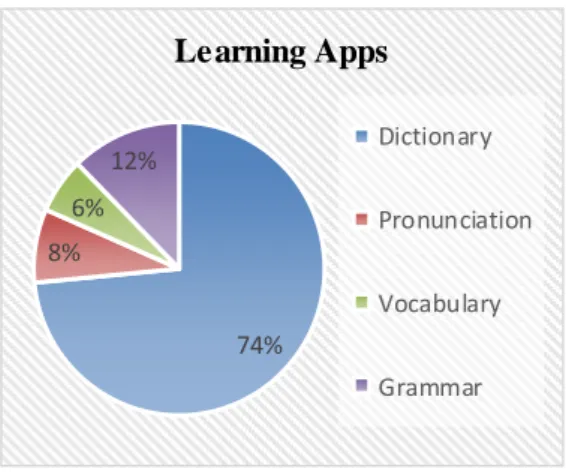
This sub-section is dedicated to the background information, demography (see table 1), and the learners' statistical information. Further, the types of electronic gadgets used by the learners are shown in Figure 1. Learning applications are used by the learners (see Fig. 2). Furthermore, the frequency of using m-learning for learning activities has also been mentioned in below Table 2. Lastly, Fig. 3 shows the results of the m-learning usage for language skills.
Table 1.
Demographic details of the learners
Gender Frequency Percentage
Male 25 51.0 Female 24 49.0 Total 49 100
Table 2.
Learners interaction to use m-learning
Days Frequency Percentage (%)
Daily 41 83.7 2-3 days 7 14.3 4-6 days 1 2.0 Never - - Total 49 100.0 86% 8%6%0%
Device used for learning
Mobile Laptop Tablet Others
Figure 1: Electronic devices used for learning
74% 8% 6% 12% Learning Apps Dictionary Pronunciation Vocabulary Grammar
Figure 2: Educational apps used by learners
b) Learners perception about m-learning
The perception of EFL learners has been presented in Table 3. The table is organized into two main sections; the first section shows the items (questions) followed by the response column 45% 37% 10%8% Language Skills Listening Reading Speaking Writing
Figure 3: M-learning used for language skills
from strongly agree (SA), agree (A), neutral (N), disagree (D), and strongly disagree (SD).
c) Discussion
Now moving to the interpretation of the result, each item’s result will be illustrated further. To conduct this study total of 16 items (close-ended) have been asked from the EFL students to determine their perception and attitudes towards the use of m-learning during COVID-19. From the above data, for item number 1, we have received responses where 19 choose strongly agree (38.8%), 25 agree (51.0%), 4 neutral (8.2%), 1 disagree (2.0%), and none disagreed. Similarly, for item 2, the data response shows that 14 strongly agree (28.6%), 26 agree (53.1%), 9 neutral (18.4%), and none of the respondents either disagree or strongly disagree. Item number 3, the respondents have given their responses like 10 strongly agree (20.4%), agree 29 (59.2%), 8 neutral (16.3%), 2 disagree (4.1%), and none choose strongly disagree. Item number 4 receives the response, 12 strongly agree (24.5%), agree (65.3%), 5 neutral (10.2%), however, none select disagree and strongly disagree option. Item 5 reveals that 10 strongly agree (20.4%), 32 agree (65.3%), 7 neutral (14.3%), and none of the respondents either hit disagree or strongly disagree choice. Item 6 says that, 16 strongly agree (32.7%), 18 agree (36.7%), 14 neutral (28.6%), 1 disagree (2.0%), and no response for strongly disagree. Item 7 offers that, 6 strongly agree (12.2%), 32 agree (65.3%), 9 neutral (18.4%), 2 disagree (4.1%), and strongly disagree remains untouched. Item number 8 reveals that 30 strongly agree (61.2%), 10 agree (20.4%), 7 neutral (14.3%), 2 disagree (4.1%), and strongly disagree again remains blank. Item 9 receives, 7 strongly agree (14.3%), 33 agree (67.3%), 7 neutral (14.3%), and 1 disagree (2.0%), and strongly disagree (2.0%). Item 10, 16 strongly
5
Table 3.
Showing the response against each item about m-learning perception
Items
SA A N D SD
No. % No. % No. % No. % No. %
1. Does mobile learning help EFL learners in acquiring
language proficiency? 19 38.8 25 51.0 4 8.2 1 2.0 - -
2. Do you agree that mobile learning has a positive impact on
EFL learners’ behavior? 14 28.6 26 53.1 9 18.4 - - - -
3. Do you agree that overall mobile learning is effective for EFL learners in terms of their learning achievements?
10 20.4 29 59.2 8 16.3 2 4.1 - -
4. EFL learners can complete their tasks/ assignments easily and quickly through mobile learning. Do you agree?
12 24.5 32 65.3 5 10.2 - - - -
5. Do you agree that mobile learning helps EFL learners to
acquire the required knowledge? 10 20.4 32 65.3 7 14.3 - - - -
6. Do you agree that mobile learning motivates EFL learners to study more and work on their assignments?
16 32.7 18 36.7 14 28.6 1 2.0 - -
7. Do you agree that mobile learning enables EFL learners to build a large vocabulary repertoire?
6 12.2 32 65.3 9 18.4 2 4.1 - -
8. Do you think that using e-dictionaries found in mobiles can help the student understand better the semantics of the English word?
30 61.2 10 20.4 7 14.3 2 4.1 - -
9. Do you think that mobile learning helps EFL learners to
minimize grammatical mistakes? 7 14.3 33 67.3 7 14.3 1 2.0 1 2.0
10. Do you think that mobile learning helps EFL learners to
minimize spelling mistakes? 16 32.7 24 49.0 7 14.3 2 4.1 - -
11. Mobile learning is effective
for listening skills. Do you agree? 7 14.3 35 71.4 5 10.2 1 2.0 1 2.0
12. Mobile learning is effective
for speaking skills. Do you agree? 7 14.3 32 65.3 9 18.4 1 2.0 - -
13. Mobile learning is effective
for writing skills. Do you agree? 7 14.3 26 53.1 13 26.5 3 6.1 - -
14. Mobile learning is effective
for reading skills. Do you agree? 18 36.7 23 46.9 7 14.3 1 2.0 - -
15. Do you think that mobile learning provides more learning materials, as a result, more learning achievements?
5 10.2 34 69.4 8 16.3 2 4.1 - -
16. Do you think that mobile learning overall helps EFL learners to improve the English language skills at all four linguistic levels (listening, reading, speaking, and writing)?
8 16.3 31 63.3 6 12.2 4 8.2 - -
agree (32.7%), 24 agree (49.0%), 7 neutral (14.3%), 2 disagree (4.1%), and none select strongly disagree. Item 11 gets, 7 strongly agree (14.3%), 35 agree (71.4%), 5 neutral (10.2%), 1 disagree (2.0%), and 1 strongly disagree (2.0%). Item 12 receives, 7 strongly agree (14.3%), 32 agree (65.3%), 9 neutral (18.4%), 1 disagree
(2.0%), and none strongly disagree. Item 13, 7strongly disagree (14.3%), 26 agree (53.1%), 13 neutral (26.5%), 3 disagree (6.1%), and strongly disagree remains blank. Item 14, 18 strongly agree (36.7%), 23 agree (46.9%), 7 neutral (14.3%), 1 disagrees (2.0%), while strongly disagree has not received any response.
Item 15 says that, 5 strongly agree (10.2%), 34 agree (69.4%), 8 neutral (16.3%), 2 disagree (4.1%), and strongly disagree remains blank. Finally, Item 16 receives, 8 strongly agree (16.3%), 31 agree (63.3%), 6 neutral (12.2%), 4 disagree (8.2%), strongly disagree again got no response.
Following the result interpretation the study further expands on the discussion. Learners response reveals that, they bear a positive perceptions towards using m-learning for their learning need. The increased usage of mobile device among EFL learners i.e. 84% out of the total number of respondents (see Fig. 1) for receiving learning material shows the vital significance of m-learning in EFL learning. This also highlights the interaction between mobile device and learners that can be fully utilised for EFL teaching learning needs. Further, this result can be utilised by the education planners of Saudi Arabia in future. The results presented in Table 2 above further indicates the chest pumping positive perception of the EFL learners about the use of m-learning. Out of 16 items, only Questions 9 and 11 receives the strongly disagree by one respondents. However, the ratio of disagree is bit higher than strongly disagree but that is not so significant to influence the results in terms of negative perception of EFL learners. Further, most of the respondents either choose strongly agree or agree option against each item. Therefore, the researcher also realises the efficacy of the mobile device especially about its use in EFL teaching-learning activities.
Finally, based on the results of this study and other previous studies [10], it can be said that, m-learning is the future dealer of the education in Saudi Arabia.
VI. C
ONCLUSIONIt is better to determine the perception and attitudes of users before implementing m-learning as a teaching tool. Therefore, this study has been conducted to understand the perception of its users. This study results further reveal that the EFL learners bear a healthy and positive perception about mobile device use for teaching-learning activities, especially when the world is going through lockdown phases during the COVID-19. M-learning makes learning more comfortable as it enables the students with the anytime-anywhere facility. The use of m-learning also promotes isolation, hence effectively connecting with groupmates/classmates and collaborators while maintaining social distancing protocols.
Further, the respondents also say that using m-learning is flexible and comfortable, as there are no time-bound or location barriers than physical classrooms. The respondents also reveal that using m-learning more time is spent on learning without actual realization of total time spent. As a result, more time spent more learning takes place. Therefore, overall they feel motivated about using m-learning. However, it cannot be denied some claims about the internet connectivity issues and lack of prior familiarity with m-learning, which results in issues like difficulty in task completion, and sometimes lack teacher-student interaction.
R
EFERENCES[1] FANSURY, A. H., JANUARTY, R., and
WIRARAHMAN, A. S. (2020) Digital
content for millennial generations: Teaching
the English foreign language learner on
COVID-19 pandemic. Journal of Southwest
Jiaotong
University, 55(3).
[Online]
Available
from:
http://www.jsju.org/index.php/journal/article/
download/630/624 doi:
10.35741/issn.0258-2724.55.3.40
[2] OZDAMLI, F., and CAVUS, N. (2011).
Basic elements and characteristics of mobile
learning. Procedia - Social and Behavioral
Sciences, 28, pp. 937-942.
[3] CAVUS, N., and IBRAHIM, D. (2009).
m-Learning: An experiment in using SMS to
support learning new English language
words. British
Journal
of
Educational
Technology, 40(1), pp. 78-91.
[4] KUKULSKA-HULME, A. (2009). Will
mobile
learning
change
language
learning? ReCALL, 21(2), pp.157-165.
[5] AL-SHARHAN, S. (2016) Smart
classrooms in the context of
technology-enhanced learning (TEL) environments. In:
ALLY,
M.
and
ALSHAHRANI,
K.
Transforming Education in the Gulf Region:
Emerging
Learning
Technologies
and
Innovative Pedagogy for the 21st Century.
London: Taylor & Francis, pp.35-42.
[6] OCAK, M. A. (2011) Blend or not to
blend: a study investigating faculty members’
perceptions of blended teaching. World
Journal on Educational Technology, 2(3),
7