Polynomial
Time Inductive Inference of Ordered
Term
Trees
with
Contractible
Variables from
Positive
Data
鈴木祐介 (Yusuke Suzuki), 正代隆義 (Takayoshi Shoudai)
九州大学システム情報科学
{
府,
研究院}
情報理学 {専攻, 部門}
Department of Informatics, Kyushu University
{
y-suzuki.
shoudai}@i.
kyushu-u.ac.jp松本哲志(SatoshiMatsumoto)
東海大学 理学部 情報数理学科
Departmentof Mathematical Sciences, Tokai University
内田智之 (Tomoyuki Uchida), 宮原哲浩(Tetsuhiro Miyahara)
広島市立大学 情報科学部
FacultyofInformation Sciences, Hiroshima City University
{
uchida@cs,miyahara@its}.hiroshima-cu.ac.jp1Introduction
Due to the rapid growth of Internet usage, tree structured data such
as
Web documents have beenrapidly increasing. In orderto analyze such tree structured data,efficientlearning from treestructured databecomes
more
andmore
important. Tree structured data suchas
$\mathrm{H}\mathrm{T}\mathrm{M}\mathrm{L}/\mathrm{X}\mathrm{M}\mathrm{L}$filesare
representedby rooted treeswithorderedchildrenandedge labels [1]. In ordertorepresentatree structured pattern
common
to such tree structured data,we
proposedan
ordered term tree, which is arooted tree withordered children and structured variables [7]. Avariable can be substituted by an arbitrary tree. An
ordered term tree $t$ is said to be regular if all variable labels in $t$
are
mutually distinct. Many treestructured data such as $\mathrm{H}\mathrm{T}\mathrm{M}\mathrm{L}/\mathrm{X}\mathrm{M}\mathrm{L}$ files have
no
rigid structure and have essential information insubtreescontainingleaves. In ordertodeal with such tree structured data,
we
introduceanew
tyPeofvariable, called acontractible variable, which is regarded
as
an
anonymous
subtree inan
ordered term tree and matches any subtree including asingleton vertex. Ausual variable, calledan
uncontractible variable, in aterm tree does not match asingletonvertex.The languageof aregular ordered term tree$t$is the set of all ordered trees which
are
obtained ffom $t$bysubstitutingordered trees for variablesin $t$. The language of aregular ordered termtree$t$ shows the
representingpowerof$t$
.
Aleastgeneralized regular ordered term tree$t$explaining given tree structureddata$S$is aterm tree$t$whoselanguage contains$S$ and is minimal. Considerthe examples in Fig. 1.The
term tree$t_{2}$ isaleast generalized regularordered term tree forTi, $T_{2}$ and$T_{3}$
.
Theorderedterm tree$t_{1}$also explains thethree trees. But $t_{1}$ explains any tree with 2or
more
vertices. So$t_{1}$ isovergeneralizedandmeaningless.
Let$\Lambda$be aset of edge labels usedintreestructured data.
$\mathcal{O}\Gamma\Gamma_{\Lambda}^{c}$denotes thesetofall regular ordered
term trees all of whose contractible variables
are
adjacent toleaves. Firstwe
givean
efficientpolynomialtime algorithmfor deciding whether
or
not agiven regularordered term tree in $m_{\Lambda}^{c}$ matchesatree,where$|\Lambda|\geq 1$
.
Secondwhen $|\Lambda|\geq 2$,we
give apolynomial time algorithm forfindingaleastgeneralizedregular ordered term tree in $\mathcal{O}\Gamma\Gamma_{\Lambda}^{\mathrm{c}}$ which explains all given data. These results imply that the class $O\Gamma\Gamma_{\Lambda}^{\mathrm{c}}$ with $|\Lambda|\geq 2$is polynomial timeinductively inferablefrom positivedata.
An ordered term treeisdifferent fromother representations ofordered treestructured patterns such
as
in [2, 4,13]inthatan
orderedtermtreehas structured variables whichcanbe substituted by arbitrary orderedtrees.Weshowedthatsome
classes ofregularunordered termtreelanguagesare
polynomial timeinductivelyinferable frompositive data$[5, 8_{\lambda}9]$
.
In $[10, 12]$,we
showedthatsome
fundamental classes ofregular ordered term tree languageswithout’ any contractible variable
are
polynomial timeinductivelyinferable from positive data. In [6],
we
showed thatsome
classes of regular ordered term treelanguageswithout any contractible variable
are
exactlylearnableinpolynomialtimeusingqueries.In [7],we
gaveadata mining method from semistructured data usingordered termtrees.
数理解析研究所講究録 1325 巻 2003 年 69-74
$\mathrm{n}2\mathrm{O}$
$g_{2}$
Fig. 1.Term trees$t_{1}$, $t_{2}$ andtrees $T_{1}$, $T_{2}$ and$T_{3}$
.
An uncontractible (resp. contractible) variable is representedbyasingle(resp. double) lined box with lines toits elements. The labelinsideabox is the variable label of the variable.
2Ordered
Term Trees
with
Contractible Variables
Let$T=(V_{T}, E_{T})$ bearooted tree with ordered children (orsimplyatree) whichhas aset $V\tau$of vertices
andaset $E_{T}$ of edges. Let $E_{g}$ and $H_{g}$ beapartition ofEt, i.e., $E_{g}\cup H_{\mathit{9}}=E_{T}$ and $E_{g}\cap H_{g}=\emptyset$
.
And
let $V_{g}=V_{T}$
.
Atriplet $g=$ $(V_{g},E_{g}, H_{g})$ is calleda
$tem$ tree, and elements in $V_{g}$, $E_{g}$ and $H_{g}$are
called avertex,an
edge and avariable, respectively. Weassume
that every edge and variable of aterm tree islabeledwith
some
words fromspecified languages. Alabel ofavariable is called avariable label. $\Lambda$ and$\mathrm{X}$ denote aset of edge labels and aset of variable labels, respectively, where $\Lambda$$\cap X=\phi$
.
For atermtree$g$ and its vertices $v_{1}$ and $v:$, apath ffom $v_{1}$ to $v_{i}$ is asequence$v_{1}$,$v_{2}$,$\ldots$,$v$
:of
distinct vertices of9such
that for any$j$ with $1\leq j<i$,there existsan
edgeor
avariable which consists of$v_{j}$ and $v_{j+1}$.
Ifthere is
an
edgeor
avariablewhich consistsof$v$ and$v’$ such that $v$ lieson
the path fromthe root to $v’$, then $v$is said to be the parent of$v’$ and $v’$ is achild of$v$.
We useanotation $[v, v’]$ to represent avariable $\{v, v’\}\in H_{g}$ such that $v$isthe parent of$v’$. Then
we
call$v$ the parent portof $[v, v’]$ and$v’$ thechild port of$[v,v’]$
.
Definition 1. Let$X^{c}$be adistinguished subsetof$X$. We call variable labels in$X^{c}$controctible variable
labels.
Acontractible
variable labelcan
be attached to avariable whose child port is aleaf. We callavariable with acontractible variable label acontractible variable, which is allowed to substitute
atree with asingleton vertex, as stated later. We call avariable which is not acontractible variable
an uncontractible variable. For avariable$[v,v’]$, when
we
pay attention tothe kind ofthe variable, wedenote by $[v,v’]^{\mathrm{c}}$ and $[v, v’]^{u}$ acontractible variable and
an
uncontractible variable, respectively.Atermtree $g$ is called ordered if
every
internal vertex$u$in $g$ has atotal orderingon
all children of$u$
.
The orderingon
the children of$u$ is denoted by $<_{u}^{g}$.
An ordered term tree9is
called regularifan
variablesin$H_{g}$ have mutually distinct variable labels in $X$
.
For aset $S$, the numberof elements in$S$ isdenoted by $|S|$.
Definition 2. An ordered termtree with
no
variableiscalledaground ordered termtree, which isastandard ordered tree. $\sigma r_{\Lambda}$ denotesthe set ofallground orderedtermtrees whoseedge labels
are
inA. $\mathcal{O}\Gamma\Gamma_{A}^{\mathrm{c}}$ denotesthe set of all ordered term trees with contractible
or
uncontractible variables whose edgelabelsare
in $\Lambda$.
In thispaPer,
we
treatonlyregularordered term trees with contractible variables.Therefore
we
call itaterm
tree simplyLet $f=(V_{f}, E_{f}, Hf)$ and $g=(V_{g},E_{g}, H_{g})$ be term trees. We say that $f$ and $g$
are
isomorphic, denoted by $f\equiv g$, if there is abijection $\varphi$ from $V_{f}$ to $V_{g}$ such that (i) the root of $f$ is mapped tothe root of$g$ by $\varphi$, (ii) $\{u, v\}\in E_{f}$ ifand only if $\{\varphi(u), \varphi(v)\}\in E_{g}$ and the two edges have the
same
edge label, (iii) $[u,v]\in Hf$ if and only if $[\varphi(u), \varphi(v)]\in H_{g}$, in particular, $[u, v]^{\mathrm{c}}\in H_{f}$ ifand only if$[\varphi(u), \varphi(v)]^{\mathrm{c}}\in H_{\mathit{9}}$, and (iv) for any internal vertex $u$ in $f$ which has
more
thanone
child, and for anytwo children $u’$ and$u’$ of$u$, $u’<_{u}^{f}u’$ ifandonly if$\varphi(u’)<_{\varphi(u)}^{g}\varphi(u’)$
.
Let $\sigma=[\mathrm{u},\mathrm{v}]$’] be alist of two vertices in $g$ where $u$ isthe root of$g$ and$u’$ isaleaf of$g$
.
The form$x:=[g, \sigma]$ is called abinding for $x$
.
If$x$ is acontractible variable label in $X^{c}$, $g$may
be atree witha
singleton vertex$u$ and thus $\sigma=[u,u]$.
It is the onlycase
that atreewith asingleton vertex is allowedfor abinding. Anew term tree$f[x :=[g,\sigma]\}$isobtained byapplying the binding$x:=[g, \sigma]$ to$f$in the
following way. Let $e=[v, v’]$ be avariable in $f$ with the variablelabel $x$
.
Let $g’$ beone
copy
of$g$ and$w$,$w’$ thevertices of$g’$correspondingto$u$,$u’$of$g$, respectively. For the variable$e=[v, v’]$,
we
attach$g’$to $f$by removingthevariable $e$ from $H_{f}$ andby identifyingthe vertices$v,v’$ with the vertices $w$,$w’$of
$g’$,respectively.If$g$isatree withasingleton vertex, i.e., $u=u’$,then$v$becomes identical to$v’$ afterthe
binding. Asubstitution $\theta$is afinite collection of bindings
$\{x_{1}:=[g_{1},\sigma_{1}], \cdots,x_{n}:=[g_{n}, \sigma_{n}]\}$, where$x_{i}$’s
aremutually distinct variable labels in$X$
.
The term tree $\mathrm{f}\mathrm{O}$,
called the instance of$f$ by $\theta$
,
is obtainedby aPplyingthe all bindings $x::=[g_{i}, \sigma:]$
on
$f$ simultaneously. Furtherwe
defineanew
total ordering$<_{v}^{f\theta}$
on
every vertex$v$ of$f\theta$in anaturalway. In thispaPer,we
omit theexact definition oftheorderingafter applyingabinding to atermtree. Thereaders
can
referit to [10]or
[12].For example, let $t_{2}$ be aterm tree described in Fig. 1and $\theta=\{x:=[g_{1}, [u_{1},v_{1}]],y:=[g_{2}, [u_{2},u_{2}]]\}$
be asubstitution, where$g_{1}$ and$g_{2}$
are
treesin
Fig.1.
Then theinstance
$t_{2}\theta$ of the term tree $t_{2}$ by$\theta$ is the tree $T_{3}$ in Fig. 1.3An Efficient Matching Algorithm for Term Trees
Amatching algorithm for term trees isanalgorithm which decides whether
or
notatermtree$t$matchesatree $T$
.
We gave matching algorithms for term trees withno
contractible variable in [10] and forterm trees withvariables having
more
than two child ports in [11]. In this section,we
give amatching algorithm for$\mathcal{O}\Gamma\Gamma_{\Lambda}^{\mathrm{c}}$ by extending the matching algorithm in [10].Let $t=(V_{t}, E_{t},H_{t})$ and$T=(V\tau,E_{T})$ be aterm tree in $\mathcal{O}\Gamma\Gamma_{A}^{\mathrm{c}}$ andatree in$U\Gamma_{\Lambda}$, respectively. We
assume
that all vertices of aterm tree $t$are
associated with mutually distinct numbers, called vertexidentifiers.
We denote by $I(u’)$ the vertex identifier of$u’\in V_{t}$.
Acorrespondence-set($\mathrm{C}$-set for short)isaset of vertex identifiers, which
are
withor
withoutparentheses, of vertices of$t$.
Avertex
identifierwith parentheses shows that thevertex is achildport ofavariable.
Our
matching algorithm proceeds by constructing $\mathrm{C}$-sets for each vertex of agiventree
$T$ in thebottom-up manner, thatis, from theleavesto the rootof$T$
.
At first,we
constructthe C-set-attachingrule ofavertex$u’$ of$t$
as
follows. Let$c_{1}’$,$\cdots$,$c_{m}’$, beallordered children of$u’$.
The C-set-attachingruleof$u’$ isof the form $I(u’)\Leftarrow J(c_{1}’)$,$\ldots$,$\mathrm{J}\{\mathrm{d}\mathrm{m},$) where $J(c’.\cdot)=I(c_{\dot{1}}’)$ if$\{u’,d.\cdot\}$ is
an
edge, $J(c_{i}’)=I(\emptyset)$if$[u’, d_{}]$ is acontractible variable, $J(d\dot{.})=(I(c^{}.))$ otherwise. $I(\emptyset)$ is aspecial symbol which shows$d_{i}$ is
the child port of acontractiblevariable. TheC-set-attachingrule of$t$, denoted by Rule(t),is defined
as
follows.
Rule(t)$=$
{
$I(u’)\Leftarrow J(d_{1})$,$\ldots$,$\mathrm{J}\{\mathrm{d}${
$)|$ the C-set-attachingrule of allinnervertices}
$\cup$
{
$(I(u’))\Leftarrow(I(u’))|u’$ is the child port ofan uncontractiblevariable}
$\cup\{I(u’)\Leftarrow I(u’)|u’$ has just
one
child and connects tothe child withacontractible
variable}.
The algorithm (Fig. 2)
runs
for $|\Lambda|=1$.
Amatching algorithm for $|\Lambda|\geq 2$can
beeasily constructedffomthis algorithm. The only workwe have todo is tocheck whether
or
notedgelabels of atreeis thesame
as
corresponding edgelabels of aterm tree at thefirst foreach-loop of$\mathrm{C}$-SET-ATTACHING.
Thenwe can
prove this theorem in asimilarway
to the proof of the correctness of the matching algorithmfor aterm tree [10].
Theorem 1. Let$t$ be
a
term tree with$n$ vertices in$m_{A}^{\mathrm{c}}$ and$T$a
tree with $N$ vertices in$\mathcal{O}\Gamma_{A}$.
Theproblem
for
deciding whetheror
not$t$ matches$T$ is solvable in$O(nN)$ $tree$.
Procedure MATCHING(t,$T$);
input $t$:aterm treein$O\Gamma\Gamma_{\Lambda}^{c}$ withroot $r$, $T$:atree in $\mathcal{O}\Gamma_{\Lambda}$ with root$R$;
begin
Construct Rule(tl ; foreachleaf$\ell$of$T$ do
$CS(\ell):=\{I(\ell’)|\ell$’isaleaf of$t$that is not achildport ofacontractiblevariable,
or$\ell$ hasjust onechildand connects to it withacontractiblevariable};
while there is avertex$v$of$T\mathrm{s}.\mathrm{t}$
.
$v$hasno$\mathrm{C}$-setand all children of$v$haveC-sets
do C-Set-Attaching(v,
Rule{t)
$)$;if$I(r)$ $\in CS(R)$ then$t$matches$T$else$t$ does not match$T$
end.
Procedure $\mathrm{C}$-SET-ATTACHING($v$, Rule(t)) ;
input $v$:avertexof$T$,Rule(t):the C-set-attaching ruleof$t$;
begin
$CS(v):=\emptyset$; Let $c_{1}$,$\cdots$,$c_{m}$ be allorderedchildren of$v$in $T$;
foreach$I(u’)\Leftarrow J(c_{1}’)$,$\cdots$,$J(c_{m’}’)$in Rule(t) do
if there isasequence$0=jo\leq j_{1}\leq\cdots\leq j*\cdot\leq\cdots\leq j_{m’-1}\leq j_{m’}=m\mathrm{s}.\mathrm{t}$
.
1. if$J(c_{j}’)=I(c_{\dot{l}}’)$ then$j:-j\dot{.}-1=1$and $I(c’.\cdot)\in CS(cj:)$,
2.if$J(c_{\dot{1}}’)=(I(c’\dot{.}))$then$CS(c_{k}.)$has$I(c’.\cdot)$ or $(I(c’.\cdot))$ forsome$k$: $(j.\cdot-1<k_{:}\leq j)$
for all$i=1$,$\ldots$,$m’//\mathrm{w}\mathrm{e}$havenoconditionon$j$
.
when$J(c_{\mathrm{i}}’)=I(\emptyset)$
.
then$CS(v):=CS(v)\cup\{(I(u’)\}j$
foreach $(I(u’))\Leftarrow(I(u’))$ inRule(t) do
ifthereis aset in$CS(c_{1})$,$\cdots$,$CS(c_{m})$ whichhas $I(u’)$ or $(I(u’))$then$CS(v):=CS(v)\cup\{(I(u’)\}$;
foreach $I(u’)\Leftarrow I(u’)$ inRule(t)$)$ do$CS(v):=CS(v)\cup\{I(u’)\}$
end.
Fig.2. Analgorithmfordecidingwhetherornot aterm tree$t\in \mathcal{O}\Gamma\Gamma_{\Lambda}$matches atree$T\in \mathcal{O}\Gamma_{A}$, where$|\Lambda|=1$
.
4Algorithms for Finding
aLeast Generalized
Term
Tree
In this section,
we
present polynomial time algorithm for finding aleast generalized term tree where $|\Lambda|\geq 2$,explaininggivensemistructureddata. Wecan
consider the language$L_{\Lambda}(t)$ tobe the descriptivepower ofaterm tree$t$
.
Aleast generalizedterm tree explaining agivenset oftrees $S\subseteq \mathcal{O}\Gamma_{\Lambda}$ is atermtree$t$suchthat $S\subseteq L_{\Lambda}(t)$ and there is
no
termtree $t’$satisfyingthat$S\subseteq L_{\Lambda}(t’)$(;
$L_{\Lambda}(t)$.
Theproblemfor finding aleast generalized term tree for agiven set of trees is discussed
as
the minimal languageproblem (MINLforshort) in computational learning theory. The main algorithm is described in Fig.
4.
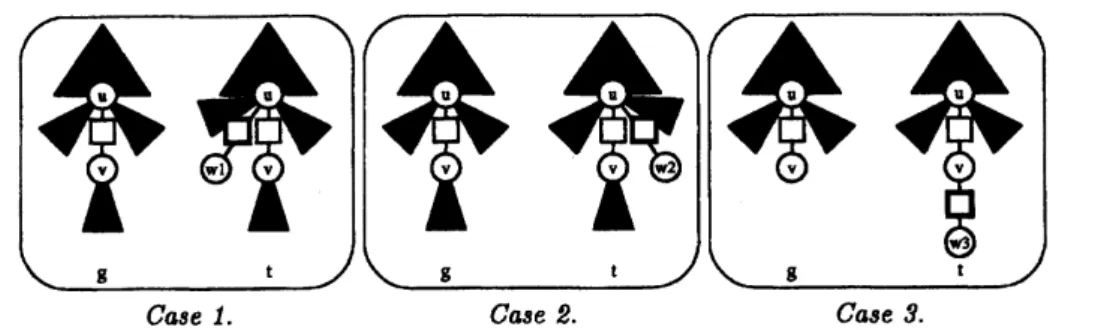
Lemma 1. Let$g$ and$t$ be $tem$ trees in $\mathcal{O}\Gamma\Gamma_{A}^{\mathrm{c}}$
for
any $\Lambda$ whichare
described inone
of
Cases
1-3of
Fig.
3.
Then $L_{\Lambda}(g)=L_{\Lambda}(t)$.
Fig.3. Cases 1-3: $g\not\equiv t$ and $L_{\Lambda}(g)=L_{\Lambda}(t)$ for $|\Lambda|\geq 2$. The parts $A$,$B$,$C$,$D$ of $g$
are
thesame
as thecorresponding parts$A$,$B$,$C$,$D$of$t$.
Algorithm MINL(S);
input $S=\{T_{1}, \ldots, T_{m}\}\subseteq U\Gamma_{\Lambda}$: aset of trees;
output $t$:aleast generalizedterm tree for$S$;
begin
Let$\Lambda s$ be the set of all edge labels which appearin $S$;
$t:=(\{u, v\}, \emptyset, \{[u, v]\})$;Let$q$be alist initialized to be $[[u, v]]$;
VARIABLE-EXTENSION$(\mathrm{t}, S, q)$;
Let$r_{t}$ be the root of$t$;
EDGE-REPLACING$(t, S, r_{t})$;
output$t$
end.
Procedure VARlABLE-ExTENsloN$(t:nput, S, q)$;
inputinput : atermtree, $S$:asetof trees, $q$:aqueueofvariables;
begin $t:=t_{*nput;}$.
while$q$is not empty do begin
$[u, v]:=q[1]$;Let$w_{1}$,$w_{2}$, andW3 benewvertices;
$//w_{1}$ becomes avertex between$u$and$v$.
$t’:=$ (Vi$\cup\{w_{1}\}$,Et,$H_{t}\cup\{[u,$$w_{1}],$ $[w_{1},$$v]\}-\{[u,$$v]\}$)$\mathrm{i}$
if$S\subseteq L_{\Lambda}(t’)$then begin$t:=t’$;$q:=q\ [[w_{1},v]]$;continue end else$q:=q[2..]$;
$//w_{2}$ and W3 become the previous and next siblings of$v$, respectively.
$t’:=$ $(\mathrm{V}\mathrm{C}\cup\{w_{2}\}, E_{t}, H_{t}\cup\{[u, w_{2}]\})$;
if$S\subseteq L_{\Lambda}(t’)$then begin$t:=t’;q$:=q&[[u,$w_{2}]$] end;
$t’:=(V_{t}\cup\{w_{3}\}, E_{t}, H_{t}\cup\{[u, w_{\theta}]\})$;
if$S\subseteq L_{A}(t’)$then begin $t:=t’j$q:=q&[[u,$w\mathrm{a}]$] end;
end;
return$t$
end;
Procedure EDGE-REpLACING(t.nPut,$S,u$);
input input: atermtree, $S$:asetof trees,$u$:avertex;
begin
if$u$isaleafthen return;
$t:=t:nput$;Let$v_{1}$,
$\ldots$ $Vk$ be the children of$u$;
for
:
$:=1$ to$k$do LABELED-EDGE-REPLACING$(4S, v_{i})$;for
:
$:=1$ to$k$doforeachedge label A$\in As$ do
$//\mathrm{L}\mathrm{e}\mathrm{t}\{u, v.\}$ beanedgewith label Aand$w_{1}$,$w_{2}$,and$w\mathrm{s}$newvertices; $w_{1}$ and$w_{2}$ become $//\mathrm{t}\mathrm{h}\mathrm{e}$previous andnext siblings of
$v:$,respectively, and if$v$:is aleaf,$w\theta$ becomesachild of$v_{\tau}$
if$v$:isaleaf then begin
$t’:=(V_{t}\cup\{w_{1}, w_{2}, w_{3}\}, E_{t}\cup\{\{u, v.\cdot\}\}, H_{t}\cup\{[u, w_{1}]^{\mathrm{c}}, [u, w_{2}]^{\mathrm{c}}, [v., w_{3}]^{\mathrm{c}}\}-\{[u, v:]\})$;
if$S\subseteq L_{A}(t’)$ thenbegin
$t_{1}:=(\mathrm{V}\mathrm{t}-\{w_{1}\}, E_{t’}, H_{t’}-\{[u,w_{1}]^{\mathrm{c}}\})$;if$S\subseteq L_{A}(t_{1})$then$t’:=t_{1j}$
$t_{2}:=$ (Vt $-\{w_{2}\},$$E_{t’},$$H_{t’}-\{[u,w_{2}]^{\mathrm{c}}\}$);if$S\subseteq L_{\Lambda}(t_{2})$ then$t’:=t_{2}$;
$t_{3}:=$ $(V_{t’}-\{w_{3}\}, E_{t’}, H_{t’}-\{[v:, w_{S}]^{e}\})$;if$S\subseteq L_{A}(t_{3})$then $t’:=t_{3}$;
$t$$:=t’$; continue
end
end else begin
$t’=(V_{t}\cup\{w_{1},w_{2}\}, E_{t}\cup\{\{u, v:1\}, H_{t}\cup\{[u, w_{1}]^{e}, [u, w_{2}]^{c}\}-\{[u,v:]\})$;
if$S\subseteq L_{\Lambda}(t’)$ thenbegin
$t_{1}:=$ (Vt $-\{w_{1}\},E_{t’},$$H_{\ell’}-\{[u,$$w_{1}]^{\mathrm{c}}\}$);if$S\subseteq L_{4}(t_{1})$then$t’:=t_{1}$; $t_{2}:=(\mathrm{V}\mathrm{t}-\{w_{2}\}, [\mathrm{t}\mathrm{i}, H_{l’}-\{[u,w_{2}]^{\epsilon}\})$;if$S\subseteq L_{\Lambda}(t_{2})$ then$t’:=t_{2}$;
$t$$:=t$’
:
continueend end; return$t$
end;
Fig. 4. Algorithm MINL
Definition 3. Let $t$be aterm tree in $\mathcal{O}\mathit{7}\Gamma_{\Lambda}^{c}$ for $|\Lambda|>2$
.
The term tree$t$is said to be acanonical $tem$tree if$t$
has no
combination of variables and edges oftheright term trees $t$ describedinCases
1-3.
Foran
arbitrary term tree$t$,we can transform
$t$into the canonical term tree$g$ such that $L_{\Lambda}(g)=L_{\Lambda}(t)$ bytransforming the right trees in
Cases 1-3
into the left trees.Lemma 2. Let$g$ and$t$ be
canonical
term trees in$\mathcal{O}\Gamma\Gamma_{\Lambda}^{\mathrm{c}}$for
any
$\Lambda$
.
If
$L_{\Lambda}(g)\subseteq L_{\Lambda}(t)$ then thereexists
a substitution$\theta$ such that$g\equiv t\theta$.
The procedure VARIABLE-EXTENSION extends aterm tree by adding uncontractible variables
as
much
as
possible. Aterm tree outputted by VARIABLE-EXTENSION is aleast generalizedterm tree for$S$ consisting of only uncontractible variables. Then the procedure EDGE-REpLAClNG tries to replace
variables with labelededges from leaves to the root. Since the output term treeis not larger than the largesttreein $S$,
we
have thefollowinglemma.Lemma 3. Let$t$ be the output
of
the algorithm MINLfor
an
inputS.
Let$t’$ bea
term tree satisfyingthat $S$ $\subseteq L_{\Lambda}(t’)\subseteq L_{\Lambda}(t)$
.
Let $g$ and $g’$ be the canonical $tem$ trees such that $L_{\Lambda}(g)=L_{\Lambda}(t)$ and$L_{\Lambda}(g’)=L_{J1}(t’)$, respectively. Then $g\equiv g’$
.
Theorem 2. Let$\Lambda$ be
a
setof
edgelabels where $|\Lambda|\geq 2$.
The algorithm MINLfinds
a
leastgeneralizedterm tree in $\mathcal{O}\Gamma\Gamma_{\Lambda}^{\mathrm{c}}$
for
agiven setof
trees in$U\Gamma_{A}$ in polynomial time.In this paper,
we
have presented polynomial time algorithms for solving themembershipandMINLproblems for the class oflabeledterm trees. From these algorithms andAngluin’s theorem [3],
we can
show that the class ispolynomial time inductivelyinferableffom positive data.
References
1. S. Abiteboul, P. Buneman, and D. Suciu. Data on the Web:
nvm
Relations to Semistructured Data andXML. MorganKaufmann, 2000.
2. T. R. Amoth, P. Cull, and P. Tadepalli. Exact learning ofunordered tree patterns from queries. Proc.
COLT-99, A CMPress, pages323-332, 1999.
3. D. Angluin. Finding patterns
common
to aset of strings. Journalof
Computer and System Science, 21:46-62, 1980.4. H. Arimura, H. Sakamoto, andS. Arikawa. Efficient learning ofsemi-structured datafrom queries. Proc. $ALT$-2001, Springer- Verlag, LNAI2225, pages315-331, 2001.
5. S. Matsumoto, Y. Hayashi, and T. Shoudai. Polynomial time inductive inference of regular term tree languages from positive data. Proc. ALT-97, Springer, Verlag, LNAI1316, pages212-227, 1997.
6. S. Matsumoto, T. Shoudai, T. Miyahara, and T. Uchida. Learning of finite unions of tree patterns with
internalstructuredvariablesfrom queries. Proc. $AI$-2002, Springer- Verlag, LNAI2557 pages523-534,2002.
7. T. Miyahara, Y. Suzuki, T. Shoudai, T. Uchida, K. Takahashi, and H. Ueda. Discovery of frequent tag tree patterns in semistructured web documents. Proc. PAKDD-20(E, Springer-Verlag, LNAI2336, pages 341-355, 2002.
8. T. Shoudai, T. Miyahara, T. Uchida, andS. Matsumoto. Inductiveinferenceofregulartermtree languages
and its application to knowledge discovery.
Info
rmation Modelling and KnowledgeBases XI, IOSPress,pages85-102, 2000.
9. T. Shoudai, T. Uchida, andT. Miyahara. Polynomial time algorithms for finding unordered tree patterns with internal variables. Proc. $FCT$-flOOl, Springer- Verlag, LNCS2138, pages335-346, 2001.
10. Y. Suzuki, R. Akanuma, T. Shoudai, T. Miyahara, and T. Uchida. Polynomial time inductive inference of ordered tree patterns with internal structured variables from positive data. Proc. COLT-2002,
Springer-Verlag, LNAI 2375,pages 169-184, 2002.
11. Y. Suzuki, T. Shoudai,T. Miyahara, and T. Uchida. Apolynomial time matching algorithmofstructured ordered tree patternsfor data mining from semistructured data. Proc. $ILP$-flOOfl, Springer-Verlag, LNAI 2583, pages270-284, 2003.
12. Y. Suzuki, T. Shoudai, T. Uchida, and T. Miyahara. Ordered term tree languages which are polynomial time inductivelyinferablefrom positive data. Proc.$ALT$-2002, Springer- Verlag, LNAI 2533,pages188-202, 2002.
13. K. Wang and H. Liu. Discovering structural association of semistructured data. IEEE Trans. Knowledge
and Data Engineering, $12:35\succ 371$,2000.