Monodromy
of
Painlev\’e
VI
Equation
Around
Classical
Special
Solutions*
Katsunori
Iwasaki (
岩崎克則
)
Faculty
of
Mathematics,
Kyushu University
6-10-1
Hakozaki,
Higashi-ku, Fukuoka
812-8581
Japan
March
29,
2009
Abstract
A global structure ofthe sixthPainlev\’eequationis described by itsnonlinear
mon-odromy map along a loop, and it is interesting to investigate its dynamical properties around classical special solutions, that is, around Gauss $hyperg\infty metric$ function
solu-tions. In ageneric situationone
sees
that the monodromymap admitsahorseshoe andthus exhibits achaotic behavior in any small neighborhood of the classical solutions.
1
Introduction
This is a report of a work [11] in progress conceming the monodromy ofthe sixth Painlev\’e
equation and the associated dynamical system created by a monodromy map.
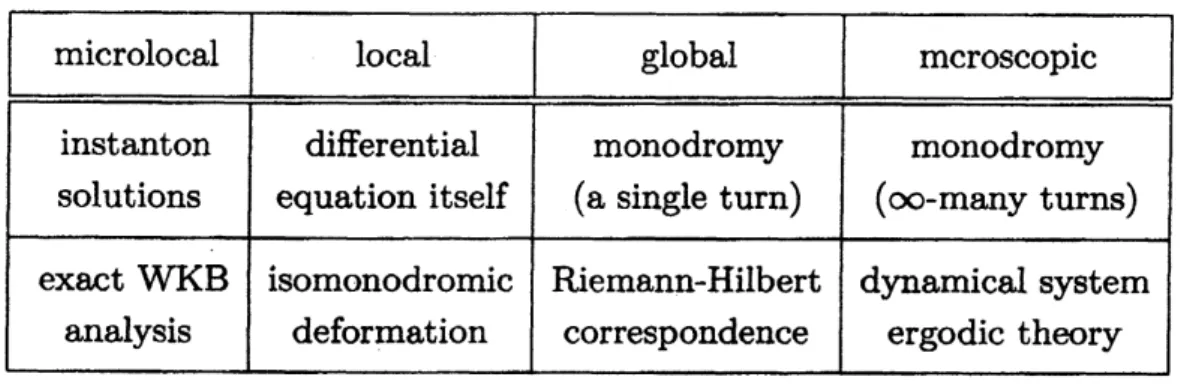
In general, a total understanding of the Painlev\’e equation would be achieved by the
scheme in Table 1, in which
some
typical issues in various scalesare
listed, from microlocalto macroscopic levels. Recent works by the author and his coworkers
are
mainly concernedwith global-txmacroscopic structures of the Painlev\’e equation. Usually,
some
properties ofthis equationhavebeen studied from the viewpointof isomonodromic deformations, but this
approach is often too local in many respects. One should take
more
global points ofview.A global structure of the Painlev\’e equation is represented by the nonlinear monodromy
map (of a single turn along
a
given loop). A clear picture of this part is made byestab-lishing
a
very precise Riemann-Hilbert correspondence basedon a
suitable moduli theory inalgebraic geometry. An even more global (namely, macroscopic) structure of the equation
is represented by the iterations of the monodromy map, that is, by infinitely many turns of
the loop. Dynamical systems theory and ergodic theory
come
into context at this stage.In the linear
case
of Gauss hypergeometric equation, the monodromy map of a singleturn and its iterations ofinfinitely many tums make no essential difference, since the former is only a linear map and the dominant effect of the latter is controlled by the spectral data
Table 1: A total understanding of Painlev\’e equation
of the former, namely, by the largest eigenvalue and its eigenspace. In the nonlinear
case
ofPainlev\’e equation, there exists
a
large gap between the single tum and the infinitely manytums, dueto the ”nonlinear effect” ofPainlev\’e equation. The analysis of the latter requires
advanced methods from dynamical systems theory and ergodic theory. But this leads to the
new
feature ofa
chaotic dynamicalsystem, whichnever
exists in Gauss equation and whichmakes the global structure of Painlev\’e equation much
more
interesting than that of Gaussequation. We
are
interested in suchan
aspect of Painlev\’e equation.The main focus of this paper is
on a
chaotic nature ofPainlev\’e equation around classical specialsolutions, that is, around Gauss hypergeometricfunction solutions (orinotherwords,Riccati solutions). The Riccati solutions
are
parametrized by acurve
called the Riccaticurve.
In this paperwe announce
the following result: In any small neighborhood of theRiccati
curve
the nonlinear monodromy map admitsa
Smale horseshoe and thus exhibitsa
very complicated dynamical behavior, for almost all loops and for almost all parameters for which Painlev\’e equation admits Riccati solutions. See Result 4 for the precise statement.
2
The
Sixth
Painlev\’e
Equation
The sixth Painlev\’e equation $P_{VI}(\kappa)$ is a Hamiltonian system
$\frac{dq}{dz}=\frac{\partial H(\kappa)}{\partial p}$, $\frac{dp}{dz}=-\frac{\partial H(\kappa)}{\partial q}$, (1)
with
a
complex time variable $z\in Z:=\mathbb{P}^{1}-\{0,1, \infty\}$ and unknown functions $q=q(z)$ and$p=p(z)$, depending
on
complex parameters $\kappa$ in the four-dimensional affine space$\mathcal{K}:=\{\kappa=(\kappa_{0}, \kappa_{1}, \kappa_{2_{1}}\kappa_{3}, \kappa_{4})\in \mathbb{C}_{\kappa}^{5}:2\kappa_{0}+\kappa_{1}+\kappa_{2}+\kappa_{3}+\kappa_{4}=1\}$ ,
where the Hamiltonian $H(\kappa)=H(q,p, z;\kappa)$ is given by
$z(z-1)H(\kappa)=(q_{0}q_{z}q_{1})p^{2}-\{\kappa_{1}q_{1}q_{z}+(\kappa_{2}-1)q_{0}q_{1}+\kappa_{3}q_{0}q_{z}\}p+\kappa_{0}(\kappa_{0}+\kappa_{4})q_{z}$,
with $q_{\nu}$ $:=q-\nu$ for $\nu\in\{0, z, 1\}$
.
Note that $P_{VI}(\kappa)$ fails to makesense
at $z=0,1,$$\infty$.
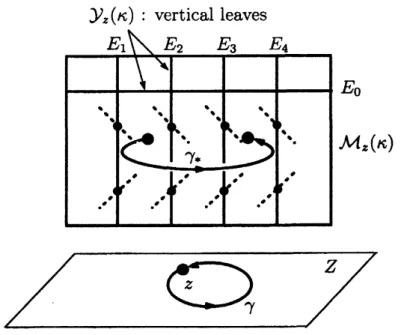
TheseFigure 1: Monodromy map $\gamma_{*}:$ $\mathcal{M}_{z}(\kappa)O$ along
a
loop $\gamma\in\pi_{1}(Z, z)$.
3
Moduli
Theory
Let $\mathcal{M}_{z}(\kappa)$ be the set of all meromorphic solution germs to $P_{VI}(\kappa)$ at
a
base point $z\in Z$.
The set $\mathcal{M}_{z}(\kappa)$
can
be realizedas
the moduli space of (certain) stable parabolic connections,so
that itcan
be equiped with the structure of a smooth quasi-projective rational complexsurface [6, 7, 8], where
a
stable parabolic connection isa
rank-two vector bundleover
$\mathbb{P}^{1}$together with
a
FMchsian connection having four regular singular points anda
parabolicstructure that satisfies a sort ofstability condition in geometric invariant theory.
Moreover there exists
a
natural compactification of the moduli space$\mathcal{M}_{z}(\kappa)arrow\overline{\mathcal{M}}_{z}(\kappa)$,
where $\overline{\mathcal{M}}_{z}(\kappa)$ is the moduli space of stable parabolic phi-connections. Here, roughly
speak-ing, a stable parabolic phi-connection “V $=\phi\otimes d+A$” is a variant of stable parabolic
connection allowing a “matrix-valued Planck constant” $\phi$, called
a
phi-field (that may bedegenerate
or
semi-classical). The compactified modulis space $\overline{\mathcal{M}}_{z}(\kappa)$ hasa
uniqueanti-canonical effective divisor $\mathcal{Y}_{z}(\kappa)$, which has the irreducible decomposition
$\mathcal{Y}_{z}(\kappa)=2E_{0}+E_{1}+E_{2}+E_{3}+E_{4}$
.
(2)The objects
on
$\mathcal{Y}_{z}(\kappa)$are
exactly those with degenerate phi-field $\phi$, where the coefficientsofthe irreducible decomposition (2) stand for the ranks ofdegeneracy of $\phi$
.
Thus one has$\mathcal{M}_{z}(\kappa)=\overline{\mathcal{M}}_{z}(\kappa)-\mathcal{Y}_{z}(\kappa)$,
and there exists a holomorphic two-form $\omega_{z}(\kappa)$
on
$\mathcal{M}_{z}(\kappa)$, meromorphicon
$\overline{\mathcal{M}}_{z}(\kappa)$ withpole divisor $\mathcal{Y}_{z}(\kappa)$
.
It is unique up to constant multiples and yieldsa
natural holomorphic area-formon
the moduli space $\mathcal{M}_{z}(\kappa)$.
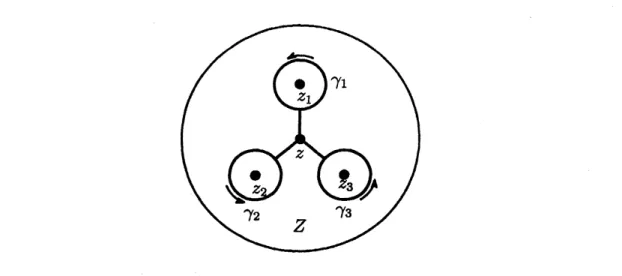
Figure 2: Three basic loops in $\pi_{1}(Z, z)$, where $z_{1}=0,$ $z_{2}=1$ and $z_{3}=\infty$
.
4
Nonlinear
Monodromy
It is known that $P_{VI}(\kappa)$ enjoys the Painlev\’eproperty, that is, any solution germ $Q\in \mathcal{M}_{z}(\kappa)$
can
be continued analytically alonganyloop$\gamma\in\pi_{1}(Z, z)$as a
meromorphicfunction. Thanksto this property, the monodromy map along the loop $\gamma$,
$\gamma_{*}:\mathcal{M}_{z}(\kappa)arrow \mathcal{M}_{z}(\kappa)$, $Q\mapsto\gamma_{*}Q$, (3)
$is$ well defined, where $\gamma_{*}Q$ is the result of the analytic continuation (see Figure 1). It is
a
holomorphic automorphism of $\mathcal{M}_{z}(\kappa)$ preserving the holomorphic area-form $\omega_{z}(\kappa)$
.
We are interested in the dynamics of the monodromy map $\gamma_{*}:\mathcal{M}_{z}(\kappa)CJ$ along a given
loop $\gamma\in\pi_{1}(Z, z)$
.
The fundamental group $\pi_{1}(Z, z)$ is representedas
$\pi_{1}(Z, z)=\{\gamma_{1},$ $\gamma_{2},\gamma_{3}|\gamma_{1}\gamma_{2}\gamma_{3}=1\rangle$,where $\gamma_{i}(i=1,2,3)$
are
the basic loopsas
in Figure 2, with $z_{1}=0,$ $z_{2}=1$ and $z_{3}=\infty$.
Deflnition 1 A loop $\gamma\in\pi_{1}(Z, z)$ is said to be elementaryif $\gamma$ is conjugate to the loop $\gamma_{i}^{m}$
for
some
$i\in\{1,2,3\}$ and $m\in Z$, namely, if it makes a finite number of tums around onlyone
of the three fixed singular points. Otherwise, $\gamma$ is said to be non-elementary.The dynamics along an elementary loop is relatively simpler [10, 13] and
we are more
inter-ested in the dynamics along a non-elementary loop.
5
Riccati Curves
For particular parameters $\kappa$ of codimension
one
in $\mathcal{K}$, there exist particular solutionsto
$P_{VI}(\kappa)$ that
can
be expressed in terms of Gauss hypergeometric functions. Theyare
knownas
Riccati solutions,as
they appearas
solutions to the Riccati equation associated witha
Gaussequation. Let$\mathcal{E}_{z}(\kappa)$ be thesetof all Riccatisolution germsto $P_{VI}(\kappa)$ atthe basepoint $z$
.
It is known that $\mathcal{E}_{z}(\kappa)$ isan
algebraic set in $\mathcal{M}_{z}(\kappa)$, each irreducible component of which$1_{\bullet}$ $\bullet^{2}$ $\emptyset’0\cdot\cdot\cdot\cdot$
.
$’$ $a$...
$3^{\bullet}$.
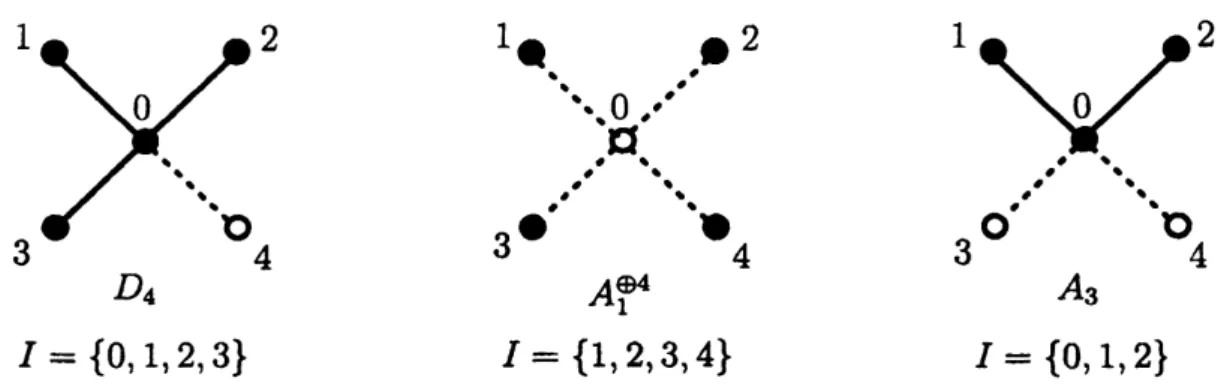
$\bullet_{4}$ $A_{1}^{\oplus 4}$$I=\{0,1,2,3\}$ $I=\{1,2,3,4\}$ $I=\{0,1,2\}$
Figure 3: Some strata and their abstract Dynkin types
number-2. Conversely, any (-2)-curve in $\mathcal{M}_{z}(\kappa)$ is
an
irreducible component of$\mathcal{E}_{z}(\kappa)$.
Forthis
reason a
(-2)-curve is called a Riccaticurve.
Wecan
think of the dual graph of $\mathcal{E}_{z}(\kappa)$which encodes the intersection relations among the Riccati
curves
in $\mathcal{M}_{z}(\kappa)$.
6
Affine Weyl Groups
The configurationofRiccati
curves
in $\mathcal{M}_{z}(\kappa)$can
most clearly be described in termsofsome
affine Weyl group structures andan
associated stratificationon
$\mathcal{K}$ (see Lemma 2). Considerthe (complex) innerproduct
on
$\mathcal{K}$ induced from the standard Euclidean innerproducton
$\mathbb{C}_{\kappa}^{4}$through the forgetful isomorphism $\mathcal{K}arrow \mathbb{C}_{\kappa}^{4},$ $\kappa\mapsto(\kappa_{1}, \kappa_{2}, \kappa_{3}, \kappa_{4})$
.
For each $i\in\{0,1,2,3,4\}$let $w_{i}$
:
$\mathcal{K}0$ be the orthogonal reflection in the affine hyperplane $H_{i};=\{\kappa\in \mathcal{K} : \kappa_{i}=0\}$.
These five reflections generatean
affine Weylgroup
oftype $D_{4}^{(1)}$,$W(D_{4}^{(1)})=\{w_{0}, w_{1}, w_{2}, w_{3}, w_{4}\}\cap \mathcal{K}$
.
Denote the nodes of the Dynkin diagram $D_{4}^{(1)}$ by $\{0,1,2,3,4\}$, where $0$ represents the
central node. The automorphism group ofthe Dynkin diagram $D_{4}^{(1)}$ is the symmetric group $S_{4}$ of degree 4 permuting
{1,
2,3,4}
while fixing the central node $0$.
The semi-direct product$W(F_{4}^{(1)}):=W(D_{4}^{(1)})xS_{4^{\Gamma}}\backslash \mathcal{K}$
is
an
affine Weyl group of type $F_{4}^{(1)}$, which is the full symmetry group of Painlev\’e VI.7
Stratification
There exists
a
natural stratification of $\mathcal{K}$, namely, theone
by proper subdiagrams of theDynkin diagram $D_{4}^{(1)}$, which
we
shallnow
describe. Let $\mathcal{I}:=\{I\subset\{0,1,2,3,4\}\}/S_{4}$ be theset of all proper subsets of $\{0,1,2,3,4\}$, including the empty set $\emptyset$, up to the action of $S_{4}$
.
Note that each element of$\mathcal{I}$ represents the abstract Dynkin type ofa proper subdiagram of
$D_{4}^{(1)}$
.
For each $[I]\in \mathcal{I}$ with $I\subset\{0,1,2,3,4\}$we
put$\overline{\mathcal{K}}([I])$ $=$ the $W(F_{4}^{(1)})$-translates of the affine subspace $H_{I}$
$:= \bigcap_{i\in I}H_{i}$, $\mathcal{K}([I])$ $=$
Xlf
$([I])- \bigcup_{|J|=|t|+1}\overline{\mathcal{K}}([J])$, where
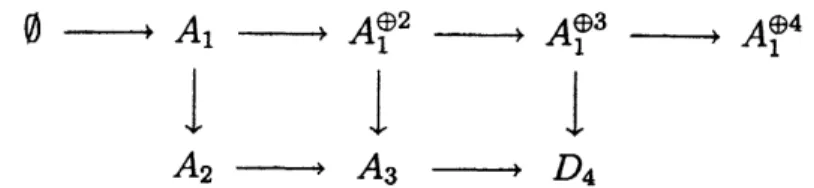
$\emptysetarrow A_{1}arrow A_{1}^{\oplus 2}arrow A_{1}^{\oplus 3}arrow A_{1}^{\oplus 4}$
$\downarrow$ $\downarrow$ $\downarrow$
$A_{2}arrow A_{3}$ $arrow D_{4}$
Figure 4: Adjacency relations among the strata
The sets $\mathcal{K}(*)$ with $*\in \mathcal{I}$define
a
stratification of$\mathcal{K}$.
For$I=\emptyset$one
has the bigopen stratum
$\mathcal{K}(\emptyset)$ and
some
other strataare
given in Figure 3.The adjacency relationsamong the strata
are depicted in Figure 4, where $*arrow**$ indicates that $\mathcal{K}(**)$ is in the closure of $\mathcal{K}(*)$
.
Lemma 2If
$\kappa\in \mathcal{K}(*)with*\in \mathcal{I}$, then the dual graphof
$\mathcal{E}_{z}(\kappa)\subset \mathcal{M}_{z}(\kappa)$ is the Dynkingraph
of
$type*$.
In particular$\mathcal{M}_{z}(\kappa)$ containsno
Riccaticurve
precisely when$\kappa\in \mathcal{K}(\emptyset)$.
8
Dynamics
around
a
Riccati Curve
Assume that $\kappa\in \mathcal{K}(A_{1})$ for simplicity. Recall that $H_{0}$ is the hyperplane in $\mathcal{K}$ defined by the
equation $\kappa_{0}=0$, namely, by $\kappa_{1}+\kappa_{2}+\kappa_{3}+\kappa_{4}=1$
.
Let $H_{0}^{x}$ denote the set of all points lyingon
$H_{0}$ but noton
any other $D_{4}^{(1)}$ reflection hyperplane, that is,$\kappa_{i}=m$, $\kappa_{1}\pm\kappa_{2}\pm\kappa_{3}\pm\kappa_{4}=2m+1$ $(i\in\{1,2,3,4\}, m\in \mathbb{Z})$
.
Then anypoint $\kappa\in \mathcal{K}(A_{1})$
can
besent toa
point in$H_{0}^{x}$ by applyinga
suitable transformationin $W(D_{4}^{(1)})$
.
Thuswe
mayassume
that $\kappa\in H_{0}^{x}$ from the beginning.If$\kappa\in H_{0}^{x}$ then $\mathcal{M}_{z}(\kappa)$ contains
a
unique Riccati curve $\mathcal{E}_{z}(\kappa)\cong \mathbb{P}^{1}$.
The Riccati solutions paramatrized by $\mathcal{E}_{z}(\kappa)$are
describedas
follows. The second equation ofsystem (1)has the null solution$p\equiv 0$
.
Substituting this into the first equation yields the Riccati equation$z(z-1)q’+\kappa_{1}q_{1}q_{z}+(\kappa_{2}-1)q_{0}q_{1}+\kappa_{3}q_{0}q_{z}=0$,
which is linearized to the Gauss hypergeometric equation
$z(1-z)f”+\{(1-\kappa_{3}-\kappa_{4})-(\kappa_{2}-\kappa_{4}+1)z\}f’+\kappa_{2}\kappa_{4}f=0$, (4)
via the change of dependent variable $q= \frac{z(1-z)d}{\kappa_{4}dz}\log\{(1-z)^{-\kappa 4}f\}$. The Riccati
curve
$\mathcal{E}_{z}(\kappa)$ isjust the projective space (line) associated with the
solution space ofequation (4).
Given
a
loop $\gamma\in\pi_{1}(Z, z)$, the nonlinear monodromy map$\gamma_{*}:$ $\mathcal{M}_{z}(\kappa)O$ restricts to
an
automorphism $\gamma_{*}:$ $\mathcal{E}_{z}(\kappa)O$ ofthe Riccati
curve.
It is justa
M\"obius transformation, arisingas
the projective monodromy map along$\gamma$ of the hypergeometric equation (4), and thus thedynamics
on
$\mathcal{E}_{z}(\kappa)$ is very simple. Now the following problem naturallyoccurs
to
us.
Problem 3 How does the dynamics look like in
a
small neighborhood of$\mathcal{E}_{z}(\kappa)$?As to this problem,
we
willsee
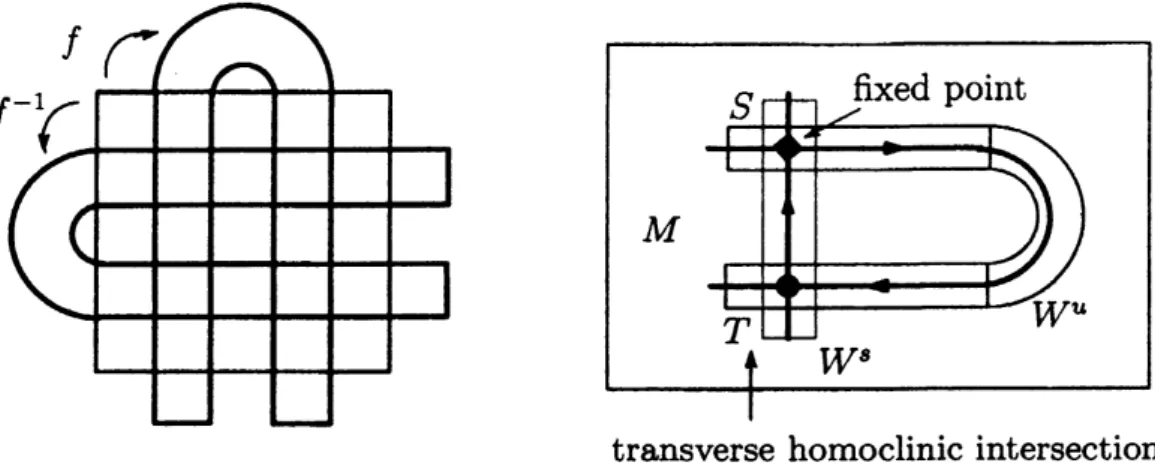
that it is very complicated, actually, chaotic in any smallFigure 5: Horseshoe: Smale’s geometric model (left) and homoclinic intersection (right).
9
Smale Horseshoe
A homeomorphism $f$ : $MO$ of a topological space $M$ is said to admit a horseshoe if there
exist
an
$f$-invariant Cantor subset $J\subset M$ anda
homeomorphism $Jarrow\Sigma$ that transfers$f$ : J $O$ to the standard symbolic dynamics $\sigma$ : $\Sigma O$, where $\Sigma$ $:=\{0,1\}^{Z}$ is the topological
space ofbi-infinite sequences of$0$’s and l’s, and $\sigma$ is the shift map
on
$\Sigma$.
This abstractsense
of horseshoe
can
be realized by Smale’s famous geometric model ofa
horseshoe-like figure(see Figure 5, left) [19, 18]. The existence of
a
horseshoe gives evidence of chaos suchas
the positivity of topological entropy and the exponential growth of the number of periodic
points
as
the period tends to infinity, andso
on.When $f$ : $MO$ is
a
diffeomorphism ofa
differentiable manifold $M$, the existence of a horseshoe is usually established through the existence ofa transversehomoclinic intersection of stable and unstable manifolds (see Figure 5, right) [20, 18]. This scenario will be appliedto the Painlev\’e dynamics in a neighborhood ofa Riccati curve.
10
Main Result
Let $\gamma\in\pi_{1}(Z, z)$ be a non-elementary loop and
assume
that $\kappa\in H_{0}^{x}$as
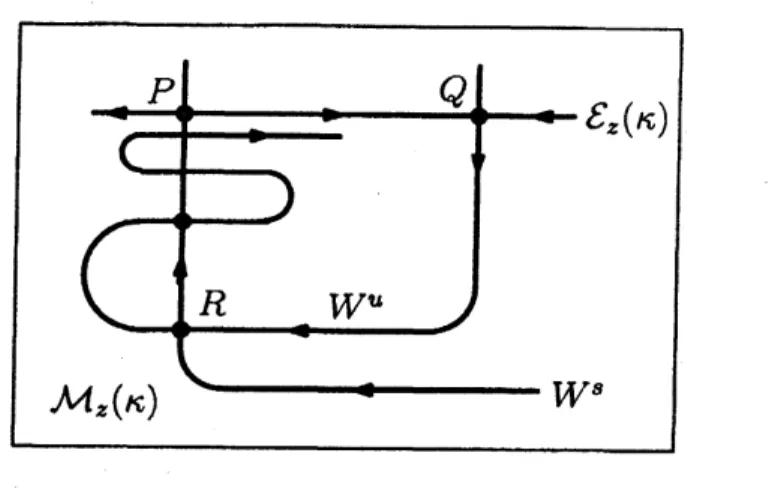
in Section 8. If theM\"obius transformation $\gamma_{*}$ : $\mathcal{E}_{z}(\kappa)O$ is hyperbolic, then it admits exactly two flxed points,
oneofwhich, say $P$, is expanding at dilationrate $\mu=\mu(\gamma)$ and the other, say $Q$, is attracting
at dilation rate $\mu^{-1}$ for some $|\mu|>1$
.
Notice that $P$and $Q$are
saddle fixed pointsat dilationrates $\mu^{\pm 1}$ of the map
$\gamma_{*}:$ $\mathcal{M}_{z}(\kappa)O$, sincethis map is area-preservingwith respect to the
area
form $\omega_{z}(\kappa)$
.
Thus one can speak of the stablecurve
$W^{s}$ through $P$ and the unstablecurve
$W^{u}$ through $Q$ ofthe map $\gamma_{*}:\mathcal{M}_{z}(\kappa)$ O. Here we remark that $\mathcal{E}_{z}(\kappa)$ is the unstable
curve
through $P$ and at the
same
time the stablecurve
through $Q$.
In order toassure
the presenceof a horseshoe, it is important to
as
$k$ when $W^{\epsilon}$ and $W$“ have a transverse intersection (seeFigure 6). An
answer
to this question is given by the following.Result 4 For any non-elementary loop $\gamma\in\pi_{1}(Z, z)$ there exists a nontrivial entire
function
$\phi_{\gamma}$ : $H_{0}arrow \mathbb{C}$ such that
if
$\kappa\in H_{0}^{x}\cap\phi_{\gamma}^{-1}(\mathbb{C}\backslash [-1,1])$ , then$P$ $Q$
$\mathcal{E}_{z}(\kappa)$
R $W^{u}$
$\mathcal{M}_{z}(\kappa)$ $W^{8}$
Figure 6: transverse intersection of the stable and unstable
curves
(2) the stable and unstablecurves
$W^{\theta}$ and $W^{u}$ have a tmnsverseintersection; and
(3) there exists an $N\in N$ such that $\gamma_{*}^{N}$ : $\mathcal{M}_{z}(\kappa)O$ admits a Smale horseshoe
in any small
neighborhood
of
the Riccaticurve
$\mathcal{E}_{z}(\kappa)_{f}$ where $N$ depends on the neighborhoodchosen.
Here $\phi_{\gamma}$ being nontrivial
means
that it is not aconstant
function
urith value in [-1, 1]. Thefunction
$\phi_{\gamma}(\kappa)$ is computableonce
the loop$\gamma$ is given explicitly.
This result may fail if $\kappa\in H_{0}^{x}\cap\phi_{\gamma}^{-1}([-1,1])$, but this exceptional subset is very tiny,
being at most of real codimension
one
in $H_{0}^{x}$, since $\phi_{\gamma}$ is anontrivial entire function. In thissense
the result holds for almost all parameters $\kappa\in H_{0}^{x}$.Example 5 We illustrate the function $\phi_{\gamma}(\kappa)$ for two loops.
(1) Aneight-figured loop $e_{ij}$ is a loop conjugate to the loop $\gamma_{i}\gamma_{j}^{-1}$ for a cyclicpermutation
$(i,j, k)$ of (1,2, 3)
as
in Figure 7 (left). If $\gamma$ is an eight-figured loop $t_{ij}$, then $\phi_{\gamma}(\kappa)=\cos\pi(\kappa_{i}-\kappa_{k})-\cos\pi(\kappa_{i}+\kappa_{k})-\cos\pi(\kappa_{j}-\kappa_{4})$.
(2) A Pochhammer loop $\wp_{ij}$ is a loop conjugate to $[\gamma_{i}, \gamma_{j}^{-1}]=\gamma_{i}\gamma_{j}^{-1}\gamma_{i}^{-1}\gamma_{j}$ for
a
cyclicpermutation $(i,j, k)$ of (1,2,3)
as
in Figure 7 (right). If$\gamma$ isa
Pochhammer loop$\wp_{ij}$,
$\phi_{\gamma}(\kappa)=2-cos2\pi\kappa_{1}-\cos 2\pi\kappa_{2}-\cos 2\pi\kappa_{3}-\cos 2\pi\kappa_{4}$
$+\cos 2\pi(\kappa_{1}+\kappa_{2})+\cos 2\pi(\kappa_{2}+\kappa_{3})+\cos 2\pi(\kappa_{3}+\kappa_{1})$.
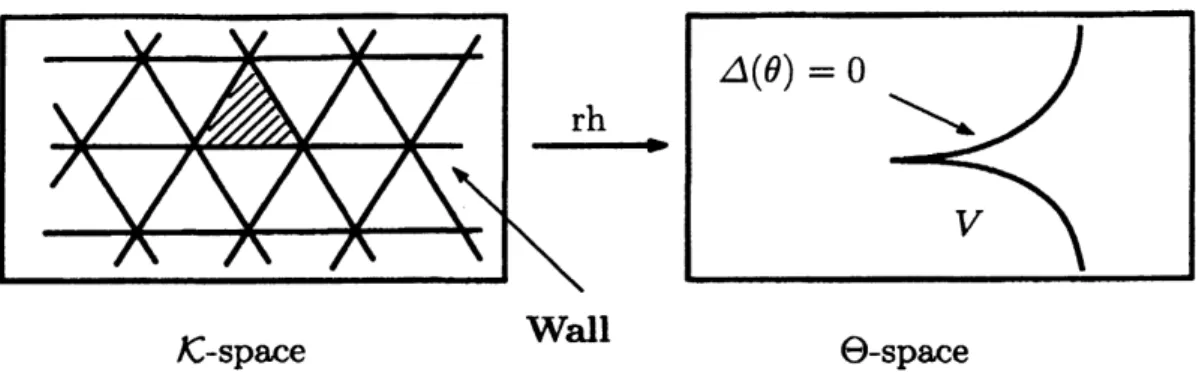
$\mathcal{K}$-space Wall $\ominus$-space
Figure 8: The Riemann-Hilbert correspondence in the parameter level
So
farwe
have restrictedour
attention to the stratum $\mathcal{K}(A_{1})$ for the $s$ake of simplicity. Thereare
similar results for the other strata. Result 4 will be shown in [11].11
Riemann-Hilbert
Correspondence
Result 4 is established, not directly
on
themoduli space $\mathcal{M}_{z}(\kappa)$, butby passing toa
charactervariety $S(\theta)$ through the Riemann-Hilbert correspondence [6, 7, 8, 10],
RH$z,\kappa$ :
$\mathcal{M}_{z}(\kappa)arrow S(\theta)$, $Q\mapsto\rho$, with $\theta=$ rh$(\kappa)$
.
(5)Here the character varieties for Painlev\’e VI
can
be realizedas a
four-parameter familyof complex affine cubic surfaces $S(\theta)$ parametrized by $\theta\in\Theta$ $:=\mathbb{C}_{\theta}^{4}$ and rh : $\mathcal{K}arrow\Theta$ is
a
holomorphic map that is abranched$W(D_{4}^{(1)})$-covering ramifying alongWall (the unionofall
reflection hyperplanes) andmapping it onto the discriminant locus $V$ $:=\{\theta\in\Theta : \Delta(\theta)=0\}$
of the cubics (see Figure 8). A fUndamental fact for the map (5) is the following.
Theorem 6 ([6, 7, 8])
If
$\kappa\in \mathcal{K}(*)$ then the chamcter variety $S(\theta)$ unth $\theta=$ rh$(\kappa)$ hassimple singularities
of
Dynkin $type*and$ the Riemann-Hilbert comespondence (5) is a proper$su\dot{\eta}ective$ holomorphic map that is
an
analytic minimal resolutionof
singularities.Take
an
algebraicminimaldesingularization$\varphi:\tilde{S}(\theta)arrow S(\theta)$.
Then the Riemann-Hilbertcorrespondence (5) uniquely lifts to a biholomorphism $\overline{RH}_{z_{2}\kappa}$ : $\mathcal{M}_{z}(\kappa)arrow\tilde{S}(\theta)$ such that
$\mathcal{M}_{z}(\kappa)\underline{\overline{RH}_{z.narrow}}\tilde{S}(\theta)$
$\Vert$ $\downarrow\varphi$
$\mathcal{M}_{z}(\kappa)\underline{R}H_{l\hslash}-,arrow S(\theta)$
is commutative. The lifted Riemann-Hilbert correspondence $\overline{RH}_{z,\kappa}$ maps the Riccati
lo-cus
$\mathcal{E}_{z}(\kappa)\subset \mathcal{M}_{z}(\kappa)$ isomorphically onto the exceptional set $\mathcal{E}(\theta)\subset\overline{S}(\theta)$ of the algebraicresolution $\varphi$
.
The cubic surface $S(\theta)$ has a natural area-form, that is, the Poincar\’e residuewhere $x=(x_{1},x_{2}, x_{3})$ is the standard coordinates of $\mathbb{C}_{x}^{3}$ and $f(x, \theta)=0$ is the defining
equation of the surface $S(\underline{\theta})$ in $\mathbb{C}_{x}^{3}$
.
The Poincar\’e residue$\omega(\theta)$ lifts to
a
holomorphic area-form $\tilde{\omega}(\theta)$ $:=\varphi^{*}\omega(\theta)$ on $S(\theta)$, with respect to which the biholomorphism RH$z_{1}\kappa$ is
area-preserving [9]. The monodromy map $\gamma_{*}:(\mathcal{M}_{z}(\kappa), \omega_{z}(\kappa))O$ is strictly conjugated to
an
automorphism $\sigma$ : $(\tilde{S}(\theta),\tilde{\omega}(\theta))O$, which in tum
can
be extended to a birational mapon
thenatural compactification of $\tilde{S}(\theta)$
.
We then apply the ergodic theory of birational maps on compact surfaces [1, 2, 5, 4] to the last map in order to establishour
main result.12
Ergodic Theory
Let $\gamma\in\pi_{1}(Z, z)$ be
a
non-elementary loop. For the monodromy map $\gamma_{*}:\mathcal{M}_{z}(\kappa)O$ the“recurrent”
dynamics takes place only away from infinity, where the vertical leaves $\mathcal{Y}_{z}(\kappa)$are
thought ofas
the points at infinity in $\mathcal{M}_{t}(\kappa)$.
Namely the non-wandering set $\Omega_{\gamma}(\kappa)$ of$\gamma_{*}$ is compact in $\mathcal{M}_{z}(\kappa)$
.
Under the interations of$\gamma_{*}$, the trajectory of each initial point
$Q\in \mathcal{M}_{t}(\kappa)\backslash \Omega_{\gamma}(\kappa)$ tends to in$finity\mathcal{Y}_{z}(\kappa)$ very rapidly.
The topological entropy $h_{top}(\gamma)$ ofthe map$\gamma_{*}:\Omega_{\gamma}(\kappa)O$ is positive, being represented
as
$h_{top}(\gamma)=\log\lambda(\gamma)$, $\lambda(\gamma)\geq 3+2\sqrt{2}$,
where $\lambda(\gamma)$ is
a
number called the dynamical degree of$\gamma$, which depends
on
$\gamma$ but isinde-pendent of $\kappa$
.
There exists a unique$\gamma_{*}$-invariant probability measure $\mu_{\gamma}=\mu_{\gamma}(\kappa)$, with its
support in $\Omega_{\gamma}(\kappa)$, that is mixing, hyperbolic of saddle type, and of maximal entropy. There
are
positive (1, 1)-currents $\mu_{\gamma}^{\pm}$on
$\mathcal{M}_{z}(\kappa)$, called thestable and unstable currents, such that$\gamma_{*}^{\pm 1}\mu_{\gamma}^{\pm}=\lambda(\gamma)\mu_{\gamma}^{\pm}$ and the probability
measure
$\mu_{\gamma}$ is given by the wedge product
$\mu_{\gamma}=\mu_{\gamma}^{+}\wedge\mu_{\overline{\gamma}}$, (6)
where the currents $\mu_{\gamma}^{\pm}$ have continuous potentials so that the wedge product is well defined.
The $s$addle periodic points of $\gamma_{*}$
are
dense in $supp\mu_{\gamma}$ and themeasure
is also representedas
$\mu_{\gamma}=\lim_{narrow\infty}\frac{1}{\lambda(\gamma)^{n}}\sum_{p}\delta_{p}$ (weak limit),
where the
sum
is takenover
all saddle points ofperiod $n$ and $\delta_{p}$ is the Diracmass
at $p$.
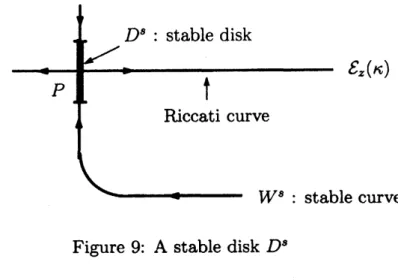
Let $D^{s}\subset W^{\epsilon}$ be
a
stable disk centered at $P\in \mathcal{E}_{z}(\kappa)$ (see Figures 6 and 9). Similarly let$D^{u}\subset W^{u}$ be
an
unstable disk centered at $Q\in \mathcal{E}_{z}(\kappa)$. Then there exist positive constants $c^{\pm}>0$ such thatone
has weak convergence ofcurrents$\lim_{narrow\infty}\frac{1}{\lambda(\gamma)^{n}}[\gamma_{*}^{\mp n}D^{s/u}]=c^{\pm}\mu_{\gamma}^{\pm}$ ,
where $[D]$ denotes the current of integration defined by $\langle[D],$ $v\rangle$ $:= \int_{D}v$ for
a
test form$v$
.
Thus the wedge product in (6) represents the geometric intersections of the stable andunstable
curves
$W^{s/u}$.
Thensome
geometric structures of the invariantmeasure
$\mu_{\gamma}$ lead to
Figure 9: A stable disk $D^{8}$
13
Concluding
Remark
There are two classes of classical special solutions to the sixth Painlev\’e equation;
one
is the class of Riccati solutions discussed in this paper and the other is that of algebraic solutions(see e.g. [12, 14, 17, 21]). Here
a
solution of the first classcan
be characterized in terms ofa compact one-dimensional algebraic subset (a curve) in $\mathcal{M}_{z}(\kappa)$ invariant by the nonlinear
monodromy map along every loop, while
a
solution ofthe second classcan
be characterizedby a compact zerodimensional algebraic subset (a set of finite points) enjoying the
same
invariance property [10]. Perhaps the method in this paper could also be applied to
a
solution ofthe second class in order to reveal the presence of chaos around it.
A closely related topic is the non-integrability test for a Hamiltonian system in terms
of differential Galois theory developed in [16], with
an
application to the second Painlev\’eequation around
a
rational solution [15]. We hope that our dynamical approach would leadto a deeper result
as
to the “complexity” ofPainlev\’e equations.References
[1] E. Bedford and J. Diller, Energy and invaiiant
meas
ures
for birationals
urface maps,Duke Math. J. 128 (2005), no. 2, 331-368.
[2] E. Bedford, M. Lyubich and J. Smillie, Polynomial diffeomorphisms of $\mathbb{C}^{2}$
.
IV: Themeasure ofmaximal entropyand laminax currents. Invent. Math $\dot{1}12$ (1993), 77-125.
[3] S. Cantat and F. Loray, Holomorphic dynamics} Painlev\’e VI equation and character
varieties, e-Print arXiv: 0711. 1579 (2007).
[4] R. Dujardin, Laminar
c
urrents and birationaldynamics, Duke Math. J. 131 (2006),no.
2, 219-247.
[5] J. Diller and C. Favre, Dynamics of bimeromorphic maps ofsurfaces, Amer. J. Math.
[6] M. Inaba, K. Iwasaki and M.-H. Saito, Dynamics of the sixth Painlev\’e equation,
Th\’eories asymptotiques et \’equations de Painlev\’e, S\’eminaires et Congr\‘es 14, (2006),
103-167.
[7] M. Inaba, K. Iwasaki and M.-H. Saito, Moduli ofstableparabolic connections,
Riemann-HilbertcorrespondenceandgeometryofPainlev\’eequation oftypeVI. PartI, Publ. Res. Inst. Math. Sci. 42 (2006), no. 4, 987-1089.
[8] M. Inaba, K. IwasakiandM.-H. Saito, Moduliofstableparabolicconnections,
Riemann-Hilbert correspondence
an
d geometry ofPainlev\’e equation oftype VI. Part II, Adv.Stud. Pure Math., 45 (2006), 387-432.
[9] K. Iwasaki, An area-preserving action ofthe modular group
on
cubic surfacesan
d thePainlev\’e VI equation, Comm. Math. Phys. 242 (1-2) (2003),
185-219.
[10] K. Iwasaki, Finite branch solutions to Painlev\’e VI around
a
fixed singularpoint, Adv.Math., 217 (2008), no. 5, 1889-1934.
[11] K. Iwasaki, SmaJe in Painlev\’e around Gauss, in preparation.
[12] K. Iwasaki, On algebraic solutions to Painlev\’e VI, to appear in RIMS Kokyuroku
Bessatsu, e-Print arXiv: 0809.1482 (2008).
[13] K. Iwasaki and T. Uehara, An ergodic study ofPainlev\’e VI, Math. Ann., 338 (2007),
no.
2, 295-345.[14] O. Lisovyy and Y. Tykhyy, Algebraic solutions of the sixth Painlev\’e equation, e-Print
arXiv: 0809.4873vl (2008).
[15] J.J. Morales-Ruiz, A remark about the Painlev\’e transcendents, Th6oriesasymptotiques
et \’equations de Painlev\’e, S\’eminaires et Congr\‘es 14 (2006), 229-235.
[16] J.J. Morales-Ruiz and J.-P. Ramis, Galoisian obstructions to integrability of
Hamilto-nian systems, Methods and Applications ofAnalysis 8 (2001),
no.
1, 33-96.[17] K. Okamoto, Studyof thePainlev\’eequations I, sixth Painlev\’eequation $P_{VI}$,Ann. Math.
Pura Appl. (4) 146 (1987), 337-381.
[18] C. Robinson, Dynamical systems–stability, symbolic dynamics, and chaos $-2i\iota d$ed.,
CRC Press, 1999.
[19] S. Smale, Diffeomorphisms with many periodic points, Differential and Combinatorial
Topology, pp. 63-80, Princeton Univ. Press, Princeton, 1965.
[20] S. Smale, Differentiable dynamicalsystems, Bull. Amer. Math. Soc. 73 (1967),
747-817.
[21] H. Watanabe, Birational canonical transformations and classical solutions of the sixth