Application of empirical
likelihood
method
to
time series
model
早稲田大学・国際教養学部 小方 浩明 (HiroakiOgata)
School
ofIntemational
Liberal Studies,Waseda University
1
Introduction
Empirical likelihood method is
one
of the nonparametric methods for statisticalin-ference proposed by Owen (1988, 1990). It is shown thatempirical likelihood ratio is
asymptotically chi-square distributed and used for constructing confidence regions for
thesample mean, for
a
class ofM-estimatesthat includes quantile, andfor differentiablestatistical functionals. $Emp\ddot{m}cal$
likelihood
has been studied extensively in thelitera-ture because ofits generality and effectiveness. We
can
name many
applications, suchas
general estimating equations (Qin and Lawless (1994)), regression models (Owen (1991), Chen (1993, 1994)$)$, biased sample models (Qin (1993)), etc. Althoughem-pirical likelihood method has been smdied by
many
authors, itseems
to have beeninvestigated mainly under i.i.$d$
.
setting. For dependent observations, Kitamura (1997)developedblockwise empiricallikelihoodfor estimatingequations and for smooth
func-tions of
means.
Monti (1997) applied the $emp\ddot{m}cal$ likelihood method to dependentobservations,essentially undercircular Gaussian assumption, using
a
spectral method.In this resume,
we
introducesome
parts ofour
previous workson
theextension
ofthe $emp\ddot{m}cal$ likelihood method to non-Gaussian stationary
processes
byuse
ofspec-tral approach. In Section 2,
we
deal with non-Gaussian scalar stationaryprocesses.
Motivated by the Whittle likelihood,
we
introduce estimating functions for dependent observations and derive the asymptotic distribution of the $emp\ddot{m}cal$ likelihood ratio.In Section 3, we extend the setting to non-Gaussian vector stationary
processes.
The method of fitting parametric model is also considered and by choosing this parametricfunction properly,we
can
considertheestimation problem of theautocorrelation,whichis
one
of the most important indices for time series analysis. In Section4,we
studyan
application of themethod with Cressie-Read power-divergencestatistic (CR statistic)to
non-Gaussian vector stationary
processes.
CR method ismore
general than $emp\ddot{m}cal$likelihood method. In this setting,
we
consider the problem of testing, too. Various2
Empirical
likelihood
method for
non-Gaussian
scalar
stationary
processes
We consider
a scalar-valued
linearprocess
$\{X(t);t\in R\}$, generatedas
$X(t)= \sum_{j=0}^{\infty}G(])e(t-j)$, $t\in R$, (1)
where $\{e(t)\}$ is
a
sequence of random variables satisfying $E\{e(t)\}=0$ and $E\{e(t)e(s)\}=$$\delta(t, s)\sigma^{2}$,with$\sigma^{2}>0,G(j)$’s
are
constants,and the$X,e$and$G$
are
allreal. If$\sum_{j=0}^{\infty}G(])^{2}<$$\infty$ (this condition isassumed throughout inthis section),the
process
$\{X(t)\}$ is
a
second-order
stationary process,
and has the spectraldensity function$g( \omega)=\frac{\sigma^{2}}{2\pi}|\sum_{j=0}^{\infty}G(])e^{-i\omega j}|^{2}$, $-\pi<\omega\leq\pi$. (2)
For the stretch $X(t),$ $t=1,$$\ldots,$ $T$,
we
denote by $1_{T}(\omega)$,the periodogram; namely$I_{T}( \omega)=\frac{1}{2\pi T}|d_{T}(\omega)|^{2}$, where $d_{T}( \omega)=\sum_{t=1}^{T}X(t)\exp\{-i\omega t\}$
$-\pi<\omega\leq\pi$
.
We setdown the following assumptions.
Assumption
2.1.
(i) $\{X(t)\}$ is strictly stationarywithallof
whose moments exist.(ii) Thejoint k-th order cumulant $c_{X^{k}}(u_{1}, \ldots, u_{k-1})$
of
$X(t),X(t+u_{1}),$ $\ldots,X(t+u_{k-1})$satisfies
$u_{1} \ldots..u=-\infty\sum_{k- 1}^{\infty}(1+|u_{j}|)|c_{X^{k}}(u_{1}, \ldots, u_{k-1})|<\infty$
for
$j=1,$ $\ldots,k-1$ andany $k,$ $k=2,3,$$\ldots$ .
Assumption
2.2.
For thesequence $\{C_{k}\}$defined
by$C_{k}= \sum_{u_{1},\ldots,u_{k}=-\infty}^{\infty}|c_{X^{k}}(u_{1}, \ldots, u_{k-1})|$,
itholds that
$\sum_{k=1}^{\infty}C_{k}z^{k}/k!<\infty$
Denote by $g_{k}(\omega_{1}, \ldots, \omega_{k-1})$, the k-th order spectral density of the process $\{X(t)\}$;
namely
$g_{k}( \omega_{1}, \ldots, \omega_{k-1})=(2\pi)^{-k+1}\sum_{u_{1},\ldots,u_{k}=-\infty}^{\infty}c_{X^{k}}(u_{1}, \ldots, u_{k-1})\exp(-i\sum_{j=1}^{k-1}u_{j}\omega_{j})$
.
Henceforth
we
assume
that spectral density dependson an
unknown parameter $\theta$in this section: thus $g(\omega)=g(\omega, \theta),$ $g_{k}(\omega_{1}, \ldots,\omega_{k-1})=g_{k}(\omega_{1}, \ldots,\omega_{k-1};\theta)$
.
In whatfollows,
we
state thefundamental resultson
periodogram.Lemma
2.1.
Let $\{X(t)\}$ satisfy Assumption 2.1. Let $A(\omega),$$-\pi<\omega\leq\pi$ bea
q-dimensional vector valuedcontinuous function, satisfying $A(\omega)=A(-\omega)$
.
Then$T^{-1/2} \sum_{t=1}^{T}A(\lambda_{t})\{I_{T}(\lambda_{t})-El_{T}(\lambda_{t})\}arrow dN(O,\Sigma_{1})$ $(Tarrow\infty)$,
where $\lambda_{t}=2\pi t/T$ and
$\Sigma_{1}$ $=$ $\frac{1}{2\pi}\int_{-\pi}^{\pi}\int_{-\pi}A(\omega_{1})A(\omega_{2})’g_{4}(\omega_{1}, -\omega_{1},\omega_{2})d\omega_{1}d\omega_{2}$
$+ \frac{1}{\pi}\int_{-\pi}A(\omega)A(\omega)’g(\omega)^{2}d\omega$
.
Lemma
2.2.
Underthesame
assumptionas
in Lemma 2.1, itholds that$T^{-1} \sum_{t=1}^{T}\{A(\lambda_{t})I_{T}(\lambda_{t})\}\{A(\lambda_{t})I_{T}(\lambda_{t})\}’arrow p\Sigma_{2}$ $(Tarrow\infty)$,
where
$\Sigma_{2}$ $=$ $\frac{1}{\pi}\int_{-\pi}^{\pi}A(\omega)A(\omega)’g(\omega)^{2}d\omega$
.
$Emp\ddot{m}cal$ likelihood allows
us
touse
likelihood methods,without assumingthatthedata
come
froma
known family ofdistribution. Empiricallikelihood method isbasedon
the nonparametric likelihood
ratio
$R(F)= \prod_{i=1}^{n}np_{i}$ where$F$is
an
arbitrary distributionwhich has probability $p_{i}$
on
the obtained data $X_{i}$.
Weuse
thisratio
$R(F)$as
a
basis forhypothesis testingand confidence intervals.
When we
are
interested in parameter $\theta\in R^{q}$ which satisfies $E[m(X,\theta)]=0$, where$m(X,\theta)\in R^{q}$ is
a
vector-valued function, calledestimating
function,we
consider theempirical likelihoodratio function $R(\theta)$ (defined in (5) below). As
a
test statistic, it isshownthat $-2\log R(\theta)$ tendstochi-square withdegree offreedom$q$,when$X_{i}$’s
are
i.i.$d$.
Here,
we
consider
thecase
of dependent sample. When $\{X(t)\}$ isa
Gaussiancircu-lar ARMA
process,
Anderson (1977) showed that the $\log$ likelihood $LL_{c}(\theta)$ for $X=$$(X(1), \ldots,X(T))’$ becomes,disregarding
a
constantterm,$LL_{c}( \theta)=-\sum_{t--1}^{T}\{\log g(\lambda_{t},\theta)+\frac{I_{T}(\lambda_{t})}{g(\lambda_{t},\theta)}\}$,
and that$2I_{T}(\lambda_{t})/g(\lambda_{t}, \theta),$$t=1,$
$\ldots,$ $(T/2)-1$
or
$(T-1)/2$,are
independentlydistributed,each with$\chi_{2}^{2}$-distribution, where $I_{T}(\lambda_{t})$is the periodogram of$X$
and$g(\lambda_{t}, \theta)$ is the
spec-tral density which depends
on an
unknown parameter $\theta$.
Without the assumption ofcircular Gaussian ARMA
process,
it is
known that Anderson’s results holdasymptot-ically (e.g. Taniguchi and Kakizawa (2000, Section 7.2.2)). That is, if $\{X(t)\}$ is
an
appropriate
stationary process,
$2I_{T}(\lambda_{t})/g(\lambda_{t},\theta),$ $t=1,$ $\ldots,(T/2)-1$or
$(T-1)/2$are
asymptoticallyindependent and asymptotically$\chi_{2}^{2}$-distributed.
Monti (1997) applied the spectral approach of this type to the $emp\ddot{m}cal$ likelihood,
andconsidered
an
integral versionof$LL_{c}(\theta)$,whichis called theWhittle likelihood,thatis,
$WL( \theta)\equiv\int_{-\pi}^{\pi}\{\log g(\omega,\theta)+\frac{I_{T}(\omega)}{g(\omega,\theta)}\}d\omega$, (3)
and used$\psi_{t}(\theta)=(\partial/\partial\theta)\{\log g(\lambda_{t},\theta)+I_{T}(\lambda_{t})/g(\lambda_{t}, \theta)\}$
as a
counterpart ofOwen’s $m(X,\theta)$.
Then,Monti(1997) showed that$-2\log R(\theta)$ tends tochi-square with degree offreedom
$q$
.
However, her proofof the above resultessentially relieson
Anderson’s results.In this section, assuming that $\{X(t)\}$ is
a
non-Gaussian scalar stationary process,we
give therigorousproof ofit. First,
we
impose thefollowing assumptions.Assumption
2.3.
$g(\omega, \theta)$ is continuously twicedifferentiable
withrespectto$\theta$.Assumption $2A$
.
(i) $\theta_{0}$ is the true valueof
a
parameterof
interest$\theta$.
(ii) $\theta_{0}$ is innovationfree, thatis,
$f_{-\pi} \frac{\partial}{\partial\theta}\{g(\omega, \theta)\}^{-1}g(\omega,\theta)d\omega|_{\theta=\theta_{0}}=0$
.
(4)If$\theta$is innovation-free,
$(\partial/\partial\theta)WL(\theta)|_{\theta=\theta_{0}}=0$ becomes
$\int_{-\pi}\frac{\partial}{\partial\theta}\{\frac{I_{T}(\omega)}{g(\omega,\theta)}\}d\omega|_{\theta=\theta_{0}}=0$
andits discriterized version of the lefthandsideis
Because
itis
knownthat $E\{I_{T}(\lambda_{t})\}$converges
to$g(\lambda_{t}, \theta_{0})$,we
can see
that$\frac{1}{T}\sum_{t=1}^{T}E[\frac{\partial}{\partial\theta}\{\frac{l_{T}(\lambda_{t})}{g(\lambda_{t},\theta)}\}|_{\theta=h}]arrow 0$
whichmotivates
our
empirical likelihoodratio function $R(\theta)$defined by$R( \theta)=\max_{w}\{\prod_{t=1}^{T}Tw_{t}|\sum_{t=1}^{T}w_{t}m(\lambda_{t}, \theta)=0,$ $w_{t}\geq 0,$ $\sum_{t=1}^{T}w_{t}=1\}$ , (5)
where $w=(w_{1}, \ldots, w_{T})’$ and
$m( \lambda_{t},\theta)=\frac{\partial}{\partial\theta}\{\frac{l_{T}(\lambda_{t})}{g(\lambda_{t},\theta)}\}$
.
We setdown thefollowing furtherassumption.
Assumption
2.5.
Theprocess $\{e(t)\}$satisfies
$cum\{e(t_{1}),e(t_{2}),e(t_{3}),e(t_{4})\}=\{\begin{array}{ll}\kappa^{4} (t_{1}=t_{2}=t_{3}=t_{4})0 (otherwise)\end{array}$
Then we get thefollowing theorem.
Theorem
2.1.
Let $\{X(t)\}$ bea
scalar-valued linearprocess
defined
in (1), andsatisff
Assumptions 2.1 $\sim$
2.5.
$Then-2\log R(\theta_{0})arrow\chi_{q}^{2}d$as
$Tarrow\infty$.
Using this theorem,
we
can
constmcta
confidence regions of $\theta$.
First,we
choosea
proper
threshold value $z_{a}$, which is $\alpha$ percentileof$\chi_{q}^{2}$.
Thenwe
calculate $-2\log R(\theta)$ atdivisionpoints
over
therange
andconstructthe region$C_{a,T}=\{\theta|-2\log R(\theta)<z_{a}\}$
.
3
Empirical likelihood
method for
non.Gaussian vector
stationary
processes
with fitting
parametric
spectral
model
Consider
a
vector-valued linearprocess
$\{X(t);t\in Z\}$ generatedby$X(t)= \sum_{j=0}^{\infty}G(])e(t-])$, $t\in Z$, (6)
where$X(t)$’shave$s$componentsand$e(t)$’s
are
$s$dimensionalvectorssatisfying$E[e(t)]=$$s$ matrices,and the components of $X,$$e$ and $G$
are
all real. If$\sum_{j=0}^{\infty}$ tr$\{G(])KG(])’\}<\infty$ (this condition is assumed throughout in this section), the
process
$\{X(t)\}$ isa
second-orderstationary
process
and has the spectraldensity matrix which is expressedas
$g( \omega)=\frac{1}{2\pi}k(\omega)Kk(\omega)^{*}$, $-\pi<\omega\leq\pi$
, (7)
where $k( \omega)=\sum_{j=0}^{\infty}G(j)e^{i\omega j}$
.
For the stretch $X(t),$ $t=1,$$\ldots,$$T$,
we
denote by $I_{T}(\omega)$,theperiodogram; namely
$I_{T}( \omega)=\frac{1}{(2\pi T)}d_{T}(\omega)d_{T}(\omega)^{*}$, $-\pi<\omega\leq\pi$
.
(8)where $d_{T}( \omega)=\sum_{t=1}^{T}X(t)e^{-i\omega}$‘. We setdown the following assumptions.
Assumption
3.1.
(i) $\{X(t)\}$ is strictlystationarywith allof
whosemomentsexist.$(li)$ Thejoint k-th order cumulant$c_{X^{k}}(u_{1}, \ldots, u_{k-1})_{\beta_{1}\beta_{2}..\beta_{k}}ofX(t)_{\beta_{1}},X(t+u_{1})_{\beta_{2}},$ $\ldots,X(t+$ $u_{k-1})_{\beta_{k}}$
satisfies
$\sum_{u1\cdots\cdot\cdot u_{k- 1}=-\infty}^{\infty}(1+|u_{j}|)|c_{X^{k}}(u_{1}, \ldots,u_{k-1})_{\beta_{1}..\beta_{k}}|<\infty$ (9)
for
$j=1,$ $\ldots,k-1,\beta_{1},$$\ldots,\beta_{k}=1,$$\ldots,$$s$andany $k,$ $k=2,3,$$\ldots$
.
Assumption
3.2.
For thesequence $\{C_{k}\}$defined
by$C_{k}= \sup_{\beta_{1},\ldots\beta_{k}}\sum_{u_{1},\ldots,u_{k}=-\infty}^{\infty}|c_{X^{i}}(u_{1}, \ldots, u_{k-1})_{\beta_{1}..\beta_{k}}|$,
itholds that
$\sum_{k=1}^{\infty}C_{k}z^{k}/k!<\infty$
for
$z$ in a neighborhoodof
$0$.We denote by $g_{k}(\omega_{1}, \ldots,\omega_{k-1})_{\beta_{1}..\beta_{k}}$, the k-th order spectral density of the
process
$\{X(t)\}$; namely
$g_{k}( \omega_{1}, \ldots,\omega_{k-1})_{\beta_{1}..\beta_{k}}=(2\pi)^{-k+1}\sum_{ku_{1},\ldots,u=-\infty}^{\infty}c_{X^{\hslash}}(u_{1}, \ldots, u_{k-1})_{\beta_{1}..\beta_{k}}\exp(-i\sum_{j=1}^{k-1}u_{j}\omega_{j})$.
In Section 2,
we
extended the $emp\ddot{m}cal$ likelihood method to non-Gaussian scalarapply the method to
non-Gaussian
vectorstationary
processes.
The difference fromSection 2 is not only that
we
deal with vectorprocesses
but also thatwe
use
a
fittingparametric spectral model insteadofparametrized true spectral density.
For the vector-valued non-Gaussian linear
process
(6) with the true spectral densitymatrix $g(\omega)$,
we
fita
parametric spectral model $f(\omega,\theta)$with $\theta\in\Theta\subset R^{q}$,to $g(\omega)$.
Here $f(\omega, \theta)$may
be different from $g(\omega)$.
Consider the multivariateWhittle likelihood$\int_{-\pi}^{\pi}[\log\det f(\omega,\theta)+ff\{f(\omega,\theta)^{-1}l_{T}(\omega)\}]d\omega$
.
Here,
we
impose
the following assumptionon
the parametric spectral model$f(\omega,\theta)$.
Assumption
33.
(i) $\Theta$ isa
compact subsetof
$R^{q}$.
(ii) $f(\omega, \theta)$ iscontinuouslytwice
differentiable
with respect to$\theta\in\Theta$.
(iii) $f(\omega,\theta)\in F$
.
Here9“
istheparametricspectralfamilywhose element isexpressed$as$
$f( \omega,\theta)=(\sum_{j=0}^{\infty}C_{j}(\theta)e^{ij\omega})\Sigma(\sum_{j=0}^{\infty}C_{j}(\theta)e^{ij\omega})^{*}$ (10)
where $C_{j}(\theta)$ is $s\cross s$matrices,$C_{0}(\theta)$ is $s\cross s$ unitmatrixand$\Sigma$ is
an
$s\cross s$positivedefinite
matrix which is independentof
$\theta$.
The above model (10) is the spectral form of the general linear
process
so
thisassump-tion is quitenamral. Notethat theparameter$\theta$does not depend
on
$\Sigma$,whichcorrespondstothecovariance matrix ofthe
innovation.
Likethis,when$\theta$dependson
only thecoeffi-ciemparts$C_{j}$and doesnotdepend
on
theinnovationpart$\Sigma$,we
call$\theta$”$innovation$-free”.Let $\theta_{0}$be thevalue defined by
$\frac{\partial}{\partial\theta}\int_{-\pi}^{\pi}[\log\det f(\omega,\theta)+\ddagger r\{f(\omega,\theta)^{-1}g(\omega)\}]d\omega|_{\theta=\theta_{0}}=0$, (11)
whichis called the pseudo-true vale of$\theta$
.
Weuse
$D(f_{\theta}, g):= \int_{-\pi}[\log\det f(\omega,\theta)+\ddagger r\{f(\omega, \theta)^{-1}g(\omega)\}]d\omega$
as a
disparitymeasure
between $f(\omega,\theta)$ and $g(\omega)$,so
$\theta_{0}$means
the point minimizingthe $D(f_{\theta}, g)$
.
If $\theta$ is innovation-free, then $J_{-\pi}^{\pi}$log det$f(\omega,\theta)d\omega$ is independent of $\theta$(Brockwell-Davis (1991,
p.
191). Therefore (11)becomesFurthermore,bychoosing$f(\omega, \theta)$ appropriately,$\theta_{0}$
can
show variousimportant
indicesoftime series model. One ofsuch examples is the autocorrelation,which is introduced
in thefollowing.
Example
3.1.
Denote$\Gamma(\delta)=cov\{X(t), X(t+\delta)\}$ asthe autocovariance matrixof
$X$withlag $\delta$
.
Letus
considerthe linear process
defined
in (6).If
we
set$\theta=(\theta_{11}, \ldots, \theta_{1s}, \ldots\ldots, \theta_{s1}, \ldots,\theta_{ss})’$,
$A(\theta)=[\theta_{s1}\theta_{11}$ $.\cdot.\cdot$ . $\theta_{ss}\theta_{1s})$, and $f(\omega,\theta)=(I-A(\theta)e^{i\delta\omega})^{-1}(l-A(\theta)e^{i\delta\omega})^{-1^{*}}$,
then condition (12) shows
$\sum_{j=1}^{s}A(\theta_{0})_{\beta_{1}j}\int_{-\pi}^{\pi}g(\omega)_{j\beta_{2}}d\omega=\int_{-\pi}e^{i\delta\omega}g(\omega)_{\beta_{2}\beta_{1}}d\omega$ $(\beta_{1},\beta_{2}=1, \ldots, s)$
.
(13)It is well known that the autocovariance and the spectral density have the following
relation
$\Gamma(\delta)=\int_{-\pi}^{\pi}e^{i\delta\omega}g(\omega)d\omega$. (14)
From (13) and(14),
we
obtain$A(\theta_{0})\Gamma(0)=\Gamma(\delta)’$ $\Leftrightarrow$ $A(\theta_{0})=\Gamma(\delta)\Gamma(0)^{-1}$
.
Hence,
we can
estimate the quantity$\Gamma(\delta)\Gamma(0)^{-1}$ , which isa
generalized quantityof
theusual autocorrelation$\rho(\delta)=\Gamma(\delta)/\Gamma(0)$in scalar
case.
As
a
natural extension from the scalarcase
in Section 2,we
definean
estimatingfunction $m(\lambda_{t}, \theta)$
as
$m( \lambda_{t},\theta)=\frac{\partial}{\partial\theta}$tr$\{f(\lambda_{t},\theta)^{-1}I_{T}(\lambda_{t})\}$ where $\lambda_{t}=\frac{2\pi t}{T},$ $t=1,$
$\ldots,$ $T$ (15)
according to (12). In addition,
we
use
the $emp\ddot{m}cal$ likelihood ratio function $R(\theta)$de-fined in (5). Then
we
obtain the following theorem.Theorem
3.1.
Let$\{X(t)\}$ be thelinearprocessdefined
in (6)satisfying Assumptions3.1
$- 3.3$
.
Thenas
$Tarrow\infty$, where $N$ hasa
q-dimensional stamdard normal distribution and $A=$$\Sigma_{4}^{-1/2}\Sigma_{3}^{1/2}$. Here $\Sigma_{3}$ is
$q$ by $q$ matrix whose $(\gamma_{1}, \gamma_{2})$ elementis
$(\Sigma_{3})_{\gamma_{1}\gamma_{2}}$ $=$ $\frac{1}{\pi}\int_{-\pi}^{\pi}tr[g(\omega)\frac{\partial f(\omega,\theta)^{-1}}{\partial\theta_{\gamma_{I}}}|_{\theta=\theta_{0}}g(\omega)\frac{\partial f(\omega,\theta)^{-1}}{\partial\theta_{72}}|_{\theta=h}]d\omega$
$+ \frac{1}{2\pi}\sum_{\beta_{1},\ldots\beta_{4}=1}^{s}\int\int_{-\pi}^{\pi}\frac{\partial f(\omega_{1};\theta)^{\beta_{1}\beta_{2}}}{\partial\theta_{71}}|_{\theta=\phi}\frac{\partial f(\omega_{2};\theta P^{3}\beta_{4}}{\partial\theta_{\gamma_{2}}}|_{\theta=h}$
$\cross g_{4}(-\omega_{1},\omega_{2}, -\omega_{2})_{\beta_{1}..\beta}$ $d\omega_{1}d\omega_{2}$,
and$\Sigma_{4}$ is
$q$ by $q$ matrixwhose $(\gamma_{1},\gamma_{2})$ elementis
$(\Sigma_{4})_{\gamma_{I}\gamma_{2}}$ $=$ $\frac{1}{2\pi}I_{-\pi}^{tr[g(\omega)}\frac{\partial f(\omega,\theta)^{-1}}{\partial\theta_{\gamma_{1}}}|_{\theta=\theta_{0}}g(\omega)\frac{\partial f(\omega,\theta)^{-1}}{\partial\theta_{\gamma_{2}}}|_{\theta=\theta_{0}}]d\omega$
$+ \frac{1}{2\pi}\int_{-\pi}^{\pi}tr[g(\omega)\frac{\partial f(\omega,\theta)^{-1}}{\partial\theta_{\gamma_{1}}}|_{\theta=\theta_{0}}]tr[g(\omega)\frac{\partial f(\omega,\theta)^{-1}}{\partial\theta_{72}}|_{\theta=\theta_{0}}]d\omega$
.
Remark
3.1.
Denote the eigenvaluesof
$A’A$ by$a_{1},$ $\ldots,a_{q}$, then wecan
write$(AN)’(AN)= \sum_{\gamma=1}^{q}Z_{\gamma}$ (17)
where $Z_{\gamma}$ is distributed
as
Gammadistribution $\Gamma(2^{-1}, (2a_{\gamma})^{-1})$.
$\Sigma_{3}$ and $\Sigma_{4}$ contain the unknown spectral density manix $g(\omega)$ and the fourth-order
spectraldensity $g_{4}(-\omega_{1},\omega_{2}, -\omega_{2})_{\beta_{1}\ldots\beta_{4}}$
.
In practice,we
can
make appropriateconsistentestimators $\hat{\Sigma}_{3}$ and $\hat{\Sigma}_{4}$ of
$\Sigma_{3}$ and $\Sigma_{4}$,respectively
as
follows. Wecan use
nonparametricspectral estimator $g_{T}(\omega)$ (see Brillinger (2001) forexample) and substitute it into $g(\omega)$
in$\Sigma_{3}$ and $\Sigma_{4}$,then
we
gettheconsistent
estimator for the integral of function of$g(\omega)$.
Itis complicatedto givethe explicit form of consistentestimator for the general integrals of fourth-order spectral density $g_{4}(-\omega_{1}, \omega_{2}, -\omega_{2})_{\beta_{1}\ldots\beta_{4}}$ in $\Sigma_{3}$
.
Basicallywe
substitutethe fourth-order weighted periodograms into the fourth-order spectral. The
consistent
estimators
can
be found in Keenan (1987 Section 2). Thuswe
can
obtain consistentestimators $\hat{\Sigma}_{3}$
and$\hat{\Sigma}_{4}$
.
Then,from Slutsky’stheorem, itfollows that$( \text{\^{A}} N)’(\hat{A}N)arrow d(AN)’(AN)=\sum_{\gamma=1}^{q}Z_{\gamma}$, (18)
where $\hat{A}=2_{4}^{-1/2}\Sigma_{3}^{1/2}^{\wedge}$ Using this theorem,
we
can
construct confidence regions for$\theta$
.
First,we
choosea proper
threshold value$z_{a}$, which is $\alpha$ percentail of estimated
distribution of(17)based
on
therelation (18). Thenwe
calculate $-2\log R(\theta)$ atdivisionpoints
over
therange
and construct the region$C_{\alpha,T}=\{\theta|-2\log R(\theta)<z_{a}\}$
.
(19)Remark
3.2.
In the scalar case,we
can easilysee
$\Sigma_{3}=\Sigma_{4}$.
Then the asymptotic4
Application of
Cressie-Read
power.divergence
statis-tics to
non-Gaussian
vector
stationary
processes
with
fitting
parametric
spectral
model
We consider
a
vector-valued linearprocess
$\{X(t);t\in Z\}$ generated by$X(t)= \sum_{j=0}^{\infty}G(J)U(t-j)$, $t\in Z$, (20)
where the $U(t)$’s
are
i.i.
$d$.
s-vectorrandom variables with probability density$p(u)>0$
on
$\mathbb{R}^{s}$ and$G(J)$’s
are
$s$ by $s$ matrices. The components of$X,$ $U$ and $G$are
all real. Wemake thefollowing assumptions.
Assumption
4.1.
(i) The
coefficient
matrices$G(])$’s satisfy$\sum_{j=0}^{\infty}i^{1/2}||G(])||<\infty$,
$where||G(J)||$ denotesthe
sum
of
all theabsolute valuesof
the entriesof
$G(])$.
(ii) The probability densiiy$p(\cdot)$
satisfies
$\lim_{||u||arrow\infty}p(u)=0$, $\int up(u)du=\theta$, and$\int uu’p(u)du=I_{s}$,
where $||u||=\sqrt{u’u}$and$1_{s}$ denotes the $s$ by $s$ identity matrix.
$(iii) \int||u||^{4}p(u)du<\infty$
.
The spectral density of the process $\{X(t)\}$ and the periodogram
are
expressedas
(7)and (8),respectively. (We set $K=I_{s}$ in this section.)
Let $\theta\in\Theta$ be
a
quantity of interest, and be characterizedby
an
$s$ by $s$ nonnegativedefinite matrix-valued function $f(\omega, \theta)$
as
isseen
in Section 3. Furtherwe
imposeAs-sumption 3.3, and
assume
thattruevalue $\theta_{0}$ satisfies (12).In Section3,
we
considered the derivative ofan
extendedWhittle likelihood, i.e.,$m( \omega, \theta)=\frac{\partial}{\partial\theta}tr\{f(\omega,\theta)^{-1}I_{T}(\omega)\}\in R^{q}$
as an
estimating function. Then,for the empirical likelihood ratio$R(\theta)$,we
showedthatIn this section, motivated by Baggerly $(1998)$’s results in the i.i.$d$. case,
we
suggestthe Cressie-Read powe-divergence (CR) statistic $CR_{v}(\theta)$fortime series $CR_{v}(\theta)$
$= \min_{w}\{$$\frac{2}{v(v+1)}\sum_{t=1}^{T}\{(Tw_{t})^{-v}-1\}$ $\sum_{-,t-1}^{T}w_{t}m(\lambda_{t},\theta)=0,$ $\sum_{t=1}^{T}w_{t}=1,$
$w_{t}\geq 0\}_{(21)}$
where $v\in(-\infty, \infty)$
.
CR statisticcontains
user-specified parameter $v\in(-\infty, \infty)$ andencompasses
several commonly-used tests,i.e.,Neyman-modified$X^{2}$ statistic $(v=-2)$,the maximum entropy, minimum information or Kullback-Leibler statistic $(v=-1)$,
the Freeman-Tukey statistic $(v=-1/2)$, the empirical likelihood statistic $(v=0)$ , and
Pearson’s$\nearrow$ statistic $(v=1)$
.
Hence, Cressie-Readpower-divergence statisticis
muchbroadercriterion than the empiricallikelihood ratio and its asymptotic theory
covers
theresults ofSection 3.
The asymptotic results of the Cressie-Read power-divergence statistic
are
givenas
follows.
Theorem
4.1.
Foranygiven $v\in$ ($-$oo2$\infty$), as $Tarrow\infty$,$CR_{v}(\theta_{0})arrow d(AN)’(AN)$, (22)
where theasymptotic distribution $(AN)’(AN)$ is
same one
in Theorem3.1.
In addition,
we
considera
power
property ofthe test basedon
Theorem 4.1. Fromnow
on, let the coefficient matrices $G(])$’s of(20) be parametrized by $\theta\in\Theta,$ $\Theta\subset R^{q}$.Write
$G_{\theta}(z)= \sum_{j=0}^{\infty}G_{\theta}(j)z^{j}$, $|z|<1$
.
Wemake the following assumptions. Assumption
4.2.
(i) $(a)$ Every $G_{\theta}(j)$ is continuously two times
differentiable
with respectto $\theta$, andthe derivativessatisfy
$|(\partial/\partial\theta_{u_{1}})\ldots(\partial/\partial\theta_{u_{k}})G_{\theta.l_{1}l_{2}}(j)|=O1_{J^{arrow 1+D}}(\log j)^{k}\}$, $k=0,1,2$
for
$l_{1},$$l_{2}=1,$$\ldots,$ $s$
.
$(b)\det G_{\theta}(z)\neq 0$
for
$|z|<1$ and$G_{\theta}^{-1}(z)$can
be expandedas
follows:
$(c)$ Every $B_{\theta}(])$ is continuously two times
differentiable
with respect to $\theta$, andthe
derivatives
satisfy$|(\partial/\partial\theta_{u_{1}})\ldots(\partial/\partial\theta_{u_{k}})B_{\theta,l_{1}l_{2}(i)|=O\{J^{arrow 1-D}}(\log])^{k}\}$, $k=0,1,2$
for
$l_{1},$$l_{2}=1,$$\ldots,$ $s$
.
(ii) The continuous derivative $Dp$
of
$p(\cdot)$existson
$R^{s}$.(iii) $\int||\kappa(u)||^{4}p(u)du<\infty$, where$\kappa(u)=p^{-1}(u)Dp(u)$
.
Considerthe problemoftesting
$H:\theta=\theta_{0}$ against $A:\theta\neq\theta_{0}$
.
To
see a
goodness ofour
testwe
evaluate the localpower
under thesequence
oflo-cal altematives $A_{T}$
:
$\theta_{T}=\theta_{0}+T^{-1/2}h$ where $h=(h_{1}, \ldots,h_{q})’$. Define $t^{X}(j)=$cum
$\{\kappa(U(t)), X(t+])’\}$, and the cross-spectral density matrix $P^{X}(\omega)$ is given by thefollowing relation
$c^{\kappa X}(J)= \int_{-\pi}^{\pi}e^{ij\omega}f^{x}(\omega)d\omega$
.
Then
we
getthe following theorem.Theorem
4.2.
Let $A,$ $\Sigma_{3},$ $\Sigma_{4}$ and$N$ be thesame
matrices and q-dimensional standardnormalvector
as
defined
in Theorem4.1.
Under the sequenceof
localalternatives$A_{T}$,for
any
given $v\in$ $(-$oo $\infty)$,$CR_{v}(\theta_{0})arrow d(AN+\mu)’(AN+\mu)$, where$\mu=2\Sigma_{4}^{-1/2}\tau$. Here$\tau=(\tau_{1}, \ldots,\tau_{q})’$ with
$\tau_{i}=I_{-\pi}^{tr[g(\omega)\frac{\partial f(\omega,\theta)^{-1}}{\partial\theta_{i}}?^{x_{(\omega)\{\sum_{j=1}^{\infty}B_{h’\delta\theta_{0}}(])e^{i\omega j}\}]}}}\theta=\theta_{0}d\omega$
.
where
$B_{h’\delta\theta_{0}}(])= \sum_{l=1}^{q}h_{l}\frac{\partial B_{\theta_{0}}(j)}{\partial\theta_{l}}$.
The difference with Theorem 4.1 is that
we
are
considering the asymptoticdistribu-tion of the test under
a sequence
of”contiguous altematives $A_{T}$”, and that its normalfactorization $AN+\mu$has
mean
$\mu$.
Thisdifference$\mu$means
thedistance from theasymp-totic distribution under the null hypothesis,
so
the magnimde $|\mu|$ shows the magnitude5
Numerical simulations
In this section,
we
introduce the results of numerical simulations for Theorems 4.1and 4.2. Let
us
consider the following scalar-valuedAR(1) model$X(t)=bX(t-1)+U(t)$ (23)
where $|b|<1$, and $U(t)’s$
are
independent and identically distributed, and thedistribu-tionof$U(t)$ satisfies (ii) and (iii)of Assumption 4.1.
As
an
application of Theorem4.1,we
can
discussthe estimation of theautocorrelationwith lag $\delta$, which
is
denoted by$\rho(\delta)$
.
As isseen
in Example 3.1,we
set $f(\omega,\theta)=$ $|1-\theta e^{i\delta\omega}|^{-2}$ andcalculate $CR_{v}(\theta)$ atdivision pointsover
$(-1,1)$.
Since theprocess
(23)is scalar,the
asymptotic
distribution of$CR_{v}(\theta_{0})$ is chi-square with degree offreedom 1,$X_{1}^{2}$ (see Remark 3.2). Then
we
construct the interval $C_{a.T}(\theta)$ in (19) where $z_{\alpha}$ is the $\alpha$percentail of$\chi_{1}^{2}$ and getthe $\alpha$percent confidence interval of$\theta_{0}=\rho(\delta)$
.
Let the
innovation
$U(t)$ have t-dishibution with degree of freedom5
and generate$X(1),$$\ldots,X(2\alpha))$ from (23), i.e. $T=200$
.
Thenwe
estimate the autocorrelation withlag$\delta=2$
.
In AR(1) model (23), the autocorrelation$\rho(\delta)$ is $b^{|\delta|}$, hence $\theta_{0}=b^{2}$.
Table 1shows that 90% confidence interval of$\theta_{0}$ by
use
ofthe Cressie-Read power-divergencemethod $(v=-2, -1, -1/2,0,1,2)$ and the usual sample autocorrelation (SAC) method
for $b=0.1,0.5$,and
0.9.
Theupper
side in each cell shows the 90%confidence intervaland the lower side shows the length of the interval. Except for a few cases, the length
ofinterval by
use
of the Cressie-Read power-divergence method is shorterthan that byuse
of the sample autocorrelation.Next,
as an
application ofTheorem 4.2,we
discuss thepower
propertyofthetest$H:\rho(\delta)=\theta_{0}$ against $A:\rho(\delta)\neq \mathfrak{g})$
.
We evaluate the local
power
under thesequence
of local altematives $A_{T}$:
$\rho(\delta)=\theta_{0}+$ $T^{-\iota/2}h,$ $h\in$ R. From Theorem 4.2,we can
see
that themean
difference $|\mu|$ showsa
magnimde of the
power.
Whenwe
considerthe AR(1)model (23),themagnimde $\beta\ell|$ isexpressed
as
$|\mu|=(2\pi)^{-\iota/2}|M_{p}h|K(b,\delta)$
where $M_{p}$ $:= \int_{-\infty}^{\infty}uDp(u)du$and $K(b,\delta)$ is
a
positive function of$b$ and $\delta$.
Thereforewe
can
see
that the larger$|h|,$ $|M_{p}|$ and $K(b,\delta)$bring the largerpower.
If the
innovation
$U(t)$isdistributedas
a
standardnormalwe
can
easilycheck $|M_{p}|=1$.
To
see
the effect of non-Gaussianitywe
consider the generalized exponentialdistribu-tions $GE(\eta)$,whose density is expressed
as
where $\eta>0,$ $\zeta=2^{-1/\eta}\Gamma(1/\eta)^{1/2}\Gamma(3/\eta)^{-1/2}$ and $c=\eta\zeta^{-1}2^{-(1+\eta)/\eta}\Gamma(1/\eta)^{-1}$. $GE(2)$
coin-cides with standard normal distribution and $GE(\eta),$ $\eta<2$ is
heavier-tailed
distribution
than normal. Therefore
we
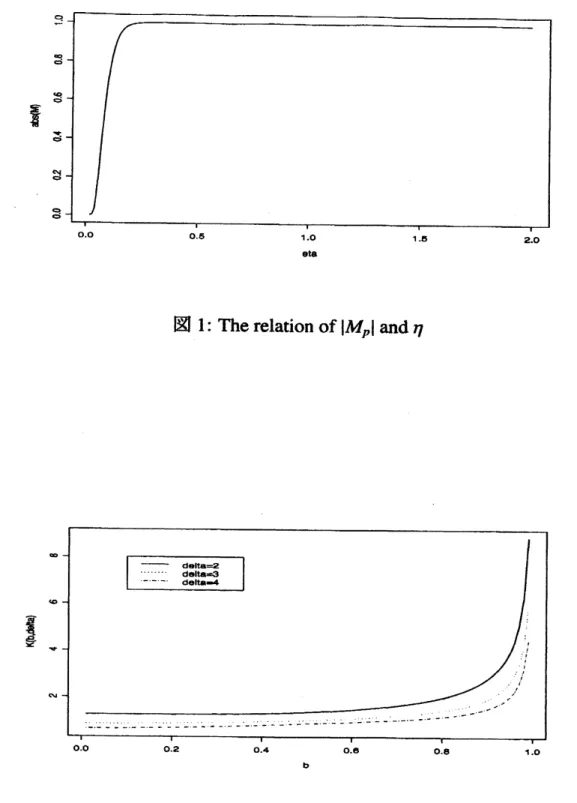
see
the behavior of $|M_{p}|$ when $\eta<2$ to check the effectof non-Gaussianity. Figure 1 shows the relation of $\eta$ and $|M_{p}|$
.
Except for the regioncloseto$0$,themagnitudeof$|M_{p}|$
is
approximately 1,so we
can
see
that theeffectof
non-Gaussianity is
very
small. Finallywe
see
themagnimde of$K(b,\delta)$.
Figures2 showsthatthe relation of$K(b, \delta)$and $b$ with $\delta=2,3$ and
4.
Inevery case
the magnimde of$K(b,\delta)$
becomes larger whenthevalueof$b$tendsto 1. Therefore thetestbased
on
Cressie-Readpower-divergence method works well for the
near
unitrootprocess.
References
[1] Anderson, T. W. (1977). Estimation for autoregressive moving
average
models inthe timeandfrequency domains.Ann. Statist. 5,
842-865.
[2] Baggerly, K. A. (1998). Empirical likelihood
as a
goodness-of-fitmeasure.
Biometrika.85,
535-547.
[31 BRILLINGER, D. R. $(2(n1)$
.
Time Series: DataAnalysisand Theory, expanded ed.Holden-Day, San Francisco.
[41 Brockwell P. J. andDavis. R. A (1991). Time Series: Theory andMethods, second
ed. Springer-Verlag.
[5] Chen, S. X. (1993). On the
accuracy
ofempiricallikelihood confidence regions forlinear regression model. Ann.Inst.Statist. Math. 45,
621-637.
[6] Chen, S. X. (1994). $Emp\ddot{m}cal$ likelihood confidence intervals for linear regression
coefficients.J. multivariate Anal. 49, 24-40.
[7] Keenan, D. M. (1987). Limiting Behavior of Functionals of Higher-Order Sample
Cumulant Spectra. Ann.Statist. 15, 134-151.
[8] Kitamura, Y. (1997). Empirical likelihood methods with weekly dependent
pro-cesses.
Ann. Statist. 25,2084-2102.
[9] Monti,A.C.(1997).$Emp\ddot{m}cal$likelihoodconfidence regionsin time series models.
Biometrika. 84, 395A05.
[10] Owen, A. B. (1988). $Emp\ddot{m}cal$ likelihood ratio confidence intervals for
a
single[11] Owen, A. B. (1990). Empirical likelihood ratio confidence regions. Ann. Statist.
18,
90-120.
[12] Owen,A.B.(1991).$Emp\ddot{m}callikelih\infty d$forlinearmodels. Ann. Statist. 19,
1725-1747.
[13] Qin, J. (1993). Empirical likelihood in biased sample problems. Ann. Statist. 21,
1182-1196.
[14] Qin, J. and Lawless, J (1994). Empmcal likelihood and general estimating
equa-tions.Ann. Statist. 22,$3(n- 325$
.
[15] Taniguchi, M. andKakizawa,Y.(2000).Asymptotic Theory
of
StatisticalInference
for
Time Series. Springer-Verlag, New York.eta
図1: Therelationof$|M_{p}|$ and$\eta$
$b$