Evolutionary
Game with
Statistical
Mechanics1)*MitsuruKIKKAWA
*
Department
of
Economics, Graduate Schoolof
Economics,Kwansei Gakuin University, Nishinomiya 662-8501 JAPAN
Abstract
This paper formulatesevolutionarygametheorywithanewconcept usingstatistical mechanics.
Thisstudy analyzes the followingsituations: eachplayeronthe lattice plays a gamewith itsnearest
neighbororwitharandomlymatchedplayer. Thesesituationsareformulatedusingananalogywith
theIsing model and the Sherrington-Kirkpatrickmodel, the simplest models instatistical
mechan-ics. Moreover, this paper examines therelations, the order parameter, and the action)$s$ probability
distributiononthe lattice withpercolation.
As aresult,theoreticalcalculations agreewithclassicalevolutionarygametheory intemsofthe
parameter size. This paper shows that bifurcations occur in aquenched system with extemalities,
hence,this systemhas multiple equilibria. This model applies toatwo-playermodel of reinforcement
learning with memory [11]. This paper analyzes Prisoner’s Dilemma Game, shows that this Nash
equilibrium isParetooptimalin terms of the length of memory.
Keywords: Evolutionary GameTheory, Statistical Mechanics, Ising Model, SK Model, Percolation
JEL classiflcation: C15, C73, C78
1
Introduction
This paperformulates evolutionarygametheory with
a new
conceptusingstatisticalmechanics. In evolu-tionarygametheory,a
largenumber ofplayersis assumedto searchatrandomfortrading opportunities, and when they meet the terms of gameare
started. We have described the above situations with the classical approaches using the replicator dynamics $[15]^{2)}$,or a
perturbed finite-state Markov process $[8|$.
Incontrasttothese approaches,ourstudyformulatesalargenumberofplayersplayinggames simultane-ouslyusingan
analogy with the Ising model and the Sherrington-Kirkpatric model, the simplest modelsinstatistical mechanics.
Numerous papers published recently have used statistical mechanics in evolutionary game theory,
Blume [1], Diederich and Opper $[6|$, McKelvey and Palkey $[$12, $13]^{3)}$, Brock and Durlauf [2]. However,
thesepapers appliedthe Ising model [1] and the standard Sherrington-Kirkpatrick model [6], vigorously researched in theoretical physics, in astraightforward manner. Furthermore, they paid verylittle atten-tion tothebasic elements. This paper presentsanovel modelusingstatistical mechanics forevolutionary
gametheory with basic elements.
Thispaperis organized
as
follows. In\S 2,we
formulatea
modelwith nearest-neighbor interaction,andcomputetheorder parameter. In \S 3, we formulatea model for play with
a
randomlymatched player inannealed and quenchedsystems, and computethe optimal order parameter for each system. In \S 4, we extendour model to add an extemality. In\S 5, wepresent theconclusions and discuss future work.
1$)$
Thispaper isbased onKikkawa [9]submitted to Progressof TheoreticalPhysics Supplement andadded. The author
thanksarefereefor helpfulcomments,theYukawa Institute for Theoretical Physics, Research InstituteforMathematical
Science at KyotoUniversity. Discussionsduring the YITP workshop YITP-W-07-16 on“Econophysics III-Physical
Ap-proach toSocial and Economic Phenomena-” and RIMSWorkshopon “2008 Mathematical Economics” were useful to complete thiswork. Errorsarethe responsibility oftheauthor.
2$)$
replicator dynamics :
$\frac{\dot{x}_{i}}{x_{l}}=((Ax)_{i}-x\cdot Ax)$, $i=1,$$\ldots,n$, $A$: payoff$mal|\backslash l$
meansthat if the player’s payoff from the outcome$i$is greaterthanthe expected utility $x\cdot Ax$,then the probability of the
action$i$is higherthan before.
3$)$
This modellscalled QuantalResponseEquilibrium(QRE).Theypointout that this model fltsavarietyof experimental
2
Nearest
Neighbor
Interaction
(Ising Model)
2.1
Theoretical Framework
In this section, weconstruct a nearest-neighborinteraction model with reference to the Ising model, the
simplest model instatistical mechanics.
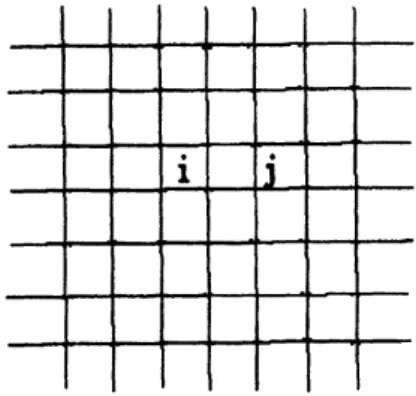
Let $Z^{2}$ be the plane square lattice and we refer to the vertex$i$
as
the site. Each site on the lattice is theaddressofone
player. Every site $i\in Z^{2}$ is directly connected to afinite number of other sites. Theset of sites $B=\{(ij)\}$ directlyconnected to site $i$ is the neighbor of$i,$ $j$ (See figure 1).
Figure 1: Square lattice andNearestNeighbor.
A player who has chosen an action strategy receives a payoff from his neighbor,which is determined
by his strategyandhis neighbor’s choiceofaction.
EXAMPLE 2.1 (Two playersand twostrategies, symmetricstrategic game)
The set of actions ofrow player 1 is
{Action
1, Action2}
and that of column player 2 is{Action
1,Action
2},
and for instance, therow
player’s payoff from the outcome (Action 1, Action 1) is $a$, then thecolumn player’s payoffis also$a$
.
Ifthe set of actions’ index is $\{+1, -1\}$ and payoff$a,$$b>0$, then this model corresponds to the Ising
model, where the payoffrepresents the energy.
PayoffMatrix 1
$\square$
PROPOSITION $2.2^{4)}$ We obtaintheprobability distributions ofactions,
{Si},
$i=1,$$\cdots,$$N$, and theplayer’spayoff ffom the outcome is $f$,
$P(\{S_{i}\})=Z^{-1}\exp(\gamma f)$
.
(1) where$\{S_{i}\}$ is aplayer$i$’s action, and$\gamma$ is
a
non-negativeconstant ; for instance,$\gamma$ is the optimal choicebehavior $[3]^{6)},$ $f$ is the player’s expected payoff from the outcome $\{S_{i}\}$, and $Z$ is the normalization
parameter, with $\sum_{i=1}^{N}P(\{S_{i}\})=1$
.
This impliesthat if payoff$f$ is greater, then theprobability of choosing the action is higher.
$\overline{4)_{We}}$
omitthis proof. There exist many waysofprovingthisproposition, however, this form is derived from the law ofthe conservationofenergyand the$p\dot{n}na|ple$ ofequal a$pno’\dot{\tau}$probability. In this model, the payoff representsthe energy
intheoretical physics,but itadmitsnegativevaluee. Of course, the totalpayoff$2f$isconstant. See statistical mechanics
textbooks fordetails.
6$)$
Whenparameter$\gamma$approaches infinity, the model ofbehaviorapproaches the beet responsemodel. When $\gamma=0$,the
DEFINITION 2.3 We define an order parameter$m\in R$, as how often
a
playerhas chosen an actionin this
game.
$m= \sum_{i}^{N}S_{i}P(\{S_{i}\})$. (2)
where $N$ is the number of the actions.
EXAMPLE 2.4 ConsideringEXAMPLE 2.1, the actions’ index $\{S_{i}\}=\{1,2\},$$N=2$, and the order
parameter for eachcaseis computed
as
follows.(i) If all the players’ actions
are
{Action 1},
then we obtain$m=1$.
(ii) If all the players’ actions
are
{Action
2},
thenwe
obtain$m=2$.
(iii) Ifhalf of all the players’ actions
are
{Action
1},
then weobtain $m= \frac{3}{2}$.
If the order parameter$m$ is
near
1, then weknow that thereare manymore
players choosing{Action
1}
than
{Action 2}.
If the order parameter$m$ is near 2, then we knowthat moreplayers chose{Action
2}
than
{Action 1}.
If $\gamma$ is sufficiently large, then the actions for all players are chosen. If $\gamma$ is sufficiently small, then
the actions for all players are essentially random
as
all strategiesare
played with equal probability,independent of the payoff size.
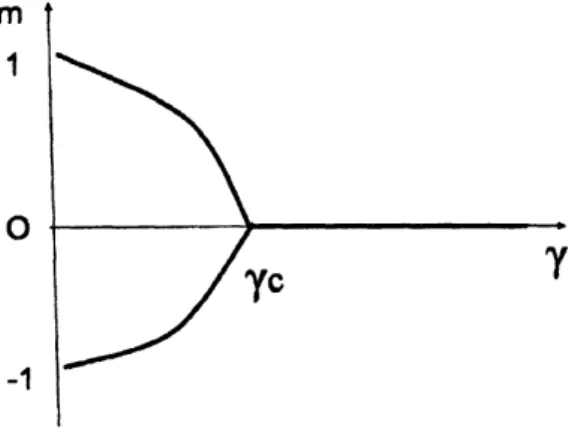
Inparticular, if the actions’ index$S_{i}$ is $\{-1,1\}$, then the order parameter$m$is 1,0(random),$-1$ for the
abovecases (See figure 2),
Figure2: Orderparameterand parameter$\gamma$(Ising model).
$\square$
DEFINITION 2.5 (Weibull [15]) $x\in\Delta$ is an evolutionary stable strategy (ESS) if for every strategy
$y\neq x$, there exists some $\overline{\epsilon}_{y}\in(0,1)$ such that the following inequality holds for all $\epsilon\in(0,\overline{\epsilon}_{y})$
$u[x,$$\epsilon y+(1-\epsilon)x]>u[y,$$\epsilon y+(1-\epsilon)x]$, (3)
where $\Delta=\{x\in R_{+}^{k}$ :$\sum_{i\in K}x_{i}=1\},$ $K=\{1,2, \cdots, k\}$
.
PROPOSITION 2.6 $x\in\Delta$ is an evolutionarystable strategy ifand only ifit meets these first-order
and second-order best-reply;
$u(y, x)\leq u(x, x)$, $\forall y$, (4)
$u(y,x)=u(x, x)\Rightarrow u(y, y)<u(x, y)$, $\forall y\neq x$. (5)
PROOF For aproof, see Weibull [15],
We characterize theevolutionarystable strategy with the order parameter $m$
.
PROPOSITION 2.7 $x\in\Delta$ is anevolutionarystable strategy in
an
evolutionarygame with statisticalmechanics, if there exists
some
$m$ such that theinequality (7) holds for all $m^{*}$.
$u(y, x)\leq u(x, x)$, $\forall y$, (Equilibrium Condition) (6)
$|m-m^{*}|<\epsilon$.
where $m^{*}$ is the index of the equilibrium action.
PROOF Obvious.
(Stability Condition) (7)
$\square$
PROPOSITION 2.6 impliesthat $x\in\Delta$ is anevolutionarystable strategy, ifandonly if it meets Nash
equilibrium and asymptotic stability conditions. On the other hand,
PROPOSITION
2.7 implies that the Lyapunovstable condition is replaced by the stability condition in PROPOSITION 2.6.Letthismodel add
an
orderparameter;we
can
analyzean
asymmetric two-persongamein thesame
way.In conclusion,
we
formulate the simplest symmetric and asymmetric two-person games with statisticalmechanics in evolutionary game theory.
Lipowski, et al. [11] introduces
a
two-player model of reinforcement leaming with memorybystatisticalmechanics approach. It shows numericallythat it is advantageousto have a largememory in symmetric
games, but it is better to have a short memory in asymmetric
ones.
The parameter $\gamma$ which wedefinedis about memory in Lipowski, et al. [11]. Thismeans that the longer memory is,the
more
likelyyou will be able to choose the action.EXAMPLE 2.8 We consider the Prisoner’s Dilemma Game, a two-player game in which each player
has only two pure strategies. A player $i(i=1,2)$ is equipped with a memory of length $l.$, where it
sequentiallystoresthe last $l_{i}$ decisions madeby its opponent.
LEMMA (Lipowski, et al. $[11|)$ It is advantageous to have a large memory in symmetric games
$(l_{1}=l_{2})$
.
It is better to havea
short memory in asymmetricones
$(l_{1}\neq l_{2})$.
PROOF The player’s each expected utility chosen the Action 1 or 2 is 3$p^{2},$ $-4p^{2}+3p+1$. If these
expected utilitiesareequivalent, weobtain$p^{*}= \frac{3+\sqrt{37}}{14}$
.
Sowe can understand that it is advantageneousto choose the Action 1 when$p>p^{*}$ and the Action 2 when $p<p^{*}$ by the function’s form.
If the probability$p$is large,the length of memoryis long. Conversely, if the probability$p$is small,the
length ofmemoryis short. Therefore,ifboth playersarelongmemory, the Nashequilibriumof thisgame
is (Action 1,Action 1). We
can see
that thePrisoner’s Dilemma is avoided. However, if both playersare
short memory, the Nashequilibrium ofthis game is (Action 2, Action2). Therefore, it is advantageous
to havea largememoryin symmetricgames $(l_{1}=l_{2})$
.
Next, we take that both player’s length ofmemory are different. We
can
consider the following twocases.
(i) ifplayer l’s lengthof the memory is long and player$2$’soneis short, thentheNashequilibriumis (Action 1, Action 2). So, we can
see
that player 2 who hasashort memory obtains higher payoff thanplayer 1 who has alongmemory.
(ii) if player $1$’s length of the memory isshort and player$2$’s
one
is long, then the Nash equilibrium is(Action 2, Action 1). So,
we can see
that player 1 who has a short memory obtains higherpayoff thanplayer 2 who has
a
long memory. Therefore, it is better to have a short memory in asymmetric ones$(l_{1}\neq l_{2})$
.
2.2
Spatial
Pattern:
Percolation
We examine the relations, the order parameter, and the action’s probability distribution
on
the latticewith $percolation^{6)}$
.
First, we introduce some definitions and notation. For $S\in\Omega$, let $S_{i}^{-1}(+1)=\{x\in Z^{2}|S\iota=+1\}$.
$S_{\dot{*}}^{-1}(-1)$ is defined in the
same
way. $C_{z}^{+}(S)$ denotes the connected component of$S_{i}^{-1}(+1)$ containing thepoint $z^{7)}$
.
$C_{\overline{z}}(S)$isdefined in thesame way. If$S_{i}(z)=+1$,$C_{z}^{+}(S_{i})=\{x\in Z^{2}|$ there $e\dot{m}t$the points $\{x_{i}\}_{i=1}^{N}\subset S_{i}^{-1}(+1)$, such that
$|x_{i}-x_{i-1}|=1,1\leq i\leq N+1$, where $x_{0}=z,$$x_{n+1}=x\}$ (8)
If$S_{i}(z)=-1,$ $C_{z}^{+}(S_{i})=\emptyset$
.
If$z$ is the orgin, then we deal with $C_{0}^{+}(S_{1})$
.
For $W\in Z^{2},$ $|W|$ is the cardinality of$W$, or the numberof vertices ofa graph $W$
.
We analyze the behavior of $\{$Si
$||C_{0}^{+}(S_{t})|=\infty\}$ on the pair $(\gamma, h)$. Theparameter $h$ represents
an
effect ofextemality. In thissection, we mainly deal with $h=0$.
Coniglio, et $d$
.
$[4]$ proves thefundamental relationshipbetween percolation and phase transition.THEOREM 2.9 (Coniglio, et $d$
.
$[4]$) In thetwo-dimensional Ising model,we
obtain,(i) if$\gamma>\gamma_{c}$, $\mu_{\gamma,0}^{+}(\{|C_{0}^{+}|= oo\})>0$, $\mu_{\gamma,0}^{-}(\{|C_{0}^{-}|= oo\})>0$.
where $\mu^{\epsilon},$ $s=t+,$$-$
}
is Gibbsmeasures.
(ii) if$\mu$ is external to the set of all Gibbs states $\mathcal{G}(\gamma, h)$,
$\mu(|C_{0}^{+}|=\infty)\mu(|C_{0}^{-}|=\infty)=0$
.
REMARK 2.10 If $\mu$ is extemal to the set of all Gibbs states $\mathcal{G}(\gamma, h)$, then $\mu(\bigcup_{x\in Z^{2}}\{|C^{+}x(\omega)|=$
$\infty\})=0$ or 1 [10]. Ifthis value is 1, then there exists a.e., an infinite cluster of the corresponding sign and no inflnite clusters of the opposite sign–this is called percolation.
The above theorem implies that for $\gamma>\gamma_{c},$$h=0$, there exists a.e., an infinite cluster of the
corre
$\cdot$sponding sign and no infinite clusters of the opposite sign$((i))$. For $0<\gamma<\gamma_{c},$$h=0$, there exists
an
infinite cluster for neither actions ((ii)),
For $0<\gamma<\gamma_{c}$ and $h=0$ (i.e.,
an
infinite cluster exists for neither action), what kindof pattern dotheactions’ distribution
on
the lattice make ? We know twotypical patterns : the concentric circle andchess patterns. The former is a cluster of$+$ actions surroundedby
a
bigger cluster of–actions, whichis surrounded by a bigger cluster of $+$ actions,$\cdots$
.
The latter isa
cluster of $+$ actions and –actionsplaced alternately (Figure 3). We definite theconnectivity to characterizethese patterns.
DEFINITION 2.11 A subset $A\subset Z^{2}$ is called $(*)$ connected ifand only if for every $x,$$y\in A$, there
existsasequence of points $\{x_{1}\rangle x_{2}, \cdots, x_{n}\}\subset A$such that $x_{0}=x,$$x_{n+1}=y$ and for every $1\leq i\leq n+1$, $\Vert x_{i}-x_{i+1}\Vert=1$
.
$\overline{6)p_{ercolationi\epsilon}}$known$\ln$thesimplat modelsasphase transition. Wedefine atypical percolation problem.
[d-dlmenslonal Percolation] Let $Z^{d}(d\geq 2)$ be the plane cubelattice and$p$be a numbersatisfying$0\leq p\leq 1$
.
Weexamineeachedge of$Z^{d}$, and considerit tobe openwith probability
$p$andclosedotherwise,independentof allother edges.
The edges of$Z^{d}$ representthe innerpassageways of thestone,and the parameter
$p$istheproportionofpassagesthatare
broadenoughto allow water to pass along them. Suppose weimmersealarge porous stone inabucketofwater. What is
the probabilitythat the center of the stone is wetted 7 7$)$
Here,we defineconnected and related matter.
DEFINITION A subset $A\subset B^{2}$ is called connect$ed$ if and only if for every $x,$$y\in A$, there exists a sequence $\{b_{1}, b_{2}, \cdots , b_{n}\}\in A$, such that
(a) $x\in b_{1}$ and$y\in b_{n}$.
(b) For every $1\leq i\leq n-1$,thereexistsapoint$x_{t}\in Z^{2}$, such that $b_{i}\cap b.+1=x.$.
DEFINITION For$A\subset B^{2},$ $C\subset A$iscalled $A$’s connectedcomponent if andonly if
(a) $C$isconnected,
$+$ $+$ $+$
$+$ $+$
$+$ $+$
Figure 3: (LEFT) ConcentricCirclePattern, (RIGHT) ChessPattern.
where$x=(x^{1}, x^{2})\in Z^{2}$, $\Vert x\Vert=\max\{|x^{1}|,$ $|x^{2}|\}$
.
Using the above definition,
we can
flnd that the concentric circle pattern has finite $(*)$ connectionsand the chess pattern has infinite $(*)$ connectionsfor eachaction. The latter iscalled the coexistence
of
infinite
$(*)$-clusters.THEOREM 2.12 (Higuchi [7]) For every sufficiently small $\gamma>0$, there exists $h$ such that $\gamma’h’<$
$\frac{1}{2}\log\frac{p_{c}}{1-p_{c}}-4\gamma’,$ $\gamma h>\frac{1}{2}\log\frac{1-p_{c}}{p_{c}}+4\gamma$, implying the coexistenceofinfinite $(*$$)$-clusters with respect
to the Gibbs state for $\mu_{\gamma,h}$
.
PROOF For detail, Higuchi [7].
$\square$
To conclude this section, the condition of the existence of infinite clusters was computed. If infinite clusters do notexist, then
we
knowthe kind of pattems the distribution of actions makeson
the lattice. These pattemsare
eitheraconcentricc\’ircleor
achesspattern. If$\gamma$is sufficiently small and meets certainconditions, then infinite $(*$$)$-clusterscoexist in achess pattern.
3
Random
Matching
Interaction
(Sherrington-Kirkpatrick
Model)
In
\S
2,we
discussed a nearest-neighbor model based on the Ising model. In this section, the playersare assumed to search at random for trading opportunities and when they meet the terms of gameare
started. This randomly matched model was formulatedby Sherrington-Kirkpatrick [14].
Eachplayer’s payofffrom theoutcome is asfollows:
$H( \{J_{ij}\})=\sum_{i\neq j}J_{ij}S_{i}S_{j}$, where
$P(J_{ij})= \frac{1}{\sqrt{2\pi J^{2}}}\exp\{-\frac{(J_{ij}-J_{0})^{2}}{2J^{2}}\}$, (9)
where $i,j$ areplayers, and $S_{k}=\{-1,1\},$ $k=i,j,$ $P(J_{ij})$ are Gaussianrandom variables witha mean of
$J_{0}$ and avariance of $J^{2}$.
3.1
Annealed
System
We analyze two models, an annealed system and
a
quenched system in spin-glass physics. First, weanalyze the annealed system, where $J_{jj}$ is chosen randomly, but then each player
moves
to obtaina
better payoff. Second, we analyzethequenched system, where $J_{ij}$ is chosenrandomly, but then is fixed.A particular spin-glasswill have
a
social welfare $function^{8)}$ and the partitionfunction isdefinedby$F=\gamma\log\langle Z\rangle$, (10)
$\langle Z\rangle=\sum_{\{S_{i}\}}\int_{-\infty}^{\infty}\prod_{(ij)}dI_{lj}P\{J_{ij}\}\exp(\gamma H\{J_{1j}\})$
$= \sum_{\{S_{i}\}}\exp[\sum_{(ij)}\{\gamma J_{0}S_{t}S_{j}+\frac{(\gamma J)^{2}}{2}(S_{i}S_{j})^{2}\}]$
.
(11)We obtain the followingproposition.
PROPOSITION 3.1 In the annealed system, the order parameter is the points that maximize the
social welfare functionin the model. If there
are
infinite playerson
thislattice, then the order parameter is$0$.
PROOF We maximize the social welfare for the order parameter$m$.
$\frac{\partial F}{\partial m}=2\gamma^{2}J_{0}n^{2}m+2\gamma^{3}J^{2}n^{4}m^{3}=0$, $m=0$ $or$ $\pm\sqrt{\frac{-J_{0}}{\gamma J^{2}n^{2}}}$
.
(12)Wecan understand $J_{0}<0$, because $m$ is areal number. The limit of optimalorder parameter$m$is $0$, as
$n$ approaches to $\infty$.
$\square$
This implies that theoptimal order parameter is apoint, like areplicator system.
3.2
Quenched
System
Weanalyzethe quenched system, where $J_{ij}$ is chosenrandomly,but then is fixed. Diederich andOpper [6]
analyzedsuch aquenched system.
In
a
quenched system, the social welfare function is givenby$F=\gamma\langle\log Z\rangle$
.
(13)The partition function is the
same
as
(11). We obtain the next proposition.PROPOSITION 3.2 In aquenched system, the order parameter maximizes the socialwelfare of the
model.
$m= \frac{1}{\sqrt{2\pi}}\int_{-\infty}^{\infty}\exp(-\frac{1}{2}z^{2})\tanh(\gamma\tilde{J}\sqrt{q}z+\gamma\tilde{J}_{0}n)dz$
.
(14)PROOF We omit the detailed proof. The above equation computes the maximization of the social welfare for order parameter$m$ by employingstandard methods.
$\square$
3.3
Extention: TAP
Equation
To this subsection, we compute the optimal order parameter in general case for $J_{ij}$
.
Here, if we takea exampie for $\{J_{ij}\}$, we analyze it. In detail, we find that the order parameter’s equation (TAP
equa-tion [14]$)$ has the condition of a phase transition, using the property of the eigenvalues ofthe matrix.
We compute the FVobenius root and the boundary condition between stability and instability from the Pemn-Robenius theorem. Theplayer’s payoff from the outcome variesrandomlybecause the players
are
randomlymatched and playa
game. These situationscan
be expressed using the random matnx theory. This th$\infty ry$ has several laws, because the elements of this matrixare
varied randomly. Moreover, ifweassumethat $J_{ij}=J_{ji}$ for theelements of the randommatrix, then this elements
can
be transformed intoa Hermite matrix, since the payoffmatrix is invariant under positive affine transformations of payoffs.
As aresult, we
can
compute the Frobenius root from Wigner’s semi-circle law, and this condition $hom$the $Perron- \mathbb{R}obenius$ theorem.
Let
a
modeladd another parameter$h_{j}$ (aneffectof extemality). We consider that thepayoff isaffectedby aroundgames. In this case, thepayoff is defined as
We obtainthe following propositions for annealed and quenched systems.
PROPOSITION 3.3 In an annealed system with externality, no phasetransition occurs.
PROOF We computethesocial welfare in the same way. We obtain
$h_{j}=2\gamma m(1-N)(J_{0}+J^{2}m^{2})$
.
(16)This impliesthat nophase transition
occurs.
$\square$
This proposition implies that no phase transition occurs because each player in an annealed system
movesto obtaina better payoff.
Second, we analyze the variation inthe orderparameterin aquenched system. In this case, weobtain
the following proposition.
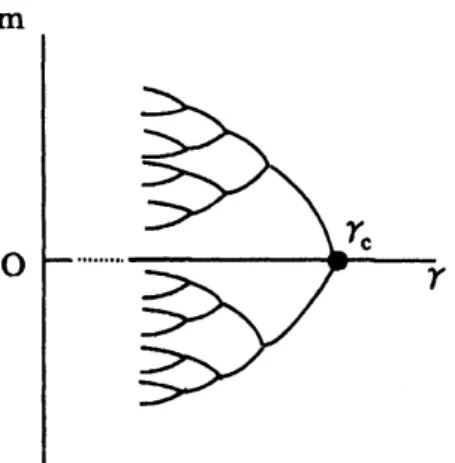
PROPOSITION 3.4 In
a
quenched system with externality, there exist discontinuous variations inthe order parameter. Bifurcations occur, hence, this systemhas multiple equilibria.
PROOF First,
we
computethe order parameterin thesame manner,as mentionedearlier. The Weissapproximation is given by
$m_{i}= \tanh\langle\gamma(h_{i}+\sum_{j}J_{ij}m_{j})\rangle$,
using the approximation $\langle f[s]\rangle\approx f[\langle s\rangle]$, i.e., by approximating the expected value of
a
function of$s$with the function of theexpected values. Thisapproximation neglects fluctuations.
Ifwe expandthis equation for $J_{0}=0$,
$m_{i}= \gamma\sum_{j}J_{ij}m_{i}-\gamma\sum_{j}J_{ij}^{2}m_{i}+\gamma h_{i}+\cdots$
.
We expand $NxNJ_{ij}$ matrices using the eigenvector. Let the eigenvector $\{\langle i|\lambda\rangle\}$ be
a
completelynormalizedorthogonal system and $J_{\lambda}$ bethe eigenvalue,
$\sum_{j}J_{ij}\langle i|\lambda\rangle=J_{\lambda}\langle i|\lambda\rangle$
.
Let $m_{\lambda}= \sum_{*}m_{i}\langle i|\lambda\rangle$,i.e., theprojection of the magnetizationvectoronto eigenvector $|\lambda\rangle$ ofmatrix $J$, with thecorresponding
eienvalue $J_{\lambda}$ and
$h_{\lambda}= \sum_{\mathfrak{i}}h_{i}\langle i|\lambda\rangle$ inthesameway. Thus let it add
$\lambda$ mode to parameters $J_{ij},$$m,$$h$, then
theorder parameter ls given by
$m_{\lambda}= \frac{1}{T-J_{\lambda}}h_{\lambda}$, where $T= \frac{1}{\gamma}$
.
On the other hand, according to the random matrix theory, the maximal eigenvalue of $J_{\Lambda}$ is $2J$, the
minimal eigenvalue is $-2J$, and the semi circle law is realized, i.e.,
$\rho(J_{\lambda})=\frac{2}{\pi J_{\Lambda}^{2}}(J_{Z\Lambda}-J_{\lambda}^{2})^{1/2}$
This implies that the critical point$T_{C}$is$2J_{\lambda}$
.
There existdiscontinuous variations for the order parameter.Bifurcations occur, hence, this system hasmultiple equilibria. (See figure 4)
$\square$
4
Concluding
Remarks
In this paper,astatistical frameworkis presented formodeling nearest-neighborand random interactions
in evolutionary game theory. This fiiamework is different from classical evolutionary gametheory. The
Figure4: Order parameter bifurcatesand multiple equilibria.
players. When $\gamma=0$, behavior is essentially random,
as
all strategiesare
played with equal probability.We compute the optimal order parameter for each system. In
a
quenched system with extemality, thereare
multiple equilibria.This framework
can
be extended invarious ways because of the simplicity of the models. For example,we
will analyze the hamework in thecase
the action number ismore
than three or infinity. We will letthe important parameter $\gamma$ be endogenous; this is known
as
superstatistics. This model extends Contand Bouchaud [5] $mode1^{9)}$ with detailed microeconomic structure.10)
References
[1] Blume, Lawrence. E. :“The Statistical Mechanics of Strategic Interaction,” Games and Economic
Behavior, Vol.5 (1993), pp. $387arrow 424$
.
[2] Brock, William A. and Durlauf, Steven N. :“Discrete choice with social interactions,” Review
of
Economic Studies, Vol.68 (2001), pp. 235-260.
[3] Chen, Hsiao-Chi, Friedman, James W. and Thisse,Jacques-Francois : “Boundedly Rational Nash
Equilibrium: A Probabilistic Choice Approach) Games and Economic Behavior, Vol.18 (1997),
pp. 32-54.
[4] Coniglio, Antonio, Nappi, Chiara Rosanna, Peruggi, Fulvio and Russo, Lucio : “Percolation and
phasetransitions intheIsing model,” Communicationsin Mathematical Physics, Vol.51 (1976), pp.
315-323.
[5] Conte,Rama andBouchaud,Jean-Philipe: “Herd Behavior and Aggregate Fluctuations in Financial
Markets,” Macroeconomic Dynamics, Vol.4 (2000), pp. 170-196.
[6] Diederich, Sigurdand Opper, Manfred : ”Replicators with random interactions: Asolvablemodel,”
Physical Review A, Vol.39 (1989), pp. 4333-4336.
[7] Higuchi, Yasunari : “Percolation in the Ising Model,” SUGAKU, Vol.47 (1995), pp. 111-124. (In Japanese)
[8] Kandori, Michihiro, Mailath, George J. and Rob, Rafael : “Learning, Mutation, and Long Run
Equilibriain Games,” Econometrica, Vol61 (1993),pp. 29-56.
$\overline{9)}$
Cont andBouchaud[5]proposedtousepercolationmodels toillustrate the herd behavior ofastock market participants.Usually,tradersareratherrational in thesensethattradersdeterminetheirtradingpositionsby analyzing thepastdataon
thestock market andtaketheir trading strategiesinto account. However, sometimes traders do notlook at the pastdata onthemarket and followanadvice ofaninvestment adviser scrupulouslythat is, traderssharingthe sameadvice behave
inthesameway. Thisherd behavior causee alarge fluctuation and derive adistribution of stock returns deviatingfrom
Gaussianand having fat tails.
[9] Kikkawa, Mitsuru : “Statistical Mechanics of Games : Evolutionary Game Theory,” Progress
of
Theoretical Physics Supplement, forthcomming.
[10] LanfordIII,
0.E.
andRuelle, David: “Observables atinfinity andstates with shortrangecorrelationsin statisticalmechanics,” Communications in Mathematical Physics, Vol.13 (1969), pp. 194-215.
[11] Lipowski, Adam, Gontarek, Krzysztofand Ausloos, Marcel :“Statistical mechanics approach to a
reinforcement learning model with memory,” Physica A, doi$:10.1016/j$.physa2009.01.028.
[12] McKelvey,
Richard
D. and Palfrey, Thomas R. : “Quantal Response Equilibria for Normal Form Games,” Games and Economic Behavior, Vol.10 (1995), pp. 6-38.[13] McKelvey, Richard D. and Palfrey, Thomas R. :“ A Statistical Theory ofEquilibrium in Games,”
Japanese EconomicReview, Vol.47 (1996), pp. 186-209.
[14] Mezard, Marc, Parisi, Giorgio andVirasoro,Miguel Angel : Spin Glass Theory andBeyond, (World
Scientific, 1987).