New
constructions
of graphs
with
large
girth
obtained from
“classical” ones
Xavier
Dahan*Faculty
of
mathematics,Ky\^ush\^u university, Japan
[email protected]
Abstract
This short note surveys some new and not so new constructions of infinite families of
constant degreeregular graphs with largegirth. Many of thesefamilies are constructed as
follows: interpret algebraicallythe infinite$d$-regulartreeasaCayley graphonarelevant free
group defined over$\mathbb{Z}$. Take finite quotientsofthis tree realized asCayleygraphson groups
defined by taking projections$\mathbb{Z}arrow \mathbb{F}_{q}$of this free group, for an infinite set ofprimes $q$
.
Forthesefamilies, the finite quotients are Cayley graphs over$GL_{2}(\mathbb{F}_{q}),$ $SL_{2}(\mathbb{F}_{q})$ or $PGL_{2}(\mathbb{F}_{q})$,
$PSL_{2}(\mathbb{F}_{q})$. We highlight theuseofquatemiongroups, allowing to obtainnewconstructions
ofregular graphs displaying agirth larger than what were able to achieve some “classical”
constructions.
1
Introduction
The girth of a graph is the length of one of its shortest cycle. For large graphs, it is difficult
to compute, and a natural question raises: how large the girth ofa graph with$N$ vertices
can
be? This very general question is not trivial as soon as there are
some
vertices of degree ofregularity greater than 2 (otherwise it is a cycle graph which have girth equal to $N$). If
one
restricts the kind of graphsto regular graphs, this question has a
more
precise signification, dueto an upper bound found out by Moore. This “Moore bound” is a simple counting observation
that
can
be summed upas
follows. Ina
regular graph of girth$g:=$ girth$(G)$, the set of verticesat distance less than $t$ from agiven vertex (the root) is a regular tree, assuming that $t\leq L_{2}^{2}\rfloor$
($g$ is odd)
or
$t<g2$ ($g$ is even). It follows that:$g\leq\{\begin{array}{ll}2\log_{d-1}|G|+1 if g is odd,2\log_{d-1}|G|+2-2\log_{d-1}2 if g is even.\end{array}$ (1)
This implies that for $d\geq 5,$
$g \leq(2+\frac{2}{\log_{d-1}|G|})\log_{d-1}|G|=(2+o(1))\log_{d-1}|G|$ (2)
Consequently given
a
family of$d$-regular graphs $(G_{n})_{n\in \mathbb{N}},$$\lim_{narrow}\inf_{\infty}\frac{girth(G_{n})}{\log_{d-1}|G_{n}|}\leq 2.$
This motivatesthe followingdefinition dueto Biggs [1]. $A$family of$d$-regular graphs is said to
be oflarge girth if$\lim\inf_{narrow\infty}\frac{girth(G_{n})}{\log_{d-1}|G_{n}|}\geq\epsilon$ for some $\epsilon>0.$
Application. The property of large girth, besides its own theoretical interest, finds an
ap-plication in error-correcting codes theory, and
more
precisely for “Low Density Parity Check”(LDPC) codes. This approach
was
pioneered by Margulis in [10], where he gave the firstcon-structive example of a family of LDPC codes of unbounded minimum distance by providing
explicit families of regular graphs of large girth. Such a property is quite useful in this context
for several
reasons:
(i) Tanner gave in [14] a construction of codes based ongraphs together with a lower boundon
the code minimum distance growing exponentially with the girth;
(ii) these LDPC codes
are
decoded with the help of iterative decoding algorithms working ona certain graph associated to the code construction and the performance of such algorithms
is known to deteriorate in the presence of small cycles. This phenomenon is related to the
fact that these iterative decoding algorithms compute symbol probabilities conditioned on an
exponentially large (in the number of iterations) number of received symbols as long as the
number of iterations is smaller than half the girth [5], but that does not hold anymore for
a
larger number of
iterations.
This motivates the construction of graphs with the largest girth possible. Define:
$\gamma(\{G_{n}\}) :=\lim_{narrow}\inf_{\infty}\frac{girth(G_{n})}{\log_{d-1}|G_{n}|}$
.
(3)We wish to determine foreach integer$d\geq 3$ the constant
$\gamma_{d}:= \sup \gamma(\{G_{n}\})$
.
$\{G_{n}\}_{n\in N}$family of$d$-regular graphs
The Moore bound (2) implies that $\gamma_{d}\leq 2$ for all $d\geq 3$
.
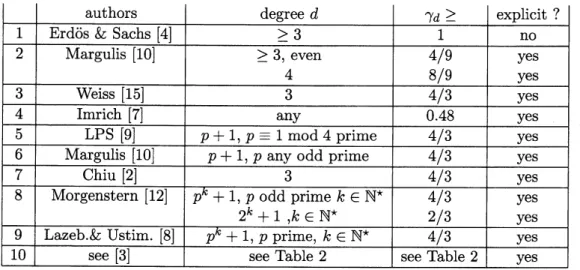
Lower bounds can be found in severalworks. Here is a non exhaustive list, written in chronological order:
Table 1: Old and
new
results about graphs with large girthExcept the graphs in [15, 8] all these families of graphs are defined as Cayley graphs on the
groups $GL_{2}(\mathbb{F}_{q}),$ $SL_{2}(\mathbb{F}_{q})$ or their projective counterparts $PGL_{2}(\mathbb{F}_{q})$ or $PSL_{2}(\mathbb{F}_{q})$
.
In thissurvey, we will focus on the constructions in [9, 11] and especially on how to modify these to
obtain the graphs in [3] that display
a
larger girth than what previously known formanyspecial2
The LPS-Margulis
construction
These
are
the famous Ramanujan graphs thatare
optimal expanders [6] with respect to theeigenvalue bound. These
can
be defined using quatemions due to a well-known isomorphismbetween the “Hamilton” quaternion algebra$\mathbb{H}(\mathbb{F}_{q})$
over
thefinite field with $q$elements,$\mathbb{H}(\mathbb{F}_{q}):=\{x_{0}+x_{1}i+X\dot{\mathfrak{U}}+x_{3}k, x_{i}\in\mathbb{F}_{q}\}$, where $i^{2}=j^{2}=-1,$ $ij=k$
and the$2x2$ matrix algebra
over
$\mathbb{F}_{q}$.
In particular, denoting$\mathbb{H}^{1}(\mathbb{F}_{q})$$:=\{x=x_{0}+x_{1}i+x_{2}j+x_{3}k\in$$\mathbb{H}(\mathbb{F}_{q})|N(x)=x_{0}^{2}+x_{1}^{2}+x_{2}^{2}+x_{3}^{2}=1\}$, and $\mathcal{Z}$ $:=\{x=\overline{x}:=2x_{0}-x, x\in \mathbb{H}(\mathbb{F}_{q})^{\cross}\}$the center
group of$\mathbb{H}(\mathbb{F}_{q})^{x}$, holds:
$\mathbb{H}(\mathbb{F}_{q})^{\cross}/Z\simeq PGL_{2}(\mathbb{F}_{q})$ and $\mathbb{H}^{1}(\mathbb{F}_{q})/\{\pm 1\}\simeq PSL_{2}(\mathbb{F}_{q})$
.
Following afamous theorem ofJacobi, every prime integer$p$canbe written in$8(p+1)$ different
ways
as
thesum
ofthesquares of 4integers. Consequently thereare
in$\mathbb{H}(\mathbb{Z})8(p+1)$quatemionsof
norm
$p$.
The group of invertible quaternions $\mathbb{H}(\mathbb{Z})^{\cross}$over
$\mathbb{Z}$ has exactly8
elements, and thisgroupacts naturally
on
theset of quaternions ofnorm
$p$.
Ifwe
isolateone
quaternionper orbitunder this action, this defines a special set $\mathscr{P}(p)$ of$p+1$ quatemions of
norm
$p$, anda
quitenatural way to achieve this is the following:
$\mathscr{P}(p)=\{\pi\in \mathbb{H}(\mathbb{Z})$ primitive : $N(\pi)=p,$ $\pi_{0}>0,$ $\pi-1\in 2\mathbb{H}(\mathbb{Z})\}$ if$p\equiv$ lmod4, (4)
$\mathscr{P}(p)=\{\pi\in \mathbb{H}(\mathbb{Z})$ primitive: $N(\pi)=p,$ $\pi_{0}>0$ if $\pi_{0}\neq 0$, or $\pi_{1}>0$ $if\pi_{0}=0,$
and $\pi-i-j-k\in 2\mathbb{H}(\mathbb{Z})\}$ if$p\equiv 3$ $mod 4$ (5)
For each prime $q>p$, define $\mathscr{S}_{p,q}$ the image of $\mathscr{P}(p)\subset \mathbb{H}(\mathbb{Z})$ in $\mathbb{H}(\mathbb{F}_{q})^{\star}/\mathcal{Z}$ and let $X_{p,q}$ $:=$
$\mathscr{C}ay(\mathbb{H}^{1}(\mathbb{F}_{q})/\{\pm 1\}, \mathscr{S}_{p,q})$ if $(\begin{array}{l}Rq\end{array})=1$
or
$X_{p,q}$ $:=\mathscr{C}ay(\mathbb{H}(\mathbb{F}_{q})^{\cross}/\mathcal{Z}, \mathscr{S}_{p,q})$ if $(\begin{array}{l}2q\end{array})=-1$.
Theseare the Ramanujan graphs of [9, 11]. They are $p+1$-regular, connected graphs, bipartite if
$(\begin{array}{l}eq\end{array})=-1$ andnot bipartiteotherwise, and havethe followingremarkableproperty: let$\lambda(X_{p,q})$
be the second largest eigenvalue of the adjacency matrix of $X_{p,q}$
.
It verifies $\lambda(X_{p,q})\leq 2\sqrt{p},$whichforlarge graphs is essentially the lowestpossible. Theconstruction of this kind of graphs
reaching the optimal lower bound
was
quitea
breakthrough in graph theory. Besides this“spectral” property, these graphs also have large girth, with the result mentioned in Table 1.
3
Modification of the
construction
The LPS graphsand its later generalization by Morgenstem yields $\gamma_{d}\geq 4/3$ for $d=p^{k}+1$ and
$\gamma_{2^{k}+1}\geq 2/3$, for$k\in \mathbb{N}^{\star}$
.
Forothervalues of$d$ thebest lower boundsfor $\gamma_{d}$ are due to Imrich [7](following
a
work of previous work ofMargulis [10]). In this section we show amodification ofthe LPS construction
as
done in [3] that allows to get the improvements in the last columnsofTable 1.
The idea is to consider
a
“symmetric” subset $\mathscr{D}(d)$ of $\mathscr{P}(p)$ of size$d+1<p+1$
.
If$d+1$ is even, such
a
set exists if and only if$p\equiv 3mod 8$.
Consider $\mathscr{D}_{p,q}$ the image of $\mathscr{D}(d)$in $\mathbb{H}(\mathbb{F}_{q})^{\cross}/\mathcal{Z}$
.
Again, if $(\begin{array}{l}Eq\end{array})=1$, then this image is contained in $\mathbb{H}^{1}(\mathbb{F}_{p})/\{\pm 1\}$.
Take theCayley graphs $G_{d,p,q}$ $:=\mathscr{C}ay(\mathbb{H}^{1}(\mathbb{F}_{q})/\{\pm 1\}, \mathscr{D}_{p,q})$ if $(\begin{array}{l}2q\end{array})=1$
or
$G_{d,p,q}$ $:=\mathscr{C}ay(\mathbb{H}(\mathbb{F}_{q})^{\cross}/\mathcal{Z}, \mathscr{D}_{p,q})$if $(\begin{array}{l}2q\end{array})=-1$
.
It is then not very difficult to prove that girth$(G_{d,p,q})\geq 4\log_{p}q-2\log_{p}2$ if $(\begin{array}{l}Rq\end{array})=-1$ or girth$(G_{d,p,q})\geq 2\log_{p}q$ if $(\begin{array}{l}Rq\end{array})=1.$It is more complicated to prove that these graphs
are
connected, and actually thiscan
be proved only if $q>p^{8}$
.
This is due tosome
properties of subgroups of $PSL_{2}(\mathbb{F}_{q})$ (see [3,\S 2.3]
$)$.
Therefore the families (indexed by$q;p$and$d$
are
fixed) ofnon-bipartite graphs $\mathscr{X}_{d,p}:=$ $\{G_{d,p,q}\}_{q>p^{8},(\begin{array}{l}Rq\end{array})=1}$andthefamilies (indexedby$q;p$and$d$arefixed) of bipartite graphs $\mathscr{X}_{d,p}^{bip}:=$
$q>p^{8},(\begin{array}{l}2q\end{array})=-1$
$\{G_{d,p,q}\}$
are
all connected and itcomes
that:girth$(G_{d,p,q})\geq\{\begin{array}{ll}\frac{2}{31og_{d}(p)}log_{d}|G_{d,p,q}| if\frac{4}{31og_{d}(p)}log_{d}|G_{d,p,q}|-4log_{p}4 if\end{array}\}qq\{\begin{array}{l}=1=-1\end{array}$ (6)
These lower bounds on the girth aremaximized when $\log_{d}(p)$ is minimal, orequivalently when
$p$ is the lowest above $d$
.
There existssome
bounds on the smallest next prime or smallest nextprime equal to3 modulo 8to a givennumber $d$
.
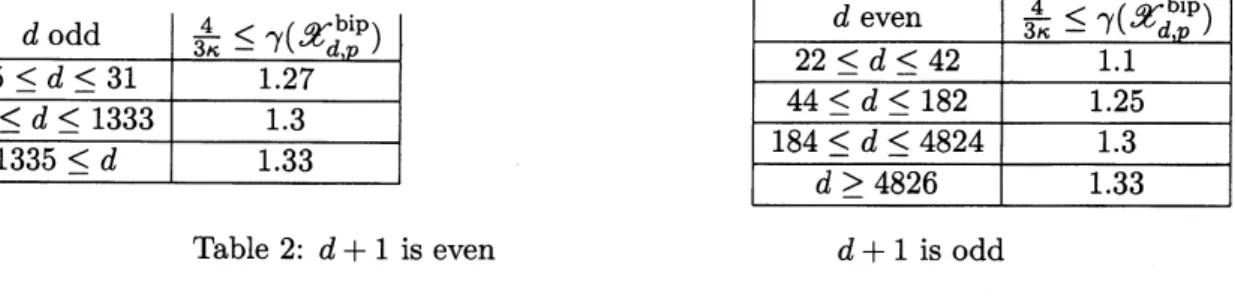
Let $\kappa$ $:= \log_{d}\min\{p\geq d|p$prime$\}$ if$d$is odd,and $\kappa$ $:= \log_{d}\min\{p\geq d|p$prime $\equiv 3mod 8\}$ if$d$is
even.
By usingthe resultsin [13]one
getsthe following:
Table 2: $d+1$ is
even
$d+1$ is oddConsidering Equality (3), it follows that $\gamma_{d+1}\geq\frac{4}{3\kappa}$ with the values taken from the two tables
above. When $d$ is not the power of
an
odd prime, these lower bounds surpass the0.48
of [7].When $d$ is not equal to
a
power of2, this surpass the previous best lower bound of 2/3 foundin [12].
References
[1] N. L. Biggs. Graphs with large girth. Ars Combin., $25(C):73-80$, 1988. Eleventh British
Combinatorial Conference (London, 1987).
[2] P. Chiu. Cubic Ramanujan graphs. Combinatorica, $12(3):275-285$, 1992.
[3] X. Dahan. Arbitrary degree regular graphs of large girth. Preprint, arXiv:1110.????,
October 2011.
[4] P. Erd\"os and H. Sachs. Regul\"are Graphen gegebener Tailenweite mit minimaler
Knollen-zahh. Wiss. Z. Univ. Halle-Willenberg Math. Nat., 12:251-258,
1963.
[5] R. G. Gallager. Low density parity check codes. M.I.T. Press, 1963. Monograph.
[6] S. Hoory, N. Linial, and A. Wigderson. Expander graphs and their applications. Bull.
Amer. Math. Soc. (N.S.), $43(4):439-561$ (electronic), 2006.
[7] W. Imrich. Explicit construction of regular graphs without small cycles. Combinato$r’ica,$
[8] F. Lazebnik and V. A. Ustimenko. Explicit construction of graphs with
an
arbitrary largegirth and oflargesize. DiscreteAppl. Math., $60(1-3):275-284$, 1995.
ARIDAM
VIandVII(New Brunswick, NJ, 1991/1992).
[9] A.Lubotzky, R. Phillips, andP. Sarnak. Ramanujan graphs. Combinatorica,$8(3):261-277,$
1988.
[10] G. A. Margulis. Explicit constructions of graphs without short cycles and low density
codes. Combinatorica, $2(1):71-78$,
1982.
[11]
G.
A. Margulis. Explicit group-theoretic constructions of combinatorial schemes and theirapplications in the construction of expanders and concentrators. Problemy Peredachi
In-formatsii, $24(1):51-60$,
1988.
[12] M. Morgenstem. Existence and explicit constructions of$q+1$-regular Ramanujan graphs
for everyprime power q. J. Combin. Theory Ser. B, $62(1):44-62$,
1994.
[13] O. Ramar\’e and R. Rumely. Primes in arithmetic progressions. Mathematics
of
Computa-tion, $65(213):397-425$, 1996.
[14] R. M. Tanner. A recursive approach to low complexity codes. IEEE Trans.
on
Infom.
Theory, $27(5):533-547$, 1981.