Strichartz estimates for wave equations
in the homogeneous Besov space
M.Nakamura (中村誠)
Department ofMathematics, HokkaidoUniversity
1
Introduction
In this note the author describes his recent work on the linear
esti-mates for wave equations inthe homogeneous Besov space. We consider the inhomogeneous
wave
equations$\partial_{t}^{2}u(t, x)-\triangle u(\mathrm{t}, X)=f(t, x)$, $t\in \mathrm{R},$ $x\in \mathrm{R}^{n},$ $n\geq 2$,
(1.1)
$u(\mathrm{O}, x)=\partial_{t}u(0, x)=0$,
where $n$ denotes the space dimension, $f$ is a complex valued function on
$\mathrm{R}\cross \mathrm{R}^{n}$, and $\triangle$ denotes the Laplacian inspace variables. We shall prove
Strichartz estimates of the following type
$||u;L^{q}(I,\dot{B}_{r}^{\rho},)2||\leq C||f;L^{\tilde{q}}(I,\dot{B}_{\tilde{r},2}\tilde{\rho})||$, (1..2)
where $I$ denotes an interval in $\mathrm{R},\dot{B}_{r,2}^{\rho}$ denotes the homogeneous Besov space defined later and the constant $C$ is independent of $f$ and $I$
.
Forany $1\leq q\leq\infty$ and a Banach space $X$, we write the mixed norm of a
function $g:Iarrow X$ by
$||g;L^{q}(I, x)||= \{\int_{t\in I}||g(t);X||^{q}dt\}^{1/}q$ for $1\leq q<\infty$,
(1.3)
$||g;L \infty(I, X)||=\sup_{t\in I}||g(\mathrm{t});^{x}||$.
On the estimate (1.2), Ginibre and Velo in [3] have shown
some
generalization of almost all Strichartz-type estimates obtained uptothat point, in which one of conditions necessary for (1.2) is given by$\rho+\delta(r)-1/q=2+\tilde{\rho}+\delta(\tilde{r})-1/\tilde{q}$, $\rho,\tilde{\rho}\in \mathrm{R}$, (1.4)
where $\delta(r)=n(1/2-1/r)$ (see [3, Proposition 3.1]). On the other
hand, Harmse in [5], Oberlin in [10], Bak, $\mathrm{M}\mathrm{c}\mathrm{M}\mathrm{i}\mathrm{C}\mathrm{h}\mathrm{a}\mathrm{e}\mathrm{l}$ and Oberlin in
[1] have already shown the ”off duality” estimates, namely (1.2) for $(n+1)/2n-2/(r\iota+1)<1/r<(n-1)/2n$ with $q=r,\tilde{q}=\tilde{r}$ and $\rho=\tilde{\rho}=0$ in (1.4). The above two results meet only on the original
The author introduce Strichartz estimates which involve the above results and have new ones. Although the proofs
are
omitted, theyare
obtained by the abstract setting such as the unitarity of the operator
$\exp(it\sqrt{-\triangle})(i=\sqrt{-1})$ , the duality argument, the
Hardy-Littlewood-Sobolev inequality and the complex interpolation method. The key method is complex $\mathrm{i}\mathrm{n}\mathrm{t}\mathrm{e}\mathrm{r}\mathrm{p}_{0}1\mathrm{a}\mathrm{t}\mathrm{i}\mathrm{o}\mathrm{n}(\mathrm{s}\mathrm{e}\mathrm{e}$ [$2$, Chapter 4] or Proposition 2.
1 below), by which we could loosen the conditions restricted by the
$\mathrm{H}\mathrm{a}\mathrm{r}\mathrm{d}\mathrm{y}- \mathrm{L}\mathrm{i}\mathrm{t}\mathrm{t}\mathrm{l}\mathrm{e}\mathrm{w}\mathrm{o}\mathrm{o}\mathrm{d}-\mathrm{s}_{0}\mathrm{b}\mathrm{o}\mathrm{l}\mathrm{e}\mathrm{v}$inequality, therefore
our
results could involve[1, Theorem 6’], [5, Theorem 2.3] and [10, Theorem 3].
Our main result is Proposition 2. 2. Recently Keel and Tao [7]
have obtained the estimate at the ”endpoint” by the real interpolation
method. We used their methods to supplement our methods in the
crit-ical cases.
2
Notation
and
propositions
As usually done, we will rewrite (1.1) to the $\mathrm{i}\mathrm{n}\mathrm{t}\mathrm{e}_{\circ}\sigma\Gamma \mathrm{a}1$ equation. For that purpose, we introduce some operators defined on the tempered
dis-tributions $S’(\mathrm{R}n)$ or$S’(\mathrm{R}\cross \mathrm{R}n)$
.
Wedenote by$\omega^{\lambda},$ $U(t)$ theoperators on$S’(\mathrm{R}^{n})$ defined by $\omega^{\lambda}=(-\triangle)^{\lambda/2},$ $U(t)=\exp(i,t\sqrt{-\Delta})$, and by $c_{0},$$c_{\pm}$
the integral operators $\mathrm{d}\mathrm{e}\mathrm{f}\mathrm{i}_{\mathrm{I}1}\mathrm{e}\mathrm{d}$by
$G_{0}f(t)= \int_{0}^{t}U(t-s)f(s)dS$, $G_{\pm}f(t)= \int_{\pm\infty}^{t}U(t-s)f(s)dS$, (2.5)
for any function $f$ in$S’(\mathrm{R}^{n+1})$
.
We denote by $G$ any of $G_{0},$ $G_{\pm}$, and by$H$ the operator $\omega^{-1}G$. To show the required inequality (1.2), it suffices
to show the boundedness of the operator $H$ from $L^{\tilde{q}}(\mathrm{R},\dot{B}^{\tilde{\rho}}(\tilde{r},2\mathrm{R}n))$ to
$L^{q}(\mathrm{R},\dot{B}^{\rho}(r,2\mathrm{R}n))$.
Here we shall introduce the homogeneous Besov space $\dot{B}_{r,s}^{\rho}(\mathrm{R}^{n})$ for
any $\rho\in \mathrm{R}$ and $1\leq r,$$s\leq\infty$ (see also [2], [3] and [12]). For $1\leq q\leq\infty$
andanormedspace$X$, we denoteby$\ell_{j}^{q}(X)$ the space of$\{a_{j}\}_{j\mathrm{z}}\in’ a_{j}\in X$,
with the
norm
given by$||a_{j};ljq(X)||$ $=$ $\{\sum_{j\in \mathrm{Z}}||a_{j};X||q\}1/q$ for $1\leq q<\infty$,
(2.6)
$||a_{j};\ell_{j}\infty(X)||$ $=$ $\sup_{j\in \mathrm{Z}}||a_{j};X||$.
in space. Let $\{\varphi_{j}\}_{j\in}\mathrm{z}\subset C^{\infty}(\mathrm{R}^{n})$ such that
$\mathrm{s}\mathrm{u}\mathrm{p}\mathrm{p}F\varphi_{j}\subset\{x|2^{j-1}<|x|<2^{j+1}\}$,
$\sum_{j\in \mathrm{Z}}F\varphi j(x)=1$ for
$|x|\neq 0$
.
(2.7)
We denote by $\dot{B}_{r,s}^{\rho}(\mathrm{R}^{n})$ the space given by
$\{u\in S’(\mathrm{R}n)|||u;\dot{B}_{r,S}^{\rho}(\mathrm{R}^{n})||\equiv||2^{\rho j}\varphi j*u;\ell^{s}(jL^{r}(\mathrm{R}^{n}))||<\infty\}$
.
(2.8)We make abbreviation such
as
$\dot{B}_{r}^{\rho}=\dot{B}_{r,2}^{\rho}(\mathrm{R}^{n})$ and $L^{q}\dot{B}_{r}^{\rho}=L^{q}(\mathrm{R},\dot{B}_{r}^{\rho})$.
The main tools
are
embeddings($\mathrm{s}\mathrm{e}\mathrm{e}[2$, Theorem 6.5.1])$\dot{B}_{r}^{0}arrow L^{r}$ for $2\leq r<\infty$, $L^{r_{\mathrm{L}}}arrow\dot{B}_{r}^{0}$ for $1<r\leq 2$, (2.9) $\dot{B}_{r}^{\rho}\llcorner_{arrow\dot{B}_{r_{1}}}\rho 1$ for $\rho\geq\rho_{1}$ with $\rho-n/r=\rho_{1}-n/r_{1}$, (2.10)
and the following complex interpolation method (see [2, Th 5.1.2, Th
6.4.5]). Let $\mu$ be
a
positivemeasure
on$\mathrm{R}$, and for any Banach space
$X$, let $L^{q}(\mathrm{R}, \mu;x)$ be the space ofa function $f$ : $\mathrm{R}arrow X$ with the norm $\{\int_{\mathrm{R}}||f;X||^{q}d\mu\}^{1}/q$ for $1\leq q<\infty$,
(2.11)
$\sup_{t\in \mathrm{R}}||f(t);x||$ for $q=\infty$
.
Proposition 2. 1 Let $n\geq 1$
.
Let $1\leq s_{0},$$s_{1},$ $r_{0},$$r_{1}\leq\infty_{f}1\leq q_{0},$ $q_{1}<\infty$and $\rho 0,$$\rho_{1}\in$ R. Let $K$ be an bounded operator
from
$L^{q_{0}}(\mathrm{R}, \mu;\dot{B}\rho 0)r_{0}$ to$\dot{B}_{s_{0}}^{0}$, and
from
$L^{q_{1}}(\mathrm{R}, \mu;\dot{B}_{r_{1}}\rho_{1})$ to $\dot{B}_{s_{1}}^{0}$.
Then $K$ is a bounded operatorfrom
$L^{q}(\mathrm{R}, \mu;\dot{B}_{r}\rho)$ to $\dot{B}_{s}^{0}$, where$s,$ $r,$ $q,$$\rho$ are given by
$1/s=(1-\theta)/s_{0}+\theta/s_{1}$, $1/r=(1-\theta)/r_{0}+\theta/r_{1}$,
(2.12)
$1/q=(1-\theta)/q_{0}+\theta/q_{1}$, $\rho=(1-\theta)\rho 0+\theta\rho 1$,
for
any $0\leq\theta\leq 1$.
In order to describe
our
statement in concise form, following Kato[6], it is convenient to
use
the following geometric notation. We denoteby $\square$ the closed unit square in $\mathrm{R}^{2}$,
defined by $0\leq x,$ $y\leq 1$
.
In thisnote we denote by $Q$ and $\tilde{Q}$ the points $(1/q, 1/r)$ and $(1/\tilde{q}, 1/\tilde{r})$ in $\square$
respectively, and we write $x(Q)=1/q,$ $y(Q)=1/r$. For $P,$ $Q\in\square$,
$[PQ]$ and $(PQ)$ represent the closed and open segment connecting $P$
and $Q$ respectively. And [$PQ)$ denotes $[PQ]\backslash \{Q\}$. We denote by $q’$ the
conjugate of $q$, namely $q’=q/(q-1)$ for $1<q\leq\infty$ and $q’=\infty$ for
points and sets in $\square$
,
by which it is convenientto state
our
propositions(see Figure 1,2,3).
$o=(\mathrm{o}, \mathrm{o})$, $A=(1,1)$, $B=(0,1/2)$, $C=(1/2, (n-3)/2(n-1))$,
$(C=(1/4,0)$ if$n=2$ ), $D=(1/2,0)$,
$E=(1, (n-3)/2(n-1))$, $F=(0, (n-3)/2(n-1))$,
( $E=D,$ $F_{--O}$ if $n=2$ ),
$T_{0}=[OBCD]$ ($T_{0}=[OBC]$ if $n=2,$ $T_{0}=[OBC]\backslash \{C\}$ if$n=3$ ),
$T=\{B\}\cup(BEF)$,
(2.13)
where [OBCD] denotes the closure of the square defined by $\mathit{0},$ $B,$ $C_{\text{ノ}}$,
$D$, and $(BEF)$ denotes the interior domain of the triangle defined
by $B$,
$E,$ $F$. For a set $S$ in $\square$, we denote by $S’$
the set of the point $Q’$ with
$Q\in S$
.
Ifwe introduce the linear functionals
$\pi(Q)=1/r+2/(n-1)q$, $\pi_{1}(Q)=1/r+1/(n-1)q$, (2.14)
for $Q$ in $\square$, then $B$ and $C$ are on
the line defined by $\pi(Q)=1/2,$ $B$ and $E$ are on $\pi_{1}(Q)=1/2,$ $B’$ and $C’$ are on $\pi(Q)=(n+3)/2(n-1),$
$B’$ and $E’$ are on $\pi_{1}(Q)=(n+1)/2(n-1)$
.
The pair $(Q,\tilde{Q})$ willbe called a conjugate pair if $Q$ and $\tilde{Q}$ in $\square$ satisfy
$\pi(\tilde{Q})=\pi(Q)+2/(n-1)$
.
(2.15)In particular, for $Q\in[BC]$ and $\tilde{Q}\in[B’C’],$ $(Q,\tilde{Q})$ is
a
conjugate pair.We
now
refer to the followingtwo properties. Let $(Q, Q’)$ be a conjugatepair. If$x(Q)=0$ and $x(\tilde{Q})=1$, then $y(Q)=y(\tilde{Q})$
.
If$Q$ is on [BE] and$x(\tilde{Q})=1$, then $y(Q’)=y(\tilde{Q})$
.
We callthepair $(Q,\tilde{Q})$ admissible if the linear operator$H$is
bounded from $L^{\tilde{q}}\dot{B}_{\tilde{r}}^{\tilde{\rho}}$ to $L^{q}\dot{B}_{r}^{\rho}$ for any
$\rho$ and $\tilde{\rho}$ in $\mathrm{R}$such that
$\rho+\delta(r)-1/q=2+\tilde{\rho}+\delta(\tilde{r})-1/\tilde{q}$
.
(2.16)Since $\omega^{\lambda}(\lambda\in \mathrm{R})$ is an isomorphism
from $\dot{B}_{r}^{\rho}$ to $\dot{B}_{r}^{\rho-\lambda}$, if the linear
operator $G$ is bounded from $L^{\tilde{q}}\dot{B}_{\tilde{r}}^{\tilde{\rho}}$ to $L^{q}\dot{B}_{r}^{\rho}$ for any
$\rho$ and $\tilde{\rho}$ in $\mathrm{R}$ such
that
$\rho+\delta(r)-1/q=1+\tilde{\rho}+\delta(\tilde{r})-1/\tilde{q}$, (2.17)
then $(Q,\tilde{Q})$ is admissible.
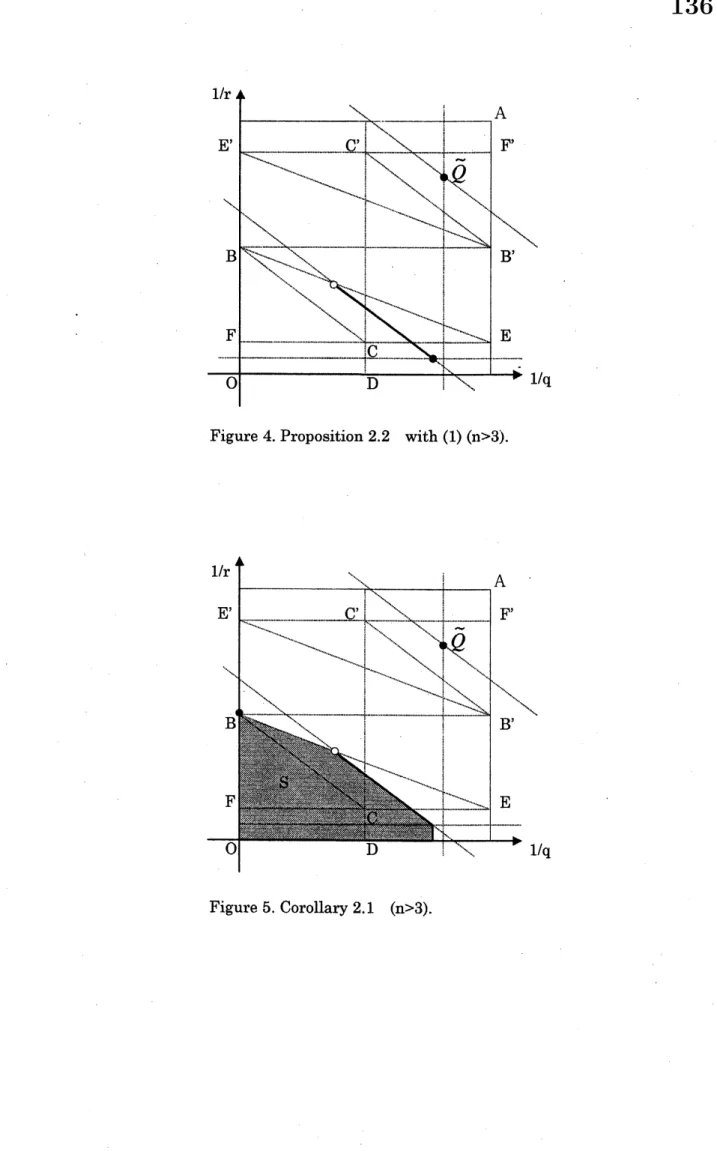
Proposition 2. 2 (see Figure 4) Let $n\geq 2$
.
Let $(Q,\tilde{Q})$ be aconju-gatepairwith$x(Q)<x(\tilde{Q})$. And let$Q$ and$\tilde{Q}$ satisfy one
of
thefollowingconditions.
(1) $\tilde{Q}\in T’,$ $(n-3)/(n-1)\tilde{r}’\leq 1/r$ ( $(n-3)/(n-1)\tilde{r}’<1/r$
for
$n=3$ ).Moreover $\pi_{1}(Q)<1/2$ and $0<x(Q)$
if
$\tilde{Q}\not\in[B’C’)$.
(2) $Q\in T_{f}1/\tilde{r}\leq 1-(\uparrow x-3)/(n-1)r(1/\tilde{r}<1-(n-3)/(n-.1)r$
for
$n=$3).
Moreover $\pi_{1}(\tilde{Q})’\backslash >(n+1)/2(n-1)$ and $x(\tilde{Q})<1$
if
$Q\not\in[BC)$.
Then the pair $(Q,\tilde{Q})$ is admissible.
Remark 1. Let $(Q,\tilde{Q})$ be an admissible pair with $\tilde{q}\neq\infty$ and $\tilde{r}\neq\infty$.
Then $(\tilde{Q}’, Q’)$ is also an admissible pair. Indeed, $H’$, the dual operator
of $H$, is a bounded operator from $L^{q’}\dot{B}_{r}^{-\rho}$, to $L^{\tilde{q}’}\dot{B}_{\tilde{r}}-,\tilde{\rho}$, and (2.16) could
be written as
$-\tilde{\rho}+\delta(\tilde{r}’)-1/\tilde{q}’=2-\rho+\delta(r’)-1/q’$
.
(2.18)Since $H$ is written as a linear combination of $H_{0}’,$ $H_{\pm}’$, therefore $(\tilde{Q}’, Q’)$
is also
an
admissible pair. In this sense, the proof for thecase
(2) inProposition 2. 2 follows from that of (1) immediately.
Remark 2. In Proposition 2. 2, applying the Sobolev embedding the-orem,
we
could take $Q$ and $\tilde{Q}$ in $\square$more
widely. For example, let$(Q,\tilde{Q})$ be an admissible pair, then for any $r_{1},\tilde{r}_{1}$ with $0\leq 1/r_{1}\leq 1/r$
and $1/\tilde{r}\leq 1/\tilde{r}_{1}\leq 1,$ $((1/q, 1/r_{1}),$$(1/\tilde{q}, 1/\tilde{r}_{1}))$ is also an admissible
pair (note that the embeddings $\dot{B}_{r}^{\rho}\mathrm{L}arrow\dot{B}_{r_{1}}^{\rho_{1}}$ and $\dot{B}_{\tilde{r}_{1}}^{\tilde{\rho}_{1}}\mathrm{e}arrow\dot{B}_{\tilde{r}}^{\overline{\rho}}$ imply
$\rho+\delta(r)=\rho_{1}+\delta(r_{1})$ and $\tilde{\rho}+\delta(\tilde{r})=\tilde{\rho}_{1}+\delta(\tilde{r}_{1})$ in (2.16) respectively).
To show some typical examples the Sobolev embedding theorem
ap-plied to Proposition 2. 2, we introduce
a
set $S$ in $\square$.
For $\tilde{Q}\in T’$, let $\nu$be the supremum of $x(Q)$ with $(Q,\tilde{Q})$ in Proposition 2. 2 with (1). Let
now
$S$ be a set given by$S\equiv$ $\{Q\in\square |\pi(\tilde{Q})\geq\pi(Q)+2/(n-1),$ $x(Q)<x(\tilde{Q})$,
$0<x(Q)\leq l^{\text{ノ}}$ ($0<x(Q)<\nu$ for $n=3$)$\}$ if $\tilde{Q}\in(B’C^{\prime_{E’}})$
,
$S\equiv$ $B\cup\{Q\in\square |\pi_{1}(Q)<1/2,$ $\pi(\tilde{Q})\geq\pi(Q)+2/(n-1)$,
$x(Q)\leq\nu$ ($x(Q)<\nu$ for $n=3$),$x(Q)<x(\tilde{Q})\}$ if $\tilde{Q}\in\tau’\backslash (B^{\prime_{C^{\prime_{E’}}}})$
.
For $Q\in T$, let $S$ be the set defined by $Q’$ as above, and let $S’$ be the set
of the point $Q_{1}’$ with $Q_{1}\in S$
.
Corollary 2. 1 (see Figure 5) Let $\tilde{Q}\in T’$ and $Q\in S$
.
Or let $Q\in T$and $\tilde{Q}\in S’$
.
Then $(Q,\tilde{Q})i_{\mathit{8}}$ admissible.Remark 3. The most familiar Strichartz-type estimates are the mixed
space-time estimates in the Lebesgue space. Ifthe conjugate pair $(Q,\tilde{Q})$
satisfies (2.16) with $\rho=\tilde{\rho}=0$, then it holds
$1/\tilde{r}-1/r=1/\tilde{q}-1/q=2/(n+1)$
.
(2.20)Therefore if $Q$ and $\tilde{Q}\mathrm{s}\mathrm{a}\mathrm{t}\mathrm{i}\mathrm{s}6^{r}(2.20)$ and (1) or (2) in Proposition 2. 2,
then we have
$||Hf;L^{q}L^{r}||\leq C||f,$ $L^{\tilde{q}}L\tilde{r}||$, (2.21) for any $f\in L^{\tilde{q}}L^{\tilde{r}}$, where we have used the embedding (2.9). Especially
for the diagonal case, namely $r=q$ and $\tilde{r}=\tilde{q}$,
we
obtain the estimategiven by [1, theorem 6’], [$\ulcorner)$, Theorem 2.3], [10,
Theorem 3]. Indeed for
$(n+1)/2n-2/(n+1)<1/r\leq(n-1)/2(n+1)$, the above $Q$ and$\tilde{Q}\mathrm{s}\mathrm{a}\mathrm{t}\mathrm{i}_{\mathrm{S}}6^{r}$
(1) in Proposition 2. 2, and for $(n-1)/2(n+1)<1/r<(n-1)/2n,$ $(2)$
in Proposition 2. 2. In the above argument, $Q$ is uniquely determined
by $\tilde{Q}$ as (2.20). But we $\mathrm{s}\mathrm{h}_{0}\mathrm{u}\mathrm{l}\mathrm{d}$ note that if $(Q,\tilde{Q})$
in Corollary 2. 1 satisfies (2.16) with $\rho=\tilde{\rho}=0$, then (2.21) also holds.
In Proposition 2. 2, we must
assume
$x(Q)<x(\tilde{Q})$ and $x(Q)>0$,or
$x(\tilde{Q})<1$
.
The following proposition could givesome
supplements forthe
cases
$x(Q)=x(\tilde{Q})=1/2,$ $x(Q)=0$ and $x(\tilde{Q})=1$.Proposition 2. 3 Let $2\leq r\leq\infty,$ $1\leq\tilde{q}\leq 2\leq q\leq\infty$
.
Let $\tilde{r}=r’$, andlet $\pi(\tilde{Q})>\pi(Q)+2/(n-1)$
.
Then $(Q,\tilde{Q})$ is admissible.The results in Proposition 2. 3 for the case $1<\tilde{q}<2<q<\infty$ are
also obtained by Corollary 2. 1 and Remark 2. Let now $\tilde{Q}$ be fixedwith $x(\tilde{Q})=1$, and let
$Q_{c}$ be the point such that
$\pi(\tilde{Q})=\pi(Qc)+2/(n-1)$ and $\pi_{1}(Q_{c})=1/2$
.
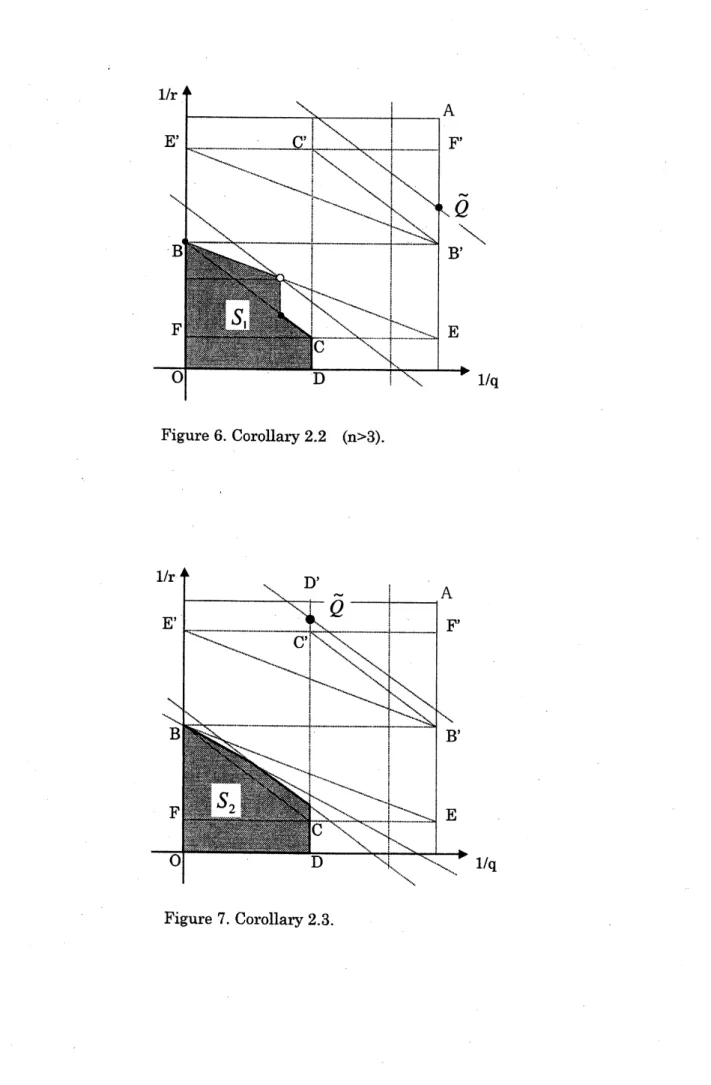
(2.22)And let $T_{1},$ $S_{1}$ be the sets given by
$S_{1}\equiv T_{1}\cup\{Q\in\square |\pi_{1}(Q)<1/2, x(Q)<x(Q_{c}), x(Q)\leq 1/2\}$
.
(2.24)For $Q$ with $x(Q)=0$, let $S_{1}$ be the set given by $Q’$
as
above, and letS\’i
be the set of the point $Q_{1}’$ with $Q_{1}\in S_{1}$
.
Corollary 2. 2 (see Figure 6) Let $1\leq\tilde{r}\leq 2,\tilde{Q}=(1,1/\tilde{r})$ and $Q\in S_{1}$. Or let $2\leq r\leq\infty,$ $Q=(0,1/r)$ and $\tilde{Q}\in S\text{\’{i}}.$ Then $(Q,\tilde{Q})$ is
$admis\mathit{8}ible$
.
Next
we
consider the case $q=\tilde{q}=2$ with $n\geq 4$.
In this case,applying Proposition 2. 3 and Remark 2,
we were
able to show the admissibility of $(Q,\tilde{Q})$ for any $Q\in(CD$] and $\tilde{Q}\in(C’D’$]. However thereal interpolation method described in [7] could give
some
extension inthis
case.
Namely with the proof in [7, section 6] slightly modified,we
obtain the following lemma.
Lemma 2. 1 Let $n\geq 4$
.
Let $(Q,\tilde{Q})$ be a conjugate pair.If
$x(Q)=$$x(\tilde{Q})=1/2$ and
$(n-1)/2(n-2)<y(\tilde{Q})<(n^{2}-_{\mathrm{t}}\ulcorner))/2(n-1)(n-2)$, (2.25)
then $(Q,\tilde{Q})$ is admissible.
Since Lemma 2. 1 is obtained quite analogously to [7], we will use it
without proof. To proceed our argument, it is convenient to introduce
the linear functional
$\pi_{2}(Q)=1/r+1/(n-2)q$
.
(2.26)For $\tilde{Q}$ with $x(\tilde{Q})=1/2$, let
$T_{2},$ $S_{2}$ be sets given by
$T_{2}\equiv\{Q\in\square |\pi_{2}(Q)\leq 1/2, \pi(Q)\leq\pi(\tilde{Q})+2/(n-1), x(Q)\leq 1/2\}$,
(2.27)
$S_{2}\equiv T_{2}$ for $\tilde{Q}\in[C’D’]$, $S_{2}\equiv T_{2}\backslash [oB]$ for $\tilde{Q}\not\in[C’D’]$
.
(2.28)For $Q$ with $x(Q)=1/2$, let $S_{2}$ be the set given by $Q’$ as above, and let
$S_{2}’$ be the set of the point $Q_{1}’$ with $Q_{1}\in S_{2}$.
Corollary 2. 3 (see Figure 7) Let $n\geq 4$. Let $\tilde{Q}\in\square$ satisfy $x(\tilde{Q})=$
$1/2$ and (2.25), and let $Q\in S_{2}$
.
Or let $Q\in\square$ satisfy $x(Q)=1/2$ and$(n-3)^{2}/2(n-1)(n-2)<y(Q)<(n-3)/2(n-2)$, and let $\tilde{Q}\in S_{2}^{l}$
.
$1/\mathrm{q}$
Fifure 1. $\mathrm{n}>3$.
Fifure 2. $\mathrm{n}=3$.
Figure 4.Proposition 2.2 with (1)$(\mathrm{n}>3)$.
Figure6. Corollary 2.2 $(\mathrm{n}>3)$.
参考文献
[1] J.-G.Bak, D.McMichael, D.Oberlin, $L^{p_{-}}L^{q}$ estimates
off
the lineof
duality, J.Austral.Math.Soc. (Series A), 58(1995),
154-166.
[2] J.Bergh, J.L\"ofstr\"om, ”Interpolation Spaces,” Springer-Verlag, Berlin-Heidelberg-New York, 1976.
[3] J.Ginibre, G.Velo, Generalized Strichartz inequalities
for
the waveequation, J. Funct. Anal., 133(1995), 50-68.
[4] G.Hardy, $\mathrm{J}.\mathrm{E}$.Littlewood, G.P\’olya, ”Inequalities (Second
edi-tion),” Cambridge Mathematical Library,
1952.
[5] J.Harmse, On Lebesgue space estimates
for
the wave equation,In-diana Univ.Math.J., 39(1990), 229-248.
[6] T.Kato, An $L^{q,r}$-Theory
for
nonlinear $Sc\Gamma\ddot{O}dinger$ equations,Ad-vanced Studies in Pure Math., 23(1994), 223-238.
[7] M.Keel, T.Tao, Endpoint $St7\dot{\mathrm{V}}ChartZ$ estimates, Amer.J.Math,
120(1998), 955-980.
[8] H.Lindblad, A sharp counterexample to the local existence
of
low-regularity solutions to nonlinear wave equations, Duke Math.J.,
72(1993), 503-539.
[9] M.Nakamura, T.Ozawa, The Cauchy problem
for
nonlinear waveequations in the homogeneous Sobolev space, Ann.Inst.Henri
Poincar\’e, Physique th\’eorique, (in press).
[10] D.Oberlin, Convolution estimates
for
some distributions withsin-gulanties on the light cone, Duke Math.J., 59(1989), 747-757.
[11] $\mathrm{R}.\mathrm{S}$.Strichartz, Restrictions
of
Fouriertransforms
to quadraticsur-$face\mathit{8}$ and decay
of
solutionsof
wave equations, Duke Math.J.,44(1977), 705-714.
[12] H.hiebel, ”Interpolation Theory, Function Spaces, Differential