Complexity
of
Gr\"obner
Bases
for
Toric
Ideals
of Acyclic Tournament Graphs
石関隆幸
(Takayuki
Ishizeki)\dagger .
今井浩(Hiroshi
Imai)\dagger
\dagger Department
of Information Science, Faculty of Science, University of Tokyo7-3-1 Hongo, Bunkyo-ku, Tokyo 113-0033, Japan
{ishizeki,
$\mathrm{i}\mathrm{m}\mathrm{a}\mathrm{i}$}
$\emptyset \mathrm{i}\mathrm{s}$.
$\mathrm{s}.\mathrm{u}$-tokyo.$\mathrm{a}\mathrm{c}$
.
jpAbstract
Applications ofGr\"obnerbases tosomecomputationally hard problems in combinatorics using the discreteness of toric ideals have been studied in recent years. Onthe otherhand, the properties of graphs maygive insight into Gr\"obnerbases. In this paper, we analyze toric ideals of acyclic tournament graphs, which are the most fundamental directed graphs. We focus especially on
the number of elements of its reduced Gr\"obnerbases. We show that there exist term orders for which reduced Gr\"obnerbases remain in polynomial order by characterizing the bases in terms
of circuits. We next analyze the number of elements of reduced Gr\"obner bases with respect to various termorders. We finally discuss applications to the minimum cost flow problem.
1
Introduction
rected bipartite graphs can be regarded as theRecently,somealgebraic approachestomanycom- subgraphs of acyclic tournament graphs by
direct-putationally hard problems in combinatorics have ing each edge from one set of vertices in bipar-been studied. The main tool is the $G_{\Gamma\ddot{O}}bner$ ba- tite graphs to the other. By the elimination
the-sis, which is an important tool in computational orem$(\mathrm{S}\mathrm{e}\mathrm{e}[3])$, reduced Gr\"obnerbases of any sub-algebra and sub-algebraic geometry. Gr\"obner bases graphs of acyclic tournament graphs can be ob-have providednewinsight intosomecombinatorial tained automatically if that of acyclic tournament problemssuchas integer programming [2, 5, 6, 12] graphs can becalculated. Thus the number of
ele-and computational statistics [6]. ments in reduced Gr\"obnerbasesof any subgraphs
are less than those of acyclic tournament graphs. Related to some combinatorial problems in
Onthe other hand, the numberof elements in
re-graph theory, toric ideals of re-graphs have been
stud-ied. De Loera, Sturmfels and Thomas [5] studied duced Gr\"obner bases of graphs are related to the thetoric ideals of undirected complete graphs, and complexity of integer programming problem aris-appliedthemtothe triangulation of second hyper- ing from the graphs.
simplex and perfect $f$-matching problem. Diaco- In this paper, we show that the number of
ele-nis and Sturmfels [6] studied the toric ideals of ments in reducedGr\"obnerbases remainin polyno-bipartite graphs, and applied them for sampling mial orderby characterizing the bases in terms of from conditional distributions and transportation circuits. We next analyze the number of elements
problem. From the viewpoint of in commutative of reduced Gr\"obner bases with respect to various algebra, Ohsugi and Hibi [10] studied the toric ide- term orders using $\mathrm{T}\mathrm{i}\mathrm{G}\mathrm{E}\mathrm{R}\mathrm{S}[8]$
.
We finally discuss als of general undirected graphs, and showed the applications tothe minimumcostflow problemon conditions when the toric ideals are generated by acyclictournament graphs.quadratic binomials. Conversely, the properties of
graphs may give insight into Gr\"obnerbases.
2
Preliminaries
Gr\"obner bases of directed graphs are not well
In thissection,wegive basic definitions ofGr\"obner
understood. In this paper, we study the toric
bases and toric ideals. We refer to $[3, 4]$ for the
ideals of acyclic tournament graphs, which are
introductions of Gr\"obner bases, and [11] for the the most fundamental directed graphs. Any
ele-introductions of toric ideals and their applications. ments in the reduced $\mathrm{G}\mathrm{r}\ddot{\mathrm{o}}\mathrm{b}\mathrm{n}\mathrm{e}\Gamma$ bases for toric
ide-als of these graphs correspond to the circuits in
the graphs. So we can characterize the reduced
2.1
Gr\"obnerBases
Gr\"obner bases of toric ideals in terms of circuits.
We focus especiallyonthenumber of elements in Let $k$ be a field and $k[x_{1}, \ldots, x_{n}]$ be the ring of reduced Gr\"obner bases. Analysis of the Gr\"obner polynomials in $n$ variables. For a non-negative
bases of acyclic tournament graphs are very im- integer vector $\alpha=(\alpha_{1}, \ldots, \alpha_{n})\in \mathbb{N}^{n}$, we write
portant. Acyclic tournament graphs contains any $x^{\alpha}:=x_{1}^{\alpha_{1}\alpha\ldots\alpha}x_{2}2x_{n}n$
.
We call $\alpha$ the exponentDefinition 2.1 $Let\succ be$atotalorderon$\mathbb{N}^{n}$
.
We$call\succ a$termorder on$\mathbb{N}^{n}$
if
itsatisfies
the follow-ing:1. $\forall_{\alpha,\beta,\gamma\in}\mathbb{N}^{n},$ $\alpha\succ\beta\Rightarrow\alpha+\gamma\succ\beta+\gamma$
.
Although there
are
infinite term orders,a
uni-versal Gr\"obnerbasis isfinite.
Proposition 2.10 Every ideal$I\subset k[x_{1}, \ldots, x_{n}]$ has a
finite
universal Gr\"obner basis.2 $\forall_{\alpha\in \mathrm{N}^{n}}\backslash \{0\},$$\alpha\succ 0$ We define
“division”
on
multi-variablepolyno-For a polynomial $f$ and a term $order\succ$, we call mialring.
the largest term in $f$ with respect$to\succ \mathrm{i}\mathrm{n}\mathrm{i}\mathrm{t}\mathrm{i}\mathrm{a}\mathrm{l}$ term
Theorem 2.11 Fix a monomial order $\succ$ and a of$f$ and write$in_{\succ}(f)$, or short, in$(f)$
.
$Gr\ddot{o}bne\Gamma$ basis $\mathcal{G}=\{g_{1}, \ldots, g_{s}\}$for
I with respect $to\succ$.
Thenevery $f\in k[x_{1}, \ldots, x_{n}]$ can be written Remark 2.2 In this paper, we line under theini-as
tial term
of
each polynomial.$f=a_{1}g_{1}+\cdots+a_{s}g_{s}+r,$ $a_{i},$$r\in k[x_{1}, \ldots, x_{n}]$
We givesome examplesof term orders.
Definition 2.3 Fix a variable ordering $x_{i_{1}}$ $\succ$ where either $r=0$ or no term
of
$r$ is divisible
by any
of
$in_{\succ}(g_{1}),$$\ldots,$$in_{\succ}(g_{s})$
.
$r$ is unique, and $x_{i_{2}}\succ\cdots\succ x_{i_{n}}$.
We $say\succ is$ $a$ purelylexico-called normal form
of
$f$ by $\mathcal{G}$.
graphic order induced by this variable ordering if,
for
any$\alpha$ and$\beta,$ $\alpha\succ\beta$if
and onlyif
there exists$1\leq m\leq n$ such that $\alpha_{i_{k}}=\beta_{i_{k}}$
for
$k<m$
and2.2
Toric Ideals
$\alpha_{i_{m}}>\beta_{i_{m}}$.
In this section, we consider $A\in \mathbb{Z}^{d\cross n}$ as a set
Definition 2.4 Fix a variable ordering $x_{i_{1}}$ $\succ$ of column vectors
$\{\mathrm{a}_{1}, \ldots, \mathrm{a}_{n}\}$
.
Each vector $\mathrm{a}_{i}$ isWe $say\succ is$ $a$ degree lexico- identifiedwithamonomial
$\mathrm{t}^{\mathrm{a}_{i}}$ inthe Laurent poly-$\mathrm{g}\mathrm{r}\mathrm{a}\mathrm{p}\mathrm{h}\mathrm{i}_{\mathrm{C}}\mathrm{o}\mathrm{r}\mathrm{d}\mathrm{e}\mathrm{r}indx_{i_{2}}\succ\cdots\succ xinuCed$
by this variable ordering if, nomialring$k[\mathrm{t}^{\pm 1}]:=k[t_{1}, \ldots , t_{d}, t_{1}^{-1}, \ldots, t_{d}^{-1}]$
.
for
any $\alpha$ and$\beta,$ $\alpha\succ\beta$if
and onlyif
$\sum_{i=1}^{n}\alpha_{i}>$Definition 2.12 Consider the homomorphism
$\sum_{i=1}^{n}\beta_{i}$ or ($\sum_{i=1}^{n}\alpha_{i}=\sum_{i=1}^{n}\beta_{i}$ and$\alpha\succ_{plex}\beta$).
($\succ_{plex}$ is purely lexicographic order induced by $\pi:k[x_{1}, \ldots, x_{n}]arrow k[\mathrm{t}^{\pm 1}],$ $x_{i}rightarrow \mathrm{t}^{\mathrm{a}:}$
.
$x_{i_{1}}\succ x_{i_{2}}\succ\cdots\succ x_{i_{n}}.)$The kernel
of
$\pi$ is denoted $I_{A}$ and called the toricDefinition 2.5 Let $\omega\in \mathrm{R}_{\geq 0}^{n}$ be a non-negative ideal
of
$A$.vector $and\succ an$ arbitrary term order. We
define
$a$refinement $\succ_{\omega}$
of
$\omega$ with respect$to\succ as$follows:
Everyvector$\mathrm{u}\in \mathbb{Z}^{n}$ canbe written uniquelyas
for
any $\alpha$ and$\beta$,$\mathrm{u}=\mathrm{u}^{+}-\mathrm{u}^{-}$ where $\mathrm{u}^{+}$ and
$\mathrm{u}^{-}$ are non-negative and havedisjoint support.
$\alpha\succ_{\omega}\beta\Leftrightarrow\omega\cdot\alpha>\omega\cdot\beta$ or($\omega\cdot\alpha=\omega\cdot\beta$and$\alpha\succ\beta$).
Lemma 2.13
Definition 2.6 Let I be an ideal in $k[x_{1}, \ldots, k_{n}]$ and $\succ$ a term order. $A$
finite
subset $\mathcal{G}$$=$
$I_{A}=\langle \mathrm{x}^{\mathrm{u}^{+}}\cdot-\mathrm{x}^{\mathrm{u}_{i}^{-}} :\mathrm{u}:\in \mathrm{k}\mathrm{e}\mathrm{r}(A)\cap \mathbb{Z}^{n}, i=1, \ldots, s\rangle$
$\{g_{1}, \ldots, g_{s}\}\subset I$ is $a$ reduced Gr\"obner basis
for
Furthermore, toric ideal is generated by
finite
bino-I with respect$to\succ if$$\mathcal{G}$satisfies
thefollowing:mials. (A binomial isapolynomial which consists 1. For any $f\in I$, there exists some $g_{i}\in \mathcal{G}$ such
of
two monomials.)that$in_{\succ}(f)$ is divisible by$in_{\succ}(g_{i})$
.
Definition 2.14 A binomial $\mathrm{x}^{\mathrm{u}^{+}}-\mathrm{x}^{\mathrm{u}^{-}}\in I_{A}$ is
2. Forany $i$, the
coefficient of
$g_{i}$ is 1. called circuit
if
the supportof
$\mathrm{u}$ is minimal withrespect to inclusion in$\mathrm{k}\mathrm{e}\mathrm{r}(A)$ and the coordinates
3. For any $i$, any term
of
$g_{i}$ is not dinisible by
of
$\mathrm{u}$ are relativelyprime. We denote the setof
all$in_{\succ}(_{\mathit{9}j})(i\neq j)$
.
circuits in $I_{A}$ by$C_{A}$.
We give some properties ofGr\"obnerbasis.
Definition 2.15 A binomial $\mathrm{x}^{\mathrm{u}^{+}}-\mathrm{x}^{\mathrm{u}^{-}}\in I_{A}$ is
Proposition 2.7 The reduced Gr\"obner basis is called primitive
if
there exists no other binomialunique
for
an ideal and a term order. $\mathrm{x}^{\mathrm{v}^{+}}-\mathrm{x}^{\mathrm{v}^{-}}$$\in I_{A}$ such that both $\mathrm{u}^{+}-\mathrm{v}^{+}$ and $\mathrm{u}^{-}-\mathrm{v}^{-}$ are non-negative. The set
of
allprim-Proposition 2.8 For any term order $\succ$, $a$ itive binomials in$I_{A}$ is called the Graver basis
of
Gr\"obner basis
for
I with respect $to\succ$ is a basis $A$ and written by $Gr_{A}$.
for
$I$.
Let $\mathcal{U}_{A}$ be the universalGr\"obnerbasis of$I_{A}$
.
Definition 2.9 We call a union
of
reducedGr\"obnerbasis
of
I with respectto any term orders Proposition 2.16 $C_{A}\subseteq \mathcal{U}_{A}\subseteq Gr_{A}$.If
$A$ is a $a$universalGr\"obnerbasisfor
I. unimodular matrix, then$C_{A}=Gr_{A}$.
2.3
Toric
Ideals of Acyclic
Tourna-ment
Graphs
Theorem 3.1 $Let\succ_{1}$ be a purely lexicographic
or-der induced by the following variable oror-dering: Let$D_{n}$be
an
acyclic tournament graph with$n$ver-
$x_{ij}\succ x_{kl}\Leftrightarrow i<k$ or ($i=k$ and$j<l$). tices which have labels 1, 2,. .
.
,$n$ such that eachedge
$(i,j)(i<j)$
is directed from $i$ to $j$.
Let Let$m=$
bethe number of edges in $D_{n}$.
Weasso-gijk $:=\underline{x_{i}jX_{jk}}-xik(1\leq i<j<k\leq n)$
$\mathrm{C}\circ \mathrm{n}\mathrm{S}\mathrm{i}\mathrm{d}\mathrm{e}\mathrm{r}\mathrm{t}\mathrm{h}\mathrm{c}\mathrm{i}\mathrm{a}\mathrm{t}\mathrm{e}\mathrm{e}\mathrm{a}\mathrm{c}\mathrm{h}\mathrm{e}\mathrm{e}\mathrm{d}\mathrm{g}\mathrm{e}\mathrm{p}\mathrm{o}1\mathrm{y}\mathrm{n}(i,\mathrm{O}j)\mathrm{w}_{1\mathrm{r}\mathrm{i}k[\cdot i}\mathrm{i}\mathrm{t}\mathrm{h}\mathrm{a}\mathrm{v}\mathrm{a}\mathrm{r}\mathrm{i}\mathrm{a}\mathrm{b}1\mathrm{e}xij,$$\mathrm{a}\mathrm{n}\mathrm{d}\mathrm{w}\mathrm{e}\mathrm{m}\mathrm{i}\mathrm{a}\mathrm{n}\mathrm{g}Xij\cdot 1\leq<j\leq n]$
.
$g_{ijkl}:=\underline{x_{ik}xjl}-XilX_{jk}(1\leq i<j<k<l\leq n)$.
We analyze the toric ideal $I_{A_{n}}$ of incidence
ma-Thenreduced Gr\"obner$ba\mathit{8}i\mathit{8}\mathcal{G}1$
of
$I_{A_{n}}$ with respecttrix $A_{n}$ of $D_{n}$
.
This ideal is not homogeneous$to\succ_{1}i_{\mathit{8}}$
with respect to the standard grading$\deg(X_{ij})=1$,
but is homogeneous with respect to the grading $\mathcal{G}_{1}$ $=$ $\{g_{ijk} : 1\leq i<j<k\leq n\}$
$\deg(x_{ij})=j-i$
.
$\cup$ $\{g_{ijk\iota:}1\leq i<j<k<l\leq n\}$ Remark 2.17 In this paper, we
define
$a$ circuitIn particular, the number
of
elements in$\mathcal{G}_{1}$ equalsof
$D_{n}$ as a simple cycle.$+$
.
Definition 2.18 Let $C$ be a circuit
of
$D_{n}$.
If
we The set $\{g_{ijk} : 1 \leq i<j<k\leq n\}$correspondsfix
a directionof
$C$, we canpartition the $edge\mathit{8}$of
toall of the circuits of lengththree, and$\{g_{ijk}\iota:1\leq$ $C$ into two sets $C^{+}$ and $C^{-}$ such that $C^{+}$ is the$i<j<k<l$
}
corresponds to some of the circuits $\mathit{8}et$of
forward
edges and$C^{-}$ is the setof
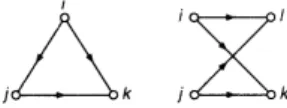
backward of length $\mathrm{f}_{0}\mathrm{u}\mathrm{r}(\mathrm{F}\mathrm{i}\mathrm{g}\mathrm{u}\mathrm{r}\mathrm{e}1)$.edges. Then the vector $\mathrm{x}=(x_{ij})_{1}\leq i<j\leq n\in \mathbb{R}^{m}$
defined
by$/j.\mathrm{X}_{k}’$
$x_{ij}=$
$(i,j)\in E$Figure 1: The circuit corresponding to $g_{ijk}$ and
is called the incidence vector
of
$C$.
the circuit corresponding to $g_{ijkl}$.(Proof) For any circuit of length three defined by
Lemma 2.19 ([1]) A binomial$\mathrm{x}^{\mathrm{u}^{+}}-\mathrm{x}^{\mathrm{u}^{-}}\in I_{A_{n}}$ three vertices $i,$
$j,$
$k(i<j<k)$
, the associatedis a circuit
if
and onlyif
$\mathrm{u}$ is the incidence vector binomial equals$x_{ij}x_{jk}-x_{i}k$, which is $g_{ijk}$
.
of
a circuitof
$D_{n}$.
The circuits $\overline{\mathrm{d}\mathrm{e}\mathrm{f}\mathrm{i}\mathrm{n}\mathrm{e}\mathrm{d}}$by four vertices
$i<j<$
$k<l$
are $C_{1}$ $:=i,j,$$k,$$l,$$i,$ $C_{2}$ $:=i,j,$$l,$$k,$$i$,By Proposition 2.16, $C_{A_{n}}=\mathcal{U}_{A_{n}}=Gr_{A_{n}}$ since $C_{3}:=i,$$k,$ $j,$$l,$$i$ and their opposites. The
bino-the incidence matrix $A_{n}$ is unimodular. mial which corresponds to $C_{1}$ or its opposite is
$\underline{x_{ij}x_{j}k^{X}kl}-x_{il}$, whose initial term is divisible by
Corollary 2.20 The universalGr\"obnerbasis$\mathcal{U}_{A_{n}}$ in
$(g_{ijk})$
.
Similarly, the initial term of binomialis the set
of
binomials which correspond to the cir- which corresponds to $C_{2}$ or its opposite isdivisi-cuits
of
$D_{n}$.
ble by in$(g_{ij}\iota)$.
The $\mathrm{b}\mathrm{i}\mathrm{n}\mathrm{o}\mathrm{n}1\dot{\ovalbox{\tt\small REJECT}}^{1}$ which correspondsto $C_{3}$ or its opposite is$g_{ijkl}$
.
Corollary 2.21 The number
of
elements in $\mathcal{U}_{A_{n}}$ isof
exponential order with respect to $n$.
3
Some
Gr\"obner
bases of
$I_{A_{n}}$In this section, we show that the elements in
re-duced Gr\"obnerbases with respect tosome specific Figure 2: The circuits $C_{1},$ $C_{2},$$C_{3}$.
term orders
can
be given in terms ofgraphs. Asacorollary, we
can
show that there exist termor- Let $C$beacircuit of lengthmore than 5. Let$i_{1}$ ders for which reduced Gr\"obner bases remain in be the vertex whose label is minimum in $C$, andpolynomial order. $C:=i_{1},$$i_{2},$
$\ldots$ ,$i_{s},$$i_{1}$. Without loss of generality,
We first show the term order for which the ele- weset $i_{2}<i_{s}$
.
Let $f_{C}$bethe binomialcorrespond-ments in reducedGr\"obnerbasis correspond to the ing to $C$, then in$(f_{c})$ is product of all variables
circuits oflength three and
some
circuits of length whose associated edges have same direction withinitial termofabinomial in$\mathcal{G}_{1}$, which implies that $\mathcal{G}_{1}$ is Gr\"obnerbasis of$I_{A_{n}}$ with respect $\mathrm{t}\mathrm{o}\succ_{1}$
.
If $i_{2}<i_{3}$, then $(i_{1}, i_{2})$ and $(i_{2}, i_{3})$ have
same
direction on $C$
.
Thus the variables $x_{i_{1}i_{2}}$ and $x_{i_{2}i_{3}}$ appear in in$(f_{C})$, and in$(f_{C})$ is divisible byin$(g_{i_{1}}i_{2}i_{3})$ (Figure
3
left).If$i_{2}>i_{3}$, then since$i_{3}<i_{2}<i_{s}$
,
there exists $k$$(3\leq k<s)$ such that $i_{1}<i_{k}<i_{2}<i_{k+1}$
.
Thenthe variables $x_{i_{1}i_{2}}$ and $x_{i_{k}i\iota+1}$ appear in in$(fc)$,
and in$(f_{C})$ is divisible by in$(gi_{1}i_{k}i_{2}ik+1)$ (Figure 3
right).
term ofother binomial in $\mathcal{G}_{2}$, which implies that
$\mathcal{G}_{2}$ is reduced.
1
We $1\mathrm{a}s\mathrm{t}$ show that there exist two term orders
for which reduced Gr\"obnerbases are same as $\mathcal{G}_{1}$
.
Theorem 3.3 $Let\prec_{3}$ beapurely lexicographic
or-der induced by the following variable oror-dering: $x_{ij}\succ x_{kl}\Leftrightarrow j<l$ or ($j=l$ and$i<k$). Then reduced Gr\"obner $baSi\mathit{8}$
of
$I_{A_{n}}$ with respect to$\prec_{3}$ is $\mathit{8}ame$ as $\mathcal{G}_{1}$ in Theorem3.1.
(Proof) For the circuits of length less than four,
we canshow similarlyasthe proofofTheorem3.1.
Let $C$ beacircuit of lengthmore than five. Let $i_{1}$be the vertex whose label is minimum in $C$, and
$C:=i_{1},$$i_{2},$
$\ldots,$$i_{s},$$i_{1}$
.
Without loss ofgenerality,Figure 3: $x_{i_{1}i_{2}}$ and $x_{i_{2}i_{3}}$ (left) or$x_{i_{1}i_{2}}$ and $x_{i\iota^{i}\iota}+1$ we set $i_{2}<i_{s}$. Let $f_{C}$ bethe associated binomial.
(right) appear in in$(f_{C})$. Let $T_{C}:=\{i_{S}\in C:i_{s-1}<i_{s}\}\cup\{i_{s}\in C:i_{s+1}<$
$i_{s}\}$
.
(We set $i_{s+1}=i_{1}$) This is the set of verticesAny term of$g_{ijk}$ is not divisible by the initial which are the terminal points of edges in $C$
.
Lettermof any other binomials in $\mathcal{G}_{1}$, and so as
$g_{ijkl}$
.
$i_{k}$ be the vertex whose label is minimumin $T_{C}$.
This implies that $\mathcal{G}_{1}$ is reduced.
1
If$k=2$, then the variable$x_{i_{1}i_{2}}$ is the maximumNext we show the term orderfor which the ele- variable in $fc$ with respect to $\prec_{3}$
.
Then in$(fc)$ mentsin reduced Gr\"obnerbasis correspond to the is product of all variables whose associated edges fundamental circuits for acertainspanning tree of havesamedirection with $(i_{1}, i_{2})$on$C$.
Inthis case, $D_{n}$.
we canshow that $\mathcal{G}_{1}$ is the reducedGr\"obnerbasiswith respect$\mathrm{t}\mathrm{o}\prec_{3}$ by similar wayas Theorem3.1. Theorem 3.2 $Let\succ_{2}$ beapurely lexicographicor- Let $k\neq 2$
.
If$i_{k-1}<i_{k}<i_{k+1}$ (Figure 4 left),der induced by the following variable ordering: the variable$x_{i_{k-1}i_{k}}$ is themaximum variable in$fc$
by thechoice of$k$
.
Then the variables$x_{i_{k-1}}i_{k}$ and $x_{ij}\succ x_{kl}\Leftrightarrow i<k$ or ($i=k$ and$j>l$).
$x_{i_{k}i_{k}}.+1$ appear in in$(f_{C})$, and in$(f_{C})$ is divisible
For$1\leq i<j-1<n$, let by in$(g_{i_{k-1}}i_{k}i_{k}+1)$
.
Similarlywe can
show for thecaseof$i_{k-1}>i_{k}>i_{k+1}$
.
$g_{ij}:=\underline{x_{i}j}-x_{i},i+1xi+1,i+2\ldots X_{j-1},j$
Thenreduced Gr\"obner basis$\mathcal{G}_{2}$
of
$I_{A_{n}}$ with respect$to\succ_{2}$ is
$\mathcal{G}_{2}=\{gij:1\leq i<j-1<n\}$.
Inparticular, the number
of
$element_{\mathit{8}}$ in $\mathcal{G}_{2}$ equals Figure 4: The cases $i_{k-1}<i_{k}<i_{k+1}$ (left) and$-(n-1)$
. $i_{k-1}<i_{k+1}<i_{k}$ (right).The elements of reduced Gr\"obner basis $\mathcal{G}_{2}$ cor- Let $i_{k-1}<i_{k}$ and $i_{k+1}<i_{k}$ (Figure 4 right). respond to the fundamental circuits of$D_{n}$ for the If $i_{k-1}<i_{k+1}$, then the variable $x_{i_{k-1}i_{k}}$ is the
spanning tree $T:=\{(i, i+1):1\leq i<n\}$. maximum variable in$f_{C}$
.
Thus thevariable$x_{i_{k-1}}i_{k}$(Proof) Let $C$ be a circuit which is not the fun- appears in in$(f_{C})$
.
By the choice of $k$, it can bedamental circuitof$T$
.
Let $i_{1}$ be the vertex whose shown that $i_{k-1}<i_{k+1}<i_{k}<i_{k+2}$.
(We set label is minimum in $C$, and $C:=i_{1},$$i_{2},$$\ldots,$$i_{s},$$i_{1}$
.
$i_{m+2}=i_{2}.$) In fact, if$i_{k+2}<i_{k+1}$ (Figure 5 left),Without loss of generality, we set $i_{2}<i_{s}$. Then then $i_{k+2}<i_{k+1}<i_{k}$
.
Thus $i_{k+1}$ is the vertexthe variable $x_{i_{1}i_{s}}$ appears in the initial term ofas- whose label is minimum in$T_{C}$, which implies$i_{k+1}$
sociated binomial $f_{C}$
.
Thus in$(fc)$ is divisible by contradicts the choice of $k$.
If $i_{k+1}<i_{k+2}<i_{k}$ $in(g_{i_{1}i_{S}})$. (Figure 5 right), then $i_{k+2}$ contradicts the choiceThe initial term of$g_{ij}$ corresponds to an edge of$k$
.
which is not contained in $T$, and other termcorre- Since $i_{k-1}$ $<i_{k+1}$ $<i_{k}$ $<i_{k+2}$, the
vari-sponds toseveral edges which are contained in T. ables$x_{i_{k-1}i_{k}}$ and $x_{i_{\iota+1}}i_{k+2}$appear in in$(f_{C})$. Thus
various term orders. The number ofelements for general toric ideals are not well understood. For the case of the toric ideals of acyclic tournament graphs, since those vertex-edge incidence matrices
areunimodular,the size of reduced Gr\"obnerbases Figure 5: $i_{k+1}$ (left) or$i_{k+2}$ (right) contradict the may be bounded.
choiceof$k$
.
For the number of elements in reducedGr\"obnerbases, we can get lower bound by Proposition 2.8.
$i_{k+1}$, similarly we can show that in$(f_{C})$ is
divisi-Theorem 4.1 The minimum number
of
elements ble by in$(gi_{k+-\mathrm{l}kk}1ikii-2)$. Thus $\mathcal{G}_{1}$ isthe Gr\"obnerin reduced Gr\"obner bases
for
$I_{A_{n}}$ is$-(n-1)$
.
basis of$I_{A_{n}}$ with respect to $\prec_{3}$.
The basis we have shown in Theorem 3.2 is the The proof that $\mathcal{G}_{1}$ is reduced issame asthe proof
example achieving this bound.
of Theorem 3.1.
1
Theorem 3.4 $Let\prec_{4}$ bea degree lexicographic
or-(Proof) Because ofProposition 2.8, the number
derinduced by the following variable ordering: of elements inreducedGr\"obner basis ismore than the number of elements in thebasisfor $I_{A_{n}}$. Since
$x_{ij}\succ x_{kl}\Leftrightarrow i<k$ or ($i=k$ and$j<l$).
$I_{A_{n}}$ corresponds tothe cycle space of$D_{n}$, the
num-ThenreducedGr\"obner basis
of
$I_{A_{n}}$ with respect to ber of elements in the basis for $I_{A_{n}}$ equals thedi-$\prec_{4}$ is $\mathit{8}ame$ as $\mathcal{G}_{1}$ in Theorem 3.1. mension of the cycle space, which is
$-(n-1)$
.1
(Proof) For the circuits of length less than four, To analyze the upper bound for the number
wecanshow similarlyasthe proof of Theorem3.1. of elements in reduced Gr\"obner bases, we
calcu-Let $C$ beacircuit of length morethan five. Let
late all reduced Gr\"obner bases for small $n$ using
$i_{1}$ be the vertex whose label is minimumin$C$, and
$\mathrm{T}\mathrm{i}\mathrm{G}\mathrm{E}\mathrm{R}\mathrm{S}[8]$. $\mathrm{T}\mathrm{i}\mathrm{G}\mathrm{E}\mathrm{R}\mathrm{S}$ is asoftware system
imple-$i_{2}$ be the vertex adjacent to$i_{1}$ in $C$ satisfying the
mented in $\mathrm{C}$ which computes the state polytope of
following: let$C_{1}$ be the set of edgesin $C$whose
di-ahomogeneoustoric ideal [9]. Table 1 is the result rection in $C$ are same as $(i_{1}, i_{2})$ and $C_{2}$ be the set
for $n=4,5,6,7$
.
of edges in $C$ which do not contained in $C_{1}$, thenthe cardinality of$C_{1}$ is morethanthat of$C_{2}$, orif
the cardinality equals, then $i_{2}$ is the vertex adja-cent to$i_{1}$ in $C$ whose label is minimum. We write
$C:=i_{1},$$i_{2},$$\cdots,$$i_{s},$$i_{1}$
.
Let $f_{C}$ be the associatedbinomial. Then in$(f_{C})$ is product of all variables
whose associated edges are contained in $C_{1}$.
If there exists $k$which satisfies $i_{k-1}<i_{k}<i_{k+1}$
(we set $i_{s+1}=i_{1}$), then the variables $x_{i_{k-1}}i_{k}$ and
$x_{i_{k}i_{k+1}}$ appears in in$(fc)$. Thus in$(fc)$ isdivisible Table 1: The number of reduced Gr\"obner basis,
byin$(g_{i_{k}i_{k}}-1ik+1)$
.
maximum of the number of elements and minimum If there does not exist such $k$, then between any of the number of elements.two edges which are contained in $C_{1}$, there exists
at leastoneedge whichare contained in $C_{2}$. Then
For $n\leq 5$, the reduced Gr\"obner basis in
The-by the choice of $i_{2}$, the cardinality of $C_{1}$ equals
orem 3.1 is the example achieving maximum
ele-that of$C_{2}$
.
Thus $i_{3}<i_{2}<i_{s}$ by hypothesis, andments, but it is not for $n\geq 6$. For $n=6$, the
there exists$k(3\leq k<s)$ such that $i_{1}<i_{k}<i_{2}<$ Gr\"obner bases of size 37 are not the bases with
$i_{k+1}$. Then the variables $x_{i_{1}i_{2}}$ and $x_{i_{k}i_{k+1}}$ appear respect to purely lexicographic orders. Thus the
inin$(f_{C})$, and in$(fc)$ is divisible byin$(g_{ii_{k}i}12i_{k}+1)$.
reduced Gr\"obner bases which achieve the maxi-The proof that$\mathcal{G}_{1}$ isreduced issame asthe proof
mum number of elements seem to be complicated
of Theorem 3.1.
1
and difficult to characterize.4
Bounds for Size of
Gr\"obner
Bases for Various
Term
Or-
5
Application
to
Integer
Pro-ders
gramming
In this section, we deal with the number of ele- In this section,weapplythe toric ideals $I_{A_{n}}$ to the
5.1
$\mathrm{C}_{0\mathrm{n}}\mathrm{t}\mathrm{i}-r\mathrm{b}\mathrm{a}\mathrm{V}\mathrm{e}\mathrm{r}\mathrm{s}\mathrm{o}$Algorithm
result for the size ofreduced Gr\"obner bases. But the upperboundforthe numberofelements is notConti and Traverso [2] introduced an algorithm known. Analyzing the upper bound for the
num-based on Gr\"obner basis to solve integer pro- berofelements should be
a
future work.grams. We describe the condensed version of We also showed the$\mathrm{a}\mathrm{p}\mathrm{p}\mathrm{l}\mathrm{i}_{\mathrm{C}}.\mathrm{a}\mathrm{t}\mathrm{i}\mathrm{o}\mathrm{n}$to minimum cost
Conti-Traverso Algorithm$(\mathrm{S}\mathrm{e}\mathrm{e}[11])$
.
This versionflowproblems. We canapplythe reducedGr\"obner
is useful for highlighting the main computational bases of acyclic tournament graphs to the mini-step involved. For the original version of Conti- mum cost flow problemsusing Conti-Traverso
Al-TraversoAlgorithm,
see
[2]. gorithm. This algorithmis similarto the minimumLet $A\in \mathbb{Z}^{d\cross n},$ $b\in \mathbb{Z}^{d},$
$c\in \mathrm{R}_{\geq 0}^{n}$
.
We considermeancycle-canceling algorithm. But the complex-the integerprogram ity of canceling cycles are not known. Analyzing
the complexityofthis algorithm should be also
a
$IP_{A,c}(b):=minimize\{c\cdot x:Ax=b, x\in \mathrm{N}^{n}\}$
.
future work.
Conti-Traverso Algorithm is the algorithm which
solves $IP_{A,c}(b)$ using the toric ideal$I_{A}$
.
Acknowledgement
Algorithm 5.1 (Conti-Traverso Algorithm) Theauthors thank Mr. Fumihiko Takeuchi for
use-Input: $A\in \mathbb{Z}^{d\cross n},$ $b\in \mathbb{Z}^{d},$
$c\in \mathbb{R}_{\geq 0}^{n}$ ful comments.
Output: An optimalsolution$\mathrm{u}’$
for
$IP_{A,c}(b)$1. Compute the redu$\mathrm{c}ed$ Gr\"obner basis $\mathcal{G}_{\succ_{c}}$
of
$I_{A}$.
References
2. For any solution u
of
$IP_{A,c}(b)$, compute the normalform
$\mathrm{x}^{\mathrm{u}’}$of
$\mathrm{x}^{\mathrm{u}}$ by $\mathcal{G}_{\succ_{\mathrm{C}}}$.
[1] A. Bachem and W. Kern. Linear Programming
3. Output$\mathrm{u}’$
.
$\mathrm{u}’$ is the unique optimalsolutionof
Duality. Springer-Verlag, Berlin, 1991.
$IP_{A,c}(b)$
.
[2] P.Conti and C. Traverso. Buchberger Algorithm
and Integer Programming. In Proc. AAECC-9,
5.2
Application
tO
Minimum
Cost
Springer, LNCS$539(1991)$,pp. 130-139.Flow
Problem
[3] $\mathrm{D}$ A Cox, $\mathrm{J}\mathrm{B}$ Little and $\mathrm{D}\mathrm{B}\mathrm{o}’ \mathrm{S}\mathrm{h}\mathrm{e}\mathrm{a}$Ide-als, Varieties, and Algorithms. Second Edition,
Using Algorithm 5.1, reduced Gr\"obner bases for Springer-Verlag, NewYork, 1996.
$I_{A_{n}}$ canbeappliedtominimum cost flow problems [4] D. A. Cox, J. B. Little and D. B. O’Shea. Using
on $D_{n}$ or the subgraphs of$D_{n}$. Algebraic Geometry. Springer-Verlag, New York,
The minimum mean cycle-canceling algo- 1998.
rithm [7] is known
as
a
strongly polynomial time [5] J. A. de Loera,B. Sturmfels and R. R. Thomas.algorithm which depends only
on
the number of $\mathrm{c}_{\mathrm{r}\ddot{\mathrm{O}}}\mathrm{b}\mathrm{n}\mathrm{e}\mathrm{r}$ Bases and Triangulations of theSec-vertices and edges. Using this algorithm, from ond Hypersimplex. Combinatorica, 15(1995), pp.
any feasible flow, we canobtain the minimum cost 409-424.
flow by canceling minimum mean cycle at most [6] P. Diaconis and B. Sturmfels. Algebraic
Algo-$O(nm^{2}\log n)$ times. rithms for Sampling from Conditional
Distribu-If reduced Gr\"obner basis with respect to the tions. Annals
of
Statistics, 26(1998),pp. 363-397. term order which corresponds to the cost vector [7] A. V. Goldberg and R. E. Tarjan. Findingis known, we can obtain the minimum cost flow Minimum-Cost Circulations by Cancelling
Neg-by canceling the cycles which correspond to the ative Cycles. J. $ACM$
.
36(1989), pp. 873-886. elements of reduced Gr\"obner basis. Thus it is in- [8] B. Huber and R. R. Thomas. $\mathrm{T}\mathrm{i}\mathrm{G}\mathrm{E}\mathrm{R}\mathrm{S}$.teresting to analyze the size of reduced Gr\"obner http:$//\mathrm{w}\mathrm{w}\mathrm{w}$.math.tamu.$\mathrm{e}\mathrm{d}\mathrm{u}/\sim \mathrm{r}\mathrm{e}\mathrm{k}\mathrm{h}\mathrm{a}/\mathrm{T}\mathrm{i}\mathrm{G}\mathrm{E}\mathrm{R}\mathrm{S}_{-}\mathrm{o}.9$ .uu
bases and the complexity of canceling the cycles [9] B.Huber and R. R.Thomas.ComputingGr\"obner
for thecase of acyclic tournament graphs. Fans of Toric Ideals. to appear in Experimental
Mathematics.
[10] H. Ohsugiand T. Hibi. Toric Ideals Generated by
6
Conclusions
Quadratic Binomials. J. Algebra, 218(1999),pp.509-527.
In this paper, we have studied the reduced [11] B. Sturmfels. Gr\"obner Bases and Convex
Poly-Gr\"obner bases for toric ideals of acyclic tourna- topes. AMS University Lecture Series,8,
Provi-ment graphs and applied them to minimum cost dence, $\mathrm{R}\mathrm{I}$, 1995.
flow problems. [12] R. R. Thomas. Gr\"obner Bases in Integer
Pro-The universal Gr\"obner basis of acyclic tourna- gramming. In Handbook
of
Combinatorial Op-ment graph is of exponential size. We have shown timization Vol. 1 D.-Z. Du and P. M. Parda-two reduced Gr\"obnerbases whose size is of poly- los1998, pp.(Eds.), KluwerAcademic Publishers, Boston,533-572.