Japan Advanced Institute of Science and Technology
https://dspace.jaist.ac.jp/
Title
Exact and Approximated Outage Probability
Analyses for Decode-and-Forward Relaying System
Allowing Intra-link Errors
Author(s)
Zhou, Xiaobo; Cheng, Meng; He, Xin; Matsumoto,
Tad
Citation
IEEE Transactions on Wireless Communications,
13(12): 7062-7071
Issue Date
2014-09-04
Type
Journal Article
Text version
author
URL
http://hdl.handle.net/10119/12280
Rights
This is the author's version of the work.
Copyright © 2014 IEEE. IEEE Transactions on
Wireless Communications, 13(12), 2014, 7062-7071.
Personal use of this material is permitted.
Permission from IEEE must be obtained for all
other uses, in any current or future media,
including reprinting/republishing this material
for advertising or promotional purposes, creating
new collective works, for resale or
redistribution to servers or lists, or reuse of
any copyrighted component of this work in other
works.
Exact and Approximated Outage Probability
Analyses for Decode-and-Forward Relaying System
Allowing Intra-link Errors
Xiaobo Zhou, Member, IEEE, Meng Cheng, Student Member, IEEE, Xin He, and Tad Matsumoto, Fellow, IEEE
Abstract—In this paper, we theoretically analyze the outage probability of decode-and-forward (DF) relaying system allowing intra-link errors (DF-IE), where the relay always forwards the decoder output to the destination regardless of whether errors are detected after decoding in the information part or not. The results apply to practical fading scenarios where all the links between the nodes suffer from independent block Rayleigh fading. The key idea of DF-IE system is that the data sequence forwarded by the relay is highly correlated with the original information sequence sent from the source, and hence with a proper joint decoding technique at the destination, the correlation knowledge can well be exploited to improve the system performance. We analyze this problem in the information theoretical framework of correlated source coding. Using the theorems for lossy source-channel separation and for source coding with side information, the exact outage probability is derived. It is then shown that the exact expression can be reduced to a simple, yet accurate approximation by replacing the theorem for source coding with side information by the Slepian-Wolf theorem. Compared with conventional DF relaying where relay keeps silent if errors are detected after decoding, DF-IE can achieve even lower outage probability. Moreover, by allowing intra-link errors, the optimal position of the relay is found to be exactly the midpoint between the source and destination. Results of the simulations are provided to verify the accuracy of the analytical results.
Index Terms—Decode-and-forward, relay channel, intra-link errors, source coding with side information theorem, Slepian-Wolf theorem, Shannon’s lossy source-channel separation theo-rem, outage probability
I. INTRODUCTION
C
OOPERATIVE communication has been recognized as a promising technology for future ubiquitous communica-tion systems, where there is an increasing demand for efficient and reliable information transmission from multiple sources to multiple destinations over wireless channels suffering from deep fading. By exploiting the broadcasting nature of the wireless signals, multiple nodes cooperate with each otherX. Zhou and M. Cheng are with School of Information Science, Japan Advanced Institute of Science and Technology, 1-1 Asahidai, Nomi, Ishikawa 923-1292, Japan (e-mail:{xiaobo, chengmeng}@jaist.ac.jp).
X. He and T. Matsumoto are with School of Information Science, Japan Advanced Institute of Science and Technology, 1-1 Asahidai, Nomi, Ishikawa 923-1292, Japan, and with Centre for Wireless Communications, Univer-sity of Oulu, P.O. Box 4500, 90014 UniverUniver-sity of Oulu, Finland (e-mail:
{hexin,matumoto}@jaist.ac.jp).
This work was supported in part by the European Union’s FP7 project, ICT-619555 RESCUE (Links-on-the-fly Technology for Robust, Efficient and Smart Communication in Unpredictable Environments), and also in part by the Japanese government funding program, Grant-in-Aid for Scientific Research (B), No. 23360170.
Manuscript received XX XX, 201x; revised XX XX, 201x.
in the network to form a virtual multiple-antenna system by sharing the single antenna of each node [1], thereby spatial diversity gain with multiple-input multiple-output (MIMO) techniques can be achieved. Furthermore, cooperative com-munications can be adopted by future cellular networks or wireless sensor/mesh networks, without requiring significant changes in infrastructure. On the contrary, techniques requiring
fixed multiple antennas in each single node may not be
suitable, if the bandwidth, size and energy limitations impose practical difficulties in achieving the MIMO gains [2].
Decode-and-Forward (DF) relaying is the most widely studied protocol for cooperative communications. For the DF protocol, after receiving signal transmitted from the source, the relay first decodes the received signal, re-encodes and then forwards it to the destination. With the help of the relay, diversity gain can be achieved. So far several derivative techniques of the DF protocol have been proposed from the perspective of diversity-multiplexing tradeoff (DMT) [3], [4]. In this contribution, however, our focus is mainly on the DF protocol which satisfies the half-duplex and orthogonal system setup, referred to as conventional DF relaying in this paper. Due to the half-duplex setup, the relay does not transmit and receive simultaneously on the same frequency. Various prac-tical implementations of conventional DF relaying have been proposed using different code families, such as convolutional codes [5], Turbo codes [6], [7] and low density parity check (LDPC) codes [8], [9]. Besides the practical coding schemes, results of the theoretical analysis on the outage probability of conventional DF relaying in Rayleigh fading channels are provided in [10]–[12].
In the conventional DF systems, the recovered data sequence is discarded at the relay if errors are detected after decoding. It has been believed that if the relay re-encodes the data sequence containing errors and forwards it to the destination, error propagation will occur, resulting in even worse performance [13]. However, even if errors are detected at the relay, the data sequences transmitted from the source and relay are still highly correlated, and therefore Slepian-Wolf’s correlated source coding theorem [14] can be well utilized in this scenario. Ref. [15] formulates this issue from the viewpoint of the Slepian-Wolf theorem, where the authors assume that the relay does not aim to perfectly correct the errors occurring in the source-relay link (referred to as intra-link). Instead, it interleaves the information sequence, re-encodes and then forwards the encoder output to the destination, even though there may remain some errors after decoding. It is shown in
[15] that with iterative processing utilizing the Log-likelihood Ratio (LLR) updating function [16], the error probability can be utilized at the destination. The key idea of the coding technique provided in [15] is that the relay system can be seen as a distributed Turbo code, and hence it can achieve Turbo-cliff-like bit-error-rate (BER) performance in Additive White Gaussian Noise (AWGN) channels. In this paper, the scheme presented in [15] is referred to as DF relaying system
allowing intra-link errors (DF-IE) for notational convenience.
Recently, outage probability of DF-IE system is investigated in [17], where the source-destination and relay-destination links are assumed to suffer from block Rayleigh fading while the intra-link is modeled by a binary symmetric channel (BSC) with a fixed crossover probability as a parameter. The admissible rate region of the source-destination link and relay-destination link are determined by the Slepian-Wolf theorem. The outage probability is expressed as a set of double integrals over the admissible rate region, with respect to the probability density function (pdf ) of the instantaneous signal-to-noise ratios (SNRs) of the source-destination and relay-destination links. However, there are two fundamental drawbacks inherent in this approach. First of all, the assumption that the intra-link is modeled by a BSC with fixed crossover probability (intra-link error probability) is not realistic in practical applications because the intra-link also suffers from block Rayleigh fading [18]. In this case, the error probability is no longer a fixed value but a random variable that changes according to the variation of the intra-link. Secondly, in the DF-IE system considered, correlated data sequences are transmitted from the source and the relay to the destination, however the destination aims only to recover the information sent from the source. This system setup does not perfectly match the Slepian-Wolf theorem which intends to recover both the two correlated sources at the destination.
The primary goal of this paper is to overcome these two drawbacks and to theoretically investigate outage probabil-ity of DF-IE system, where account is taken of the fading variations of all the links. As mentioned before, in DF-IE system, the intra-link error probability is considered as a random variable rather than a fixed value, hence deriving the
pdf of the intra-link error probability is of crucial importance
and a challenging topic. In our method, instead of deriving the pdf of the intra link error probability, we establish the relationship between the intra-link error probability and the instantaneous SNR of the intra-link according to Shannon’s lossy source-channel separation theorem [19]. Furthermore, we found the data transmission over DF-IE system falls exactly into the category of source coding with side information problem [20], where only one of the two correlated sources is to be recovered and the other is served as a helper. Hence, the admissible rate region for the source and relay can be accurately determined by the theorem for source coding with
side information [21]. We then show that the exact outage
probability of DF-IE system can be expressed by a set of triple integrals over the admissible rate region, with respect to the pdf of the instantaneous SNRs of each link. Moreover, inspired by [17], we found that the exact outage probability expression can be reduced to a simple, yet accurate enough
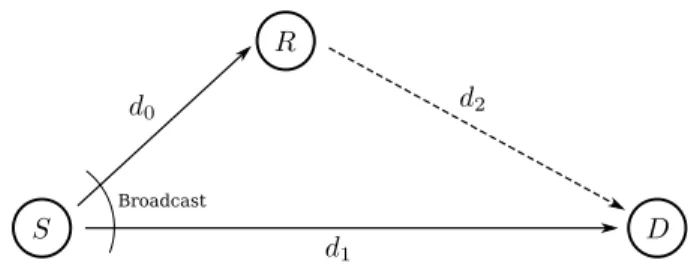
Broadcast
Fig. 1. The block diagram of the single relay system.
approximation by replacing the theorem for source coding with
side information by the Slepian-Wolf theorem. It is shown
that this approximation is quite accurate so far as the relay location scenarios assumed in this paper are concerned. As stated above, the outage analyses provided in this paper purely follow the correlated source coding theorems and assume infinite frame length. Therefore the analytical results upper bound the performance of the practical signaling schemes.
The rest of this paper is organized as follow. In Section II, we introduce the abstract model of DF-IE system assumed in this paper, and the corresponding channel model as well. The relationship between intra-link error probability and the instantaneous SNR of the source-relay link is established in Section III. In Section IV, we derive the exact outage probabil-ity of DF-IE system, based on the theorem for source coding
with side information. In Section V, the approximated outage
probability of DF-IE system is derived by using the Slepian-Wolf theorem. Numerical results are provided in Section VI to verify the theoretical analysis. Finally, conclusions are drawn in Section VII with some concluding remarks.
II. SYSTEMMODEL
A. DF-IE system
We consider a simple one-way orthogonal half-duplex relay system, where a source S and a relay R cooperate to transmit a message to a destination D, as shown in Fig. 1. To guarantee orthogonal transmission, a time-division channel allocation is assumed; the transmission consists of two time slots. During the first time slot, S encodes the original message and broad-casts it to both R and D. R always decodes to recover the information sequence, interleaves the information sequence, re-encodes it and forwards the encoder output to D during the second time slot, even though the decoding result may contain errors in the original information sequence (such errors are referred to as intra-link errors). Note that the decoder output at R is highly correlated with the original message sent from
S. This correlation is referred to as source-relay correlation
in this paper.
After receiving signals from S and R, D performs joint decoding by exploiting the source-relay correlation to retrieve the original message sent from S. The relay system assumed in this paper, as a whole, can be seen as a distributed Turbo code. Hence, an iterative decoding process is required at D between the decoders for the codes used by S and R [15].
B. Channel Model
The links between S and R, S and D, and R and D are assumed to suffer from independent block Rayleigh fading, where the channel gains keep constant within one transmission block but vary transmission-by-transmission. The received signals at S and D can be expressed as
y0[k] = √ G0· h0· s[k] + n0[k], (1) y1[k] = √ G1· h1· s[k] + n1[k], (2) y2[k] = √ G2· h2· s′[k] + n2[k], (3)
where s[k] and s′[k] denote the signals transmitted from S and R, respectively, with k being the timing index of the symbols. hiand ni[k] denote the complex channel gain and the zero-mean AWGN with the variance σ2
i per dimension, where
i∈ {0, 1, 2} denotes the SR, SD and RD links, respectively.
It is assumed that σ2
0 = σ12 = σ22 = N0/2 without loss of
generality. The geometric-gain of each link is also considered in this paper, which is represented by Gi, i∈ {0, 1, 2}. With
di denoting the distance of its corresponding link and G1
being normalized to the unity, G0 and G2 can be defined as
G0 = (d1/d0)l and G2 = (d1/d2)l, respectively,1 where l
is the pathloss exponent, which is empirically set at 3.52 as in [7]. Note further that we assume the transmit power per symbol at S and R is the same, which is denoted as Es.
With the definitions described above, the instantaneous and average SNRs of SD link are expressed as γ1 =
G1|h1|2Es/N0 and Γ1 = G1Es/N0, respectively. Similar
definitions apply to γ0, Γ0, γ2 and Γ2. With Rayleigh fading
assumption, the pdf of γi is given by [22]
p(γi) = 1 Γi exp ( −γi Γi ) , i = 0, 1, 2. (4) III. INTRA-LINKERRORPROBABILITYANALYSIS
With the block Rayleigh fading assumption, the intra-link error probability p stays constant over one block, but varies transmission-by-transmission. In this section, we consider the point-to-point intra-link transmission and identify the relation-ship between p and γ0.
According to Shannon’s lossy source-channel separation theorem [19], [23], U1 can be transmitted over the intra-link,
with a distortion levelD, if
Rc,1· R(D) ≤ C(γ0), (5)
where Rc,1 and R(D) are the spectrum efficiency2 of the transmission chain of the intra-link and the source rate-distortion function [21], respectively. C(γ0) denotes the
in-stantaneous channel capacity of the intra-link given γ0.3 With
the Hamming distortion measure and for a given γ0 value, the
minimum distortion Dmin is equivalent to the intra-link error
1The geometric-gain between two nodes with distance d is defined as G =
(1d)laccording to [7].
2The spectrum efficiency includes both the channel coding rate and the
modulation multiplicity.
3Assuming Gaussian codebook is used for modulation, C(x) =
ND
2 log2(1 +N2xD), with its inverse function C
−1(x) = ND
2 (2
2x
ND − 1),
where NDdenotes the dimensionality of the channel input.
Encoder
Encoder
Decoder
+
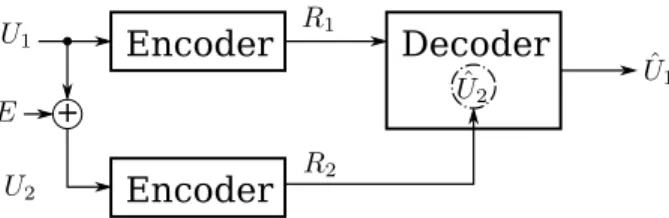
Fig. 2. Abstract model for the coding/decoding of U1 and U2 from the
viewpoint of source coding with side information. U2is the bit-flipped version
of U1and served as a helper for the decoding of U1 at the decoder.
probability p [24]. By substituting p into (5) and taking the equality, we have R(p) = Φ1(γ0) = C(γ0) Rc,1 . Therefore, p can be further expressed as4 p = { Hb−1[1− Φ1(γ0)], for Φ−11 (0)≤ γ0≤ Φ−11 (1), 0, for γ0≥ Φ−11 (1), (6) where Hb−1(·) denotes the inverse function of the binary entropy function Hb(x) = −x log2x− (1 − x) log2(1− x),
and Φ−11 (·) is the inverse function of Φ1(·).
IV. EXACTOUTAGEPROBABILITYANALYSIS
A. Admissible Rate Region Based on Source Coding with Side Information
As mentioned before, the intra-link error probability p stays fixed within one transmission. In this subsection, we consider only one transmission, and hence p is regarded as a fixed parameter. Let U1 denote the original binary information
sequence transmitted from S, and U2 the decoder output at
R. As described above, U2 may contain some errors. Hence,
U2 can be regarded as the bit-flipped version of U1, as
U2 = U1 ⊕ E, where ⊕ indicates modulus-2 addition and
E is a binary random variable with probability Pr(E = 1) =
1− Pr(E = 0) = p, as shown in Fig. 2. The correlation between U1 and U2 is characterized by p, where p = 0
indicates perfect decoding at R, and 0 < p ≤ 0.5 indicates errors occurring in the intra-link.
Assume U1 and U2 are described with rates R1 and R2,
respectively, as shown in Fig. 2. As stated before, in DF-IE system, the objective of D is only to retrieve U1, which was
sent from S. On the other hand, U2sent from R does not need
to be successfully recovered at D. The coding/decoding of U1
and U2 falls exactly into the category of source coding with
side information problem [20], where two correlated sources are encoded separately and transmitted to the same decoder at the destination, but only one of the two sources is to be recovered at the destination and the other one serves as a helper (side information). Obviously, in DF-IE system, U2
provides side information to help the decoding of U1 at the
destination. According to the theorem for source coding with
side information [21], successful recovery of U1 after joint
decoding at D can be achieved if R1 and R2 satisfies
{
R1 ≥ H(U1| ˆU2),
R2 ≥ I(U2; ˆU2),
(7) 4For i.i.d. binary source, R(D) = 1 − H
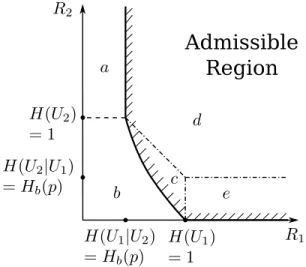
Admissible
Region
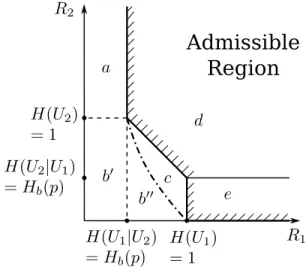
Fig. 3. The admissible rate region for S and R determined by the theorem
for source coding with side information.
where ˆU2 is the estimate of U2 at the final output, as shown
in Fig. 2. The relationship between U2 and ˆU2 can also be
expressed as a bit-flipping model with a error probability α, where α ∈ [0, 0.5]. Let H(U1| ˆU2) and I(U2; ˆU2) denote the
entropy of U1 conditioned on ˆU2 and the mutual information
between U2 and Uˆ2, respectively. In this paper, we only
consider independent and identically distributed (i.i.d.) source, therefore it is easily found that H(U1| ˆU2) = Hb(α ∗ p) and I(U2; ˆU2) = H( ˆU2)− H( ˆU2|U2) = 1− Hb(α), where
α∗ p = (1 − α)p + α(1 − p).
LetRSI denote the admissible rate region specified by (7). To facilitate the rate region comparison to be provided later in this paper, we divide the entire rate region into five sub-regions,Ra, Rb, Rc, Rd andRe, as shown in Fig. 3. From this figure, we have RSI = Rc ∪ Rd∪ Re. Consider two extreme cases: (1) In the case U2can be successfully decoded
at the decoder, ˆU2= U2 and α = 0. Therefore, the conditions
become as R1≥ Hb(0∗p) = Hb(p) and R2≥ 1−Hb(0) = 1, which corresponds to the linear boundary betweenRaandRd. (2) In the case the estimate ˆU2of U2after decoding is totally
wrong, ˆU2does not contain any information about U2and α =
0.5. Therefore, the conditions become as R1≥ Hb(0.5∗p) = 1 and R2 = 1− Hb(0.5) = 0, which corresponds to the lower linear boundary of Re. In all other cases (0 < α < 0.5), it is easily to know the conditions become as R1≥ Hb(α∗ p) and
R2≥ 1−Hb(α), which corresponds to the nonlinear boundary between Rb and Rc. According to the discussions presented above, RSI can be expressed even in an explicit way as
R1≥
{
Hb(p), for R2≥ 1,
Hb(α∗ p), for 0 ≤ R2≤ 1.
(8) The three boundaries between Rd andRc, Rd and Re, and
Rc andRe will be discussed in Section V-A.
B. Relationship Between R1, R2 and Their Corresponding
Channel SNRs
It should be emphasized here that, in the system consid-ered in this paper, specific source coding for compression
is performed neither at S nor at R. Instead, the correlation knowledge between U1 and U2 is exploited at D to enhance
the error correction capability of the system. Now consider the transmission of the SD and RD links. According to Shannon’s separation theorem, if the total information transmission rates over these two independent channels satisfy [16]
{
R1Rc,1 ≤ C(γ1),
R2Rc,2 ≤ C(γ2),
(9) the message error probability can be made arbitrarily small. Here, Rc,1 and Rc,2 indicate the spectrum efficiency of the transmission chain of the SD and RD links, respectively.
C(γ1) and C(γ2) denote the channel capacity of the SD and
RD links, respectively, given the instantaneous SNRs of the SD and RD links being γ1 and γ2.
In the theoretical analysis, we only consider the equality of (8) and (9). The relationship between rate Ri and its corresponding instantaneous channel SNR γi is given by
Ri= Φi(γi) =
C(γi)
Rc,i
, (10) with its inverse function
γi= Φ−1i (Ri) = C−1(RiRc,i), (11) where i = 1, 2 and C−1(·) denotes the inverse function of channel capacity.
C. Exact Outage Calculation Based onRSI
Within one transmission and for a given p value, the outage event happens when (R1, R2) falls outside the admissible rate
region RSI, i.e., the set (R1, R2) is in Ra or Rb. Note that the intra-link error probability p changes, according to the variation of γ0, as described in Section III. Taking into
account the impact of the variation of the intra-link, the outage probability of the system is defined by taking average over all the transmissions, which results in
PoutSI = Pr{0 ≤ p ≤ 0.5, (R1, R2) /∈ RSI} = Pr{p = 0, (R1, R2)∈ Ra∪ Rb} + Pr{0 < p ≤ 0.5, (R1, R2)∈ Ra∪ Rb} = Pr{p = 0, (R1, R2)∈ Ra} + Pr{p = 0, (R1, R2)∈ Rb} + Pr{0 < p ≤ 0.5, (R1, R2)∈ Ra} + Pr{0 < p ≤ 0.5, (R1, R2)∈ Rb}. (12)
Note that the intra-link error probability p and the rates R1,
R2 can be converted into the instantaneous channel SNR
of their corresponding links, as shown in Section IV-B and III. Moreover, since all the three links are suffering from statistically independent block Rayleigh fading, the joint pdf of the instantaneous SNRs can be expressed as p(γ0, γ1, γ2) =
p(γ0)· p(γ1)· p(γ2). Given the facts described above, the
respectively, can be further expressed as P1,a= Pr{p = 0, R2≥ 1, 0 ≤ R1≤ Hb(p)} = Pr{γ0≥ Φ−11 (1), γ2≥ Φ−12 (1), Φ−11 (0)≤ γ1≤ Φ−11 (0)} = ∫ Φ−11 (1) Φ−11 (0) dγ0 ∫ Φ−12 (1) Φ−12 (0) dγ2 · ∫ Φ−11 (0) Φ−11 (0) p(γ0)· p(γ1)· p(γ2)dγ1 = 0, (13) P1,b= Pr{p = 0, 0 ≤ R2≤ 1, 0 ≤ R1≤ Hb(α∗ p)} = Pr{γ0≥ Φ−11 (1), Φ−12 (0)≤ γ2≤ Φ−12 (1), Φ−11 (0)≤ γ1≤ Φ−11 [1− Φ2(γ2)]} = ∫ Φ−11 (∞) Φ−11 (1) dγ0 ∫ Φ−12 (1) Φ−12 (0) dγ2 · ∫ Φ−11 [1−Φ2(γ2)] Φ−11 (0) p(γ0)· p(γ1)· p(γ2)dγ1 = 1 Γ2 exp [ −Φ−11 (1) Γ0 ] ∫ Φ−12 (1) Φ−12 (0) exp(−γ2 Γ2 ) · [ 1− exp(−Φ −1 1 [1− Φ2(γ2)] Γ1 ) ] dγ2, (14) P2,a= Pr{0 < p ≤ 0.5, R2≥ 1, 0 ≤ R1≤ Hb(p)} = Pr{Φ−11 (0)≤ γ0≤ Φ−11 (1), γ2≥ Φ−12 (1), Φ−11 (0)≤ γ1≤ Φ−11 [1− Φ1(γ0)]} = ∫ Φ−11 (1) Φ−11 (0) dγ0 ∫ Φ−12 (∞) Φ−12 (1) dγ2 · ∫ Φ−11 [1−Φ1(γ0)] Φ−11 (0) p(γ0)· p(γ1)· p(γ2)dγ1 = 1 Γ0 exp [ −Φ−12 (1) Γ2 ] ∫ Φ−11 (1) Φ−11 (0) exp(−γ0 Γ0 ) · [ 1− exp(−Φ −1 1 [1− Φ1(γ0)] Γ1 ) ] dγ0, (15) and P2,b= Pr{0 < p ≤ 0.5, 0 ≤ R2≤ 1, 0 ≤ R1≤ Hb(α∗ p)} = Pr{Φ−11 (0)≤ γ0≤ Φ−11 (1), Φ−12 (0)≤ γ2≤ Φ−12 (1), Φ−11 (0)≤ γ1≤ Φ−11 [Ψ(γ0, γ2)]} = ∫ Φ−11 (1) Φ−11 (0) dγ0 ∫ Φ−12 (1) Φ−12 (0) dγ2 · ∫ Φ−11 [Ψ(γ0,γ2)] Φ−11 (0) p(γ0)· p(γ1)· p(γ2)dγ1 = 1 Γ0Γ2 ∫ Φ−11 (1) Φ−11 (0) ∫ Φ−12 (1) Φ−12 (0) exp(−γ0 Γ0 − γ2 Γ2 ) · { 1− exp [ −Φ−11 [Ψ(γ0, γ2)] Γ1 ]} dγ0dγ2 (16)
Encoder
Encoder
Decoder
+
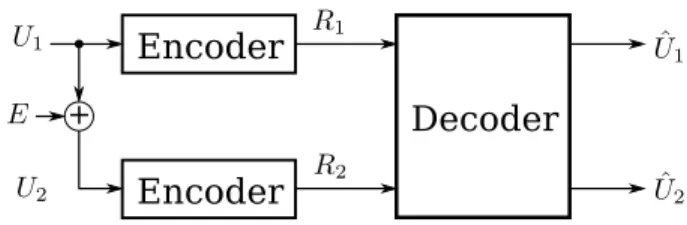
Fig. 4. Abstract model for the coding/decoding of U1 and U2 from the
viewpoint of Slepian-Wolf theorem. U2is the bit-flipped version of U1and
also needs to be recovered at the decoder.
with Ψ(γ0, γ2) = Hb{Hb−1[1− Φ1(γ0)]∗ Hb−1[1− Φ2(γ2)]}.
As indicated by (13), the value of P1,ais found to be always
equal to 0. Since the derivation for the explicit expressions of the integrals in (14), (15) and (16) may not be possible, we use a numerical method [25] to calculated the values of P1,b, P2,a and P2,b. Note that the boundary between Rb and Rc is nonlinear, and the calculation of PoutSI requires an inverse binary entropy function Hb−1(·). However, it is difficult to derive explicit expression of Hb−1(·) and we use an approximation technique which is described in Appendix B.
V. APPROXIMATEDOUTAGEPROBABILITYANALYSIS
The Slepian-Wolf theorem is well known for lossless transmission of correlated sources. Unlike the theorem for
source coding with side information, the Slepian-Wolf theorem
provides the admissible rate region required to recover all the correlated sources. In this section, we show that the rate region of the DF-IE system can also be approximated by the Slepian-Wolf theorem. With this assumption, the boundary can be expressed by a connection of linear lines. Based on the approximated admissible rate region with linear boundary, we derive the outage probability, which eliminates the difficulty in numerical calculation due to the nonlinear boundary ofRSI.
A. Approximated Admissible Rate Region Based on Slepian-Wolf Coding
First of all, we consider the successful transmission of both
U1 and U2 from the viewpoint of Slepian-Wolf theorem, as
shown in Fig. 4. According to the Slepian-Wolf theorem [14], successful recovery of both U1and U2 after joint decoding at
D is possible if R1 and R2 satisfies
R1 ≥ H(U1|U2), R2 ≥ H(U2|U1), R1+ R2 ≥ H(U1, U2), (17)
where H(U1|U2) (H(U2|U1)) denotes the conditional entropy
of U1 (U2) given U2 (U1), and H(U1, U2) denotes the joint
entropy of U1 and U2. It is obvious that H(U1) = H(U2) =
1, H(U1|U2) = H(U2|U1) = Hb(p) and H(U1, U2) =
1 + Hb(p). The admissible rate region identified by (17) is represented by Rd, which is an unbounded polygon, as shown in Fig. 3. However,Reshould also be included as the admissible rate region for DF-IE system [17], [18], since we only focus on the transmission of U1 and an arbitrary value
Admissible
Region
Fig. 5. The approximated admissible rate region for S and R determined by the Slepian-Wolf theorem.
Let RSW denote the admissible rate region that includes bothRd andRe(RSW =Rd∪ Re),RSW can be expressed as R1≥ Hb(p), for R2≥ 1, 1 + Hb(p)− R2, for Hb(p)≤ R2≤ 1, 1, for 0≤ R2≤ Hb(p). (18)
According to (18), if 0 ≤ R2 ≤ Hb(p), R1 should always
be larger than 1 to guarantee successful recovery of U1at the
receiver. However, U2can be partially recovered at the receiver
as long as R2> 0, and the partially recovered U2can serve as
side information for recovering U1. Intuitively, with the help of
the side information at the receiver, R1can be further reduced
to less than 1 while keeping the possibility that U1 still can
be successfully recovered at the receiver, which is obviously excluded in (18). This shows that RSW is an approximation of the admissible rate region for S and R. As shown in Fig. 3, RSI ≥ RSW, and the difference is represented by
Rc. Although RSW is an approximation of RSI, if we set
p = 0 and according to (8) and (18), the boundaries of RSI andRSW become the same, andRc vanishes. This indicates that as the instantaneous SNR of intra-link is large enough,Rc does not have any impact on the outage probability calculation.
B. Approximated Outage Calculation Based on RSW Similarly, given RSW, the outage event happens when (R1, R2) falls outside RSW. In this case, the outage prob-ability of DF-IE system is defined as
PoutSW = Pr{0 ≤ p ≤ 0.5, (R1, R2) /∈ RSW} = Pr{p = 0, (R1, R2)∈ Ra∪ Rb∪ Rc} + Pr{0 < p ≤ 0.5, (R1, R2)∈ Ra∪ Rb∪ Rc} = Pr{p = 0, (R1, R2)∈ Rab′} + Pr{p = 0, (R1, R2)∈ Rb′′c} + Pr{0 < p ≤ 0.5, (R1, R2)∈ Rab′} + Pr{0 < p ≤ 0.5, (R1, R2)∈ Rb′′c}. (19)
To simplify the calculation of PSW
out , we further divide Rb into two subregions,Rb′ andRb′′, i.e., Rb=Rb′∪ Rb′′, as shown in Fig. 5. In (19),Rab′ andRb′′care defined asRab′ =
Ra∪ Rb′ andRb′′c =Rc∪ Rb′′, respectively. It is obvious
that Rab′ = {(R1, R2) : 0 ≤ R1 ≤ Hb(p), R2 ≥ 0}, and
Rb′′c={(R1, R2) : Hb(p)≤ R1≤ 1, R1+ R2≤ 1+Hb(p)}.
Note that R1, R2 and p can be expressed as functions of
their corresponding channel SNRs, as shown in Section IV-B and III. Let P1,ab′, P1,b′′c, P2,ab′ and P2,b′′c denote the last four terms in (19), respectively. They can be calculated as
P1,ab′ = Pr{p = 0, 0 ≤ R1≤ Hb(p), R2≥ 0} = Pr{γ0≥ Φ−11 (1), Φ−11 (0)≤ γ1≤ Φ−11 (0), γ2≥ Φ−12 (0)} = ∫ Φ−11 (∞) Φ−11 (1) dγ0 ∫ Φ−11 (0) Φ−11 (0) dγ1 · ∫ Φ−12 (∞) Φ−12 (1) p(γ0)· p(γ1)· p(γ2)dγ2 = 0, (20) P1,b′′c= Pr{p = 0, Hb(p)≤ R1≤ 1, R1+ R2≤ 1 + Hb(p)} = Pr{γ0≥ Φ−11 (1), Φ−11 (0)≤ γ1≤ Φ−11 (1), Φ−12 (0)≤ γ2≤ Φ−12 [1− Φ1(γ1)]} = ∫ Φ−11 (∞) Φ−11 (1) dγ0 ∫ Φ−11 (1) Φ−11 (0) dγ1 ∫ Φ−12 [1−Φ1(γ1)] Φ−12 (0) p(γ0)· p(γ1)· p(γ2)dγ2 = 1 Γ1 exp [ −Φ−11 (1) Γ0 ] ∫ Φ−11 (1) Φ−11 (0) exp(−γ1 Γ1 ) · [ 1− exp(−Φ −1 2 [1− Φ1(γ1)] Γ2 ) ] dγ1, (21) P2,ab′ = Pr{0 < p ≤ 0.5, 0 ≤ R1≤ Hb(p), R2≥ 0} = Pr{Φ−11 (0)≤ γ0≤ Φ−11 (1), Φ−11 (0)≤ γ1≤ Φ−11 [1− Φ1(γ0)], γ2≥ Φ−12 (0)} = ∫ Φ−11 (1) Φ−11 (0) dγ0 ∫ Φ−11 [1−Φ1(γ0)] Φ−11 (0) dγ1 · ∫ Φ−12 (∞) Φ−12 (0) p(γ0)· p(γ1)· p(γ2)dγ2 = 1 Γ0 ∫ Φ−11 (1) Φ−11 (0) exp(−γ0 Γ0 ) · [ 1− exp(−Φ −1 1 [1− Φ1(γ0)] Γ1 ) ] dγ1, (22)
−10 −5 0 5 10 15 10−4 10−3 10−2 10−1 100 Average SNR of SD link (dB) Outage Probability DF DF−IE, Pout SW DF−IE, PoutSI DF, MC DF−IE, MC 3.995 4 4.005 4.01 4.015 10−2.283 10−2.282 10−2.281 10−2.28 3.9 4 4.1 4.2 10−1.61 10−1.59 10−1.57 Location B Location A
Fig. 6. Comparison of the outage probability of the DF-IE and conventional DF system. and P2,b′′c= Pr{0 < p ≤ 0.5, Hb(p)≤ R1≤ 1, R1+ R2≤ 1 + Hb(p)} = Pr{Φ−11 (0)≤ γ0≤ Φ−11 (1), Φ−11 [1− Φ1(γ0)]≤ γ1≤ Φ−11 (1), Φ−12 (0)≤ γ2≤ Φ−12 [2− Φ1(γ0)− Φ1(γ1)]} = ∫ Φ−11 (1) Φ−11 (0) dγ0 ∫ Φ−11 (1) Φ−11 [1−Φ1(γ0)] dγ1 · ∫ Φ−12 [2−Φ1(γ0)−Φ1(γ1)] Φ−12 (0) p(γ0)· p(γ1)· p(γ2)dγ2 = 1 Γ0Γ1 ∫ Φ−11 (1) Φ−11 (0) ∫ Φ−11 (1) Φ−11 [1−Φ1(γ0)] exp(−γ0 Γ0 − γ1 Γ1 ) · [ 1− exp(−Φ −1 2 [2− Φ1(γ0)− Φ1(γ1)] Γ2 ) ] dγ1dγ0. (23) Again, the value of P1,ab′ is always equal to 0. To calculate
the values of P1,b′′c, P2,ab′ and P2,b′′c, the numerical method [25], used to calculate PoutSI, was also used here. Note that the outage probability PoutSW and PoutSI both include the average SNR and the spectrum efficiency of all the three links, only as parameters, i.e., Pout = g(Γ0, Γ1, Γ2, Rc,1, Rc,2). Therefore, they both can be applied to arbitrary relay location case. However, since RSI is larger than RSW, it is expected that
PSI
out is smaller than PoutSW.
VI. NUMERICALRESULTS
In this section, the numerical results of the theoretical outage probability calculation and the simulation results using Monte Carlo (MC) method are presented. In the simulations,
Rc,1 and Rc,2 both are set at 1/2.
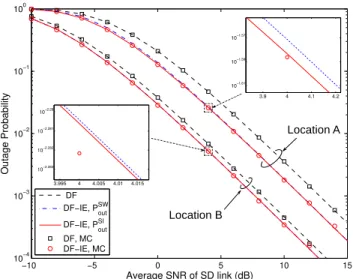
The outage curves of DF-IE, obtained using the analytical expressions of PoutSW and PoutSI, respectively, are shown in Fig. 6. Here, two different relay location scenarios are consid-ered: in Location A, d0= d1= d2; in Location B, d0= 14d1
0.1 0.2 0.3 0.4 0.5 0.6 0.7 0.8 0.9 10−3 10−2 10−1 x−coordinate of relay Outage Probability DF DF−IE, Pout SI DF, MC DF−IE, MC Γsd= 5dB Γsd= 1dB
Fig. 7. Outage probability versus the relay location, where Γsd= 1 dB and
Γsd= 5 dB.
and d2 = 34d1.5 From the figure we can see the difference
between PoutSW and PoutSI is roughly 0.01 dB in Location A, and 0.001 dB in Location B. This observation indicates PSW
out is an accurate approximation to the exact outage probability PSI
out. Moreover, it is found that PSI
out is always smaller than PoutSW, which is consistent with the theoretical analysis provided in Section V-B. As a reference, the outage probability of a conventional DF system [12], where the relay keeps silent in case of intra-link error is detected, is also provided in the same figure. As can be seen from the figure, DF-IE system can achieve better performance than the conventional DF system,6
which also agrees with the theoretical analysis. However, the performance gain obtained in Location B (≈ 0.6 dB) is smaller than that obtained in Location A (≈ 1.5 dB). This is because, in Location B, the quality of the intra-link is better than that in Location A, resulting in lower probability of the intra-link transmission failure. Note that the theoretical outage probabilities of the both DF-IE and conventional DF system are in excellent agreement with their corresponding simulation results, respectively.
The impact of the relay location on the outage probability of the both DF-IE and conventional DF systems is depicted in Fig. 7, where the average SNR of SD link is kept at Γsd= 1 dB and Γsd = 5 dB. Here, the position of R is assumed to vary along the line between S (x = 0) and D (x = 1). With the conventional DF relaying system, the lowest outage probability is achieved at a certain point (x≈ 0.43) between S and the midpoint. With DF-IE system, interestingly, we found that when the relay is located at the midpoint (x = 0.5), the lowest outage probability can be achieved. In general, the lowest outage probability can be achieved at a point where the contributions of both SR and RD links to outage are
5According to (5), the average SNR of L
sr and Lrd are Γsr = Γsd+
10 log10[(dsd/dsr)3.52] (dB) and Γrd = Γsd+ 10 log10[(dsd/drd)3.52]
(dB), respectively.
6Note that DF-IE system causes more complexity or energy consumption
than conventional DF system when the intra-link errors are detected. However, the increase in complexity or energy consumption over the conventional DF is negligible, especially in high SNR regime.
balanced. Since in conventional DF, the relay stops forwarding the information sequence when errors are found, the quality of the SR link has to be good enough, which results in the optimal position shifted more closer to the side of the source. In DF-IE system, the contributions of the two links to the outage probability are balanced because there is a chance that the errors occurring in the SR link can be corrected at the destination, and as a consequence, the optimal location is the midpoint.
VII. CONCLUSIONS
In this paper, the outage probability of DF-IE system was theoretically analyzed, where all the links between source, re-lay and destination are subject to independent block Rayleigh fading. The exact and approximated outage probabilities are derived from the viewpoint of the theorem for source coding
with side information and the Slepian-Wolf theorem,
respec-tively. The admissible rate region is determined by the theorem
for source coding with side information, and found to be
larger than that determined by the Slepian-Wolf theorem. The exact outage probability is lower than its approximation by the Slepian-Wolf theorem, however, the difference is negligible.
Compared with the conventional DF system, DF-IE can al-ways achieve better outage performance. The most significant finding of this paper is, with the DF-IE system, the optimal relay location is shifted to exactly the midpoint between the source and destination, where the contributions of the SR and RD links are balanced. The accuracy of the theoretical analysis has been verified through computer simulations. The analytical results presented in this paper provide a theoretical basis for designing cooperative networks where intra-link error is allowed. The extension of the analytical results to relay systems with multiple sources and/or multiple relays is straightforward. This is left as a future study.
APPENDIXA PROOF OFRSI ≥ RSW
According to (8) and (18), for a given p value,RSI ≥ RSW is equivalent to f1(x)≤ f2(x), where f1(x) = { Hb(p), for x≥ 1, Hb(α∗ p), for 0 ≤ x ≤ 1, (24) and f2(x) = Hb(p), for x≥ 1, 1 + Hb(p)− x, for Hb(p)≤ x ≤ 1, 1, for 0≤ x ≤ Hb(p), (25)
are the boundaries for the sets of the inequalities for RSI andRSW, respectively. It is obviously that f1(x) = f2(x) for
x≥ 1. For 0 ≤ x ≤ Hb(p), f1(x)≤ f2(x) since Hb(α∗p) ≤ 1 always holds. For Hb(p)≤ x ≤ 1, we can obtain x = R2=
1− Hb(α) according to (7). In this case,
f2(x)− f1(x) = 1 + Hb(p)− x − Hb(α∗ p) = Hb(α) + Hb(p)− Hb(α∗ p).
(26) To prove f2(x)−f1(x)≥ 0 for Hb(p)≤ x ≤ 1, we consider the joint entropy of two binary random variable X and Y ,
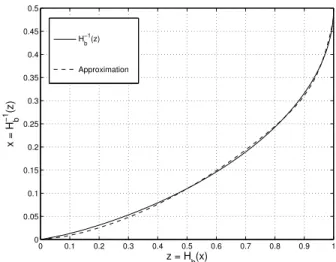
0 0.1 0.2 0.3 0.4 0.5 0.6 0.7 0.8 0.9 1 0 0.05 0.1 0.15 0.2 0.25 0.3 0.35 0.4 0.45 0.5 z = H b(x) x = H b − 1 (z) H b −1(z) Approximation
Fig. 8. The inverse entropy function and its approximation.
where X follows a Bernoulli distribution with parameter α, and Y is the observation of X over a BSC with a crossover probability p. The joint entropy of X and Y can be expressed as
H(X, Y ) = H(X) + H(Y|X)
= H(Y ) + H(X|Y ), (27)
where H(X) = Hb(α), H(Y ) = Hb(α∗ p) and H(Y |X) =
Hb(p). From (27), we get
H(X|Y ) = H(X) + H(Y |X) − H(Y )
= Hb(α) + Hb(p)− Hb(α∗ p)
≥ 0.
(28)
Hence, it can be concluded that f2(x)−f1(x)≥ 0 for Hb(p)≤
x≤ 1.
In summary, f1(x) ≤ f2(x) for x≥ 0, and RSI ≥ RSW has been proven.
APPENDIXB APPROXIMATION OFHb−1(·) The binary entropy function is defined as
Hb(x) = z =−x log2x− (1 − x) log2(1− x). (29)
For 0 ≤ x ≤ 0.5, Hb(x) is monotonically increasing and therefore has a unique inverse function
x = Hb−1(z). (30) However, it may not be possible to derive the explicit expres-sions of Hb−1(z), according to (29). By using a curve fitting technique [26], it can be well approximated by
Hb−1(z)≈ (2c1zc2− 2−c3zc4)c5, (31) with c1 = 0.6794, c2 = 0.7244, c3 = 0.1357, c4 = 21.8026
and c5= 1.9920. The numerically calculated Hb−1(z) and its approximated curves are shown in Fig. 8.
ACKNOWLEDGMENT
The authors would like to thank Mr. Pen-Shun Lu for stimulating discussions.
REFERENCES
[1] J. Laneman, D. N. C. Tse, and G. W. Wornell, “Cooperative diversity in wireless networks: Efficient protocols and outage behavior,” IEEE
Trans. Inf. Theory, vol. 50, no. 12, pp. 3062–3080, 2004.
[2] P. Liu, Z. Tao, Z. Lin, E. Erkip, and S. S. Panwar, “Cooperative wireless communications: a cross-layer approach,” IEEE Wireless Commun.
Mag., vol. 13, no. 4, pp. 84–92, 2006.
[3] K. Azarian, H. El Gamal, and P. Schniter, “On the achievable diversity-multiplexing tradeoff in half-duplex cooperative channels,”
IEEE Trans. Inf. Theory, vol. 51, no. 12, pp. 4152–4172, 2005.
[4] N. Prasad and M. Varanasi, “High performance static and dynamic cooperative communication protocols for the half duplex fading relay channel,” IEEE Trans. Wireless Commun., vol. 9, no. 1, pp. 328–337, 2010.
[5] A. Stefanov and E. Erkip, “Cooperative coding for wireless networks,”
IEEE Trans. Commun., vol. 52, no. 9, pp. 1470–1476, 2004.
[6] B. Zhao and M. C. Valenti, “Distributed turbo coded diversity for relay channel,” Electronics Letters, vol. 39, no. 10, pp. 786–787, 2003. [7] R. Youssef and A. Graell i Amat, “Distributed serially concatenated
codes for multi-source cooperative relay networks,” IEEE Trans.
Wire-less Commun., vol. 10, no. 1, pp. 253–263, 2011.
[8] D. Duyck, J. Boutros, and M. Moeneclaey, “Low-density parity-check coding for block fading relay channels,” in Information Theory
Workshop, 2009. ITW 2009. IEEE, 2009, pp. 248–252.
[9] Y. Li, G. Song, and L. Wang, “Design of joint network-low density parity check codes based on the exit charts,” IEEE Commun. Lett., vol. 13, no. 8, pp. 600–602, 2009.
[10] J. N. Laneman and G. W. Wornell, “Distributed space-time-coded protocols for exploiting cooperative diversity in wireless networks,”
IEEE Trans. Inf. Theory, vol. 49, no. 10, pp. 2415–2425, Oct. 2003.
[11] Y. Zhao, R. Adve, and T. J. Lim, “Outage probability at arbitrary SNR with cooperative diversity,” IEEE Commun. Lett., vol. 9, no. 8, pp. 700–702, 2005.
[12] N. C. Beaulieu and J. Hu, “A closed-form expression for the outage probability of decode-and-forward relaying in dissimilar Rayleigh fading channels,” IEEE Commun. Lett., vol. 10, no. 12, pp. 813–815, Dec. 2006.
[13] Y. Li, “Distributed coding for cooperative wireless networks: An overview and recent advances,” IEEE Commun. Mag., vol. 47, no. 8, pp. 71–77, 2009.
[14] D. Slepian and J. Wolf, “Noiseless coding of correlated information sources,” IEEE Trans. Inf. Theory, vol. 19, no. 4, pp. 471–480, July 1973.
[15] K. Anwar and T. Matsumoto, “Accumulator-assisted distributed Turbo codes for relay system exploiting source-relay correlations,” IEEE
Commun. Lett., vol. 16, no. 7, pp. 1114–1117, July 2012.
[16] J. Garcia-Frias and Y. Zhao, “Near-shannon/slepian-wolf performance for unknown correlated sources over AWGN channels,” IEEE Trans.
Commun., vol. 53, no. 4, pp. 555–559, Apr. 2005.
[17] M. Cheng, K. Anwar, and T. Matsumoto, “Outage probability of a relay strategy allowing intra-link errors utilizing Slepian-Wolf theorem,”
EURASIP J. on Advances in Signal Process., vol. 2013:34, 2013.
[18] X. Zhou, M. Cheng, X. He, K. Anwar, and T. Matsumoto, “Outage analysis of decode-and-forward relaying system allowing intra-link errors,” in Proc. 20th European Wireless Conf. (EW 2014), Barcelona, Spain, 14-16 May 2014.
[19] C. E. Shannon, “Coding theorems for a discrete source with a fidelity criterion,” in IRE Nat. Conv. Rec., Pt. 4, 1959, pp. 142–163.
[20] A. D. Wyner, “On source coding with side information at the decoder,”
IEEE Trans. Inf. Theory, vol. 21, no. 3, pp. 294–300, 1975.
[21] T. M. Cover and J. A. Thomas, Elements of Information theory 2nd
Edition. USA: John Wiley & Sons, Inc., 2006.
[22] M. Schwartz, W. R. Bennett, and S. Stein, “Communication systems and techniques,” IEEE Commun. Mag., vol. 34, no. 5, 1996.
[23] F. J. Vazquez-Araujo, O. Fresnedo, L. Castedo, and J. Garcia-Frias, “Analog joint source-channel coding over mimo channels,” Eurasip J.
on Wireless Commun. and Netw., vol. 2014:25, 2014.
[24] G.-C. Zhu and F. Alajaji, “Joint source-channel Turbo coding for binary markov sources,” IEEE Trans. Wireless Commun., vol. 5, no. 5, pp. 1065–1075, 2006.
[25] L. Shampine, “Matlab program for quadrature in 2D,” Applied
Mathematics and Computation, vol. 202, no. 1, pp. 266 – 274, 2008.
[26] J. C. Lagarias, J. A. Reeds, M. H. Wright, and P. E. Wright, “Conver-gence properties of the nelder-mead simplex method in low dimensions,”
SIAM Journal of Optimization, vol. 9, no. 1, pp. 112–147, 1998.
Xiaobo Zhou (S’11−M’13) recieved the B.Sc. in Electronic Information Science and Technology from University of Science and Technology of China (USTC), Hefei, China, in 2007, the M.E. in Computer Application Technology from Graduate University of Chinese Academy of Science (GU-CAS), Beijing, China, in 2010, and the Ph.D. degree from School of Information Science, Japan Ad-vanced Institute of Science and Technology (JAIST), Ishikawa, Japan, in 2013. From October 2013 to March 2014, he was a researcher with the School of Information Science, JAIST. Now he is with Department of Communications Engineering, University of Oulu, Finland as a researcher. His research interests include coding techniques, joint source-channel coding, cooperative wireless communications and network information theory.
Meng Chengreceived the B.Eng degree in telecom-munication engineering from Anhui University of Technology (AHUT), China, in 2009, the M.Sc in wireless communications with distinction from the University of Southampton, UK, in 2010, and the PhD degree in information science from Japan Ad-vanced Institute of Science and Technology (JAIST) in 2014. Now, he is working in JAIST as a re-searcher. His research interests are cooperative com-munications, iterative decoding algorithm and opti-mal power allocation strategies.
Xin He received the M.Sc in information science with best graduation award from Japan Advanced In-stitute of Science and Technology (JAIST) in 2013. He is now pursing his PhD degree both in School of Information Science, JAIST and Department of Communications Engineering, University of Oulu, Finland under dual doctoral degree program. His research interests are lossy distributed source coding problem, optimal coding/decoding design.
Tad Matsumoto(S’84−SM’95−F’10) received his B.S., M.S., and Ph.D. degrees from Keio Univer-sity, Yokohama, Japan, in 1978, 1980, and 1991, respectively, all in electrical engineering. He joined Nippon Telegraph and Telephone Corporation (NTT) in April 1980. Since he engaged in NTT, he was in-volved in a lot of research and development projects, all for mobile wireless communications systems. In July 1992, he transferred to NTT DoCoMo, where he researched Code-Division Multiple-Access tech-niques for Mobile Communication Systems. In April 1994, he transferred to NTT America, where he served as a Senior Technical Advisor of a joint project between NTT and NEXTEL Communications. In March 1996, he returned to NTT DoCoMo, where he served as a Head of the Radio Signal Processing Laboratory. In March 2002, he moved to University of Oulu, Finland, where he served as a Professor at Centre for Wireless Communications. In 2006, he served as a Visiting Professor at Ilmenau University of Technology, Ilmenau, Germany, funded by the German MERCATOR Visiting Professorship Program. In April 2007, he returned to Japan and since then he has been serving as a Professor at Japan Advanced Institute of Science and Technology (JAIST), while also keeping a part-time position at University of Oulu. Prof. Matsumoto has been appointed as a Finland Distinguished Professor for a period from January 2008 through December 2012, funded by the Finnish National Technology Agency (Tekes) and Finnish Academy, under which he preserves the rights to participate in and apply to European and Finnish national projects. Prof. Matsumoto is a recipient of IEEE VTS Outstanding Service Award (2001), Nokia Foundation Visiting Fellow Scholarship Award (2002), IEEE Japan Council Award for Distinguished Service to the Society (2006), IEEE Vehicular Technology Soci-ety James R. Evans Avant Garde Award (2006), and Thuringen State Research Award for Advanced Applied Science (2006), 2007 Best Paper Award of Institute of Electrical, Communication, and Information Engineers (IEICE) of Japan (2008), Telecom System Technology Award by the Telecommunications Advancement Foundation (2009), IEEE Communication Letters Exemplifying Reviewer Award (2011), UK Royal Academy of Engineering Distinguished Visiting Fellow Award (2012) and Nikkei Electronic Wireless Japan Awards (2013). He is serving as an IEEE Vehicular Technology Distinguished Lecturer since July 2011. He is a Fellow of IEEE and a member of IEICE.