Gravity Waves Observed
in
a
High-Resolution
GCM
Simulation
ByKaoru Sato
Department of Geophysics, Faculty ofScience, KyotoUniversity ToshiroKumakura
Department of CiviI andEnvironmentalEngineering, Nagaoka University of Technology and
Masaaki Takahashi
Center for ClimateSystemResearch,University of Tokyo
1
Introduction
Alot ofefforts havebeenmade toelucidategravity
wave
characteristics in the real atmosphere using various observational data. However,observational stationsare
notuniformly distributedon
the earth and usuallywe
cannotobtain all physical quantities from observations whichare
needed forthe analysis. Thus,
we use a
GCM with high resolution both in the horizontal and vertical directionstoexamine global characteristics ofgravitywaves
in the lower stratosphere.2
Model Experiments
Themodel usedis the first version of the atmospheric general circulation model (GCM)which
was
developedatthe Center forClimateSystem$\mathrm{R}\mathrm{e}\mathrm{s}\mathrm{e}\mathrm{a}\mathrm{r}\mathrm{c}\mathrm{h}/\mathrm{N}\mathrm{a}\mathrm{t}\mathrm{i}_{0}\mathrm{n}\mathrm{a}1$Institute for EnvironmentalStudies $(\mathrm{C}\mathrm{C}\mathrm{S}\mathrm{R}/\mathrm{N}\mathrm{I}\mathrm{E}\mathrm{S})$ (Numaguti, 1993; Numaguti etal., 1995; Nakajimaet al. (1995). The
horizontalresolution isT106, whichcorrespondsto
a
gridspacingof about120km. Thereare
53layers inthe vertical,havingabout600$\mathrm{m}$vertical resolution in theuppertroposphere and lower
stratosphere. This fine vertical gridspacingisnecessarytoresolvesmall vertical wavelengths of gravity
waves as
observed in the real atmosphere. The top level of the model is locatedatabout0.5
$\mathrm{h}\mathrm{P}\mathrm{a}$. The moist convective adjustment scheme is usedas
the cumulus parameterizationin this experiment following Takahashi (1996) who successfully obtained realistic QBO in
a
GCM.Thebottom boundary condition is that of
an
aqua-planet. Values of SST climatology in Februaryare
given independent of longitude and time(perpetual February). The otherprocessesandschemes
are
almost thesame as
thoseinthestandard GCMexperiments. As for thestart-uplun,
a
horizontal resolution T21,53
layers $(\mathrm{T}21\mathrm{L}53)$ model of thesame
boundary conditionwas
integrated withan
initial condition ofan
isothermal atmosphere at restover
120 model daysto obtaina
quasi-steady state. Thefinal day of$\mathrm{T}21\mathrm{L}53$ model simulationwas
usedas
theinitial condition of the$\mathrm{T}\mathrm{l}06\mathrm{L}53$ model. The$\mathrm{T}\mathrm{l}06\mathrm{L}53$ model
was
run
for80
days and obtaineda
quasi-steady state. The data of final 20 days ata
time interval of 1 hourwere
used forthe analysis of gravitywave
activities. To avoid aliasing from fluctuationswithhigher frequencies, values averagedover one
hourare
used. Asa
resultwe
obtaineda
realisticmean
zonal windfield. The$\mathrm{s}\mathrm{u}\mathrm{b}\mathrm{t}\mathrm{r}_{1}\mathrm{o}-\mathrm{p}\mathrm{i}_{\mathrm{C}}\mathrm{a}1$ westerlyjet is situated around
$32\mathrm{N}$and$45\mathrm{S}$,withpeak values larger than
40and30$\mathrm{m}\mathrm{s}$ ,respectively. The polar nightjet and subtropicaljet
are
clearly separated in thenorthernhemisphere. The tropopause heights
are
alsorealistic;15-16
kmin the tropicalregionand about9-10kmin the middle and high-latitude regions.
3
Comparison With
MST
Radar
Observations
To
see
how realistic the gravitywave
field simulated in this model is,we
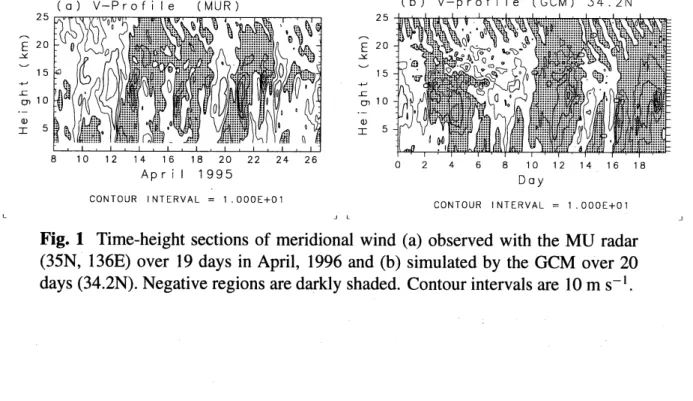
made comparisonwith observation data. Figure lashows
a
time-height sectionof meridional winds (v) obtained througha
special long-term(19days)continuous observation with the MU (Middleand Upperatmosphere)radarwhichis
an
MST radarlocatedatShigaraki, Japan$(35\mathrm{N}, 136\mathrm{E})$.
See Fukaoet $\mathrm{a}1.(1985)$for details of the MU radar. Clear downwardpropagatingphasestructureisobservedin the heightregionof
19-25
km(seecontoursof$0$or
10$\mathrm{m}\mathrm{s}^{-1}$),where the zonalmean
windisvery weak. Thevertical wavelength and
wave
periodare
about3.5
km and 20$\mathrm{h}$,respectively. Satoetal. (1997) made detailedanalysis and showed that the
wave
structure is due to inertia-gravitywaves
witha
horizontal wavelength of about 1200 km propagating westward witha
phase speed of about 10$\mathrm{m}\mathrm{s}^{-1}$. The vertical and horizontal wavelengths
are
sufficiently large tobe resolvedin
our
high-resolution model.Figure lb shows
a
time-heightsection of simulated$v$ atthelatitude of34.$2\mathrm{N}$over
20days.The tickmarks
on
theright indicate the locations of vertical grids in the model. The tilt ofzero
contours of the simulated $v$ (e.g., Day 10 and Day 16) is similarto that ofradar observation
(e.g., 12 and20April), indicating that simulated baroclinic
waves
are
realistic. Mostimportantis the feature that gravity
wave
structure having vertical wavelength andwave
period similar to observation isseen
in lower stratosphere in the model data. Comparison ofpowerspectra indicates that the amplitude of simulated gravitywaves
accords with observation. This good$\mathrm{a}\mathrm{g}\mathrm{r}\mathrm{e}\mathrm{e}\mathrm{m}\mathrm{e}\ulcorner \mathrm{n}\mathrm{t}$ withobservationssuggeststhat the
$\mathrm{g}\mathrm{r}\mathrm{a}\urcorner\ulcorner$vity
wave
field inour
modelis fairly realistic. $\neg$CONTOUR }$\mathrm{N}\mathrm{T}\mathrm{E}$RVA$\llcorner$ $=$ 1 000$\mathrm{E}+01$
CONTOUR I$\mathrm{N}\mathrm{T}\mathrm{E}$RVA$\mathrm{L}$ $=$ 1 000$\mathrm{E}+01$
Fig. 1 Time-height sections of meridional wind (a) observed with the MU radar
$(35\mathrm{N}, 136\mathrm{E})$
over 19
days in April,1996
and (b) simulatedby the GCMover
204 Stati
$s$tical
Characteristics
of
Gravity Waves
Since there is
no
longitudinal dependence of boundary condition inthe presentmodel,thestatis-tical characteristicsofgravity
waves
mustbe independent of longitude. Thus, inthe followingsections
we
analyzetime seriesofeight longitudes with thesame
longitudinalinterval$(45^{\mathrm{o}})$ andexaminethe
average as
thestatisticsof the model.4.1
Spectral
characteristics
as a
function
of latitude
Frequencypowerspectra
were
calculatedateach of eight longitudesas
a
function of latitude$(\phi)$andheight$(z)$, andthe
average
ofeightspectrawas
obtained. The spectrawere
further averagedfor the the heightregionsof
22-27
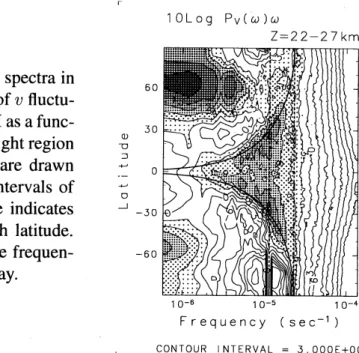
km with fine vertical resolution. Aresultfor$v$ is shown inFig. 2. Thick solid
curves
indicate the inertial frequencyateach latitude and red dashedcurves
indicate the periods of
one
day anda
half day.Large values
are
distributed at higher frequency regions bordered with thecurve
of the inertial frequency. This is consistentwith the theory of internal gravitywaves
that theirwave
frequencies should be higher than the inertial frequency. An interesting featureis that isolated peaks
are
observed around the inertial frequencyateach latitudeexceptaround theequator. The spectra aroundtheequatorwhere the inertial frequency becomeszero
are
widely distributed andno
particular peaksare
observed.Fig. 2 Frequency
power
spectra in theenergy-contentformof$v$fluctu-ationssimulated by GCM
as a
func-tionoflatitude for the height region of $22-27\mathrm{k}\mathrm{m}$.
Contoursare
drawnfor $10\log P(v\omega)\omega$ with intervals of
$3\mathrm{d}\mathrm{B}$
.
A thick solidcurve
indicatesinertial frequency at each latitude. Two dashed lines indicate frequen-cies of 1 day and
a
half day.$\mathrm{F}\ulcorner \mathrm{e}\mathrm{q}_{\mathrm{U}\mathrm{e}}\mathrm{n}\mathrm{c}\mathrm{y}$ $(\mathrm{s}\mathrm{e}\mathrm{c}-))$
CON$\mathrm{T}$OU$\mathrm{R}$ I$\mathrm{N}\mathrm{T}\mathrm{E}\mathrm{R}$VA$\mathrm{L}$ $=$ $3$ $000\mathrm{E}+\mathrm{o}\mathrm{o}$
4.2
$\mathrm{G}\mathrm{l}\mathrm{o}\mathrm{b}\mathrm{a}\mathrm{l}\mathrm{e}\mathrm{n}\mathrm{e}\mathrm{r}\mathrm{g}\mathrm{y}\mathrm{d}\mathrm{i}S\mathrm{t}\Gamma \mathrm{i}\mathrm{b}\mathrm{u}\mathrm{t}\mathrm{i}\mathrm{o}\mathrm{n}\mathrm{a}\mathrm{n}\mathrm{d}\mathrm{m}\mathrm{e}\mathrm{r}\mathrm{i}\mathrm{d}\mathrm{i}_{\mathrm{o}\mathrm{n}}\mathrm{a}\mathrm{l}\mathrm{P}\Gamma \mathrm{o}\mathrm{p}\mathrm{a}\mathrm{g}\mathrm{a}\mathrm{t}\mathrm{i}\mathrm{o}\mathrm{n}\mathrm{o}\mathrm{f}\mathrm{g}\mathrm{r}\mathrm{a}\mathrm{v}\mathrm{i}\mathrm{t}\mathrm{y}_{\mathrm{W}}\mathrm{a}\mathrm{V}\mathrm{e}s$We made
energy
and momentum flux analysis for two kinds ofcomponents, whichare
fre-quently treatedas
gravitywaves
in observational studies: short-period ($<1$ day)waves
andhorizontal propagation of intemal gravity
waves.
Positive (negative) eastward(westward) propagation and positive (negative) $\overline{\prime\prime}$$vw$
means
northward (southward)
propaga-tion relative to the
mean
wind for gravitywaves
propagatingenergy
upward. The signsare
reversed for downward
energy
propagation. The verticalenergy
flux$\overline{p’w’}$, where$p$ isthe
pres-sure,indicates dominance of upwardenergy propagationin the lower stratosphere for bothtwo kinds ofgravity
wave
components.The distribution $\mathrm{o}\mathrm{f}\overline{u’w’}$showstheshort-period gravity
waves
propagate westward relativeto the
mean
wind (not shown). Interestingare
the characteristics $\mathrm{o}\mathrm{f}\overline{v^{\prime/}w}(\mathrm{F}\mathrm{i}\mathrm{g}.3\mathrm{a})$.
Negative(positive)values
are
observed in the southern(northern) hemisphere. Moreoverthe latitudinalexpanse
oflarge$vw$$\overline{\prime l}$isncrease as
altitude increases. The edge of the large$\overline{v^{\prime_{w’}}}$regionreachesthemid-latitude of$\phi=50^{0}\mathrm{a}\iota Z=27$km. This$\mathrm{V}$-shaped distribution suggeststhatgravity
waves
are
generated in the equatorialregion andpropagate poleward in both hemispheres.The
energy
andmomentumflux features of small vertical-scalewaves are
similarto thoseof short period
waves: wave
energy is maximized around the equator; thewaves
propagate westward relative to themean
wind. Howeverthereare a
few remarkable differences. Figure$3\mathrm{b}$shows latitude-height sections$\mathrm{o}\mathrm{f}\overline{v’ w’}$for small vertical-scale
waves.
Itis noted that negative(positive) values $\mathrm{o}\mathrm{f}\overline{v’ w^{J}}$above thesubtropical jet in the northem (southem) hemisphere. This
means
equatorward propagation ofgravitywaves
and is consistent with observations (Sato,1994). This feature isnot
seen
for short-periodwaves.
Thus small vertical-scalewaves
prop-agating equatorward above the subtropical jethave
wave
periods longerthan 1 day. The$\overline{v’w’}$profile in the equatorial region suggests the dominance of polewardpropagationfrom the
equa-tor,similarto short-periodwaves,but themagnitude is smaller. Thusshort-period
waves
prop-agatingpoleward have vertical wavelengths longer than5 km.
A westwardforcecalculatedfrom theEliassen-Palmflux due togravity
waves was
5$\mathrm{m}\mathrm{s}^{-11}\mathrm{m}\mathrm{o}\mathrm{n}\mathrm{t}\mathrm{h}^{-}$atthemaximum in the
upper
part ofthesubtropical westerly jetaround $30\mathrm{N}$, whichis smallerby
one
order of magnitude compared with the drag duetotopographically forced gravitywaves
(e.g. Palmeretal., 1986; $\mathrm{M}\mathrm{c}\mathrm{F}\mathrm{a}\mathrm{r}\mathrm{l}\mathrm{a}\mathrm{n}\mathrm{e}$, 1987).
5
Concluding
Remark
$s$With the aid of
a
high-resolution GCM $(\mathrm{T}106\mathrm{L}53)$, global distribution and characteristics ofgravity
waves were
examined. By using subsets outofthe huge amount of data obtained with this high-resolution GCM simulation like observational data, further interesting analyses arepossible: three dimensional structure of gravity
waves
having near-inertial frequency in the stratosphere; the generation and interaction with synoptic-scale baroclinicwaves
of gravitywaves
thatare dominant above thesubtropical jet; and thepossible role of small-scalegravitywaves on
the QBO in the equatorial stratosphere. However, it isa
matter of course, andwe
CONTOUR I NT$\mathrm{E}$RVA$\mathrm{L}$ $=$ $2$ 000 E-03 CON$\mathrm{T}$OUR I NT$\mathrm{E}$RVA$\mathrm{L}$ $=$ $2$ 000 E-03
Fig.
3
Latitude-height sections of vertical fluxes of meridionalmomentum$(v’w)\overline{/}$for(a)short-periodgravity
waves
and(b)small vertical-scalewaves.
Contour intervalsare 0.002
$\mathrm{m}^{2}\mathrm{s}^{-2}$.
Negative regionsare
shaded.Acknowledgment
This study
was
supportedby Centerfor Climate System Research ofthe University of Tokyo, partly bya
Grant-in-AidforScientific Research(A)(2)08404026 $(\mathrm{K}\mathrm{S})$and(B)06452083
$(\mathrm{M}\mathrm{T})$of the Ministry ofEducation, Science and Culture, Japan, and by Intemational Cooperative Study of Stratospheric Change and itsRolein ClimatefromtheScienceandTechnology Agency of Japan $(\mathrm{T}\mathrm{K})$. A part of calculation of the low resolution model
was
made by KDK (Kyotodaigaku Denpakagaku Keisanki-jikken souchi) Radio Atmospheric Science Center (RASC)
of Kyoto University. The MU radar belongsto and is operated by RASC of Kyoto University. GFD-DENNOU library
were
used for drawing figures. Thispaper
was submitted to J. Atmos. Sci.REFERENCES
1. Fukao, S., T. Sato,T. Tsuda, S.Kato, K. Wakasugi and T.Makihira, 1985:RadioSci., 20,
1155-1168.
2. McFarlane, N.A., 1987: J. Atmos. Sci., 44,
1775-1880.
3. Nakajima, T., M. Tsukamoto, Y. Tsusima, and A. Numaguti,
1995:
Studiesof
global environmentchange with specialreference
toAsiaandPacific
regions, I-3, 104-123. 4. Numaguti, A.,M. Takahashi,T. Nakajima, and A. Sumi,1995:
ibid, I-3, 1-27.5.
Numaguti,A.,1993:
J. Atmos. Sci., 50,1874-1887.
6.
Palmer, T.N., G.J. Shutts, and R. Swinbank,1986:
Quart. J. Roy. Met. Soc., 112,1001-1040.
7. Sato, K.,
1994:
J. Atmos. Terr. Phys., 56,755-774.
8. Sato, K., D. J. O’Sullivan and T. J. Dunkerton, 1997: Geophys. Res. Lett., 24,
1739-1742.