An
application
of
Draghicescu’s
fast
summation
method
to vortex
sheet
motion
Takashi
SAKAJO
and Hisashi
OKAMOTO
Research Institute for Mathematical
Sciences
Kyoto University, Kyoto,
606-01
Japan
September 2,
1996
Abstract
The fast summation method of Draghicescu is appliedto computationof$2\mathrm{D}$ vortex
sheet motions. In the present paper we report our numerical experimentswhich show
the effectiveness as well as difficulties of Draghicescu’s fast summation method in $2\mathrm{D}$
vortex-sheet computations. For instance, the fast summation method is nearly five
times faster than the direct summation method when we use 16,$384=2^{14}$ vortex
blobs. On the other hand, if it is used together with the Fourier filter, the method is
found to be sensitive tothe filter threshold.
1
Introduction
We perform some numerical experiment on Draghicescu’s fast summation method. It is
appliedto acomputationof$2\mathrm{D}$ vortex sheetmotion. Ouraim is to compare the performance
of the fast summation with that of the direct summation.
What we consider is the Birkhoff-Rott equation with periodic boundary condition $($
Krasny $[6, 7])$. Namely,
we
consider the following equation:$\frac{\partial z(t,\mathrm{r})*}{\partial t}=\frac{1}{2_{\dot{i}}}\mathrm{p}.\mathrm{v}.\int_{0}^{1}\cot\pi(Z(t, \mathrm{r})-z(t, \mathrm{r}’))d\Gamma’$ , (1)
where $t$ represents time, the integral is Cauchy’s principal value, $\dot{i}=\sqrt{-1},$ $\mathrm{a}\mathrm{n}\mathrm{d}*\mathrm{i}\mathrm{m}\mathrm{p}\mathrm{l}\mathrm{i}\mathrm{e}\mathrm{s}$ the
complex conjugate.
The vortex sheet is represented by the
curve
$z(t, \Gamma)=x(t, \Gamma)+\dot{i}y(t, \Gamma)$ with $\Gamma$ beingtaken along the
curve.
$\Gamma$ is called the circulation parameter. The physical space is filledwith an inviscid incompressible fluid, whose motion is irrotational everywhere except on a
Birkhoff-Rott equation, see [6, 7, 9].
Krasny $[6, 7]$ solved (1) with Chorin’s vortex blob approximation and the Fourier filter.
In the present paper,
we
add another technique, Draghicescu’s fast summation method, toKrasny’s method. We then compare the performances. In the
course
of our study, wefound that Draghicescu’s method directly applied to the equation (1) has some difficulty in
programming. The difficulty, whichwe will explain in section 3, can be reduced ifwe put
$w=\exp(2_{T\dot{i}Z})$
and if (1) is rewritten as
$\frac{\partial w(t,\mathrm{r})^{*}}{\partial t}=-\pi\dot{i}w^{*}\mathrm{P}^{\mathrm{V}.\int_{0}^{1}}.\frac{w(\Gamma,t)+w(\Gamma/,t)}{w(\Gamma,t)-w(\mathrm{r}’,t)}d\Gamma’$. (2)
The
reason
why this equation has advantageover
(1) will be given in section 3.Thepresentpaper consists of five sections. In section 2, weexplainthe numerical method.
In section 3, wereport what we obtained in ournumerical experiments. Herewe focusonthe
computational $\mathrm{a}\mathrm{d}\mathrm{V}\mathrm{a}\mathrm{n}\mathrm{t}\mathrm{a}\mathrm{g}\mathrm{e}/\mathrm{d}\mathrm{i}_{\mathrm{S}}\mathrm{a}\mathrm{d}_{\mathrm{V}\mathrm{a}\mathrm{n}\mathrm{t}\mathrm{a}}\mathrm{g}\mathrm{e}$ of the method. Section 4 is devoted to
phenomeno-logical description of the sheet. The relation between the fast summation and Fourier filter
is discussed in section 5. Concluding remarks are presented in section 6.
2
$\delta$Equation and
Discretization
In the computation, we use a smoothedversion of (2). Namely, wefollow Krasny’s idea ([7])
of desingularization. Specifically, we consider
$\frac{\partial w(t,\mathrm{r})^{*}}{\partial t}=\int_{0}^{1}K_{\delta}(w(t, \mathrm{r}),$ $w(t, \Gamma/))d\mathrm{r}’$.
(3) where
$K_{\delta}(w, v)=- \pi iw\frac{(w+v)(w^{*}-v^{*})}{|w-v|^{2}+\delta^{2}}*$.
Note that the equation (3) reduces to (2) when $\delta=0$. We solve (3) with
some
initialcondition, $w(\mathrm{O}, \Gamma)$.
The equation (1) is known to be ill-posed (see, e.g., Caflisch et al. [1]). The smoothed
version (3) is, however, well-posed for any time interval if$\delta>0$. The high frequency modes
are
stabilized, see for instance [7].We discretize (3) by the point vortices. Choosing a positive integer $N$, we consider the
following system of ordinary differential equations:
with the following initial condition:
$w_{n}(0)= \exp(\frac{2\pi\dot{i}n}{N}-\pi+2\pi i\epsilon(1-\dot{i})\sin(\frac{2\pi in}{N}))$ $(n=1,2, \cdots, N)$. (5)
Here $\epsilon$ is a constant, which we fix to $\epsilon=0.01$.
This initial date is a rescaled function from
the one considered in Krasny [7]. The
reason
of rescaling is that after transformation, vortexsheet is contained in the square-0.5 $\leq x,$$y\leq 0.5$ in C.
When
we
get $\{w_{n}(t)\}_{1}\leq n\leq N$, which approximate the vortex sheet at time $t$, we integrate(4) to obtain $\{w_{n}(t+\triangle t)\}1\leq n\leq N$. A fourth order Runge-Kutta method is used to integrate
(4).
Now it is immediately noticed that the summation in the right hand side of (4)
consumes
considerableCPUtime when$N$is large: in order tocompute$u_{n}(t)$ for all$n$, it takes$O(N\cross N)$
multiplications if it is directly computed. Greengard and Rokhlin [4] devised an algorithm
which computes the the right hand side of (4) for all $n$ with $O(N)$ numbers (not $O(N^{2})$
$)$ of operations of
$\mathrm{m}\mathrm{u}\mathrm{l}\mathrm{t}\mathrm{i}\mathrm{p}\mathrm{l}\mathrm{i}\mathrm{c}\mathrm{a}\mathrm{t}\mathrm{i}\mathrm{o}\mathrm{n}/\mathrm{d}\mathrm{i}\mathrm{v}\mathrm{i}_{\mathrm{S}}\mathrm{i}_{\mathrm{o}\mathrm{n}}$. Its efficiency and limitation are studied well now
(see, e.g., Hamilton and Majda [5]). Later, other fast summation methods
are
proposed(see Introduction of [3]). Among them, Draghicescu [2] proposes a fast summation method,
which we are going to
use
in this paper. Thereason
we chose Draghicescu’s method is thatthe method can be applied to rather wide class of integral kernels. Also, the method
seems
to be easier to make astructured program. Our objective in this paper is to give anumerical
experiment which demonstrate the usefulness of the algorithm.
Although [2] and [3] present convincing experiments,
we
think that twoissueshave escapedfrom the analysis of these papers. One is the periodic boundary condition and the other is
the Fourier filter. Our experiments pay attention to these items, too.
Let us now briefly explain Draghicescu’s algorithm. This method provides us with a
velocity field with $O(N(\log N)^{3})$ operations. However, it has a drawback: the velocity fields
are computed only approximately. Namely, we can enjoy the fast summation only ifwe can
tolerate the truncation
error
committedby the algorithm.Consider
a
fixed $w_{n}$.
Then $\{w_{m}\}_{1\leq m}\leq N$are
divided into two subsets: far field andnear
field. Far field is the set of those points whose distance from $w_{n}$ are greater than a $\mathrm{c}\mathrm{e}\mathrm{r}\mathrm{t}\mathrm{a}\mathrm{i}\mathrm{n}\vee$
constant. Near field is the set of those points not belonging to far field. We compute
$\sum$ $K_{\delta}(w_{n},$$w_{m})$
$w_{m}\in \mathrm{n}\mathrm{e}\mathrm{a}\mathrm{r}$field
directly. The region of far field is divided into rectangles, which are set up in advance. Then
$K_{\delta}(w_{n}, w_{m})$ for a $w_{m}$ in far field is approximated by replacing $w_{m}$ with the center of the
rectangle containing $w_{m}$. Then $K_{\delta}$ is approximated byits Taylor expansion about the center.
This procedurecontains twoparameters. One is theorder of the Taylor polynomial which
we shall write by A. The other is the distance parameter which distinguishes far field and
nearfield.
In order to explain the distance parameter, webriefly recall definitions in [2]. We
assume
$h=2^{-l’}$. An $h\cross h$ mesh square is called
a
cell. The set $\sigma$ of all admissible collections is$\sigma=\sigma_{0}\cup\sigma_{1}\cup\cdots\cup\sigma_{l}$,
where $\sigma_{k}$ is a set of pairwise disjoint admissible collections of level $k$ defined recursively
as
follows: If$k=0$ at level $0$, each collection consists ofa single cell.
$\sigma_{0}=\{[(i-1)h,\dot{i}h]\cross[(j-1)h,jh] ; \dot{i},j=1, \cdots, 2^{l’}\}$.
If$k\geq 1$, an admissible collection at level $k$ is obtained byjoiningtogethertwo adjacent level
$k-1$ admissible collections such that each level $k-1$ collection is included in exactly one
level $k$ collection. The joining is along a vertical if $k$ is even and along
a
horizontal if $k$ isodd. More precisely, for $k=2k’$:
$\sigma_{k}=\{[2^{k’}(\dot{i}-1)h, 2^{k’}\dot{i}h]\cross[2^{k’}(j-1)h, 2k’jh] ; \dot{i},j=1, \cdots , 2^{l’-k’}\}$
and for $k=2k’-1$:
$\sigma_{k}=\{[2^{k}(\dot{i}l-1)h, 2^{k’}\dot{i}h]\cross[2^{k’+1}(j-1)h, 2^{k+}1jh]’ ; \dot{i}=1, \cdots, 2^{l’k}-’,j=1, \cdots, 2^{l’k’}--1\}$
The only admissible collection at level $l$ is S.
Let $\tau$ be an arbitrary admissible collection. Define the radius of$\tau$ with center $y_{\tau}$ as
$\rho(\mathcal{T})=\sup\{|y-y_{\Gamma}J| : y\in\tau\}$.
For
a
fixed $x\in \mathrm{S}$ and a positive parameter$\nu,$ $F(x)$ is defined as the set of all collections of
$\tau$ with center $y_{\mathcal{T}}$ such that the following holds
$\rho(\tau)\leq h\nu|_{X}-y\tau|$,
and $\tau$ is maximal, i.e., it is not strictly included in any other collection satisfying this
con-dition. Then
we
define far fieldas
$\cup F(x)$. The parameter $\nu>0$ is determined in orderto obtain the smallest possible number of operations while preserving the desired order of
accuracy. In
our
computation below,we
set $\nu=0.245$ in all the experiments. We definea
near field $\mathrm{N}(\mathrm{x})$ as $\mathrm{S}\backslash \mathrm{F}(\mathrm{x})$. For more details, see [2].
3
Numerical Experiments
Since our objective is to show the effectiveness of Draghicescu’s algorithm and our change
of variables from $z$ to $w$,
our
experiments are limited to what are illustrative to numerical3.1
The property of
Draghicescu’s
fast
summation
In order to show quantitatively the effectiveness of Draghicescu’s algorithm, we make some
definitions. In this section,
we
define execution timeas
the time to evaluate the right handside of (4) at all $w_{n}$. Evaluation
error
$e_{vec}$ is definedas
$e_{vec}-- \max 1\leq n\leq N|u_{n}^{fast}(t)-u_{n}(direCtt)|$,
where$u_{n}^{fast}(t)$ and $u_{n}^{direct}(t)$ are the velocity vectors at the position of n-th vortex blob
evalu-ated by the fast and direct summations, respectively. We define the word “efficiency” as the
reduction rate of execution time:
efficiency $( \%)=\frac{\mathrm{t}\mathrm{h}\mathrm{e}\mathrm{e}\mathrm{x}\mathrm{e}\mathrm{c}\mathrm{u}\mathrm{t}\mathrm{i}\mathrm{o}\mathrm{n}\mathrm{t}\mathrm{i}\mathrm{m}\mathrm{e}\mathrm{b}\mathrm{y}\mathrm{f}\mathrm{a}\mathrm{s}\mathrm{t}\mathrm{s}\mathrm{u}\mathrm{m}\mathrm{m}\mathrm{a}\mathrm{t}\mathrm{i}\mathrm{o}\mathrm{n}}{\mathrm{t}\mathrm{h}\mathrm{e}\mathrm{e}\mathrm{x}\mathrm{e}\mathrm{c}\mathrm{u}\mathrm{t}\mathrm{i}\mathrm{o}\mathrm{n}\mathrm{t}\mathrm{i}\mathrm{m}\mathrm{e}\mathrm{b}\mathrm{y}\mathrm{d}\mathrm{i}\mathrm{r}\mathrm{e}\mathrm{c}\mathrm{t}_{\mathrm{S}\mathrm{u}}\mathrm{m}\mathrm{m}\mathrm{a}\mathrm{t}\mathrm{i}_{\mathrm{o}\mathrm{n}}}\cross 100$
If efficiency is less than
100%,
this fast algorithm is effective. The parameterswe
can changeare the number of vortex $\mathrm{b}1_{0}\mathrm{b}_{\mathrm{S}}(N)$, the amplitude of disturbance$(\epsilon)$, the desingularization
parameter$(\delta)$, and approximation order of Taylor expansion of integral kernel(A). $\epsilon$ is fixed
to 0.01 in this paper. The following experiments
are
concerned with (4). Theyare
performedwith double precision on Hewlett-Packard workstation J210. We discretize (4) by the fourth
order Runge Kutta method and compute the elapsed time needed to go one step forward
(i.e., from from $t=0$ to $t=\triangle t$ ). $\triangle t$ is 0.01. “time” in each table
means
CPU time byseconds.
1. approximation order (A):
Table 1 shows the execution time and error $e_{vec}$ with various approximation orders
of Taylor expansion of integral kernel. A is varied from 4 to 14. We make other
numericalparametersfixed; $N=4096$ and $\delta=0.01$. Itis obvious that the higher-order
approximation makes
error
small. However, it takesmore
time to evaluate the vectorfield
as
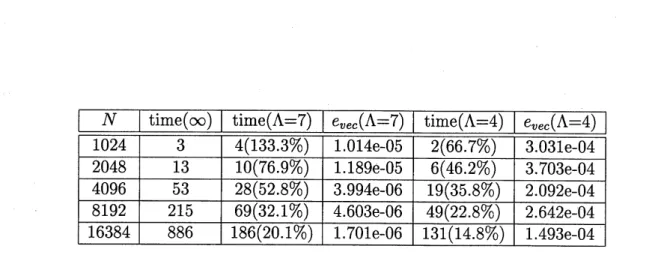
A grows. IfA is greater than 11, efficiency exceeds 100.0%.2. number of vortex blobs $(N)$:
Table 2 shows the execution time and $e_{vec}$ for various numbers of vortex blobs. We
execute numerical computation with two
cases:
$\Lambda=7$ and $\Lambda=4$. $\delta$ is fixed to 0.01.If
errors
of order $10^{-6}$ are tolerated, when $\Lambda=7,$$N=2^{14}$ yieldsa
five times fastercomputation.
3. desingularization parameter $(\delta)$:
Table3 shows evaluation
errors
withvarying$\delta$. Twocases are
considered:(l) $N=4096$and $\Lambda=8,$ (2) $N=16384$ and $\Lambda=8$
.
As $\delta$ increases, error gets smaller.In order to make accurate computations, we need higher-order approximation. However,
since efficiency is reduced when $N$ is small, approximation order is restricted by the number
of vortex blobs. The
more
vortex blobs make accurate and effective computation possible.From these results, we can conclude that this fast summation method is very effective when
$N$ and $\delta$ is large. These are already known in $[2, 3]$. However,
our
experiments seems to beA time efficiency $e_{vec}$
$\ovalbox{\tt\small REJECT}_{1}^{4}1\infty 53000\%- 7470131361255110983228528\% 3994516\mathrm{e}066252149433761249351110_{70\% 25\mathrm{e}}928160453198\% 3038494\mathrm{e}-0^{6}7963215\% 3319052\mathrm{e}-0_{9}^{7}4\% 1265061\% 1135958\mathrm{e}- 02\% 2046922\mathrm{e}_{09}8\% 20928\% 2562842\mathrm{e}- 0\% 389558\mathrm{o}^{\mathrm{e}}\mathrm{e}-05\% 241796060607626- 044\mathrm{e}- \mathrm{e}- 0--050_{8}8$
Table 1: Execution time and evaluation
error
with various approximation order of Taylorexpansion A. $N=4096$ and $\delta=0.01$. $\infty$ means CPU time by direct summation. Efficiency
is lost, if $\Lambda\geq 12,$
.
$N$ time$(\infty)$ time$(\Lambda=7)$ $e_{vec}(\Lambda=7)$ time$(\Lambda=4)$ $e_{vec}(\Lambda=4)$
$\ovalbox{\tt\small REJECT}_{8}^{102}16384886186(201\%)1701\mathrm{e}-06131(40965328(528\%)3994\mathrm{e}- 06193582019424821513346109(32(1333\%)1014\mathrm{e}-052(667\%\%(769\%)1189\mathrm{e}- 056(46281\%)4603\mathrm{e}-0649(228\%)\% 370_{2}^{1}3\mathrm{e}- 04)2642\mathrm{e}-0(14\%)14\mathrm{e}044)30_{93-})209\mathrm{e}- 043\mathrm{e}- 04$
Table 2: Execution time and
error
when the number of vortex blobs $N$ is varied. $\Lambda=7$ and4. $\delta=0.01$. $\mathrm{T}\mathrm{i}\mathrm{m}\mathrm{e}(\infty)$ is execution time using direct summation. Large number of vortex
$\delta$
$e_{vec}(N=4096)$ $e_{vec}(N=16384)$
$\ovalbox{\tt\small REJECT}_{2420_{9}}^{00}0104123106\mathrm{e}-01414214\mathrm{e}-- \mathrm{o}\mathrm{o}\mathrm{o}0004300_{6166}829185712078623\mathrm{e}-6065064376281271\mathrm{e}- 083\mathrm{e}-\mathrm{e}-\mathrm{e}- 06571300777392612488\mathrm{e}-0_{8}97626379870_{12\mathrm{e}}51298\mathrm{e}-07715\mathrm{e}07\mathrm{e}-\mathrm{o}- 08097$
Table 3: The relation between evaluation error $e_{ve\mathrm{c}}$ and desingularization parameter $\delta$. Two
combinations ofparameters; (1) $(\Lambda, N)=(8, 4096)$, and $(\Lambda, N)=(8, 16384)$
are
tested.3.2
The
effect of changing variable
It is natural to ask if
we
need to change variables from $z$ to $w$. To show the effectivenessof the change, we apply the fast summation algorithm to the discrete version to the original
equation (1), too.
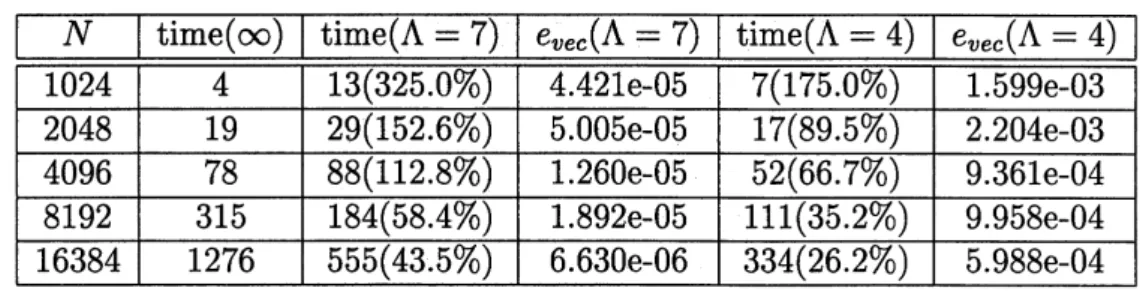
Table 4 is the list of execution time and
error
with various number of vortex blobs. $\Lambda=7$and $\Lambda=4$
are
tested. $\delta$is fixed to 0.01. Timestep size for Runge-Kuttamethod, $\triangle t$, is 0.01.
For small $N’ \mathrm{s}$, there is no advantage in using fast summation because of loss of efficiency.
If we compare Table 4 with Table 2, we
see
that the efficiency of Draghicescu’s algorithmis improved very much by changing variables. One
reason
for this is as follows: Because ofperiodic boundary condition, two points which are located at each edge of computational
domain ( ${\rm Re}[z]=0$ and ${\rm Re}[z]=1$ must be judged as those in near field. Some points which
were included in far field if it
were
not for the periodic boundary condition, are regarded asthose in near field. Consequently, number of points in nearfield increase, which is the reason
why it takes much time to evaluate the velocity field in original equation.
In addition to the
reason
above, there is another advantage of (2)over
(1). In orderto approximate the vector field accurately
we
have to obtain higher order Taylor expansionof the integral kernel. However, it is difficult to get higher order Taylor coefficients of the
integral kernel of (1), since it involves complicated combinations of trigonometric functions.
Even if we can obtain higher order Taylor coefficients, say, by
some
computer manipulation,it
consumes
CPU time because ofverymany trigonometric function calls. Onthe otherhand,we can easily obtain higher order coefficients of integral kernel of (2). Note that they are
rationalfunctions. Therefore, changing variable from $z$to$w$ makes it possibleto approximate
the kernel with little pain.
4
The
motion
of transformed
vortex
sheet
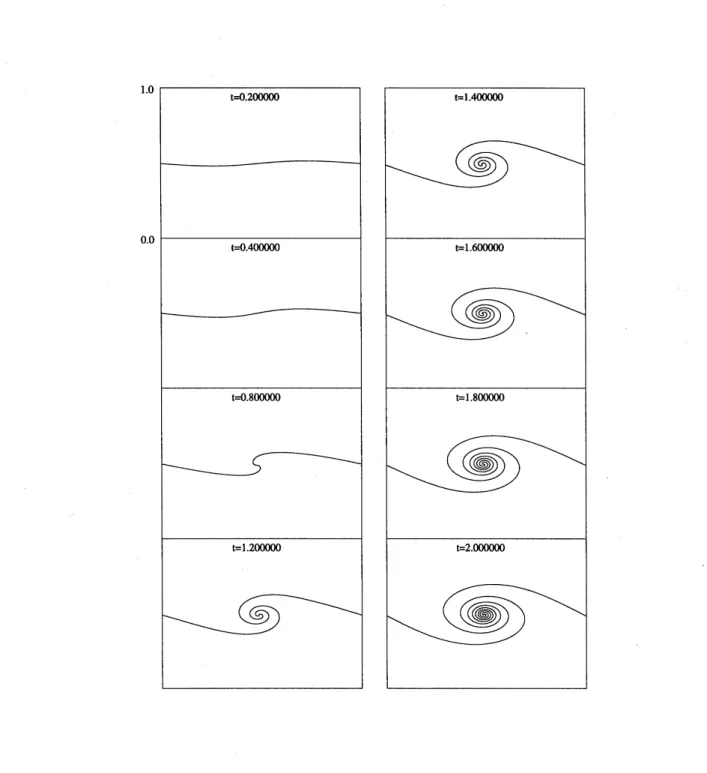
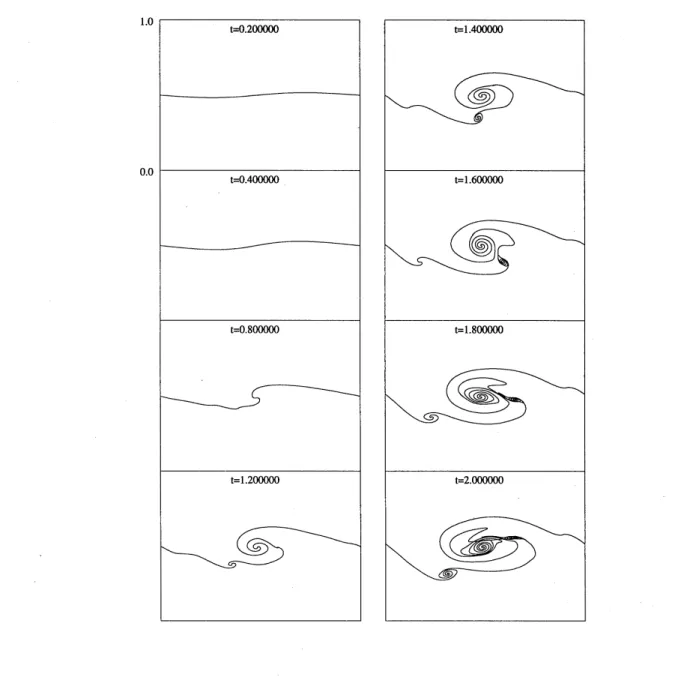
Figure 1 shows the time evolution of transformed vortex sheet by Draghicescu’s fast
$N$ time$(\infty)$ time$(\Lambda=7)$ $e_{vec}(\Lambda=7)$ time$(\Lambda=4)$ $e_{vec}(\Lambda=4)$
$\ovalbox{\tt\small REJECT}_{4}^{20}163841276555(35)6630\mathrm{e}-06334(262\%)5988\mathrm{e}- 40^{48}8110292967888(1128\% 4314131592184(584\% 9(32(15250_{\%}6\%)500_{2\mathrm{e}}^{1}5\mathrm{e}-\mathrm{o}_{5}\%)442\mathrm{e}-057(175)189-05111)126\mathrm{o}\mathrm{e}- 052517((667\%\%(352\%)9958\mathrm{e}-048950\%)15)9361\mathrm{e}- 04)2204\mathrm{e}- \mathrm{o}\mathrm{o}-499\mathrm{e}033$
Table 4: Execution time and evaluation
error
$e_{vec}$ with various $N$ when we applyDraghicescu’s algorithm to the original equation of a vortex sheet with periodic boundary
condition. Desingularization parameter $\delta=0.01$. $\mathrm{T}\mathrm{i}\mathrm{m}\mathrm{e}(\infty)$ is execution time obtained by
direct summation.
and $\triangle t=0.05$
.
The equation (4) is solved with the initial condition (5). Fourier filter is notused. While $t$ is small, the sheet is nearly flat. At about $t=0.8$ , vortex sheet begins to
roll-up and a spiral grows afterwards. Figure 2 is the time evolution of transformed vortex
sheet by direct summation. When
we
compare these two figures,no
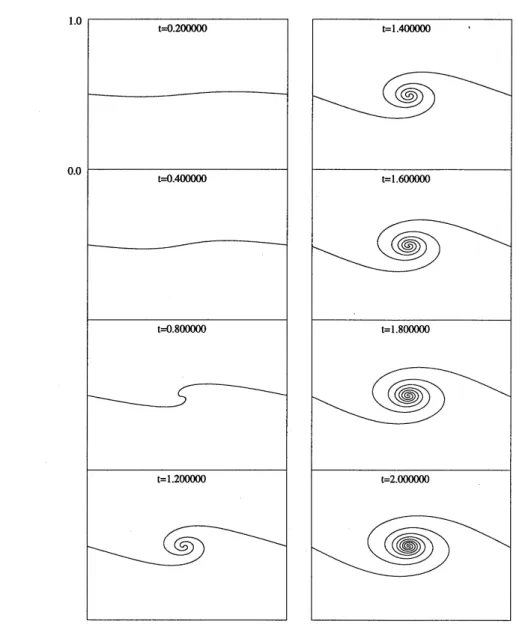
difference is observed.When we reduce A from 7 to 4, the numerical result is shown in Figure 3. In this case,
although its efficiency is
35.8%,
spurious spirals appear and complex pattern is formed byvortex sheet at $t=2.0$
.
Thus $\Lambda=4$ is totally unacceptableas a
numericalmean.
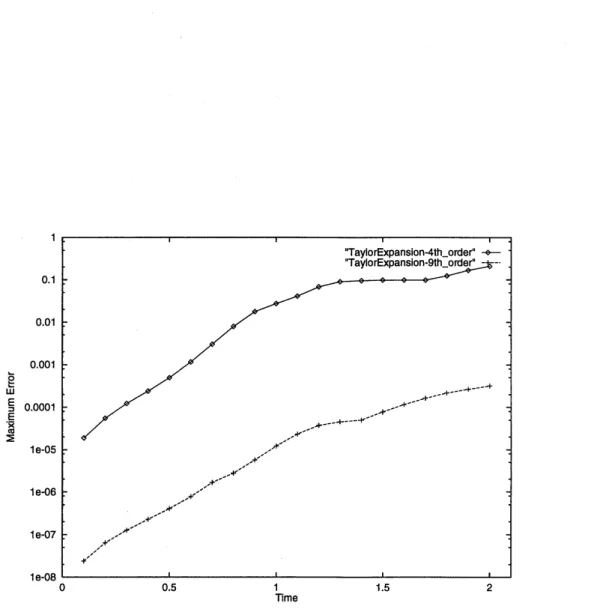
In order to study the accuracy, we define the position error, $e_{pos}$, as follows.
$e_{pos}=1\leq n\leq N\mathrm{m}\mathrm{a}\mathrm{x}|w_{n}^{fas}(tt)-w_{n}(direCt)t|$,
where $w_{n}^{fast}(t)$ and $w_{n}^{diect}(rt)$
are
the position of n-th vortex blob by Draghicescu’s fastsum-mation and direct summation, respectively. In Figure 4, we show position
error
$e_{pos}$ when$\Lambda=9$ and $\Lambda=4$
.
The position error is smaller than 0.0001 at $t=2.0$ when $\Lambda=9$.
Thiserror seems
to be tolerable forsome
purposes.We need more vortex blobs to compute accurately for a long time and to make efficiency
better. Figure 5 is the long time evolution when $(\Lambda, N)=(10, 8192)$. Other parameters
are
the same as before. In this case, we can compute up to $t=4.5$. A spiral gets bigger as time
grows. Efficiency is 46.0%.
5
Fourier
filter
As Krasny [7] notes, the numerical computations for small $\delta$ requires
a
technique calledFourier filter. Figure 5 shows a reasonable computation, but we must note that this is
because, due to the largeness of $\Delta t(0.05)$, the number of iterations (90) is rather small,
hence the accumulation of evaluation
errors
is negligible. If$\triangle t$ issmall,we
observe numericalinstabilityin early stages. AIso, if$\delta$ is small, numerical instability becomes obvious for small
Figure 1: The time evolution of transformed vortex sheet by Draghicescu’s fast evaluation.
Figure 2: The time evolution of transformed vortex sheet by direct summation. Numerical
Figure 3: The time evolution of transformed vortex sheet by Draghicescu’s fast method.
Numerical parameters: $N=4096,$ $\Lambda=4,$ $\delta=0.01$, and $\triangle t=0.05$. Because of the loss of
precision, the numerical solution is quite different from the directly evaluated solution for
Figure 4: The logarithm plotof evaluationerror$e_{pos}$ byfast algorithmwith$\Lambda=9$ and $\Lambda=4$.
Figure 5: The time evolution of transformed vortex sheet by Draghicescu’s fast method.
Numerical parameters: $N=8192,$ $\Lambda=10,$ $\delta=0.01$, and $\Delta t=0.05$. The increase of vortex
The present section is
Fourier filter works wellonly when the lowfrequencymodes
are
dominant and high frequencymodes decay sufficiently rapidly. In view ofthis,
we
consider the following initial condition:$w_{n}(0)= \exp(\frac{2\pi\dot{i}n}{N})+\epsilon\exp(\frac{4\pi\dot{i}n}{N})$ $(n=1,2, \cdots, N)$,
where $\epsilon=0.01$
as
before.We first study the effectiveness of the direct summation and the Fourier filter applied to
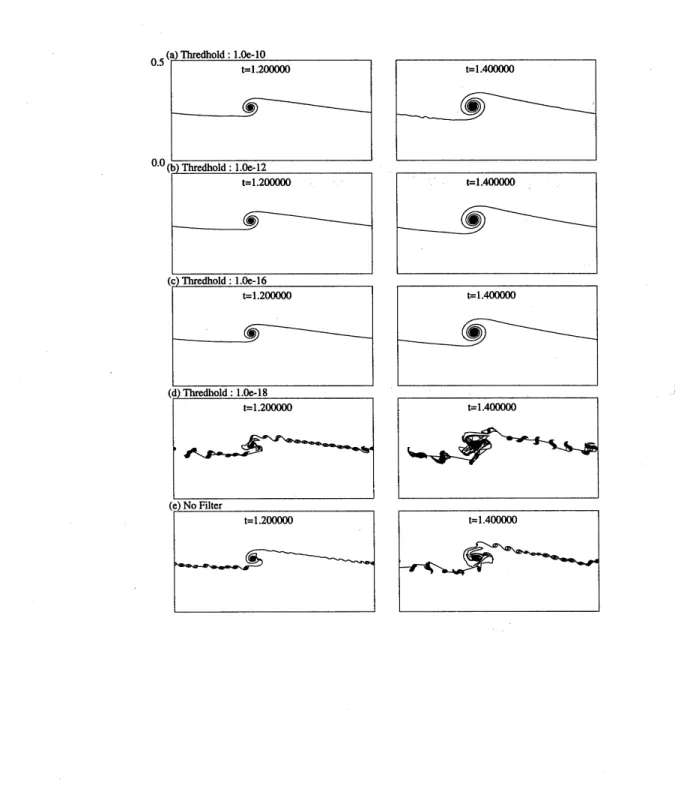
thetransformed equation (4). What wewant to cut off by the filter is round-offerror. Figure
6 shows the numerical solution of the sheet at $t=1.2$ and $t=1.4$, with thevarious threshold
value from $10^{-18}$ to $10^{-10}$ and without filtering. Numerical parameters are $N=8192,$ $\triangle t=$
O.Ol,and $\delta=0.01$. When Fourier filter is not applied, numerical solution is at $t=1.2$.
When the threshold is less than $10^{-18}$, round-off
error
can’t be cut off by the filter. Asa
result, round-off error is amplified and makes the numerical solution unstable. Therefore,
the threshold must be at least greater than $10^{-18}$. On the other hand, when the threshold is
equalto $10^{-10}$, numerical computation becomes unstable at$t=1.4$. This is because the filter
cutsoff the genuine increase of the modes. Consequently, to make accurate computation with
Fourier filter up to $t=1.4$, we find that it is desirable to choose the threshold value from
$10^{-16}$ to $10^{-12}$.
Next we apply Fourier filter to Draghicescu’s fast method. In this case, in addition to
round-off error, approximation
error
must be erased by the filter. However, approximationerror is much greater than round-off error. Therefore, unless the threshold value is chosen
properly, it isdifficult to cut off both
errors
by thefilter. Inorder tostudythe validthreshold,we
give in Figure 7 logarithmic plots of Fourier coefficients of the numerical solution whenwe proceed by one time step. Approximation order of each graph from top to bottom in the
Figure 7 is (a) A $=10,$ $(\mathrm{b})$ A $=12$, and (c) A $=\infty$ (direct method), respectively. Other
parameters are $N=8192,$ $\triangle t=0.\mathrm{O}\mathrm{l},\mathrm{a}\mathrm{n}\mathrm{d}\delta=0.01$. This figure indicates that if we set the
threshold value to $10^{-12}$, the numerical errors of high frequency modes can’t be eliminated
in the
case
of$\Lambda=10$ and $\Lambda=12$.Figure8is the time evolution of the sheet by Draghicescu’s fast method with Fourier filter.
Approximation order A is 12 and the threshold is $10^{-12}$. At $t=0.6$, numerical computation
doesn’t work well because of the failure of the filter. In order to cut off the errors surely the
threshold must be greater than $10^{-12}$, for example $10^{-10}$, which is found to be unsuitable in
the previous observation.
In order to usesmaller threshold, approximation error must be reduced. From the results
from section 3, there are three possibilities to improve accuracy of approximation;
$\bullet$ larger number of vortex blobs $(N)$ $\bullet$ higher order Taylor expansion $(\Lambda)$
In this paper, since the desingularized parameter $\delta$ is fixed to 0.01, we
use
larger $N$ andhigher order approximation, so that the effect of Fourier filter is compatible with efficiency.
Figure 9 shows the time evolution of the sheet. Numerical parameters
are
$N=$ 16384,$\triangle t=0.01,$ $\delta=$ O.Ol,and A $=15$. The threshold value is $10^{-12}$. Efficiency is 42.3%. In
this combination of parameters, Draghicescu’s fast method with Fourier filter works well.
Therefore, Fourier filter is effective only when approximation error is sufficiently small, in
other words,
a
large number of vortex blobsare
needed ifwe
take efficiency intoconsidera-tion. From the viewpoint of practical application, this restriction is not serious because the
necessity of the fast method arises only when
we
want touse.a
large number of vortex blobs.Acknowledgment.
Theauthors began thepresentstudy bythe suggestion from $\mathrm{P}\mathrm{r}\mathrm{o}\mathrm{f}\mathrm{e}\mathrm{s}_{\vee}\mathrm{s}\mathrm{o}\mathrm{r}$R. $\mathrm{K}\mathrm{r}\mathrm{a}\mathrm{S}\mathrm{n}\mathrm{y}.$ We express
our
gratitude to Prof. R. Krasny, who kindly introduced to us Draghicescu’s algorithm asReferences
[1] R.E. Caflisch and O. F. Orellana, Singular solutions and ill-posedness for the evolution
of vortex sheets, SIAM J. Math. Anal., vol. 20(1989), pp. 293-307.
[2] C.I. Draghicescu, An efficientimplementation of particle methodsfor the incompressible
Euler equations, SIAM J. Numer. Anal., vol. 31 (1994), pp. 1090-1108.
[3] C. I. Draghicescu and M. Draghicescu, A fast algorithm forvortex blob interactions, J.
Comput. Physics, vol. 116 (1995), p.
69-78.
[4] L. Greengard and V. Rokhlin, A fast algorithm for particle simulations, J. Comput.
Phys., vol. 73 (1987), pp. 325-348.
[5] J. Hamilton and G. Majda, On the Rokhlin-Greengard method with vortex blobs for
problems posed in all space
or
periodic in one direction, J. Comput. Phys., vol. 121(1995), pp. 29-50.
[6] R. Krasny, A study of singularity formation in
a
vortex sheet by the point-vortexap-proximation, J. Fluid Mech., vol. 167 (1986), pp. 65-93.
[7] R. Krasny, Desingularization ofperiodic vortexsheet roll-up , J. Comput. Phys., vol. 65
(1986), pp. 292-313.
[8] R. Krasny, Computation of vortex sheet roll-up, Springer Lecture Notes in Math., $\#$
1360 (1988), Eds., C. Anderson and C. Greengard, pp. 9-22.
Figure 6: The numerical solution of transformed equation at t $=1.2$ and t $=1.4$ calcurated
by direct method with Fourier filter. Each
row
corresponds to the case of threshold value:Figure 7: The logarithmic plot of Fourier coefficient of the numerical solution when we
proceed
one
time step. Numerical parameters; $N=8192,$ $\delta=0.01,\mathrm{a}\mathrm{n}\mathrm{d}\Delta t=0.\mathrm{O}1$.Approxi-mation order in (a) and (b)
are
$\Lambda=10$ and $\Lambda=12$, respectively. In (c), we calcurated byFigure 8: The time evolution of transformed vortex sheet using Draghicescu’s fast algorithm
with Fourier filter. Approximation order A is 12 and the threshold value is $10^{-12}$. Numerical
Figure 9: The time evolution of transformed vortex sheet using Draghicescu’s fast algorithm
with Fourier filter. $N=$ 16384. Approximation order A is 15 and the threshold value is