On Super Numerical
Simulation
Hitoshi IMAI (今井仁司), Toshiki TAKEUCHI (竹内敏己),Hideo SAKAGUCHI (坂口秀雄) and Tetsuya HISHINUMA (菱沼哲也) \dagger
Faculty of Engineering, University of Tokushima, Tokushima 770-8506, Japan.
(徳島大学工学部)
\daggerGraduate School ofEngineering, University ofTokushima, Tokushima 770-8506, Japan.
(徳島大学大学院工学研究科)
1Introduction
Recently,
we can
easilyuse
powerful computers. This year high-end PCs with $16\mathrm{G}\mathrm{B}$mem-ory(chipset:E7500) or $64\mathrm{G}\mathrm{B}$ memory(chipset:GC-HE) are available. In next thirty years
computers will have more amillion times capability. What will be the future numerical
simulation ?Taking into consideration such development of computers,
we
propose apewterminology: super numerical simulation. It means numerical simulation which highly
over-strides usual one. The similar terminology is seen in super computer. In what sense super numarical simulation should be super ?We propose five points: ultimate precision(
ul-timate reliability ), ulul-timate visualization, ultimate fast-computing, ultimate applicability,
and hardware implementation (cf. http:$//\mathrm{i}\mathrm{s}$am.$\mathrm{p}\mathrm{m}.\mathrm{t}\mathrm{o}\mathrm{k}\mathrm{u}\mathrm{s}\mathrm{h}\mathrm{i}\mathrm{m}\mathrm{a}-\mathrm{u}.\mathrm{a}\mathrm{c}.\mathrm{j}\mathrm{p}/\sim \mathrm{i}\mathrm{m}\mathrm{a}\mathrm{i}/$ ).
Hard-ware implementation
means
for example the flow simulator where the nural networksimu-latingflowis implemented ascircuitries. Amongthesefive pointsultimate precision, ultimate
visualization and ultimate applicability are shown in the paper.
2Ultimate
precision
In numerical simulation reliability of numerical solutions is checked by comparing those obtained in different precision. If numerical solutions converge, then it is recognized reliable
numerical solutions are obtained. However sometimes numerical solutions do not converge.
This is because they
are
not prepared abundantly. Usual numerical methods sometimes do not give abundant series of numerical solutions in different accuracy.On the other hand, numerical simulation sometimes fails due to instability caused by
numerical
errors.
Especially, the roundingerror
plays afatal role. If the truncationerror
isas
smallas
the rounding error, the roundingerror
spoils mathematical validity of the numerical method.数理解析研究所講究録 1265 巻 2002 年 9-17
To
overcome
thesedifficultieswe
proposedIPNS(Infinite-Precision NumericalSimulation)[6]. IPNS consists of the arbitrary order approximation method and the multiple precision arithmetic. The former is used for arbitrary reduction of the truncation
error.
The latteris used for arbitrary reduction of the rounding error As the arbitrary order
approxima-tion method, spectral methods
are
available from the pratical view point[l]. AmongspectralmethodsSCM (SpectralCollocation Method) is very useful. Thisisbecausethewayofits
ap-plication issimilarasFDM. It iseasily applicable to nonlinear problemsincludingfree
bound-ary problems[ll]. Themultiple precision arithmetic is easily carried out by using free subrou-tine libraries on the net, e.g. http:$//\mathrm{w}\mathrm{w}\mathrm{w}$
.
$\mathrm{l}\mathrm{m}\mathrm{u}.\mathrm{e}\mathrm{d}\mathrm{u}/\mathrm{a}\mathrm{c}\mathrm{a}\mathrm{d}/\mathrm{p}\mathrm{e}\mathrm{r}\mathrm{s}\mathrm{o}\mathrm{n}\mathrm{a}\mathrm{l}/\mathrm{f}\mathrm{a}\mathrm{c}\mathrm{u}\mathrm{l}\mathrm{t}\mathrm{y}/\mathrm{d}\mathrm{m}\mathrm{s}\mathrm{m}\mathrm{i}\mathrm{t}\mathrm{h}2/$FMLIB.html[10].
In the paper,
SCM
usingChebyshev Polynomials and Chebyshev-Gauss-Lobattocolloca-tion points is used. Afunction $u(x)$ in [-1, 1] is approximated by the $N$-th order Chebyshev
Polynomials as follows:
$u(x)= \sum_{k=0}^{N}\tilde{u}_{k}T_{k}(x)$, $T_{k}(x)=\cos$(k $\arccos x)$
.
(1)There is
an
inversion formula$u_{j}= \sum_{k=0}^{N}\tilde{u}_{k}T_{k}(x_{j})$, $\tilde{u}_{k}=\frac{2}{N\overline{c}_{k}}\sum_{j=0}^{N}\frac{1}{\overline{c}_{j}}u_{j}T_{k}(x_{j})$ (2)
where
$\overline{c}_{j}=\{$
2, $j=0$,$N$,
$x_{j}= \cos\frac{j\pi}{N}$, $j=0,1$,$\cdots$ ,$N$.
1otherwise, (3)
$\{x_{j}\}$ are called Chebyshev-Gauss-Lobatto collocation points. Derivatives at the collocation
points
are
easily computed from $\{u_{j}\}$.
In SCM it is easy to increase the order of theapprox-imation by increasing the number of collocation points. This feature is quite remarkable and different from other discretization methods. Of
course
SCM is applicable both in space andin time.
To see IPNS is realized, the following simple one-dimensional boundary value problem is
solved.
Problem 1. Find $u(x)$ s.t.
$u_{xx}=- \frac{\pi^{2}}{16}\sin\frac{(x+1)\pi}{4}$,
$-1<x<1$
, (4)$u(-1)=0$, $u_{x}(1)=0$. (5)
Remark 1. The exact solution to Problem 1is $u(x)= \sin\frac{(x+1)\pi}{4}$
.
Numerical results are shown in Table 1. Here $(N+1)$ Chebyshev-Gauss-Lobatto points
are
used. Extremely high accuracy is obseved. It should be remarked that even to such asimple
problem IPNS needs huge memory spaces and too much computational time
now.
Table 1. Maximumerror
for Problem 1.(2500 digit numbers)3Ultimate visualization
In numerical simulation visualization is very important. However, in super numerical
simu-lation normal visualization may not be available. For example IPNS gives numerical datain
long digits. There is no visualization softwarewhich can deal with such data. Among highly
accurate results by IPNS difference is extremely small. There is no visualization software
which can show such small difference.
Here anew visualization for IPNS is presented. Multiple precision arithmetic is used in
pre-processing which is programed in FORTRAN. Then suitable data whose regulation is
given by the visualization software are created and delivered to the visualization software.
Some examples obtained by the new visualization
are
shown below. It is interesting thatbasic facts in numerical analysis
are
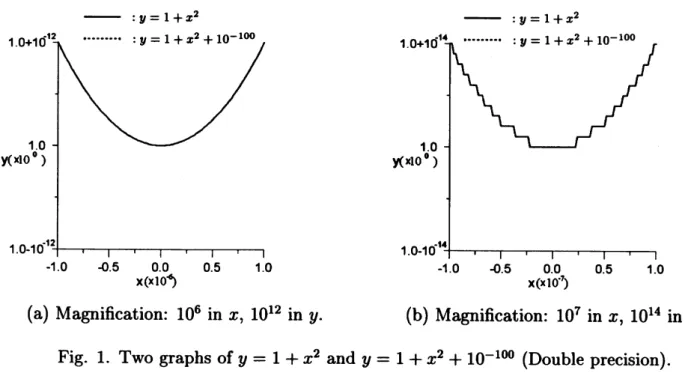
visualized.Fig. 1shows two graphs of $y=1+x^{2}$ and $y=1+x^{2}+10^{-100}$ in different
magnifica-tion. Graphs are generated by connecting $(x_{j}, y(x_{j}))_{j=0}^{100}$ in astraight line, $\{x_{j}\}$
are
equallydistributed. Data are prepared in double precision. Two graphs are not distinguished. This is because $10^{-100}$ is neglected compared with $1+x^{2}$
.
Fig. 1(b) shows machine epsilonor
distribution of floating-point numbers
–: y$=1+x^{2}$ –:y$=1+x^{2}$
(a) Magnification: 10 in x, 10 in y. (b) Magnification: 10 in x, 10 in y.
Fig. 1. Two graphs of y $=1+x^{2}$ and y $=1+x^{2}+10^{-100}$ (Double precision).
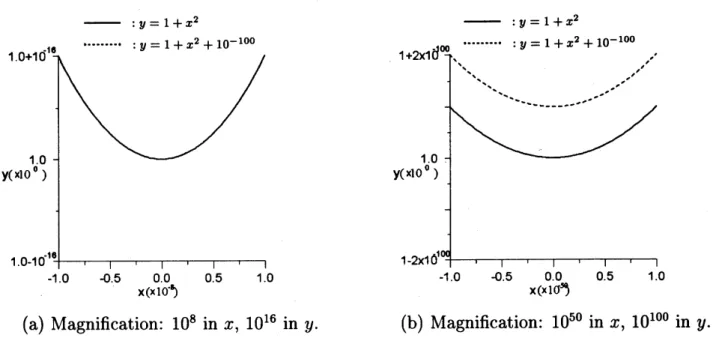
Fig. 2shows two graphs of $y=1+x^{2}$ and $y=1+x^{2}+10^{-100}$ in different magnifica-tion. Graphs
are
generated by connecting $(x_{j},\tilde{y}(x_{j}))_{j=0}^{100}$ in astraight line, $\{x_{j}\}$are
equallydistributed. $\tilde{y}(x)$ is theinterpolated function by SCM with $(x:, y(x:))_{i=0}^{10}$, $\{x:\}$ :
Chebyshev-Gauss-Lobatto Collocation points in [-1, 1]. Data
are
prepared in double precision. Two graphsare
not distinguished. This is because 10 is neglected compared with $1+x^{2}$.
InFig. $2(\mathrm{b})$ oscillation to be induced from the rounding
error
isseen.
– :y$=1+x^{2}$ – :y$=1+x^{2}$
(a) Magnification: 10 in x, 10 in y. (b) Magnification: 10 in x, 10 in y.
Fig. 2. Two graphs ofinterpolated functions created by SCM with data from y $=1+x^{2}$
and y $=1+x^{2}+10^{-100}$ (Double precision).
Fig. 3shows the new visualization for two graphs of $y=1+x^{2}$ and $y=1^{\backslash }+x^{2}+$ $10^{-100}$ in (jifferent magnification. Graphs
are
generated by connecting $(x_{j},\tilde{y}(x_{j}))_{j=0}^{100}$ in astraight line, $\{x_{j}\}$ are equally distributed. $\tilde{y}(x)$ is the interpolated function by SCM with
$(x_{i}, y(x_{i}))_{i=0}^{10}$, $\{x_{i}\}$ : Chebyshev-Gauss-Lobatto Collocation points in [-1, 1]. Data
are
prepared in 200 digit numbers. In Fig. $3(\mathrm{b})$ two graphs are very natural and distinguished
from each other.
– :$y=1+x^{2}$ – :$y=1+x^{2}$
(a) Magnification: 10 in $x$, 10 in $y$. (b) Magnification: 10 in $x$, 10 in $y$
.
Fig. 3. Two graphs ofinterpolated functions created by SCM with data from $y=1+x^{2}$ and $y=1+x^{2}+10^{-100}$ (200 digits).
4Ultimate applicability
Inverse problems often arise from practical problems. It is well-known they are very difficult to besolved[3]. Their directsimulation has been ataboo due to easycorruption bythestrong
oscillation phenomenon. To avoid this oscillation phenomenon
some
additional methodsare
usually used together. To say roughly, these are regularization[12], the method of least
squares and $\mathrm{A}\mathrm{I}$
.
Restriction of the dimension of the solution space is asort of regularization.These methods
are
very useful but unfortunately not absolute. Especially, in numerical simulation the roundingerror
fails their theoretical usefulness.On the other hand, direct simulation by IPNS was applied to several inverse problems governed by PDE systems[4, 5, 7, 8]. Numerical results were very satisfactory. This
means
numerical
errors
are extremely small,so
they do not induce the oscillation phenomenon. Inthe paper the following integral equation of the first kind with
an
analytic kernel and ananalytic solution is solved by IPNS without any additional methods like regularization$[2, 5]$.
Problem 2. Find $u(y)$ s.t.
$\int_{-1}^{1}e^{xy}u(y)dy=f(x)$, $f(x)= \frac{(2x-1)e^{x}+e^{-x}}{2x^{2}}$, $f(0)=1$
.
(6)Remark 2. The exact solution to Problem 2is $u(y)= \frac{y+1}{2}$.
SCM is applied to the integrand
as
follows:$e^{xy}u(y) \cong\sum_{k=0}^{N}\tilde{g}_{k}(x)T_{k}(y)$
.
(7)From the inversion formula
$\tilde{g}_{k}(x)\cong\frac{2}{Nc_{k}}\sum_{j=0}^{N}\frac{1}{c_{j}}e^{xy_{\mathrm{j}}}u_{j}T_{k}(y_{j})$, k $=0,$ 1,
\cdots , N, (8)
where
$y_{j}= \cos\frac{j\pi}{N}$, $u_{j}=u(y_{j})$, j $=0,$ 1,
\cdots , N. (9) Thus $e^{xy}u(y) \cong\sum_{k=0}^{N}\frac{2}{Nc_{k}}\sum_{j=0}^{N}\frac{1}{c_{j}}e^{xy_{\mathrm{j}}}u_{j}T_{k}(y_{j})T_{k}(y)$
.
(10) Then $\int_{-1}^{1}e^{xy}u(y)dy\cong\int_{-1}^{1}\{\sum_{k=0}^{N}\frac{2}{Nc_{k}}\sum_{j=0}^{N}\frac{1}{c_{j}}e^{xy_{\mathrm{j}}}u_{j}T_{k}(y_{j})T_{k}(y)\}dy$ $= \frac{2}{N}\sum_{k=0}^{N}\sum_{j=0}^{N}\frac{1}{c_{k}c_{j}}e^{xy_{\mathrm{j}}}u_{j}T_{k}(y_{j})\int_{-1}^{1}T_{k}(y)dy$ (11) $= \frac{2}{N}\sum_{k\neq 1}^{N}\sum_{jk=0=0}^{N}\frac{1}{c_{k}c_{j}}e^{xy_{\mathrm{j}}}u_{j}\cos\frac{jk\pi}{N}\cdot\frac{1+(-1)^{k}}{1-k^{2}}$.
We choose properly points $\{x_{l}\}$, $l=0,1$, $\cdots$ , $N$
on
which the integral equation issatisfied. Set $f_{l}=f(x_{l})$, then
we
have the following linear system:$\sum_{j=0}^{N}a_{lj}u_{j}=\frac{N}{2}f_{l}$, $\mathit{1}=0,1$,$\cdots$ , $N$, (12)
14
$a_{lj}= \sum_{k=0,k\neq 1’}^{N}\frac{1}{c_{k}c_{j}}e^{x_{l}y_{\mathrm{j}}}\cos\frac{jk\pi}{N}\cdot\frac{1+(-1)^{k}}{1-k^{2}}$. (13)
After solving this linear system, $u(y)$ is reconstructed
as
follows :$u(y)= \sum_{k=0}^{N}\sum_{j=0}^{N}\frac{2}{Nc_{k}c_{j}}u_{j}T_{k}(y_{j})T_{k}(y)$. (14)
$\xi$
$\not\in$
(a) Double precision (b) 400 digits
$\not\in$
1
(c) 1000 digits (d) 2000 digits
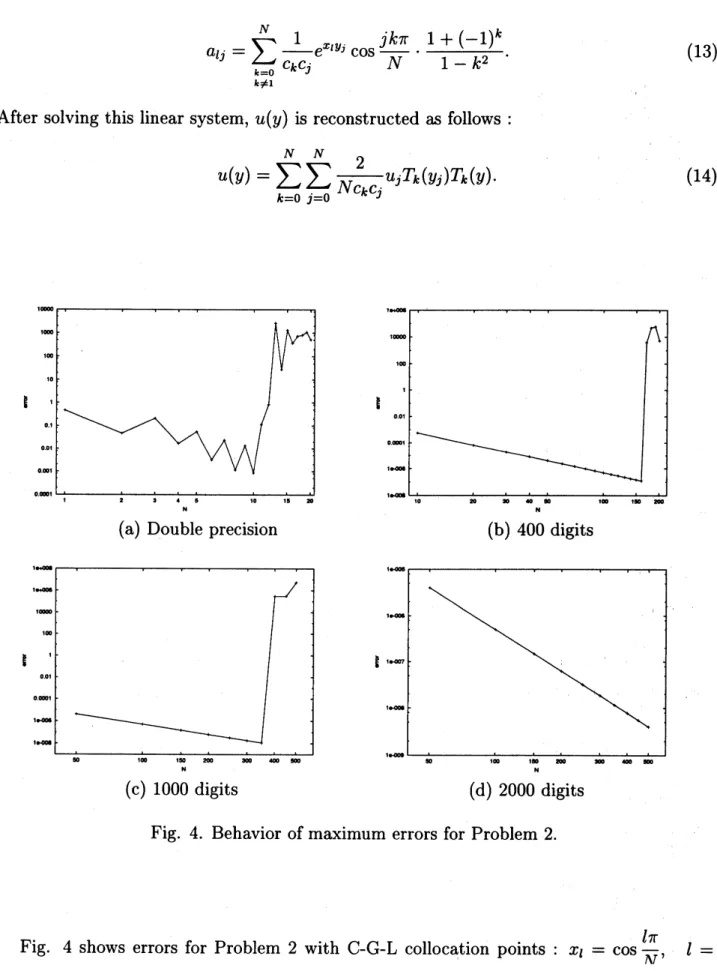
Fig. 4. Behavior of maximum
errors
for Problem 2.Fig. 4shows
errors
for Problem 2with C-G-L collocation points : $x_{l}= \cos\frac{l\pi}{\mathrm{w}}$, $l=$15
0, 1, \cdots ,N. Here,
error
$= \max_{0\leqq j\leqq N}|u_{N}(y_{j})-u(y_{j})|$, $y_{j}= \cos\frac{j\pi}{N}$, $\dot{\gamma}=0,$1,\cdots ,N (15)$u(y)$ is the exact solution, and $u_{N}(y)$ is the right-hand side ofEq. (14). If rounding
error
isnotsmall enough,
error
growsexplosivelybeforeobtaining good results. This shows the linearsystem (12) is very ill-conditioned. Atthe
same
time, ifroundingerror
is smallenough,error
reduces successively
as
$N$ becomes large. In Fig. $4(\mathrm{d})$ the regression line by the method ofleast squaresis $\log$(error) $=-3.00*\log N$ 0.686 with the correlationcoefficient $\rho=-3.00$
.
This
means
IPNS works well.5Conclusion
In the paperanew terminology: super numericalsimulation isproposed. Severalexamples of super numerical simulation
are
also presented. As computers becomemore
powerful today’s super numerical simulation becomes normal. However, super numerical simulation exists atany time, as super computer exists at any time.
Acknowledgements
This work ispartially supported byGrants-in-Aids for Scientific Research (No. 13640119), from the Japan Society of Promotion ofScience.
References
[1] C. Canutoet al., Spectral Methods in Fluid Dynamics, Springer, 1998.
[2] H. Fujiwara and Y. Iso, NumericalChallengeto fll-posedProblems byFastMultiple PrecisionSystem,
Proc. the 50th Japan National Congress on Theoretical and Applied Mechanics, 2001, 419-424.
[3] G. Hammerlin et al., ImproperlyPosed Problems and Their Numerical Treatment, Birkh\"auser, 1983.
[4] H. Imai and T. Takeuchi, Application of the Infinite Precision Numerical Simulation to an Inverse
Problem, NIFS-PROC-40(1999), 38-47.
[5] H. Imaiand T. Takeuchi, Some AdvancedApplications of the SpectralCollocationMethod, GAKUTO
Int. Ser. Math. Sci. Appl., 17(2001), 323-335.
[6] H. Imai, T. Takeuchi and M. Kushida, On Numerical Simulation of Partial Differential Equations in
Infinite Precision, Advances in Mathematical Sciencesand Applications, $9(2)(1999)$, 1007-1016.
[7] H. Imai, T. Takeuchi, M. Nakamura and N. Ishimura, ADIRECT APPROACH TO AN INVERSE
PROBLEM, GAKUTOInt. Ser. Math. Sci. Appl., 12(1999), 223232.
[8] H. Imai, T. Takeuchi and H. Sakaguchi, Infinite Precision Numerical Simulation for PDE Systems and
Its Applications, RIMSKokyuroku, Kyoto University, 1147(2000),42-50
[9] D. E. Knuth, The Art of Computer Programming, Addison-Wesley, 1981.
[10] D. M. Smith, AFORTRAN Package For Floating-Point Multiple-Precision Arithmetic, Tran
on Mathematical Software, 17(1991), 273-283.
[11] Tarmizi, T.Takeuchi, H. Imai andM. Kushida, Numerical simulation of one-dimensional free$\mathrm{b}_{1}$
problems ininfinite precision, Advancesin MathematicalSciencesand Applications, 10(2)
672.
[12] A. N. Tikhonov and V. Y. Arsenin, Solution of$\Pi 1$-Posed Problems, John Wiley&Sons, 1977