https://dspace.jaist.ac.jp/
Title
Knowledge Transfer in R&D Project Management: Application to Business-academia Collaboration Project
Author(s) Uchihira, Naoshi; Hirabayashi, Yuji; Sugihara, Taro; Hiraishi, Kunihiko; Ikawa, Yasuo
Citation 2012 Proceedings of PICMET '12: Technology Management for Emerging Technologies: 3473-3480
Issue Date 2012-07-31
Type Conference Paper
Text version publisher
URL http://hdl.handle.net/10119/10943
Rights
Copyright (C) 2012 PICMET. Naoshi Uchihira, Yuji Hirabayashi, Taro Sugihara, Kunihiko Hiraishi, Yasuo Ikawa, 2012 Proceedings of PICMET '12: Technology Management for Emerging Technologies, 2012, 3473-3480.
Knowledge Transfer in R&D Project Management:
Application to Business-academia Collaboration Project
Naoshi Uchihira
1, Yuji Hirabayashi
2, Taro Sugihara
3, Kunihiko Hiraishi
3, Yasuo Ikawa
3 1Toshiba Corporation, Japan 2
Shimizu Corporation, Japan 3
Japan Advanced Institute of Science & Technology, Japan Abstract--This paper proposes a method of project
management knowledge transfer in order to increase the success probability of R&D projects. Our method consists of knowledge externalization and knowledge internalization. "Structured project analysis" is a method of knowledge externalization that reviews a finished project and produces a structured project case. "Internalization workshop" is a method enabling managers to internalize the project management knowledge based on the analogical transfer approach. The method selects success and failure scenarios (future chance and risk items) from the structured project cases that have some similarities to the ongoing target project. Then, the method prompts the managers to imagine and analyze future scenarios of their target project by analogy and take action concerning them. We apply this method to an ongoing business-academia collaborative project in which Toshiba, Shimizu Corporation, and the Japan Advanced Institute of Science and Technology (JAIST) are developing an innovative healthcare information system. We qualitatively evaluate the effectiveness of the proposed knowledge transfer method and show how to fill the project management knowledge gaps among project team members drawn from business and academia.
I. INTRODUCTION
The ineffectiveness of research and development is recognized as a priority issue in Japanese manufacturing companies. There are several reasons for the ineffectiveness, including inability to meet the structural change of innovation and to gain exclusive profit from innovative technology. Quality of project management also affects the effectiveness of R&D. This paper focuses on project management knowledge of R&D managers and proposes a method of project management knowledge transfer in order to increase the success probability of R&D projects.
Several management tools, such as stage gate and phase review, have been introduced in R&D project management. However, they tend to become a dead letter if managers lack sufficient skill and knowledge to utilize these tools. In fact, it is not easy to gain experience because each manager participates in a limited number of projects. Therefore, we have been developing a knowledge transfer method and tools for R&D project management to overcome this limitation [1][2][3].
Some kind of open innovation has become inevitable in much corporate R&D recently and there are many collaborative R&D projects. Therefore, we try to apply this method to collaborative projects involving project team members drawn from academia and the private sector and
show its effectiveness in the collaborative projects.
The remainder of the paper is organized as follows. In section II, we clarify difficulties in R&D project management. Section III reviews the literature on knowledge transfer in R&D project management. A knowledge transfer model and procedure are introduced in section IV. We apply it to a collaborative project in section V and present our conclusions in section VI.
II. DIFFICULTIES IN R&D PROJECT MANAGEMENT We identify what we consider to be the principal difficulties encountered in R&D project management.
A. R&D project managers do not necessarily have great experience
For the following reasons, project managers in corporate R&D divisions do not necessarily have great experience and this is particularly so in Japan.
(1) Project terms are long: The average project term in corporate R&D divisions may be more than 6 years. Consequently, managers can only participate in a limited number of projects.
(2) Projects vary greatly: Research topics in corporate R&D divisions are often novel. Past experiences may be irrelevant.
(3) Projects are subject to high risk: Since project risk is high in corporate R&D divisions, managers are more likely to experience failure than success.
(4) Mobility of managers is low: Japanese companies recruit few managers in mid-career.
Therefore, organizational learning is necessary to compensate for managers’ lack of experience. However, organizational leaning of R&D project management has not yet to be systematized because project management is dependent on individual skills. Whereas technical knowledge transfer, using technical reports and patents, tends to be well established in organizations, the importance of management knowledge transfer tends not to be fully recognized. The post-project review is one of the few tools for management knowledge transfer. According to Zedtwitz, 80% of the R&D projects that he investigated lacked a post-project review system, and moreover, the post-project review systems that do exist tend to be unsystematic [4].
B. Project phase review does not necessarily work
Project phase review methods are widely used worldwide [5][6]. Project phase review methods have two functions: project selection and project quality control (different from product quality control). In the case of new product development by electronics manufacturers and automobile manufacturers, the project quality control function is particularly important because the product development typically involves the integration of many technologies. However, the project quality control function often becomes a dead letter in routine operation because inexperienced managers cannot understand the real meaning of the checklist used in the phase review. Project management knowledge transfer is necessary in order to ensure that the project quality control function works effectively in the project phase review.
C. Difficulties in business-academia collaborative projects
Many publicly funded business-academia collaborative projects have been conducted recently in order to create new businesses and new industries. In comparison to project management in a single organization, business-academia collaborative project management involves additional difficulties, including gaps between project team members in terms of background, purpose, and managerial knowledge. Therefore, managers of business-academia collaborative projects require systematic methods capable of filling these gaps.
III. LITERATURE REVIEW
Since knowledge of new technology and product development is recognized as a core competence in manufacturing companies, there is much research on knowledge transfer [7][8][9]. However, most of this research focuses on knowledge transfer of technology and there are few reports on project management knowledge transfer. Project management knowledge is structured and standardized as PMBOK (Project Management Body of Knowledge). But PMBOK does not mention the knowledge transfer procedure, especially in regard to knowledge internalization.
Niwa and his colleagues proposed a knowledge transfer support system for large plant construction project management where useful project management knowledge is codified in an expert system [10]. Aoshima and Nobeoka introduced “project knowledge” and considered knowledge transfer in automobile manufacturers [11]. Compared with project management in plant construction and automotive development in which the target product requirement is clear, R&D projects involve many uncertainties and risks, and therefore additional considerations are required.
Ramchandani mentioned that the phase review process was found to be effective for project management knowledge
transfer in new product development at Xerox [12]. In Japan, The New Energy and Industrial Technology Development Organization (NEDO) has investigated its past projects through post-project review and developed “NEDO R&D Management Guidelines” in which the reviewed past project cases are linked to a project management checklist [13]. These activities are a step in the right direction but they do not amount to the concrete procedure of a knowledge transfer process.
The literature includes many reports on the difficulties involved in business-academia collaborative project management, but few knowledge transfer approaches have been proposed to overcome these difficulties.
IV. KNOWLEDGE TRANSFER MODEL
A. Knowledge transfer model for R&D project management
Figure 1 represents the proposed knowledge transfer model consisting of knowledge externalization and knowledge internalization. The senders of knowledge externalize their knowledge as boundary objects. The receivers internalize the knowledge through boundary objects. A boundary object is a codified medium of knowledge transfer [14] and boundary objects are structured using the structure of organizational knowledge.
Subject Subject
Sender
Knowledge Boundary Knowledge
Object Externalization Internalization Externalization Support Internalization Support Receiver
Knowledge Structure in Organizational Routine
Experiences Structuralization Experiences
“Ba”
Fig. 1: Knowledge transfer model with boundary object
Figure 2 shows the knowledge transfer process in R&D project management based on the model. This process consists of post-project review and project phase review (Table 1). "Structured project analysis" is a method of knowledge externalization that reviews a finished project and produces a structured project case in the post-project review. The structured project analysis clarifies success and failure factors of the project by using some structures mentioned below. This structured project case is utilized as a boundary object in the context of knowledge transfer.
Phase Review Management Post Project Review (Structured Project Analysis) Past Project Project Case Database Project Phase Review (Internalization Workshop) Ongoing Project Project Manager Project manager Knowledge Transfer Facilitator Sender Receiver
Externalization Boundary Objects Internalization
Fig. 2: Knowledge transfer process in R&D project management TABLE 1: POST-PROJECT REVIEW AND PROJECT PHASE REVIEW
Post Project Review (PPR) Project Phase Review (PHR) Target Finished past project Ongoing project
Purpose
Externalization of knowledge which should be learned from the past project.
(1) Recognition and sharing of future chance and risk items and action items to improve the project.
(2)Decision-making in project management using results of (1).
Timing When the project has finished. When the project is reviewed in phasetransition.
Participants Project manager, project members,facilitator. Project manager, project members,stakeholders, facilitator.
Method Structured project analysis Internalization workshop
The extracted project management knowledge is stored in a project case database. However, it is not trivial for project managers to internalize the knowledge using the case database. We also propose the "internalization workshop" method for managers to internalize the project management knowledge based on the analogical transfer approach. The method selects success and failure scenarios from the case database that have some similarities to the ongoing target project and shows them to the managers. Then, the method prompts the managers to imagine and analyze future scenarios (future chance and risk items) of their target ongoing project by analogy and take action concerning them.
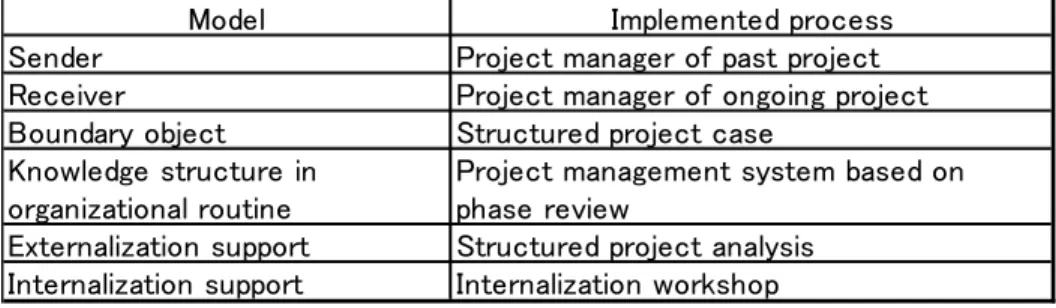
The internalization workshop is held in the first half of the project phase review ((1) in Table 1). Table 2 shows the correspondence between the proposed model and the implemented process.
Well-structured project cases can improve quality and motivation of project phase reviews. Good project phase reviews leave qualified records of projects, which improve post-project reviews. As shown in Fig. 3, the combination of post-project review and project phase review utilizing the knowledge transfer method can create a virtuous cycle. It can improve R&D project management quality, and then improve the success probability of R&D projects.
TABLE 2: CORRESPONDENCE OF MODEL AND IMPLEMENTATION
Model Implemented process
Sender Project manager of past project
Receiver Project manager of ongoing project Boundary object Structured project case
Knowledge structure in organizational routine
Project management system based on phase review
Externalization support Structured project analysis Internalization support Internalization workshop
Project (Qualified review records) Structured case
(many qualified cases)
Improvement of R&D project management quality Success probability improvement of R&D projects
Post Project Review (high quality and
efficiency)
Project Phase review (high quality and high motivation)
Continuing virtuous cycle
Fig.3: Virtuous cycle in R&D project management B. Structured project analysis
"Structured project analysis" is a method of knowledge externalization that reviews a finished project and produces a structured project case. Figure 4 shows a structured project case in which we introduce three types of structures to the traditional text-based cases:
(1) Phase review framework:
7-phase structure (idea discovery, concept generation, feasibility study, development, testing and validation, product production and launch, and product support). (2) Review checkpoint areas:
4 areas (technology, market, business, human resources and organization) of the review checklist. Table 2 shows an example of checklists consisting of 22 items classified into 4 areas. This checklist has been used in project phase reviews in the R&D organization which one of authors belongs to.
(3) Cause-and-effect relations
The structured project analysis clarifies success and failure factors of the project with these structures.
The proposed structured project analysis consists of the following 4 steps.
Step1: Organize records relating to past projects (project plan, weekly reports, design documents, phase review documents, etc.).
Step2: Enter project events (activities) in the matrix of the phase review process and review checkpoint areas (Fig. 4).
Step3: Analyze success factors and failure factors using cause-and-effect relations.
Step4: Summarize analysis and store the structured project case in the project case database as an outcome of the analysis.
Technology Market Business Resource
Stage0:Idea Discovery Stage1:Concept Generation Stage2: Feasibility Study Stage3: Development Stage4:Testing & Verification Stage5:Launch Stage6:Product Support event event event event event event event event event Ph ase Revi ew P ro c ess Checkpoint Areas Cause-and-effect relation
Fig.4: Structured project case
TABLE 3: CHECKLIST FOR PROJECT PHASE REVIEW
Area Check Point
1 Technology Strong core technologies
2 Technology Robustness of core technologies
3 Technology Sufficient system technologies
4 Technology Sufficient process technologies
5 Technology Standardization & Regulation
6 Technology Killer application
7 Technology Unbiased consideration
8 Marketing Future big market
9 Marketing Changing point
10 Marketing Real needs
11 Marketing Competitor
12 Marketing Alternative technologies
13 Marketing Contextual consideration
14 Business Responsible business unit
15 Business Strategically fitness
16 Business Utilization of business unit
17 Business Sharing chance and risk with business unit
18 Resources Communication among stakeholders
19 Resources Strong leadership
20 Resources Key person's support
21 Resources Utilization of outside resource
C. Internalization workshop
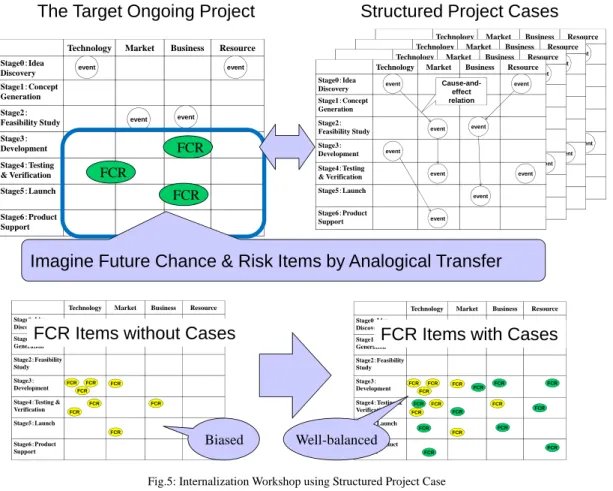
The internalization workshop is a brainstorming process using structured project cases. In the workshop, a facilitator selects success and failure scenarios from the case database that have some similarities to the ongoing target project and shows them to the managers. Then, the managers imagine and analyze future risk and chance items (called FCR items) of their ongoing target project by analogy with similar cases (Fig. 5) and take actions concerning them. Table 4 shows an example of FCR items, which look like FMEA (Failure Mode and Effect Analysis), but FMEA deals only with risks and not with chances. Each FCR item can be classified with both phase review process and review check point area corresponding to the matrix in Figure 4. Without structured project cases, one can only imagine FCR items within one’s experience. We contend that the number of FCR items not only increases but also the balance of FCR items is improved by using structured project cases as shown in Fig. 5. Balance
is measured by cover ratio and variance of FCR items. V. APPLICATION TO BUSINESS-ACADEMIA
COLLABORATION PROJECT
A. Project overview
In recent years, the need to improve the efficiency of nursing and caregiving services has been widely recognized. However, conventional PC-based support tools are unsuitable for services involving physical tasks (we call them “intelligent physical services”) such as nursing and caregiving because these tools impose great strain physically and mentally on nursing staff and caregivers. Therefore, new, less stressful, computer-human interaction technologies for intelligent physical services are required. Moreover, service design and evaluation methodologies for intelligent physical services are also necessary for improving these services step by step.
Technology Market Business Resource Stage0:Idea Discovery Stage1:Concept Generation Stage2: Feasibility Study Stage3: Development Stage4:Testing & Verification Stage5:Launch Stage6:Product Support event event event event event event event event event Cause-and-effect relation Technology Market Business Resource Stage0:Idea Discovery Stage1:Concept Generation Stage2: Feasibility Study Stage3: Development Stage4:Testing & Verification Stage5:Launch Stage6:Product Support event event event event event event event event event Cause-and-effect relation Technology Market Business Resource Stage0:Idea Discovery Stage1:Concept Generation Stage2: Feasibility Study Stage3: Development Stage4:Testing & Verification Stage5:Launch Stage6:Product Support event event event event event event event event event Cause-and-effect relation Technology Market Business Resource Stage0:Idea Discovery Stage1:Concept Generation Stage2: Feasibility Study Stage3: Development Stage4:Testing & Verification Stage5:Launch Stage6:Product Support event event event event event event event event event Cause-and-effect relation
Technology Market Business Resource
Stage0:Idea Discovery Stage1:Concept Generation Stage2: Feasibility Study Stage3: Development Stage4:Testing & Verification Stage5:Launch Stage6:Product Support event event event event
The Target Ongoing Project
Structured Project Cases
Imagine Future Chance & Risk Items by Analogical Transfer
Technology Market Business Resource
Stage0:Idea Discovery Stage1:Concept Generation Stage2:Feasibility Study Stage3: Development Stage4:Testing & Verification Stage5:Launch Stage6:Product Support FCR FCR FCR FCR FCR FCR FCR FCR
Technology Market Business Resource
Stage0:Idea Discovery Stage1:Concept Generation Stage2:Feasibility Study Stage3: Development Stage4:Testing & Verification Stage5:Launch Stage6:Product Support FCR FCR FCR FCR FCR FCR FCR FCR FCR FCR FCR FCR FCR FCR FCR FCR FCR FCR
FCR Items without Cases
FCR Items with Cases
FCR
FCR FCR
Biased Well-balanced
Fig.5: Internalization Workshop using Structured Project Case TABLE 4: FUTURE CHANCE AND RISK ITEMS (EXAMPLE)
FCR Name Phase Area Type Cause Effect
High-cost parts developme
nt
business risk Use of particular
kind of parts
High-cost product for niche market Collaboration with
market key person
testing & validation
resource chance Key person use it
as a early adopter
Useful feedback from key person and promotion
To satisfy these requirements, we have been developing a novel temporal-spatial communication system utilizing hands-free smart voice messaging (Fig. 6). In our system, voice messages are adequately distributed among co-workers according to human behavior analysis. Based on interviews in a hospital, we find smart voice messaging not only increases the efficiency of nursing and caregiving, but also provides new value, that is, temporal-spatial collaboration “ba” (Nonaka & Takeuchi 1995), such as Twitter facilitates in cyberspace.
We have also been developing a visualization and evaluation tool for intelligent physical services that consists of traffic line evaluation, stress evaluation, and work efficiency evaluation (Fig. 7). We propose a service design methodology for the target service space (physical space + information space + workflow space design).
Database
Doctor
Endoscope room Leader
message message message Semi-automatic Message Distribution Collaboration Task tracking Reporting Nurse Patients room Nurse station Service Space
Fig.6: Concept of smart voice messaging
Smart Voice Messaging System Service Space Visualization & Evaluation System Log DB Workflow Information Space Move line Evaluation Stress Evaluation Work Efficiency Evaluation Semi-automatic Message Distribution Double Loop Learning Single Loop Learning 3D Visualization Database Doctor
Endoscope room Leader message message message Semi-automatic Message Distribution Collaboration Task tracking Reporting Nurse Patients room Nurse station Service Space
Fig.7: Service space evaluation system
This project started in October 2010 supported by the service science founding program in the Japan Science and Technology Agency (JST) (S3FIRE: Service Science, Solutions and Foundation Integrated Research Program). Our project consists of a company with expertise in healthcare information technology (Toshiba), a general construction company with considerable experience in hospital
construction (Shimizu), system modeling and knowledge management researchers (JAIST), and a hospital (Toshiba Rinkan Hospital) and several care facilities. Since a project leader comes from company, not from academia, the project focuses on commercialization as well as academic contribution. In this situation, perception gaps among members of the project team drawn from academia and industry become critically important.
B. Knowledge transfer process (internalization workshop)
We have applied this method to four core members (two from companies: M1(Co), M2(Co) and two from academia: M3(Ac), M4(Ac)) of the project team. Since the four members are from different organizations, the in-house project case databases of the organizations cannot be used. Instead, we introduce structured project analysis in Step 3 for the past projects that the members have experienced. We focus on the project phase review (internalization) rather than the post-project review (externalization) as follows.
Step0: Define project scope
This project may be positioned as part of a larger target of each organization. Firstly, we define the common project scope and share it among the members.
Step1: Extract future chance and risk items (own experience)
Each member independently extracts future chance and risk items based on his own experiences.
Step2: Extract Future Chance and Risk Items (Checklist) Each member independently modifies and adds future chance and risk items based on the project phase review checklist (Table 3).
Step3: Share past project experiences by structured project analysis
Each member refers to his own past project and analyzes it by applying the structured project analysis method. Table 5 shows analyzed and shared projects. Two projects provided by company members led to commercialization. The other two projects encountered management difficulties at universities. Members share the results of the analysis, which are externalized project management knowledge.
Step4: Extract future chance and risk items (project case) Each member independently modifies and adds future chance and risk items based on the structured project cases provided in Step 3.
Step5: Extract action items
After sharing and classifying all of the extracted future chance and risk items through brainstorming, important future chance and risk items are extracted and future action items are derived. These action items are used in the phase review meeting.
TABLE 5: PAST PROJECTS
ID Project Organization Characteristic Features
1 Credit information infrastructure project Companies +
University
Business-academia collaborative project. Outcome of the project was commercialized.
2 Commercialization project of verification
tool for arrangement of bars Companies
Companies collaborative project. Outcome of the project was commercialized.
3 Verifiable and evolvable e-society project University + Companies
Big project having a lot of members who had varied interests.
4 MOT education course development
project University
University project whose stakeholders include company members.
C. Result
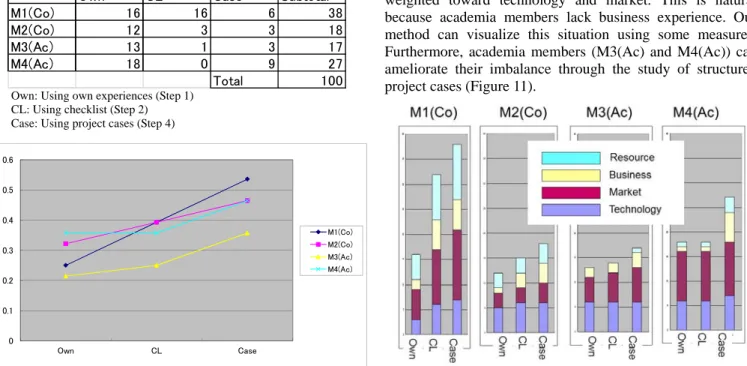
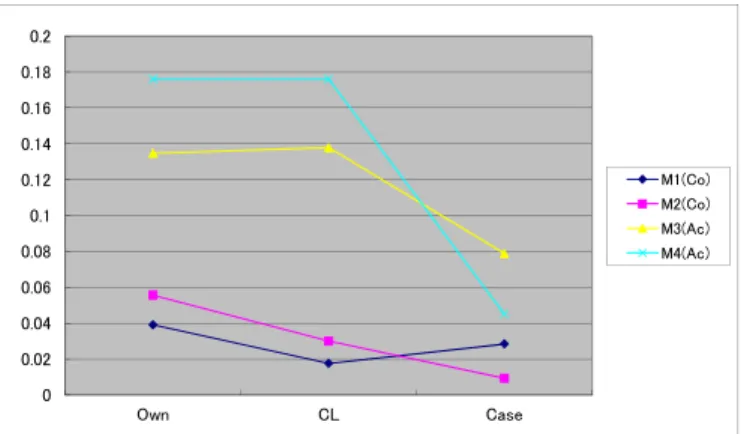
During the internalization workshop, 100 future chance and risk items were extracted by four members (Table 6). Since members are experienced managers, many items can be extracted in Step 1. Company members can utilize the checklist and project cases can be utilized by both academia and company members. Figures 8 and 9 represent transition of cover ratio and variance of FCR items for each member from Step 1 to Step 4. Here, the cover ratio is the ratio of the number of cells filled by FCR items divided by the number of cells in the matrix shown in Figure 4. The variance shows imbalance of FCR items over the matrix. Since structured project cases are represented by the same matrix, FCR items can be easily imagined according to the matrix. By using the checklist and structured project cases, the cover ratio and variance of FCR items were improved, which is interpreted as showing the effectiveness of the proposed method.
TABLE 6: EXTRACTED FUTURE CHANCE AND RISK ITEMS
Own CL Case Subtotal
M1(Co) 16 16 6 38
M2(Co) 12 3 3 18
M3(Ac) 13 1 3 17
M4(Ac) 18 0 9 27
Total 100
Own: Using own experiences (Step 1) CL: Using checklist (Step 2) Case: Using project cases (Step 4)
0 0.1 0.2 0.3 0.4 0.5 0.6 Own CL Case M1(Co) M2(Co) M3(Ac) M4(Ac)
Figure 8: Transition of Cover Ratio
Figure 9: Transition of Variance
From the viewpoint of difference between academia and company members, the balance of FCR items among checkpoint areas (technology, market, business, human and organization) diverges drastically. Figure 10 shows that whereas company members extracted well-balanced FCR items, FCR items extracted by academia members are weighted toward technology and market. This is natural because academia members lack business experience. Our method can visualize this situation using some measures. Furthermore, academia members (M3(Ac) and M4(Ac)) can ameliorate their imbalance through the study of structured project cases (Figure 11).
0 0.02 0.04 0.06 0.08 0.1 0.12 0.14 0.16 0.18 0.2 Own CL Case M1(Co) M2(Co) M3(Ac) M4(Ac)
Figure 11: Transition of variance among checkpoint areas
Finally, in Step 5 we derive 6 action items from 100 FCR items. These action items are evenly extracted from all checkpoint areas. The most important item is clarification and sharing of the business model and commercialization process.
D. Discussion
For 3 members, it was their first experience of applying this method. We interviewed them to identify the method’s merits and demerits. The merits include clarifying and sharing future chances and risks and gaps between academia and corporate members. Before the internalization workshop, project members in academia have interests in commercialization of their technology by the mind, but understand little about actual future risks and chances. The demerits include limited sharing of information on past projects among different organizations.
Analysis of past projects was found to be particularly useful for achieving mutual understanding. It involves not only sharing management knowledge among members but also understanding how their backgrounds and perspectives differ through the sharing of their life stories (narratives) as researchers and engineers. Narratives are thought to be effective for achieving mutual understanding [15].
VI. CONCLUSION
We have developed a knowledge transfer method for R&D project management that consists of structured project analysis (externalization) and an internalization workshop (internalization), and applied it to a business-academia collaboration project in which a healthcare information system has been developed. The uniqueness of the paper is that we show the effectiveness of the knowledge transfer method quantitatively by using several measures (cover ratio
and variance of FCR items).
We intend to apply the method to other projects and confirm its effectiveness multilaterally because the method depends on the characteristics of the project and of the members.
In the application to the business-academia collaboration project, we find that narratives are effective for achieving mutual understanding when members have different backgrounds and are drawn from different organizations. In future work, we intend to explicitly introduce narratives in our method.
ACKNOWLEDGMENTS
This research project has been supported by JST RISTEX S3FIRE (Service Science, Solutions and Foundation Integrated Research Program).
REFERENCES
[1] Uchihira, N., “Stage Gate Analysis in Business - Academia Collaborative Project,” PICMET 2005.
[2] Uchihira, N., “Internalization Method of R&D Project Management Knowledge in Stage Gate Analysis,” IAMOT 2006.
[3] Uchihira, N. “Knowledge transfer in R&D project management,” Ph.D thesis, Japan Advanced Institute of Science and Technology, 2010. [4] Zedtwitz, von M. “Organizational learning through post-project
reviews in R&D,” R&D Management, Vol.32, No.3, pp. 255-268. [5] Cooper, R.G. “Winning at New Products - Accelerating the Process
from Idea to Launch (Third Edition),” Basic Books.
[6] McGrath, M.E. “Setting the Pace in Product Development: A Guide to Product and Cycle-Time Excellence,” Butterworth-Heinemann. [7] Allen, T.J. “Managing the Flow of Technology,” MIT Press.
[8] Szulanski, G. “Exploring Internal Stickiness: Impediments to the Transfer of Best Practice Within the Firm,” Strategic Management Journal, Vol.17, Winter Special Issue, pp. 27-43.
[9] Cummings, J.L. and Teng, B.S. “Transferring R&D knowledge: the key factors affecting knowledge transfer success,” J. Eng. Technol. Manage., vol.20, pp.39-68.
[10] Niwa, K. and Okuma, M. “Know-how transfer method and its
application to risk management for large construction projects,” IEEE Trans. Eng. Mgmt., Vol.29, No.4, pp. 146-153.
[11] Aoshima,Y., Nobeoka,K., “Management of Project Knowledge,” (in Japanese) Organizational Science, Vol. 31, No. 1, pp. 20-36.
[12] Ramchandani, T. (2002) “Role of Stage Gates in Effective Knowledge Sharing During the Product Development Process,” MIT LFM/SDM Thesis, URI=http://hdl.handle.net/1721.1/29173.
[13] Takada, K. “Concept of NEDO R&D management guideline,” (in
Japanese) JSSPRM annual conference Vol.21, No.2, pp. 1096-1099. [14] Carlile, P. R. “A Pragmatic View of Knowledge and Boundaries:
Boundary Objects in New Product Development,” Organization Science, Vol.13, No.4, pp.442-455.
[15] Denning, S. “Telling Tales,” Harvard Business Review, Vol.82, No.5, pp. 122-129.