Nonregular triangulations, view graphs of triangulations,
and linear programming
duality
Fumihiko Takeuchi
(竹内史比古)fumi@is.
$\mathrm{s}.\mathrm{u}$-tokyo.
$\mathrm{a}\mathrm{c}$.jp
Dept.
of Information Science,
Univ. of
Tokyo,
113-0033, Japan
August 31,
2000
Abstract
For a triangulation and a point, we define a directed graph representing the
order of the maximal dimensional simplices in the triangulation viewed from the
point. We prove that triangulations having a cycle the reverse of which is not
a cycle in this graph viewed from some point are forming a (proper) subclass
of nonregular triangulations. We use linear programming duality to investigate
further properties of nonregular triangulations in connection with this graph.
1
Introduction
Let $A=\{p_{1}, \ldots , p_{n}\}\subset \mathbb{R}^{d}$be
a
point configuration with itsconvex
hullconv
$(A)$ beinga
$d$-polytope. A triangulation$\Delta$of
$A$ isa
geometric simplicial complex withits verticesamong $A$ and the union of its faces equal to
conv
$(A)$.
A triangulation is regular (orcoherent) ifit can appear
as
the projection of the lower boundary ofa $(d+1)$-polytopein 1R$d+1$
.
If not, the triangulation is nonregular..}.
..
$\iota_{\sim}$.Starting from thestudyof generalized hypergeometricfunctions, Gel’fand, Kapranov
$\ \mathrm{z}_{\mathrm{e}}1\mathrm{e}\mathrm{v}\mathrm{i}\mathrm{n}\mathrm{S}\mathrm{k}\mathrm{i}1$showedthat regular triangulations altogether of a point configuration
are
forming apolytopalstructure described by the secondary polytope [4] [5]. In connection
to Gr\"obner bases, Sturmfels showed that initial ideals for the affine toric ideal
deter-mined by a point configuration correspond to the regular triangulations of the point
configuration [8] [9]. Regular triangulations
are
a
generalization of the Delaunaytrian-gulation well known in computational geometry, and have also been used extensively in
this field [2].
Though nonregular triangulations
are
know to be behaving differently from regulartriangulations, they
are
not wellunderstood
yet.Santos
showeda
nonregulartriangula-tion with
no
flips indicating thata
flip graphcan
be disconnected, whichnever
happenswhen restricted to regular triangulations [7]. Ohsugi&Hibi showed the existence ofa
point configuration with
no
unimodular regular triangulations, but witha
unimodularnonregular triangulation [6]. Also, de Loera, Ho\S ten,
Santos&Sturmfels
showed thatcyclic polytopes
can
have exponential number ofnon-regular triangulations comparedto polynomial number of regular
ones
[1]. The aim ofthispap..e.r
is to putsome
insightinto nonregular triangulations.
Hereafter in this paper, we fix a triangulation $\Delta$
.
For the triangulation $\Delta$ anda
point $v$ in $\mathbb{R}^{d}$,
we
define the graph$G_{v}$of
$\Delta$ viewedcorresponding to the $d$-simplices of$\Delta$ and
a
directed edge $\overline{\sigma}\not\simeq$existing when $v$ belongs
to the closed halfspacehavingthe affine hull $\mathrm{a}\mathrm{f}\mathrm{f}(\sigma\cap\tau)$
as
its boundary and including $\sigma$.
When$v\in \mathrm{a}\mathrm{f}\mathrm{f}(\sigma\cap \mathcal{T})$
,
both edges $\overline{\sigma}\not\simeq,\overline{\tau}\neq$ appear in $G_{v}$.
Thegraph $G_{v}$ isa
directed graphwith the underlying undirected graph the adjacency graph ofthe $d$-simplices in $\Delta$
.
Ofcourse, $G_{v}$ might differ for different choices of $v$
.
Though thereare
infinite choices ofviewpoints $v$, there
are
only finitely many possibilities of view graphs $G_{v}$.
A sequence of vertices $\sigma_{1},$$\sigma_{2},$
$\ldots,$$\sigma_{i},$$\sigma_{1}$ in $G_{v}$ forms
a
cycle when$\overline{\sigma}_{1\eta,\ldots,\frac{\backslash }{\sigma_{i-1}\sigma_{i}^{\gamma}}}\sigma$, $\frac{}{\sigma_{i}\sigma 1}$
are
edges of $G_{v}$ and $\sigma_{i}\neq\sigma_{j}$ for $i\neq j$.
We definea
cycle $\sigma_{1},$ $\sigma_{2,\ldots,i}\sigma,$$\sigma_{1}$ tobe contradicting when the
reverse
order $\sigma_{1},$ $\sigma_{i},$$\ldots,$$\sigma_{2},$$\sigma_{1}$ is not
a
cycle in $G_{v}$.
Forvertices $\sigma_{1},$
$\ldots,$$\sigma_{i}$ in $G_{v}$, edges $\frac{}{\sigma_{1}\sigma \mathrm{g}},$
$\ldots$ ,
$\frac{\backslash }{\sigma_{i-1}\sigma_{i}’},\frac{\mathrm{t}}{\sigma_{2}\sigma \mathrm{i}},$$\ldots,\frac{}{\sigma_{i}\sigma_{i-\mathrm{i}}}$ exist if and only if
$v\in \mathrm{a}\mathrm{f}\mathrm{f}(\sigma_{1}\cap\cdots\cap\sigma_{i})$
.
Regularity of
a
triangulationcan
be statedas a
linear programming problem,so
thetwo subjects obviously have connection. But,
an
interesting point inour
argument isthat we use linear programming duality to analyze further in detail some properties of
nonregular triangulations.
For any triangulation, the condition of regularity
can
be writtenas
a linearpro-gramming
prob.lem.
The variables $w_{1},$ $\ldots,$ $w_{n}$ correspond to the lifting (or weight) ofthe vertices $p_{1},$$\ldots,p_{n}$
.
The inequality constraints correspond to the interior $(d-1)-$simplices in $\triangle$ anddescribes the local convexity of the two $d$-simplices intersecting there.
Altogether,
we
geta
system of inequalities $Aw>0$ ($0$ is thezero
vector), and thetri-angulation is regular when this has
a
solution. Easily, this is equivalent to $Aw\geq 1$(1 is the vector with all entries one) having
a
solution. By linear programmingdual-ity (or Farkas’ lemma), the $\mathrm{t}\mathrm{r}\mathrm{i}\mathrm{a}\mathrm{n}\mathrm{g}\mathrm{u}\mathrm{l}\mathrm{a}\mathrm{t}\mathrm{i}_{0}\mathrm{n}$
. is nonregular if and only if the dual problem
$u.A=0,$ $u\geq 0$ has
a nonzero
solution.Our main theorem constructs
a nonzero
solution of the dual problem combinatoriallyand $\mathrm{e}\mathrm{x}\mathrm{p}\mathrm{l}\mathrm{i}\mathrm{c}\mathrm{i}\mathrm{t}’ \mathrm{l}\mathrm{y}$ from
a
$\mathrm{c}\mathrm{o}\mathrm{n}\mathrm{t}\mathrm{r}\mathrm{a}\dot{\mathrm{d}}$icting cycle.
Theorem. For a triangulation $\triangle$,
if
a graph $G_{v}$ viewedfrom
some point $v$ contains acontradicting cycle, in correspondence with this cycle, we can make a nonzero solution
of
the dual problem stated above. Thus, $\Delta$ is nonregular. The supportset ($i.e$.
collectionof
nonzero
elements)of
this solution is a subsetof
the edges forming the cycle. $On$the other hand, the
reverse
of
the claim above is not true. There existsa
nonregulartriangulation with none
of
its view graphs $G_{v}$ containing a contradicting cycle. (SeeExample 3.3)
The
theoremsays
that triangulations containinga
contradictingcycleinits graph $G_{v}$viewed from some point $v$
are
forminga
(proper) subclass of nonregular triangulations.This subclass of triangulations is interesting in that they have combinatorial
explana-tion.
On
the other hand, regularityor
nonregularity, defined by linear inequalities,are
of continuous nature. This is the first attempt to givea
(combinatorial) subclassof nonregular triangulations. Even if
we
consider contradicting closed paths insteadof contradicting cycles, allowing to pass the
same
vertexmore
than once, the class ofthe triangulations having such contradicting thing in its view graph does not change,
because any contradicting closed path includes
a
contradicting cycle.Checking that Example 3.3 is a counterexample to the reverse of the implication in
the theorem (i.e. the view graph from any viewpoint does not contain
a
contradictingcycle), can be done by extensive enumeration ofview graphs. However, by describing
we
prove the counterexample ina more
elegant way.A
similar but different directedgraphofa
triangulationviewed froma
point has beenstudied byEdelsbrunner [3]. This
was
in the context ofcomputer vision, and his graphrepresents the $\mathrm{i}\mathrm{n}\mathrm{f}\mathrm{r}\mathrm{o}\mathrm{n}\mathrm{t}/\mathrm{b}\mathrm{e}\mathrm{h}\mathrm{i}\mathrm{n}\mathrm{d}$ relation
among
simplices of any dimension,even
notadjacent to each other. When
our
graph and the restriction of Edelsbrunner’s graph to$d$-simplices
are
compared, neither includes the other in general. However, ifwe
take thetransitive closure of
our
graph, it includes his graphas a
subgraph (possibly withmore
edges).
Our
graph might bemore
appropriate in describing combinatorial structuresof triangulations, because their underlying undirected graphs
are
the adjacency graphof$d$-simplices. Edelsbrunner proves that if
a
triangulation is regular, his graph viewedfrom any point is “acyclic”. The line shelling argument in a note there gives a proof
for the contrapositive of
our
theorem, but without explicit constructioin ofa
solutionof the dual problem.
2
Regularity, linear
programming,
and
duality
2.1
Inequalities for
regularity
A triangulation $\Delta$ of the point configuration
$p_{1},$$\ldots,p_{n}$ is regular if their exists
a
lifting(or weight) $w_{1},$$\ldots,$$w_{n}\in \mathbb{R}$such that the projection ofthe lower boundary with respect
to the$x_{d+1}$ axis ofthe $(d+1)$-polytope
conv
$(, \ldots, )$ becomes $\Delta$.
This conditioncan be described by inequalities with $w_{1},$$\ldots$ ,$w_{n}$ the variables.
A straightforward description ofthis “global” convexity is
as
follows:$\bullet$ For each $d$-simplex
$\mathrm{c}\mathrm{o}\mathrm{n}\mathrm{V}(p_{i}0’\ldots,p_{i_{d}})$ in $\Delta$, and any point
$p_{j}\not\in\{p_{i0}, \ldots,p_{i_{d}}\}$, the
lifted point $(_{w_{\mathrm{j}}}^{p_{j}})$ is above the hyperplane $\mathrm{a}\mathrm{f}\mathrm{f}(, \ldots, )$ in $\mathbb{R}^{d+1}$:
$|w_{i_{0}}p_{i_{0}}1$
.
..
$w_{i_{d}}p_{i_{d}}1$ $w_{j}p_{j}1|>0$.
However, the above condition is equivalent to thefollowing “local” convexity, with much
less inequalities:
$\bullet$ For eachinterior $(d-1)$-simplex
conv
$(p_{i_{1}}, . . ., p_{i_{d}})$ in$\triangle$,
wherethe twod-simplicesconv$(p_{i},p_{i}01’\ldots,p_{i_{d}})$ and conv$(p_{i_{1}}, \ldots , p_{i_{d}}, p_{i_{d+1}})$ areintersecting, the lifted point
1 1 1
$p_{i_{0}}$ $p_{i_{d}}$ $p_{i_{d+1}}$
$w_{i_{0}}$ $w_{i_{d}}$ $w_{i_{d+1}}$
$>0$
.
$(*)$The equivalence ofthese two convexity conditions is proved easily by reducing to the
one
dimensionalcase.
We
define the collection of the inequalities $(*)$ for all interior $(d-1)$-simplices in $\Delta$as
$Aw>0$
.
Lemma 2.1. For
a
triangulation $\Delta$, and the matrix A representing its regularity, $we$have
$\Delta$ is regular
$\Leftrightarrow$ there exists $w\in \mathbb{R}^{n},$ $Aw>0$,
$\Leftrightarrow$ there exists $w\in \mathbb{R}^{n},$ $Aw\geq 1$
.
By linear programming duality (or Farkas’ lemma),
we
have$\Delta$ is nonregular
$\Leftrightarrow$ there does not enist $w\in \mathbb{R}^{n},$ $Aw\geq 1$,
$\Leftrightarrow$ there exists $u\geq 0,$ $uA=0,$ $u\neq 0$
.
Thus, the (non)regularity of$\Delta$
can
bejudged by the existence ofa
nonzero
point inthe polyhedron $\{u\geq 0:uA=0\}$ ofthe set of solutions of the dual problem.
2.2
A
nonzero
solution
of the dual problem from
a
contradicting
cycle
Here, we give an explicit construction of
a nonzero
solution ofthe dual problem $uA=$$0,$$u\geq 0$, from
a
contradicting cycle in the graph $G_{v}$ viewed fromsome
point $v$.
For$v\in \mathbb{R}^{d}$, a d–simplex $\sigma$ in $\Delta$, and $w\in \mathbb{R}^{n}$,
we
let$x_{d+1(}- v,$$\sigma,$$w)=(\mathrm{t}\mathrm{h}\mathrm{e}Xd+1$ coordinate ofthe point
(the hyperplane containing the lifting of the $d$-simplex $\sigma$ by $w$)
$\cap\{(v, Xd+1) : x_{d+1}\in \mathbb{R}\})$
.
Lemma 2.2. Let $\Delta$ be a triangulation, A the matrix representing its regularity, and
$v\in \mathbb{R}^{d}$
.
For an edge$\overline{\sigma}\not\simeq in$ the graph$G_{v}$ viewedfrom
$v$, there exists a constant$\alpha_{\sigma\cap \mathcal{T}}\geq 0$such that
$x_{d+1}(v, \sigma, w)-xd+1(v, \mathcal{T}, w)=\alpha_{\sigma\cap\tau}A_{\sigma\cap\tau},*w$ (for any $w\in \mathbb{R}^{n}$),
where $A_{\sigma\cap \mathcal{T},*}$ is the row
of
A corresponding to the interior $(d-1)$-simplex$\sigma\cap\tau$ in $\Delta$
.
Furthermore, $v\in \mathrm{a}\mathrm{f}\mathrm{f}(\sigma\cap\tau)$
if
and onlyif
$\alpha_{\sigma\cap \mathcal{T}}=0$.
Proof.
Straightforward. $\square$Now
we
construct anonzero
solution ofthe dualproblem froma
contradicting cycle.This gives the proofof
our
main theorem.Proof.
(main theorem) Suppose we have a contradicting cycle $\sigma_{1},$ $\sigma_{2},$$\ldots$ ,$\sigma_{i},$ $\sigma_{1}$ in$\alpha\geq 0$, satisfying for any $w\in \mathbb{R}^{n}$
,
$x_{d+1}(v, \sigma_{1}, w)-X_{d+}1(v, \sigma 2, w)$
$+x_{d+1}(v, \sigma_{i}, w)-X_{d+}1(v, \sigma 1, w)$
$=\alpha_{\sigma_{1}\cap\sigma_{2}\sigma}A1^{\cap*}\sigma_{2},w$
$+\alpha_{\sigma:^{\mathrm{n}\sigma\sigma}}1A:\cap\sigma 1^{*},w$
$=\alpha Aw$ ($\alpha$ is
a
vector with those elements not in the cycle $0$)$=0$
.
Thus, $\alpha A=0$
.
Since we took a contradicting cycle, by Lemma 2.2, $\alpha\neq 0$.
Hence,we
obtaina nonzero
solution of the dual problem $uA=$.
$0,$$u\geq 0$.
This together withLemma2.1 proves the claim of the main theorem. $\square$
2.3
Recognizing nonregularity
or
finding contradicting
cycles
Judging whether the given triangulation $\Delta$ is (non)regular reduces to judging whether
the inequalities $Aw\geq 1$, with $A$ the matrix of regularity, has
a
solution$w$
.
This isa linear programming problem, and can be computed, for example by interior point
method, in polynomial time.
One way to judge ifa triangulation $\Delta$ has a contradicting cycle in
some
viewgraph
$G_{v}$ is to enumerate all possible view graphs and enumerate the cycles there. The
generation of view graphs
can
be done, for example, by generating all graphs viewedfrom the minimal cells in the hyperplane arrangement made by the affine hulls of the
3
Examples
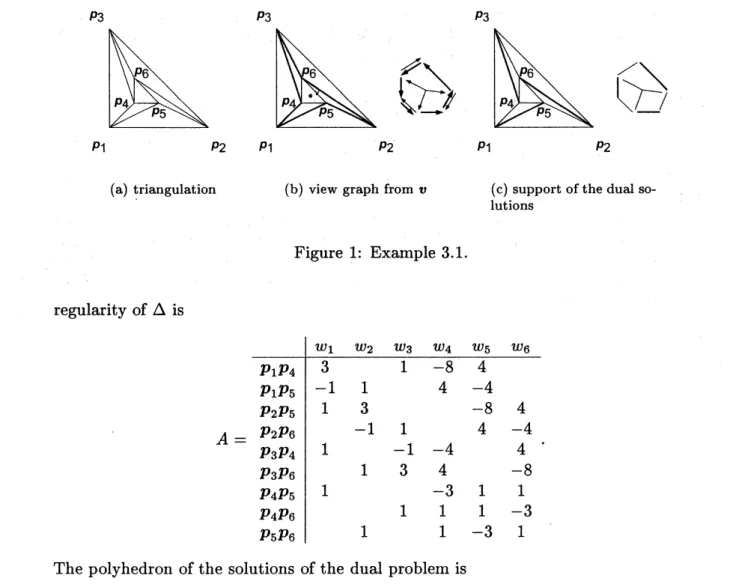
Example 3.1 (A nonregular triangulation with 6 vertices). For the point
con-figuration
$p_{1}=(00)$, $p_{2}=(40)$, $p_{3}=(04)$, $p_{4}=(11)$, $p_{5}=(21)$, $p_{6}=(12)$,
we
consider the triangulation $\Delta$ indicated in Figure $1(\mathrm{a})$ below. The graph $G_{v}$ viewedfrom$v=( \frac{4}{3}\frac{4}{3})$ is in Figure 1(b). It has one contradicting cycle$p_{1}p_{4}p_{5},p1p_{2}p_{5},p2p_{5}p_{6}$,
$p_{2}p_{3}p_{6},p_{3}p_{4}p6’ p1p_{3}p_{4},p1p_{4}p_{5}$ denoted by bold edges. The matrix representing the
$(_{\backslash }\tau_{arrow}f\nearrow\nearrow\backslash _{\mathit{1}}$ $(>_{-}^{\backslash _{/}}/$
$\rho_{1}$ $P2$ $\rho\uparrow$ $\rho_{2}$ $\rho_{1}$ $\rho_{2}$
(a) triangulation (b) view graph from$v$ (c) supportof the dual
so-lutions
Figure 1: Example 3.1.
regularity of$\Delta$ is
$A=$
.
The polyhedron of the solutions of the dual problem is
$\{u\geq 0 : Au=0\}=\mathbb{R}\geq 0(010110000)$,
where interior 1-simplices are indexed lexicographically. The support of the
nonzero
solutions is denote by bold edges in Figure $1(\mathrm{c})$
.
Remark that theyare
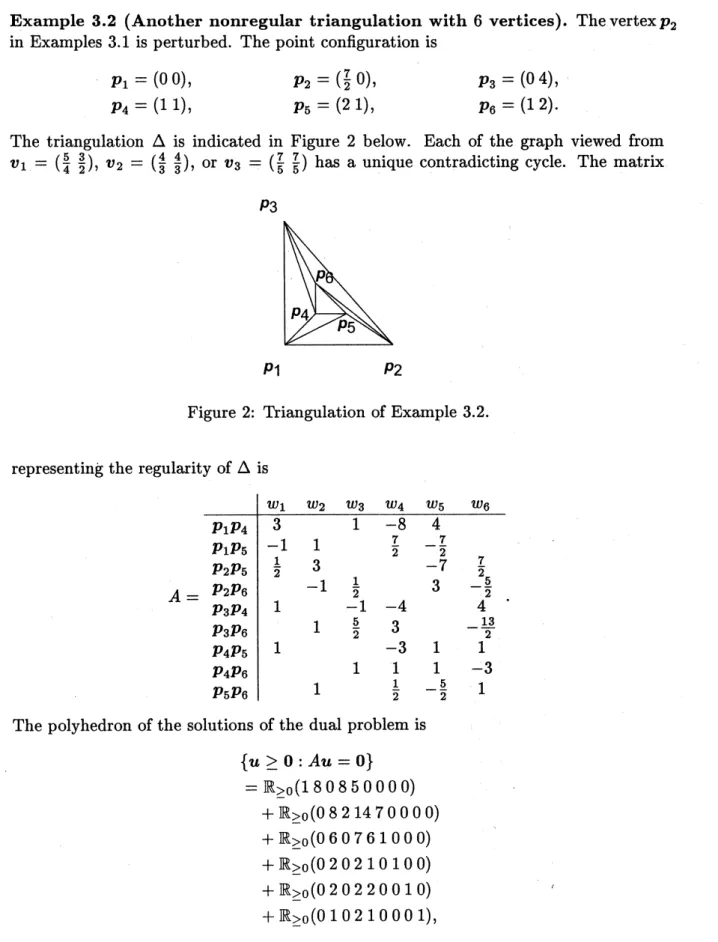
included in theExample 3.2 (Another nonregular triangulation with 6 vertices). Thevertex$p_{2}$
in Examples 3.1 is perturbed. The point configuration is
$p_{1}=(00)$
,
$p_{2}=( \frac{7}{2}0)$, $p_{3}=(04)$,
$p_{4}=(11)$
,
$p_{5}=(21)$,
$p_{6}=(12)$.
The triangulation $\Delta$ is indicated in Figure 2 below. Each of the graph viewed from
$v_{1}=( \frac{5}{4}\frac{3}{2}),$ $v_{2}=( \frac{4}{3}\frac{4}{3})$,
or
$v_{3}=( \frac{7}{5}\frac{7}{5})$ hasa
unique contradicting cycle. The matrix $p_{3}$$p$
$\rho_{4}$ $p_{5}$
$\rho_{1}$ $\rho_{2}$
Figure 2: Triangulation ofExample 3.2.
representing the regularity of$\Delta$ is
$A=$
.
The polyhedron ofthe solutions ofthe dual problem is
$\{u\geq 0: Au=0\}$ $=\mathbb{R}\geq 0(180850000)$ $+\mathbb{R}\geq 0(0821470000)$ $+\mathbb{R}0(\geq 060761000)$ $+\mathbb{R}_{\geq 0}(020210100)$ $+\mathbb{R}0(\geq 020220010)$ $+\mathbb{R}\geq 0(010210001)$
,
where interior 1-simplices
are
indexed lexicographically. The first three 1-rayscorre-spond to the solutions made by the contradicting cycles in view graphs $G_{v_{1}},$$G_{v_{2}},$$G_{v_{3}}$,
Example 3.3 (Counterexample to the reverse of the
main
theorem).With
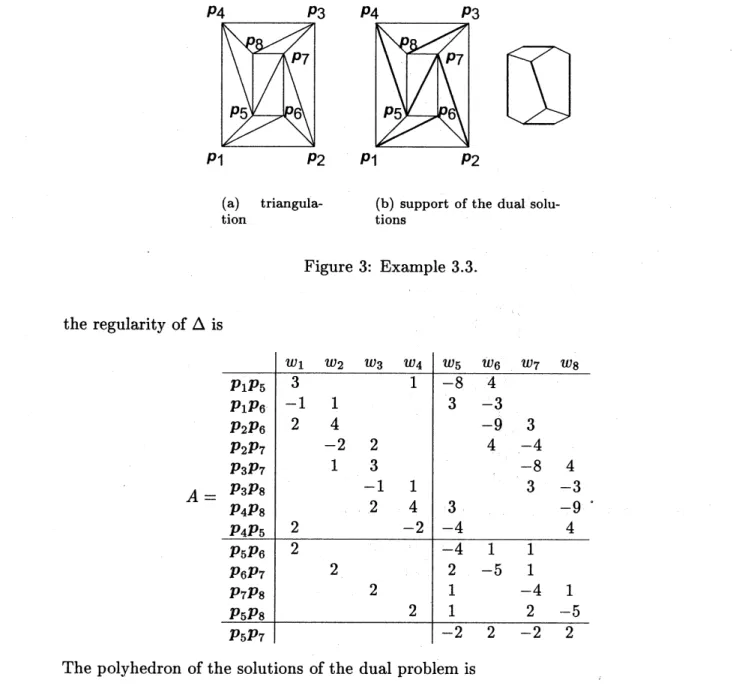
thepoint configuration
$p_{1}=(00)$, $p_{2}=(30)$, $p_{3}=(34)$, $p_{4}=(04)$, $p_{5}=(11)$, $p_{6}=(21)$, $p_{7}=(23)$, $p_{8}=(13)$,
the triangulation $\Delta$ indicated in Figure
$3(\mathrm{a})$ below is
a
nonregular triangulation withnone
ofits view graphs $G_{v}$ containinga
contradicting cycle. The matrix representing(a) triangula- (b) support of the dual solu-tion tions
Figure 3: Example 3.3.
the regularity of $\Delta$ is
The polyhedron ofthe solutions of the dual problem is
$\{u\geq 0 : Au--\mathrm{O}\}=\mathbb{R}\geq 0(0201020100001)$,
where interior 1-simplices are indexed lexicographically. The support of the nonzero
solutions is denote by bold edges in Figure $3(\mathrm{b})$
.
Ifa
contradicting cycle existed forunderlying undirected counterpart). However, there
are no
cycles containing all of thesebold edges. Hence, there exists
no
view graph $G_{v}$ containinga
contradicting cycle forthis example. (Remark: If
we
take the edge $p_{6}p_{8}$ instead of $p_{5}p_{7}$, thisnew
flippedtriangulation becomes regular.)
Acknowledgments
The author thanks Kenji Kashiwabara for bringing the problem to the author’s
inter-est, and Herv\’e Br\"onnimann, Masahiro Hachimori, Hiroshi Imai, Mary Inaba, Francisco
Santos, and Akihisa Tamura for comments and encouragements.
References
[1]
JESU’S
A. DE LOERA, SERKAN HO\S TEN, FRANCISCO SANTOS, AND BERNDSTURMFELS, The polytope of all triangulations of
a
point configuration, Doc.Math., 1 (1996) 103-119.
[2] HERBERT EDELSBRUNNER, Algorithms in combinatorial geometry,
Springer-Verlag, Berlin, 1987.
[3] HERBERT EDELSBRUNNER, An acyclicity theorem for cell complexes in d
dimen-sion, Combinatorica, 10 (1990) 251-260.
[4] ISRAEL M. GELFAND, MIKHAIL M. KAPRANOV, AND ANDREI V. ZELEVINSKY,
Discriminants, resultants and multidimensionaldeterminants,
Birkh\"auser,
Boston,1994.
[5] ISRAEL M. GEL’FAND, ANDREI V. $\mathrm{z}_{\mathrm{E}\mathrm{L}\mathrm{E}\mathrm{v}\mathrm{I}\mathrm{N}\mathrm{s}}\mathrm{K}\mathrm{I}\mathrm{I},$ AND MIKHAIL M. KAPRANOV,
Newton polyhedra of principal
A-d.eterminants,
Soviet Math. Dokl., 40 (1990)278-281.
[6] HIDEFUMI OHSUGI AND TAKAYUKI HIBI, A normal (0,$1)$-polytope
none
ofwhoseregular triangulationsis unimodular, Discrete Comput. Geom., 21 (1999)
201-204.
[7] FRANCISCO SANTOS, A point configuration whose space of
triangulat.ions
isdis-connected, J. Amer. Math. Soc., 13 (2000)
611-637.
[8] BERND STURMFELS, Gr\"obner bases of toric varieties,
iT\^ohoku
Math. J., 43 (1991)249-261.
[9] BERND STURMFELS, Gr\"obnerbases and convexpolytopes, American Mathematical
Society, Providence, RI, 1996.
[10] G\"UNTER M. ZIEGLER, Lectures onpolytopes, Springer-Verlag,