THE
CONTINUATION
OF
HOLOMORPHIC SOLUTIONS
TO
CONVOLUTION
EQUATIONS IN
COMPLEX
DOMAINS
Rvuichi
ISHIMURA,
Jun-ichi
OKADA,
Yasunori
OKADA
(
石面
F-z(\mp --
岡田純
-/
岡田郎即
])
1
Introduction
First ofall, The problem of analytic continuation of the solutions toa
ho-mogeneous linear partial differential equation with constant coefficients was
considered by Kiselman [7]. He proved that the directions to whom every
solution is analytically continued
are
determined by its characteristic set. (See also Zerner [12].) After that, under an additional hypothesis, $\mathrm{S}6\mathrm{b}\mathrm{b}\mathrm{a}\mathrm{r}$[11] extended the method of [7] to the
case
of local differential operators of infinite order with constant coefficients. Motivated by [11], Aoki [1] proveda
local continuation theorem for the general differential operators of infinite order with variable coefficients, using his theory of exponential calculus for pseudo-differential operators. In the case of convolution equation with ahyperfunction kernel defined in tube domains invariants by any real
trans-lations, Ishimura and Y. Okada [2] proved that the directions to whom not
every solution can be continued at
once were
contained to the characteristicset of the operator, by using the method developped by [7] and [11].
In this talk,
we
consider the homogeneous convolution equation $S*f=0$ with an analytic functional $S$ and study the analytic continuation of thesolution $f$.
We refer to [5] for the details and the proof.
2
The
characteristic set
and the condition (S)
In this section, weshall introduce the characteristic set and the condition
$(S)_{\zeta_{0}}$. For anyopenset$\omega\subset \mathbb{C}^{n}$,
we
denote by$\mathcal{O}(\omega)$ thespace ofholomorphicthat $S$ is supported by a compact
convex
set $K\subset \mathbb{C}^{n}.\hat{S}$denote itsFourier-Borel-transform
$\hat{S}(\zeta)=<S,$$\exp(z\cdot\zeta)>_{z}$, (2.1)
which is an entire function of exponential type satisfying the following esti-mate (the theorem ofPoly\‘a-Ehrenpreis-Martineau). For every$\epsilon$, we cantake
a
constant $C_{\epsilon}>0$ such that$|\hat{S}(\zeta)|\leqq C_{\epsilon}\exp(H_{K}(\zeta)+\epsilon|\zeta|)$, (2.2)
where $H_{K}(\zeta)=\mathrm{s}\mathrm{u}\mathrm{p}{\rm Re}<z,$ $\zeta>\mathrm{i}\mathrm{s}$ the supporting function of$K$.
$z\in K$
For a set $A\subset \mathbb{C}^{n}$, we set $A^{a}=-A.$
we
define the convolution operator$S*\mathrm{b}\mathrm{y}$
$(S*f)(Z)=<S,$ $f(z-w)>_{w}$ for $f\in O(\omega+K^{a})$, (2.3)
and consider the homogeneous convolution equation
$S*f=0$. (2.4)
We define the sphere at infinity
$S_{\infty}^{2n-1}=(\mathbb{C}^{n}\backslash \{0\})/\mathbb{R}_{+}$
and denote by $\zeta\infty$ the equivalent class of $\zeta\in \mathbb{C}^{n}\backslash \{0\}$. We consider the
compactification with directions
$\mathrm{D}^{2n}=\mathbb{C}^{n}\mathrm{u}s^{2n}\infty-1$
$\mathrm{o}\mathrm{f}\mathbb{C}^{n}$.
Let $f(\zeta)$ be
an
entire function of exponential type. In accordance withLelong and Gruman [9],
we
define the growth indicator of $f$ by$h_{f}( \zeta)=\lim_{rarrow}\sup_{\infty}\frac{\log|f(r\zeta)|}{r}$, (2.5)
and the regularized growth indicator of $f$ by
$h_{f}^{*}( \zeta)=\lim_{arrow\zeta},\sup_{\zeta}hf(\zeta)$. (2.6)
As in [2], and generalizing to the present case, we define the characteristic set of$S*$:
Definition 2.1. We set
$\mathrm{C}\mathrm{h}\mathrm{a}\mathrm{r}_{\infty}(s*)=\mathrm{t}\mathrm{h}\mathrm{e}$ complement of
{
$\tau\infty\in S_{\infty}^{2n-1}$ ;for every $\epsilon>0$, there exist $N>0$ and $\delta>0$ such that
for any $r>N$ and ( $\in \mathbb{C}^{n}$ satisfying $| \zeta-\frac{\tau}{|\tau|}|<\delta$,
we have $|S^{\mathrm{A}}(r\zeta)|\geqq\exp(h_{\hat{S}}^{*}(\zeta)-\epsilon)r\}$
and call it the characteristic set ofthe operator $S*$.
Nowwerecall thedefinitionof the condition (S), originally dueto T. Kawai [6] and was defined in a direction in [4].
Definition 2.2. We say that an entire function $f$ of exponential type
satis-fies the condition (S) at direction $\zeta_{0}\in \mathbb{C}^{n}\backslash \{0\}$, if it satisfies the following:
$(S)_{\zeta_{0}}$ $\{|\mathrm{f}_{0}\mathrm{r}\mathrm{a}\mathrm{n}\mathrm{y}r>N,\mathrm{W}\mathrm{e}\mathrm{h}\mathrm{a}\mathrm{v}\mathrm{e}\mathrm{F}_{0}\mathrm{r}\mathrm{e}\mathrm{V}\mathrm{e}\mathrm{r}\mathrm{y}\mathcal{E}\zeta-\zeta 0|<\epsilon,|f(r>0,\mathrm{t}\zeta)\mathrm{h}\mathrm{e}|\geqq \mathrm{e}\mathrm{x}\zeta\in \mathbb{C}n\mathrm{a}\mathrm{S}\mathrm{t}\mathrm{i}\mathrm{S}\mathrm{f}\mathrm{y}\mathrm{i}\mathrm{n}\mathrm{r}\mathrm{e}\mathrm{e}\mathrm{X}\mathrm{i}\mathrm{p}(h^{*}(f\zeta 0)-\mathrm{s}\mathrm{i}\mathrm{t}\mathrm{s}N>0\mathrm{S})\epsilon r.\mathrm{h}\mathrm{u}\mathrm{c}\mathrm{g}$
that
Remark. This condition is equivalent to the condition of regular growth
whichis the classialc notion in the theory ofentire functions (see [4]).
Remark. By (2.2) and (2.6),
we
have in general $h_{\hat{S}}^{*}(\zeta)\leqq H_{K}(\zeta)$. Hereafterwe
shall make assumption $h_{\hat{S}}^{*}(\zeta)\equiv H_{K}(\zeta)$. For openconvex
domains, thiscondition and the condition $(S)$
are
, in a sense, necessary and sufficientconditions for the solvability of inhomogeneous convolution equation $S*f=$
$g$. See Krivosheev [8] for the
more
precise statement.3
Main
theorem and example
For the characteristic set $\mathrm{C}\mathrm{h}\mathrm{a}\mathrm{r}_{\infty}(S*)$ and an open
convex
set $\omega\subset \mathbb{C}^{n}$, weset
$\Omega=\mathrm{t}\mathrm{h}\mathrm{e}$ interior of $(\zeta\infty\in \mathrm{C}\mathrm{h}\mathrm{a}\mathrm{n}\{\mathrm{r}\infty(s_{)}*az\in \mathbb{C}^{n} ; {\rm Re}<z, \zeta>\leqq H_{\omega}(\zeta)\})$
.
$(3.1)$Our main theorem is the following:
Theorem 3.1. Let $K\subset \mathbb{C}^{n}$ be a compact convex set and $S$ an analytic
functional
supported by K. We suppose that $S$satisfies
the condition $(S)_{\zeta 0}$in any directions in$\mathbb{C}^{n}$ and $h_{\hat{S}}^{*}(\zeta)\equiv H_{K}(\zeta)$. For an open convex set$\omega\subset \mathbb{C}^{n}$,
we
define
the open set $\Omega$ by (3.1). Then every holomorphic solution $f$ toExample. Let $\Lambda=\{\lambda_{1}, \lambda_{2}, \ldots, \lambda_{l}\}$ be a finite set in $\mathbb{C}^{n},$ $K$ its convex-hull
and$p_{j}(\zeta)$ an entire function of minimal type for $1\leqq j\leqq l$. For the analytic
functional $S$, we suppose its Fourier-Borel transform $\hat{S}=\sum_{j=1}^{l}p_{j}(\zeta)\exp<$ $\zeta,$$\lambda>$. Then $S$ is supported by $K$ and by Ronkin [10] and by [4], we also
know $h_{\hat{S}}^{*}(\zeta)\equiv H_{K}(\zeta)$and that
$\hat{S}$
satisfies the condition $(S)_{\zeta_{0}}$ in anydirections
in $\mathbb{C}^{n}$. Therefore this analytic functional $S$ satisfies all hypothesis of the
theorem above.
In particular, in
case
where$p_{j}’ \mathrm{s}$ areelliptic, that is to say, its characteristicset is empty,
we can
prove that the characteristic set $\mathrm{C}\mathrm{h}\mathrm{a}\mathrm{r}_{\infty}(S*)$ coincideswith the following:
$\{\zeta\infty\in S_{\infty}^{2n}-1 ; \#\{j ; {\rm Re}<\zeta, \lambda_{j}>=H_{K}(\zeta)\}\geqq 2\}$ .
See [3] for
more
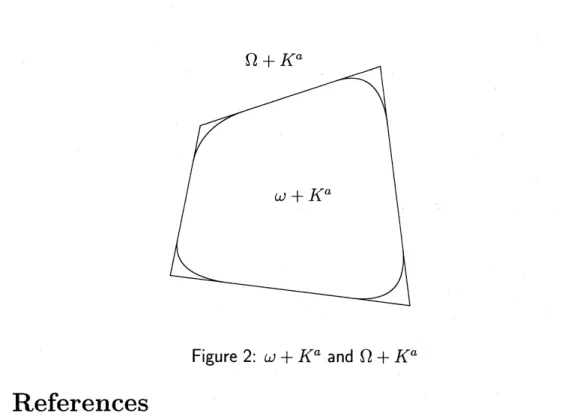
detailed results. In the case of $n=1,$ $l=4$ and $K=$the convex-hull of $\Lambda$, the figures are the following:
$\mathrm{F}_{\mathrm{I}}\mathrm{g}\mathrm{u}\mathrm{r}\mathrm{e}1$: $K^{a}$, Char$(s*)^{a}$ and $\omega$
In this case, we remark
$\mathrm{C}\mathrm{h}\mathrm{a}\mathrm{r}_{\infty}(s*)=\mathrm{t}\mathrm{h}\mathrm{e}$exterior normal directions $\{n_{1}\infty, n_{2}\infty, n_{3}\infty, n_{4}\infty\}$.
In Figure 2, every solution $f\in O(\omega+K^{a})$ of $S*f=0$ can be analytically
Figure
2:
$\omega+K^{a}$ and $\Omega+K^{a}$References
[1] T. Aoki, Existence and continuation
of
holomorphic solutionsof
dif-ferential
equationsof infinite
order, Adv. in Math., 72(1988), 261-283.
[2] R. Ishimura and Y. Okada, The existence and the continuation
of
holo-morphic solutionsfor
convolution equations in tube domais, Bull. Soc.math. France, 122(1994), 413–433.
[3] R. Ishimura and Y. Okada, Examples
of
convolution operators with described characteristics, in preparation.[4] R. Ishimura and J. Okada, Sur la condition (S) de Kawai etla propri\’et\’e de croissance r\’eguli\‘ere d’une
fonction
sous-harmonique etd’unefonction
enti\‘ere, Kyushu J. Math., 48(1994), 257–263.
[5] R. Ishimura, J. Okada, and Y. Okada, The continuation
of
holomorphicsolutions to convolution equations in complex domains, preprint.
[6] T. Kawai, On the theory
of
Fourier hyperfunctions and its applications to partialdifferential
equations with constant coefficients, J. Fac. Sci. Univ. Tokyo, Sect. IA Math., 17(1970),467–517.
[7] C. O. Kiselman, Prolongement des solutions d’une \’equation auxd\’eriv\’ees
partielles \‘a
coefficients
constants, Bull. Soc. Math. France, 97, 1969, p.[8] A. S. Krivosheev, A criterion
for
the solvabilityof
nonhomogeneouscon-volution equations in
convex
domain8of
$\mathrm{C}^{n}$, Math. USSRIzv., 36(1991),497–517.
[9] P. Lelong and L. Gruman, Entire
functions of
several complex variables,Grung. Math. Wiss., Berlin, Hidelberg, New York, Springer vo1.282,
1986.
[10] L. I. Ronkin, Functions
of
completely regular growth, MIA, Kluwer,1992.
[11] A. S\’ebbar, Prolongement des solutions holomorphes de certains op\’erateurs
diff\’erentiels
d’ordreinfini
\‘acoefficients
constants, Se’minaire Lelong-Skoda, LNM822, Springer, Berlin $(1980),199-220$.[12] M. Zerner, Domaines d’holomorphie des
fonctions
v\’erifiant
une $\acute{e}quati_{on}$aux d\’eriv\’ees partielles, C. R. Acad. Sc., Paris, 272(1971),
1646–1648.
Ryuichi
ISHIMURA
Department of Mathematics and Informatics, Faculty of Sciences, Chiba University
Yayoi-cho, Inage-ku, Chiba 263-8522, Japan
$E$-mail address: [email protected]
Jun-ichi
OKADA
Institute of Natural Sciences,
Yayoi-cho, Inage-ku, Chiba 263-8522, Japan
$E$-mail addre8S: [email protected]
Yasunori
OKADA
Department of Mathematics and Informatics,
Faculty ofSciences, Chiba University
Yayoi-cho, Inage-ku, Chiba 263-8522, Japan