A
Simple Near Optimal Parallel Algorithm for Recognizing
Outerplanar Graphs
Shin-ichi
Nakayama (中山慎–) Shigeru Masuyama (増山繁)Department of
Knowledge-Based
Information Engineering, Toyohashi University of TechnologyToyohashi-shi, Aichi 441, Japan
E–mail: [email protected], [email protected]
Abstract. Anouterplanargraph isa graph whichcanbeembedded inthe planesothat allverticeslieonthe boundary of theexteriorface. Inthis paper, wepropose asimple
near optimal parallel algorithm forrecognizingwhether a givengraph$G$isouterplanar
in $O(\log n)$ time using $O(n\alpha(l, n)/\log n)$ processors on an arbitrary-CRCW PRAM
where $n$ is the number of vertices in $G,$ $\alpha(l, n)$ is the inverse Ackermann function,
which growsextremely slowly with respect to $l$ and $n[9]$ and $l=O(n)$. Although a
near optimal parallel algorithmfor general graphs can also beobtained bycombining the algorithm in [3] with the algorithm for finding biconnected $\mathrm{c}\mathrm{o}\mathrm{m}_{\mathrm{P}}\mathrm{o}\mathrm{n}\mathrm{e}\mathrm{n}\mathrm{t}\mathrm{s}[4][9]$ , our
algorithmuses methods completely different from the algorithm in $[3]’ \mathrm{s}$ and is much
simpler than $[3])\mathrm{s}$.
1
Introduction
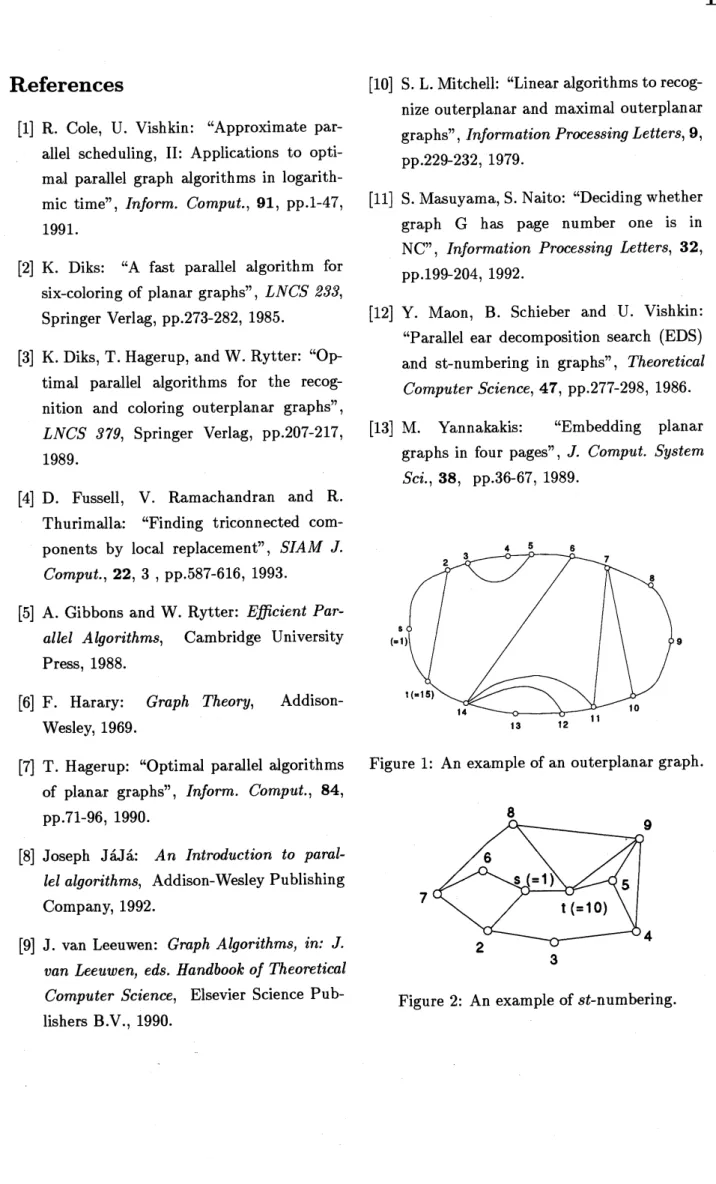
An outerplanar graph is an undirected graph which can be embedded in the plane in such a way that all vertices lie on the exterior face(, see Fig. 1). A graph always denotes an undirected graph throughout this paper, except when it is specified to be directed. For outerplanar graphs, several efficient algorithms for solving
important problems e.g., vertex-coloring, edge-coloring, longest path, are known $[9][5]$
.
Fur-thermore, it is well-known that a given graph is outerplanar if and only if a given graph has
pagenumberone, wheregraph$G$haspage
num-ber one if there exists a linear arrangement of verticesso that no pair of edges is crossing when they are drawn on the same side of the lin-ear arrangement of the vertices $[13][11]$
.
Theproblem of deciding whether a given graph has
pagenumberone is the special case of the book embedding, whose application to fault-tolerant VLSI design is described e.g., in the introduc-tion of [13]. Thus, it is useful to develop effi-cient algorithms for recognizing whether a given graph is outerplanar or not.
Mitchell [10] proposed an $O(n)$ sequential
algorithm for recognizing outerplanar graphs where $n$ is the number of vertices in $G$
.
Thesequential algorithm removes a vertex $v$
sat-isfying some properties from a given graph $G$
step by step, and cannot straightforwardly be
applied to develop an efficient parallel algo-rithm. Diks, Hagerup and Rytter [3] devel-oped a parallel algorithm for recognizing
out-erplanar graphs. When an input graph is bi-connected, the algorithm [3] runs in $O(\log n)$
time using $O(n/\log n)$ processors on a CRCW
PRAM (, see e.g., [8]), where $n$ is the
num-ber of vertices in $G$
.
However, when an inputgraph is a general graph, we need to find bi-connectedcomponentsbefore applying the algo-rithm [3] to each biconnected component. The best known parallel algorithm for finding bicon-nected components runs in $O(\log n)$ time
us-ing $O((n+m)\alpha(m, n)/\log n)$ processors on the
arbitrary-CRCW PRAM [4] [9] where $m$ is the number of edges and $\alpha(m, n)$ is theinverse
Ack-ermannfunction, which growsextremely slowly
with respect to $m$ and $n[9]$
.
\dagger Thearbitrary-CRCW PRAM is defined by the property that when several processorstry towrite tothesame memory cell in the same step, then exactly one of them succeeds [8]. As outerplanar graphs haveat most $2n-3$edges [10], by checking this fact first, we can find biconnected components
in $O(\log n)$time using$O(n\alpha(l, n)/\log n)$
proces-sors on the arbitrary-CRCW PRAM where $l=$ $O(n)$
.
Thus, the algorithm [3] combined withthe algorithm for finding biconnected
compo-nents [4] [9] takes, in total, $O(\log n)$ time using $O(n\alpha(l, n)/\log n)$ processors on the
arbitrary-CRCWPRAM, when appliedtogeneral graphs. Similarly, on a CREW PRAM(, see e.g., [8]),
the complexityofparallel algorithm [3] is
domi-natedby
fin.
ding $\mathrm{b}\mathrm{i}_{\mathrm{C}\mathrm{O}}\mathrm{n}.\mathrm{n}$ectedcomponents,whenapplied to general graphs.
In this paper, we present a simple near
optimal parallel algorithm for recognizing
outerplanar graphs in $O(\log n)$ time using
\dagger Ifthe class of input graphs is linearly contractible graph class [7] such as the class of planargraphs, an
optimal parallelalgorithm for finding biconnected
com-ponentsthatruns in$O(\log n)$time using$O(n/\log n)$ pro-cessors on the arbitrary-CRCW PRAM exists [7].
How-ever, this algorithm does not work for general graphs.
$O(n\alpha(l, n)/\log n)$ processors on the
arbitrary-CRCW PRAM, in the sense that $O(\log n)\cross$ $O(n\alpha(l, n)/\log n)=O(n\alpha(l, n))$ is almost
lin-ear with respect to $n$
.
Although anear optimalparallelalgorithm for general graphs can also be obtained bycombining the algorithm in [3] with the algorithm in [4] [9],our algorithm uses meth-ods completely different from the algorithm in
$[3]’ \mathrm{s}$, e.g., the well known $st$-numbering, and is
much simpler than $[3]’ \mathrm{s}$
.
2
Definitions
Given an undirected connected graph $G=$
(V,$E$) having no multiple edges. A path $P$
from $v_{0}$ to $v_{k}$ in $G$ is a finite non-null
se-quence $v_{0},$$e_{1},$$v_{1},$$e2,$ $v2,$$\cdots,$$e_{k},$ $v_{k},$ $v_{i}\in V,$ $i=$
$0,1,$ $\cdots,$$k,$ $e_{j}\in E,$ $j=1,2,$$\cdots,$$k$, such that,
for $1\leq i\leq k$, the end vertices of $e_{i}$ are $v_{i-1}$
and $v_{i}$, respectively. If $v_{0}=v_{k}$, then path $P$ is
a circuit.
A biconnected graph $G$ is a connected graph
whichhasnovertex$v$suchthat$G-v$ (thegraph
obtained byremoving$v$from $G$) hasatleasttwo
connected components. A biconnected
outer-planar graph hasa planar embedding consisting of a circuit bounding the exterior face, where
(possibly) a number of non-crossing edges are embedded within the interior region of this cir-cuit [5]. Edges on the boundary of the exterior face are called sides, while the other edges are called diagonals [5].
Next, we describe the $st$-numbering used in our parallel algorithm.
Definition 1 [12] An $st$-numbering is a one-to-onefunction $f$from$V$to$\{1, \cdots, n\}$ satisfying the following twoconditions :
(ii) for each $v\in V-\{s,t\}$, there exist
adja-centvertices$v_{1}$ and$v_{2}$such that$f(v_{1})<f(v)<$
$f(v_{2})$
.
Fig. 2 illustrates $st$-numbering. The st-numbering is used as an indispensable
compo-nent in several algorithms [12]. We have the following theorem.
Theorem 1 [$\mathit{1}\mathit{2}f$ A graph $G$ is biconnected
if
and onlyif
it has an $st$-numbering by letting$s=u$ and $t=v$
for
each edge $(u, v)$.
(Note 2.1) If graph $G$ is biconnected, its
st-numbering can be obtained in $O(\log n)$ time
using $O((n+m)\alpha(m, n)/\log n)$ processors [4]
where $n$ (resp., $m$) is the number of vertices
(resp., edges) in $G$ and $\alpha(m, n)$ is the inverse Ackermann function.
3
The
Parallel
Algorithm
We first assumethat the given graph $G$is
bicon-nected. We shall describe how to treat general graphs at the end of this section. The following theorems characterize outerplanar graphs. Theorem 2 $f\theta$] Given graph $G=(V, E),$ $G$
is outerplanar
if
and onlyif
$G$ has no subgmphhomeomorphic to either $K_{4}$ or $K_{2,3}$, where $K_{4}$
is the complete graph on
four
vertices and $K_{2,3}$is the graph illustrated in Fig. 3. $\square$
Theorem 3 $f\mathit{1}\mathit{0}f$ An outerplanar graph $G$
with $n(\geq 3)$ vertices has (i) at most $2n-3$ edges,
(ii) at least two vertices
of
degree 2. $\square$Our parallel algorithm first checks, based on Theorem 3, if $G$ has at most $2n-3$ edges and
at least two vertices of degree 2. Then, this al-gorithm chooses a vertex $v$ of degree 2 and a
vertex $v’$ incident to $v$; regards $v$ (resp., $v’$) as $s$ (resp., $t$) and finds $st$-numbering of $G$
.
Notethat, by Note 2.1 just after Theorem 1, we can find $st$-numbering of $G$ because $G$ is assumed
to be biconnected. When $G$ is outerplanar,
ex-actly one Hamiltonian circuit always exists in
$G$, and the edges constructing the Hamiltonian
circuit can be regarded as sides of the
outerpla-nar graph $[2][5]$
.
Consequently, the above $\mathrm{p}\mathrm{r}\mathrm{c}\succ$cess finds the sides by the following lemma. In the following, suppose that the vertices in$G$ are
numbered from 1 to $n$ by$st$-numbering where$s$
is avertexofdegree 2 and $t$ is a vertex incident
to $s$ and each vertex in $G$ is identified with its
vertexnumber.
Lemma 1
If
$G$ is outerplanar; then alledges$(i, i+1),$ $i=1,$$\cdots,$$n-1$, are in $G$
.
(proof) We shall show that, if$G$ does not have
some edge among $(\dot{i}, i+1),$ $i=1,$$\cdots,$$n-1$,
then $G$ is not outerplanar. Assume that
ver-tex $i$ is not incident to vertex $\mathrm{i}+1$
.
By thedefinition of $st$-numbering, each vertex $x,$ $x=$
$2,$$\cdots,$$n-1$, must be incidentto avertexwhose
number is less than $x$ and to a vertex whose
number is more than $x$, respectively. By this
fact and the connectivity of $G,$ $G$ has simple
path $P_{i,s}$ $=i,j_{1},j_{2},$$\cdots,j\iota,$$s$, $(l\geq 1)$ where
$i>j_{1}>j_{2}>\cdots>j_{l}>1(=s)$
.
Vertex 1$(=s)$ is adjacent to exactly two vertices $n(=t)$
and 2 by definition, so $j_{l}$ of $P_{i,s}$ must be 2$($,
see Fig. 4). Similarly, for $\mathrm{i}+1$, simple path
$P_{i+1,s}$ $=i+1,j_{1}’,j_{2}’,$$\cdot\cdot,$$,j’\iota$
” $s,$ $(l’\geq 1)$ where
$i+1>j_{1}’>j_{2}’>\cdots>2(=j_{\iota’},)>1(=s)$exists.
Moreover, bythefact that eachvertex$x,$ $x=$
whose number is more than $x,$ $G$ has simple
paths$P_{i,t}=i,$$k_{1},$ $k_{2},$$\cdots,t$, where$i<k_{1}<k_{2}<$
$<t(=n)$, and $P_{i+1,t}=i+1,$$k_{1’ 2}’k’,$$\cdots,$$t$,
where $i+1<k_{1}’<k_{2}’<\cdots<t(=n)$
.
Since $t>\cdots>k_{2}>k_{1}>i>j_{1}>j_{2}>$ $>j_{l}>1(=s),$ $P_{i,t}$ and $P_{i,s}$ share no vertex
except $i$
.
Similarly, $P_{i,t}$ and$P_{i+1,s},$ $P_{i+1,t}$ and
$P_{i,s},$ $P_{i+1,t}$ and $P_{i+1,s}$ share no vertex except $i$,
$\dot{i}+1$
.
$G^{*}$, constructed by $P_{i},,$${}_{s}P_{i+1},S’ Pi,t$ and$P_{i+1,t}$, has a subgraph homeomorphic to $K_{2,3}$
(, see Fig 4). Hence, $G$ is not outerplanar by
Theorem 2, which however contradicts the
as-sumption that $G$ is outerplanar. Thus we have
shown that if $G$ is outerplanar, then $G$ has all
edges $(i,\dot{i}+1),$ $i=1,$$\cdots$,$n-1$
.
$\square$By Lemma 1, if at least one edge among
$(i, i+1),$ $i=1,$$\cdots,$$n-1$, does not exist in $G$, then the algorithm stops since $G$is not
out-erplanar, otherwise the edges $(i, i+1),$ $i=$
$1,$$\cdots,$$n-1$, and $(n, 1)$ construct a Hamiltonian
circuit $C$
.
We regard the edges constructing $C$as sides of the outerplanar graph. (Note that if $G$ is outerplanar, Hamiltonian circuit $C$ is
unique [5]. )
We assume that $C$ is embedded in the plane
so that each edge of$C$ bound the exterior face and the edges of
$G-C(G-C$
denotes the graph obtained by removing edges of $C$ from $G)$ are embedded within the interior region of $C$.
The edges of$G-C$ are called $di,a$gonals of$G$
.
If the diagonals do not intersect each otheronsuch embedded edges, then$G$is outerplanar,
otherwise $G$ is not outerplanar.
Tosee this, weexecute the following process. Hereafter, we identify each vertex with its
ver-tex number assigned by st-numbering.
Let$M(i),$$i=1,$ $\cdots,$ $n$, be an array such that
$M(i)$ contains vertex$j_{0}$ where $j_{0} \equiv\min\{j|j$
is the endpoint of diagonals adjacent to $i$
}.
If there is no diagonal incident to $i,$ $M(i)$ has
a value $+\infty$ where $+\infty$ is a sufficiently large
number $\mathrm{s}\mathrm{a}\mathrm{t}\mathrm{i}\mathrm{s}\mathrm{f}\mathrm{y}\mathrm{i}\mathrm{n}\mathrm{g}+\infty>n$
.
For each diagonal$(x, y)$ such that $x<y$, we execute $val(x, y)arrow$ $\min\{M(i)|x\leq i\leq y\}$ and regard $val(x, y)$
as the value of diagonal $(x,y)$
.
On the value$val(x, y)$ for each diagonal $(x, y)$, we obtain the
following lemma.
Lemma 2 Assume that Hamiltonian circuit $C$ is embedded in the plane so that each edge
of
$C$ bounds the exteriorface
and diagonals are embedded within the interiorregionof
$C$.
The diagonals intersect each other
if
andonlyif
there is a diagonal $(x, y)$, where$x<y$, suchthat the value $val(x, y)$ is less than vertex num-$berx$
.
(proof) $(\Rightarrow)$ Assume that there is a pair of
diagonals which intersect each other. Let $(x, y)$, $(x’, y’)$, where $x<y,$ $x’<y’$ and $x’<x$, be
a pair of intersecting diagonals. As these two diagonals intersect each other, vertex $y’\mathrm{s}\mathrm{a}\mathrm{t}\mathrm{i}_{\mathrm{S}}-$
fies
$x<y’<y$
and is adjacent to diagonal$(x’, y)’$ where $x’<x$ (See Fig. $6(\mathrm{a})$). Hence,
$val(x, y)= \min\{M(i)|x\leq i\leq y\}<x$
.
$(\Leftarrow)$ Assume thatno diagonals intersect each
other. Since no diagonals intersect each other,
each vertex $j$ adjacent to vertex $\dot{i}$, where
$x\leq$
$i\leq y$, satisfies $x\leq j\leq y$ for each diagonal $(x, y)$ where $x<y$ (See Fig. $6(\mathrm{b})$). Hence,
$val(x, y)= \min\{M(i)|x\leq i\leq y\}\geq x$
.
$\square$In the following, we introduce Procedure Recognition for recognizing whether a given graph is outerplanar.
Proced$\mathrm{u}$re Recognition
begin
The list ranking algorithm [8] can handle
steps1,2 in$O(\log n)$timeusing$O(n/\log n)$
pro-(Step 1) if $m>2n-3$,
then print “$G$is not outerplanar” and
stop.
(Step 2) if $G$does not haveatleasttwovertices
ofdegree 2,
then print “$G$is not outerplanar” and
stop.
(Step 3) Choose a vertex $v$ of degree 2 and a
vertex $v’$ incident to $v$; regard $v$ and $v’$ as $s$ and $t$, respectively, and find an
$st$-numbering of$G[12][4]$
.
(Step4) if$G$ does not have at least one edge
among $(i, i+1)$ for all $i,$ $1\leq i\leq$
$n-1$, where $i,$$i+1$ are the vertex
numbers assigned by Step 3,
then print “$G$is not outerplanar” and
stop.
(Step 5) For each vertex $i,$ $i=1,$ $\cdots,$ $n$,
$M( \dot{i})\vdash\min\{j|j$ is the endpoint of
diagonals adjacent to $i$
}.
(Step 6) For each diagonal $e_{j}=(x, y)$ where
$x<y$,
$val(x, y) arrow\min\{M(i)|x\leq i\leq y\}$
(Step 7) if there is a diagonal $(x, y)$, where
$x<y$, such that $val(x, y)<x$, then print “$G$ is not outerplanar”, else print “$G$ is outerplanar”.
end. $\square$
The correctness of Procedure Recognition is obvious by Theorem 3 and Lemmas 1 and 2. We then analyze the computation time and the number of processors required.
The$\mathrm{c}.0$mplexity analysis is done under the
as-sumption that each vertex of theinput graph$G$
has a pointer to its predefined adjacency list,
that is, for each vertex $v\in V$, the vertices
ad-jacent to vertex $v$ are given in a liked list, say, $L[v]=\langle u_{1}, u_{2}, \cdots, u_{d}\rangle$, in some order, where $d$is the degree of$v$ (Fig. $5(\mathrm{a})$). Recall that the
arbitrary-CRCW PRAM is used as a parallel computation model in this paper.
cessors.
Notethat $m=O(n)$ in the following analysis,
assteps 3-7 are executed only when $m\leq 2n-3$
by step 1.
Theparallel algorithm for finding st-numbering runs in$O(\log n)$time using$O((n+m)\alpha(m, n)/\log n)$
processors [4] where $n$ (resp., $m$) is the
num-ber of vertices (resp., edges) in input graphs and $\alpha(m, n)$ is the inverse Ackermann func-tion. Thus, in step 3, finding $st$-numbering of$G$
requires $O(\log n)$ time using $O(n\alpha(l, n)/\log n)$
processors where $l=O(n)$
.
After finding the $st$-numbering, each of the
initial vertex numbers in the adjacency lists
$L[\iota]’ \mathrm{s}$ is replaced by its number assigned by the
$st$-numbering. For this process, we first
trans-form the adjacency lists $L[i]’ \mathrm{s}$ into a linked list
$L’$asfollows. Let a vertex$u_{d}^{i}$ bethe last element
in the adjacency list$L[i]$ of vertex$i$and avertex
$u_{1}^{i+1}$ the first element in $L[i+1]$
.
Each vertex$u_{d}^{i}$ has a pointer to $u_{1}^{i+1}$, for $i=1,$
$\cdots,$ $n-1$,
(See Fig. $5(\mathrm{b})$). We then convert the linked list
$L’$ into an array $A$ by applying the list
rank-ing algorithm [8] which runs in $O(\log n)$ time
using $O(n/\log n)$ processors. And we replace
each of the initial vertex numbers by its
num-ber assigned by$st$-numbering using a standard
technique used to implement Brent’s schedul-ing $\mathrm{p}\mathrm{r}\mathrm{i}\mathrm{n}\mathrm{C}\mathrm{i}_{\mathrm{P}}1\mathrm{e}[5][8]$ as follows. Partition elements
of $A$ into equal-sized blocks $E_{i},$ $i=1$, ,
$|A|/\log n$, where each size is $O(\log n)$
.
Treateach block $E_{i}$ separately, and sequentially
re-place each of the initialvertex numbers belong-ing to block $E_{i}$ by its number assigned by
st-numbering. This process runs in $O(\log n)$ time
Step 4runsin$O(\log n)$ timeusing$O(n/\log n)$
processors by applying Brent’s scheduling
$\mathrm{p}\mathrm{r}\mathrm{i}\mathrm{n}\mathrm{c}\mathrm{i}\mathrm{p}\mathrm{l}\mathrm{e}[5][8]$ stated in step 3.
Let $A[k, k’],$ $1\leq k<k’\leq|A|(=O(n))$ be
an interval between $k$ and $k’$ in $A$
.
Note thatthe elements in $A$ are numbers assigned by
st-numbering. As the degree of each vertex is found in step 2, we can recognize the vertices
adjacent to vertex $v$ as the element in
inter-val $A[k, k’]$ where $1\leq k<k’\leq|A|$
.
Forex-ample, assume that $d_{i}$ is the degree of vertex $i$, the vertices adjacent to vertex 1 are the
ele-ments in $A[1, d_{1}]$, the vertices adjacent to ver-tex2 are the elements in $A[d_{1}+1, d_{1}+d_{2}]$, and
so on. (Note: Given the degree of each
ver-tex, the intervals in $A$ corresponding to vertex
$i$ for $i=1,$
$\cdots,$ $n$, are found in $O(\log n)$ time
using $O(n/\log n)$ processors by applying
prefix-sums algorithm [8]. ) Hence, in step 5, finding each minimum vertex number adjacent to ver-tex$i$ for $i=1,$
$\cdots,$ $n$, can be done by
comput-ing the minimum of interval in $A$ corresponding
to vertex $i$
.
As described in [8]$(\mathrm{p}\mathrm{p}$
.
131-136$)$,after executing a preprocessing algorithm
(AL-GORITHM 3.8 in [8]$)$ which runs in $O(\log n)$
time using $O(n/\log n)$ processors, we can
com-pute the minimum $A_{\min}[k_{i}, k_{i}’]$ of$A[k_{i}, k_{i}’]$, that
is, $\min\{A(k_{i}), A(k_{i}+1), \cdots, A(k_{i}’)\}$, where
1 $\leq$ $k_{i}$ $<$ $k_{i}’$ $\leq$ $|A|$, in $O(1)$ time using
$O(1)$ processors. We need to compute the
minimum $A_{\min}[k_{i}, k’]_{\mathrm{S}}i$’ corresponding to vertex $i,$ $i=1,$ $\cdots,$ $n$
.
Hence, by Brent’sschedul-ing $\mathrm{p}\mathrm{r}\mathrm{i}\mathrm{n}\mathrm{c}\mathrm{i}\mathrm{p}\mathrm{l}\mathrm{e}[5][8]$, we can compute the
mini-mum$A_{\min}[k_{i}, k’]_{\mathrm{S}}i$’ for $i=1,$ $\cdots,$ $n$, in $O(\log n)$
time using $O(n/\log n)$ processors. The total
complexity in step 5 is $O(\log n)$ time using
$O(n/\log n)$ processors.
In step 6, we compute $\min\{M(i)|x\leq$
$i\leq y$ $\}$, where
$x<y$
, for each diagonal$e_{j}=(x, y),$ $j=1,$ $\cdots,$ $k(=O(n))$
.
Since thisprocess is equivalent to the process described in step 5, this can be done in $O(\log n)$ time using
$O(n/\log n)$ processors.
Step 7 takes $O(\log n)$ time using $O(n/\log n)$
processors.
Having assumed that the input graph $G$ is a
biconnected graph sofar, we shalldescribe,
be-fore closing this section, how to decide whether
$G$ is outerplanar when $G$ is a general graph.
We first check if $G$ has at most $2n-3$ edges.
We next find biconnected components, that
is, blocks $B_{1},$ $B_{2},$$\cdots,$$B_{k}$ of $G$ by applying the
algorithm of finding biconnected components
in [4] [9], which runs in $O(\log n)$ time using $O(n\alpha(l, n)/\log n)$ processors. If $G$ is
outerpla-nar, then each of blocks $B_{1},$$B_{2},$ $\cdots$ ,$B_{k}$ is also
outerplanar [2]. Thus, we independently exe-cute Procedure Recognition for each of these blocks $B_{1},$ $B_{2},$$\cdots,$$B_{k}$
.
If a block$B_{i}$ is an edge,then ProcedureRecognition tells that $B_{i}$ is
out-erplanar. When each block $B_{i},$ $i=1,$$\cdots,$$k$,
is outerplanar, we print “$G$is outerplanar” and
stop. By the above-mentioned statements, we
have thefollowing theorem.
Theorem 4 Given a graph $G$ with $n$
ver-tices and $m$ edges, whether $G$ is outerplanar
or not can be decided in $O(\log n)$ time using $O(n\alpha(l, n)/\log n)$ processors on the
arbitrary-CRCW PRAMwhere$\alpha(l, n)$ is the inverse
Ack-ermannfunction, which grows extremely slowly
with respect to $l$ and
References
[1] R. Cole, U. Vishkin: “Approximate
par-allel scheduling, II:
Ap.
plications to opti-mal parallel graph algorithms in logarith-mic time”,Inform.
Comput., 91, PP.1-47,1991.
[2] K. Diks: “A fast parallel algorithm for six-coloring ofplanar graphs”, LNCS 233,
Springer Verlag, pp.273-282, 1985.
[3] K. Diks, T. Hagerup, and W. Rytter: “Op-timal parallel algorithms for the recog-nition and coloring outerplanar graphs”,
LNCS 379, Springer Verlag, pp.207-217,
1989.
[4] D. Fussell, V. Ramachandran and R.
Thurimalla: “Finding triconnected
com-[10] S. L.Mitchell: “Linear algorithmsto recog-nize outerplanar and maximal outerplanar graphs”,
Information
Processing Letters, 9,pp.229-232, 1979.
[11] S. Masuyama,S. Naito: “Decidingwhether graph G has page number one is in
NC”,
Information
Processing Letters, 32,pp.199-204, 1992.
[12] Y. Maon, B. Schieber and U. Vishkin: “Parallel ear decomposition search (EDS) and $\mathrm{s}\mathrm{t}$-numbering in graphs”, Theoretical
ComputerScience, 47, pp.277-298, 1986.
[13] M. Yannakakis: “Embedding planar graphs in four pages”, J. Comput. System Sci., 38, pp.36-67, 1989.
ponents by local replacement”, SIAM J. Comput., 22, 3 , pp.587-616, 1993.
[5] A. Gibbons and W. Rytter:
Efficient
Par-allel Algorithms, Cambridge University
Press, 1988.
[6] F. Harary: Graph Theory,
Addison-Wesley, 1969.
[7] T. Hagerup: “Optimal parallel algorithms of planar graphs”,
Inform.
Comput., 84,pp.71-96, 1990.
Figure 1: An example of an outerplanar graph.
[8] Joseph J\’aJ\’a: An Introduction to paral-lel algorithms, Addison-Wesley Publishing Company, 1992.
[9] J. van Leeuwen: Graph Algorithms, in: J. van Leeuwen, eds. Handbook
of
TheoreticalComputer Science, Elsevier Science Pub-lishers B.V., 1990.
.q-. $K_{00_{-}}$
(a)L (b)L
5: Adiarpnrv liqt.$.\mathrm{q}T,/i$) i
$=1,$ \cdots , n, and linked list $L’$
.
{0’