DIABETES RESEARCH
PUBLISHERS
Open Journal
Attenuated Efficacy of Dulaglutide in Elder Type 2
Diabetes Mellitus (T2DM) Cases
Case Report
Article information
Received: March 30th, 2018; Revised: April 9th, 2018; Accepted: April 11th, 2018; Published: April 11th, 2018
Takako Abe, MD1; Miwako Nakanishi, MD1; Osami Watanabe, MD1; Hiroe Kawano, MD1; Hiroshi Bando, MD, PhD, FACP1,2
1Yoshinogawa Hospital, Tokushima, Japan
2Tokushima University/ Medical Research, Tokushima, Japan
*Corresponding author Hiroshi Bando, MD, PhD, FACP
Instructor, Tokushima University and Medical Research, Nakashowa 1-61, Tokushima 770-0943, Japan; Tel. +81-90-3187-2485; Fax: +81-88-603-1030 E-mail:[email protected]
Cite this article
Abe T, Nakanishi M, Watanabe O, Kawano H, Bando H. Attenuated efficacy of Dulaglutide in elder type 2 diabetes mellitus (T2DM) cases. Diabetes Res Open J. 2018; 4(1): 1-8. doi: 10.17140/DROJ-4-136
ABSTRACT
Copyright 2018 by Bando H. This is an open-access article distributed under Creative Commons Attribution 4.0 International License (CC BY 4.0), which allows to copy, redistribute, remix, transform, and reproduce in any medium or format, even commercially, provided the original work is properly cited. cc
INTRODUCTION
T
he acute increase in type 2 diabetes mellitus (T2DM) is one of the most serious medical problems today. T2DM patients were about 385 million in 2014 and increase to 592 million by 2035.1,2 Furthermore, the global health expenditure for diabeteshas been approximately 11% of total medical spending on adults in the world.1,2 T2DM is characteristic for the deterioration of
pan-creatic β-cell function and insulin resistance in the liver and periph-eral tissues. A combination of these factors, T2DM has an over-production of hepatic blood glucose, elevation of fasting blood glucose, and insufficient glucose uptake by muscle cells which would increase postprandial blood glucose.3 Furthermore, several
pathophysiological impairments have played a role in the progres-sion and development of T2DM, such as liver, muscle, dysfunction of pancreatic α-cells with elevated glucagon value, fat cells with Acute increase of type 2 diabetes mellitus (T2DM) is a serious medical problem. Recently, an agent known as Glucagon-like peptide-1 receptor agonists (GLP-1 RAs) was developed for T2DM which has remarkable efficacy and safety profile. In this article, we reported 2 T2DM cases with dulaglutide treatment, showing interesting clinical course. Case 1 is an 88-year-old man with hypertension, arteriosclerosis and mild cognitive impairment (MCI) without difficulties of Quality of Life (QOL)/Activities in Daily living (ADL) in daily life. He has been rather stable on liraglutide with HbA1c 7.2%. After switching from liraglutide to dulaglutide, HbA1c decreased to 6.7% in 2 months, but later increased to 11.3% in 3 months. C-peptide index (CPI) decreased from 2.5 to 0.8. Case 2 is an 83-year-old man and was treated by degludec with CPI 1.35. After switching to dulaglutide, HbA1c decreased to 7.6% in 2 months, but later increased to 10.3% in 2 months. These two cases revealed similar clinical course. Some possibilities might be speculated, including antibody production, differences of GLP-1 RAs from man-origin or lizard-origin, changes in body weight, a possible complication of renal, hepatic inflammatory influences and the subacute decreased ability of insulin secretion in the β cells. The current report would be useful for treatment of GLP-1 RAs in the future.
Key words
Dulaglutide; Glucagon-like peptide-1 (GLP-1); Incretin; Type 2 diabetes mellitus (T2DM); C-peptide index (CPI); Basal sup-ported oral therapy (BOT).
Abbreviation
GLP-1 RA: Glucagon-Like Peptide-1 Receptor Analogue; GLP-1: Glucagon-Like Peptide-1; T2DM: Type 2 Diabetes Mellitus; CPI: C-Peptide Index; BOT: Basal Supported Oral Therapy; BPT: Basal supported post-prandial GLP-1 therapy; HRQOL: Health-Related Quality of Life.
Abe T, et al 2
accelerated lipolysis and kidney with increased glucose reabsorp-tion.1,2
T2DM has a chronic elevation of blood glucose levels, re-sulting in microvascular complications with neuropathy, retinopa-thy, nephroparetinopa-thy, and macrovascular complications with ischemic heart disease, cerebrovascular disease, peripheral arterial disease.4
Therefore, clinical research and therapy have been continued for the achievement of optimal glycemic control associated with opti-mal management of body weight, blood pressure, and lipid levels for years. Recently, several new anti-diabetic medicines have been developed. They have some beneficial effects for lowering HbA1c, body weight, hypoglycemia incidence and others.5
As to the history of endocrinology and diabetes, Elrick and colleagues revealed interesting findings. It was reported that, when an oral glucose tolerance test was conducted on a healthy person, markedly increased insulin secretion was observed com-pared to an intravenous load test.6 From this report, it suggested
the presence of incretin (intestine secretion insulin (INCRETIN)) as a substance that enhances insulin secretion in the intestinal mu-cosa.
Later gastric inhibitory polypeptide (GIP) was identified by purification of intestinal hormone and glucagon-like peptide-1 (GLP-1) showing incretin action was reported.7 Successive studies
revealed the role and mechanism of GLP-1.8
The function of GIP-1 has been reported to have several functions as follows: stimulating insulin secretion, inhibiting glucagon secretion, promoting glucose production and glucose uptake in the liver, increasing glucose uptake and glycogen production in skeletal muscle, decreasing food intake for the central nerve and delay of gastric emptying and so on.
Recently, an agent was developed for T2DM known as Glucagon-like peptide-1 receptor agonists (GLP-1 RAs). They have a remarkable efficacy and safety profile distinct from other anti-diabetic agents.9GLP-1 RAs could decrease blood glucose
level by several function or mechanism, which are an enhancement of glucoinduced insulin secretion, suppression of glucagon se-cretion and delayed gastric emptying.10,11
As described above, in recent years, GLP-1 RAs and DPP-4 inhibitors for diabetes have been widely used. Under these circumstances, the authors have been treating patients with lifestyle-related diseases including diabetes and obesity for many years.12-14In particular, we have been conducting clinical research
on low carbohydrate diet for numerous cases, research on metabo-lism related to ketone bodies and carbohydrates, treatment of dia-betes, etc., reporting on glucose limitation, blood glucose variation, ketone body and carbohydrate.14-16
We recently administered dulaglutide that is one of GLP-1 RA for two elderly patients with T2DM, which showed interest-ing clinical course. Then we have described these cases and dis-cussed in detail.
CASE REPORTS Case 1
An 88-year-old male patient who has been formerly diagnosed with type 2 diabetes mellitus (T2DM) at the age of 73. Later he had been given oral medicine for years, and recently he got treated with insu-lin administration twice by a mixed type of 3:7 in a different cinsu-linic. From 2014, he started getting treated at our diabetes department of our hospital.
On physical examination, he showed 163 cm in height, 67 kg in weight, BMI 25.2 at first visit, and his vitals and con-sciousness are normal, and lung, heart, abdomen and neurologi-cal findings were unremarkable. Laboratory data were as follows: postprandial glucose-120 min 156 mg/dL, HbA1c was 7.4%, Hb 11.4 g/dL, GOT 22 IU/mL, GPT 26 IU/mL, r-GTP 26 IU/mL, BUN 24 mg/dL, Cre 1.1 mg/dL, TG 334 mg/dL, LDL 117 mg/ dL.
The patient had some other medical problems, such as hypertension, arteriosclerosis, benign prostate hypertrophy (BPH) and mild cognitive impairment (MCI) without difficulties of Qual-ity of Life (QOL)/Activities in Daily Living (ADL) in daily life. He has been given several oral medicines including aspirin 100 mg, valsartan 20 mg and tamsulosin hydrochloride 0.2 mg. For the fine adjustment of treatment for T2DM, glimepiride dosage from 0.5-3 mg per day has been added according to the value of HbA1c and daily profile of blood glucose.
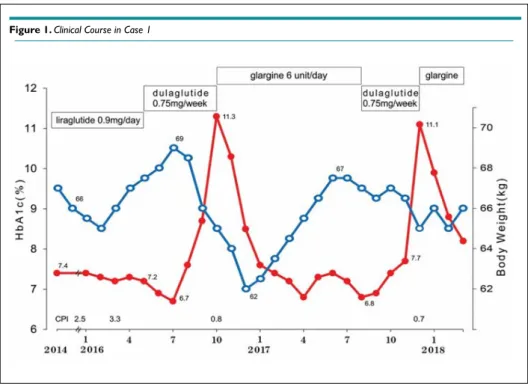
Progress course of case 1 is shown in Figure 1. Until May 2016, his control status of blood glucose was good and stable on the administration of liraglutide 0.9 mg/day. C-peptide indexes (CPI) were 2.5 and 3.3 which were satisfactory. Then, GLP-1 ana-logue was switched from liraglutide to dulaglutide. The reason was that the injection can be lessened from once per day to once per week by the strong hope of the patient and family.
After the switch of the GLP-1 agent, the clinical course was stable for 3-4 months. However, a daily profile of blood glu-cose and HbA1c was gradually elevated. The patient was admit-ted for hyperglycemia with blood glucose 394 mg/dL and HbA1c 11.3% in October, 2016. After that, long-acting insulin glargine was applied for the treatment. HbA1c was good and stable for 8 months until August, 2017. The patient and the family hoped again to change from glargine to dulaglutide for their inconvenience and forgotten the episode of injection every day.
There was good glucose control for 3 months, but blood glucose and HbA1c was again elevated in December, 2017 with the value of 518 mg/dL and 11.1%, respectively. He was admitted and treated with enhanced insulin therapy by insulin glargine and humulin R, which are long-acting and short-acting insulin. After his improvement and discharge from the hospital, he has been on glargine 12-14 units/day. After the switch of the GLP-1 agent, the clinical course was stable for 3-4 months. However, a daily profile of blood glucose and HbA1c was gradually elevated. The patient
was admitted for hyperglycemia with blood glucose. As mentioned above, case 1 has been treated as basal supported oral therapy (BOT), which were glargine (insulin) and glimepiride (sulpho-nylurea agent). The combination of liraglutide and sulpho(sulpho-nylurea agent indicated satisfactory result for long months, but dulaglutide and sulphonylurea agent had an effect of only about 3 months.
Case 2
An 83-year-old male patient who has been treated as T2DM at another clinic for more than 20 years. He has been in the nursing home in recent few years. He was admitted to our hospital in Oc-tober, 2016 for further evaluation and treatment.
On physical examination, he showed 152 cm in height, 40.3 kg in weight, BMI 17.4 at first visit, and his vitals and con-sciousness are normal, and lung, heart, abdomen, and neurologi-cal findings were unremarkable. Laboratory data were as follows: postprandial glucose-120 min 207 mg/dL, HbA1c was 8.5%, C-peptide- immunoreactivity 5.2 ng/mL, CPI=1.35. Hb 11.0 g/dL, WBC 5200/μL, Plt 17.4x10⁴ /μL, GOT 14 IU/mL, GPT 11 IU/ mL, r-GTP 11 IU/mL, LDH 163 IU/mL, BUN 29 mg/dL, Cre 1.6 mg/dL, uric acid 3.7 mg/dL, Na 143 mEq/L, Cl 106 mEq/L, K 4.0 mEq/L, TG 83 mg/dL, HDL 31 mg/dL.
The patient has other medical problems, such as hyper-tension, chronic heart failure, chronic renal failure and mild cogni-tive impairment (MCI). Consequently, the list of oral medications per day were as follows: 1) linagliptin 5 mg qd., voglibose 0.3 mg tid., repaglinide 0.5 mg tid. for diabetes, 2) azosemide 60 mg qd., telmisartan 40 mg qd., amlodipine besilate 5 mg qd. and carvedilol 5 mg qd. for hypertension and chronic heart failure, 3) febuxostat 10 mg qd., calcium polystyrene sulfonate 50 g bid., calcitriol 0.5 µg qd., and epoetin beta pegol 50 μg per month for chronic renal fail-ure, 4) esomeprazole magnesium hydrate 20 mg qd., donepezil
hy-drochloride 5 mg qd and clopidogrel sulfate 50 mg qd. for Gastro-esophageal Reflux Disease (GERD), dementia and anticoagulation therapy. Progress course of case 2 is shown in Figure 2. Until May 2017, his glycemic control had been good and stable on the ad-ministration of degludec 3-5 unit/day. C-peptide index (CPI) was 1.35 which seemed to be stable. HbA1c value increased to 8.0% in June 2017, and then dulaglutide was started for the expectation for improving glycemic variability and for convenient therapeutic injecting of GLP-1 analogue once per week by the hope of the patient and family.
After starting dulaglutide in June 2017, the clinical course was stable and HbA1c value was decreased for 3 months. Howev-er, in OctobHowev-er, blood glucose and HbA1c were increased up to for 3-4 months. However, daily profile and blood glucose and HbA1c were gradually increased. On November, postprandial glucose-120 min and HbA1c were 592 mg/dL, and 11.2%. He was immediately admitted to the hospital on urgent basis.
GLP-1 agent was discontinued and degludec and humu-lin R was administered in order to maintain stable glucose vari-ability. With this treatment, HbA1c was gradually decreased and it was 7.3 % in January 2018. Regarding the changes in body weight (Figure 2), it increased for a few months during twice treatment of degludec, and it decreased for a few months during treatment of dulaglutide.
As mentioned above, case 2 had been treated as basal supported oral therapy (BOT), which were degludec (insulin) and glimepiride (sulphonylurea agent). Combination therapy of degludec and sulphonylurea agent revealed stable condition un-til June, 2017. After that dulaglutide was first tried and seemed to show satisfactory effect. However, the efficacy has lasted only about 3 months, associated with the exacerbation of blood glucose profile and HbA1c level.
Abe T, et al 4
Basal Information of GLP-1 and Dulaglutide
GLP-1 relies on insulin secretion and stimulates glucose. Several types of GLP-1 RA have been developed and have been clinically used. It is thought that GLP-1 RAs administered alone does not have a risk of hypoglycemia.17GLP-1 RAs also promote weight
reduction, probably through the suppression of appetite by the ac-tivation of GLP-1 receptors in the brain.18,19 They can decrease
blood pressure by increasing urinary sodium excretion with va-sodilation, resulting in lowering blood pressure. GLP-1 RAs can improve postprandial hyperlipidemia by suppressing the produc-tion of apolipoprotein B-48 and triglyceride absorpproduc-tion.10,11
Fur-thermore, they can suppress inflammation responses by reducing production of inflammatory cytokines and macrophage infiltra-tion.10,11Therefore, GLP-1 RAs have indicated beneficial effects
for decreasing blood glucose and weight reduction, blood pressure, lipid levels and inflammatory responses.
Dulaglutide is a novel, long-acting GLP-1 RA which was developed as a once-weekly subcutaneous injection for the treat-ment of T2DM (Eli Lilly and Company, USA).20 It consists of two
GLP-1 analogs covalently linked by a small peptide to a human immunoglobulin G4 (IgG4-Fc) region-specific heavy chain. The GLP-1 moieties contain amino acid substitutions protecting from inactivation by dipeptidyl peptidase-IV (DPP-4), while the linker peptide is maintaining the potency of the GLP-1 analog. The hu-man IgG4-Fc is modified by substituting several amino acids to reduce interaction with high-affinity Fc receptors, cytotoxicity, and immunogenicity.21 The half-life is approximately 5 days, and time
to peak concentration after a single 0.75 mg dose is approximately 3 days.
Dulaglutide is a once a week formulation. The beneficial points are high blood glucose improving the effect, easy injection procedure, and low frequency of antibody appearance. It is also effective for patients who have poor compliance or cognitive im-pairment and require nursing care and others. Concerning clinical
efficacy, it showed a dose-dependent reduction in HbA1c and ac-ceptable safety profile in the randomized, double-blind, placebo-controlled, parallel-group, 12-week study.22
Concerning dulaglutide, decrease in absorption rate and clearance after injection is found due to increase in molecular weight. Therefore, the half-life of blood concentration is extended to 4-5 days, and stable blood concentration can be maintained for 1 week.23
Dulaglutide is manufactured by Eli Lilly, where the trade name is Trulicity, and it has been approved by The European Medicines Agency (EMA) and the United States Food and Drug Administration (FDA).20.23 There are reports for the efficacy of
du-laglutide. Several studies have been reported as the Assessment of Weekly Administration of dulaglutide in Diabetes (AWARD) pro-gram.20.23As a study of dose setting, two-years of study was
con-ducted with AWARD-5.24 The standard dose has become 1.5 mg/
week in the United States and Europe. Meanwhile, 0.75 mg/week has been the standard usage method in Japan. HbA1c change was -1.60% at 26 weeks in 855 T2DM patients.25There are 4 subgroups
according to age (<65, >65) and BMI (<25, >65), in which elder/ light and elder/heavy subgroups revealed -1.68% and -1.72%, re-spectively.26
One year clinical research was carried out, resulting from the improvement of HbA1c was found at 14-52 weeks with -1.65%±0.13%.27 Furthermore, there was randomized, open-label,
parallel-group, 26-week study with 361 patients with T2DM re-ceiving sulphonylureas and/or biguanides, in which dulaglutide or glargine were added and compared in 2 groups. The decrease in HbA1c after 26 weeks was -1.44% vs. -0.90%, respectively, with a
significant difference.28
Effects of once-weekly dulaglutide on kidney function in patients with T2DM was investigated in phase II and III clini-cal trials.29Integrated data from 2005 T2DM patients were used
Case Report | Volume 4 | Number 1|
to evaluate the influences on estimated glomerular filtration rate (eGFR), urine albumin-to-creatinine ratio (UACR) and kidney adverse events (AEs). The results were dulaglutide treatment for T2DM did not affect eGFR and slightly decreased albuminuria.
DISCUSSION
In this report, two cases seemed to show an attenuated effect of GLP-1 RAs in a few months. This may be related to the function of GLP-1 RAs including short-acting and long-acting types.
In general, GLP-1 RAs are categorized into 2 groups, which are short- and long-acting agents according to their half-lives. They would change the mechanism of function for glucose lowering effects.30,31The former seems to act mainly on gastric
motility and lowers blood glucose after meals. On the other hand, the latter mainly acts on the pancreas to regulate insulin and glucagon secretion, thereby leading to stabilization of blood sugar. In addition, it is pointed out that the high-molecular-weight formulations found in some long-acting forms may attenuate the appetite suppressing effect due to the passage of brain blood barrier.32,33
Actually, several studies of GLP-1 RAs have been re-ported. In previous studies, long-acting liraglutide was found to be rather superior to the short-acting exenatide, comparing the achievement of composite end-points.34
Recently, there are lots of studies reported on short-act-ing (exenatide, lixisenatide) and long-actshort-act-ing GLP-1RAs (liraglutide, exenatide long-acting release, albiglutide, dulaglutide and semaglu-tide).35-38These agents are available in the clinical settings,
allow-ing comparison of the study of composite end-points in future. Moreover, long-acting GLP-1 RAs seem to have weight reduction effects according to their molecular weight and permeability across the blood-brain barrier, possibly by affecting their accessibility to GLP-1 receptors in the brain.39,40 Through various cases treated
with GLP-1 RAs, further investigation would be expected con-cerning pathophysiological comparison and difference between long-acting and short-acting agents.
As to dulaglutide study, 492 T2DM cases were studied for 26 weeks in 3 groups including dulaglutide 0.75 mg/week, lira-glutide 0.9 mg/day and placebo.41 Changes in HbA1c were -1.43%,
-1.33%, and -0.14%, respectively, in which the former two were equivalent.41
Fasting blood glucose levels were -39.2 mg/dL, -39.8 mg/dL, +1.0 mg/dL, respectively, with equivalent efficacy. Inter-estingly, the group of dulaglutide 0.75 showed a decrease in urinary albumin excretion rate and triglyceride value compared to placebo. Regarding the adverse effects, several symptoms were observed such as nasopharyngitis, gastrointestinal symptoms, constipation, diarrhoea, nausea and decreased appetite. As pancreatic enzymes, amylase, and lipase were slightly elevated, and the increase of lipase was 18.5%, 29.8%, 4.9% in the three groups, respectively. Anti-body at dulaglutide 0.75 appeared at only 1.1%, but no neutralizing antibody appeared.41
Subsequently, in the 52-week study, the two groups of dulaglutide 0.75 mg/week and liraglutide 0.9 mg/day showed -1.39% and -1.19%, respectively, with slight superiority in the for-mer.42 In western countries, these two agents have been used twice
daily.. According to the results of AWARD-6, the two groups of dulaglutide 1.5 mg/week and liraglutide 1.8 mg/day at 26 weeks showed the changes in HbA1c, which are equivalent to -1.42% and -1.36%, respectively.40
In AWARD-9 study, the addition of weekly dulaglutide
vs. the addition of placebo to titrated glargine was compared.43
Subjects were 300 T2DM and phase III, double-blind, parallel-arm, placebo-controlled study were randomized to weekly subcu-taneous injections of dulaglutide 1.5 mg or placebo with titrated daily glargine. The results were that decrease HbA1c at 28 weeks was -1.44% with dulaglutide/glargine and -0.67% with placebo/ glargine with significant difference (p<0.01). The hypoglycemia’s
rate was 7.69 and 8.56, respectively without any difference. These findings suggest that weekly dulaglutide 1.5 mg added to basal in-sulin would be an efficacious and well-tolerated treatment option for patients with T2DM.43
As mentioned above from the study on dulaglutide once a week by injection, blood glucose and HbA1c for T2DM are de-creased with enough efficacy. Furthermore, adverse effects are not clinically significant. Judging from the clinical outcome to the third phase internationally, dulaglutide seems to be effective and safe GLP-1 RA. It will be useful for diabetic patients of all pathological conditions pharmacologically. Especially, it can be applicable for young and elderly patients with some impairment and dementia with some impairment and dementia with insufficient QOL/ADL ability.
As current 2 cases, recent treatment of type 2 diabetes has moved from the previous Basal Supported Oral Therapy (BOT) to a new Basal supported post- Prandial GLP-1 therapy (BPT). The former is basal insulin + oral medicine, and the latter is basal insulin + GLP-1 RA treatment.
There is a comparison study between BOT and BPT. For the comparison group, 557 T2DM patients were classified into 2 groups.44Degludec/liraglutide group and glargine group showed
that basal HbA1c as 8.4% vs. 8.2%, the changed HbA1c at 26
weeks as -1.81% vs. -1.13% respectively with meeting criteria for
non-inferiority (p<0.001) and confirmed hypoglycemic episodes as
2.23 vs. 5.05 per year with estimated rate ratio as 0.43 (p<0.001).
Consequently, BPT may have a superior effect than BOT, and benefits of BPT include stabilization of blood glucose fluctuation and good health-related quality of life (HRQOL).
HRQOL and cost-effectiveness have been also impor-tant aspects in addition to management of glycemic control for prevention of diabetic complications. GLP-1 RAs are treated by injections, which sometimes decrease HRQOL for the patients. Moreover, considerably higher medical costs are needed com-pared with that of oral anti-diabetic drugs. There are few reports concerning HRQOL and medical costs regarding GLP-1 RAs so
Abe T, et al
far, expecting the future development of clinical administration study.35,36 Expecting the future development of clinical
administra-tion studies.
Liraglutide therapy is necessary to receive a once-daily injection. In contrast, other long-acting GLP-1 RAs are given by injection only once weekly. This merit may bring better adherence and prevent the deterioration of HRQOL.
Combined therapy of basal insulin and GLP-1 RAs which is called BPT, has been recently gaining attention due to their beneficial and complementary action.45,46 When GLP-1 RAs
are added to insulin treatment, the effects would include weight re-duction without increasing hypoglycemic risk, in comparison with the insulin treatment with increased dosage. In the recent meta-analysis, BPT decreased HbA1c value which is similar to basal-bolus insulin therapies.46 Furthermore, BPT can improve HRQOL
by reducing injection frequency. For T2DM patient with severely reduced β-cell function, the combined therapy can give beneficial effects and achieve optimal glycemic control by GLP-1 RAs.45,46In
order to have optimal glycemic control, the extent remaining β-cell function would be speculated according to the actual dosage units of insulin and GLP-1 RAs.
The long-acting type slowly acts on pancreatic β-cells, improves insulin secretion ability, and tends to improve blood glucose control. In fact, any GLP-1 RA can be selected on a case-by-case basis, including differences in devices or syringes.
In summary, we reported that 2 T2DM cases showed an attenuated effect of dulaglutide in a few months. For this clinical situation, several possibilities might be speculated as follows:
1) Antibody production could be considered. The frequency of appearance of dulaglutide anti-drug antibodies was very rare, where only 1 out of 136 cases28 and 3 out of 281 cases.41Then, it is
not likely due to antibody production in 2 cases.
2) GLP-1 RAs were made from human-origin and lizard-origin (exendin-4). The former includes that 1 mal/day in liraglutide and 1 mal/week in dulaglutide, and the latter includes that 1 mal/ day in exenatide (byetta)/lixisenatide (liximia), and exenatide (videlion) in 1 mal/week. Since dulaglutide is human-origin, it does not prob-ably influence the formation of an antibody. Moreover, there has not been clarified whether these two agents have any difference of function.
3) The changes in body weights of 2 cases were found, where they increased during treatment of liraglutide, glargine and degludec, and they decreased during treatment of dulaglutide. The latter would be one of the merits of dulaglutide that has been reported so far.18,19,39,40,45,46 However, it is not known whether it has any
rela-tions with clinical efficacy or any other adverse effects. This point would be further evaluated through clinical studies.
4) Current two cases have seemed to have similar pathophysiologi-cal problems, such as late elderly person, a little impaired cognitive function and declined renal function. In the clinical course, they
have not suffered from any changes of nutritional or hepatic func-tion, or inflammatory status during the period. Any remarkable changes have not found which were related to subacute exacerba-tion of glycemic control.
5) There is a possibility of the subacute decreased ability of insulin secretion in the β-cell. We had measured C-peptide index (CPI) a few times which may give a key to the changed pathophysiological situation. In the cases, we would consider all possible related fac-tors influencing to insulin secretion, administration of insulin and GLP-1 RAs and others.
CONCLUSION
This report described 2 cases of T2DM which showed interesting clinical course. The effect of dulaglutide that is one of the GLP-1 RAs was attenuated in a few months. We speculated the possibili-ties related to the function and comparison of GLP-1 RAs. GLP-1 RAs treatment is increasing widely in the clinical practice, expect-ing that this report would be useful resource for management of the T2DM.
ETHICAL CONSIDERATIONS
The current study was conducted in compliance with the ethical principles of the Declaration of Helsinki. Furthermore, it was also with Japan’s Act on the Protection of Personal Information along with the Ministerial Ordinance on Good Clinical Practice (GCP) for Drug (Ordinance of Ministry of Health and Welfare No. 28 of March 27, 1997).
As regard to this study, we have established an ethical committee in the Yoshinogawa Hospital that included the presi-dent, the vice-presipresi-dent, the head-nurse of the nursing depart-ment, director of the Pharmaceutical departdepart-ment, director of the administration and expert in the medical/legal specialty. We have discussed and made confirmation that this study is valid and agreed with all members without any problems. Furthermore, informed consents and written paper agreements have been obtained from both the subjects.
CONFLICTS OF INTEREST
The authors declare that they have no conflicts of interest.
REFERENCES
1. International Diabetes Federation (IDF). Standards of medical care in diabetes-2015. Diabetes Care. 2015; 38: S1-S94. doi: 10.2337/ dc15-S002
2. Diabetes Atlas 2014 Update. Brussels, Belgium: International Diabetes Federation; 2014.
3. Defronzo RA. Banting Lecture. From the triumvirate to the om-inous octet: A new paradigm for the treatment of type 2 diabetes mellitus. Diabetes. 2009; 58: 773-795. doi: 10.2337/db09-9028
Case Report | Volume 4 | Number 1| 6
4. Forbes JM, Cooper ME. Mechanisms of diabetic complications.
Physiol Rev. 2013; 93: 137-188. doi: 10.1152/physrev.00045.2011
5. Einarson TR, Garg M, Kaur V, Hemels ME. Composite end-points in trials of type-2 diabetes. Diabetes Obes Metab. 2014; 16:
492-499. doi: 10.1111/dom.12226
6. Elrick H, Stimmler L, Hlad CJ Jr, Arai Y. Plasma insulin re-sponse to oral and intravenous glucose administration. J Clin
Endo-crinol Metab. 1964; 24: 1076-1082. doi: 10.1210/jcem-24-10-1076
7. Kreymann B, Williams G, Ghatei MA, Bloom SR. Glucagon-like peptide-1 7-36: A physiological incretin in man. Lancet. 1987;
2(8571): 1300-1304. doi: 10.1016/S0140-6736(87)91194-9
8. Smith EP, An Z, Wagner C, et al. The role of β cell glucagon-like peptide-1 signaling in glucose regulation and response to di-abetes drugs. Cell Metab. 2014; 19(6): 1050-1057. doi: 10.1016/j. cmet.2014.04.005
9. Yabe D, Seino Y. Defining the role of GLP-1 receptor agonists for individualized treatment of type 2 diabetes. Expet Rev Endocrinol
Metabol. 2014; 9: 659-670. doi: 10.1586/17446651.2014.949672
10. Drucker DJ. Incretin action in the pancreas: Potential promise, possible perils, and pathological pitfalls. Diabetes 2013; 62:
3316-3323. doi: 10.2337/db13-0822
11. Seino Y, Yabe D. Glucose-dependent insulinotropic polypep-tide and glucagon-like peppolypep-tide-1: Incretin actions beyond the pan-creas. J Diabetes Investig. 2013; 4: 108-130. doi: 10.1111/jdi.12065
12. BandoH, Ebe K, Muneta T, Bando M, Yonei Y. Investigation of uric acid and cystatin C on low-carbohydrate diet (LCD).
Diabe-tes Res Open J. 2017; 3(2): 31-38. doi: 10.17140/DROJ-3-133
13. Ebe K, Bando H, Muneta T, Bando M, Yonei Y. Effect of low carbohydrate diet (LCD) for diabetic patients with hypertriglyce-mia. Endocrinol Metab. 2017; 1(1): 104.
14. Muneta T, Kawaguchi E, Nagai Y, et al. Ketone body elevation in placenta, umbilical cord, newborn and mother in normal deli-very. Glycative Stress Research. 2016; 3(3): 133-140.
15. Bando H, Ebe K, Manabe T, Bando M, Yonei Y. Less carbo-hydrate intake increases serum ketone bodies in low carbocarbo-hydrate diet. Endocrinol Metab. 2018; 2(1): 9.
16. Ebe K, Bando H, Yamamoto K, Bando M, Yonei Y. Daily car-bohydrate intake correlates with HbA1c in low carcar-bohydrate diet (LCD). J Diabetol. 2018; 1(1): 4-9.
17. Yabe D, Seino Y. Two incretin hormones GLP-1 and GIP: Comparison of their actions in insulin secretion and beta cell pres-ervation. Progr Biophys Mol Biol. 2011; 107: 248-256. doi: 10.1016/j. pbiomolbio.2011.07.010
18. Secher A, Jelsing J, Baquero AF, et al. The arcuate nucleus
me-diates GLP-1 receptor agonist liraglutide-dependent weight loss. J
Clin Invest. 2014; 124: 4473-4488. doi: 10.1172/JCI75276
19. Sisley S, Gutierrez-Aguilar R, Scott M, et al. Neuronal GLP1R mediates liraglutide’s anorectic but not glucose-lowering effect. J
Clin Invest. 2014; 124: 2456-2463. doi: 10.1172/JCI72434
20. Wysham C, Blevins T, Arakaki R, et al. Efficacy and safety of dulaglutide added onto pioglitazone and metformin versus exena-tide in type 2 diabetes in a randomized controlled trial (AWARD-1).
Diabetes Care. 2014; 37(8): 2159-2167. doi: 10.2337/dc13-2760
21. Glaesner W, Vick AM, Millican R, et al. Engineering and char-acterization of the long-acting glucagonlike peptide-1 analogue LY2189265, an Fc fusion protein. Diabetes Metab Res Rev. 2010; 26:
287-296. doi: 10.1002/dmrr.1080
22. Terauchi Y, Satoi Y, Takeuchi M, Imaoka T. Monotherapy with the once weekly GLP-1 receptor agonist dulaglutide for 12 weeks in Japanese patients with type 2 diabetes: Dose-dependent effects on glycaemic control in a randomised, double-blind, place-bo-controlled study. Endocr J. 2014; 61(10): 949-959. doi: 10.1507/ endocrj.EJ14-0147
23. Gurung T, Shyangdan DS, O’Hare JP, Waugh N. A novel, long-acting glucagon-like peptide receptor-agonist: Dulaglutide. Diabetes
Metab Syndr Obes. 2015; 10; 8: 363-86. doi: 10.2147/DMSO.S34418
24. Skrivanek Z, Gaydos BL, Chien JY, et al. Dose-finding results in an adaptive, seamless, randomized trial of once-weekly dulaglutide combined with metformin in type 2 diabetes patients (AWARD-5).
Diabetes Obes Metab. 2014; 16(8): 748-756. doi: 10.1111/dom.12305
25. Onishi Y, Oura T, Nishiyama H, Ohyama S, Takeuchi M, Iwa-moto N. Subgroup analysis of phase 3 studies of dulaglutide in Japanese patients with type 2 diabetes. Endocr J. 2016; 63(3):
263-273. doi: 10.1507/endocrj.EJ15-0518
26. Hamano K, Nishiyama H, Matsui A, Sato M, Takeuchi M. Ef-ficacy and safety analyses across 4 subgroups combining low and high age and body mass index groups in Japanese phase 3 studies of dulaglutide 0.75 mg after 26 weeks of treatment. Endocr J. 2017;
64(4): 449-456. doi: 10.1507/endocrj.EJ16-0428
27. Emoto M, Terauchi Y, Ozeki A, Oura T, Takeuchi M, Imaoka T. A 1-year safety study of dulaglutide in Japanese patients with type 2 diabetes on a single oral hypoglycemic agent: an open-label, nonrandomized, phase 3 trial. Endocr J. 2015; 62(12): 1101-1114.
doi: 10.1507/endocrj.EJ15-0401
28. Araki E, Inagaki N, Tanizawa Y, Oura T, Takeuchi M, Imaoka T. Efficacy and safety of once-weekly dulaglutide in combination with sulphonylurea and/or biguanide compared with once-daily insulin glargine in Japanese patients with type 2 diabetes: A ran-domized, open-label, phase III, non-inferiority study. Diabetes Obes
Metab. 2015; 17(10): 994-1002. doi: 10.1111/dom.12540
Abe T, et al
KD, Botros FT. Effects of once-weekly dulaglutide on kidney function in patients with type 2 diabetes in phase II and III clini-cal trials. Diabetes Obes Metab. 2017; 19(3): 436-441. doi: 10.1111/ dom.12816
30. Yabe D, Seino Y. Defining the role of GLP-1 receptor agonists for individualized treatment of type 2 diabetes. Expet Rev Endocrinol
Metabol. 2014; 9: 659-670. doi: 10.1586/17446651.2014.949672
31. Meier JJ. GLP-1 receptor agonists for individualized treatment of type 2 diabetes mellitus. Nat Rev Endocrinol. 2012; 8: 728-742.
doi: 10.1038/nrendo.2012.140
32. Kuwata H, Iwasaki M, Shimizu S, Minami K, Maeda H, Sei-no S. Meal sequence and glucose excursion, gastric emptying and incretin secretion in type 2 diabetes: A randomised, controlled crossover, exploratory trial. Diabetologia. 2016; 59(3): 453-461. doi: 10.1007/s00125-015-3841-z
33. Yabe D, Kuwata H, Usui R, Kurose T, Seino Y. Glucagon-like peptide-1 receptor agonist therapeutics for total diabetes manage-ment: Assessment of composite end-points. Curr Med Res Opin.
2015; 31(7): 1267-1270. doi: 10.1185/03007995.2015.1045471
34. Davies MJ, Kela R, Khunti K. Liraglutide. Overview of the pre-clinical and pre-clinical data and its role in the treatment of type 2 dia-betes. Diabetes Obes Metab. 2011; 13: 207-220. doi: 10.1111/j.1 463-1326.2010.01330.x
35. King AB, Montanya E, Pratley RE, et al. Liraglutide achieves A1C targets more often than sitagliptin or exenatide when added to metformin in patients with type 2 diabetes and a baseline A1C 58.0%. Endocr Pract. 2013; 19: 64-72. doi: 10.4158/EP12232.OR
36. Langer J, Hunt B, Valentine WJ. Evaluating the short-term cost-effectiveness of liraglutide versus sitagliptin in patients with type 2 diabetes failing metformin monotherapy in the United States. J Manag Care Pharm. 2013; 19: 237-246. doi: 10.18553/ jmcp.2013.19.3.237
37. Brady EM, Davies MJ, Gray LJ, et al. A randomized controlled trial comparing the GLP-1 receptor agonist liraglutide to a sulpho-nylurea as add on to metformin in patients with established type 2 diabetes during Ramadan: The Treat 4 Ramadan Trial. Diabetes
Obes Metab. 2014; 16: 527-536. doi: 10.1111/dom.12249
38. Li CJ, Li J, Zhang QM, et al. Efficacy and safety comparison between liraglutide as add-on therapy to insulin and insulin dose-increase in Chinese subjects with poorly controlled type 2 diabetes and abdominal obesity. Cardiovasc Diabetol. 2012; 11: 142-149. doi: 10.1186/1475-2840-11-142
39. Pratley RE, Nauck MA, Barnett AH, et al. Once-weekly al-biglutide versus once daily liraglutide in patients with type 2 dia-betes inadequately controlled on oral drugs (HARMONY 7): A randomised, open-label, multicentre, non-inferiority phase 3 study.
Lancet Diabetes Endocrinol. 2014; 2: 289-297. doi:
10.1186/1475-2840-11-142
40. Dungan KM, Povedano ST, Forst T, et al. Once-weekly dula-glutide versus once-daily liradula-glutide in metformin-treated patients with type 2 diabetes (AWARD-6): A randomised, open-label, phase 3, non-inferiority trial. Lancet. 2014; 84: 1349-1357. doi: 10.1016/ S0140-6736(14)60976-4
41. Miyagawa J, Odawara M, Takamura T, Iwamoto N, Takita Y, Imaoka. Once-weekly glucagon-like peptide-1 receptor agonist dulaglutide is non-inferior to once-daily liraglutide and superior to placebo in Japanese patients with type 2 diabetes: A 26-week randomized phase III study. Diabetes Obes Metab. 2015; 17(10):
974-983. doi: 10.1111/dom.12534
42. Odawara M, Miyagawa J, Iwamoto N, Takita Y, Imaoka T, Takamura T. Once-weekly glucagon-like peptide-1 receptor ago-nist dulaglutide significantly decreases glycated haemoglobin com-pared with once-daily liraglutide in Japanese patients with type 2 diabetes: 52 weeks of treatment in a randomized phase III study.
Diabetes Obes Metab. 2016; 18(3): 249-257. doi: 10.1111/dom.12602
43. Pozzilli P, Norwood P, Jódar E, et al. Placebo-controlled, ran-domized trial of the addition of once-weekly glucagon-like pep-tide-1 receptor agonist dulaglutide to titrated daily insulin glargine in patients with type 2 diabetes (AWARD-9). Diabetes Obes Metab.
2017; 19(7): 1024-1031. doi: 10.1111/dom.12937
44. Lingvay I, Pérez Manghi F, García-Hernández P, et al. DUAL V Investigators. Effect of insulin glargine up-titration vs insulin de-gludec/ liraglutide on glycated hemoglobin levels in patients with uncontrolled type 2 diabetes: The DUAL V Randomized Clinical Trial. JAMA. 2016; 315(9): 898-907. doi: 10.1001/jama.2016.1252
45. Balena R, Hensley IE, Miller S, Barnett AH. Combination ther-apy with GLP-1 receptor agonists and basal insulin: A systematic review of the literature. Diabetes Obes Metab. 2013; 15: 485-502. doi: 10.1111/dom.12025
46. Eng C, Kramer CK, Zinman B, Retnakaran R. Glucagon-like peptide-1 receptor agonist and basal insulin combination treatment for the management of type 2 diabetes: A systematic review and meta-analysis. Lancet. 2014; 384: 2228-2234. doi: 10.1016/S0140-6736(14)61335-0
47. Usui R, Yabe D, Kuwata H, et al. Retrospective analysis of safety and efficacy of insulin-to-liraglutide switch in Japanese type 2 diabetes: A caution against inappropriate use in patients with reduced beta cell function. J Diabet Invest. 2013; 4: 585-594. doi: 10.1111/jdi.12111
48. Yabe D, Ambos A, Cariou B, et al. Adjunctive lixisenatide treatment improves glycemic control in patients with T2DM irre-spective of b-cell function. Diabetes. 2014; 64(Suppl 1): A253. doi: 10.1016/j.jcjd.2014.07.138
Case Report | Volume 4 | Number 1| 8