PDZ-BASED ADAPTOR PROTEINS IN
EPI-THELIAL TIGHT JUNCTIONS
Specialized epithelial cells constitute selective bar-riers between diverse tissues and different body compartments in multicellular organisms. These cells are segregated into an apical and basolateral domain-that is, they are polarized-and they adhere to each other side-by-side through complexes that form junctions between the cells (1). These inter-cellular junctions play several important roles in the physiology of epithelial cells and tissues. First, they constitute a semipermeable barrier that controls the flow of ions and fluid through the paracellular path-way. Second, they contribute to the establishment and maintenance of the polarity of the apical and ba-solateral membranes. Third, they are the targets and effectors of diverse intracellular signaling pathways that control function, differentiation and proliferation
of epithelial cells. These cell junctions are assem-bled by an array of scaffolding molecules that link adhesion molecules and signaling proteins to the cytoskeleton (2). Genetic and biochemical studies over the past 20 years led us recognize the mem-brane-associated guanylate kinase (MAGUK) as ubiquitous scaffolding molecules concentrated at sites of junctional complexes. The MAGUKs con-tain several PDZ domains, one SH3 domain, and a guanylate kinase domain (GuK) (3).
PDZ DOMAINS
PDZ domains were first discovered in three re-lated MAGUKs including PSD-95, Dlg, and ZO-1, which were abbreviated by each initial letter. Genomic sequencing revealed that the C. elegans,
Drosophila melanogaster, and Homo sapiens genomes
each encode 60-100 PDZ proteins. The PDZ domain is a conserved protein-protein interaction module consisted of 80-90 amino acids which typically bind target proteins harboring specific C-terminal se-quences called PDZ-binding motif (4). PDZ do-mains have two major functions. 1) They anchor
MINI-REVIEW
PDZ-based adaptor proteins in epithelial anion transport
and VIP receptor regulation
Heon Yung Gee, Hyun Woo Park, Kyung Hwan Kim, and Min Goo Lee
Department of Pharmacology and Brain Korea 21 Project for Medical Science, Yonsei University College of Medicine, Seoul, Korea
Abstract : Polarized protein deposition at the apical and basolateral membranes of epithe-lial cells is critical for the asymmetrical transport of ions and fluids across the epithelia. PDZ-based modular adaptor proteins are expressed in the junctional areas in epithelial cells and are generally part of a molecular scaffold that determines the localization and activity of ion channels, receptors, and other signaling molecules to their correct spatial arrangement for proper response to diverse stimuli. Hence, understanding the regulatory mechanisms of channels and receptors via PDZ-based adaptors will provide valuable in-sights into the physiology of epithelial cells as well as pathophysiology of many human diseases including cystic fibrosis. J. Med. Invest. 56 Suppl. : 302-305, December, 2009
Keywords : PDZ domain, CFTR, NHE3, VPAC, S-SCAM/MAGI-2
Received for publication November 10, 2009 ; accepted Novem-ber 17, 2009.
Address correspondence and reprint requests to Min Goo Lee, Department of Pharmacology, Yonsei University College of Medicine, 134 Sinchon Dong, Seoul 120 752, Korea and Fax : +82 2 -313 - 1894.
The Journal of Medical Investigation Vol. 56 Supplement 2009
integral membrane proteins including receptors, transporters, channels and adhesion proteins through their PDZ-binding motif and 2) they bind to the PDZ domains of other PDZ proteins, thus forming scaffolding networks mediated by homo- and hetero-multimers. Therefore, PDZ domains cluster their target proteins in specific subcellular domains, de-termine the polarity of many proteins including channels and transporters and regulate their activ-ity as well as endocytic trafficking. In addition, PDZ-containing proteins near the junctional area contain additional structural domains, which function as scaf-folds for signaling proteins, such as small GTPases, kinases and transcription factors (5).
REGULATION OF CFTR AND NHE3 BY
PDZ-BASED PROTEINS
The cystic fibrosis transmembrane conductance regulator (CFTR) localized at the apical membrane is a cyclic AMP/PKA-activated Cl-channel which
functions as the key regulator of fluid and anion secretion in the gastrointestinal, respiratory, and genitourinary system. CFTR and other transport-ers, such as choloride-bicarbonate exchangers form large macromolecular complexes mediated by PDZ-based adaptor proteins. Such adaptor proteins have
been known to regulate CFTR activity in the plasma membrane. For example, EBP50/NHERF1 and E3KARP/NHERF2 augment cAMP-induced activa-tion of CFTR by recruiting a cAMP-dependent pro-tein kinase (PKA)/PKA-anchoring propro-tein (AKAP) complex (6), whereas Shank2 attenuates the effect of cAMP on CFTR by placing the cyclic nucleotide phosphodiesterase PDE4D in proximity (7, 8). Con-versely, in the case of Na+/H+exchanger 3 (NHE3)
which plays a major role in Na+, Cl-absorption in
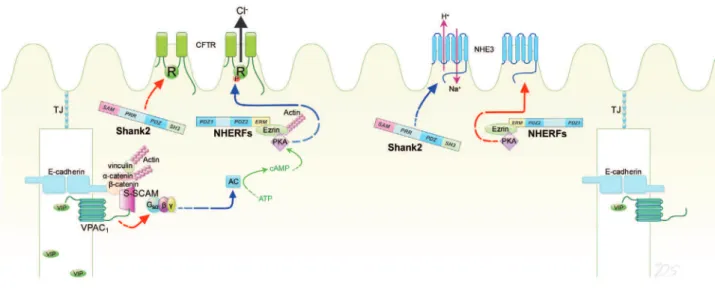
intestinal epithelia, EBP50/NHERF1 and E3KARP/ NHERF2 mediate cAMP-dependent inhibition of NHE3 (9), whereas Shank2 up-regulates its sur-face expression and basal activity (10). Therefore, NHERFs and Shank2 modulated CFTR and NHE3 in a reciprocal manner and by utilizing this combi-natorial regulation, these adaptors can effectively govern the net epithelial transport via absorptive and secretory transporters (Fig. 1).
REGULATION OF VIP RECEPTORS BY
S-SCAM/MAGI-2
Vasoactive intestinal peptide (VIP) is a 28 amino acid peptide that was first isolated in 1970 from the duodenum and lung. VIP is one of the major physi-ologic regulators of CFTR, which is released from
Fig. 1 Regulation of CFTR, NHE3 and VPAC1 by PDZ- based adaptor proteins in the plasma membrane of epithelial cells. The PDZ- based proteins NHERF1 and Shank2 regulate CFTR and NHE3 in an opposite manner. NHERF1 activates CFTR and inhibits NHE3, whereas Shank2 activates NHE3 and inhibits CFTR in epithelial cells (see text for details). Another PDZ scaffold, S -SCAM/MAGI - 2 recruits VPAC1to the junctional area and negatively regulates VPAC1activity to prevent excess production of cAMP
which can cause secretory diarrhea. The arrows indicate positive (blue) and negative (red) regulation. AC, adenylate cyclase ; ERM, ezrin, radixin, moesin binding domain ; PDZ, PSD- 95/Dlg/ZO- 1 domain ; PRR, proline - rich region ; R, regulatory domain ; SAM, sterileα motif ; SH3, Src homology 3 domain ; TJ, tight junction.
enteric nerves. Hence, it stimulates 1) biliary bicar-bonate and water secretion from pancreatic and bili-ary duct cells, 2) enzyme secretion from pancreatic acinar cells, and 3) chloride secretion from intesti-nal epithelia. Such physiological actions of VIP are mediated via activation of two common G-protein coupled receptors (VPAC1and VPAC2) which
pref-erentially stimulate adenylate cyclase followed by in-creased intracellular cAMP (11). Of those receptors, the VPAC1receptor contains a typical PDZ-binding
motif which makes it a strong candidate to interact with PDZ-based adaptors. Recently, we firstly re-ported the biochemical and functional interaction be-tween VPAC1and the synaptic scaffolding molecule
(S-SCAM), a member of MAGUK PDZ-based scaf-fold, also known as membrane-associated guanylate kinase inverted-2 (MAGI-2) (Fig. 1) (12). S-SCAM/ MAGI-2 inhibited VIP-induced VPAC1
internaliza-tion and cAMP generainternaliza-tion which resulted in re-duced CFTR Cl-current. Aberrant VPAC1
activa-tion which causes the watery diarrhea syndrome in VIPoma (also known as Werner Morrison syndrome or WDHA syndrome) suggests that the delicate regulation of VPAC1via S-SCAM/MAGI-2 is
essen-tial for VIP-mediated fluid and electrolyte secre-tion in normal epithelial cells. In addisecre-tion, S-SCAM/ MAGI-2 associates with E-cadherin, a key protein at the adherens junction, in aβ-catenin dependent manner (13) and recruits VPAC1to the junctional
area near the apical end of the lateral membrane in epithelial cells. Therefore, S-SCAM/MAGI-2 con-fines VPAC1to the junctional area and restricts
VIP-induced cAMP signaling within close proximity to the apical effectors such as CFTR. This, in turn, enables efficient electrolyte and fluid secretion in epithelial cells in response to VIP with minimal ef-fects on the cell interior. This study demonstrates the critical role of PDZ-based scaffolds in receptor-mediated signal transduction as well as in the regu-lation of ion transporters and channels activity. It is noteworthy that PDZ-binding motifs are found in numerous receptors which imply the importance of these PDZ-based adaptor targets in wide range of receptor signaling (14). Emerging evidence sug-gests that PDZ-based adaptors utilize various modes of action to elicit effective hormonal response of physiological stimuli, such as 1) the assembly of sig-naling complexes which include hormone receptors and its effectors ; 2) the regulation of trafficking and tethering of membrane proteins, and 3) the modu-lation of second-messenger generation as described for VPAC1.
CONCLUSIONS
In conclusion, modulation of PDZ-mediated pro-tein-protein interaction allows a single stimulus to result in diverse functional consequences. Hence, the balanced interactions between the membrane proteins including transporters, channels, and recep-tors and PDZ-based adaprecep-tors are likely to play a critical role in the homeostatic regulation of epi-thelial transport. Considering that both hypo- and hyper-functioning of receptors, channels or trans-porters may result in life-threatening diseases, such as cystic fibrosis or secretory diarrhea caused by CFTR, respectively, retaining prudent regulation via PDZ-based adaptor proteins is an important mecha-nism for the maintenance of body homeostasis.
ACKNOWLEDGEMENTS
We thank Dong-Su Jang for their editorial assis-tance. This work was supported by grants R01-2007-000-20710-0 from the Korea Science and Engineer-ing Foundation, and E00067 from the Korea Re-search Foundation, Ministry of Education, Science and Technology, Korea.
REFERENCES
1. Matter K, Balda MS : Signalling to and from tight junctions. Nat Rev Mol Cell Biol 4 : 225-236, 2003
2. Guillemot L, Paschoud S, Pulimeno P, Foglia A, Citi S : The cytoplasmic plaque of tight junc-tions : a scaffolding and signalling center. Bio-chim Biophys Acta 1778 : 601-613, 2008 3. Funke L, Dakoji S, Bredt DS : Membrane-
as-sociated guanylate kinases regulate adhesion and plasticity at cell junctions. Annu Rev Bio-chem 74 : 219-245, 2005
4. Kim E, Sheng M : PDZ domain proteins of syn-apses. Nat Rev Neurosci 5 : 771-781, 2004 5. Guggino WB, Stanton BA : New insights into
cystic fibrosis : molecular switches that regu-late CFTR. Nat Rev Mol Cell Biol 7 : 426-436, 2006
6. Yun CH, Lamprecht G, Forster DV, Sidor A : NHE3 kinase A regulatory protein E3KARP binds the epithelial brush border Na+/H+ ex-changer NHE3 and the cytoskeletal protein ezrin. J Biol Chem 273 : 25856-25863, 1998 H. Y. Gee, et al. PDZ proteins and VIP receptor in epithelia
7. Kim JY, Han W, Namkung W, Lee JH, Kim KH, Shin H, Kim E, Lee MG : Inhibitory regu-lation of cystic fibrosis transmembrane conduc-tance regulator anion-transporting activities by Shank2. J Biol Chem 279 : 10389-10396, 2004 8. Lee JH, Richter W, Namkung W, Kim KH, Kim
E, Conti M, Lee MG : Dynamic regulation of cystic fibrosis transmembrane conductance regulator by competitive interactions of molecu-lar adaptors. J Biol Chem 282 : 10414-10422, 2007
9. Donowitz M, Cha B, Zachos NC, Brett CL, Sharma A, Tse CM, Li X : NHERF family and NHE3 regulation. J Physiol 567 : 3-11, 2005 10. Han W, Kim KH, Jo MJ, Lee JH, Yang J,
Doctor RB, Moe OW, Lee J, Kim E, Lee MG : Shank2 associates with and regulates Na+/H+ exchanger 3. J Biol Chem 281 : 1461 - 1469, 2006
11. Laburthe M, Couvineau A, Marie JC : VPAC
receptors for VIP and PACAP. Receptors Chan-nels 8 : 137-153, 2002
12. Gee HY, Kim YW, Jo MJ, Namkung W, Kim JY, Park HW, Kim KS, Kim H, Baba A, Yang J, Kim E, Kim KH, Lee MG : Synaptic scaffold-ing molecule binds to and regulates vasoactive intestinal polypeptide type-1 receptor in epithe-lial cells. Gastroenterology 137 : 607-617, 617 e601-604, 2009
13. Subauste MC, Nalbant P, Adamson ED, Hahn KM : Vinculin controls PTEN protein level by maintaining the interaction of the adherens junction protein beta-catenin with the scaffold-ing protein MAGI-2. J Biol Chem 280 : 5676-5681, 2005
14. Weinman EJ, Hall RA, Friedman PA, Liu-Chen LY, Shenolikar S : The association of NHERF adaptor proteins with g protein-coupled recep-tors and receptor tyrosine kinases. Annu Rev Physiol 68 : 491-505, 2006