COMMUNICATION
Please do not adjust margins
Please do not adjust margins
Received 00th January 20xx,Accepted 00th January 20xx DOI: 10.1039/x0xx00000x
Traceless synthesis of protein thioesters using enzyme-mediated
hydrazinolysis and subsequent self-editing of cysteinyl prolyl
sequence
Chiaki Komiya,
aAkira Shigenaga,*
aJun Tsukimoto,
bMasahiro Ueda,
aTakuya Morisaki,
aTsubasa
Inokuma,
aKohji Itoh
band Akira Otaka*
aA traceless thioester-producing protocol featuring carboxypeptidase Y-mediated hydrazinolysis of cysteinyl prolyl leucine-tagged peptides has been developed. The hydrazinolysis followed by thioesterification affords cysteinyl prolyl thioesters. Self-editing of the tag and subsequent trans-thioesterification yields peptide thioesters. The developed protocol was successfully applied to conversion of recombinant proteins to thioesters.
Proteins possessing various modifications or unnatural amino acids have served as molecular probes in the investigation of the biological significance of proteins. Access to such proteins is achieved mainly by native chemical ligation (NCL) with peptide/protein thioesters as key synthetic intermediates.1–3
Because NCL produces proteins via a chemoselective amide forming reaction between a thioester and N-terminal cysteine units, protein thioesters available from expressed proteins could function as indispensable intermediates in the preparation of semi-synthetic proteins.3 Among semi-synthetic
protocols using recombinant-protein-derived thioesters, expressed protein ligation has gained wide popularity.4 This
technique features the use of intein-fused recombinant proteins for production of the requisite thioesters. Such intein-fused proteins produce protein thioesters by the action of intein as a self-processing element. Application of the intein-mediated protocol however, does not always produce the desired thioesters efficiently. This is due partly to incomplete folding or the less soluble nature of some intein fusions.5 Thus, other
recombinant protein-compatible protocols are highly desired. Transpeptidase-mediated methods using sortase A (SrtA)6 or
butelase 17 were developed as alternative protocols and have
enjoyed success in producing thioesters. A potential limitation of these protocols is that enzyme-recognizing sequences
required for trans-peptidylation remain in the resulting thioesters. Consequently, a traceless synthesis of protein thioesters has been required.8 In this context, we focused on
carboxypeptidase Y (CPaseY) (EC 3.4.16.5),9 which is easily
obtained from commercial sources or baker’s yeast,10 for
C-terminal selective thioesterification of an appropriate recombinant protein. CPaseY, a serine protease, exhibits exopeptidase activity and can hydrolyze a peptide bond at the C-terminal end of a peptide or protein through an O-acyl enzyme intermediate. Instead of hydrolysis of the O-acyl enzyme intermediate affording peptide/protein acids, it was envisioned that hydrazinolysis of the intermediate could yield a peptide/protein hydrazide which works as a thioester precursor
via the corresponding acyl azide.11,12 Herein, we report a novel
traceless thioester-producing system using the CPaseY-mediated hydrazinolysis of a C-terminal tagged peptide. Initially, we attempted the CPaseY-mediated hydrazinolysis of a model peptide (1) in the presence of hydrazine in aqueous solution (Figure 1A). Although the desired peptide hydrazide (2) was observed in the reaction, over-reaction products (3, 4) were generated (Figure 1B).
Figure 1. (A) CPaseY-mediated digestion of model peptide 1 in the presence of hydrazine; (B) HPLC monitoring of CPY-mediated hydrazinolysis. HPLC conditions: see Table S2 in ESI.
a.Institute of Biomedical Sciences and Graduate School of Pharmaceutical Sciences,
Tokushima University; Tokushima 770-8505, Japan, E-mail: [email protected] (A.O.); [email protected] (A.S.)
b.Institute of Medicinal Resources, Graduate School of Pharmaceutical Sciences,
Tokushima University; Tokushima 770-8505, Japan
Electronic Supplementary Information (ESI) available: See DOI: 10.1039/x0xx00000x
This is an Accepted Manuscript of an article published by The Royal Society of Chemistry in Chemical Communications, available online: https://doi.org/10.1039/C9CC03583D
COMMUNICATION
Journal Name
2 | J. Name., 2012, 00, 1-3 This journal is © The Royal Society of Chemistry 20xx
Please do not adjust margins
Please do not adjust margins
Figure 2. (A) Suppression of over-reaction by the use of substrate preference ofCPaseY in the presence of cyclohexanone; (B) HPLC monitoring of CPaseY-mediated hydrazinolysis of peptide 5. HPLC conditions: see ESI.
This result is consistent with the fact that CPaseY also hydrolyzes C-terminal amide peptides.13,14 Applicability of other
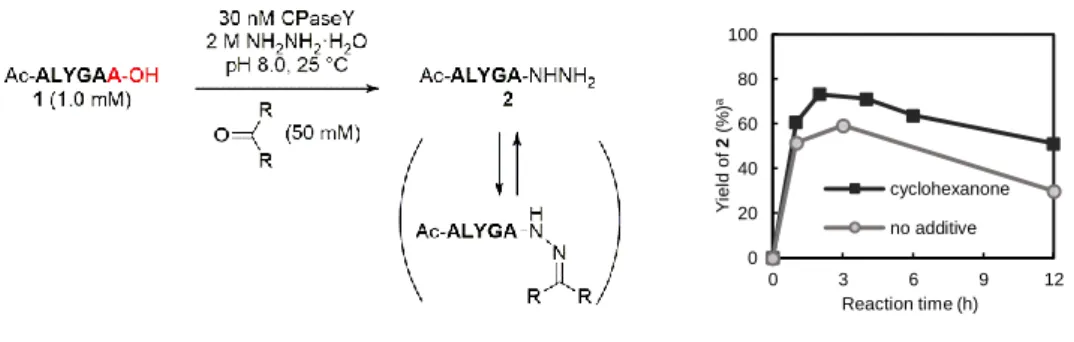
nucleophiles, including thiols, to the CPaseY-mediated reaction was examined, but attempts failed to yield the desired products (Table S3 in ESI). We next attempted to suppress further degradation of the resulting hydrazide (2) by hydrazone formation using carbonyl compounds (Figure S1 in ESI). Although cyclohexanone suppresses the CPaseY-induced over-reaction with the yield of 2 approaching 70%, no further significant improvement of the yield by tuning the reaction conditions including the use of aniline catalyst15 was achieved.
We next examined the applicability of the substrate preference of CPaseY to suppression of the over-reaction. CPaseY shows strong preference for hydrophobic amino acids as the C-terminal residue with such residues being quickly cleaved.16 On
the other hand, hydrophilic and prolyl residues are disfavored and are removed slowly. We reasoned that a peptide possessing a C-terminal “–(disfavored amino acid)–(favored amino acid)– OH” sequence should resist the CPaseY-induced over-reaction to yield the corresponding C-terminal disfavored amino acyl hydrazide peptide preferentially. To test this hypothesis, Ac-ALYGPL-OH (5) (1.0 mM), which has Pro and Leu as disfavored and favored residues, respectively, was subjected to the hydrazinolysis protocol (2.4 μM CPaseY, 2 M NH2NH2·H2O, 50
mM cyclohexanone, pH 8.0, 25 °C) as shown in Figure 2A. After a 12 h reaction of 5, the desired Ac-ALYGP-NHNH2 (6) was
formed as the major product (Figure 2B). Proline was proven to be the best choice for the disfavored residue because the reaction of Ac-ALYGXL-OH (X = R or K) under the aforementioned conditions produced over-reaction products (Figure S2 in ESI). The resulting hydrazide (6) should be efficiently converted to the corresponding prolyl thioester via the peptidyl azide according to Liu’s protocol.12 However, the
sequence of reactions affords only the prolyl thioester which is not a versatile thioester in the standard NCL protocol.17
Consequently, we next examined the conversion of the prolyl thioester to other amino acyl thioesters.Our previous research concerned the use of the prolyl thioesters under a specific NCL conditions optimized for the prolyl thioesters. NCL of a prolyl thioester peptide tended to produce two-residue (Xaa-Pro)-deleted ligation products, by diketopiperazine formation.18 The
cysteinyl prolyl ester (CPE) system was developed by Kawakami and Aimoto19 for preparation of peptide thioesters. Under
weakly basic conditions (pH > 7.8), CPE peptides (-XaaCysPro-OR) are converted to thioesters (-Xaa-SR) via its self-editing through an N–S acyl transfer followed by diketopiperazine
formation. We envisioned that an amino acyl cysteinyl prolyl thioester (-XaaCysPro-SR) resulting from the hydrazinolysis of a C-terminal CysProLeu-OH-tagged peptide (-XaaCysProLeu-OH), followed by thioesterfication, should be converted to the Xaa thioester (Xaa-SR: R = cysteinyl proline diketopiperazine) (Scheme 1).
Scheme 1. Envisioned strategy for synthesis of thioester other than prolyl thioester.
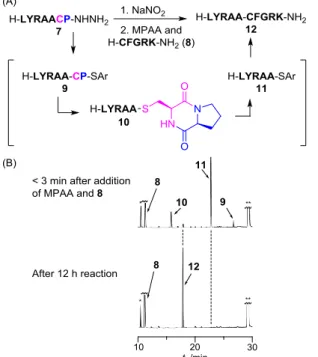
In order to confirm the versatility of such a protocol in preparation of proteogenic amino acid thioesters, conversion of a model -XaaCysPro-SR peptide to the corresponding Xaa-SR peptide followed by NCL was conducted. A model peptide, H– LYRAACP–NHNH2, (1.0 mM) (7) was treated with NaNO2 in 6 M
guanidine·HCl–50 mM Na phosphate (pH 3.0) at -10 °C for 30 min and then the reaction was followed by the addition of 4-mercaptophenylacetic acid (MPAA) and an N-terminal cysteinyl peptide (8) (pH 6.5) (Figure 3). After 3 min of the addition, three types of possible thioesters including 9 (AlaCysProSAr: Ar = -C6H4CH2COOH), 10 (-Ala-SDKP: SDKP = cysteinyl prolyl
diketopiperazine) and 11 (-Ala-SAr) as the major thioester were detected. After 12 h reaction, the thioester (11 (or 10)) underwent NCL with 8 to afford the ligated peptide (12) as shown in Figure 3B. Although the conversion of prolyl ester in the CPE system to the thioester requires weakly basic conditions (pH > 7.8),19 the prolyl thioester (9) was converted to
the thioester (11) under slightly acidic conditions without any accompanying hydrolysis products. This result clearly indicates that the C-terminal-XaaCysPro-NHNH2 peptides function as
precursors to the Xaa-SR peptide.
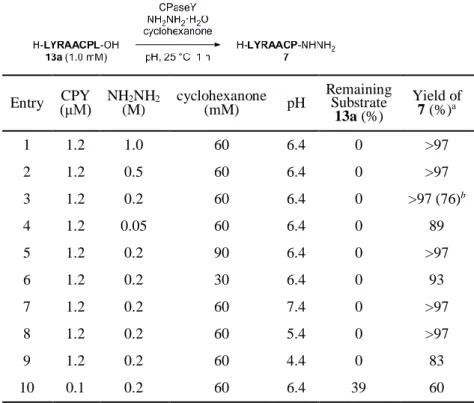
Thus, we optimized the reaction conditions for efficient formation of the -XaaCysPro-NHNH2 peptide. As summarized in
Table S6 in ESI, a C-terminally CysProLeu-OH-tagged model peptide H-LYRAACPL-OH (13a) was subjected to the hydrazinolysis reaction under various reaction conditions (concentration of CPaseY, hydrazine and cyclohexanone and pH). On the basis of these results, the reaction conditions shown in entry 3 in Table S6 (1.2 μM CPaseY in the presence of 0.2 M NH2NH2·H2O, 60 mM cyclohexanone, pH 6.4, at 25 °C) were
tentatively adopted as optimal. We then re-evaluated the effectiveness of carbonyl compounds in suppression of the over-reaction as summarized in Table S7 in ESI. Some carbonyl compounds clearly suppressed the over-reaction and cyclohexanone was the most effective and economical additive among carbonyl compounds examined.
Journal Name
COMMUNICATION
This journal is © The Royal Society of Chemistry 20xx J. Name ., 2013, 00, 1 -3 | 3
Please do not adjust margins
Please do not adjust margins
Figure 3. (A) Scheme for the conversion of model hydrazide (7) to thioesters andsubsequent NCL with N-terminal cysteinyl peptide (8). (B) HPLC monitoring of the sequence of reactions (after 3 min of addition of 8 (above); after 12 h of the addition (below)). HPLC conditions: see Table S4 in ESI. *Non-peptidic impurity. **MPAA.
Finally, we attempted to fix the C-terminal amino acid by subjecting model peptides H-LYRAACPX-OH, (X = various amino acids) (13) to the tentative optimal conditions (Table S8 in ESI). Peptides possessing C-terminal hydrophobic residues such as Met, Leu, Ile, Val and Ala were converted to the corresponding prolyl hydrazide (7) with less than 5% of accompanying over-reaction products. On the other hand, hydrophilic and aromatic residues, especially Trp, were not suitable as the C-terminal amino acid. We therefore decided that treatment of the C-terminally CysProLeu-OH-tagged substrate (1.0 mM) with 1.2 μM CPaseY in the presence of 0.2 M NH2NH2·H2O and 60 mM
cyclohexanone, pH 6.4, at 25 °C represents the optimal reaction conditions.
With the conditions established for the conversion of the CysProLeu-OH-tagged substrate to the corresponding -CysPro-NHNH2 peptide, the applicability to various amino acids
adjacent to the CysProLeu-tag was evaluated by the treatment of substrates H-LYRAXCPL-OH, (X = various amino acids) (14). All the peptides (14) examined were converted to the corresponding hydrazides H-LYRAXCP-NHNH2 (15) with >90%
conversion (Table 1, entries 1–9, 11–19). Although the reaction of peptides possessing hydrophobic amino acids was accompanied by over-reaction products, employment of a reduced quantity of CPaseY suppressed the over-reaction (entries 15–19). These phenomena can be explained by the fact that CPaseY has a deep hydrophobic recognition cavity which accepts a C-terminal region of up to five residues.20 Because NCL
of the Asp thioester is known to afford a mixture of α- and -peptides, we did not examine the application to Asp (entry 10).21 All obtained hydrazides (15 or 7) were shown to function
as precursors of thioesters H-LYRAX-SAr (16) yielding the
corresponding ligated products (17 or 12) via NCL with H-CFGRK-NH2 (8). Next, we applied the developed protocol to
practical peptide synthesis and protein modification.
Table 1. Application to preparation of various amino acyl thioester.
Entry X Step 1 Step 2 Time (h) Yield of 15 (or 7) (%)b Time (h) Yield of 17 (or 12) (%)b 1 Ala (13a) 1 >97 1 >97 2 Gly (14a) 1 >97 1 >97 3 Arg (14b) 3 >97 3 >97 4 Lys (14c) 6 >97 3 91 5 His (14d) 3 >97 3 >97 6 Ser (14e) 3 >97 3 91 7 Thr 14f) 1 92 12 94 8 Cys (14g) 1 94 6 83 9 Asn (14h) 1 >97 3 >97 10c Asp – – – – 11 Gln (14i) 1 >97 6 94 12 Glu (14j) 3 >97 3 80 13 Met (14k) 1 94 3 94 14 Trp (14l) 1 95 6 >97 15d Tyr (14m) 1 94 3 96 16d Phe (14n) 1 >97 1 >97 17e Leu (14o) 1 94 12 96 18e Ile (14p) 1 90 24 81 19e Val (14q) 1 93 24 92
a Reactions of steps 1 and 2: see sections 5-2 and 5-3 in ESI. b See section 5-2 and 5-3 in ESI. c Not attempted. d CPaseY (0.3 μM) was used. e CPaseY (0.1 μM) was used and NCL was conducted at 37 ˚C.
Chemical synthesis of the reduced form of 53-residue C-type natriuretic peptide 53 (CNP53 (S3))22 was attempted by NCL of
the 36-residue thioester (S4) corresponding to CNP (1-36) with the 17-residue N-terminal cysteinyl peptide (S5) (Figure S3 in ESI). The CysProLeu-OH-tagged 39-residue peptide (S6) was synthesized by Fmoc SPPS. Treatment of S6 with CPaseY in the presence of NH2NH2 and cyclohexanone gave the 38-residue
prolyl hydrazide peptide (S7) in 70% isolated yield (Figure S3B in ESI). The thioesterification of S7 followed by NCL with S5 yielded the desired S3 in 88% isolated yield (Figure S3C in ESI).
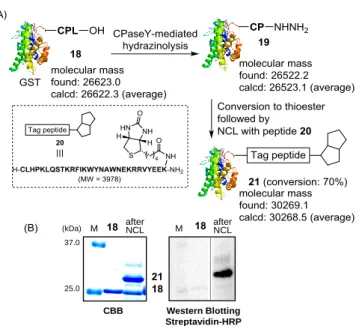
Success in the synthesis of CNP53 prompted us to examine the chemical modification of expressed proteins (Figure 4A). As a model expressed protein, we used the 229-residue glutathione S-transferase (GST) protein.23 The CysProLeu-OH-tagged
232-residue GST (18) was expressed and the resulting protein was converted to the C-terminal prolyl hydrazide protein (19). Then, conversion of 19 to GST thioester followed by NCL with a biotinylated peptide (20) yielded the biotinylated protein (21). A newly formed band showed the biotinylated signal by Western blotting using streptavidin-HRP (Figure 4B). The over-all conversion was estimated by Coomassie Brilliant Blue (CBB)
COMMUNICATION
Journal Name
4 | J. Name., 2012, 00, 1-3 This journal is © The Royal Society of Chemistry 20xx
Please do not adjust margins
Please do not adjust margins
stained gel analysis to be about 70%. The generality of the developed protocol was further confirmed by successful chemical modification of DsRED-express protein (S8 in ESI, Figure S5 in ESI).24 37.0 25.0 CBB Western Blotting Streptavidin-HRP M afterNCL afterNCL (kDa) 19 M 19 22 19
Figure 4. (A)Scheme for the application of CPY-mediated protocol to C-terminally CysProLeu-OH-tagged recombinant GST protein (18); (B) SDS-page analysis of protein samples
Conclusions
A traceless thioester-producing protocol applicable to naturally occurring sequences has been developed. The protocol features a sequence of enzymatic and chemical reactions. The enzymatic reaction of C-terminally CysProLeu-OH-tagged peptides with CPaseY in the presence of NH2NH2 and cyclohexanone affords
the -CysPro-NHNH2 peptides. Chemical conversion of the
hydrazide to -CysPro-SR results in the formation of various peptide thioesters via self-editing process. Chemical modification of recombinant proteins is also achieved with the developed protocol.
Conflicts of interest
There are no conflicts to declare.Acknowledgements
We are grateful to Dr. Mai Makino (Nara Medical University) and Prof. Hiroshi Ueno (Nara Women’s Univ.) for providing information about CPaseY. And we acknowledge Prof. Toru Kawakami and Prof. Hironobu Hojo (Osaka Univ.) for providing comments about the CPE system. We are grateful to Prof. Toshifumi Takao (Osaka Univ.) for measuring ESI-Q-TOF MS. This research was supported in part by a Grant-in-Aid for Scientific Research (KAKENHI). C.K. is grateful for a Scholarship from the Yoshida Scholarship Foundation. And A.S. is grateful for the Research Foundation for Pharmaceutical Sciences.
Notes and references
1 a) P. E. Dawson, T. W. Muir, I. Clark-Lewis, S. B. H. Kent,
Science, 1994, 266, 776; b) S. B. H. Kent, Chem. Soc. Rev., 2009,
38, 338.
2 S. S. Kulkarni, J. Sayers, B. Premdjee, R. J. Payne, Nat. Rev.
Chem., 2018, 2, 17.
3 a) T. W. Muir, Annu. Rev. Biochem., 2003, 72, 249; b) M. Vila-Perelló, T. W. Muir, Cell, 2010, 143, 191.
4 a) K. Severinov, T. W. Muir, J. Biol. Chem., 1998, 273, 16205; b) T. W. Muir, D. Sondhi, P. A. Cole, Proc. Natl. Acad. Sci. U. S.
A., 1998, 95, 6705.,
5 F. I. Valiyaveetil, R. Mackinnon, T. W. Muir, J. Am. Chem. Soc., 2002, 124, 9113.
6 J. J. Ling, R. L. Policarpo, A. E. Rabideau, X. Liao, B. L. Pentelute,
J. Am. Chem. Soc., 2012, 134, 10749.
7 Y. Cao, G. K. T. Nguyen, J. P. Tam, C.-F. Liu, Chem. Commun., 2015, 51, 17289.
8 a) R. Okamoto, K. Morooka, Y. Kajihara, Angew. Chem. Int. Ed., 2012, 51, 191; b) A. L. Adams, B. Cowper, R. E. Morgan, B. Premdjee, S. Caddick, D. Macmillan, Angew. Chem. Int. Ed., 2013, 52, 13062; c) Y. Kajihara, Y. Kanemitsu, M. Nishihara, R. Okamoto, M. Izumi, J. Pept. Sci., 2014, 20, 958; d) Y. Tsuda, A. Shiganaga, K. Tsuji, M. Denda, K. Sato, K. Kitakaze, T. Nakamura, T. Inokuma, K. Itoh, A. Otaka, ChemistryOpen, 2015, 4, 448; e) R. Miyajima, Y. Tsuda, T. Inokuma, A. Shiganaga, M. Imanishi, S. Futaki, A. Otaka, Pep. Sci., 2016, 4, 531.
9 a) R. Hayashi, Y. Bai, T. Hata, J. Biochem., 1975, 77, 1313; b) J. A. Endrizzi, K. Breddam, S. J. Remington, Biochemistry, 1994, 33, 11106.
10 R. Hayashi, Carboxypeptidase Y. In Enzyme Structure Part B:
Proteolytic Enzymes; L. Lorand, Eds.; Methods in Enzymology;
Academic Press; 1976; Vol. 45, pp 568.
11 K. D. Wilkinson, S. E. Smith, L. O'Connor, E. Sternberg, J. J. Taggart, D. A. Berges, T. Butt, Biochemistry, 1990, 29, 7373. 12 G.-M. Fang, Y.-M. Li, F. Shen, Y.-C. Huang, J.-B. Li, Y. Lin, H.-K.
Cui, L. Liu, Angew. Chem. Int. Ed., 2011, 50, 7645. 13 K. Breddam, Carlsberg Res. Commun., 1984, 49, 535.
14 A. Hamberg, M. Kempka, J. Sjödahl, J. Roeraade, K. Hult, Anal.
Biochem., 2006, 357, 167.
15 a) A. Dirksen, P. E. Dawson, Bioconjug. Chem., 2008, 19, 2543; b) V. T. Bhat, A. M. Caniard, T. Luksch, R. Brenk, D. J. Campopiano, M. F. Greaney, Nat. Chem., 2010, 2, 490. 16 R. Hayashi, Y. Bai, T. Hata, J. Biochem., 1975, 77, 69. 17 S. B. Pollock, S. B. H. Kent, Chem. Commun., 2011, 47, 2342. 18 a) T. Nakamura, A. Shigenaga, K. Sato, Y. Tsuda, K. Sakamoto,
A. Otaka, Chem. Commun., 2014, 50, 58; b) L. Raibaut, P. Seeberger, O. Melnyk, Org. Lett., 2013, 15, 5516.
19 a) T. Kawakami, S. Aimoto, Chem. Lett., 2007, 36, 76; b) T. Kawakami, A. Saburo, Bull. Chem. Soc. Jpn., 2010, 83, 570. 20 H. Nakase, S. Murata, H. Ueno, R. Hayashi, Biosci. Biotechnol.
Biochem., 2001, 65, 2465.
21 B. Dang, T. Kubota, K. Mandal, F. Bezanilla, S. B. H. Kent, J. Am.
Chem. Soc., 2013, 135, 11911.
22 Y. Tawaragi, K. Fuchimura, S. Tanaka, N. Minamino, K. Kangawa, H. Matsuo, Biochem. Biophys. Res. Commun., 1991, 175, 645.
23 R. Morgenstern, C. Guthenberg, J. W. Depierre, Eur. J.
Biochem., 1982, 128, 243.
CPaseY-mediated hydrazynolysis Thioesterification Xaa-Cys-Pro-NHNH2 Xaa-SR Xaa: Any amino acids Self-editing
Xaa-Cys-Pro-SR
Thioester-producing protocol featuring carboxypeptidase Y (CPaseY)-mediated hydrazinolysis and subsequent self-editing of tag affords protein thioesters in a traceless manner.
S1
Supplementary Information
Traceless synthesis of protein thioesters using
enzyme-mediated hydrazinolysis and subsequent
self-editing of cysteinyl prolyl sequence
Chiaki Komiya,
[a]Akira Shigenaga,
*,[a]Jun Tsukimoto,
[b]Masahiro Ueda,
[a]Takuya
Morisaki,
[a]Tsubasa Inokuma,
[a]Kohji Itoh,
[b]and Akira Otaka
*,[a][a] Institute of Biomedical Sciences and Graduate School of Pharmaceutical Sciences, Tokushima
University; Tokushima 770-8505, Japan.
[b] Institute of Medicinal Resources, Graduate School of Pharmaceutical Sciences, Tokushima University;
Tokushima 770-8505, Japan.
General Information ...S2
1. General Procedure for Peptide Synthesis ...S3
2. Attempt of CPaseY-mediated Hydrazinolysis of Peptide Acids (1 and 5) ...S3
3. CPE-like Thioesterification of Peptide Hydrazide (7) and Subsequent NCL with N-Terminal Cys
Peptide (8) ...S6
4. Evaluation of CPaseY-mediated Hydrazinolysis under Several Reaction Conditions ...S7
5. Application to Preparation of Various Amino Acyl Thioester ...S9
6. Chemical Synthesis of Reduced Form CNP 53 (S3) ...S11
7.
Application of CPaseY-mediated Protocol to Expressed Proteins ...S13
S2
General Information
All commercial reagents were used without further purification. CPaseY
S1was purchased from
Worthington Industries. CPaseY was stored as 0.5 mg/mL (7.7
M) of aqueous solution (pure
water) at –78 °C. Each peptide or protein was characterized by MS analyses as mentioned below.
Mass spectra (for peptide samples) were recorded on Waters
MICROMASS
®LCT
PREMIER
TMby electrospray ionization time-of-flight (ESI-TOF) reflection experiments or
LC-MS (Shimadzu, Japan, Prominence-I LC-2030, LCMS-2020, a Cosmosil 5C18-AR-II
analytical column (Nacalai Tesque, Japan, 4.6×250 mm, flow rate 1 mL min
−1, eluting products
were detected by UV at 250 nm and MS).
ESI mass spectra (for protein samples) were obtained
using a QTOF mass spectrometer, which is a hybrid quadrupole orthogonal acceleration tandem
mass spectrometer fitted with a Z-spray
TMnanoflow electrospray ion source (Waters, MA).
Samples were dissolved in 0.3 % aqueous formic acid/acetonitrile (1:1, v/v) at the concentration
of 20 pmol/
L, and loaded into a borosilicate nanoflow tip (Thermo Fisher Scientific, MA).
Calibration was performed using cluster ions derived from NaI as the external standard, and
allowed for the measurements with a mass accuracy of about 50 ppm. MS data were processed
by the maximum entropy data enhancement program, MaxEnt 1
TM(Waters), which is capable
of deconvoluting a spectrum with peaks in a variety of charge states to the singly charge-state
spectrum.
For HPLC separation, Cosmosil 5C
18-AR-II analytical column (Nacalai Tesque, 4.6
× 250 mm, flow rate 1.0 mL/min), Cosmosil 5C
18-AR-II semi-preparative column (Nacalai
Tesque, 10 × 250 mm, flow rate 3.0 mL/min), or Cosmosil 5C
18-AR-II preparative column
(Nacalai Tesque, 20 × 250 mm, flow rate 10.0 mL/min). was employed, and eluting products
were detected by UV at 220 nm. A solvent system consisting of 0.1% TFA aqueous solution
(v/v, solvent A) and 0.1% TFA in MeCN (v/v, solvent B) was used for HPLC elution.
S3
1. General Procedure for Peptide Synthesis
Unless otherwise noted, peptides used in this work were synthesized by Fmoc solid-phase
peptide synthesis (Fmoc SPPS) on NovaSyn
®TGR resin (Rink amide type: 0.25 mmol amine/g),
Rink Amide AM resin (0.62 mmol amine/g), Wang resin (0.80 mmol alcohol/g) or
HMPB-ChemMatrix resin (0.5 mmol alcohol/g). Fmoc SPPS was performed according to the following
protocol.
1. Removal of Fmoc groups was carried out using 20% (v/v) piperidine in DMF for 10 min
at room temperature.
2. The resin was washed with DMF (10 times)
3. A standard Fmoc-protected amino acid (4 equiv.) was coupled with the aid of
N,N-diisopropylcarbodiimide (DIPCI) (4 equiv.) and 1-hydroxybenzotriazole monohydrate
(HOBt·H
2O) (4 equiv.) or N,N-diisopropylethylamine (DIPEA) (4.0 equiv.) and
N,N,N’,N’-tetramethyl-O-(benzotriazole-1-yl)uronium hexafluorophosphate (HBTU,
3.9 equiv.) in DMF for 1.5 h. Completion of the coupling reaction was checked by the
Kaiser ninhydrin test. The coupling reaction was repeated until the Kaiser test became
negative.
4. The resin was washed with DMF (5 times).
5. The cycle of steps 1 to 4 was repeated.
Deprotection of acid-lable protecting groups with concomitant release of peptides from a resin
was achieved using a cocktail of TFA-m-cresol-thioanisole-H
2O-1,2-ethanedithiol (80:5:5:5:5
(v/v), 50 μL/1 mg resin) at room temperature for 2 h. The resin was filtered off and the filtrate
was concentrated by N
2stream. Then cooled diethyl ether (Et
2O) was added to the concentrate
and the formed precipitate was collected by centrifugation. The obtained precipitate was
thoroughly washed with cooled Et
2O, and purified by preparative HPLC.
2. Attempt of CPaseY-mediated Hydrazinolysis of Peptide Acids (1 and 5)
2-1. Preparation of peptides acids (1 and 5)
Peptides were synthesized on Fmoc-Ala-O-Wang (for 1) or Fmoc-Leu-O-Wang (for 5) resin
(see below) by Fmoc SPPS (see general procedure for peptide synthesis).
Requisite Fmoc-amino acid-loaded resins were prepared as follows. On Wang resin (0.80
mmol/g), Fmoc-Xaa-OH (10 equiv.) was coupled with the aid of HBTU (9.9 equiv.), DIPEA
(10 equiv.) and DMAP (0.05 equiv.) in DMF at room temperature for 3 h. The resulting resin
was treated with Ac
2O (10 equiv.) and pyridine (10 equiv.) in DMF at room temperature for 30
min to mask the unreacted hydroxyl groups with Ac group. After the capping, the loading of
Xaa was checked by quantification of the Fmoc group. Using Fmoc-Xaa resins, peptide acids
(1 and 5) were synthesized as mentioned above. Characterization data of synthetic peptides are
shown in Table S1.
Table S1. Characterization data of synthetic peptides (1 and 5).
Peptide
Analytical HPLC
aPreparative HPLC
bm/z
Yield
(%)
Retention
time (min)
Gradient
(%)
Gradient (%)
Calcd
Found
1
20.4
1–40
13–23
607.3 [M + H]
+607.2
45
S4
2-2. Initial attempt of CPaseY-mediated hydrazinolysis of peptide acid (1)
Peptide substrate Ac-ALYGAA-OH (1) (0.050 μmol) was incubated in 250 μL of aqueous
solution containing 30 nM CPaseY and 2 M NH
2NH
2·
H
2O (pH 8.0) at 25 ˚C for 12 h. The
reaction was monitored and analyzed by HPLC. Before analysis, the reaction solution was
diluted two-fold by quenching buffer
aand incubated at 37 ˚C for 10 min. Data of the resulting
peptides including over-reaction products from reaction are summarized in Table S2.
a
Quenching buffer: 50 mM Na phosphate, 100 mM TCEP, pH 6.8.
Table S2. Characterization data of peptides.
2-3. Attempt of the direct conversion of peptide substrate (1) to the corresponding
thioester
For the attempt of the direct conversion to the thioester, 1 (0.050 μmol) was incubated in 250
μL of 50 mM HEPES buffer containing 100 nM CPaseY and 1 M sodium
2-mercaptoethanesulfonate (MESNa) (pH 6.0, 7.0 and 8.0) at 25 ˚C for 24 h. And the attempted
reactions were monitored and analyzed by HPLC. Before analysis, the reaction solution was
diluted two-fold by quenching buffer
aand incubated at 37 ˚C for 10 min. Furthermore, other
nucleophiles indicated in Table S3 were also examined. Results are summarized in Table S3.
a
The quenching buffer: 50 mM Na phosphate, 100 mM TCEP, pH 6.8.
Table S3. Examination of other nucleophiles in the CPaseY-mediated reaction.
Peptide
Analytical HPLC
a
m/z
Retention time (min)
Calcd
Found
Ac-ALYGAA-OH (1)
20.5
607.3 [M + H]
+607.4
Ac-ALYGA-NHNH
2(2)
17.8
550.3 [M + H]
+550.3
Ac-ALYG-NHNH
2(3a)
17.5
479.3 [M + H]
+479.4
Ac-ALYG-OH (3b)
19.4
465.2 [M + H]
+465.4
Ac-ALY-NHNH
2(4a)
17.5
422.2 [M + H]
+422.2
Ac-ALYGA-OH
b19.4
536.3 [M + H]
+536.3
aCosmosil 5C18-AR-II analytical column was employed with a linear gradient of solvent B in solvent A over 30
min.; HPLC conditions: a linear gradient of 0.1% TFA-MeCN (1–40% over 30 min) in 0.1 % TFA aq. bTrace amount
of hydorolysis product of 1 was detected.
Entry CPaseY
(nM)
Nucleophile
X = Nu (%)
X = OH (%)
1
100
MESNa (pH 6.0)
0
100
2
100
MESNa (pH 7.0)
0
100
3
100
MESNa (pH 8.0)
0
100
4
60
NH
2NH
2·H
2O
84
16
5
60
NH
2NHMe
62
38
6
60
NH
2NMe
226
74
7
60
NH
2OH
29
70
8
60
NaN
30
100
S5
2-4. Suppression of the over-reactions by the addition of cyclohexanone
To suppress the CPaseY-mediated over-reaction, 1 (0.050 μmol) was incubated in 250 μL of
aqueous solution containing 30 nM CPaseY, 2 M NH
2NH
2·H
2O and 50 mM cyclohexanone (pH
8.0) at 25 ˚C for 12 h. The reaction was monitored and analyzed by HPLC. Before analysis, the
reaction solution was diluted two-fold by quenching buffer
aand incubated at 37 ˚C for 10 min.
a
The quenching buffer: 50 mM Na phosphate, 200 mM MeONH
2
·HCl, 100 mM TCEP, pH 6.8.
The HPLC yield was calculated as described in Figure S1.
Figure S1. Suppression of over-reaction with cyclohexanone by formation of hydrazone.
aYield (%) was
determined by HPLC separation of product 2 (integ. 2) as a fraction of the sum of remaining substrate 1 (integ. 1)
+ over-reaction products (integ. over) + integ. 2.
2-5. CPaseY-mediated hydrazinolysis of peptide 5 and other C-terminal –XaaLeu-OH
(Xaa = Arg (S1) or Lys(S2))
Ac-ALYGPL-OH (5) (0.050 μmol) was incubated in 50 μL of aqueous solution containing 2.4
μM CPaseY and 2 M NH
2NH
2·
H
2O with 50 mM cyclohexanone (pH 8.0) at 25 ˚C for 12 h. The
reaction was monitored and analyzed by LC-MS. Before analysis, the reaction solution was
diluted two-fold by quenching buffer
aand incubated at 37 ˚C for 10 min. Ac-ALYGP-NHNH
2
(6): retention time = 15.8 min (analytical HPLC conditions: linear gradient of solvent B in
solvent A, 5–40% over 30 min); The observed m/z was 576.2 (calculated m/z: 576.3 [M + H]
+).
a
The quenching buffer: 50 mM Na phosphate, 200 mM MeONH
2
·HCl, 100 mM TCEP, pH 6.8.
Ac-ALYGXL-OH (S1 (X = R) and S2 (X = K)) was subjected to CPaseY-mediated
hydrazinolysis in a manner similar to that for peptide 5 (Figure S2).
0 20 40 60 80 100 0 3 6 9 12 Y ie ld o f 2 (% ) a Reaction time (h) cyclohexanone no additive
S6
Figure S2. CPaseY-mediated hydrazinolysis of C-terminal -XaaLeu-OH peptide
3. CPE-like Thioesterification of Peptide Hydrazide (7) and Subsequent NCL with
N-Terminal Cys Peptide (8)
3-1. Synthesis of peptide hydrazide (7) and N-terminal Cys peptide (8)
H-LYRAACP-NHNH
2(7) was synthesized on hydrazine 2-Cl Trt resin by Fmoc SPPS (see
general methods). The hydrazine 2-Cl Trt resin was prepared according to the protocol
described by Liu. LC-MS conditions: A linear gradient of solvent B in solvent A, 5–35% over
30 min, retention time = 14.8 min. Semi-preparative HPLC condtions: A linear gradient of
solvent B in solvent A, 5–18% over 30 min. MS (ESI-TOF) m/z calcd ([M+H]
+) 807.4, found
807.4.
H-CFGRK-NH
2(8) was synthesized on NovaSyn
®TGR resin by Fmoc SPPS according to the
protocol described by Otaka.
S23-2. Thioesterification of 7 and subsequent NCL with 8
S3Peptide hydrazide (7) sample obtained by chemical synthesis (mentioned above) or by
CPaseY-mediated protocol (mentioned below) (0.100 μmol) was subjected to NCL with N-terminal Cys
peptide (8). Experimental procedure was described in the following section (
Typical
experimental procedure for conversion of C-terminally CysProLeu-OH-tagged peptide to the
corresponding hydrazide followed by the NCL protocol: Page S9).
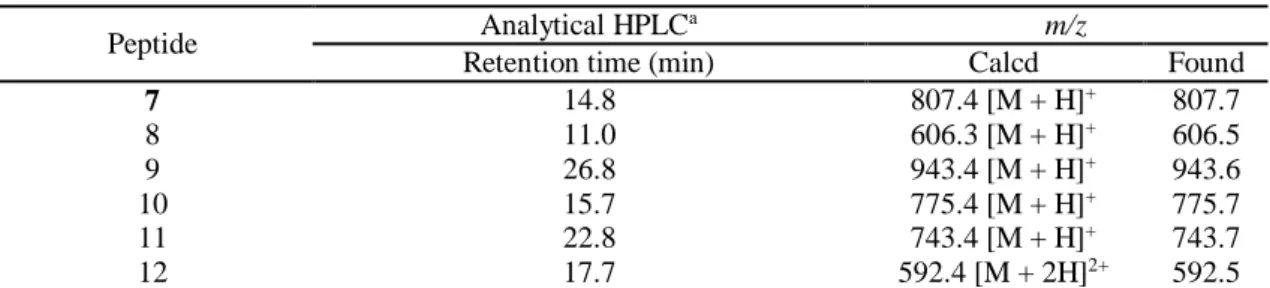
Data of peptides formed in
the reaction were summarized in Table S4.
Table S4. Characterization data of substrate peptide and observed peptide sample in the reaction.
Peptide
Analytical HPLC
a
m/z
Retention time (min)
Calcd
Found
7
14.8
807.4 [M + H]
+807.7
8
11.0
606.3 [M + H]
+606.5
9
26.8
943.4 [M + H]
+943.6
10
15.7
775.4 [M + H]
+775.7
11
22.8
743.4 [M + H]
+743.7
12
17.7
592.4 [M + 2H]
2+592.5
aCosmosil 5C18-AR-II analytical column was employed with a linear gradient of solvent B in solvent A over 30
S7
4. Evaluation of CPaseY-mediated Hydrazinolysis under Several Reaction
Conditions
4-1. Preparation of C-terminal –CPX–OH substrate peptides (13)
All peptides were prepared according to the protocol described for preparation of peptide acids
1 and 5.
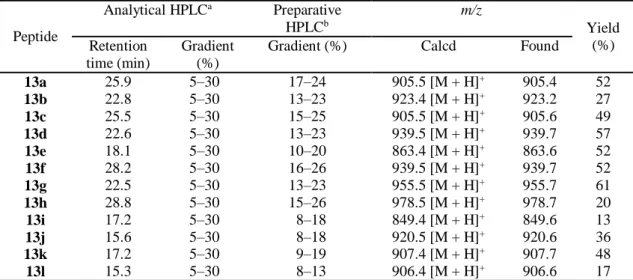
Characterization data of peptides are shown in Table S5.
Table S5. Characterization data of synthesized peptides.
4-2. Experiments for optimization, re-evaluation of carbonyl additives, and evaluation of
influence of the C-terminal amino acids shown in Table S6, S7 and S8
To optimize the reaction conditions, the concentrations of NH
2NH
2·H
2O, cyclohexanone and
CPaseY and the pH were separately changed from the standard procedure. HPLC yields were
summarized in Table S6.
Standard procedure (Table S6, entry 3): H-LYRAACPL-OH (13a) (0.050 μmol) was incubated
in 50 μL (1 mM peptide) of aqueous solution of 1.2 μM CPaseY, 0.2 M NH
2NH
2·H
2O, 60 mM
cyclohexanone, pH 6.4 at 25 ˚C for 1 h. The reaction was monitored and analyzed by LC-MS.
Before analysis, the reaction solution was diluted two-fold by quenching buffer
aand incubated
at 37 ˚C for 10 min.
aThe quenching buffer: 50 mM Na phosphate, 200 mM MeONH
2
·
HCl, 200
mM TCEP, pH 6.8.
To re-evaluate carbonyl compounds as additives for this reaction, each carbonyl compound was
used instead of cyclohexanone. HPLC yields were summarized in Table S7.
To evaluate the influence of C-terminal amino acid of substrate, instead of peptide substrate
(13a), each peptide 13b–k was subjected to the optimal reaction conditions shown in Table S6
(entry 3). HPLC yields were summarized in Table S8.
Peptide
Analytical HPLC
aPreparative
HPLC
bm/z
Yield
(%)
Retention
time (min)
Gradient
(%)
Gradient (%)
Calcd
Found
13a
25.9
5–30
17–24
905.5 [M + H]
+905.4
52
13b
22.8
5–30
13–23
923.4 [M + H]
+923.2
27
13c
25.5
5–30
15–25
905.5 [M + H]
+905.6
49
13d
22.6
5–30
13–23
939.5 [M + H]
+939.7
57
13e
18.1
5–30
10–20
863.4 [M + H]
+863.6
52
13f
28.2
5–30
16–26
939.5 [M + H]
+939.7
52
13g
22.5
5–30
13–23
955.5 [M + H]
+955.7
61
13h
28.8
5–30
15–26
978.5 [M + H]
+978.7
20
13i
17.2
5–30
8–18
849.4 [M + H]
+849.6
13
13j
15.6
5–30
8–18
920.5 [M + H]
+920.6
36
13k
17.2
5–30
9–19
907.4 [M + H]
+907.7
48
13l
15.3
5–30
8–13
906.4 [M + H]
+906.6
17
aCosmosil 5C18-AR-II analytical column and bCosmosil 5C18-AR-II preparative column were employed with a linear
S8
Table S6. Optimization of CPaseY-mediated hydrazinolysis.
Entry
(μM)
CPY
NH
2NH
2(M)
cyclohexanone
(mM)
pH
Remaining
Substrate
13a (%)
Yield of
7 (%)
a1
1.2
1.0
60
6.4
0
>97
2
1.2
0.5
60
6.4
0
>97
3
1.2
0.2
60
6.4
0
>97 (76)
b4
1.2
0.05
60
6.4
0
89
5
1.2
0.2
90
6.4
0
>97
6
1.2
0.2
30
6.4
0
93
7
1.2
0.2
60
7.4
0
>97
8
1.2
0.2
60
5.4
0
>97
9
1.2
0.2
60
4.4
0
83
10
0.1
0.2
60
6.4
39
60
aYield (%) was determined by HPLC separation and integration of product 7 (integ. 7) as a fraction of the sum of the remaining 13a (integ. 13) + over-reaction products (integ. over) + integ. 7. bIsolated yield.
Table S7. Re-evaluation of carbonyl additives for CPaseY-mediated hydrazinolysis
Entry
Additive
Yield of 7
(%)
Over-reaction products
(%)
1
No
48
52
2
2-formylpyridine
25
75
3
3-formylpyridine
54
46
4
acetone
27
73
5
isobutylaldehyde
64
36
6
pivalaldehyde
27
73
7
3-pentanone
87
13
8
cyclopentanone
94
6
9
cyclohexanone
97
3
10
cycloheptanone
97
3
11
4-piperidone·HCl
86
14
12
2,2,6,6-tetramethyl-4-piperidone·HCl
85
15
13
1,4-cyclohexanedione
76
24
aYield (%) was determined by HPLC separation and integration of product 7 (integ.
7) as a fraction of the sum of product 7 (integ. 7) + over-reaction products (integ. over).
S9
Table S8. Evaluation of C-terminal amino acids of a substrate for CPY-mediated
hydrazinolysis.
Entry X Remaining Substrate 13 (%) Hydrazide 7 (%)a Over-reaction products (%) 1 Leu (13a) 0 >97 <3 2 Met (13b) 0 >97 <3 3 Ile (13c) 0 >97 <3 4 Val (13d) 0 >97 <3 5 Phe (13e) 0 95 5 6 Tyr (13f) 4 91 5 7 Trp (13g) 73 16 11 8 Gly (13h) 90 9 –b 9 Lys (13i) 71 29 –b 10 Asp (13j) 88 12 –b 11 Asn (13k) 77 23 –baYield (%) was determined by HPLC separation and integration of product 7
(integ. 7) as a fraction of the sum of the remaining substrate (integ. substrate) + over-reaction products (integ. over). b Not observed.
5. Application to Preparation of Various Amino Acyl Thioester
5-1. Preparation of the C-terminal -XaaCysProLeu-OH peptides (14)
All peptides were prepared according to the protocol described for preparation of peptide acids
1 and 5.Characterization data of synthetic peptides are summarized in Table S9
Table S9. Characterization data of synthetic peptides (14).
Peptide
(14) Xaa
Analytical HPLC
aPreparative HPLC
bm/z
Yield
(%)
Retention
time (min)
Gradient
(%)
Gradient (%)
Calcd
Found
14a (Gly)
25.0
5–30
14–24
892.5 [M + H]
+892.6
39
14b (Arg)
24.2
5–30
16–26
991.5 [M + H]
+991.5
44
14c (Lys)
23.5
5–30
12–22
963.5 [M + H]
+963.6
35
14d (His)
23.8
5–30
13–23
972.5 [M + H]
+971.6
26
14e (Ser)
25.0
5–30
16–26
922.5 [M + H]
+922.6
43
14f (Thr)
25.8
5–30
16–26
936.5 [M + H]
+936.5
41
14g (Cys)
27.9
5–30
16–36
938.5 [M + H]
+938.6
35
14h (Asn)
24.4
5–30
14–24
949.5 [M + H]
+949.6
49
14i (Gln)
25.2
5–30
15–25
963.5 [M + H]
+963.5
50
14j (Glu)
26.0
5–30
14–24
964.5 [M + H]
+964.5
44
14k (Met)
26.0
5–35
18–28
967.2 [M + H]
+9675
54
14l (Trp)
22.4
5–40
22–32
1021.5 [M + H]
+1021.4
6
14m (Tyr)
25.2
5–35
16–26
998.5 [M + H]
+998.5
31
14n (Phe)
25.5
5–40
22–32
982.5 [M + H]
+982.6
49
14o (Leu)
27.5
5–35
18–28
948.5 [M + H]
+948.6
52
14p (Ile)
18.6
5–55
20–30
948.5 [M + H]
+948.3
42
14q (Val)
29.2
5–35
18–28
934.5 [M + H]
+934.7
28
aCosmosil 5C18-AR-II analytical column bCosmosil 5C18-AR-II preparative column were employed with a linear
S10
5-2. CPaseY-mediated hydrazinolysis of C-terminal -XaaCysProLeu -OH peptides (14)
CPaseY-mediated conversion of various substrate peptides (14) to the corresponding hydrazide
(15) were performed as follows.
Each peptide (14) (per 1 mM peptide) was treated with aqueous
solution containing 1.2 μM CPaseY, 0.2 M NH
2NH
2·H
2O and 60 mM cyclohexanone, pH 6.4
at 25 ˚C for 1 h. And the yield (%) of 15 was determined by HPLC separation and integration
of product (integ. product) as a fraction of the sum of the remaining substrate (integ. substrate)
+ other products derived from substrate (integ. others) + integ. product.
The HPLC yields were
summarized in the column Step 1 of Table 1. Furthermore, characterization data of the obtained
hydrazide were summarized in Table S10.
5-3. CPE-like thioesterification of peptide hydrazide (15) and subsequent NCL with
N-terminal Cys peptide (8)
Each peptide hydrazide (15) was subjected to NCL with N-terminal Cys peptide (8) as shown
in below.
Each obtained hydrazide peptide (15) (per 1.5 mM peptide) was treated with 50 mM
Na phosphate buffer containing 6 M Gn·HCl and 7.5 mM NaNO
2, pH 3.0 at -10 ˚C for 30 min.
Then 50 mM Na phosphate buffer containing 6 M Gn·HCl, 50 mM MPAA and 2.0 mM
H-CFGRK-NH
2(8) was added to the reaction mixture and the pH was adjusted to pH 6.5. the
reaction mixture was incubated at rt for 12 h. And the yield (%) of 17 was determined by HPLC
separation and integration of product (integ. product) as a fraction of the sum of the remaining
substrate (integ. substrate) + other products derived from substrate (integ. others) + integ.
product.
The HPLC yields were summarized in the column Step 2 of Table 1. Data of peptides
formed in the reaction were summarized in Table S11.
Table S10. Characterization data of obtained peptide hydrazide (15).
Peptide
Analytical HPLC
a
m/z
Retention time (min)
Gradient (%)
Calcd
Found
15a (Gly)
14.0
5–30
793.4 [M + H]
+793.5
15b (Arg)
14.2
5–30
892.5 [M + H]
+892.6
15c (Lys)
14.0
5–30
864.5 [M + H]
+864.5
15d (His)
14.2
5–30
873.5 [M + H]
+873.6
15e (Ser)
14.1
5–30
823.4 [M + H]
+823.4
15f (Thr)
14.8
5–30
837.4 [M + H]
+837.5
15g (Cys)
16.5
5–30
839.4 [M + H]
+839.4
15h (Asn)
13.6
5–30
850.4 [M + H]
+850.6
15i (Gln)
14.6
5–30
864.4 [M + H]
+864.4
15j (Glu)
15.2
5–30
865.4 [M + H]
+865.4
15k (Met)
16.5
5–35
867.4 [M + H]
+867.4
15l (Trp)
20.5
5–35
922.5 [M + H]
+922.7
15m (Tyr)
18.2
5–30
899.5 [M + H]
+899.5
15n (Phe)
19.7
5–35
883.5 [M + H]
+883.6
15o (Leu)
18.5
5–35
849.5 [M + H]
+849.6
15p (Ile)
17.4
5–35
849.5 [M + H]
+849.5
15q (Val)
15.8
5–35
835.5 [M + H]
+835.5
aCosmosil 5C18-AR-II analytical column was employed with a linear gradient of solvent B in solvent A over 30 min.
5-4. Detail experimental procedure for conversion of C-terminally CysProLeu-OH-tagged
peptides (13a, 14) to the corresponding hydrazides (7, 15) followed by the NCL protocol.
C-Terminally CysProLeu-OH-tagged peptide substrate (H-LYRAACPL-OH (13a)) (2.0 μmol)
was incubated in 0.4 mL (5.0 mM peptide) of hydrazinolysis solution [0.3 μM CPaseY, 0.2 M
NH
2NH
2·
H
2O, 60 mM cyclohexanone, pH 6.4] at 25 ˚C for 1 h. To prepare hydrazinolysis
S11
solution, aqueous solution containing NH
2NH
2·
H
2O (0.2 M) and cyclohexanone (60 mM) was
prepared and the pH was adjusted to pH 6.4 with 6 M HCl. To the resulting solution was added
the stock solution of CPaseY in H
2O (7.7
M: 0.5 mg protein/mL) (final concentration: 0.3 μM
CPaseY, 0.2 M NH
2NH
2·H
2O, 60 mM cyclohexanone, pH 6.4). The solution was used for the
hydrazinolysis reaction. After completion of the reaction, the reaction solution was diluted
two-fold by the quenching buffer (50 mM Na phosphate, 200 mM MeONH
2·
HCl, 200 mM TCEP,
pH 6.8) with additional incubation at 37 ˚C for 10 min. The crude material was analyzed by
LC-MS and purified by semi-preparative HPLC to give the hydrazide (7) (1.2 mg, 1.50 μmol,
76%). Semi-preparative HPLC conditions: A linear gradient of solvent B in solvent A, 5–18%
over 30 min. MS (ESI-TOF) m/z calcd for C
35H
59N
12O
8S [M+H]
+807.4; Found 807.4. The
resulting hydrazide (7) (0.10 μmol) was dissolved in 65 μL of 50 mM Na phosphate buffer
containing 6 M Gn·HCl (pH 3.0) and the reaction mixture was stored at -10 ˚C. Then, 2.5 μL
of 0.2 M NaNO
2aq. was added to the solution and the reaction mixture was stored at -10 ˚C for
30 min. After that, 33 μL of 50 mM Na phosphate containing 6 M Gn·HCl and 150 mM MPAA
was added to the mixture, and the pH of the mixed solution was adjusted to pH 6.5 with 1.0 M
NaOH aq.. To the mixture was added N-terminal cysteinyl peptide (8) (0.20 μmol) and the
mixed solution was incubated at room temperature for 12 h. Resulting solution was analyzed
by LC-MS and HPLC yield of NCL products (12) was calculated according to the equation as
described in section 5-3. ESI-TOF MS, found: 592.5, m/z calcd for m/z [M+2H]
2+(C
53H
88N
18O
11S): 592.4. HPLC yields of other NCL products (17) were also similarly obtained.
Table S11. Characterization data of substrate peptide and observed peptide sample in the reaction.
6. Chemical Synthesis of Reduced Form CNP53 (S3)
6-1. Preparation of peptide fragments S5 and S6
Both peptides were prepared according to the protocol described for the preparation of peptide
acids 1 and 5.
Characterization data of peptides are shown in Table S12.
Peptide
Analytical HPLC
a
m/z
Retention time (min)
Gradient (%)
Calcd
Found
17a (Gly)
17.1
5–35
585.3 [M + 2H]
2+585.6
17b (Arg)
16.5
5–35
634.9 [M + 2H]
2+635.2
17c (Lys)
16.7
5–35
620.8 [M + 2H]
2+621.2
17d (His)
16.3
5–35
625.3 [M + 2H]
2+625.7
17e (Ser)
17.4
5–35
600.3 [M + 2H]
2+600.6
17f (Thr)
17.9
5–35
607.3 [M + 2H]
2+607.7
17g (Cys)
18.9
5–35
608.3 [M + 2H]
2+608.6
17h (Asn)
17.2
5–35
613.8 [M + 2H]
2+614.1
17i (Gln)
17.5
5–35
620.8 [M + 2H]
2+621.2
17j (Glu)
17.8
5–35
621.3 [M + 2H]
2+621.7
17k (Met)
20.1
5–35
622.3 [M + 2H]
2+622.6
17l (Trp)
20.7
5–40
649.9 [M + 2H]
2+650.2
17m (Tyr)
17.5
5–35
638.3 [M + 2H]
2+638.7
17n (Phe)
20.3
5–40
630.3 [M + 2H]
2+630.6
17o (Leu)
19.1
5–40
613.4 [M + 2H]
2+613.7
17p (Ile)
18.7
5–40
613.4 [M + 2H]
2+613.6
17q (Val)
17.5
5–40
606.4 [M + 2H]
2+606.7
aCosmosil 5CS12
Table S12. Characterization data of synthetic peptides required for the preparation of reduced form CNP 53
6-2. CPaseY-mediated hydrazinolysis of C-terminally CysProLeu-tagged peptide (S6)
Peptide S6 (0.85 μmol) was incubated in 1.0 mL (0.85 mM peptide) of aqueous solution
containing 0.6 μM CPaseY, 0.2 M NH
2NH
2·H
2O and 60 mM cyclohexanone (pH 6.4) and
incubated at 25 ˚C for 1 h. After completion of the reaction, the solution was diluted two-fold
by the quenching buffer
a. The crude material was analyzed by HPLC and purified by
semi-preparative HPLC to give hydrazide S7 (2.6 mg, 0.60 μmol, 70%).
Characterization data of
peptides are shown in Table S13.
a
The quenching buffer: 50 mM Na phosphate, 200 mM MeONH
2
·HCl, 200 mM TCEP, pH 6.8.
6-3. CPE-like Thioesterification followed by NCL using peptide S7 and S5
Figure S3. Preparation of reduced form CNP 53 (S3) using the CPaseY-mediated synthesis of thioester fragment
(S4) followed by NCL with N-terminal cysteine peptide (S5). (A) Synthetic scheme for the preparation of reduced
form CNP 53 (S3). (B) CPaseY-mediated hydrazinolysis reaction of the C-terminally CysProLeu-tagged substrate
(S6) (after 1 h of reaction). (C) NCL of 0.5 mM of in-situ formed thioester (S4) with 1.0 mM of N-terminal
cysteinyl peptide (S5) (after 4 h of NCL). HPLC conditions: a linear gradient of 0.1% TFA-MeCN (5–35% over
30 min) in 0.1 % TFA aq. *Non-peptidic impurity.
Peptide
Analytical HPLC
aPreparative
HPLC
bm/z
Yield
(%)
Retention
time (min)
Gradient
(%)
Gradient (%)
Calcd
Found
S6
22.1
5–35
14–20
547.9 [M + 8H]
8+547.8
7
S5
23.9
5–30
22–32
878.9 [M + 2H]
2+878.7
16
aCosmosil 5C18-AR-II analytical column and bCosmosil 5C18-AR-II preparative column were employed with a
S13
Purified hydrazide (S7) (0.60 μmol) was dissolved in 390 μL of 50 mM Na phosphate buffer
containing 6 M Gn·HCl (pH 3.0) and the reaction mixture was stored at -10 ˚C. Then, 15 μL of
0.2 M NaNO
2aq. was added to the solution, and the reaction mixture was stored at -10 ˚C for 1
h. After that, 200 μL of 50 mM Na phosphate containing 6 M Gn·HCl and 150 mM MPAA was
added to the solution, and the pH of the mixed solution was adjusted to pH 6.5 with 1.0 M
NaOH aq.. To the mixture was added N-terminal Cys peptide S5 (1.2 μmol) in 600 μL of 50
mM Na phosphate containing 6 M Gn·HCl and 50 mM MPAA (pH6.5) and the reaction mixture
was incubated at room temperature for 4 h. The reaction was monitored and analyzed by HPLC.
Before analysis, the reaction solution was diluted twice with quenching buffer
aand incubated
at 37 ˚C for 10 min. After completion of the reaction (4 h), the solution was diluted twice with
the quenching buffer. The crude material was purified by semi-preparative HPLC to give
reduced form CNP 53 S3 (3.0 mg, 0.522 μmol, 88%).
a
The quenching buffer: 6 M Gn·HCl, 50 mM Na phosphate, 100 mM TCEP, pH 6.8.
Table S13. Characterization data of the resulting hydrazide (S7) and reduced form CNP 53 (S3).
7. Application of CPaseY-mediated Protocol to Expressed Proteins
7-1. Expression and purification of recombinant C-terminally tagged GST (18) and
DsRED-express (S8)
Amino acid sequence of C-terminally CysProLeu-tagged GST (18)
MSPILGYWKIKGLVQPTRLLLEYLEEKYEEHLYERDEGDKWRNKKFELGLEFPNLPY
YIDGDVKLTQSMAIIRYIADKHNMLGGCPKERAEISMLEGAVLDIRYGVSRIAYSKDFE
TLKVDFLSKLPEMLKMFEDRLCHKTYLNGDHVTHPDFMLYDALDVVLYMDPMCLD
AFPKLVCFKKRIEAIPQIDKYLKSSKYIAWPLQGWQATFGGGDHPPKSDLVPRAACPL
Amino acid sequence of C-terminally CysProLeu-tagged DsRED-express (S8)
GMASSEDVIKEFMRFKVRMEGSVNGHEFEIEGEGEGRPYEGTQTAKLKVTKGGPLPF
AWDILSPQFQYGSKVYVKHPADIPDYKKLSFPEGFKWERVMNFEDGGVVTVTQDSSL
QDGSFIYKVKFIGVNFPSDGPVMQKKTMGWEASTERLYPRDGVLKGEIHKALKLKDG
GHYLVEFKSIYMAKKPVQLPGYYYVDSKLDITSHNEDYTIVEQYERAEGRHHLFLYR
AACPL
cDNAs of C-terminally CysProLeu-tagged GST (18) and C-terminally CysProLeu-tagged
Ds-RED-express (S8)
S4were cloned into the pEV3b
S5and the pGEX-2T vectors, respectively
(pEV3b and PGEX-2T constructs were designed for affording the tagged GST (18) itself and
GST-tagged DsRED-express fusion (S8), respectively). The expressions of the proteins were
done by transforming the constructed plasmids in to E. coli Rosetta 2 DE3 (Merck) competent
cells. The transformed cells were grown in 1 L of LB-ampicillin (+) medium at 37 °C until the
optical density became 0.6 before the addition of isopropyl-α-D-thiogalactopyranoside(IPTG).
After 24 h growth at 25 °C in the presence of 0.1 mM IPTG, cells were harvested by
centrifugation and suspended in phosphate-buffered saline (PBS). The cells were then lysed in
Peptide
Analytical HPLC
aSemi-preparative
HPLC
bm/z
Yield
(%)
Retention
time (min)
Gradient
(%)
Gradient (%)
Calcd
Found
S7
22.8
5–35
13–23
1070.1 [M+4H]
4+1070.2
70
S3
23.9
5–35
14–24
1161.0 [M+5H]
5+1161.1
88
aCosmosil 5C18-AR-II analytical column and bCosmosil 5C18-AR-II preparative column were employed with a linear