タンザニア連合共和国ザンジバルの教員養成大学にお けるICT導入
-UTAUTモデルによる要因の分析-
Factors Affecting ICT Adoption in Zanzibar, Tanzania Teacher Training Universities:
The Unified Theory of Acceptance and Use of Technology
コンボ,アシャ ジュマ KOMBO, Asha Juma
● 国際基督教大学大学院アーツ・サイエンス研究科
Graduate School of Arts and Sciences, International Christian University
成果期待,努力期待,社会的影響,促進条件,教育現場でのICT導入
Performance expectancy, effort expectancy, social influence, facilitating conditions, ICT adoption in teaching
ABSTRACT
本研究は,タンザニア連合共和国ザンジバルの教員養成大学において,インストラクターへのICT導 入に影響を及ぼす要因を明らかにしようとしたものである。公立大学1校および私立大学2校の計3校 でデータを収集し,ICTの導入にあたってインストラクターの行動意図(BI: Behavioral Intention)が Unified Theory of Acceptance and Use of Technology(UTAUT モデル)のどの要因に起因して促進あるいは 阻害されたものであるかを検証した。UTAUTモデルにおける要因とは成果期待,努力期待,社会的影響,
促進条件である。重回帰分析の結果,教育にICTを導入するインスラクターの行動意図の予測に際して は,どの要因も影響が見られなかった。2要因の分散分析では,女性の回答者は男性の回答者に比べて
より強いBIを有することが認められた。また,教育学部の回答者は自然科学学部の回答者に比べICT導
入に対してより強い意図を持つ傾向を示した。インストラクターのICT導入を妨げている共通の課題と しては,ICTインフラの不足およびICT訓練のための有能な専門家の不足が挙げられる。
研 究 論 文 RESEARCH ARTICLE
1. Introduction
1. 1 Background of the Study
The expansion of socio-economic growth across the globe has convinced educators and policymakers in Africa and other regions to recognize the importance of adopting Information and Communication Technology (ICT) in teaching. One goal of ICT scholars in this information age is to improve the focus of education policymakers, curriculum developers, designers, ICT administrators, monitors, and evaluators towards a more interactive knowledge-dissemination approach.
In light of this, Kozma (2005) emphasized the importance of making significant changes in education curriculum development in African educational institutions, especially in teaching methodologies.
Chris (2015) noted that teacher-training universities need to change their way of teaching to enable them to produce “a global workforce not limited to the provision of national workforce”
(p.182). He added that ICT might be an alternative solution for international challenges, including creating employment in societies. In line with this global shift, the Zanzibar government, through the Ministry of Education and Vocational Training (MoEVT), has acknowledged the importance of ICT in teaching. The government has promoted the adoption of ICT by establishing e-governance and policies necessary for technology implementation
across all sectors. This e-government is intended to monitor and evaluate the progress of adopting ICT in all sectors, including teacher training. The Zanzibar government through MoEVT has further put in place various initiatives such as the Zanzibar Strategy for Growth and Reduction of Poverty (ZSGRP 2010-2015). ZSGRP provides training to pre- and in-service teachers through Teacher Centers (TCs) to expose instructors to ICT in teaching. The government has recently installed new internet infrastructure by deploying optical fiber to facilitate the availability of the internet around the islands.
Recently, e-governance has been extended to engage with citizens and provide services online.
MoEVT has implemented the above measures because it believes that ICT might spur job creation and improve the quality of life of individuals.
1.2 Problem Statement
While the government has made progress in adopting ICT across its departments, this research, however, has revealed that most respondents were reluctant to adopt ICT in teaching. Very few instructors showed interest in incorporating the blended method in teaching.
Furthermore, a review of the literature revealed there is a scarcity of empirical research regarding the adoption of ICT in Zanzibar teacher training.
However, there is one study by Mtebe (2014), This article investigated factors affecting ICT adoption of instructors in teacher training universities in Zanzibar, Tanzania. Data were collected from three universities: one public and two private and analyzed to examine which factors from the Unified Theory of Acceptance and Use of Technology might promote or hinder the instructors’ behavioral intention (BI). All factors: performance expectancy, effort expectancy, social influence and facilitating conditions were important for ICT adoption. Multiple regressions revealed none of the factors were influential in predicting instructors’ behavioral intention to adopt ICT in teaching.
Two-way ANOVA discovered that female respondents had a stronger BI than their male counterparts.
Respondents from the Department of Education had a stronger intention to adopt ICT than ones from the Department of Natural Sciences. Common challenges hindering the instructors’ ICT adoption included lack of ICT infrastructure and competent experts for ICT training were discovered and documented.
involving two of Zanzibar’s universities, State University (SUZA) and Zanzibar University (ZU).
The University College of Education of Zanzibar (current name: Sumait) was not included. This research focused on Open Educational Resources (OER) and not on adoption of ICT tools.
Many guideline models have been developed with the aim of promoting the adoption of ICT at the international level, such as by Oye, Lahad and Rahim (2012). These models are important because they present national and international best practices for adopting ICT in teaching. However, many African countries, including Zanzibar, are yet to develop national models that reflect their specific local needs. The nearest they have come is developing fundamental national ICT policies and strategies. In this regard, Zanzibar has developed necessary national policies for implementing ICT, such as the Zanzibar National ICT Policy (2013) and e-government (2012). These policies provide guidance on how Zanzibar intends to roll out ICT in various sectors at the national level.
1.3 Research Purpose and Questions This study investigated significant factors affecting the adoption of ICT in teacher training in Zanzibar using the Unified Theory of Acceptance and Use of Technology (UTAUT). The study focused mainly on the adoption of ICT in teacher training by instructors and included an overview of the policy makers (curriculum developers and designers) from MoEVT regarding the acceptance of ICT in teaching. To achieve the principal purpose of this study, this survey included the following research questions: (1) What were the factors influencing the adoption of ICT in teacher training universities?; (1a) Do the four factors of UTAUT (performance expectancy, effort expectancy, social influence, and facilitating conditions) explain the adoption of ICT in teaching by Zanzibar instructors?; (1b)Do monetary
incentives, rewards, recognition, and promotion influence the adoption of ICT in teaching by instructors in Zanzibar teacher training universities?; (2) Do gender (male vs. female) or department (Education vs. Natural sciences) affect the factors influencing the adoption of ICT?; and (3) What are the perceived challenges hindering the adoption of ICT by instructors in teacher training universities?
2. Review of the Literature on Adopting ICT in Education
2.1 Concept of ICT in Teaching and Learning Scholars have defined the concept of ICT in teaching and learning in a variety of ways. Most, however, seem to share a similar concept, for instance, Wee and Zaitun (2006) defined ICT in teaching as “the inclusion of each communication device or application hardware and software” (p.
203). Others referred to it as a way of disseminating information to learners through software and hardware in an interactive and collaborative way (i.e., teacher to students, students to students, or students to instructions) via a blended teaching method to raise the standard of educational outcomes (Chris, 2015; Grenman, Isomursu, Federly,& Seisto, 2013).
Based on the above literature, ICT in education could be defined as a way of teaching using the traditional method and incorporating ICT and its applications, for instance, Google classroom, personal computers, spreadsheets, e-mails, Skype, PowerPoint presentations, video conferencing, word processing, and websites to increase student participation and enjoyment during lessons.
2.2 Benefits of ICT in Teaching and Learning A number of ICT scholars noted the benefits of ICT in education, which suggested how technology can be made to fit all adopters, regardless of age,
their specialist field, and ability. The flexibility and the inclusiveness of ICT tools in teaching and learning provide opportunities for all students of differing abilities to learn without any form of isolation. The Japan Ministry of Education, Culture, Sports, Science and Technology (MEXT) (2011) said researchers found that if ICT in teaching is utilized properly, an electronic device such as an iPad or software applications such as PowerPoint can even help students with special needs to interact with their studies as regular students do. For example, students who have moderate visual impairment can maximize font size and use different colors. Effective teaching with ICT makes the lesson collaborative, easy to practice, and inclusive, and thus it provides students with active interaction.
Furthermore, ICT revolutionizes education, in that it causes both educators and practitioners to always think ahead to the new teaching demands of tomorrow, as technology profoundly changes instructors’ accepted way of teaching. Mikre (2011) asserted that yesterday’s way of delivering knowledge might not fit that of today in disseminating and receiving knowledge. Nyakowa (2014) elaborated on this: neglecting the concurrent use of ICT in teaching in this technological age “will affect the complete learning and teaching process of today and in the future” (p.21).
However, adopting ICT in teaching is not easy and simple to achieve the desired goal, especially at a preliminary stage like that of Zanzibar teacher training universities. Much more effort and determination from the universities observed in this study and the government is needed to trigger the process. Rogers (2003) asserted that adopting new technology is a long process that requires considerable time and money. Stigzelius (2011) proposed that a combination of efforts (such as government investment) and measures (such as understanding instructors’ preferences) might be helpful in
adopting ICT in teaching.
The process of adopting new technology has to be linked to various points of preparation. They are links in a chain that connect to one another, and of these, research, planning, and strategy are crucial for success. Stigzelius (2011) stated, “The process of implementing new tools can be seen as an implementation bridge. The current practices are on one side of a large gap, and on the other are new routines with new tools. To get to the new routines, the instructors must have enough support;
otherwise, the bridge will collapse” (p.21).
Therefore, this study suggests further research regarding the adoption of ICT using UTAUT as a guideline to examine which working environment would encourage instructors to adopt ICT in their teaching. However, there are common models for testing the intention of new technology adopters such as Socio-Cognitive Theory (Bandura, 1989) (SCT), and the Diffusion of Innovations (Rogers, 2003) (DI); however, those models and theories seemed to miss significant factors when they are exclusively applied. The missed factors might be crucial to the contribution of technology acceptance for the new adopters to adopt ICT in teaching. For example, Roger’s (2003) model of the adoption process and the Socio-Cognitive Theory of Bandura (1989) focused on environmental motivation and knowledge gain.
From this, it was determined that UTAUT is the best fit model because it integrates all potential components from eight technology acceptance models and theories that seem to trigger the behavioral intention of new adopters to accept ICT in their working areas.
2.3 Unified Theory of Acceptance and Use of Technology (UTAUT)
The UTAUT model was founded by Venkatesh, Morris, Davis, and Davis (2003), based on the conceptual and empirical similarities among eight
competitive technology acceptance models and theories, namely, TRA, TAM, MM, TPB, C-TAM- TPB, MPCU, IDT, and SCT. For the UTAUT model, Venkatesh et al. (2003) reviewed 32 variables from the existing models and theories and determined four key factors and moderators to fulfill the intention of new technology adopters to accept ICT. The four key UTAUT factors are performance expectancy (PE),the extent to which an instructor feels to have benefited from using ICT in teaching; effort expectancy (EE),the extent to which an instructor perceives the ease and enjoyment of using ICT in teaching; facilitating conditions (FC),the degree to which the new ICT instructor feels supported by the infrastructure, internet, technical support, and maintenance of the ICT resources available to facilitate their adoption in teaching; and social influence (SI),the situation in which people believe a non-ICT instructor can also adopt ICT in teaching. Behavioral intention (BI) is the instructor’s willingness to accept ICT in
teaching.
The UTAUT model is widely used in examining new adopters’ willingness to accept technology indifferent contexts and organizations. Mtebe (2014) commented that TAUT has a high rate of citation, about 70% compared with40% for other models and theories. Figure 1 shows the UTAUT key factors and moderators for new adopters to adopt ICT.
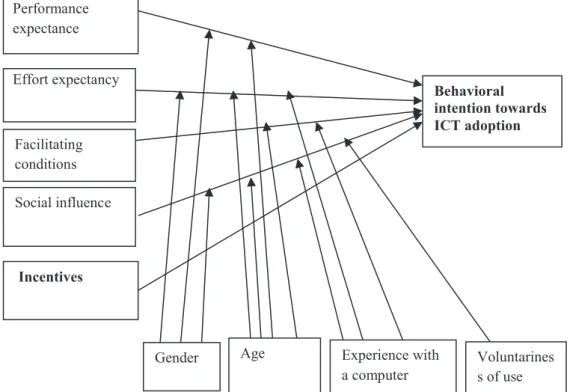
2.4 Conceptual Framework of the Study Several studies, including Mtebe and Raisamo (2014b), reported dropping some constructs from the UTAUT model and adding new ones and determiners to ensure their studies matched the selected contexts. Likewise, for the Zanzibar instructors to adopt ICT in teaching, this study extended the UTAUT model by adding an incentives factor that included recognition, special salary increments, promotion, and rewards to better suit the Zanzibar context (see Figure 2).
Figure 1 The original Unified Theory of Acceptance and Use of Technology model. Adapted from “User Acceptance of Information Technology: Toward a Unified View” by V. Venkatesh, M. G. Morris, G. B. Davis, & F. D. Davis,2003, MIS Quarterly, 43, p.
425–478. Copyright 2003 by the Management Information Systems Research Center, University of Minnesota.
Furthermore, the supplementary factor has been added because the pay of educational stakeholders in Zanzibar is low, and providing incentives is recommended to motivate instructors to adopt ICT.
One suggested reason for the lack of interest in adopting ICT in teaching is the low salary level of instructors in Zanzibar teacher training. Most of the required ICT resources are not regularly available at the universities. This meant that only a few instructors were enthusiastic enough to purchase the required ICT resources from outside the university, but many other instructors were unwilling and remained resistant to its adoption.
Allahawiah and Tarawneh (2015) noted instructors would not adopt and use ICT in teaching until they felt that their attempts were valued by their universities and government; only then did the instructors perceive that using ICT was enjoyable.
Chigona and Chigona (2010) argued that “people should look at poverty” (p.4) because it might be the reason instructors lack the capability to choose technology for teaching.
3. Methodology
First, the approval for research implementation and permission for data collection was obtained from the research ethics office of International Christian University (ICU), followed by approval from the government office responsible for research permission at the Second Vice President Office in Zanzibar, Tanzania.
Furthermore, a pilot group of 20 ICU students were selected to test the instruments for detecting potential faults with the survey instrumentation.
Respondents were then contacted via e-mail, WhatsApp, or telephone after they were notified
Performance expectance Effort expectancy
Behavioral intention towards ICT adoption Facilitating
conditions Social influence
Incentives
Voluntarines s of use Experience with
a computer Gender Age
Figure 2 Modified UTAUT research model for the study from the original Unified Theory of Acceptance and Use of Technology model. Adapted from “User Acceptance of Information Technology: Toward a Unified View” by V. Venkatesh, et al., 2003, MIS Quarterly, 43, p. 425–478. Copyright 2003 by the Management Information Systems Research Center, University of Minnesota.
about the granting of permission for conducting research. Subsequently, consent letters were sent to the potential participants to ask whether they would be willing to participate in the study.
The study adopted a mixed method of quantitative and qualitative data gathering and analysis, achieved by interviewing participants and analyzing questionnaire responses. Of 228 instructors, 162 (97 (60%) were male and 65 (40%) were female) from three solely teacher-training universities, the State University of Zanzibar (SUZA), Sumait University, and Zanzibar University (ZU), all located on Unguja Island, Zanzibar, Tanzania, together with 10 curriculum developers and designers from MoEVT participated in this study. For the purpose of this study, an additional factor, incentives, was added to the survey to better fit the Zanzibar teacher-training context (see Figure 2).
A total of 27 (68%, 20 male and 7 female) participated in the interview session (9, SUZA; 10, ZU; and 8 from Sumait University). The interviewed respondents were selected based on gender, length of teaching experience, and their use of ICT in teaching.
A total of 14 out of all 20 departments, from both arts and sciences, were included in this study to facilitate inclusiveness of participation. The Departments of Education (33 respondents, 19%) and Natural Science (23 respondents, 14%) were selected because they had the highest number of respondents (36 males and 20 females). The remaining respondents were from other departments.
Quantitative data were descriptively analyzed and interpreted using Statistical Package for Social Science (SPSS). Multiple regression analysis was then conducted to determine whether there were any statistically significant relationships between the UTAUT factors (independent variables) and the behavioral intention variable (dependent variable).
Furthermore, two-way ANOVA analyses were carried out to examine whether gender (male vs.
female) or department (Education vs. Natural sciences)
affected adoption and use of ICT in teaching.
Data collected through interviews were transcribed, coded, entered, and then organized into two main themes, namely, common factors, and the unique challenges from Zanzibar. Common factors are those challenges determined by many scholars studying the adoption of ICT.
4. Findings and Discussions
4.1 Four Predictors of UTAUT and the Adoption of ICT
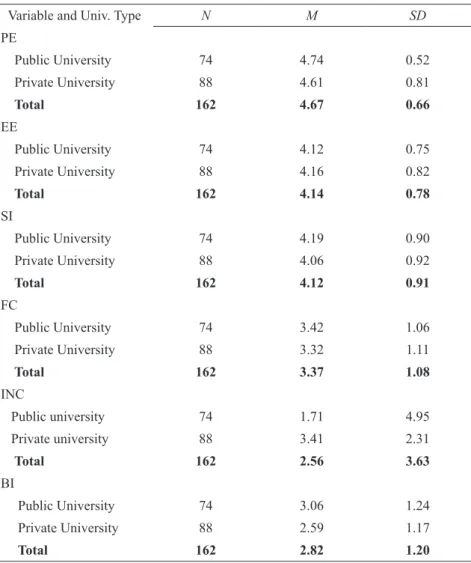
Prior to conducting a series of multiple regression analyses for Research Question 1, a descriptive statistics analysis was carried out (see Table1) to investigate the mean and standard deviation of each factor. The results show that the total mean scores of four predictors and behavioral intention (BI) ranged from a low of 3.37 to a high of 4.67. The standard deviations for three constructive variables (performance expectancy, effort expectancy, and social influence) were less or slightly more than one; however, the standard deviation of the facilitating conditions predictor was 1.08. For the additional factor, incentive, the mean average was 2.56 and the standard deviation was 3.63, which signifies that nearly all the instructors from the selected teacher training universities who participated in this study agreed that the four UTAUT factors were substantial in terms of average in promoting their intention of accepting ICT in teaching.
This result was consistent with the results of Hosman and Cvetanoska (2010) that nearly all the selected teachers (98%) agreed that the adoption and use of ICT in teaching was found to be significant for them.
4.2 Factors Promoting the Adoption of ICT To investigate which factor among the four UTAUT constructs and the incentives variable had the strongest effect on the behavioral intention (BI) for adopting ICT in teaching (Research Question 1), a series of multiple regressions was performed. As
shown in Table 2, none of the factors had a statistically significant effect on BI. All the p-values were greater than 0.05. The adjusted R2 was 0.017. R2 = 0.047 shows that only 4.7% of BI is explained by the explanatory variables, namely performance expectancy, effort expectancy, social influence, facilitating conditions, and incentives.
The adjusted R2 = 0.017(1.7%) shows that this model did not fit the data well. The low value of R-squared and adjusted R-squared suggested that the relationship between the dependent variable
(BI) and the independent variables (the four UTAUT factors and the incentives variable) was weak and hence led to a statistically insignificant result.
This result seemed to contradict many of the previous studies that used UTAUT as a guideline.
Jung and Lee’s (2013) study on YouTube acceptance between Japan and US educators and students revealed that PE, SI, and FC were influential in the selected respondents’ decision to use YouTube in teaching and learning. Furthermore,
Table 1 Descriptive Statistics of the Four UTAUT Constructs, the Incentives Variable, and the Behavioral Intention Variable (statistics are shown by type of university)
Variable and Univ. Type N M SD
PE
Public University 74 4.74 0.52
Private University 88 4.61 0.81
Total 162 4.67 0.66
EE
Public University 74 4.12 0.75
Private University 88 4.16 0.82
Total 162 4.14 0.78
SI
Public University 74 4.19 0.90
Private University 88 4.06 0.92
Total 162 4.12 0.91
FC
Public University 74 3.42 1.06
Private University 88 3.32 1.11
Total 162 3.37 1.08
INC
Public university 74 1.71 4.95
Private university 88 3.41 2.31
Total 162 2.56 3.63
BI
Public University 74 3.06 1.24
Private University 88 2.59 1.17
Total 162 2.82 1.20
Mtebe (2014) found that only EE was an influential predictor for instructor’s acceptance of OER in higher education in East Africa.
The contradictory results from several of the previous studies, as a result of the multiple regressions on BI as a dependent variable conducted in this paper, can possibly be explained by the following.
First, the coverage of the adoption of ICT in this study appeared to be very broad and did not focus on a specific area of adoption, as was the case in the above-quoted research findings. For instance, Jung and Lee (2013) specified YouTube acceptance solely in the context of Japan and USA—PE, SI, and FC were positively significant, whereas Mtebe and Raisamo (2014b) looked only at students’
adoption of mobile technologies for learning in East Africa and all factors were significant.
Second, in nearly all the universities selected for inclusion in this study, there were large numbers of instructors who had yet to consider and decide upon adopting ICT compared with a very small number of instructors and heads of department who were aware of and had already agreed to choose ICT in their teaching. The result of this imbalance was that the non-adopters were not exposed to sufficient influence and peer pressure to affect their consideration and adoption of ICT in teaching. The poor current situation in teacher training universities contributed to many instructors not being ready to adopt ICT in their
teaching. For example, Venkatesh et al. (2003) and Bandura (1989) stressed learning by observing others is important. This form of learning by observation would increase the probability of non-ICT adopters perceiving its importance and therefore its adoption, based simply on the behavior of their colleagues.
They, in turn, would then become an agent for the adoption of ICT by others in their working environment.
Last, the study found that the concept of adopting ICT appeared not to be in the mindset of many of the instructors because the existing environment at their universities hinders the adoption of ICT in teaching. Stigzelius’s (2011) study emphasized that the majority of the non-adopters, Zanzibar instructors included, want to see a welcoming environment in their working areas for them to enthusiastically accept ICT in teaching.
4.3 Incentives and the Adoption of ICT This study found the incentive factor was not substantially predictive for the adoption of ICT in teaching by instructors (see Table 1 and 2). The mean average appeared very low, with a high of only 3.41 in the private universities and 2.0 in the public university, which was reflected by the
‘neither agree nor disagree’ and ‘moderately disagree’ options. The vast majority (98%) of the 27 instructors, from all three selected universities involved in this study, said knowing how to teach using ICT was for their own benefit and they stressed that there was no need for them to receive any extra payment or promotion. One instructor responded:
“I receive sufficient salary; I have no need of extra money. A good reward might be a certificate for those who tried using ICT the most in teaching. Promotion again is not necessary, since teaching using ICT is for my own good enabling me to teach anywhere around the world where the resources are
Table 2 Standardized Coefficients from the Multiple Regressions of the Four UTAUT Constructs and the Incentives Variable on the Behavioral Intention Variable
Standardized Coefficient Sig.
Adjusted R2 .017 .002
SI .1063 .262
FC .108 .207
PE −.026 .762
EE .090 .332
INC −.013 .874
available and used, therefore, it is to my own advantage in that it will widen my teaching skills.”
This finding contradicts that of Sahin (2006), who reported the importance of incentives to education stakeholders in increasing the probability or continuation of the behavior to take place.
In contrast, interviews with instructors revealed that 88% of the 27 instructors and 100% of the 10 curriculum developers and designers from MoEVT emphasized positive reinforcement such as PCs for teaching, pocket WiFi, modems, certificates, and providing leaflets on simple up-to-date directives for teaching using ICT was not only welcome but paramount. Furthermore, 26% of the 27 instructors stressed providing recognition in the form of introducing an ICT Day, to recognize all who had already adopted and frequently use ICT in teaching was highly desirable. This finding is consistent with that of Hosman and Cvetanoska (2010), who emphasized non-monetary incentives for the successful adoption of ICT. However, this finding is inconsistent with the study of Sahin (2006), who preferred the lure of financial incentives for new ICT adopters.
This paper’s findings further revealed a social desirability bias and fear to express the truth in many of the respondents participating in the study, who were perceived to be unwilling to communicate the truth about the real situation in which they were working. For instance, the results shown in tables 1 and 2, regarding incentive, show that instructors were not in need of this suggested factor. Conversely, interviews revealed that, to some extent, respondents who participated in the interview were scared to reveal the truth and instead were answering in a way that was socially desirable rather than reflecting reality.
Comparable results were found by Miller (2012) and Uzumcu (2016), who said that the sensitivity of the questions asked, could lead to contradictory
responses that may threaten the reliability and validity of the research survey. In the same way, it might be inferred that the instructors were scared to mention the reality because it could embarrass their employers.
Because the education sector has been ignored by successive governments as was not including the purposive and progressed plan, and instructors have fallen into the mindset of not believing that changes would happen at their universities. They may, therefore, have refused the idea of incentives to adopt ICT simply because they believed that it was never going to transpire. In addition, fear of offending employers, or being seen as ungrateful or greedy, might lead to adverse reactions, which, may also have created an atmosphere where instructors are reticent to state a need for incentives. This situation can be seen as an example of social desirability: in essence, a subject’s responses being influenced by non-test relevant factors are an obstacle to all researchers in the social sciences (Fisher, 1993).
4.4 Gender and the Adoption of ICT
To answer Research Question 2, two-way ANOVA was performed. Based on Table 3, it was found that female respondents (M=13.3, SD=2.90) have a stronger BI to use ICT in teaching than their male counterparts (M=11.39, SD=3.11, F (1, 52)=6.89, p=.011). Furthermore, the two-way ANOVA results verified that respondents from the Department of Education (M=13.24, SD=2.9) show a stronger BI to adopt ICT in teaching than those from the Department of Natural Sciences (M=10.39, SD=4.01, F (1, 52)=10.71, p=.002).The effect of both gender and department on BI was statistically significant. However, the two-way ANOVA results show that the effect on BI of interaction between gender and department was not significant (p=.511).
Introducing different basic ICT documents and
having a special ICT department, e-government, under the Zanzibar Ministry of Public Service and Good Governance (2012) demonstrated the importance of stakeholders in adopting ICT as teacher training instructors. Furthermore, the Tanzanian government’s program, fifty/fifty agenda for women by 2020/2030, makes it mandatory for any policy initiated within the country to consider female contribution as part of gender inclusiveness.
This consideration has built a sense of deserving
and empowerment within Tanzanian females in that they can equal or surpass males. Yoon (2011) commented that the female agenda program’s aim was to decrease gender disparity and elevate gender equality, hence more female participation in all national initiatives including adopting ICT in teaching. The results of this study were consistent with the gender characteristics made by Venkatesh et al. (2003).
In a UK study, Stanworth (2000) said that
Table 3 Mean Differences between Gender (Male vs. Female) and Department (Education vs. Natural Sciences)
SS df MS F P
PE
Gender 20.91 1 20.91 3.361 .072*
Department 9.47 1 9.47 1.52 .223
Gender×Department 7.42 1 7.423 1.193 .280
Error 323.475 52 6.221
EE
Gender 5.99 1 5.992 .642 .427
Department 3.32 1 3.323 .356 .553
Gender × Department 12.88 1 12.884 1.379 .246
Error 485.701 52 9.340
SI
Gender 29.27 1 29.267 3.320 .074*
Department 21.36 1 21.360 2.423 .126
Gender×Department 3.02 1 3.022 .343 .561
Error 458.358 52 8.815
FC
Gender 7.10 1 7.104 1.146 .298
Department .81 1 .808 .130 .720
Gender×Department 1.57 1 1.568 .253 .617
Error 322.378 52 6.200
BI
Gender 72.73 1 72.73 6.887 .011**
Department 113.06 1 113.062 10.705 .002**
Gender×Department 4.64 1 4.636 .439 .511
Error 549.193 52 10.561
(**) Statistically significant (*) marginally or relatively significant
adopting ICT should no longer be taken as a masculine matter; instead, technology should be considered as a way of improving and enabling females to achieve their potential, especially in education. Stanworth revealed that female instructors adopted computers more confidently than their male counterparts.
Moreover, Elsaadani (2012) argued that despite women being left behind in adopting technology for a long period, currently women are more interested in adopting ICT in their working activities than men. In supporting this, the current study revealed a relationship between female instructors’ duties and their reasons for adopting ICT in teaching. All instructors and curriculum developers and designers who participated in this research refer to ICT as a “time-saving tool” in their teaching process. The benefit of saving time in future lesson preparation was perceived as an additional significance of adopting ICT, especially by female instructors. This result stems from technology offering flexibility when it comes to planning future lessons and flexibility that can be used to attend to emergency child-rearing duties or other household activities.
4.5 Departments and the Adoption of ICT The results suggest that an existing gap between science and arts departments is apparently shrinking, because instructors from education departments (arts departments), who have not habitually used ICT; currently seem eager to adopt it. This finding is consistent with that of Wang (2014), who looked at adoption of ICT in English subjects, and Buabeng-Andoh (2012), who commented that departments of education currently seem eager to receive training on how to teach using ICT, which is a strong indication of their intention to adopt it in practical teaching. This indication was evident in one participating instructor from the Department of Education who
revealed the extent to which he was determined to adopt ICT when asked the question, “Who motivated you to adopt ICT in teaching?”, and he replied:
“We, as teacher training university instructors should assess ourselves first, then, we should accept that we need to teach our students in a more interactive and attractive way than before, to meet the 21st century needs and avoid being challenged by our students. Again we should protect ourselves from being found to be outdated instructors and change to fit the teaching style of the information age.”
4.6 Challenges in the Adoption of ICT The challenges found in response to the question,
“What are the challenges hindering instructors’
adoption of ICT in teaching?”, have been addressed by instructors and curriculum developers and designers, and they have been divided into the following two main categories.
4.6.1 Common challenges: This study revealed that a lack of supportive infrastructure, a lack of proper and professional trainers and training, a lack of skilled instructors in using ICT in education, and a lack of awareness still remain as chief challenges to instructors’ permanently adopting ICT. Instructors still continue to experience shortages of hardware and software, such as unstable power and internet connections, and insufficient ICT resources, such as enough dedicated PCs and projectors for teaching.
This situation was highlighted by many instructors during the interviews. One instructor reported that currently each department at his university had only one projector for teaching. The available projector was shared, and if an instructor needed the projector for teaching it had to be booked in advance, and if not, they would run the risk of it being unavailable.
This result was found to be consistent with the study of Abaidoo and Arkorful (2014) in Ghana,
where ICT infrastructure and teaching resources were determined to be a barrier to teaching.
However, this result was dissimilar to that of Tasir, Abour, Halim, and Harun (2012) in Malaysia, who showed that instructors were satisfied with the infrastructure around them and the professional training they were receiving from their universities.
This satisfaction led them to feel competent enough to teach using ICT tools, and hence instructors were willing to adopt and regularly use ICT in teaching.
Further, this study found a lack of experts who could provide training for instructors on how to adopt and adapt ICT in teaching specific subjects in each department. This lack of training contributed to a sense of isolation in some of the instructors and colored their view towards adopting ICT in teaching, which appeared to be consistent with the results obtained by Buabeng-Andoh (2012) in Ghana.
This study also revealed that ICT policies and the administration concerned, including government, are not persuasive enough in motivating and attracting instructors to adopt ICT in teaching.
The findings indicate that simply having a sequence of ICT policies in place, as mentioned in the introduction, is not enough to reach the goal of adopting ICT. While nearly all the ICT policies do indeed show intention and appreciation in adopting ICT, they lack significant and practical supportive documents that would provide clear and directive techniques to the instructors on adopting ICT in teaching. Unfortunately, the current ICT policies seem to lose direction in that the efforts in adopting ICT are focused on elementary levels instead of on teacher training universities, where the production of professional teachers could then implement ICT at basic educational levels. Comparable findings were found by Oye et al. (2012), who stated that education institutions currently lack ICT policies that go together with a simple and clear frame work and that could support and guide instructors in
adopting ICT in a straightforward manner. In the same way, Somekh (2008) and Murgor (2015) added that less educated and creative ICT administrators, such as ICT policy makers and evaluators, who do not successfully plan and evaluate the instructors’ environment for adopting ICT, leads to a low level of instructors’ desire to choose ICT in teaching.
Another similar study by Hüsing and Selhofer (2002) noted that national policies and leaders, particularly in developing countries, still put more effort into e-administration issues. They further commented that leaving behind important public sector services, such as education, as unnecessary institutions for contributing to e-inclusion and e-participation, leads to an increase in the digital divide and hence instructors who lose hope and confidence in adopting ICT in their working areas.
Therefore, it would be desirable if the Zanzibar e-government, which is responsible for monitoring and evaluating the adoption and use of ICT in all government sectors, starts to prioritize teacher- training institutions.
4.6.2. Unique challenges from Zanzibar: This study revealed the intention to adopt ICT in11% of the instructors (3 out of 27) was slowed due to a sense of isolation caused by ICT not being considered for arts subjects. This feeling caused instructors, who were teaching art subjects, to develop a sense of being undeserving to adopt ICT, especially those who teach Arabic and religious studies.
Furthermore, this study also found that19% of the 27 instructors preferred information gleaned from textbooks because they considered it to be more reliable than from the internet.
The interviews conducted in this study provide a clue to interpreting these results and reveal that intermittent internet availability on campuses led some instructors to find it easier and more
comfortable to continue referring to textbooks rather than the internet for teaching preparation.
This situation gives the impression that some of the instructors are text book oriented and believe that textbooks provide a more reliable source of information than that gathered from the internet.
This hindrance is similar to that observed by Mtebe (2014) in higher institutions in East Africa, reporting that the level of internet use for teaching was very low.
In addition, a lack of sufficient knowledge of available teaching resources in university libraries and online databases led some instructors to ignore or even undervalue using the internet for teaching preparations. In support of this view, instructors revealed an awareness of the reliability of internet information, but also showed a lack of understanding of how powerful and important the internet is in professional teaching. This study found this factor to be one of the main contributive factors in leading a number of instructors to think of textbooks as having more consistent information than the internet.
Similar findings were found in Mtebe and Raisamo’s (2014a) OER study of the Tanzania mainland: that instructors were not interested enough to accept using the internet in their teaching.
Additionally, motivation and knowledge within each department to ensure every instructor feels deserving and fit to adopt ICT in teaching appears to be absent. Unexpectedly, not enough documents were found in this study to demonstrate this argument (isolation feeling); however, the above factors combine to create a new contributive challenge that reduces instructors’ intention to adopt ICT unless necessary measures are taken.
5. Conclusion
In conclusion, the findings of Research Question 2 show a more positive effect on the instructors’
adoption of ICT in teaching and are considered as
guidance for the application of this study. One important finding of this study was that female instructors are more willing to adopt ICT in teaching than their male counterparts. This result implies that the Tanzanian national agenda of fifty/
fifty for females has succeeded in empowering and motivating women throughout the education sector.
In doing this, to some extent, the national program agenda seems to be succeeding in achieving the planned goal of female participation.
Furthermore, the study elaborated the UTAUT- based model for adopting ICT by adding relevant variables that seem to be important in explaining the adoption of ICT by university instructors. The study added an incentive factor to the four UTAUT components, even if the influence of BI was not confirmed but is considered an important variable.
The study also found two further variables (gender and area of the study) that mediate instructors’
adoption of ICT. This revised model has created a foundation for further research to design and investigate the adoption of ICT. In addition, policy makers and curriculum developers should understand what specific factors and preferences need improvement and inclusion for instructors to accept ICT in teaching, especially for teacher training in Zanzibar, Tanzania. Besides UTAUT being relevant to this study, it was found that this model needs to include a cultural factor of religion to investigate how respondents might consider the concept of adopting ICT as a threat or disruption to Islamic culture and the entire culture of Zanzibar society. In general, this study succeeds in showing MoEVT how and to what extent determination, effort, and motivation is needed in future for the permanent adoption and implementation of ICT in teaching.
Based on the findings discussed above, this study reveals the following fundamental limitation. The findings of this study found that nearly all the instructors were demoralized over the issue of
adopting ICT in teaching because they have little hope and had no expectation of change and governmental privileges in terms of providing enough ICT resources to support their educational institutions. Therefore, this paper strongly recommends the Zanzibar e-government and the universities concerned take sensible action to start prioritizing education sectors, particularly teacher- training universities. Now is the right time for government leaders to change their mind set and not totally rely on assistance from outside donors and agencies to support the program, because inborn determination is paramount for success.
Acknowledgement: This paper was developed based on my unpublished MA thesis “Factors Affecting ICT Adoption in Zanzibar, Tanzania Teacher Training Universities: An Application of the Unified Theory of Acceptance and Use of Technology”. I would like to thank Professor Insung JUNG (my advisor) for her untiring support during the writing of this paper.
References
Abaidoo, N., & Arkorful, V. (2014). Adoption and effective integration of ICT in teaching and learning in higher institutions in Ghana.
International Journal of Education and Research, 2 (12), 411-422.
Allahawiah, S., & Tarawneh, S. A. (2015). Factors affecting information and communication technology (ICT) use by Southern colleges teachers in Balqa Applied University. Barcelona.
Spain. The 2015 WEI International Academic Conference Proceedings, 139-145.
Bandura, A. (1989). Social cognitive theory. In R.Vasta (Ed.), Annals of child development. Six theories of child development. Greenwich, CT: JAI Press, 6, 1-60.
Buabeng-Andoh, C. (2012). Factors influencing teachers’ adoption and integration of information and communication technology into teaching: A review of the literature: International Journal of Education and Development using Information and Communication Technology (IJEDICT), 8 (1), 136- 155.
Chigona, A., & Chigona, W. (2010). An investigation of factors affecting the use of ICT for curriculum delivery in the Western cape, South Africa. 18th European Conference Systems (ECS), 1-12.
Chris, L. A. (2015). Reassessment of the adoption and integration of ICTs to enhance teaching and lear ning in academic programs in M oi University–Kenya. International Journal of Recent Research in Social Sciences and Humanities (IJRRSSH), 2 (4), 179-192.
Elsaadani, M. (2012). Teaching staff attitude toward ICT: Is gender a factor? Alexandria. Egypt.
International Women Online Journal of Distance Education, 1(2),21-30.
Fisher, R. J. (1993). Social desirability bias and the validity of indirect questioning. Journal of consumer research, 20 (2), 303-315.
Grenman, K., Isomursu, M., Federley, M., & Seisto, A.
(2013).Benefits and Financial Impacts of Adopting Technology in Learning. International Association for Development of the Information Society.
Hosman, L., & Cvetanoska, M. (2010, December).
Technology, teachers, and training: combining theor y with Macedonia’s experience. In Proceedings of the 4th ACM/IEEE International Conference on Information and Communication Technologies and Development, 20. ACM.
Hüsing, T., & Selhofer, H. (2002).The Digital Divide Index-A Measure of Social Inequalities in the Adoption of ICT. ECIS 2002 Proceedings, 35.
Jung, I., & Lee, Y. (2013). YouTube acceptance by university educators and students: A cross- cultural perspective. Innovations in education and teaching international, 52(3), 243-253.
Kozma, R. B. (2005). National policies that connect ICT- based education reform to economic and social development. Human Technology: An interdisciplinary journal on humans in ICT environments, 1 (2),117-156.
Mikre, F. (2011). The roles of information communication technologies in education: Review article with emphasis to the computer and internet. Ethiopian Journal of Education and Sciences, 6 (2), 109-126.
Miller, A. L. (2012). Investigating Social Desirability Bias in Student Self-Report Surveys. Educational Research Quarterly, 36 (1), 30-47.
Ministry of Education, Culture, Sports, Science and Technology (2011).The vision for IC T in education- toward the creation of a learning system and school suitable for the 21st century.
Ministry of Public Service and Good Governance (2012). E-Government Policy. Zanzibar, Tanzania:
Government Press.
Ministry of Infrastructure and Communication.
(2013). Zanzibar National ICT Policy. Zanzibar,
Tanzania: Government Press.
Ministry of Public Service and Good Governance (2012). E-Government Policy. Zanzibar, Tanzania:
Government Press.
Mtebe, J. S. (2014). Acceptance and use of e -learning solution in higher education in East Africa. Finland:
Juvenes Print.
Mtebe, J. S., & Raisamo, R. (2014a). Challenges and Instructors’ Intention to Adopt and Use Open Educational Resources in Higher Education in Tanzania. The International Review of Research in Open and Distributed Learning, 15 (1).
Mtebe, J. S., & Raisamo, R. (2014b). Investigating students’ behavioural intention to adopt and use mobile learning in higher education in East Africa.
International Journal of Education and Development using Information and Communication Technology, (IJEDICT), 10 (3), 4-20.
Murgor, T. K. (2015).Challenges facing adoption of information communication technology in African universities. Journal of Education and Practice, 6 (25), 62-68.
Nyakowa, L. (2014). Factors influencing ICT adoption among public secondary school teachers: A case of Webuye sub-county, Bungoma County, Kenya.
Unpublished Doctoral Dissertation, University of Nairobi, Nairobi, Kenya.
Oye, N. D., Lahad, N., & Rahim, N. (2012). A proposed guideline for ICT acceptance and usage for universities in developing countries. International Journal of Computer Science and Information Technology and Security (IJCSITS), 2(1), 30-39.
Rogers, E. (2003). Diffusion of innovation 5th edition.
New York: The Free Press.
Sahin, I. (2006). Detailed review of Rogers’ diffusion of innovations theory and educational technology- related studies based on Rogers’ Theory. The Turkish Online Journal of Educational Technology – TOJET, 5(2), 1-10.
Somekh, B. (2008). Factors affecting teachers’
pedagogical adoption of ICT. International Handbook of Information Technology in Primary and Secondary Education, 449-460.
Stanworth, C. (2000). Women and work in the information age. Gender, Work & Organization, 7 (1), 20-32.
Stigzelius, E. (2011). User adoption of an online learning environment. Unpublished master’s thesis, School of Science, Aalto University, Espoo, Finland.
Tasir, Z., Abour, K. M., Halim, N. D., and Harun, J.
(2012). Relationship between teachers’ ICT competence level and satisfaction toward ICT training programmes: A case study among postgraduate students. TOJET: The Turkish Online
Journal of Education Technology. 11(1), 138-144.
Uzumcu, B. (2016). Study of social desirability levels of female youth camp leader candidates in accordance with some variables. Journal of Education and Training Studies, 4 (7), 92-99.
Venkatesh, V., Morris, M. G., Davis, G. B., & Davis, F. D.
(2003). User acceptance of information technology: Toward a unified view. MIS quarterly, 425-478.
Wang, M. (2014). The current practice of integration of information communication technology to English teaching and the emotions involved in blended learning. TOJET: The Turkish Online Journal of Educational Technology, 13 (3), 188- 198.
Wee, M. C., & Zaitun, A. B. (2006). Obstacle towards the use of ICT tools in teaching and learning of information systems in Malaysian Universities.
The International Arab Journal of Information Technology, 3(3), 203-209.
Yoon, M. Y. (2011). More women in the Tanzanian legislature: Do numbers matter? Journal of Contemporary African Studies, 29(1), 83-98.