• 検索結果がありません。

Japanese ODA and the Environment: The Calaca Power Plant Complex in the Philippines

N/A
N/A
Protected

Academic year: 2021

シェア "Japanese ODA and the Environment: The Calaca Power Plant Complex in the Philippines"

Copied!
8
0
0

読み込み中.... (全文を見る)

全文

(1)

Japanese ODA and the Environment: The Calaca Power Plant Complex in the Philippines

Temario C. Rivera

This paper examines the controversial process that marked the construction of a coal power plant in the Philippines in the 1990s funded by Japanese official develop- ment assistance (ODA) loans through the Overseas Economic Cooperation Fund (OECF). It analyzes how contested issues on the environment provoked by the con- struction of a coal power plant were pursued and addressed by the two governments, the local community hosting the power plant, and the non-governmental organiza- tions in each country. A brief discussion of the background and importance of Japa- nese ODA in the Philippines provides an overall context for understanding the prob- lem.

1)

ODA and Japanese Foreign Aid Policy

With its dramatic economic recovery and growth after World War II, Japan has used official development assistance (ODA) as the single most visible and significant instrument for the exercise of its power.

In its continuing effort to clarify the use of ODA for political and strategic con- cerns, particularly in response to Western criticism in the 1980s, Japan, in a Cabinet decision, approved on June 30, 1992 an ODA charter. In the Charter, Japan commits itself to four principles in the provision of ODA: 1) environmental conservation and development; 2) avoidance of aid for military purposes or the aggravation of interna- tional conflicts; 3) full attention to recipient countries’ trends in military expenditures including the production of mass weapons and the export and import of arms; and 4) promotion of democratization, market-oriented economies and basic human rights and freedoms in the recipient country.

2)

In practice, however, the government is left with a lot of flexibility in implementing ODA even in light of the Charter as the same document mandates the need to take into account each recipient country’s request, its socioeconomic conditions, Japan’s bilateral relations with the recipient country and United Nations’ principles such as those of sovereign equality and non-intervention in domestic affairs.

Among the regions of the world, Asia continues to receive the largest ODA flows

from Japan, averaging 56% of the total from 1990–1998. Within Asia, Southeast Asia

has consistently received the largest share from the 1970s to the 1990s albeit at a

decreasing rate. From an average of 33% of total ODA flows in the 1980s, Southeast

(2)

Asia’s share declined to 28% in the nineties (1990–1998).

3)

Since the 1970s to the present, the Philippines, together with Indonesia and Thailand, has consistently ranked among the top 10 country recipients of Japanese bilateral aid.

Southeast Asia’s importance to Japan has been underpinned by a postwar history of trade and investment relations, “resource diplomacy” and the broader issue of Japan’s national security.

4)

Rix stresses the centrality of the region to Japan’s foreign aid pol- icy in these terms:

There is no doubt that aid to ASEAN is the centerpiece of Japan’s aid program. It represents a lengthy aid relationship, it appears to justify the MOFA’s emphasis on aid to enhance political stability, it bolsters a broad set of economic relationships between Japan and the economies of the region, and reflects a highly instrumentalist Japanese foreign policy towards Southeast Asia.

5)

What makes the relationship of Japan to Southeast Asia politically challenging is the existence of the ASEAN, which now groups together all the countries of the re- gion. As early as 1977 and 1978, then Prime Minister Fukuda through his “ASEAN diplomacy” sought to create a “special” relationship with the ASEAN in the wake of the growing communist threat in the region and anti-Japanese popular protests in the early 1970s.

6)

While the ODA process has been implemented primarily through bilat- eral channels, the existence of the ASEAN has provided Japan an alternative channel by which to pursue its other economic and political initiatives.

Features of Japanese ODA in the Philippines

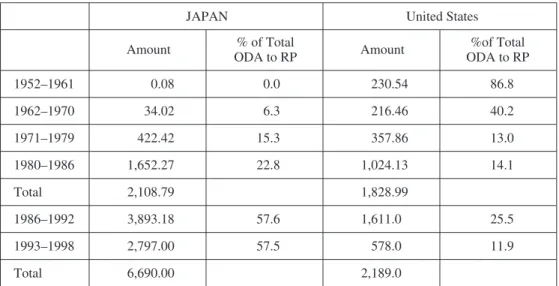
During the three decades following World War II up to the end of the seventies, the United States was the biggest source of ODA for the Philippines (Table 1). By the 1970s, however, with Japan’s transition from the reparations program to the provision

Table 1: Japanese and U.S. Total ODA to the Philippines: 1962–1998.

(in million US dollars)

JAPAN United States

Amount % of Total

Amount %of Total

ODA to RP ODA to RP

1952–1961 0.08 0.0 230.54 86.8

1962–1970 34.02 6.3 216.46 40.2

1971–1979 422.42 15.3 357.86 13.0

1980–1986 1,652.27 22.8 1,024.13 14.1

Total 2,108.79 1,828.99

1986–1992 3,893.18 57.6 1,611.0 25.5

1993–1998 2,797.00 57.5 578.0 11.9

Total 6,690.00 2,189.0

Sources: Pante and Reyes (1989); Japan’s ODA. Tokyo: Ministry of Foreign Affairs. (various issues).

(3)

of yen loans, its share of ODA increased significantly. In the 1980s, Japan supplanted the United States as the Philippines’ main source of ODA. By the 1990s, Japan had become the country’s dominant provider of ODA accounting for 58 percent of total bilateral assistance while the United States’ share had decreased rapidly to just a little over 10 percent.

Not counting the reparations funds, Japan had disbursed a total of US$8.7 billion of ODA funds to the Philippines during a 27 year period from 1971 to 1998 or an aver- age of US$325 million each year. Of the total ODA funds, 24 percent were disbursed during the Marcos years (US$2.1 billion), about 44 percent to the Aquino administra- tion (US$3.8 billion) and 32 percent (US$2.8 billion) to the Ramos leadership.

An examination of OECD yen loan allocations to the Philippines as of the end of March 1999 shows that about 60 percent went to economic infrastructure (transporta- tion, electric and gas, irrigation and flood control, and telecommunications). One- third of all loans (31 percent) went to the transportation sector and commodity loans ate up close to one-fourth (23 percent) of the total. The power sector accounted for close to one-fifth (18 percent) and much of this took place during the 1990s in re- sponse to the acute power shortages. Quite noticeably, the social services sector re- ceived a niggardly 8 percent of total loan allocations.

A more disaggregated study of total ODA sectoral allocation including both yen loans and grants shows more or less the same pattern with the economic infrastructure receiving close to 60 percent of the total and the social infrastructure accounting for 15 percent as of the end of 1995. However, in the late 1990s (1996–1998), there is an interesting trend of an increased share of the social sectors (25 percent) with the envi- ronmental sector accounting for 15 percent of total ODA in this period. The center- piece of the allocation for the environmental sector is a total loan commitment of Y36.3 billion by the OECF for the Metro Manila Air Quality Improvement Sector Development Program which is also being co-financed by the ADB.

Japanese ODA, the Environment and the Power Sector

Since the late 1980s, Japan has emphasized the importance of environmental pro- tection in the developing world. As pointed out by Potter: “In part, this is an attempt by the Japanese government to define for itself a role which will help it meet its inter- national responsibilities, and, in part, it is a response to a new issue in international politics.”

7)

The 1990s also saw the emergence of a stronger concern for environmental issues as seen in Philippine government regulations requiring environmental clearances for all investment and development projects and the growth of environment-focused NGOs. In addition, the OECF and Japan International Cooperation Agency (JICA) have their own set of environment guidelines for their development projects.

In the Philippines, the allocation of ODA for the power sector and its consequent

problematic impact on the environment came into prominence starting in the mid-

1980s. The Ramos administration (1992–1998), in particular, inherited a crippling

(4)

power shortage that deprived the country of electricity for as many as 10–12 hours daily during its worst months in 1992–1993. Reflecting its major crisis during its first two years on the power shortage and related infrastructural bottlenecks, the Ramos administration used OECF yen loans to help address this problem. Through a combi- nation of an aggressive “build-operate-transfer” policy incentive for the private sector and the appointment of competent technocrats and managers, the government basi- cally had the power shortage problem under control by the end of 1994.

During its first two years in 1993 and 1994, the government allocated about 43 billion yen from OECF loans to construct or expand and upgrade four geothermal plants (Palinpinon, Tiwi, Mak-ban, and Mt. Labo) and the Calaca coal-fired power plant. In 1993, allocation for energy-related projects constituted 17 percent of the total OECF loan funding, and in 1994, this allocation jumped to 27 percent of the total. In terms of geothermal power development in the country, OECF-assisted projects have a share of 26 percent of overall capacity.

8)

In terms of the sectoral allocation of OECF yen loans, the most interesting change during the 1993–1998 period featured a significant share going to environment-re- lated projects, accounting for 14 percent of the total. This is in sharp contrast to the overall average for the environmental sector which was 3.2 percent for the period from 1971–1995. While about half of this allocation (47 percent) goes to the air qual- ity improvement program in Metro Manila, there is also funding for reforestation, the rehabilitation of watersheds, rivers, fishery resources, and an environmental support credit program.

The Odyssey of a Power Plant: Calaca I and II

The controversy that attended the construction of the OECF-funded Calaca II coal power plant is linked directly with the operation of an earlier coal power plant, Calaca I, built and completed in 1984 under the Marcos martial law regime. Financed by funds from the Japan EXIM Bank and the Bank of Tokyo, Calaca I was built under the overall supervision of the Philippines’ National Power Corporation (NPC) through a Mitsui-led consortium as the main contractor. The Calaca I plant, the first coal-fired plant in the country, is located in barrio San Rafael, Calaca town in Batangas province about 110 kilometers south of Manila.

A 300 megawatt coal-fired thermal power plant, Calaca I which cost US$250 mil- lion, generated a lot of problems from the very start.

9)

First, the construction of the power plant uprooted and relocated about 300 families into a 20 hectare site which was eventually abandoned by the relocatees because the place turned into a catch basin for the soot from the coal yard. The relocation site was further made unlivable by the toxic fumes emitted by the plant and extremely noisy plant start-up operations.

Moreover, the evicted residents complained about water pollution caused by the

plant’s operation and the undercompensation they received from the NPC as reloca-

tion costs. In 1990, a non-government investigating body composed of representa-

tives from different environmental groups affirmed that Calaca I had done harm to the

(5)

people and the environment. In response to these problems and in protest against the decision by government to build a second coal-fired power plant in the same barrio and town of Calaca, the community residents organized the “Citizens Movement for a Better Calaca, Inc. (CMBCI)”.

The original feasibility study for Calaca I already envisaged a second plant from the beginning and the construction of unit I (Calaca I) in fact already included the basic facilities for both.

10)

In October 1986, the Philippine government under Pres.

Aquino submitted a project funding request to Japan for the use of ODA loans to construct Calaca II to address serious power problems. An appraisal mission was sent by the Japanese government to the Philippines in response to the project request but the group appears not to have fully considered both the environmental and operational problems that troubled Calaca I. Moreover, the appraisal mission did not include the issuance of an environmental clearance certificate (ECC) as a condition for a Japanese binding commitment to fund the project even while an ECC was required by the Phil- ippines’ Department of Environment and Natural Resources (DENR).

In November 1986, JICA also signed an implementing agreement with NPC for a feasibility study (completed in 1988) on the upgrading of Calaca I. However, there was also little connection between this study and the one on Calaca II since the OECF treated the project request for Calaca II as a new one funded by ODA while Calaca I was commercially financed. After the international bidding processes were com- pleted under the supervision of NPC and the project consultant made up of a consor- tium of Japanese, Canadian and Philippine companies, the OECF formally approved the contracts for the successful bids in March 1991.

By about this time, the reports on the environmental situation in Calaca and pro- tests against the construction of Calaca II had reached the Japanese public and media.

In this campaign to highlight the dangers of environmental pollution being associated with Japanese official policy, particularly in the provision of ODA, Senator Akiko Domoto played a high profile role. She summoned Mitsushide Yamaguchi, the presi- dent of the Export-Import Bank (which largely financed Calaca I) to a Diet hearing. In an open letter to the Philippine government, Sen. Domoto also asserted that the pollu- tion problems experienced by the Calaca residents should be resolved first before construction of the new plant (Calaca II) begins.

11)

In addition, Domoto argued for an additional 20 billion yen to provide for desulfurization equipment at both Calaca I and II. In one crucial budget committee hearing in the Diet, Domoto asked questions about government plans to address the environmental problems in the two power plants that even Prime Minister Kaifu himself had to respond.

12)

Thus, the well-timed position papers and investigative reports by both Philippine and Japanese NGOs, wide coverage by the Japanese media, and Sen. Domoto’s active intervention in Diet hearings, all succeeded in pressuring the OECF to reconsider its earlier decision.

In August 1991, the OECF sent back to the Philippines the requests for the ap-

proval of the bid contracts citing the absence of the environment clearance certificate

(ECC) required by the DENR as the formal reason. By this time, the DENR had also

(6)

clarified that an ECC should include as one of its components, the community’s ac- ceptance of the proposed project. Later in the year, the OECF sent an intermediate supervising mission which discussed the environmental issues in a joint meeting with the DENR and NPC, including the reasons for the overrun costs for the environmental improvements of the Calaca complex. This mission also insisted on the installation of flue gas desulphurization (FGD) equipment which the NPC strongly rejected. The NPC resisted this proposal on two grounds: the FGD devices were expensive and would have required much greater government expenditure and that the pollution lev- els were manageable and within the tolerable levels.

13)

In 1992, Japan’s ODA policies on the environment occupied much attention in light of the UN Conference on Environment and Development in Rio de Janeiro, particularly with Japan’s status as the biggest source of ODA. Sen. Domoto reiterated environmental concerns in Parliament and the Calaca controversy was highlighted once again by an NHK TV special in July. In April 1992, the DENR through its Environmental Management Bureau finally issued the required ECC and also issued a statement that a desulphurization (FGD) equipment was not necessary. Later in the year a Japanese government mission visited Calaca and held discussions on the sul- phur oxide issue with the NPC and other Philippine government agencies. The mis- sion tried to persuade the Philippine government to install a desulphurization facility and also requested the following measures:

14)

a) formation of a multipartite monitor- ing team in which opposing NGOs were to be represented; b) 100 per cent support from village leaders through signatures; and c) DENR’s acceptance of NPC’s use of blended coal to meet the proposed revised air quality standard of DENR and confir- mation by DENR that the power plants could be operated without an FGD. The DENR issued a letter in December 1992 confirming that the coal-blending method would be sufficient to meet environmental standards.

Meanwhile, in the Philippines a three year negotiation among the local government officials (represented by the town mayor and provincial governor) and the National Power Corporation (NPC) finally resulted in a memorandum of agreement in Septem- ber 1992 for the construction of Calaca II. In this agreement, the NPC committed to provide Calaca town a development assistance package which includes the following:

construction of a P15 million peso public market; provision of materials for a P2.5 million peso centralized water system for the town center; installation of an indepen- dent water system for each of the 13 villages (barangays) worth a total of P3.5 million pesos; construction of a P2.7 million covered sports court; cementing of the town center’s main road; rehabilitation of the Calaca municipal hall; provision of materials for a community hospital and a vocational school; installation of an electronic pollu- tion indicator at the town hall; provision of four sets of computers with printers and two sets of cellular phones; and introduction of livelihood enhancement programs for Calaca’s residents.

15)

The NPC’s livelihood program in Calaca has been directed primarily for those fam-

ilies displaced by the construction of the power plant. Chosen by the beneficiaries in

(7)

consultation with NPC representatives, these livelihood programs have focused on the tricycle business, hog fattening, buy and sell business, and ready to wear (RTW) garments.

16)

Resettled residents have also formed a cooperative and with funding pro- vided by NPC, they have bought engines for bancas and sewing machines for making rags which in turn are bought by NPC.

17)

Aside from NPC’s developmental package, another major factor explaining the readiness of the local government officials to con- sider favorably the construction of Calaca II was the prospect of vastly increased revenue shares and business taxes to be enjoyed by the town with the passage of the Local Government Code in 1991. The NPC alone was projected to be paying some P12.8 million per year in franchise tax for the operation of the plant.

18)

There is also a plan to develop an industrial zone in the area that will attract heavy industries to be enticed by Calaca’s guarantee of electric power, deep harbor and industrial peace.

Finally in March 1993, after almost seven years of controversy and opposition marked by continuous bargaining and negotiations at all levels — intergovernmental agencies of Japan and the Philippines, local and national government agencies, NGOs, peoples’ organizations and government agencies — the letter of agreement for the environmental upgrading of the Calaca complex was signed during the Tokyo visit of President Ramos.

Conclusion

The construction of the Calaca power plant complex in the Philippines shows how national governments and their powerful agencies such as Japan’s OECF and the Philippines’ National Power Corporation can be pressured to rethink and revise offi- cial policies by the determined and concerted actions of an informed and aroused citizenry with the timely interventions of non-governmental organizations, the media and well-placed sympathetic government officials. It also helped that in this particular case involving ODA and environmental policy, Japan was particularly sensitive to international pressures at a time when the government was trying to shape a clearer ODA and environmental policy given its status and commitments as a world power and world’s biggest source of ODA. The Calaca experience also set a precedent in the Philippines for the strict implementation of a law requiring social acceptability for environmental standards for the construction of any power plant.

Notes

1) The brief background description on ODA in the Philippines draws largely from Temario C.

Rivera, “The Political Economy of Aid: Japanese ODA in the Philippines, 1971–1999” (forth- coming publication). This research paper was completed in 2000 under the auspices of the Joint Research Forum on Philippines-Japan Relations, Tokyo.

2) Japan’s ODA, Annual Report 1999, Ministry of Foreign Affairs (Tokyo: Association for Promo- tion of International Cooperation, 1999), pp. 169–171.

3) Computations are based on Japan’s ODA, Annual Report (various issues) Ministry of Foreign Affairs (Tokyo: Association for Promotion of International Cooperation).

4) For a discussion of these issues see Alan Rix, “Japan and ASEAN: More than Economics,” in A.

Broinowski (ed.), Understanding ASEAN (London: Macmillan, 1982), pp. 169–95; and “Man-

(8)

aging Japan’s Aid: ASEAN,” in Koppel and Orr, Jr., eds., Japan’s Foreign Aid: Power and Policy in a New Era, (Boulder, Colorado: Westview Press, 1993) pp. 19–40;

5) Alan Rix, “Managing Japan’s Aid: ASEAN,” in Koppel and Orr, Jr., eds., p. 34

6) Takashi Shiraishi, “Japan and Southeast Asia,” in Peter J. Katzenstein and Takashi Shiraishi, eds., Network Power: Japan and Asia (Ithaca and London: Cornell University Press, 1997), pp. 185–186.

7) David Potter, “Assessing Japan’s Environmental Aid Policy,” Pacific Affairs, 67, no. 2 (Summer 1994), p. 200.

8) OECF Manila Office, 20th Anniversary Report (December 1995), p. 16.

9) Data about the environmental problems of Calaca I are based on an investigative report pub- lished by the Sunday Inquirer Magazine, 12 January 1992, pp. 11–13.

10) Unless specified, the data and discussion on the controversy surrounding Calaca II are drawn largely from Ben Warkentin, “Power and Democracy in the Philippines,” in Marie Soderberg, ed., The Business of Japanese Foreign Aid: Five Case Studies from Asia (London: Routledge, 1996), pp. 151–210.

11) “Japanese solon airs concern over project,” Malaya, 5 August 1991, p. 6.

12) Ben Warkentin, “Power and Democracy in the Philippines,” p. 167.

13) Interview with a former Cabinet departmental secretary, 23 March 2000.

14) Ben Warkentin, p. 171.

15) “Plant construction gets nod of Calaca residents,” Manila Times 18 September 1992, B6.

16) “The Calaca testimony: Projects all around,” Malaya 30 July 1993, p. 13.

17) “Mayor Jerry Katigbak: The Motivator,” Philippines Free Press, 11 March 1995, p. 32.

18) Ibid.

Table 1: Japanese and U.S. Total ODA to the Philippines: 1962–1998.

参照

関連したドキュメント