30
Copyright@SPSD Press from 2010, SPSD Press, Kanazawa
Empowering the Local Community via Biomass Utilization: A Case Study in Thailand
Thanapan Tantiwatthanaphanich
1and Xiaolong Zou
1*1 Graduate School of Asia Pacific Studies, Ritsumeikan Asia Pacific University
* Corresponding Author, Email: [email protected] Received 21 June, 2015; Accepted 5 November, 2015
Keywords: Biomass, Biogas, Thailand, Renewable energy, Policies.
Abstract: As an agricultural country, Thailand produces a large amount of agricultural products and the stench of decomposing biomass is a common problem in many local communities. To dispose of biomass, some communities have utilized it to produce renewable energy or other products for household purposes. Currently, some villages have successfully implemented biomass utilization technology at the household level. Villagers have adopted skills and technical knowledge on biomass waste management from institutions dedicated to research on the development of renewable energy technology at the community level and are now able to mitigate and control waste problems systematically. Presently, biomass utilization technologies in Thailand are able to produce biogas, biodiesel, livestock feeds and organic fertilizers. In addition to the aforementioned environmental and economic benefits, villages that have adopted biomass utilization technology were also able to reduce greenhouse gas emissions, prevent deforestation and reduce household spending for energy and farming products. This paper investigates the current status of the general renewable energy policy in Thailand with specific focus on biomass utilization as a renewable energy source. Case studies further illustrate how these energy policies are being implemented at the community level. We apply the strength, weakness, opportunity and threat (SWOT) analysis to further analyze the case studies, identify potential issues and propose counter measures to solve them.
1. INTRODUCTION
Energy consumption has continuously increased over the years due to the expansion of industry across the globe and to the continuously increasing world population. Fossil fuels remain the world’s main energy source; these fuels and other natural resources for energy are diminishing in the face of increasing demand. Oil prices are rising, as are environmental problems that result from burning fossil fuels. Hence, renewable energy alternatives receive attention from many developing countries. Several policies and tools are implemented in order to promote and support the research sector to find suitable sources for alternative energy such as biomass, solar energy, wind energy and hydropower.
Thailand is actively promoting and supporting the utilization of
alternative energy and improving energy efficiency while reducing the usage
of fossil fuels. The Thai Ministry of Energy aims to increase alternative
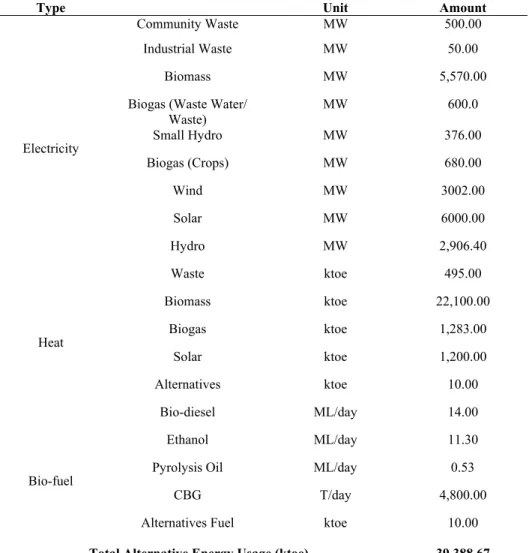
energy consumption from 9,025 ktoe to 39,388.67 ktoe of the total energy
consumption in ten years. The Alternative Energy Development Plan (AEDP
2015-2036) has strategies to promote usage of energy at the community level under the green community concept, as well as to support domestic manufacturers for technology, research and development. The Thai government uses several methods such as incentives for private investment, public education campaigns, as well as activities to raise public awareness.
The expected economic and environmental benefits include saving money from oil imports and reducing emissions, respectively.
Since Thailand is abundant in agricultural products, biomass has been the traditional energy source in Thai rural areas, by using agricultural crops and livestock manure as major sources. Several households and small-scale industries in rural areas utilize biomass for generating renewable energy for cooking purposes and for process heating in residential and manufacturing sectors. The obtained benefits are increasing household incomes, reducing greenhouse gas emissions and improving quality of life for local people.
The rural village of Na Duang in north-eastern Thailand is a community that was chosen for the implementation of a biomass utilization plan based on this concept, with help from several Thai government ministries and the Japanese Ministry of Agriculture, Forestry and Fisheries (MAFF). The goal of the plan is to implement biomass utilization technologies, also known as conversion technologies, in the village so that the villagers can use these products in their households, farmlands, and livestock farms.
Biomass crops that Na Duang village produces are oil palm, corn, cassava and rice, which can be processed into fuel (biodiesel, biogas), cooking oil (palm oil), animal feedstock and fertilizer (organic fertilizer and liquid fertilizer). Since production and consumption of biodiesel has become a trend in recent years, there are more than 437 hectares of oil palm plantation in the area and this is increasing annually. If this project becomes successful, it would be a model to other villages that produce similar crops.
In order for it to succeed, the project must overcome the problems or threats it might face in the future.
This study aims to provide an analysis on the strengths, weaknesses, opportunities and threats (SWOT) of biomass utilization in Na Duang village of Thailand in order to identify the benefits, opportunities and challenges that exist. The agricultural community empowerment aspect that is observed will be mentioned in the work as well. This research will be useful to governments, organizations, local communities and those who aim to study or implement community-based projects in the agricultural sector. Moreover, the findings of this work can help villagers in Na Duang and other stakeholders to acknowledge the possibilities of development in biomass utilization.
2. METHODOLOGY
This research takes a mainly qualitative approach by investigating and
examining the current status of alternative energy, particularly biomass and
biogas utilization in Thailand. Moreover, a case study of the community
level biomass utilization project is employed for a more in-depth analysis on
which to base further conclusions and recommendations.
2.1 Data collection
Gathering of data regarding national policies and general statistics have been accomplished through desktop research. However, due to the country- specificity of this study, some Thai-language literature has been cited where the corresponding literature in English is not available. Other sources of data include academic publications, reports from relevant governmental entities and trust-worthy news reports.
2.2 Case Study Selection and Analysis
Na Duang village's biomass utilization project was chosen as a case study because it receives support from MAFF of Japan, and the focus is not only on technical support but also on human capacity development (Hayashi, 2013). This village is a fitting model because many villages in Thailand do similar crop cultivation and livestock domestication for their livelihoods (Choenkwan, et al., 2014).
Na Duang resembles a number of villages in Thailand in the way of agriculture, the types of crops grown and the livestock raised. The Strengths, Weaknesses, Opportunities and Threats (SWOT) analysis is applied for the qualitative analysis of the Na Duang village project. A similar method has been used to analyze case studies of China's biogas development in the renewable energy sector (Zou, 2014), where SWOT analysis and stakeholder analysis was applied to obtain the potentials and challenges on the implementation of each biogas project site in China. Conclusions are made based on the most influential factors or obstacles in those projects for better recommendations to the policy makers as well as the stakeholders.
However, it is not yet possible to conduct stakeholder interviews due to geographical constraints. As a result, conclusions, recommendations and discussion are conducted based on only the data collected and reviewed literature for this pilot study.
3. CURRENT STATUS OF BIOMASS UTILIZATION IN THAILAND
3.1 The Energy Situation in Thailand
Thailand’s economy has mainly relied on imported energy. According to energy statistics from the Energy Policy and Planning Office, 57% total commercial energy consumption in Thailand in 2014 came from imports, of which crude oil accounted for 70% of the total energy import (Energy Policy and Planning Office, 2015). Thailand also relies on domestically produced natural gas as a primary fuel to produce electricity. As of 2014, 59% of total electricity production came from natural gas (Energy Policy and Planning Office, 2015). These high ratios contribute to vulnerabilities to the country’s supply. Moreover, Thailand’s energy demand is forecasted to increase from 75,804 ktoe in 2014 to 131,000 ktoe by 2036 (Department of Alternative Energy Development and Efficiency, 2015).
At present, the Thai government has a strategy that aims to increase the
use of renewable energy in an attempt to reduce and replace the usage of
fossil fuels. The Thai Ministry of Energy has an Alternative Energy
Development Plan (AEDP 2012-2021), which aims to create a framework
and direction for increasing alternative energy consumption from 9,025 ktoe in 2014 to 39,388.67 ktoe by 2036 within 10 years (Department of Alternative Energy Development and Efficiency, 2015; Sutabutr, 2013).
Table 1. Target for Alternative Energy Development Plan in 2036
Type Unit Amount
Electricity
Community Waste MW 500.00
Industrial Waste MW 50.00
Biomass MW 5,570.00
Biogas (Waste Water/
Waste) MW 600.0
Small Hydro MW 376.00
Biogas (Crops) MW 680.00
Wind MW 3002.00
Solar MW 6000.00
Hydro MW 2,906.40
Heat
Waste ktoe 495.00
Biomass ktoe 22,100.00
Biogas ktoe 1,283.00
Solar ktoe 1,200.00
Alternatives ktoe 10.00
Bio-fuel
Bio-diesel ML/day 14.00
Ethanol ML/day 11.30
Pyrolysis Oil ML/day 0.53
CBG T/day 4,800.00
Alternatives Fuel ktoe 10.00
Total Alternative Energy Usage (ktoe) 39,388.67 (Source: Department of Alternative Energy Development and Efficiency, 2015)
The available alternative energy sources in Thailand include electricity generation from solar energy sources, wind and hydro power, bio-fuel, bio- energy from waste, biomass and biogas, and new energy types such as tidal power, geothermal energy and hydrogen. The strategies are set by following the following key components (Sutabutr, 2012):
1. Promoting community participation in alternative energy development and consumption across the country
2. Improving incentive measures to foster private investment 3. Amending laws and regulations unfavourable to alternative
energy development
4. Improving essential infrastructure such as transmission and distribution system as well as smart grid
5. Promoting public relations and knowledge enhancement 6. Promoting research activities as an entire development tool for
the alternative energy industry
3.2 Potential for Biomass and Biogas Utilization in Thailand
According to the AEDP 2015, the plan’s target is to increase biomass for renewable energy to 5,570 MW for the year 2036, while the generating capacity of 2014 was 2,451.82 MW (Department of Alternative Energy Development and Efficiency, 2015). This is because biogas sources can be found from biomass especially in agricultural and agro-industrial wastes.
The target for biogas production is to increase from 379 ktoe to 1,000 ktoe by 2021 (Sutabutr, 2012). Thailand is an agricultural country that can produce a large volume of agricultural products. According to World Bank Statistics, the agricultural sector contributed 10.5% to Thailand’s GDP in 2014 (World Bank, 2015). Approximately 34% of all the households in Thailand work in the agriculture sector, and most of them are located in rural areas. These agriculture activities include crop cultivation and integrated crop-livestock farming, of which the major forms of Thai livestock are pigs, various types of poultry and cattle (Charoensook, et al., 2013). The major sources of biomass from agriculture-based industries are sugar cane, rice and oil palm sectors (Papong, 2015). Therefore, Thailand has the potential to produce biogas from the decomposition of organic matter from biomass and waste water, as well as livestock manure up around 7,800 and 13,000 TJ/year, respectively (Tippayawong & Thanompongchart, 2010).
Currently, the stench of decomposing biomass is a common problem in many communities in Thailand. In order to dispose of biomass, some communities have utilized it to produce biogas for household purposes (Mikled, 2009).
In addition, trends on the international tourism market are changing as the principles of sustainable development become more widely accepted in daily life. Modern tourists are becoming aware of the necessity to preserve and protect natural resources and environment from destruction. Therefore, implementation of green technologies and ecological approaches to business development represent a reasonable solution for the protection of the human environment and helps in increasing awareness of the general public on the necessity to implement these approaches in business. Based on this trend, cities or regions that successfully adopt the principles of sustainable development are likely to gain more attention from concerned tourists. With more tourism, these communities would gain positive economic benefits (Cerović, 2014).
3.3 Promoting Biomass Utilization at the Household Level
The government is attempting to promote biomass in all areas of Thailand and develop biomass networks in communities, as well as to improve incentive measures for attracting private investment by allowing the establishment of bio-fuel factories, increasing the number of bio-fuel service stations, and engaging in public relations to create public acceptance of bio- fuel (Department of Alternative Energy Development and Efficiency, 2015).
Several laws and regulations on the system security standards have been studied and publicized through various types of media (Sarochawikasit, 2007; Sutabutr, 2013).
At present, several rural areas in Thailand such as Pong Sang Thong
district in Lampang province, Takham subdistrict in Trang province,
Krathum Lom district in Nakhon Pathom province, and more, have successfully implemented renewable energy from biomass as pilot projects in their respective communities. From the collaboration between The National Innovation Agency and Energy Policy and Planning Office, community-level pilot projects for gasification can be implemented.
Gasification is the process of converting solid biomass consisting of carbon and hydrogen elements into fuel gas. The private sector acts as a sponsor for development of gasification technology for each village. The villages that utilize this technology successfully can decrease the amount of biomass in their communities (Ministry of Energy & Energy Research Center, 2011).
In the northern region of Thailand, Rong Wua village in Chiang Mai province has succeeded in utilizing biomass. Having adopted skills and technical knowledge on biomass waste management from Nakornping Energy Research and Development Institute, which is dedicated to research on the development of renewable energy technology at the community level, the villagers are now able to mitigate and control stench problems systematically.
Biogas from these processes is stored and used to generate electricity as well as to produce Compressed Bio-methane Gas (CBG), which is equivalent in quality to Natural Gas for Vehicles (NGV). CBG can then be used to fuel vehicles and it can also replace (Liquid Petroleum Gas (LPG) for cooking purposes. In addition to the aforementioned environmental and economic benefits, villages that adopted biogas technology were also able to reduce the emission of greenhouse gases, prevent forest trees from being used as firewood and cut their household spending for energy (Deutsche Gesellschaft für Internationale Zusammenarbeit (GIZ), 2014; Nakornping Energy Research and Development Institute, 2013).
3.4 Government intervention
The popularity of energy crops has recently grown due to higher prices resulting from government policies (Mangmeechai & Pavasant, 2013).
Government intervention in agricultural products aims to support both providers and buyers. In the case of raising the price of biomass, the government can provide financial support between the biomass farmers and bio-product producers. In 2012, the Thai government provided a total of US$5.8 million to ethanol producers to compensate for the rise in cassava prices (Thailand Ministry of Energy, 2012). This intervention created a favourable situation for everyone: end-users who are exempted from paying the oil tax, producers who are compensated for cost and farmers who profit from selling crops (Thailand Ministry of Energy, 2012).
The government intervenes in the energy market situation in their own country by issuing policies that favour the use of renewable energy, discouraging the use of conventional energy, or both (France International Energy Agency, 2011). For bio-fuel in Thailand, the government subsidized its use by reducing the excise tax on both gasohol and biodiesel, creating a price distortion between the renewable energy and fossil energy markets (Isvilanonda & Bunyasiri, 2009).
In theory, these policies mainly aim to help renewable energy firms
compete in the energy market and encourage the adoption of renewable
technology by potential investors (Jacobsson & Lauber, 2006; Organization
for Economic Co-operation and Development, 2012). However, these
policies may also create an unfavourable shift in crop production in Thailand
since the net returns from energy crops are more lucrative than those of rice (Mangmeechai & Pavasant, 2013).
4. CASE STUDY OF NA DUANG VILLAGE, LOEI PROVINCE
4.1 Background of Na Duang District
Na Duang village is one of the four villages in Na Duang district, located in Loei province in the north-eastern region of Thailand. The total population is around 3,519 people with a total area of 9,747 Rai (1,560 ha).
There are 784 total households, most of which are engaged in agriculture.
Therefore, agriculture and livestock farming are the main industry of this village. Maize, rice, cassava, rubber and soybeans are major crops. Others are fruits such as tamarind, longan (lamyai) and mango (Niamsrichand, 2011).
Since 2003, oil palm cultivation has been practiced by local farmers.
There is approximately 7,000 rai (1,100 ha) of oil palm planted in Loei province. The oil palm industry has become a new industry in this village since 2003, and the planting area been expanding year by year (Department of Agriculture, 2010).
Table 2. Oil Palm Plantation in Na Duang District B.E.
(A.D.) Cultivation area (Rai) Harvest (est.) (MT)
Community Other Community Other
2548 (2006) 182.6 458 0 0
2549 (2007) 50.3 116 0 0
2550 (2008) 50.0 633 0 0
2551 (2009) - - 273 687
2552 (2010) 98.0 1,275 358 861
Total 380.9 2,482 631 1,548
(Source: Department of Agriculture, 2010)
For livestock farming, there are 63 livestock farms in this area, which include buffalo, beef cattle and pig livestock. Tilapias are raised in small fishing ponds by utilizing rice bran as fish meal (Department of Agriculture, 2010).
Table 3. Animal Husbandry in Na Duang Village
No Livestock No. of farmholds No. of heads
1 Buffalo 8 108
2 Beef cattle 43 303
3 Pig 12 114
(Source: Department of Agriculture, 2010) Table 4. Tilapia Culture in Na Duang Village
No. of
farmholds Scale (Rai) Average yield (per Rai)
Selling price (per kg)
Average profit (per Rai)
898 675 120 kg THB 40 THB 1,620
(Source: Department of Agriculture, 2010)
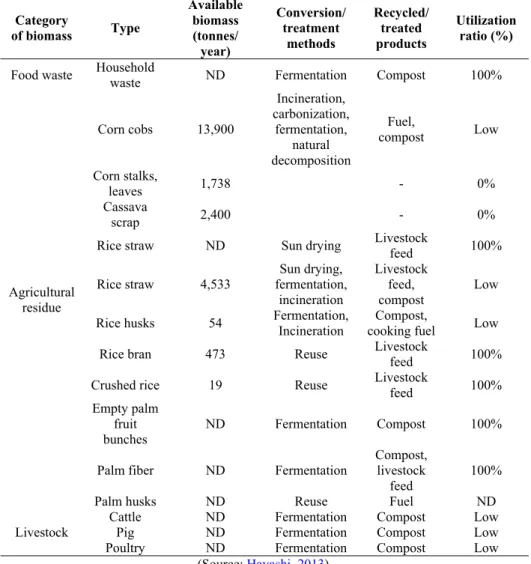
Na Duang village has begun partially utilizing biomass from these activities to make compost or to reuse it as livestock feed. Household waste, empty palm fruit bunches and palm fibre are totally converted into compost.
On the other hand, cassava scraps, rice bran and crushed rice are converted
into livestock feed (Hayashi, 2013).
Table 5. The Amount of Major Available Biomass and State of Utilization in Na Duang Village
Category
of biomass Type
Available biomass (tonnes/
year)
Conversion/
treatment methods
Recycled/
treated products
Utilization ratio (%) Food waste Household
waste ND Fermentation Compost 100%
Agricultural residue
Corn cobs 13,900
Incineration, carbonization,
fermentation, natural decomposition
Fuel,
compost Low
Corn stalks,
leaves 1,738 - 0%
Cassava
scrap 2,400 - 0%
Rice straw ND Sun drying Livestock
feed 100%
Rice straw 4,533 Sun drying, fermentation,
incineration
Livestock feed, compost
Low Rice husks 54 Fermentation,
Incineration
Compost,
cooking fuel Low
Rice bran 473 Reuse Livestock
feed 100%
Crushed rice 19 Reuse Livestock
feed 100%
Empty palm fruit bunches
ND Fermentation Compost 100%
Palm fiber ND Fermentation
Compost, livestock
feed 100%
Palm husks ND Reuse Fuel ND
Livestock
Cattle ND Fermentation Compost Low
Pig ND Fermentation Compost Low
Poultry ND Fermentation Compost Low
(Source: Hayashi, 2013)
However, according to the utilization ratios in Table 6, there are some biomass sources that are available in great volume and have not yet been utilized, such as stalks and leaves of corn and cassava; some such as corn cobs, rice straw, rice husks and manure of cattle and pigs are in use, but less commonly so (Hayashi, 2013).
Since the government has been promoting its support for biomass utilization nationwide, Na Duang village has an opportunity to seek more support in order to exploit more potential. Recently, the demand for organic fertilizer from biomass has been increasing as well. The reasons for this are an awareness of health and organic agriculture that has been increasing in recent years, and that the price of chemical fertilizer has increased since 2007.
“Biomass Town Plan” began in Na Duang village with the aim of full
realization of potential in every aspect, including biogas production. The
utilization of local biomass for organic fertilizer is able to increase farmers'
income by reducing the need to buy chemical fertilizer, and substituting it
with an organic fertilizer, thereby also creating employment. This
opportunity could help prevent the phenomenon of depopulating and aging
rural communities by discouraging able-bodied locals from migrating to
local areas. Moreover, utilizing local biomass could help the village improve
its image, which could then have a positive effect on tourism in the area (Department of Agriculture, 2010).
There are two committees involved in this project, central and local.
They were organized to promote the formulation of the Biomass Town Plan and act together in a feedback loop manner: the central committee provides cooperation (support) toward the local committee, while the latter reports on the result.
The project is implemented with support from the Ministry of Agriculture and Cooperative (MOAC) of Thailand and Ministry of Agriculture, Forestry and Fisheries (MAFF) of Japan, which play an important role in the central committee. Moreover, the Department of Agriculture (DOA) acts as the mediator, takes orders, provides technical support to locals and reports back to the central committee (Hayashi, 2013). This organization of planning bodies is possible because all related parties are aware of the need to raise farmer income and to improve their quality of life.
Table 6. Organization of Local and Central Committees Central Committee Ministry of
Agriculture and Cooperatives Ministry of Energy Ministry of
Science and Technology Ministry of Natural Resources and Environment Local Committee
Local Government Na Duang Village
Central Government Ministry of Agriculture and Cooperatives University/Research
Institutions Khon Kaen University
Involved parties
in the community Farmers
(Source: Hayashi, 2013)
4.2 Operational status of the Na Duang Project
In Na Duang village, several biomass utilization projects were launched under the Biomass Town Plan: bio-digester installation, livestock feed production, mushroom cultivation, composting of bio-waste and introduction of oil palm cultivation. For the bio-digester aspect of the plan, pig manure is collected and sent through an anaerobic fermentation process in tanks in order to be converted into methane gas or biogas. Local people use this biogas as cooking fuel and the liquid residues are digested for liquid fertilizer. Effective management systems and centralized manure collection are able to reduce odours. The operation succeeded with help from the Ministry of Agriculture and Cooperatives that provided financial support for the research and development of optimal fertilizer application, as well as Khon Kaen University that helped in design and construction of the digester as well as technical support (Niamsrichand, 2011; Hayashi, 2013).
There are other projects as well. Feed production for livestock targets unused biomass agricultural waste such as corn cobs, rice straw and rice husks. Private sector relationships also provide support to the mushroom cultivation project. Residue from oil palm and digestive liquid from bio- digesters are being used to make mushroom beds for cultivating mushrooms.
With support from the department of Land Development, compost facilities
were built for the local community for composting household food waste, agricultural residue and livestock waste (Niamsrichand, 2011; Hayashi, 2013).
Since oil palm became a new industry in this village, a small scale crude palm oil mill was introduced to the community by the members themselves with a low interest loan from the Ministry of Energy. In the future, a biodiesel refinery is planned to be built for processing extracted oil into biodiesel for vehicle fuel and converting the residue (fibre, shells, etc.) into livestock feed and compost.
However, most projects have been only partially completed (Hayashi, 2013). So far, the achievements include the capacity development of the core members in the local and central committees, completion of the Biomass Town Concept at Na Duang Village, implementation of some projects in Biomass Town and the setup of a program for research, and the formation of the “Central Committee” for Biomass Town Concept promotion.
Figure 1. Future Plan in the Area (Develop to "Integrated Biomass Town") (Source: Niamsrichand, 2011)
4.3 SWOT Analysis of Na Duang Project
The SWOT analysis is used as a tool for identifying challenges and obstacles of the project for sustainable development in Na Duang village.
Table 7. SWOT Analysis of Na Duang Village Project Strengths
Strong collaboration between involved parties
Renewable energy sources
Create value to biomass products
Environmental friendliness
Health improvement
Reduce odours
Raise farmer incomes
Reduce use of chemical fertilizer
Weaknesses
Unable to standardize the project
Limitation in cultivating area due to cluster of mountainous and lowland area
Limitation in variety of biomass crops due to water shortage
Organic Fertilizer Livestock
Residue Agricultura
l Residue
Liquid Residue Bio-Digester
Agri- cultural
Crops
Biogas
Oil Palm
Biodiesel Small Scale
Crude Palm Oil
Cultivation Mushroom Composting
Facility Livestock
Feed
Opportunities
Create new industry
Create new employment
Improve local image toward tourism
Increase potential of similar projects to succeed in the future
Expanding research area
Potential for Low-Carbon emitting Renewable Energy Production for vehicular use
Threats
Risk of being neglected if not successfully standardized
Risk from the rising price of agricultural products
Risk of fluctuation in amount of biomass produced annually
4.3.1 Strengths
Strong collaboration of community members made it possible to form the central committees and capacity development. Active participation of the members in attending seminars and workshops show how much they are willing to participate in the project. Also, the committees are open for members to voice their opinion and propose new projects (Niamsrichand, 2011).
The project was able to provide renewable energy sources in the form of biogas for cooking in households. Also, value is added to biomass by converting it into environmentally friendly organic fertilizers and livestock feeds. From there, the problem of odours from manure is mitigated, thereby reducing stress on the villagers’ health.
In addition, by using organic fertilizers from biomass, farmers can reduce use of chemical fertilizers. Without having to buy the chemical fertilizers, farmers’ costs decrease, increasing their profits.
4.3.2 Weaknesses
Even though the Na Duang project seemed to be successful in producing biogas and other products, the standard of this project is still questionable.
The final outcome of the whole project is still uncertain, meaning that its overall success or lack thereof remains to be seen. At present, there is no known monitoring or evaluation report that compares Na Duang with other villages applying a similar approach. Without clear evidence, this project currently is not sufficient as a role model to other villages.
In terms of the landscape, Na Duang village is located in a mountainous region of Loei province which limits cultivating and farming. The potential for increasing crops and livestock production is therefore limited.
Water shortage, which is common in the north-eastern part of Thailand, might affect the variety of biomass as well. As water is crucial for consumption as well as for crop plantation and for livestock farming, there is a concern that some crops with a high demand for water might be unsuitable for cultivation in Na Duang. In the year 2021, two watersheds in the north- eastern region are going to face serious water stress if no measures are taken (Gheewala, et al., 2013).
4.3.3 Opportunities
The achievement of project implementation will create new opportunities
for manufacturers who are interested in investing in facilities such as a
biogas power plant or refinery plant in Na Duang. If new business is being created, more jobs will be available in the area. In terms of tourism, the number of agro-tourists increased greatly in 2014 to 494,582 compared to previous years (Office of Agrotourism Promotion, 2014). According to a study of agriculture in the mountains of north-eastern Thailand, specialty crops (for example, mushroom) generate high income and serve as a magnet for tourism; if Na Duang village can promote mushroom cultivation, they might gain more visitors (Choenkwan, et al., 2014). Moreover, as eco- tourism in nearby villages becomes more popular, the likelihood that they will visit Na Duang village could also increase (Naduang Sub-district Municipal Office, 2014)
Na Duang would be a model village for developing and applying technology in order to spread it to other areas. The potential for successful adoption can increase by using Na Duang village as a case study.
Expanding the research area might help in improvement of existing technology or creation of new technology. Also, research opportunities can be expanded by conducting joint research, researcher exchanges, and technical transfers.
Lastly, there is also the potential of having a locally produced renewable energy that will be specifically used in vehicles. Biodiesel and Compressed Bio-methane Gas (CBG) are common fuels that come from biomass.
Compared to typical fossil fuels, they produce less carbon dioxide and are more cost-effective.
4.3.4 Threats
In the long term, the project faces a risk of being neglected since there was no active reporting about the project. It is possible that this village either achieved the project's goals already, or failed to do so. If the government does not continue to keep in touch with the local committees, the locals might not be able to seek proper support from the government for maintenance or fixing problems that might occur.
Renewable fuels are affected by economic factors just as fossil fuels are.
Biodiesel is no exception; when the price of oil palm rises above a certain level due to increase in demand of renewable energy, farmers would instead sell it for other purposes if the profit from selling to make biodiesel is not the most lucrative. However, their actions may depend on government policy regarding the issue. For example, if the government subsidizes farmers, they might agree to sell oil palm at a lower price than that of the market.
Fluctuation in biomass production is another threat to this project. In the event of an agriculturally unproductive year, only a small amount of biomass would be available for bio products. To ensure adequate supplies of biomass throughout the year; farmers should plan ahead of time and stock some biomass to prevent shortages.
5. DISCUSSION & RECOMMENDATIONS
In order to ensure the success of the biomass utilization plan and to handle the risks from opportunities and threats, support and protection need to be addressed.
Since there is a potential for renewable energy production, the problem of
emission of greenhouse gases that might follow should be considered. The
Pollution Control Department (PCD) of the Ministry of Natural Resources
and Environment (MNRE) provides standards and regulation that includes an approach to measure the emission from the energy production process (Pollution Control Department & Ministry of Natural Resources and Environment, 2012). To regulate compliance from energy producers, MNRE should act as a regulator by providing pollution measuring personnel to monitor the emissions.
In addition, villagers could benefit if the energy can be commercialized, which would require government support, for example, to adopt technology for compressing biogas in to compressed bio-methane gas (CBG) and packaging into containers for selling it (Sutabutr, 2013). Currently, the Ministry of Energy of Thailand supports renewable energies, including biogas by allowing the establishment of bio-fuel factories, increasing the number of bio-fuel service stations, and engaging in public relations to create public acceptance of bio-fuel (Department of Alternative Energy Development and Efficiency, 2015). At the economic level, the government has three strategies to support biogas commercialization: 1) To encourage investment and development for economic benefits; 2) To improve biogas innovation and technology to decrease imports from other countries; and 3) to improve latent energy crop cultivation for stability in long-term procurement (Energy Research Institute of Chulalongkorn University, 2014).
In regard to the issue of agricultural price fluctuations, the government should help to provide an incentive for the buying and selling parties, to ensure that farmers will sell their crops while producers can afford them. To handle the risk of fluctuation in the amount of biomass produced annually, the local government should work with researchers to come up with farming techniques to produce more crops annually.
In terms of new industry opportunities, the government can provide financial incentives to attract private investors to invest in businesses such as biomass power plants. These businesses will create job opportunities;
however, in order to protect the interests of people in the community, businesses should focus on hiring as locally as possible. Furthermore, even though the introduction of new industries can affect the community positively, the resources of the community should be protected from being excessively utilized by the businesses.
6. CONCLUSION
This analysis of the Na Duang village biomass utilization project has been conducted based on a sustainable development approach. The project itself is hosted by MAFF of Japan and several Thai government ministries that intend to have this project follow the objectives of AEDP. The objective of this project is to improve farmer incomes in Na Duang village and their quality of life. The village is located in the north-eastern part of Thailand and its major industries are agriculture and livestock farming which make it suitable for the biomass utilization project.
It has been found that the key influential factors for empowering people
in the community is strength in collaboration. Strong collaboration was made
successful through the support from various government agencies both
domestically and overseas; it seems to have authority that is sufficient to
support the local people, and the small size of the Na Duang village farming
community makes it easier to create a local network. The villagers welcome
supporters from outside because they are willing to help the community by
sharing knowledge about how to utilize the biomass in farms. Also, because
the villagers do wish to improve their financial status, they are willing to accept outside support.
There are several benefits and opportunities obtained from the biomass utilization project in Na Duang village that are related to social, economic and environmental aspects:
The project succeeded in providing renewable energy sources in the form of biogas. The village also succeeded in producing organic fertilizers and livestock feeds. In the social aspect, the community has become more liveable because more jobs have been created within the agricultural sector and through the creation of the bio-product sector. By creating local village jobs, the social problem of depopulation of the village can be mitigated.
This project has important economic contributions as well. Farmers directly benefit from the money they save by utilizing biomass. For the community, the future production of other kinds of renewable energy is made possible with this project; this will create new business opportunities and new jobs for people in the village. Additionally, the number of visitors to Na Duang village can be expected to increase, which would bring additional income to the village.
In terms of the environment, utilizing pig manure to produce biogas successfully removes the stench from the air; thus, the health of villagers also improves. There is also a chance that, by expanding research in the area, technological improvements or the creation of new environmentally-friendly technologies is being made possible, especially regarding techniques of reducing of carbon-emissions. Other researchers that were not participating in the project could take an interest, so it is possible that in the future there could be more joint research, research exchanges, and technical transfers.
Several challenges this project might face in the future that could lower the benefits of the project, or even make it unsuccessful will require local and national government support to solve. Landscape and water problems are physical problems that require provincial level resource management. On the other hand, the agricultural product price fluctuations depend on the current policy of the national government. The attention that local and national government pay to these issues will determine this project’s odds of success. Without proper management, some farms might go out of business, and the village might face depopulation because people would try to look for better opportunities in other areas. Resources in the community could be unsustainably consumed, which would eventually lead to shortages.
Additionally, the environment can be strained by pollution resulting from the lack of technical knowledge. Eventually, they might fail to develop the village socially, environmentally and economically.
ACKNOWLEDGEMENTS
The authors are grateful to the referees who gave constructive comments and suggestions in improving the manuscript. And also would like to show our appreciation towards Ms. Christine Meister and Mr. Wanas Panasahatham for their valuable input during the revisions of the manuscript.
This work was partially funded by the MEXT scholarship and JASSO
scholarship entrusted from Ritsumeikan Asia Pacific University.
REFERENCES
Charoensook, R., Knorr, C., Brenig, B., & Gatphayak, K. (2013). "Thai pigs and cattle production, genetic diversity of livestock and strategies for preserving animal genetic resources". Maejo International Journal of Science and Technology, 7(1), 20.
Choenkwan, S., Fox, J.M., & Rambo, A.T. (2014). "Agriculture in the Mountains of Northeastern Thailand: Current Situation and Prospects for Development". Mountain Research and Development, 34(2), 95-106.
Mikled, C. Faculty of Agriculture, Chiang Mai University. (2009). Development of biogas technology for livestock farms in Thailand [Powerpoint Slide]. Retrieved from http://www.mekarn.org/workshops/environ/PDF/Choke Mike.pdf
Department of Agriculture, Ministry of Agriculture and Cooperatives. (2010). "Biomass Town Concept in Na Duang village, Loei Province". International Symposium on East Asia Biomass Town Concept Promotion.
Department of Alternative Energy Development and Efficiency, Ministry of Energy, Thailand (2015). Alternative Energy Development Plan - AEDP2015 [In Thai] (pp. 1-22).
Retrieved from http://www.dede.go.th/download/files/AEDP2015_Final_version.pdf Deutsche Gesellschaft Für Internationale Zusammenarbeit (Giz). (2014, Feb 20). Thailand:
New support for community-based biogas “Distributed Green Generation for Community
Enterprises” programme published. Retrieved from
http://www.giz.de/fachexpertise/downloads/giz2014-en-community-based-biogas- thailand-factsheet.pdf
Energy Policy and Planning Office, Ministry of Energy, Thailand,. (2015). Energy Statistics of Thailand 2015 [In Thai and English]. Retrieved from http://www.eppo.go.th/info/cd- 2015/Energy Statistics of Thailand 2015.pdf.
Energy Research Institute of Chulalongkorn University. (2014). Draft for Bio-methane Promotion Strategies 2015-2035. Retrieved from http://www.eri.chula.ac.th/eri-main/wp- content/uploads/2014/08/Final-CBG-Roadmap-Presentation-PART-2.pdf
France International Energy Agency. (2011). Deploying Renewables 2011: Renewable Energy
Markets & Policies. Retrieved from
http://www.iea.org/publications/freepublications/publication/Deploying_Renewables2011 .pdf
Gheewala, S.H., Silalertruksa, T., Nilsalab, P., Mungkung, R., Perret, S.R., &
Chaiyawannakarn, N. (2013). "Implications of the biofuels policy mandate in Thailand on water: the case of bioethanol". Bioresour Technol, 150, 457-465.
Jacobsson, S. & Lauber, V. (2006). "The politics and policy of energy system transformation—explaining the German diffusion of renewable energy technology".
Energy Policy, 34(3), 256-276.
Cerović, L. Drpić, D.,Milojica, V. (2014). "Renewable Energy Sources in the Function of Sustainable Business in Tourism and Hospitality Industry". TURIZAM, 18(3), 130-139.
Naduang Sub-district Municipal Office. (2014). 3-Year Develop Plan of Na Duang District [In Thai].
Mangmeechai, A., & Pavasant, P. (2013). "Water Footprints of Cassava- and Molasses-Based Ethanol Production in Thailand". Natural Resources Research, 22(4), 273-282.
Ministry of Energy, & Energy Research Center, M.U. (2011). Biogas from Pig Farm Developing program. [In Thai].
Nakornping Energy Research and Development Institute, C.U. (2013). Energy Research and Development Institute - Nakornping of Chiangmai University successfully developed tank CBG to replace LPG, led Rongwua village to be the first LPG-free village in Thailand [In Thai]. Retrieved from http://www.prcmu.cmu.ac.th/perin_detail.php?perin_id=574 Office of Agrotourism Promotion, Department of Agricultural Extension. (2014). Thailand's
Agrotourism Statistics - Summary of Tourist and Income from Agrotourism of Fiscal Year 2014. Rectrieved from http://agrotourism.doae.go.th/agro-stat.html
Organization for Economic Co-Operation and Development. (2012). Linking Renewable Energy to Rural Development Retrieved from http://www.oecd.org/regional/regional- policy/Renewable-rural-energy-summary.pdf
Niamsrichand, P. Department of Agriculture, Ministry of Agriculture & Cooperatives,.
(2011). Biomass Town Concept Promotion Project in Thailand [Powerpoint Slide].
Retrieved from http://www.apip-
apec.com/ja/policies/upload/Biomass_Town_Concept_Promotion_Project_Thailand.PPT.
Pollution Control Department, & Ministry of Natural Resources and Environment. (2012).
Road Map to Pollution Control [In Thai] (pp. 1-92). Retrieved from http://oic.go.th/FILEWEB/CABINFOCENTER3/DRAWER056/GENERAL/DATA0000/
00000304.PDF
Sarochawikasit, R. (2007). Renewable Energy Development and Environment in Thailand Retrieved from http://www.jst.go.jp/astf/document2/en_22doc.pdf
Papong, S. C.Y., Lohsomboon, P. and Malakul,P. (2015). "Overview of Biomass Utilization in Thailand". Clearner Technology Advancement Program, National Metal & Materials Technology Center.
Isvilanonda, S. & Bunyasiri, I. (2009, August 24-28). Food Security in Thailand: Status, Rural Poor Vulnerability, and Some Policy Options. Paper presented at the Agricultural and Food Policy Reforms: Food Security from the Perspectives of Asian Small-scale Farmers ,International Seminar in Seoul.
Hayashi, T. (2013). Biomass Town Plan: Japan’s experience in ASEAN countries [Powerpoint Slide] Department of Agriculture, Ministry of Agriculture & Cooperatives.
Retrieved from
http://www.globalbioenergy.org/fileadmin/user_upload/gbep/docs/2015_events/3rd_Bioe nergy_Week_25-29_May_Indonesia/25_5_5_HAYASHI.pdf,
http://www.maff.go.jp/e/pdf/part3-2.pdf
Thailand Ministry of Energy. (2012). National Energy Policy Council Resolution [In Thai].
Retrived from http://www.eppo.go.th/nepc/kbg/kbg-104.htm - 3
Tippayawong, N., & Thanompongchart, P. (2010). "Biogas quality upgrade by simultaneous removal of CO2 and H2S in a packed column reactor". Energy, 35(12), 4531-4535.
Sutabutr, T. (2012). "Alternative Energy Development Plan: AEDP 2012-2021". International Journal of Renewable Energy, 7(1), 10.
Sutabutr, T. (2013). Thailand’s Renewable Energy Development-Plans and Implementation at the community level [Powerpoint slides]. Retrieved from http://www.thai-german- cooperation.info/download/20130902_04_pdp_twarath_thailand__re_development_plan.p df
World Bank. (2015). Agriculture, value added (% of GDP). Retrieved from:
http://data.worldbank.org/indicator/NV.AGR.TOTL.ZS/countries
Zou, X. (2014). "Analysis of the Chinese Biogas Project Development in the Renewable Energy Sector – Strengths, Weakness,Opportunities and Threats". University of Applied Sciences Trier.