熊本大学学術リポジトリ
Coprecipitation of Aromatic Hydrocarbons from Water with β‑Cyclodextrin
journal or
publication title
Analytical Sciences
volume 7
number 4
page range 641‑643
year 1991‑08
URL http://hdl.handle.net/2298/10998
doi: 10.2116/analsci.7.641
ANALYTICAL SCIENCES AUGUST 1991, VOL. 7
641Notes Coprecipitation of Aromatic Hydrocarbons from Water with /J-Cyclodextrin
Isao Sanemasa, Ikuko Koga and Toshio Deguchi
Department of Chemistry, Faculty of Science, Kumamoto University, Kurokami, Kumamoto 860, Japan
Keywords /3-Cyclodextrin, coprecipitation, aromatic hydrocarbon, inclusion complex
Cyclodextrins (CyDs) are cyclic oligosaccharides comprising six, seven, or eight glucopyranose units (called a, /3, or y, respectively) with a central cavity of the corresponding size. It is well-established that CyDs form inclusion complexes with a variety of molecular species (guests) in an aqueous medium. In complexa- tion, both the size (and shape) and hydrophobicity of a guest molecule play important roles.
In analytical chemistry, CyDs have been used as modifiers1'2 in the solvent extraction or carriers3 which selectively transport certain isomers. We recently found that /?-CyD is easily precipitated from aqueous solution upon introducing a cyclohexane vapor into the solution. There is a possibility that, when hydrophobic solutes are present in the aqueous solution, these solutes could be coprecipitated with CyD.
Experimental
Reagents
All of the reagents used were of analytical reagent grade. Deionized distilled water was used throughout the experiments. Stock solutions of aromatic hydrocar bons were prepared by adding a known amount of each hydrocarbon into chloroform. Working solutions were prepared by suitable dilution with chloroform. An appropriate amount of /3-CyD (Nakarai Chemical Co.), dried over phosphorus pentoxide under vacuum, was weighed and dissolved in water in order to prepare CyD solutions of the desired concentrations.
Apparatus and procedure
The device used to precipitate /3-CyD from a sample solution was the same as that mentioned in a previous paper;4 Teflon film and a trap were removed from the device for the present use.
A 50 cm3 portion of the /3-CyD solution was placed in a cylindrical separatory funnel (6.5 cm i.d., 600 cm3 capacity), and a 0.1cm3 portion of the working chloroform solution of the sample hydrocarbon was added to the CyD solution; the mixture was gently hand- shaken in the funnel. The CyD did not precipitate in
this stage and there was no appearance of chloroform in the liquid phase (chloroform dissolves 0.82 g in 100 g water at 25° C). A 10 cm3 portion of cyclohexane was placed in a test-tube (2.8 cm i.d.X25 cm). The funnel and the test-tube were connected together with a Viton diaphragm air pump (Iwaki Co., AP-032Z). The cyclohexane vapor generated by bubbling air was dispersed through the aqueous sample solution via a sintered glass ball and circulated in the closed system; the flow rate of air pump was set at 100 to 500cm3/min.
The aqueous solution becomes turbid owing to CyD precipitation just after the introduction of cyclohexane
vapor.
Vapor-circulation was continued for two minutes, and a 5 cm3 portion of the turbid solution was immediately removed from the funnel and diluted with water to 75 cm3. The suspension of CyD became clear due to this dilution. A 5 cm3 portion of cyclohexane was added to the solution; CyD does not precipitate in this step unless the CyD concentration of the aqueous sample solution is not very high. The sample hydrocarbon extracted with cyclohexane was measured in the way that will be described shortly afterward. The amount of the hydrocarbon found in the turbid solution of 5 cm3 was multiplied by 10, and the total recovery in percent was calculated by referring to the sample hydrocarbon initially taken.
The remainder of the turbid solution (45 cm3) was withdrawn from the funnel, transferred into a centrifuge tube, and centrifuged for 10 min at 4500 rpm. A 15 cm3 portion of the supernatant solution was diluted with water to 75 cm3 and extracted with cyclohexane (5 cm3).
The amount of the hydrocarbon remaining in the aqueous phase through the CyD precipitation procedure was determined and the residual percent was estimated.
To the solid phase deposited on the centrifuge tube was
added successively a suitable portion of water to dissolve
the CyD. The aqueous solution was diluted to a certain
volume of 100 to 500 cm3, depending on the detector
sensivity and on the CyD collecting ability for the
hydrocarbon of interest. A 25 cm3 portion of the
aqueous solution was diluted with water to 75 cm3 and
extracted with cyclohexane (5 cm3). The amount of the
642 ANALYTICAL SCIENCES AUGUST 1991, VOL. 7
Table 1 Experimental conditions and results
Hydrocarbon
Anthracene
Biphenyl
Phenanthrene Fluorene Naphthalene Fluoranthene PyreneConcentration
of hydrocarbon
in 0-CyD solutiona/
mol dm"3
1.OX1O-7(2.2X1O"7) 2.0Xl0"5(7.0X10⁻⁴)
1.5X1O"6(6.5X1O-6) i.oxio-5(i.oxio-5) 4.OX1O"6(2.4X1O-4) 4.0Xl0-7(1.0Xl0"6) 2.OX1O-7(5.7X1O"7)Wavelength/nm
Fluorescence Ex.
253 247
252 261
220.4
360 335.5
Em.
378
365.5
462 383.5
Suspen
sion6
95 76 100 89 83 89 101
Recovery, %
Super natant0
10 10 3 2 5 3 3
/3-CvD solid
phased
87 61 98 87 74 87 89
Complex formation constant6/
dm3 mol"1
3000 2600 1500 1490 900 160 160 a. Concentration of /?-CyD in aqueous sample solutions: 3.0X 10~3 mol dm"3. The value given in the parentheses is the solubility of the hydrocarbon in water, b. Total recovery, c. Residual percent, d. Coprecipitation percent, e. The 1:1 complex formation constant taken from ref. 6.
hydrocarbon coprecipitated with CyD was determined and the coprecipitation percent was estimated.
Spectrophotometric or spectrofluorometric measure ments were made on the cyclohexane extracts.
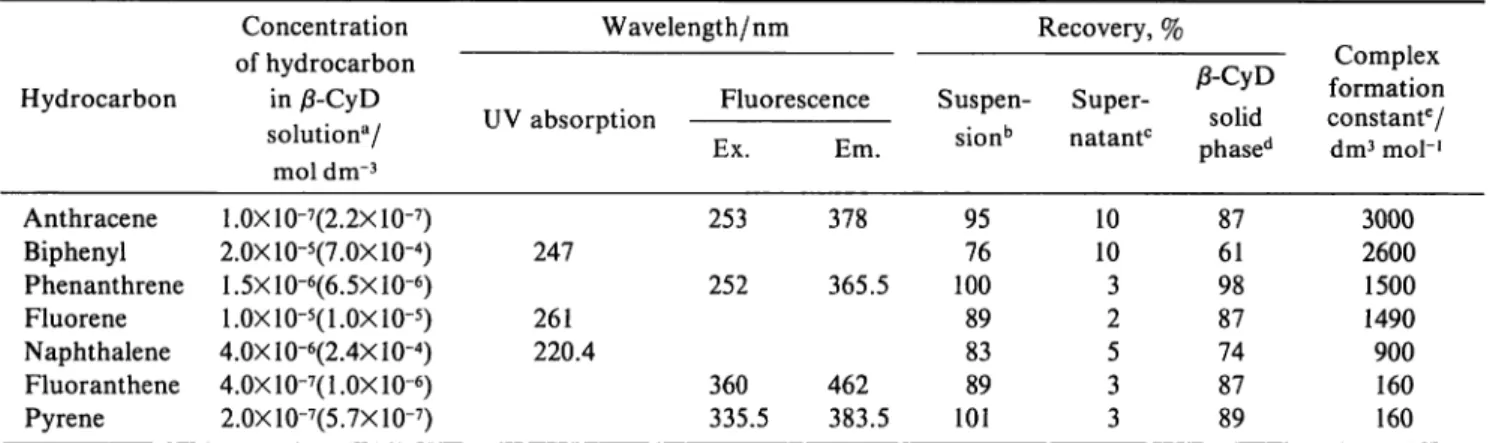
Calibration graphs were prepared for each hydrocarbon by shaking 75 cm3 water with 5 cm3 cyclohexane solutions of hydrocarbon of known concentration; it had been confirmed in the preliminary experiment that the extractability of hydrocarbon was not appreciably affected by the presence of CyD in the aqueous phase at the concentrations employed. The wavelengths selected for the hydrocarbon are listed in Table 1, where the concentration of hydrocarbon in the sample aqueous solution of 50 cm3 and the aqueous solubility of the hydrocarbon are also listed. Runs were made under the condition that the hydrocarbon concentration in each sample aqueous solution was lower than the hydrocarbon solubility in water.
Results and Discussion
The total recovery in percent, the residual percent, and the coprecipitation percent for the hydrocarbons studied are shown in Table 1. The total recovery is not necessarily equal to 100%. During cyclohexane vapor circulation, volatile hydrocarbons, such as biphenyl and probably naphthalene, are vaporized to some extent from the aqueous CyD solution and transferred into the cyclohexane reservoir. Benzene, the most volatile aromatic hydrocarbon, was recovered only 0.2% from the /3-CyD solid phase, 5% from the suspension, and 2%
from the supernatant (the total recovery amounts to only 7.2%). Since the hydrocarbons studied in this work exhibit more or less volatility, long-time aeration is undesirable (two-minute-aeration is satisfactory).
When the volume of an aqueous sample solution was increased from 50 cm3 to 200 cm3, it was necessary to circulate cyclohexane vapor for 5 min to make the
solution turbid.
Using anthracene as a test hydrocarbon, runs were made at /3-CyD concentrations of (1.5, 2.0, 2.5, 3.0, and 4.0)XlO"3moldm"3. The coprecipitation percent at 1.5X10"3 mol dm"3 was found to be ca. 17% lower than that obtained at (3.0 and 4.0)Xl0"3 mol dm"3 (both gave the same coprecipitation percent).
It was found that much higher concentrations are necessary to precipitate a- or y-CyD from water. This is probably due to either or both of the following reasons:
(1) the much higher solubility of these two hosts in water;
the solubilities at 25° C are 14.5(a), 1.8503), and 23.2 g(y) in 100 g water, and (2) the much lower complex formation constant of the two hosts with cyclohexane5 (the 1:1 formation constant is 9 (a), 156 (/?), and 11 dm3 mol'^y)). Using sample solutions with high CyD concentration, the solid phase that is precipitated increases to a large mass, making subsequent treatments difficult.
The precipitation mechanism of the CyD dissolved in water was not studied in this work. There are two possible causes: one is a change in the polarity of the aqueous phase; the other is the formation of an inclusion complex with cyclohexane. Let us consider the latter
case:
j3-CyD+C6Hi2 C6H,2
and
0-CyD • C6Hi2 ^ 0-CyD • C6Hi2(s)
(1)
(2)
Upon cyclohexane vapor being introduced, the aqueous
sample solution is then saturated with cyclohexane; its
concentration remains constant during the vapor
circulation, with a cyclohexane solubility of 6.9X10"4
mol dm"3 at 25° C. By considering the complex forma
tion constant of Eq. (1), it can be seen that ca. 90% of the
j8-CyD is present in the free uncomplexed form when the
concentration of 0-CyD is set at 3.0X10"3 mol dm"3. If,
ANALYTICAL SCIENCES AUGUST 1991, VOL. 7
643however, /?-CyD precipitates via Eq. (2), /3-CyD in the free form is assumed to become reduced to 22% as a result of the following experiment. The /3-CyD precipitated from its 3.0X10"3 moldm"3 aqueous solution was collected after circulating cyclohexane vapor for 2 min, dried at 110°C and then over P2O5 at room temperature under vacuum, and weighed; ca. 76% of fi- CyD was recovered in the solid form from the aqueous solution in the absence of sample hydrocarbon.
As a measure of the stability of the inclusion complex, we take the 1:1 complex formation constant of the hydrocarbon with /3-CyD listed in Table 1. No positive correlation was observed between the coprecipitation percent and the formation constant, indicating that the hydrocarbon is coprecipitated with CyD without being included in its cavity. Let us consider the case in which biphenyl and cyclohexane are in equilibrium with /3-CyD just before CyD precipitation occurs. Then, the equilibrium concentration of /3-CyD*C6Hi2 and that of j3-CyD-Ci2Hio is estimated to be (0.29 and 0.017)Xl0"3 mol dm~3, respectively, when the initial concentration of 0-CyD is set at 3.0X10"3 mol dm"3. Even though biphenyl may be present partly as /3-CyD-Ci2Hio(s), the amount seems to be extremely small. Cyclohexane in a sample aqueous solution, the concentration of which is maintained by continuous vapor circulation at a relatively high level (almost equal to its aqueous solubility) predominates Eq. (2). Therefore, biphenyl, once precipitated as the inclusion complex, may be easily dissociated.
If it is true that the hydrocarbon is coprecipitated with /?-CyD without forming an inclusion complex, the use of non-cyclic saccharides may be effective. We thus used dextran((C6Hio05)n, M.W.=60000- 90000 and 100000- 200000) and dextrin ((C6H10O5VXH2O). These saccharides, however, cannot be precipitated from an aqueous solution, even at nearly saturated concentra
tions, by the introduction of cyclohexane vapor.
In conclusion, this work was initiated while hoping that hydrophobic aromatic hydrocarbons would be coprecipitated with /3-CyD by forming inclusion complexes. The coprecipitation percent, however, was found not to be related to the inclusion complex formation constant of the hydrocarbon with j8-CyD.
Although the coprecipitation mechanism is still not clear, the method proposed here is useful for collecting low volatile aromatic hydrocarbons from water to the solid /3- CyD phase.
This work was partly supported by a Grant-in-Aid for Scientific Research (No. 01470040 and No. 02804046) from the Ministry of Education, Science and Culture, Japan.
References
1. K. Matsunaga, M. Imanaka, T. Ishida and T. Oda, Anal
Chem., 56, 1980 (1984).2. L. A. Blyshak, T. M. Rossi, G. Patonay and I. M.
Warner, Anal. Chem., 60, 2127 (1988).
3. D. W. Armstrong and H. L. Jin, Anal. Chem., 59, 2237 (1987).
4. I. Sanemasa, T. Tochihara and T. Deguchi, Bunseki
Kagaku, 39, 239 (1990).5. Unpublished data (to be submitted to Bull. Chem. Soc.
Jpn.).