Anomalous Temperature Dependency of the Anderson-Grüneisen Parameters in High Ionic Conductors
H Sadakuni*, M Aniya
Department of Physics, Graduate School of Science and Technology, Kumamoto University, Kurokami 2-39-1, Kumamoto, Japan
Abstract
The Anderson-Grüneisen (AG) parameter carries information on the anharmonicity of the atomic vibrations of the materials. Therefore, its study is expected to provide useful insights to understand the ion transport properties in solids. However, few attentions on the AG parameter of ionic conductors have been paid till now. In the present paper, a comparative study on the temperature dependence of the AG parameter in superionic materials and other crystals is presented. It is shown that the AG parameter of superionic materials exhibit anomalously large temperature dependencies.
The relations of this finding with the materials properties of ionic conductors are briefly discussed.
Keywords:
Anderson-Grüneisen parameter Anharmonicity
Superionic conductors
1. Introduction
The properties of binary compounds have been studied by many researchers. However, concerning silver halides, their properties, in particular those properties related to solid electrolytes are not yet sufficiently understood. For instance, the lattice dynamical properties of silver halides are quite different from those of alkali halides. Among these, we can mention the low melting point, the large dielectric constants, the large cation Frenkel defects and the high ionic conductivities that the silver halides exhibit when compared to alkali halides [1]. Some alkaline-earth difluorides exhibit also superionic conduction. That is, a high ionic conductivity comparable to those observed in molten salts. In fluoride superionic conductors, it is believed that the high ionic conductivity is governed by the high concentration of lattice defects [2]. On the other hand, there are models that argue that the peculiar behaviors of superionic conductors are related to the bonding nature of the compounds [3,4].
That is, despite the large number of studies that has been done, no consensus exits concerning the
extensive studies on different properties are necessary. In the following, a study on the Anderson- Grüneisen parameter is reported.
In an attempt to improve the equation for the Young modulus [5], Anderson introduced a parameter δ, which now is known as the Anderson-Grüneisen parameter (AG parameter) [6]. This parameter has provided an important tool for investigating the temperature dependence of the bulk modulus and other elastic properties of solids [7-13]. Usually, the AG parameter is assumed to take a constant or a weak temperature dependent value for a given material. Indeed, for typical ionic crystals, such as alkali halides, the AG parameter is constant over a wide range of temperatures [14,15]. In the past, some researchers have studied the temperature dependence of the AG parameter [16-19]. However, concerning ionic conductors, only few studies have been done [20]. The study of AG parameter of ionic conductors is of particular interest, because the ionic conduction is related to the anharmonicity of lattice vibrations.
In the present paper, a comparative study on the temperature dependence of the AG parameter in superionic materials and other crystals is presented. It is shown that the AG parameter of superionic materials exhibit an unusual large temperature dependence. The implication of this behavior in the understanding of the mechanism of superionic transport is briefly discussed.
2. Anderson-Grüneisen parameter
The Anderson-Grüneisen parameter is used widely in the discussion of elastic properties of solids.
It is defined as [6]
1 , T P
K
K
∂
− ∂
= α
δ (1)
where α is the thermal expansion coefficient and K is the bulk modulus. This equation was originally derived by Grüneisen [21] on the basis of the Mie-Grüneisen equation of state,
, dV E V d
PV + φ =γ
(2) where γ is the Grüneisen parameter, E is the vibration contribution to the energy and φ is the interatomic potential.
In cubic crystals, the bulk modulus is given by 3 ,
2 12
11 C
K =C + (3)
where Cij is the elastic stiffness constant. In cubic crystals, there are three independent elastic constants, C11, C12 and C44. These elastic constants describe the longitudinal, transverse and shear stiffness, respectively. Since the bulk modulus is related intimately with the cohesive energy and interatomic interaction of the materials, the studies of elastic constants provide a tool to obtain these quantities.
According to the expression of elastic constant given by Varshni [22], the temperature dependence of the elastic constant is given generally by the following formula,
ij a bT,
C ≈ − (4) where a and b are constants. As the temperature increases, the lattice vibration is damped, and the values of the elastic constant decreases. The degree of decrease is given by the temperature derivative of the elastic constant, that is, it is related with the AG parameter. Since the AG parameter contains information on the anharmonicity of the lattice vibration of the materials, it will be interesting to study how this parameter evolves with the increase of temperature. In particular, the relation with the superionic transport is of special interest.
In the past study, Tallon [23] showed that Eq. (1) can be generalized as 1 ,
M
T P
M M
∂
− ∂
= α δ
(5) where M is any of the elastic moduli such as bulk modulus and elastic constants. Based on this observation and the definition given in Eq. (1), the AG parameter can be evaluated using the following expression,
) . ( ) (
1 ij
ij
ij
∆
− ∆
≈ T
M T M α T δ
(6)
Here δij denotes the AG parameter associated with each elastic constant Cij. The definition of δij
enables us to consider the anisotropy of the AG parameter.
3. Results and discussion
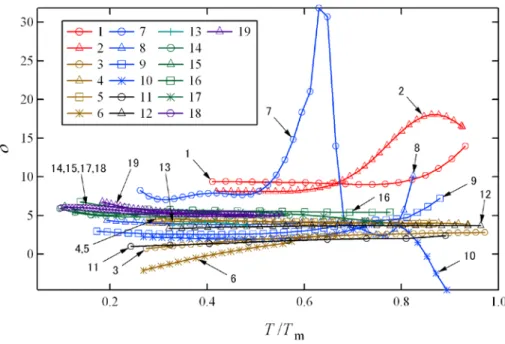
The temperature dependence of the AG parameter of various materials such as alkali halides, silver halides, oxides, fluorides, metals, etc. have been evaluated based on Eqs. (1), (3) and (6). The results are shown in Fig. 1. The elastic constants and the thermal expansion coefficients used in the evaluation have been obtained from various sources listed in the caption of the figure. From Fig. 1, we can see that the AG parameters of LiF, NaCl, KCl, KBr, MgO, CaO, Al2O3, Mg2SiO4, KCN, AlN, Si3N4, Ag and Al are almost constant or weakly temperature dependent as usually assumed [37-39].
Concerning the ionic conducting materials, AgCl, AgBr, PbF2, CaF2, SrF2 and BaF2, large temperature dependences in the high temperature region are observed. We can recognize clearly that the behavior exhibited by AgCl and AgBr are sufficiently anomalous when compared with those of alkali halides, compounds that have the same crystal structure. The large difference arises from the high defect concentration that the Ag halides have. The high defect concentration also influences the ionic conductivity. Measurement [40] indicates that the ionic conductivity of AgBr starts to increase abruptly at around 500K (which corresponds to T/Tm = 0.7), analogously to the case of AG parameter.
In PbF2, CaF2, BaF2 and AgBr, peaks at high temperatures are observed in Fig. 1. However, caution is needed in the interpretation of these peaks. The small upward peak in BaF2 and downward peak in CaF2 arise from the different relative contributions of temperature derivatives of C11, C12 and thermal expansion coefficient. In the case of these fluorides, when the temperature dependence of C11 dominates, the AG curve shows an upward peak. On the other hand, when the temperature dependences of C12 and thermal expansion coefficient dominate, the AG curve shows a downward curve. The large peak around T/Tm = 0.6 observed in PbF2 is related to the transition to the superionic state. That is, it is ascribed to the large increase of the defect concentration and its saturation at high temperature. The peak observed in AgBr arises from thermal expansion coefficient which exhibit a large temperature dependency. Indeed, if the temperature dependency of the thermal expansion coefficient is ignored, the peak is not observed.
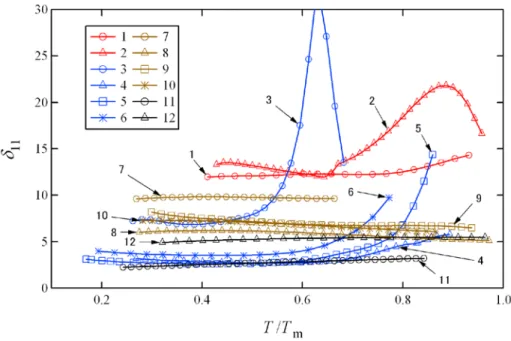
The common behavior of the AG parameter of superionic conducting materials could be seen by studying the anisotropy of the AG parameter. In Figs. 2, 3 and 4, the temperature dependences of δ11, δ12 and δ44, respectively, for various compounds are shown. From these figures, we observe that the temperature dependences of these parameters in LiCl, NaCl, KCl, KBr, Ag and Al are very weak as expected. In contrast, in superionic materials, the parameter δ11 increases at high temperature. In some cases such as AgBr and PbF2, clear peaks are observed. As mentioned above, the appearance of this peak arises from the interplay between elastic constant and thermal expansion coefficient.
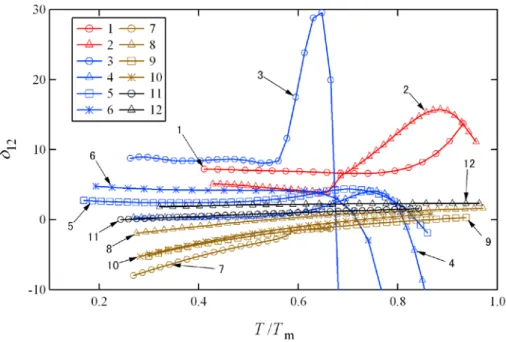
For the case of parameter δ12, peaks at high temperature are observed except AgCl and BaF2. This observation suggests that δ12 is more sensitive to the interplay between elastic constants and thermal expansion coefficient. Here, we can see that some materials have negative values of δ12. This behavior arises from the positive temperature dependence of the elastic constant that these materials exhibit [28]. It has been suggested that this temperature dependence could arise by considering the phonon pressure due to lattice vibrations [41]. Concerning δ44, an interesting behavior is observed.
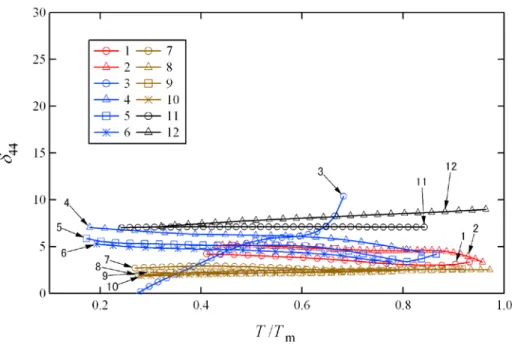
That is, the temperature dependence is weak when compared with δ11 and δ12. PbF2 exhibits an exception to this behavior, whose microscopic origin is not clear at present. However, it is probable that such difference results from the peculiarities of the bonding nature of each material. Although with some exceptions, the above results indicate that the AG parameter of superionic materials exhibit strong temperature dependencies at high temperatures.
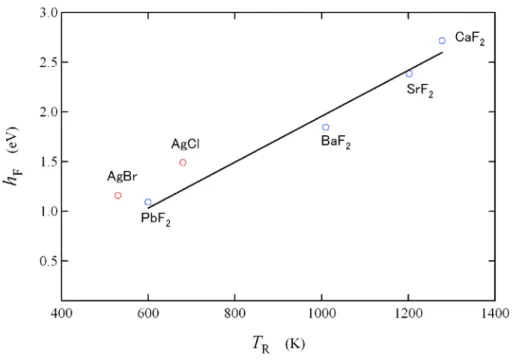
In the course of our study, we have found an interesting correlation shown in Fig. 5. It shows that the Frenkel defect formation enthalpy [42,43] in fluoride compounds correlate with the temperature TR defined as
) . 300 (
) (
11 R
11 A
K T = δ
δ (7) That is, the temperature TR is defined as the temperature where the ratio between the AG parameter evaluated at TR and the reference temperature taken as 300K adopts a constant value A. Fig. 5 shows the result for the case where the constant A takes the value 1.2. If we take another value of A, a similar linear behavior, but with different slope is obtained. In the figure, the values evaluated for AgCl and AgBr are also shown. It is interesting to note that they are located near the line that connects the fluoride compounds. The small difference in the trend is probably due to the difference
in the structure, although the difference in the transport mechanism could not be discarded. In order to discuss the origin of this small difference in the trend, the number of data should be increased.
This is a task left for the future, because additional data are not available at present. Concerning δ12, although the data are somewhat dispersed, analogous behavior to that obtained with δ11 was confirmed. On the other hand, concerning δ44, it is difficult to obtain such kind of behavior due to the weak temperature dependence of δ44. These observations suggest the possibility that the anisotropy of AG parameter is an important ingredient to understand the mechanism of ion conduction. As mentioned in the introduction, the AG parameter carries information on the anharmonicity of the atomic vibrations of the materials. The result shown in Fig. 5 is a manifestation of this observation. It indicates clearly the importance of the anharmonicity in the ion transport processes of the materials.
4. Summary
A comparative study on the temperature dependence of the AG parameter in various materials was presented. It was found that the AG parameter of superionic conductors exhibit anomalously large temperature dependence. On the other hand, the AG parameters of other materials that do not exhibit superionic conduction are almost constant or weakly temperature dependent as usually assumed. The results on the anisotropy of AG parameters indicated that they could provide useful information to understand the peculiarities of each material from the point of view of anharmonicity of lattice vibrations. An interesting correlation between the Frenkel defect formation enthalpy and a quantity which is defined by the ratio between AG parameters evaluated at two different temperatures was found. The result reflects the importance of the anharmonicity in the ion transport processes of the materials.
References
[1] O. Madelung, M. Schulz, H. Weiss (Eds.), Landolt-Börnstein Numerical Data and Functional Relationships in Science and Technology, New Series, Group III/17b, Springer, Berlin, 1982.
[2] R.C. Agrawal, R.K. Gupta, J. Mat. Sci. 34 (1999) 1131.
[3] M. Aniya, J. Chem. Phys. 96 (1992) 2054.
[4] K.P. Padmasree, D.K. Kanchan, A.R. Kulkarni, Solid State Ionics 177 (2006) 475.
[5] J.B. Wachtman Jr., W.E. Tefft, D.G. Lam Jr., C.S. Apstein, Phys. Rev. 122 (1961) 1754.
[6] O.L. Anderson, Phys. Rev. 144 (1966) 553.
[7] U.C. Srivastava, Phys. Rev. B 21 (1980) 2602.
[8] R.J. Wolf, K.A. Mansour, M.W. Lee, J.R. Ray, Phys. Rev. B 46 (1992) 8027.
[9] X.F. Li, X.R. Chen, C.M. Meng, G.F. Ji, Solid State Commun. 139 (2006) 197.
[10] J.J. Zhao, J.M. Winey, Y.M. Gupta, Phys. Rev. B 75 (2007) 094105.
[11] J. Shanker, B.P. Singh, K. Jitendra, Condens. Matter Phys. 11 (2008) 681.
[12] A.C. Lawson, H. Ledbetter, Phil. Mag. 91 (2011) 1425.
[13] S. Upadhyay, H. Chandra, M. Joshi, D.P. Joshi, Pramana 76 (2011) 183.
[14] S.P. Srivastava, J. Phys. Chem. Solids 39 (1978) 573.
[15] V. Pandey, S. Gupta, D.S. Tomar S.C. Goyal, Physica B 405 (2010) 4943.
[16] C. Nie, S. Huang, W. Huang, Appl. Phys. Res. 2 (2010) 144.
[17] M.N. Sharma, S. Gupta, Phys. Rev. B 12 (1975) 3458.
[18] K. Dinesh, B.P. Singh, Physica B 357 (2005) 525.
[19] K.Y. Singh, B.R.K. Gupta, Physica B 334 (2003) 266.
[20] H. Sadakuni, M. Aniya, in: B.V.R. Chowdari, J. Kawamura, J. Mizusaki, K. Amezawa (Eds.), Proceedings of the 13th Asian Conference on Solid State Ionics, Ionics for Sustainable World, World Scientific, Singapore, 2012, 705.
[21] E. Grüneisen, Ann. Phys. (Leipz.) 39 (1912) 257.
[22] Y.P. Varshni, Phys. Rev. B 2 (1970) 3952.
[23] J.L. Tallon, J. Phys. Chem. Solids 41 (1980) 837.
[24] W.C. Hughes, L.S. Cain, Phys. Rev. B 53 (1996) 5174.
[25] B.R. Lawn, Acta Cryst. 16 (1963) 1163.
[26] L.S. Cain, G. Hu, Phys. Rev. B 64 (2001) 104104.
[27] K.K. Srivastava, H.D. Merchant, J. Phys. Chem. Solids 34 (1973) 2069.
[28] O.D. Slagle, H.A. McKinstry, J. Appl. Phys. 38 (1967) 437.
[29] M.O. Manasreh, D.O. Pederson, Phys. Rev. B 30 (1984) 3482.
[30] R.B. Roberts, G.K. White, J. Phys. C 19 (1986) 7167.
[31] C.R.A. Catlow, J.D. Comins, F.A. Germano, R.T. Harley, W. Hayes, J. Phys. C 11 (1978) 3197.
[32] A. Wolfden, M.R. Harmoche, J. Mater. Sci. 28 (1993) 1015.
[33] D. Gerlich, E.S. Fisher, J. Phys. Chem. Solids 30 (1969) 1197.
[34] S. Haussühl, Solid State Commun. 13 (1973) 147.
[35] O.L. Anderson, D. Isaak, H. Oda, Rev. Geophys. 30 (1992) 57.
[36] R.J. Bruls, H.T. Hintzen, G. de With, R. Metselaar, J.C. van Miltenburg, J. Phys. Chem. Solids 62 (2001) 783.
[37] A. Vijay, T.S. Verma, Physica B 291 (2000) 373.
[38] S.K. Srivastava, S.K. Sharma, Physica B 388 (2007) 350.
[39] R. Ramji Rao, Physica 77 (1974) 126.
[40] J.K. Aboagye, R.J. Friauf, Phys. Rev. B 11 (1975) 1654.
[41] U.C. Shrivastava, Phys. Stat. Sol. (b) 100 (1980) 641.
[42] A.V. Chadwick, Solid State Ionics 8 (1983) 209.
[43] R.J. Friauf, J. Physique 41 (1980) C6-97.
Fig. 1. The Anderson-Grüneisen parameters δ of various materials as a function of normalized temperature T/Tm, where Tm is the melting temperature. The numbers after the compound names denote the melting temperature in K and the sources of the experimental values of elastic constant and thermal expansion coefficients, respectively. 1: AgCl [730; 24,25], 2: AgBr [700; 26,25], 3: NaCl [1091; 28,27], 4: KBr [1063; 28,27], 5: KCl [1003; 28,27], 6: LiF [1115; 1,27], 7: PbF2 [1143; 29,30], 8: BaF2 [1553; 31,30], 9: SrF2 [1733; 31,30], 10: CaF2 [1673; 31,30], 11: Ag [1235; 32], 12: Al [934;
33], 13: KCN [911; 34], 14: MgO [3125; 35], 15: CaO [2798; 35], 16: Mg2SiO4 [2163; 35], 17: Al2O3
[2345; 35], 18: AlN [3023; 36], 19: Si3N4 [2173; 36].
Fig. 2. The Anderson-Grüneisen parameters δ11 of various materials as a function of normalized temperature T/Tm. 1: AgCl, 2: AgBr, 3: PbF2, 4: CaF2, 5: SrF2, 6: BaF2, 7: LiF, 8: NaCl, 9: KCl, 10:
KBr, 11: Ag, 12: Al.
Fig. 3. The Anderson-Grüneisen parameters δ12 of various materials as a function of normalized temperature T/Tm. 1: AgCl, 2: AgBr, 3: PbF2, 4: CaF2, 5: SrF2, 6: BaF2, 7: LiF, 8: NaCl, 9: KCl, 10:
KBr, 11: Ag, 12: Al.
Fig. 4. The Anderson-Grüneisen parameters δ44 of various materials as a function of normalized temperature T/Tm. 1: AgCl, 2: AgBr, 3: PbF2, 4: CaF2, 5: SrF2, 6: BaF2, 7: LiF, 8: NaCl, 9: KCl, 10:
KBr, 11: Ag, 12: Al.
Fig. 5. Relationship between the Frenkel defect formation enthalpy and the temperature TR in fluoride compounds and silver halides. The definition of TR is given in Eq. (7).