
An Examination of the Complementary Currencies Past and Present
Yasushi Hayashi Tetsuya Utashiro
Abstract
So-called complementary currencies are broadly divided into community currencies, whose main purpose is to deepen and restructure relationships between constituents within a community, and “market transaction” type complementary currencies, whose main aim is to activate transactions within a given market. Complementary currencies flourished in various countries in the 1980s, during which time community currencies were the dominant form. Stamp scrip, which is viewed as the original form of a
“market transaction” type complementary currency, was used in the US and Europe in the 1930s. Actual stamp scrips partially complement the functions of legal tender by finely adjusting the legal tender system. Free money, a method of affixing the stamps to a certificate, conceived by Gesell and others, is a substitute for legal tender, i.e. an alternative cur- rency. The difference between alternative currency and complementary currency needs to be considered distinctly. Moreover, stamp scrip is fre- quently talked about in terms of negative interest rates, but it is a mistake to consider the depreciation of stamp currency as a negative interest rate.
Confusion can be seen in interpretations of Gresham’s Law. In this paper, while examining these misperceptions and misunderstandings, we inves- tigate the mechanisms and roles of stamp scrip and market transaction type complementary currencies, and consider the use of complementary currencies.
Acknowledgments
We graciously accept a 2018 grant from the Rissho University Economic Research Institute.
Introduction
Regular money (currency) is a tool used to smoothly conduct market trans- actions, regardless of industrial or financial circulation, and the market is composed of that money. In that sense, there is today both a market econ- omy and a monetary economy. The unification of currency is effective for the strong promotion of growth in market transactions. For example, advancing unification with legal tender, introducing a common currency, dollarization or alignment with the euro or renminbi, and so on. On the other hand, there is money that also exists as an antithesis to the market and monetary economies.
These are the so-called complementary currencies, which connote a depar- ture from a unified currency or the act of unbundling.
Money is diverse; however, that is not to say that diversity is acquired automatically or voluntarily. Markets and money can be described as organic things, but naturally this is only rhetoric. Money is diverse because the com- munity has given it the roles it expects for the money it uses, and so its role is a definition given by the community. This dynamic is termed “ambiguity.”
Although complementary currencies have frequently been used in Japan as communication tools, our academic interest is in complementary currency as money that is used to activate transactions within a market or a “mar- ket-transaction” type of complementary currency. A market-transaction type complementary currency is one that can be exchanged for goods as legal tender in transactions between people in their daily lives. Of course, because a market-transaction type complementary currency is used by a community, it may also play a role as a communication tool.
This paper recognizes and examines the mechanisms of depreciation, cir- culation and the pattern of users’ value changes in stamp scrip in Europe and the US since the 1920s, as well as the stamp scrip conceived by Irving Fisher in 1933. We investigate the role of complementary currency, motives for stor- ing money, and negative interest, as well as the possibility of use as a fiscal easing policy in designated regions. We further consider topics involving Gresham’s Laws of complementary currency, and the use of complementary currency with the aim of stimulating disaster recovery.
This paper is a short summary that focuses on chapters 3 and 4 of The Contemporary Interpretation and Significance of Irving Fisher’s ‘Stamp Scrip’ (Complementary Currencies) (Utashiro & Hayashi, 2019), with addi- tional adjustments.
1. Historical Development of Market-transaction Type Complementary Currencies
1.1 Silvio Gesell’s Free-Money
Gesell proposed free money in 1916 in Die Natürliche Wirtschaftsordnung to reduce and eliminate the predominance of coin.1 Put simply, Gesell’s idea was as follows (Gesell, 1916, pp. 179-183): The value of all goods besides money decreases over time due to deterioration, wear, destruction, rot, etc.
Money, by contrast, does not deteriorate or wear out. Money is superior to other goods in terms of carrying costs, and it is easy to postpone its use; in other words, money tends to be a method of savings. Money was originally simply a medium used to facilitate the transaction of goods, but differences in carrying costs hinder smooth exchange. Gesell therefore proposed the in- troduction of free money, the value of which decreases with time, as follows.
・ Issue 6 types of bills in denominations of 1, 5, 10, 50, 100, and 1,000 marks.
・ The 6 types of marked bills would lose 0.1% of their face value each week. A supplementary bill equivalent to 0.1% must be affixed to the back of the bill, which the holder bears the cost.
Gesell’s proposal was a reform of legal tender itself. The government issues free money according to demand for bills (an alternative currency applying the stamp system) and collects any surplus (Gesell, 1916, pp. 184- 185). The existing currency, the mark, would initially be continued, and individuals would be free to exchange free money for the currency; the two currencies would circulate simultaneously during an exchange period several months long. At the end of the exchange period, the conventional mark would lose its status as legal tender and only free money would be distributed.
1.2 Stamp Scrip from the 1930s
Since around 1930, local governments and citizens’ groups in Europe have issued complementary currencies with the aim of aiding local employ- ment and reviving stagnant economic activity. The Wara (Wära) was issued in Germany in 1929, the JAK in Denmark in 1931, the Woergl Certified Compensation Bill (Arbeitswertscheinen) in Austria in 1932, and the WIR in Switzerland in 1934.2,3,4,5
In the US, states, local governments, and chambers of commerce had also issued many such bills as measures to counter a recession. Stamp scrip was frequently issued in the city of Anaheim in California between late 1932 and early 1933. The US was comprised of 48 states at the time, since Hawaii and Alaska had yet to achieve statehood, but according to depressionscrip.
com, in the 48 states, 319 municipalities in 45 states, and one municipality in the Alaskan territory, a total of 320 municipalities, were issuing complemen- tary currencies.6 Of these, around 50 municipalities were issuing stamp scrip, chiefly in Iowa and California.7
The stamp scrip found at that time in various regions in Europe and in the US were directly born from Gesell’s idea of free money. However, the stamp scrip actually issued then, as well as the stamp scrip devised by Fisher, was not the alternative currency that Gesell seems to have contemplated; rather, it temporarily and partially complemented the function and/or role of legal tender, as a means of fine-tuning the conventional legal tender system.8
1.3 Evaluation of Stamp Scrip by Keynes and Fisher
Complementary currency circulates simultaneously with legal tender in a society where legal tender are in circulation (this is called a parallel cur- rency system). Alternative currency is used in a single currency system and intended to be circulated in place of the existing currency. The difference between alternative currency and complementary currency needs to be con- sidered distinctly. What role stamp scrip should play, and, moreover, the mechanism that should be adopted differ depending on whether the stamp scrip is to be an alternative currency or a complementary currency.
In the quantity theory of money, the amount of money in circulation in society and the velocity of its circulation determine the price level, expressed by Fisher’s Equation of Exchange. Fisher thought that the circulation rate of
money (velocity of circulation) ought to be increased to lift the economy.
Fisher published “Stamp Scrip” in 1933. In the 1930s, Fisher, who was interested in the use of stamp scrip in various parts of the US to lessen the pain being caused by the Great Depression, sought to find a path out of the recession by positioning stamp scrip as a means of raising money’s velocity of circulation to promote consumption. Only the part about reducing value was adopted from Gesell’s idea of free money, to be a tool to cause reflation and overcome deflation.
Keynes also refers to Gesell’s stamp scrip in his 1936 General Theory (Keynes, 1936, p. 358). However, Keynes’ criticism was of Gesell’s free money, which had never been realized, and not of Fisher’s idea or stamp scrip in practice.
1.4 The Stamp Scrip Family Tree
Complementary currencies have spread in various countries since the 1980s.
LETS and the Time Dollar are said to be the pioneers of complementary currencies, and, as of 2013, there are thousands of examples of their im- plementation around the world (Seyfang & Longhurst, 2013, pp. 69-70).
These complementary currencies are largely found in Europe and the US, and spread primarily in developed economies. The LETS and Time Dollar types, as well as the eco-money type in Japan, are complementary currencies generally referred to as community currencies.9
Conversely, there are over 200 types of market-transaction (mar- ket-economy) type complementary currencies, with a few examples of their implementation (Seyfang & Longhurst, 2013, pp. 70-71). The principle aim of “market-transaction” type complementary currency is its use for exchange with market-transactable goods that are transacted using legal tender. Rather than circulate within a specific group, it can be obtained and used by anyone in the region, and its main use is to pay for general merchandise in the same way as legal tender. Fisher’s stamp scrip was also intended to stimulate market transactions, and market-transaction type complementary currencies are descended from stamp scrip (however, some adopt a stamp system).10 Stamp scrip and market transaction-type complementary currency, similar to legal tender, basically do not lose purchasing power through the provision of that currency, and purchasing power is transferred to the person receiving
it. Moreover, it is intended to be distributed, unlike gift cards, which are in- tended for a single use. The transferred purchasing power circulates through its subsequent use in goods transactions, and continues to function as a medium for exchange.
2. The Stamp Scrip Mechanism
2.1 Overview of the Issuance and Distribution of Stamp Scrip
Here, rather than describe individual stamp scrip, we instead explain the stamp scrip Fisher sought to adopt. Fisher states the characteristics of stamp scrip as being similar to money in that it “can be deposited, invested and consumed,” and different in that it “cannot be hoarded” (Fisher, 1933, p. 8).
There are frames on the rear side of the stamp scrip on which stamps can be attached, and the date is printed in each frame. When stamps are affixed each month, 12 frames are printed, and 52 frames are printed when stamps are affixed each week. The first user after a set date and time (for example, each Wednesday at midnight) is required to purchase and affix a stamp in the form of a postage stamp or frank to the designated frame on the stamp scrip.
This system of affixing stamps prompts people to use stamp scrip promptly, and as a result increases its velocity of circulation (Fisher, 1933, p. 13).
To obtain acceptance as currency, the exchange of issued stamp scrip for cash was guaranteed. If a stamp is two cents, over 52 weeks this would have a sales price of $1.04, of which one dollar could be redeemed and the four cents would be used to print stamps and manage the plan.
The major point of difference between Europe and the US is that in Europe the timing for affixing stamps was regular (for example, every Wednesday), while in the US this was generally done for each transaction.11 In addition, in Europe, where stamps were affixed on a regular basis, annualized stamp costs were 12% of face value for the Wara and the Woergl Certified Compensation Bills and 24% for WIR bills, while in America these costs exceeded 100%.
2.2 The Shape of Stamp Scrip Value
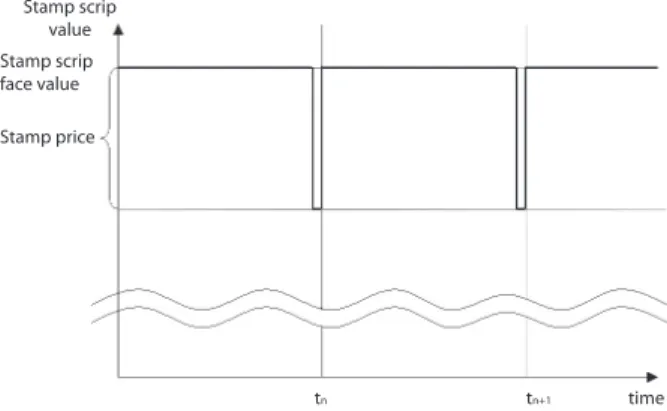
For stamp scrip to be circulated efficiently, the movement of change in value is important in the system design. This consists of: 1) the price of stamps, or
the ratio of stamps to face value, and 2) the frequency of affixing stamps (the interval between the date to affix a stamp, tn, and the subsequent date to affix a stamp, tn+1). Here, we consider a European-style stamp scrip in which the first user must affix a stamp after the date to affix a stamp tn.
The value of stamp scrip without the newly affixed stamp declines from face value to zero at the moment the date changes from the day before the date to affix a stamp, tn–1, to the date to affix the stamp, tn. However, in prac- tice, the stamp scrip is returned to face value by paying the additional cost of the stamp, since its actual value does not become zero, and depreciates only by the value of the stamp (see Fig. 1).
However, assuming that it is highly likely that others will not accept this, at the extreme, even when received immediately after affixing a stamp the value of the stamp scrip to the recipient is its face value less the value of the stamp. In other words, its actual shape is as shown in Figure 1, but exactly when the decrease in value occurs is an individual issue. Furthermore, if it is thought that it (the scrip) has no acceptance at all, its value will not be the face value less the value of the stamps, but almost zero. Even if Figure 1 has a logical shape, the value differs between individuals.
Fig. 1 The shape of changes in stamp scrip value. (Created by the author)
Stamp scrip value Stamp scrip face value Stamp price
time
tn tn+1
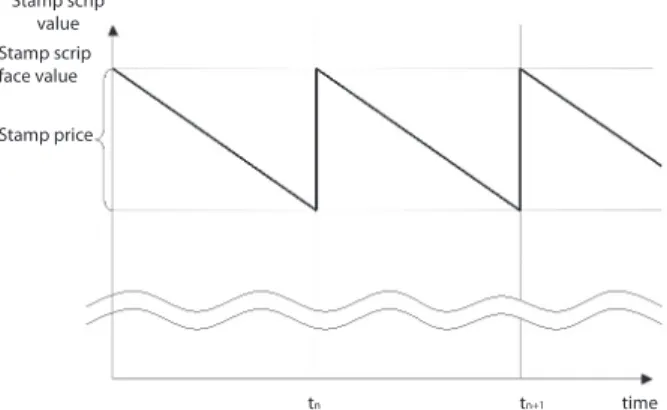
Next, we consider a case that did not exist in the 1930s, one of paying for stamps on a daily basis. If done electronically, it would not be difficult today to require stamps on a daily basis. Although different from actual stamp scrip, we consider a situation where the cost of stamps must be paid on a daily
basis.
From the date a stamp is to be affixed, tn, to the next date on which a stamp is to be affixed, tn+1, the value of the stamp scrip decreases linearly from its face value at tn to the time tn+1, and affixing a stamp increases the value ver- tically back to its face value. At this time, the shape of its value is regarded as a sawtooth shape, repeating this motion (Fig. 2).
Fig. 2 The shape of changes in stamp scrip value when paid daily. (Created by the author)
Stamp scrip value Stamp scrip face value Stamp price
time
tn tn+1
However, in this case it is possible that different shapes are drawn in the minds of different people.
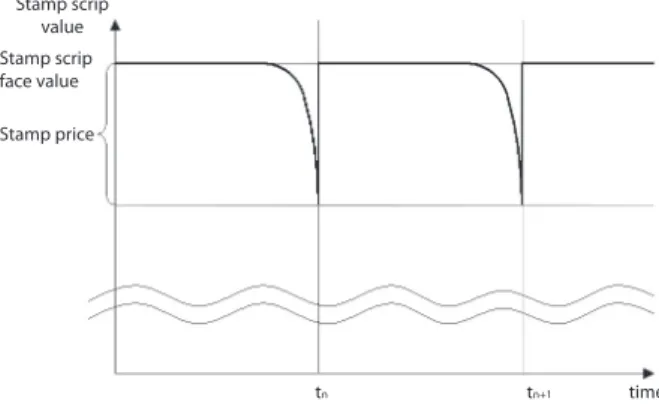
Although Figures 1 and 2 above show the actual value per unit of time for the stamp scrip, this may be different for different people. Next, we consider how people generally perceive changes in value, and the general shape of value that people internalize.
The stamp price is paid only by the first person to use it after the date a stamp is affixed. Although it is unclear whether a specific individual will bear that cost, the probability increases as time goes by. When someone be- lieves an individual will bear the cost, the shape of the change in value people perceive will be such that the linear sections that descend diagonally as the sawtooth edges will be convex in the top right direction in the daily-rate case described above (Fig. 3). People act on the premise that these are approxi- mately worth face value for a certain period of time and begin to lose value as the stamp date approaches, and they act on the assumption that the value will fall sharply at some point. How to think about the acceptability of stamp scrip differs depending on the individual and the situation; some people may
believe value begins to diminish at a different point in time than that in Figure 3, and the point when value begins to drop sharply will also differ between people and depending on the situation at the time.
Fig. 3 The shape of people’s perception of changes in stamp scrip value. (Created by the author)
Stamp scrip value Stamp scrip face value Stamp price
time
tn tn+1
3. Problems with Complementary Currencies
3.1 The Function and Role of Complementary Currency, and Motives for Storing Money
3.1.1 The function and role of money
What we often call the “function of money” should strictly speaking be called the “role of money.”12 While we do not discuss this in detail here due to space constraints, we describe it briefly.
How economists have expressed and handled this issue is deeply inter- esting. William Stanley Jevons is thought to have first compiled economists’
views on the functions of money up to that point, and cites them as (1) a medium of exchange, (2) a common measure of value, (3) a standard of value, and (4) a store of value (Jevons, 1875, pp. 20-22).13
Financial theory textbooks today often cite (1), (2), and (4) as the three functions and/or roles.14 Here there is also a notion separating exchange and settlement. Note that there are also some that regard (4) as not being unique
to money.
Hayek was also skeptical about the expression “function,” and did not use the term “function” in the Denationalization of Money; instead, he presented the uses of money.15 Moreover, he comments,
I have always found it useful to explain to students that it has been rather a misfortune that we describe money by a noun, and that it would be more helpful for the explanation of monetary phenomena if “money” were an adjective describing a property which different things could possess to varying degrees. “Currency” is, for this reason, more appropriate, since objects can “have currency” to varying degrees and through different re- gions or sectors of the population (Hayek, 1976, p. 56).
The difference between “noun” and “adjective” appears to be consistent with an awareness of the issue we are considering between “function” and
“role” (Nishibe, 2014, p. 94, pp. 148-154).16 For example, Goodhart de- scribes “money’s initial role” and seems to consciously use the term “role”
(Goodhart, 1998, p. 413).
It is often pointed out that money is diverse, but considering that its ex- pected role is conferred by society, it is more than diverse; it is ambiguous in the sense that it can be defined by others.
3.1.2 The functions and roles of complementary currencies
So-called complementary currencies can be viewed as not being fully-fledged currencies in that they are not given the three roles. Yet when we consider currency as ambiguous, the role of complementary currency re-emerges.
Speaking in terms of so-called hard and soft classifications, hard money will satisfy some of its expected roles more strongly, while soft money has fewer expected roles and satisfies these less strongly or more sparsely.17
Role Hard money
(legal tender) Soft money (complementary currency)
Settlement (Exchangeability) ○ △
Storability ○ △?
Scale ○ △×
Fig. 4 The Role of Money (Legal Tender and Complementary Currency). (Created by the author)
With respect to legal tender and complementary currency, legal tender is hard, while complementary currency is soft. This difference arises from the
scope and strength of their expected roles. For example, if its expected role can no longer be fulfilled, the currency will soften, even for legal tender. The order in which these can be expected to not be satisfied is storage, settle- ment, and then measurability. Legal tender has the strength of having to be accepted; however, it is not necessarily hard money. Where there is a discrep- ancy between general acceptability and compulsory acceptance, compulsory acceptance may not be exerted (in that sense, the term “compulsory accep- tance” may be more appropriately called “legal acceptance”). Even if it is legal tender, if the state or government lacks credibility, it will lose compul- sory acceptance.
For example, in Ecuador in 2000, immediately prior to dollarization, the softening of the Sucre was accompanied by the loss of its storability, a sharp decline in its use for settlement, and at the same time, the loss of its mea- surability, and so was replaced by the US dollar (see Hayashi & Kinoshita, 2014).
Storability, the third role of money, which is characteristically lost in com- plementary currency, is the ability to bring today’s purchasing power into the future. There are few complementary currencies that play the role of storage.
From the outset, complementary currencies lacked compulsory acceptance and had less credibility than legal tender, and so have been more oriented towards promoting consumption in the present rather than for carrying pur- chasing power over into the future.
3.1.3 Motives for storing complementary currency
Next, let us look at the differences between hard and soft money from the perspective of motives for storing money.
Motive Hard money
(legal tender) Soft money (complementary currency)
Transaction ○ △
Precautionary ○ △
Speculative ○ ×
Fig. 5 Motives for Holding Currency (Legal Tender and Complementary Currency).
(Created by the author)
※The motivation to hold cash upon understanding that opportunity costs have occurred.
Comparing the two, as with their roles, hard money is superior to soft money for each motive.
Rather than comparing them, let us assume there is only one currency and consider the three motives. Where no money is held, the order of priorities for the receiving side is generally thought to be the transaction motive, precau- tionary motive, and finally, the speculative motive. In other words, money is first received to satisfy the transaction motive, and when that is satisfied, or is
“expected to be satisfied,” the subsequent precautionary motive begins to act to receive money. Last, money is received through the speculative motive.
These three motives are often thought of as similar to the process by which water fills in a cascade from upstream of a triple dam; in reality, however, the transaction motive is not fully satisfied before the subsequent precautionary motive acts. The three motives are arbitrarily selected according to the com- bination of expectations about the future receipt of money and payment.
The same holds where hard and soft money coexist. The three motives are arbitrarily selected according to the combination of expectations about the future receipt of the two currencies and payment. For example, let us consider a case where a person is in the following financial position.
Target of possession 〈1〉 〈2〉 〈3〉 〈4〉 〈5〉 〈6〉 〈7〉 〈8〉
Transaction motive + - + + - - + -
Precautionary motive + + - + - + - -
Speculative motive + + + - + - - -
Fig. 6-1 The State of Hard Money Holding [Assumption] (Created by the author)
※The + symbol indicates that it is fully satisfied, and the - symbol indicates that it is insufficiently satisfied.
At this time, the room for that person to accept soft money is thought to be as follows.
Target of possession 〈1〉 〈2〉 〈3〉 〈4〉 〈5〉 〈6〉 〈7〉 〈8〉
Transaction motive - + - - + + - +
Precautionary motive - - + - + - + +
Speculative motive - - - + - + + +
Fig. 6-2 Room for Accepting Soft Money (Created by the author)
※The + symbol indicates that it is fully accepted, and the - symbol indicates that it is not fully accepted.
These include combinations that are thought to be virtually non-existent in practice. For example, in case <1>, there is no room to accept soft money for any motive. In case <2>, there is scope to accept soft money under the transaction motive, and in case <3>, there is scope to accept soft money under the precautionary motive. The situation in case <3> must be transferred to case <2> for the purpose of circulating soft money throughout a city. This also depends on the state of that individual’s holding of hard money; how- ever, this may be possible by devising a plan with soft money. For example, if soft money depreciates at fixed intervals, the precautionary and speculative motivations for soft money are reduced.
Regardless of the manner in which hard money is held, case <2> is de- sirable as room for accepting soft money. Cases <5> and <8> show the excessive issuance of soft money.
3.2 The Significance of Stamps and Monetary Easing 3.2.1 Stamps as demurrage
The notion of a depreciating complementary currency is Gesell’s starting point, but Gesell did not position the depreciation of free money as a neg- ative interest rate. Not limited to agricultural products, Gesell believed that goods deteriorate and wear, and he thought the only issue was that money does not deteriorate; thus, the tool by which to cause money to deteriorate was stamps.18
Stamp scrip depreciates at regular intervals, and stamps are affixed not to restore depreciated value; rather stamp scrip is forcibly stopped at fixed intervals, and a stamp is affixed to lift this cancellation. Strictly speaking, stamp scrip does not “depreciate,” but rather demurrage (carrying costs) must be paid at regular intervals.19 In that respect, it is “subordinated” to currency with regular circulatory power.
Gesell explains that for money to travel on the roads of the market, tolls must be paid. Stamps are the tolls to lift the barriers (Gesell, 1916, pp.
141-142).20
Fisher terms stamps as an ambulatory tax or a tax on hoarding, and de- scribed stamp scrip thus: “I think, to liken the scrip to a pre-dated check”
(Fisher, 1933, pp. 4-5). “The stamp is more like a tax on hoarding than a sales tax. Hoard, and the tax is heavy; spend (or invest or deposit), and the tax is light” (Fisher 1933, p. 15). He states that if it is not paid on each transaction
but instead apportioned based on the number of times used, then it cannot be considered a consumption tax. In pursuit of demurrage, stamps can be con- sidered a public fee for the public stamp scrip system, used to promote the circulation of stamp scrip. However, there is a lack of fairness to its burden.
This is, however, by design.
3.2.2 Misunderstanding interest rates
Recently, in the debate surrounding so-called negative interest rates, depre- ciation and negative interest rates are often confused, and complementary currency is mentioned. Focusing on the decrease in value over time is a mis- take. Strong opposition may not be warranted if we treat the “depreciation”
of stamp scrip and complementary currency as “negative interest” because its actual social effects are similar. However, discussions based solely on an analogy as a phenomenon is erroneous, and must be discussed with the proper understanding. Usually, where money lacks a lending relationship, no interest occurs. For example, even if it appears at a glance that there is no lending relationship, as with net present value, if we receive and deposit (use) it today, this means calculating the value of interest, and can be said to be a pseudo-loan relationship because it imitates a loan relationship.21
Fisher never considered this system of depreciation to be a negative inter- est rate. It is subordinated to legal tender using the mechanism of demurrage.
Keynes states:
According to my theory it should be roughly equal to the excess of the money-rate of interest (apart from the stamps) over the marginal effi- ciency of capital corresponding to a rate of new investment compatible with full employment. The actual charge suggested by Gesell was 1 per mil. per week, equivalent to 5.2 per cent per annum. This would be too high in existing conditions, but the correct figure, which would have to be changed from time to time, could only be reached by trial and error (Keynes, 1936, p. 358).22
We cannot say directly from this sentence that Keynes considered the cost of the stamp as interest, and do not know whether he dared to do so, but Keynes treats it as a kind of interest.
3.2.3 The issuance of complementary currency as a monetary easing measure Currency other than legal tender circulates in areas where stamp scrip is used.
If legal tender is not used for the amount of stamp scrip issued, the base
shared by the two currencies, legal tender and stamp scrip, will not change.
However, if the rotation velocity in the process of circulation differs, the mul- tiplier effect will be greater for the stamp scrip, which is expected to circulate more. The same also applies for systems where stamps are not affixed.
Even within a limited scope of distribution, the total amount of money issued and the volume of circulation are likely to increase, which is equiv- alent to performing quantitative easing (see Nishibe, 2018, p. 13 et al.). As described later, complementary currency used for disaster recovery can be expected to play a role as a regional monetary easing measure. Of course, this can be implemented not only for special purposes such as recovery, but also during normal periods. The issuance of complementary currency can be considered a measure for lifting the economy in regions suffering prolonged economic stagnation. For example, development in the American region of Appalachia began under government leadership in 1965, but has been said to be the poorest region in the entire US.23 Besides governmental fiscal spend- ing, monetary easing can be considered to ease the economy; however, it is almost impossible to reduce the interest rate of the US dollar, which is legal tender only in limited regions.24 Monetary easing effects can be expected by issuing complementary currency.25
3.3 Gresham’s Law and Complementary Currency
Gresham’s Law is an ideology, and the definition varies from person to person. In addition, Gresham himself did not claim it to be a “law,” and the fact that it has not been defined has created confusion.
3.3.1 The validity of Gresham’s Law
Gresham’s Law immediately comes to mind when there is competition be- tween two types of currency, or the withdrawal of currency. Let us investigate Gresham’s Law.
The law’s name appears to have been derived from Thomas Gresham, who in the mid-16th century suggested that the cause of the outflow of good money (or that English sovereign debt was trusted) from England overseas was due to its low unit value, and that the unit value should be increased.
The general understanding of Gresham’s Law is that “bad money drives out good,” which can be summarized as “for precious-metal currency, a phe- nomenon that occurs in which high unit value currency is hoarded or used
for foreign trade, and only low unit value currency features in the process of circulation.”26 Currency with a high unit value is good money and cur- rency with a low unit value is bad money. Note that the process of circulation refers to a narrowly-defined circulation market, and Gresham’s Law does not describe society as a whole. Jevons states that the reason the phenomenon occurs where good money is withdrawn and only bad money remains in the circulation process is that the side purchasing goods tries to purchase the best goods with inferior money, but this is thought to be a misunderstanding (Jevons, 1875, p. 74). For such a phenomenon to occur, it must be assumed that good and bad money with the same face value are traded at face value rather than at unit value. Hayek points out that this is only the case where a fixed exchange rate between good and bad money is enforced. Because the exchange rate is fixed, the goods purchaser pays in bad money; if the exchange rate is variable, the value of bad money declines, and people may choose not to accept it (Hayek, 1976, pp. 42-43).27
Fisher regarded Gresham’s Law as concerning precious-metal currency, and moreover, that it depended on transactors’ power relationships. He states that if the buy-side is dominant they will pay with bad money and the bad money will drive out the good, while if the sell-side is dominant they will receive good money and so good money will drive out bad money.28
Gresham’s Law must be relative because the relationship between the two types of currency is not substitutional but rather complementary.
3.3.2 Fiduciary currency and Gresham’s Law
Here, whether Gresham’s Law also holds for bills becomes an issue. Being literally made of paper, there is no difference in the unit value of materials between bills, and the strength of its credibility determines whether to hold it or use it quickly. In short, bills with high creditworthiness (generally legal tender) are usually considered good money. Again, if Hayek’s idea is ex- panded to the story of bills, banknotes will be selected based on differences in creditworthiness because the unit value has no relevance to paper bills. If currency can be freely chosen, there should not be anyone who chooses the one whose value will deteriorate.
For example, if a certain country’s foreign exchange is a floating exchange rate system, foreign exchange is established as a market. However, if a fixed exchange rate is assumed, Gresham’s Law is likely to be observed because a currency whose purchasing power is likely to be maintained will be retained.
Foreign currency with high creditworthiness drives out foreign currency with low creditworthiness. This is considered the driving force for transition to a floating exchange rate system. Ecuador’s dollarization can be regarded as having been a forced dollarization because the superior purchasing power of the dollar over the Sucre had grown to a point that became intolerable (see Hayashi & Kinoshita, 2014).
However, it should be noted that the meaning of “drive out” here dif- fers from that used by Gresham. According to Gresham’s Law, the reason only bad money features in the circulation process is that good money is withdrawn, but that does not mean good money is driven out of society as a whole. In Hayek’s case, he states that bad coins are driven out of the circula- tion process as well as from society at large.
Moreover, in the relationship between legal tender and stamp scrip, bad money will circulate during recessions because goods buyers have the initia- tive. In other words, Fisher dared to create “bad money” called stamp scrip to circulate it in parallel with the legal tender.
4. Use of Complementary Currency
4.1 Community Regeneration Type and Market Transaction Type Complementary Currencies
Since the 1980s, so-called complementary currencies have been implemented in various parts of the world. These complementary currencies have two main purposes: community revitalization and revitalization of a local economy.
There are many examples of the implementation of community-revitaliza- tion type complementary currencies in developed economies such as those in Europe, the US, and Japan. The significance of a complementary currency as a medium for promoting volunteerism, mutual assistance, and connections is stronger than its significance as a medium for the exchange of currency or goods. There are, of course, also cases where community regeneration or revitalization of the local economy is an intermediate goal, and the final goal is something else. In any case, these two goals are nearly inseparable.
The discussion thus far has focused on stamp scrip and market transaction type complementary currencies, but let us mention the possibility of com- plementary currencies, including community currency, while considering the
relationship between community regeneration type and market transaction type complementary currencies. Considering complementary currency can contribute socially and economically as a medium for exchange, we consider what type of uses it is suitable for.
Take so-called genkai shūraku (depopulated villages) as an example of the relationship between a community currency and market transaction type complementary currencies. In some depopulated villages, the community is so extremely small that a community currency is unnecessary. Half a century ago, there were five shops in the village, but today there is a single general store, which is also a place for the village community. As residents of the vil- lage, it may be possible to maintain the store through donations or charity, for example, but this may differ from the residents’ original intentions; from the viewpoint of sustainability, it may lead to the future collapse of the village as a community. What this village could do is issue and circulate a complemen- tary currency that can only be used at the general store. It may be necessary for the municipal office to accept a public charge from residents as a spe- cial case. This complementary currency is an extreme market transaction type that incidentally becomes a community currency. Regional economic development effects would generally be expected concomitantly from a com- munity currency, but it is highly interesting that in this case the opposite is true. While that is not to say any new concept is introduced here, it can be seen that the current economic system has been modified. This example of a depopulated village clearly shows the relationship between community re- generation type and market transaction type complementary currencies, and moreover, implies the possibility of complementary currency.
4.2 Reconstruction and Development Currency
The use of the stamp scrip mechanism is not limited to overcoming reces- sions that occur during normal business cycles. Let us consider expanding complementary currency to maintain the general store in the depopulated village described previously. For example, we consider it meaningful to apply it as one measure for reconstruction support in areas damaged by earth- quakes, heavy rainfall, and so on. A great many disasters have occurred in Japan recently. There may also be cases where there are short reconstruction goals; however, in many cases it is extremely prolonged. Recovery from di- sasters such as earthquakes and heavy rain carried out using conventional
macroeconomic policy does not always proceed smoothly. Reconstruction budgets such as emergency disaster response measure budgets are spent in legal tender. In this reconstruction work, the restoration of infrastructure es- sential to the livelihoods of local residents in the affected areas and rapid response to new disasters is emphasized. The businesses that undertake this are not only from the affected area but also from outside the area. Although infrastructure will recover, the funds invested in the recovery will flow out of the stricken area. These conventional methods inevitably restrict the return of reconstruction-related funds to local residents who have suffered damage to their homes and loss of their employment and livelihoods.
Thus, a complementary currency (reconstruction and development cur- rency) for reconstruction projects can be considered a method of contributing not only to the disaster recovery but also to the local economy.29 For exam- ple, suppose the government provides ¥100bn to the local government (or joint business group) as special financial support for disaster recovery. This financial support also may incorporate private sector donations.The local government could create a reconstruction fund with this ¥100bn, and issue a volume of reconstruction and development currency that can continue to circulate in the area backed by those funds as an asset.30 Taking that ratio to be 70%, for example, ¥70bn of reconstruction and development currency will be issued. The remaining ¥30bn will be spent as yen on projects that must be paid in yen, such as those performed by businesses from outside the region with the aim of carrying out emergency recovery work. The ¥70bn of reconstruction and development currency will be paid to local businesses for reconstruction projects and spent as financial support for rebuilding and sup- porting the lives of poor households. The remainder of the ¥70bn yen can be used outside of the stricken area where legal tender (yen) is particularly nec- essary, for example scholarships for disaster victims, as well as interest-free loans for companies and individuals.
If, for example, this reconstruction and development currency is accepted for payment of taxes in the municipality, payment of public utility fees, and repayment of loans, circulation is unlikely to be impeded.31 To promote the use of reconstruction and development currency, it may be desirable to pro- vide a premium, such that ¥95 in legal tender can be exchanged for 100 units of the reconstruction and development currency, or a discount (by including a commission) such that 100 units of the reconstruction and development currency can be exchanged for ¥90.32 Moreover, in light of the objective of
disaster recovery, it may also be desirable not to exchange it for yen, or to have a mechanism whereby it can only be exchanged for yen after a period of time has elapsed.
It is good for the scope of circulation of the reconstruction and devel- opment currency to be large. While it may also depend on the scale of the disaster, it is desirable to have one or more prefectures or, at a minimum sev- eral municipalities, in the scope of circulation, and it may be better to design the system such that circulation includes not only the stricken area but also neighboring prefectures or parts thereof. The wider the scope of circulation, the more balanced the supply and demand of goods, making the use of the complementary currency easier, and increasing the opportunity for transac- tions. The circulation of currency centered on the stricken area and its partial acceptance in the surrounding region can increase opportunities to use the re- construction and development currency for transactions for goods that cannot be procured from within the region and for special reconstruction skills. The issuance and circulation of these currencies also provides an incentive for volunteer activities.
Besides reconstruction and development currency, complementary cur- rency can also be used. For example, it is possible to issue event support currency or volunteer support currency during events such as the Olympics or World Expo.
5. Conclusion
There are several creation and characteristic systems for money, and these are difficult to understand comprehensively and exhaustively. Because of ambiguity, it is natural that there are differences in what we wish to newly conceptualize and introduce into society. It is necessary to fully understand not only the mechanism and form, but also what it is we wish to conceptualize.
It is impossible to avoid discussions of propositions about the enigmas of human history and the nature, use, and role of money when considering the new currencies that have been gathering recent attention, such as cryp- tocurrencies and electronic money, so-called negative interest rates, and present or near-future monetary economic systems like cashless economies.
Complementary currency is one clue in considering these kinds of new cur- rency systems.
Notes
1 Besides Gesell, C.H. Douglas, Heinrich Rittershausen, and Henry Meulen argued for free money.
2 Stamp scrip was issued by the Wara-Exchanges (Wära-Tauschgesellschaft), founded in Germany in 1929. Offices for the exchanges were opened in 14 cities in Germany where the Wara could be purchased. Issuance was halted in 1931 be- cause the German government banned emergency currency, including the Wara.
3 This was a complementary currency issued in Denmark by the Land, Labor and Capital Cooperative (JAK) in 1931. Bills were issued; however, a stamp mech- anism was not adopted. This attempt was banned and ended based on a High Court decision in 1933.
4 Stamp scrip was issued and operated by the Austrian town of Woergl in 1932. It was circulated and used for paying an unemployment relief allowance within the town. It was banned and ended in 1933 for violating money sovereignty (Hoheit) set out in Article 122 of the National Banking Law.
5 This was a complementary currency operated by the Economic Circle Cooperative (Wirtschaftsring-Genossenschaft), established in Zurich in 1934.
Rather than issuing bills, the Cooperative used a method of exchanging balances using books it managed collectively. Stamp scrip was issued and circulated be- tween 1938 and 1948.
6 Collected and published images of the bills issued during the period of The Great Depression can be found at http://www.depressionscrip.com/index.html 7 Some documents indicate that Roosevelt prohibited stamp scrip. However, there
is no such fact. They seem to be confused with the bank’s prohibition of handling stamp scrip. (see Elvins, 2005 & Miyazaki, 2009 & Gatch, 2012)
8 Alternative currency is a single currency system that circulates in place of the currency already in circulation, while complementary currency is a parallel cur- rency system in which multiple currencies circulate.
9 Community currency is a complementary currency that circulates within com- munities; local residents gather and exchange the currency with one another based on a particular purpose or interest, such as production, consumption, ed- ucation, cultural activities, sports, etc. The LETS type is a system that records contents and value in a bankbook where transactions are recorded. The Time Dollar type is a unit-of-time type complementary currency that adopts the time spent for activities, such as volunteering (or labor), as the currency’s scale of value. The eco-money type is a currency specializing in activating volunteer ser- vices that are not usually used in market-type transactions and are not measured in yen.
10 Market transaction type complementary currencies were specifically the stamp scrip and WIR in the 1930s. The Ithaca Hour is said to be a pioneer of comple- mentary currencies after the 1980s, and since the 2000s, there have been the
Chiemgauer, which uses stamps, and UDIS in Latin American countries.
11 Fisher opposes the method of affixing a stamp for each transaction (Fisher, 1933, p. 31). If stamps are affixed for each transaction, it can be called a consumption 12 The word “function” is the inherent ability or property of the thing itself, whether tax.
it is an ability that is provided or fulfilled from the outset. “Function” is the kind of item described in specifications, and it is relatively clear whether the “func- tion” is fulfilled. The term “role” refers to a position within an organization as a whole, and is a function that is expected to be fulfilled. “Role” is a crude standard that does not involve details, and has the characteristics described in articles of incorporation. For example, in the case of bills, “function” and “role” are often confused in discussions, but in the case of engines, it is easy to understand that these are different concepts.
13 Note that the 1870s was a period during which European countries were shifting from the double standard system to the gold standard.
14 In many books on complementary currency, growth is a fourth. This point is discussed in the next section.
15 There are four uses; use as cash for the purchase of goods and services, use to prepare for future needs, use for deferment payment, and use as a unit of account (Hayek, 1976, pp. 66-67). Exchange is its basic function, and as a result, its other uses are secondary.
16 Nishibe states that money is not just a “physical object” but a “matter.”
17 Hard/soft is relative, not absolute.
18 Gold and silver do not deteriorate, but incur storage fees.
19 This refers to excess storage fees in the logistics industry. Excess storage fees are incurred where a container is not picked up during the free storage period and is kept in the container yard. Lietaer explains this as “demurrage fees.” Gesell re- vived this concept, but historically, demurrage was introduced into the monetary systems in Europe between the 10th and 13th centuries and ancient Egyptian dy- nasties from about 3000 BC to 332 BC (from the Early Dynastic Period through to the Old Kingdom, Middle Kingdom, New Kingdom, through to the end of the Late Period) (Lietaer, 2000).
20 However, Gesell also describes “depreciation.”
21 When talking of real values that take into account the rate of price increase, even if there is no lending relationship, in practice, the purchasing power of money will increase or decrease.
22 As already described, stamp prices in the US were a source of redemption, which when converted to an annual rate often exceeded 100%, resulting in an unfairly high rate of interest. At least in the US, it is unlikely this was considered by converting it to an interest rate. Moreover, with regard to the method of affixing a stamp for each transaction, stamps are independent of the time axis, and can be
23 According to the Appalachian Regional Commission, a vast region spanning 13 eastern states.
24 Countries can use fiscal, monetary, and exchange rate policies as macroeco- nomic stabilization policies. In general, under the system where only legal tender is distributed, only fiscal policy can be considered to conduct macroeconomic stabilization in a particular region within a country, however, monetary policy using complementary currency may offer region-specific effects.
25 In the International financial trilemma, the three policy goals of stable exchange rates, free movement of capital, and independent monetary policy cannot be achieved simultaneously. Following dollarization, Ecuador performed monetary policy by regulating banks and capital. Hayashi and Kinoshita (2014, pp. 52- 58). The Ecuador example is not a tale of complementary currency; however, complementary currencies have a limited circulation area, which is to say there is no movement of capital, but the issuance of complementary currency may contribute to regional monetary easing.
26 This is a case where two or more types of currency with different ratios between face value and unit value exist in parallel.
27 Hayek points out that Jevons is not valid, excluding the part that describes how everyone chooses the better one and rejects the worse, conversely, in currency, it seems bad money is left and good money is removed.
28 “Bad money drives out good. When anyone has the choice of paying his debts in either of two moneys, motives of economy will prompt him to use the cheaper.
If the initiative and choice lay principally with the person who receives, instead of the person who pays the money, the opposite would hold true. The dearer or
‘good’ money would then drive out the cheaper or ‘bad’ money” (Fisher, 1911, p. 69).
29 Reconstruction and development currency is a temporary currency partially circulated within a region, with legal tender supplied by the national or local government as a deposit. Its purpose is to increase the velocity of circulation of money in disaster recovery areas. For reconstruction and development currency, the difference is that rather than the price of stamps, legal tender supplied at the outset is used as a deposit; either way, it does not impose a burden on local gov- ernment finances.
30 Reconstruction and development currency does not prevent the inflow of capital or labor from external sources nor does it aim to restrict the outflow of funds.
The funds invested in reconstruction in cases of large-scale disasters are also large, a very small part of which might be used for a reconstruction and develop- ment currency.
31 Nishibe cites (1) the premium rate when exchanging yen for the complementary currency, (2) the commission fee when converting the complementary currency to yen, (3) the rate of depreciation or negative interest rate of the complementary
the legal tender) as factors that determine the circulation of complementary cur- rency (Nishibe, 2018, p. 13).
32 The value used is ¥1=1 unit (of complementary currency), however the conver- sion rate with the yen, when expressed in yen, is 100 units (of complementary currency) = 90-95 yen.
References
Depressionscrip.com. (n.d.) Retrieved from http://www.depressionscrip.com/index.
html
Elvins, S. (2005). Scrip money and slump cures: Iowa’s experiments with alternative currency during the Great Depression. The Annals of Iowa, 64(3), 221-245.
Fisher, I. (1911). The purchasing power of money, its determination and relation to credit, interest and crises. Macmillan(The Online Library of Liberty 2011) Fisher, I. (1933). Stamp Scrip. Adelphi.
Gatch, L. (2012). Tax anticipation scrip as a form of local currency in the USA during the 1930s. International Journal of Community Currency Research, 16(1), 22-35.
Gesell, S. (1916). Natürliche Wirtschaftsordnung durch Freiland und Freigeld (1949 edition, Herausgeber: Karl Walker).
Goodhart, C. A. (1998). The two concepts of money: Implications for the analysis of optimal currency areas. European Journal of Political Economy, 14(3), 407-432.
Hayashi, Y. & Kinoshita, N. (2014). Monetary policy in countries implementing dollarization policy: Case studies from Ecuador, El Salvador and Panama. The Quarterly Report of Economics, 64(1), 35-65.
Hayek, F. A. (1976). Denationalization of money: The argument refined: An analysis of the theory and practice of concurrent currencies. Institute for Economic Affairs.
Jevons, W. S. (1875). Money and the mechanism of exchange. D. Appleton and Co.(The Online Library of Liberty 2010)
Keynes, J. M. (1936). The general theory of employment, investment, and money.
Macmillan.
Lietaer, B. A. (2000). Mysterium geld: Emotionale eedeutung und wirkungsweise eines tabus. Riemann I. Bertelsmann Vlg.
Nishibe, M. (2014). The mystery of money: Gold, Bank of Japan notes and Bitcoin.
NHK Publishing.
Nishibe, M. (2018). Hokkaido’s virtual complementary currency: Aiming for an au- tonomous and decentralized local economic society. Center for Regional Economic and Business Networks Annual Report, 7, 3-18.
Seyfang, G. & Longhurst, N, (2013). Growing green money? Mapping community currencies for sustainable development. Ecological Economics, 86, 65-77.
of Irving Fisher’s “Stamp Scrip” (Complementary Currency). The Quarterly Report of Economics, 68(2-3,), 39-119.
Warner, J. (2012). Iowa stamp scrip: Economic experimentation in Iowa communities during the Great Depression. The Annals of Iowa, 71(1), 1-38.
![Fig. 6-1 The State of Hard Money Holding [Assumption] (Created by the author)](https://thumb-ap.123doks.com/thumbv2/123deta/6922839.2264827/12.629.76.539.462.527/fig-state-hard-money-holding-assumption-created-author.webp)
