数学と化学の学際共同研究と福井プロジェクト XI
有本 茂1*
Massoud Amini
2* 福田信幸3* 森島 績4* 村上達也5* 成木勇夫6*斎藤恭司7*
Mark Spivakovsky
8* 竹内 茂9*Keith F. Taylor
10* 山中 聡11* 横谷正明12*Peter Zizler
13*Mathematics and Chemistry
Interdisciplinary Joint Research and the Fukui Project XI
Shigeru ARIMOTO, Massoud AMINI, Nobuyuki FUKUDA, Isao MORISHIMA
Tatsuya MURAKAMI, Isao NARUKI, Kyoji SAITO, Mark SPIVAKOVSKY, Shigeru TAKEUCHI Keith F. TAYLOR, Satoshi YAMANAKA, Masaaki YOKOTANI and Peter ZIZLER
This is the 11th part of the series of articles that records and further develops essentials of the Mathematics and Chemistry Interdisciplinary Symposium 2013 Tsuyama, whose main themes were symmetry, periodicity, and repetition.
The symposium was held on April 5th and 6th in Tsuyama city, Okayama, Japan, in conjunction with the Fukui Project and was devoted to the memory of the late Professor Kenichi Fukui (1981 Nobel Prize) who initiated the project. The present series also provides challenging cross-disciplinary problems which are directly related to the Fukui conjecture and to recent carbon nanotube research. Some of these problems are formulated using mathematical language of unique factorization domains (UFD) and related notions, which are not well known among chemists despite the importance of these notions in elucidating additivity and high-speed asymptotic phenomena in molecules having many repeating identical moieties. Some problems are formulated in terms of Fourier analysis connected to the theory of analytic curves, other problems are formulated in connection with the Science-Art Multi-angle Network (SAM Network) Project, which seeks to bridge Science and Art (visual, audible, and conceptual art) for a creative collaboration, and is an important part of the Fukui Project.
Key Words
: the Fukui conjecture, Memoir of Prof. K. Fukui, Unique factorization domain (UFD), Carbon nanotube, Fourier analysis
I Introduction
6.数学と音楽 (1)
現代音楽=無調音楽と民族音楽、その将来と可能 性
竹内 茂 はじめに:
前回の、数学と音楽の続編として、本プロジェクト 主催者の有本教授の勧めに従って、今回はその中の第 3節で取り上げたシェーンベルクの12音技法、また は無調音楽と、その対比として民族音楽について、そ の可能性と意義などを、数学的観点から少し詳しく述
原稿受付 平成27年9月24日
1*, 12* 一般科目 3*, 11* 一般科目非常勤講師
2* Dept. of Math.Tarbiat Modares University, Iran 4* 京都大学名誉教授
5* 京都大学 物質−細胞統合システム拠点 (iCeMS) 6* 立命館大学 理工学部・数学物理学系・数理科学科 7* 東京大学 カブリ数物連携宇宙研究機構
8* CNRS and Institute de Mathématiques deToulouse, France 9* 岐阜大学 教育学部・数学科
10* Dept. of Math. and Stat., Dalhousie University, Canada 13* Dept. of Math., Phys., and Eng., Mount Royal University, Canada
− 59 −
べてみたいと思う。現代音楽全般について述べるため には、12音技法の発展として、トータルセリエリズ ムがあり、最後の節でそれに触れる予定であるが、そ れなくしては最早現代音楽の全体像を語ることは出来 ない。
前回[5]同様、趣旨としてはサーベイであるが、学際 的分野を取り上げているために、関連する文献・資料 は多く、web へのアクセスを含め、目を通すことが出 来たのはそのごく一部である。また音楽史・民族音楽 に関するものは、昔の楽譜など一次資料にアクセスす ることが困難であり、また本来引用すべき原典、初出 資料と、そうでないものとの区別が容易でない、など の理由で、挙げないことを原則とするが、例外的に一 部の文献を参考までにあげておく。理由は日本語で書 かれていて、二次、三次資料ではあるが比較的アクセ スし易いこと、また現代音楽学を専攻する研究者の間 で、どのようなことに関心が寄せられているかを知っ てもらうためである。読者諸氏はそこで挙げられた文 献や、適当なキーワードによって、(ウエブサイトでも)
必要な文献を知ることができるであろう。筆者の[5]
の論文で取り上げた「専門用語・事項」も、特に必要 が無い限り、個別に言及はしないで、そのまま使用す る。音楽の主要な要素としては、音階の他に様式、リ ズム、音の強弱、和声等があるが、トータルセリアリ ズムの関係で取り上げる以外は、ここでは、主に音階 のみを取り扱う。
1.古典音楽
1. 1 音階の由来
打楽器を含め、管楽器、弦楽器は古代より音の変化
(リズム、旋律)を楽しむために、広く用いられてき た。オルガンやチェンバロ、ピアノなどの鍵盤楽器は、
作成、演奏ともに、高度な技術を必要とするために、
発明され実際に使用されるようになったのは、近世以 降である。ピタゴラス音階、純正律のような数学的厳 密さをもって、音階論を発展させたギリシア(東洋に おいても古代中国で同様な理論・三分損益法が存在し た[4])と、その後の西洋音楽を別として、世界的には 多くの民族が、古代よりそれぞれ固有の音階に基づく 音楽を発展させてきた[4]。ただ、実際の古代の音楽は、
記譜法が残っていない場合が多く、それらを再現する ことは難しい。西洋でも、日本でも絵画や文学作品な どに楽器など奏楽場面の描写はしばしば見られるもの の、実際の音楽がどうであったかは、想像するしかな い。
近代の作曲家の中でも、ブラームスやリスト、バル トーク[1]や、ドボルザーク、スメタナ、シベリウス等、
積極的に東欧、北欧の民謡に題材を求めて、エスニッ
クなメロディを保存・再現するように努めてきており、
一般にも広く音楽の民族性に対する理解を促進するの に貢献している。東洋では日本、中国、朝鮮、ベトナ ム、モンゴル等の固有の民族音楽を、昔から伝わる民 謡・古謡の中に見出すことができる[3]。それらを、現 代の音楽理論の観点から整理するためには、12音階 の中で議論するのが、正確でかつ普遍的であろう。先 行論文[5]で述べたように、平均律は古典的な純正律 のもつ転調の不便さを解消することが、最大の目的で あったが、それは同時に調性の存在や各種の作曲形式 を重視してきた、古典的音楽理論に対する疑問も惹起 した。
1.2. 音階の民族性
民族音楽の中で沖縄音楽をその一つの例として取り 上げ、対極にある無調音楽との対比を考えてみたい。
よく知られているように琉球音階はレ(2音)とラ(6 音)のない所謂2、6抜きの5音音階で構成されてい る。これが沖縄民謡独特の調性を与えていて、日本人 なら誰でもすぐに、沖縄の音楽と気が付く。ピタゴラ ス音律風に表現すれば、この音階は12:15:16:18:21の 周波数比で表される。実際に西洋音楽が導入される(明 治維新)まで三線(さんしん)で奏でられる琉球音楽 は、正確にこのような音階によって調律されていたも のと考えられる。中国(明、宋)等の交流があった琉 球であるから、音階にもそれらの影響があったと考え られる。
さて、この沖縄音階はどの程度普遍的なものであろ うか?アジア、アフリカ、ヨーロッパ中南米にもこの ような、独特の音階が存在する。理論的な可能性とし ては、12から24までの一オクターブの区切り(12,24 をとりあげているのは、約数の多さが弦楽器の調弦に は便利だからであり、それ以外の素数による分割をし ている例もある)として、13,14,17,19,20をどう取り 扱うかが問題になる。しかし13,17,19は素数であるた め、取り外すことも、組み込むこともどちらも、かな り困難である。
筆者の調べた限りでは(音の再現が困難でもあるこ ともあって、とても網羅的とは言えないが)、民族音楽 は一般に 5 音音階が普遍的な現象のようである[4]。因 みに中世の音階が実際にどのようなものであったかは、
西洋では教会音楽にその源を辿る縁があるように、日 本でも室町期まで能楽・謡曲の源流を辿る研究がある [3]。沖縄以外に、海外の例を挙げれば、身近なところ ではハンガリー、ルーマニア(バルトークの詳しい研 究がある[1])、中国、スコットランド、などがあげら れる。国内でも明治以後学校教育現場で導入された、
洋楽が主流になる以前は、雅楽、邦楽では、陽旋法、
陰旋法(或いは律呂)による5音音階が一般的であっ
− 60 −
た。読者も聞きなれたスコットランド民謡などを口遊 んでみれば、その説に同意できるであろう。ただ、5 音階と云っても、「普遍的な」12音階の中のどれらを 選択するかは、音楽的な根拠抜きで単純に考えれば、
組合せの数だけあり、かなりの数になる。実際に民族 音楽として、(かつて流布したものを含め)現存するも のは、そんなに多くはないが、類似したものも区別す れば、民族(言語)の数だけあると言っても過言では ない。ただ、方言程度まで言語学者が厳密に区別する ような客観的基準が、音楽においても存在するかとな ると、バルトークらの著作[1]が示すように、(どちら がオリジナルかで)論争を呼び、民族問題・政治問題 化する(第一次、二次の大戦間という)時代状況もあ った。今回音楽圏の議論を試論として提起する一つの 理由もそこにある。
1.3. 音階の普遍性
5音階にせよ、7音階、12音階にせよ、民族を超 えて共通する普遍的原理があるはずではないか?とい うのが今回の執筆の動機のひとつである。その立論の 出発点は音についての物理的・数学的理論である。本 来はこれに更に、音の知覚に関する心理学的、(大脳)
生理学的研究が加わるのが理想であろう。
離散的な音階論に対して(弦楽器以外の楽器で実現 するのは困難であるが)連続的スペクトラムの音程変 化もある。この場合、音階という用語は相応しくない が、統合して考える際は便宜的に連続音階という表現 もありうるであろう。しかし、人間の音声でしか実現 が難しい上に、余り一般的ではないので、今回の議論 からは除外するが、能楽の謡曲「ツヨ吟」にそのよう な連続音階が現れる[3]。
現存する音階の物理的、数学的根拠として考えられ るのが、弦楽器に限定して言えば、音の高低を弦長で 調整することを、早期に(ごく自然に)発見したこと であろう。文明の初期段階では試行錯誤的であったと しても、一旦2:1、3:2或いはその逆比1:2、
2:3等が心地よいメロディを奏でる、また合奏すれ ば、協和音として受け入れやすいなどの事実は、人類 に普遍的な現象のようである。
音の高低が、振動数や波長の比として正確に認識さ れるは、物理現象の厳密な数式表現が可能になる近世 以降であるが、弦楽器、(ピアノなどの)鍵盤楽器もそ れに歩調を合わせるかのように、近世になって種類も 増え、技術的に高度に発展していく。12音音階が普 遍的である理由は、音階の多様性にも関わらず、5音 音階が民族音楽として広く採用されていることと無関 係ではない。沖縄の三線や中国の二胡、筝、日本の和 琴(6本)など、弦の本数に関わらず、古代より5音 が好まれたのは、職業的演奏家でなくても、誰もが演
奏できるほど簡単ではあるが、かといって退屈するほ ど単調ではない、丁度ほどよい変化に富んでいること がその理由として考えられる。しかもその5音の構成 は、全音階のみ、半音階混じりなど多様性に富んでい る。それが短調、長調の二つの調性・旋法を生んだ理 由でもあろう。それらの5音階が5度(弦長比3:2)
を基調として、逐次(分数 3/2 の累乗として)構成さ れていく中で、7音階、12音階が完成し、鍵盤楽器 ピアノの発明・完成、ハープなどの多絃化(47本)
を伴う。[5]の用語、記号を用いれば、音階群Mの中で 1度=Cを(乗法的単位元の)
1
とし、5度=Gをg
で表せば、D=g
2, A=g
3, E=g
4, B=g
5, F#=
g
6, F=g
−1, A#=g
−2,D#=g
−3, G#=g
−4 等々である。但しここで、等号は2を法とする乗 法的同値関係である。これらが、2の12乗根の冪で 近似される程度は、偶然と思えないほどの素晴らしさ であり、近世の平均律提唱者が確信を持つに至った歴 史も、数学的にはむべなるかなである。長三度の不協 和性など物の数ではない。実際三分損益法から派生し た十二律は西洋の十二音階と完全に符合している。2.現代音楽
2.1.音階論の現代化-ピッチクラスセット アレンフォートによる体系化された教科書[6]によ って、それまで一般には余り広く知られていなかった ピッチクラスセット理論(以後PCS)は、20世紀 後半において、無調音楽=現代音楽の主流となった感 がある。筆者によって導入された音階群[5]と本質的に は同等の概念であるが、提唱者ミルトン・バビットは 数学科出身の作曲家だけあって、第二次大戦直後プリ ンスト大学に提出された学位論文における定式化は、
完全に数学的な集合論に立脚している。ただ、(筆者と 違い)その集合の代数的構造にまでは踏み込まないで、
古典音楽理論における和音の生成に相当する定理を、
「純粋に数学的に」証明した。それはある意味で現代 音楽の作曲上の技法としての「和音論」の提唱に相当 し、以後の作曲家に多大の影響を与えている。筆者が [5]において、音階群を導入したとき、その利用価値・
目的については、将来の課題だとして全く触れなかっ たが、[6]の文献やPCSについてはまだ視野に入って いなかった。彼のPCSは作曲技法に多くの影響を与 えてはいるが、数学的には特に注目されているとは言 えない。それは既に古典化した集合論における同値関 係や商集合という数学的概念を用いているだけで、新 しい数学を生み出している訳ではないから当然ではあ るが、音楽という分野への現代数学の適用・応用とい う点では、ピタゴラス音階(平均律)以来の快挙とい える。今後は[5]で述べたように、加群という、代数的
− 61 −
構造を利用して、[6]で触れていない新たな課題を解決 していくことが望まれる。(次節参照)[Part XIIに続 く。]
7. Asymptotic Linearity Theorem Extension Conjecture (ALTEC) C(I) version
Shigeru Arimoto, Masaaki Yokotani Nobuyuki Fukuda, Satoshi Yamanaka
Mark Spivakovsky, Massoud Amini Keith F. Taylor, Peter Zizler
Throughout this section, let
+,
0+, and denote respectively, the set of all positive integers, nonnegative integers, and real numbers.
In this section, we first recall two lemmas below, Lemmas A and B, which were used for proving the Asymptotic Linearity Theorem Extension Conjecture (ALTEC) in ref. 1). [In ref. 1), Lemmas A and B were respectively called Lemmas 2.1 and 2.2.]
Recall that a real sequence E
Nis said to have an asymptotic line if there exist α , β ∈ such that E
N– ( α N + β ) → 0 as N → ∞ , i.e., if there exist α , β ∈ such that E
N= α N + β + o(1), as N → ∞ , where o(1) denotes the Landau notation.
In the present article, a real sequence E
Nis said to be on a line if there exist α , β ∈ such that E
N– ( α N + β ) = 0 for all N ∈
+.
Notation 1.1. Let I = [a, b] (a, b ∈ , a < b) denote a closed interval.
V
I( ϕ ): the total variation of a real-valued function ϕ on I, i.e.,
V
I( ϕ ) = sup
Δ1 n
∑
i=| ϕ (t
i) – ϕ (t
i- 1)|. (1)
( Δ : a = t
0≤ t
1≤ . . . ≤ t
n= b)
C(I): the Banach space of all real-valued continuous functions on I equipped with the norm given by || ϕ || = sup {| ϕ (t)|: t ∈ I}. (2)
In what follows, C(I) is often denoted by C[a, b].
AC(I): the Banach space of all real-valued absolutely continuous functions on I equipped with the norm given by
|| ϕ || = sup {| ϕ (t)|: t ∈ I} + V
I( ϕ ). (3) B (X, Y): the normed space of all bounded linear operators
from a normed space X to a normed space Y.
B (X): = B (X, X).
Proving the following Asymptotic Linearity Theorem Extension Conjecture (ALTEC) has been a fundamental problem in the first and second generation Fukui Project, which is in recent years called the New Frontier Project (cf.
1),8),9) and references therein).
Asymptotic Linearity Theorem Extension Conjecture (ALTEC C(I)-version) The Asymptotic Linearity Theorem (ALT) cannot be extended from AC(I) to C(I), where AC(I) denotes the functional space of all real-valued absolutely continuous functions defined on the closed interval I, and C(I) denotes the functional space of all real-valued continuous functions defined on the closed interval I.
In recent publication 1), one of the authors (S.A.) has proved the above conjecture by using the following two Lemmas A and B established in ref. 1). The purpose of this section is to review the prototypal approach given in 1) and develop a new tool, Lemma C, for getting a deeper insight into the ALTEC C(I) version. For this purpose, we first recall the practical version of the Asymptotic Linearity Theorem, we next reproduce the two lemmas, and finally provide Lemma C. We remark that the paper 1) provides a proof using fractal functions used in the Matrix Art Program from the Niagara Project [cf. ref. 2)], which was a part of the second generation Fukui Project and has recently grown to a broader project called Science-Art Multi-angle (SAM) Network Project. The SAM Network Project, which involves some museums, artists, and musicians and seeks to bridge natural science, art (visual, audible, and conceptual), literature, and philosophy for a creative collaboration.
Before recalling the following practical version of the Asymptotic Linearity Theorem 3), the reader is referred to refs. 4)-7) for the definition of the repeat space X
r(q).
Theorem 1.1 (Practical ALT, X
r(q)-version). Let {M
N} ∈ X
r(q) be a fixed repeat sequence, let I be a fixed closed interval compatible with {M
N}. Then, for any ϕ ∈ AC(I), there exist α ( ϕ ), β ( ϕ ) ∈ R such that
Tr ϕ (M
N) = α ( ϕ )N + β ( ϕ ) + o(1) (4) as N → ∞ .
Lemma A. If there exists a ϕ ∈ C[0, 1] such that the real sequence E
N( ϕ ) := ∑
kN=1ϕ (k/N) does not have an asymptotic line, then the Asymptotic Linearity Theorem Extension Conjecture (ALTEC) C(I)-version is true.
− 62 −
Lemma B. Let f: Z
+→ R be a real sequence. Suppose that there exist a positive integer m ≥ 2 and a real number A such that the equality
f(mN) = f(N) + AN (5) holds for all N ∈ Z
+. Then, the following statements are equivalent:
(i) The sequence f(N) has an asymptotic line.
(ii) The sequence f(N) is on a line.
Lemma C. For any ϕ ∈ C[0, 1], let E
N( ϕ ) denote the real sequence defined by E
N( ϕ ) := ∑
Nk=1ϕ (k/N).
Suppose that there exists a positive integer m ≥ 2 and ϕ
∈ C[0,1] such that
E
mN( ϕ ) = E
N( ϕ ) + N (6) for all N ∈
+. Let β ϕ
N( ) := E
N( ϕ ) − (1/(m − 1))N. Then, the following conditions (i), (ii), (iii), (iv) are equivalent.
(i) The sequence E
N( ϕ ) has an asymptotic line.
(ii) The sequence E
N( ϕ ) is on a line.
(iii) The sequence β ϕ
N( ) converges.
(iv) The sequence β ϕ
N( ) is a constant sequence, i.e., β ϕ
1( ) = β ϕ
2( ) ... = .
Moreover, if one of the conditions (i), (ii), (iii), (iv) is not fulfilled, then the Asymptotic Linearity Theorem Extension Conjecture (ALTEC C(I) version) is true.
Proof. Suppose that there exist a ϕ ∈ C[0, 1] and a positive integer m ≥ 2 such that the real sequence E
N( ϕ ) satisfies (6) for all N ∈
+. Fix such a ϕ ∈ C[0, 1] and an m ≥ 2, and set E
N= E
N( ϕ ) and β
N= β ϕ
N( ) . We know from Lemma A that if (i) is not fulfilled, then the Asymptotic Linearity Theorem Extension Conjecture (ALTEC C(I) version) is true. Thus, for the proof of the lemma, we have only to show the equivalence of the conditions (i), (ii), (iii), and (iv):
Assume (i). Since E
Nhas an asymptotic line, there exist α , β ∈ such that
E
N= α N + β + o(1), (7) as N → ∞ . Hence, we have
E
mN= α mN + β + o(1), (8) as N → ∞ . By (7) and (8), we see that
( 1) 1 ,
mN N
E E m o
N − = α − + ⎜ ⎟ ⎛ ⎞ ⎝ ⎠ N (9) as N → ∞ .
Since the right-hand side of (9) is 1 by (6), letting N →
∞ , we infer that
1 . 1 α = m
− (10)
Thus, by the definition of β
N, we have
β
N= E
N− α N, (11) N ∈
+. Observe that the following equalities hold for all N
∈
+.
β
mN− β
N= E
mN− α mN − E
N+ α N
= N − α (m − 1)N
= N − N = 0. (12)
Thus,
β
mN= β
N(13)
for all N ∈
+.
Note that (7) and the definition of β
Ntogether imply that
β
N= E
N− α N = β + o(1), (14) as N → ∞ . Thus, the sequence β
Nmust converge to β . So, we see that (i) => (iii). We also see that (iii) => (i).
Suppose that for some N
0∈
+N0
β ≠ β , (15)
then we would have by (13) β ≠ β
N0=
mN0
β =
2 m N0β =
3 m N0β = … , (16) which contradicts (14). Thus, we have
β
N= β (17)
for all N ∈
+, i.e.,
E
N= α N + β (18) for all N ∈
+. We therefore infer that the sequence is on a line. So, we see that (i) => (iv). Clearly, (iv) => (ii) => (i).
This completes the proof. //
Note: One can use higher-dimensional Magic Mountains and the Tsuyama Castle function to study the ALTEC. [Cf.
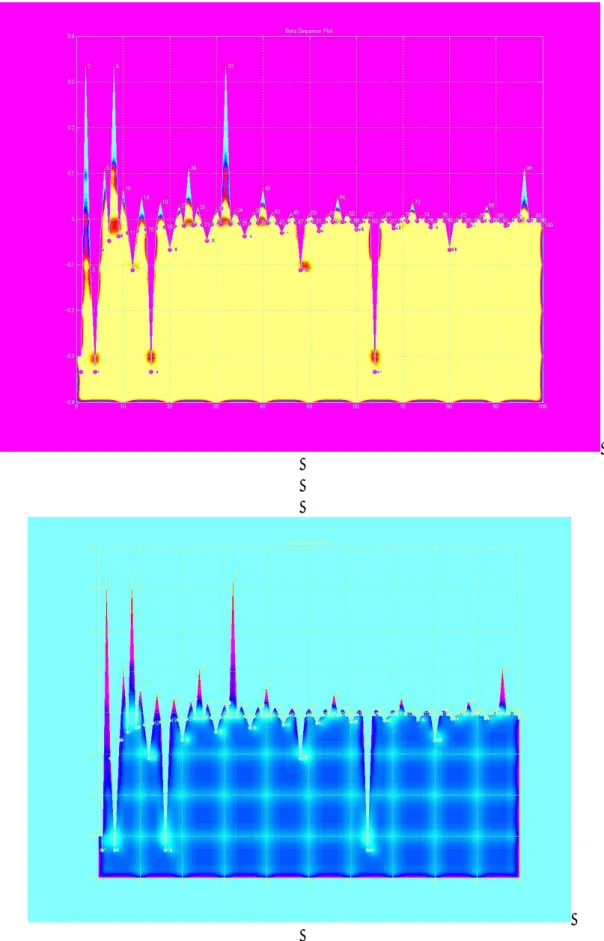
ref. 1) and references therein for details and for the definitions of the T and K functions.] In the appendix, we provide our code of Graphing Calculator (Graphing Calculator; Pacific Tech: http://www.pacifict.com/) for computing β
N(T) = E
N(T) − N. The resulting graph and one of its Matrix Art pictures are given in Fig. 1. Matrix art pictures of β
N(K) = E
N(K) − (1/3)N are given in Fig. 2.
− 63 −
Fig. 1. Sequence βN( )T calculated by using the above code of Graphing Calculator
Fig. 2. Matrix Art pictures of the sequenceβN( )T created by using MATLAB
− 64 −
Fig. 3. Matrix Art pictures of the sequenceβN( )K
− 65 −
Appendix (Graphing Calculator Code):
=====================
Change the subscript of the following DeltaZero for higher-dimensional computer experiments.
=====================
References
1) S. Arimoto, Proof of the Asymptotic Linearity Theorem Extension Conjecture (ALTEC), accepted for publication in: J. Math. Chem. (2015) (DOI) 10.1007/s10910-015-0549-8 ' Online First' on SpringerLink:
http://link.springer.com/article/10.1007/s10910-015-0549-8
2) S. Arimoto, M. Spivakovsky, E. Yoshida, K.F. Taylor, and P.G. Mezey, Proof of the Fukui conjecture via resolution of singularities and related methods. V, J. Math. Chem. 49 (2011) 1700.
3) S. Arimoto and K.F. Taylor, Practical Version of the Asymptotic Linearity Theorem with Applications to the Additivity Problems of Thermodynamic Quantities, J. Math. Chem. 13 (1993) 265-275.
4) S. Arimoto, New proof of the Fukui conjecture by the Functional Asymptotic Linearity Theorem, J. Math. Chem. 34 (2003) 259.
5) S. Arimoto, Repeat space theory applied to carbon nanotubes and related molecular networks. II, J. Math. Chem. 43 (2008) 658-678.
6) S. Arimoto and M. Spivakovsky, The Asymptotic Linearity Theorem for the study of additivity problems of the zero-point vibrational energy of hydrocarbons and the total pi-electron energy of alternant hydrocarbons, J.
Math. Chem. 13 (1993) 217.
7) S. Arimoto, The Second Generation Fukui Project and a New Application of the Asymptotic Linearity Theorem, Bulletin of Tsuyama National College of Technology, 52 (2010) 49-56.
8) 有本 茂、「福井予想と New Frontier Project」化学(化学同人)Vol.68 No.11, (2013) 24-27.
http://www.kagakudojin.co.jp/kagaku/web-kagaku03/c6811/c6811-arimoto/i ndex.html
9) 有本 茂「<数学と諸科学>福井予想とNew Frontier Project 学際 研究」数学、日本数学会(2015年出版確定)
− 66 −