Different Politeness Strategies: Japanese and the U.S. American students
Southern Illinois University Carbondale Department of Linguistics Masanobu Nakatsugawa 1. Introduction
One day, a teacher stands in front of forty students who are sitting silently, and asks their answers regarding his/her question. However, no one raises his/her hand and keep silent. Once the teacher calls on one student, the student starts to talk very quietly. That is the typical Japanese situation in school setting. In such a classroom setting, when a Japanese student is selected by the teacher to answer a question, the student gets nervous and hesitates in supplying the answer question. Thus, Japanese people often observe how others behave and imitate the behaviors accordingly. On the contrary, the people of the Western countries: Great Britain, U.S.A, Canada, Australia, New Zealand, and other European countries try what they have learned first, test and evaluate it, and decide for themselves whether or not the project is feasible. This situation is often called „„ „Trial and Error‟ versus „Watch, Then Do‟‟‟(Samovar, Porter, and McDaniel,2007:269). Mushakoji (1976), summarized this feature by stating that Japan has an awase (adjusting) culture and North America has an erabi (selecting) culture.
In addition to this, it is often said that Japanese people have a concept of collective culture, whereas English speaking countries are more prone to embrace individualism.
According to Anderson (2003), collectivistic cultures emphasize „„community… harmony, the public good, and maintaining face‟‟ (p.77). On the contrary, individualistic countries think that they belong to many groups because their personal goals take precedent over preserving and allying the group (Goleman,1990).
There are many theories related to the subject of intercultural communication as mentioned above, and we often agree with these theoretical characteristics and behaviors through our own experiences. However, there are often not enough empirical studies to support particular theories, and that this paper contributes to that gap in the research how these theories are credible through pragmatics. Also, this research implies that teaching styles should vary in the case of English as a global language.
2. Literature Review
2-1 Japanese culture vs. North American culture
There are many theories stated regarding intercultural communication and the Japanese characteristics are often appeared on the theories like mentioned above. For example, Japanese culture emphasizes the „„Silence is money‟‟ value. People talk a mile a
minute will be regarded as brutally frank. This attitude of talking will lose the trust of listeners. Hall called this High-context culture, which prefer to use high-context messages in which most of the meaning is either implied by the physical setting ore presumed to be part of the individual‟s internalized beliefs, values, norms, and social practices, very little is provided in the coded, explicit, transmitted part of the message (Hall, 1989).
He assumed Japanese culture is a high-context culture, which means nonverbal communication is acceptable. On the contrary, North Americans are low-context culture.
As you can see through the English proverb; „„the wheel that squeaks gets the oil.‟‟ In this culture, people tend to be assertive. (Hall, 1989)
2-2 Face Threatening Act
The term, “Face Threatening Act (FTA)” was coined by Brown and Levinson in 1978.
The „„Face‟‟ plays a key role in the formation of a good relationship, as it refers to the construct of the emotional and social sense of self (Yule, 1996:60). As described by Yule (1996), an FTA is „„if a speaker says something that represents a threat to another individual‟s expectations regarding self-image‟‟ (p.61). A set of five possible ways in which a FTA can be carried out are presented, ranging from not enacting a FTA at all, to enacting the FTA without any redressive action (Watts, 2003:87).
There are two distinctive types of politeness: positive and negative politeness.
Positive politeness is based on the notion that the addressee pays respect to others, whereas negative politeness is based on avoidance, ultimately there being no interference with the addressee‟s freedom of action. Negative politeness is defined as „„self-effacement, formality and restraint, with attention to very restricted aspects of other image ‟‟ (Brown &
Levinson, 1978: 70).
3. Method & Hypothesis 3.1 Method
I created questionnaires for both Japanese and U.S. Americans (see AppendixⅠ). I asked 35 Japanese college students and 35 U.S. American students to answer these questions. The questionnaires that I created had two sections: Question 1 and Question 2.
Each question had two sub questions, all being contextually based upon a classroom setting, and in essence highlighting the teacher-student relationship. The purpose of this was to examine the power-distance relationship between that of the teacher and the student from the viewpoint of different cultures. Junior-Senior interaction, for instance, is an example of a power-distance relationship. However, some of the juniors are older than the seniors, for example the age of entering university may vary and promoting in a
company may also vary. In this case, the relationship would be of a lower level
power-distance, varying accordingly with regard to other factors such as the age difference and period of time those involved have been acquainted. Conversely, with teacher-student interaction, the teacher has much more authority, and thus more power, than the students, this being a common theme throughout the world.
Question 1 asked the respondents to choose the strategy they would use in order to ask the teacher a question in a school setting. They could choose one of up to six possible responses. 1: Do not enact an FTA, 2: Imply, 3: Perform an FTA in a rude way, 4: Negative politeness, 5: Positive politeness and 6: Alternative. In Question 2, the respondents were asked what strategy they would employ in order to refuse an offer by a teacher. The choices were, 1: Do not enact an FTA, 2: Imply, 3: Perform an FTA in a rude way, 4: Negative politeness, 5: Negative politeness (through giving a substitute idea), 6: Positive politeness and 7: Alternative.
3.2. Hypothesis
My hypothesis for Question 1-1: If your teacher is explaining the wrong question, what they would say and 1-2: If your teacher is explaining the formula but you don‟t remember the formula, what would they response are 1: do not enact an FTA and 2: imply.
The majority of Japanese students would choose these responses because generally, they do not want to disturb the harmony of the group and hesitate in speaking out in the classroom. Therefore, these responses would be the most popular answers. However, as I perceived the U.S American students to be more individualistic and assertive with respect to their thoughts and actions, I presumed the most popular response to be that of negative politeness, response 5.
I hypothesized that Japanese students would on the whole choose response 5:
negative politeness (through giving a substitute idea) for Question 2: If your teacher ask you a favor, but you don‟t want to, how would you turn down his/her offer, I think that Japanese students feel strongly about protecting the harmony of the group, as well as not wanting to bother the teacher, thus leading me to hypothesize that they would give an alternative idea or option. Contrarily, the U.S. American students would choose response 6:
positive politeness, since they would be happy about any offers made by the teacher, especially where there would have been a personal positive recommendation and the offer was that of promotion to a higher power position. As I have stated above, they are assumed to assert their opinions.
I will now present the results of my research of each sub-question, and provide analysis of the questions in the next section. All results are shown by figures.
4. Result
ⅰThe results of Question1-1.
Question 1-1 asked the respondents how they would react if the teacher is explaining the wrong question. As Figure 1 shows, the majority of both the Japanese and the American students chose response 4: negative politeness. The Japanese students chose response 3: Perform the FTA in a rude way, as the second most popular reaction, whereas responses 1 and 5 were the second highest in popularity for the U.S. American students.
Interestingly, some of the U.S. American students chose responses 1 and 5, whereas none of the respondents from the Japanese students chose them (see Figure 1).
It clearly shows that both Japanese and the U.S. American students would choose negative politeness to maintain the relationship and respect the teacher. However, the Japanese respondents never choose the ways not to enact an FTA and positive politeness.
These results would imply that Japanese people take harmony as one of the important factors to maintain the relationship.
Figure 1. The results of Question1-1
ⅱThe results of the Question1-2
Similarly, Question1-2 asked about the way in which each student would ask the teacher to review class material. The results are the same as that of Question 1-1. The majority of both sets of respondents chose response 4: Negative politeness. Surprisingly, the second largest number of Japanese students chose response 3: Perform an FTA in a rude way. On the contrary, response 6: Alternative, such as „„I see… what is the formula again?‟‟, „„Sorry, but I didn‟t understand this formula,‟‟ and other responses were the second most popular answer for the American students. These alternatives are very similar to responses associated with negative politeness. No American students chose response 1:
Japanese Students 0%
23%
29%
48%
0%
0%
1 2 3 4 5 6
U.S.American Students
14%
0%
32% 14%
20% 20%
1 2 3 4 5 6
Pretend you know the formula, whereas 12% of the Japanese students would take this strategy, and 17% of them would imply what they wanted to say (see Figure-2)
As seen from these results of the Question1-1 and 1-2, it is obvious that negative politeness strategy is a common way to request; however, Japanese students being less direct in order to maintain the good relationship among the teacher.
Figure 2. The results of Question 1-2
ⅲThe results of Question2-1
In Question 2, I asked the respondents how they behaved when refusing offers from teachers. In the Questions, I put two negative politeness strategies in the choices: 4.
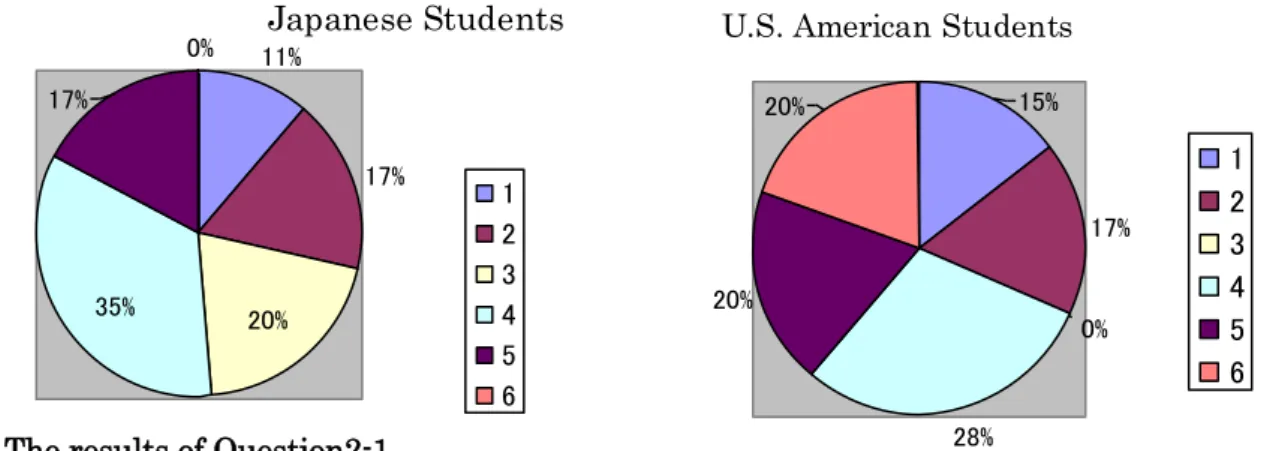
Negative politeness strategy giving a reason, and 5: negative politeness strategies through giving substitute ideas, such as „„ I‟ll find other student,‟‟ and „„ after the class, I would be happy…‟‟ The results of the refusing-related questions (Question 2-1, 2-2) are slightly different among the subjects. The majority of the Japanese students chose response 2:
Imply, to be the most popular, followed by response 5: Negative politeness, though giving a substitute idea.
In contrast, the American students chose response 4: negative politeness and response 6: Positive politeness, in approximately equal numbers, those two being the most popular answers. Also, response 5: Negative politeness, though giving a substitute idea, had the second largest vote among the 7 choices (see Figure 3).
The result shows that the Japanese people tend to use a nonverbal expression:
implication in order to avoid being direct. In addition, the choice of negative politeness strategy with substitute ideas shows that the Japanese people consider harmony in the group as an important factor. On the other hand, the U.S. Americans chose both negative and positive strategy in order to protect the teacher‟s face and it may vary in each respondent.
Japanese Students
11%
17%
0%
17%
35% 20%
1 2 3 4 5 6
U.S. American Students
17%
0%
28%
20%
20% 15%
1 2 3 4 5 6
Figure 3. The results of Question 2-1.
ⅳ. The results of Question 2-2.
A large number of Japanese students chose response 2: Imply, and around 30 percent of the Japanese students also preferred response 5: Negative politeness. This result for the Japanese students is the same as the result for Question2-1; the American students choosing responses 4 and 6 accordingly as was the trend in the previous question also.
Large numbers of the American students chose response 6, response 4 being the second highest in popularity regarding Question2-2. In addition to this, the number of students who chose response 5 was higher than for other choices. (see Figure 4)
The result is similar to that of the Question2-1. The Japanese respondents chose 2:
imply is the most proper answer to refuse the teacher‟s request, whereas the U.S.
American students chose both negative and positive politeness. The results showed that the U.S. American students are more assertive than the Japanese students.
Figure 4. The results of Question2-2.
5. Analysis
In this section the paper analyzes the results that were summarized in the previous section. The first part of this section shall explore whether or not the hypotheses that I
0%
30%
17%
6%
29%
9%
9%
1 2 3 4 5 6 7
12%
15%
12%
17%
15%
17%
12%
1 2 3 4 5 6 7
Japanese Students
11%
38%
26%
3% 0%
11%
11%
1 2 3 4 5 6 7
U.S. American Students
14% 0%
0%
29%
17%
23%
17%
1 2 3 4 5 6 7
originally made are correct, the latter portion investigating many intercultural postulated theories that I stated in Section 1.
i) Analysis of Question 1.
Question 1-1 and 1-2 ask students how they would request information from the teacher. The result of Question 1-1 shows that both sets of students chose response 4:
Negative politeness. It is unequivocal that they show their homage towards the teacher, and this behavior is immutable among all students. In addition, the result of Question1-2 is the same as that of Question 1-1. This proves that they tend to use the negative politeness strategy when they request something to the teacher. Interestingly, the Japanese students choose incongruous responses which are very abusive. However, it could be assumed that the relationship between the students and the teacher is close enough to warrant such informal responses and/or they did not recognize that these answers are not rude for the teacher. Some of the American students choose responses 1 and 5, in particular response number 5, whereas no Japanese students choose it at all.
According to the results regarding the responses with the second highest popularity rating, the U.S. Americans tend to choose positive politeness, whereas the Japanese students never choose the one. However, the response chosen by the majority of both the Japanese and the American students were the same: choosing negative politeness strategy.
Therefore, my hypothesis 1 was void.
ii) Analysis of Question 2.
Question2 asks students how they refuse requests from the teacher. According to the results of Question 2-1, Japanese students would imply otherwise in order to turn down the offer. Japanese characteristics, such as collectivism and high context culture could be seen to have had a large amount of influence on the results. Likewise, in Question2-2, around 30 percent of the Japanese students thought to imply the negative response. In addition to this, around 30 percent of the Japanese students chose response 5: Negative politeness, though proposing an alternative. Conversely, the American students chose response 4: Negative politeness, and response 6: Positive politeness. Thus, my hypothesis 2 was valid to a certain extent.
As I mentioned in my introduction, Japan has an awase (adjusting) culture and North America has an erabi (selecting) culture. The fact that some of the Japanese students chose responses 1 and 2 in Question1-1 and 1-2, shows that they adjust to the person who holds a higher level of power. For example, in Question1-2, even though the Japanese students hypothetically did not know the formula, some of them would pretend to understand the formula so as not to cause any disruptions in the classroom due to what
they perceive to be a fault of their own. On the contrary, the American students would ask the teacher if they did not know or remember said formula. The results might be ideologically affected: in other words, it is important to note that this is not necessarily what people do but what they say they would do.
The results of Question 2 show that Japanese students do not want to cause discord to the relationship and atmosphere between the students and the teacher. Thus, they regard harmony, the public good, and maintaining face as important. On the other hand, the American students chose positive politeness, which indicate that they desire personal advancement over the preservation and allying of the group, in consequence appreciating the evaluation of others. The teacher asking them to run for a position of higher authority due to the teacher‟s positive regard of the student‟s abilities highlights this.
6. Conclusion
Through the research undertaken for this paper, I have found that there are slight variances in the significance of the teacher-student relationship from the viewpoint of Japanese students and American students. In particular, the results corroborate the theory relating to the Japanese characteristics of collectiveness and high context culture.
Consequently, this can be perceived as one of key reasons behind the preferred Japanese student choice of „„implying‟‟ as their refusing-response. In addition to this, the American students are far more individualistic and live in a lower context culture. As can be seen from the English proverb „„the wheel that squeaks gets the oil‟‟, people tend to be more assertive in this culture (Hall, 1989). Thus, they are more likely to choose a negative or positive response. However, the results clearly show that the majority of both the Japanese and the American students preferred response 4 in answer to Question 1. Hence, we cannot categorically state there to be a set of fixed traits describing Japanese students and
American students independently.
It seems obvious that the characteristic way of communication may be influenced by the use of language to some extent, and said language use is susceptible to change with regard to the immediate environment of which people are encircled, the surrounding culture. However, the research was very limited in terms of the number surveyed, the region surveyed, and as the data was collected via questionnaire only, it cannot be deemed credible. The problem of stereotyping and misunderstanding amongst and between
Japanese people and those throughout the world may have also played an influential role in the outcomes I obtained. As a result, observing and dealing with the issues regarding the relationship between culture and language more carefully, may provide a stronger foundation for further future research into this field.
Reference
Andersen, P.A, Hecht, M.L., Hoobler, G.D., & Smallwood, M. (2003). Nonverbal Communication Across Cultures. In Cross-Cultural and Intercultural Communication.W.B. Gudykunst (ed.) California: Sage Publications.
Brown, P., & Levinson, S.C. (1978). Politeness Some universals in language usage. Cambridge: Cambridge University Press.
Goleman, D. (1990, December, 12). The Group and Self: New Focus on Cultural Rift.
New York Times,p.40.
Hall, E. T. (1989). Beyond Culture. New York: Anchor Books.
Mushakoji, K. (1976). „„ The Cultural Premise of Japanese Diplomacy,‟‟in The Silent Power: Japan‟s Identity and World Role. Tokyo: Simul Press, pp 39
Samovar, L.A., Porter, R.E., & McDaniel, E.R.(2007). Cultural Influences on Context: The Educational setting. In Communication between cultures. California: Thomson Higher Education.
Watts, J.R.(2003). Politeness. Cambridge: Cambridge University Press.
Yule, G.(1996). Pragmatics. Oxford: Oxford University Press.
AppendixⅠ Questionnaire for American Students Age:______
If you think these answer keys are too casual to your teacher, then please states so on „your answer.‟
Question-1
1. You(a)are taking a class in school.
2. Your teacher(b)is explaining.
a: Hey, Mr. Takai, what questions should we answer?
b: Please do the Question 1 and 2 on page 5.
a: Could you write them on the blackboard, please?
b: O.K. Now, I‟ll explain it.
[Your teacher is explaining the wrong question]
a: You:
① Work on the correct problem without saying anything
② look at the techer with a puzzled expression
③ Say, “Hey, you are explaining the wrong question.”
④ Say, “Excuse me, I am very sorry to disturb you but I think you are explaining the wrong question; could you check, please?”
⑤ “Excuse me, I would like to hear the explanation, but I would be happy if you could explain Questions 1 and 2 on page 5 first.”
⑥ Other answers: >
Answer:________________
Question-1.2; you are in the classroom and do not understand a problem you are working on.
a. Hi, Mr. Takai, I don‟t understand this part.
b. Did you listen to my explanation in the last class?
a. I‟m very sorry… I didn‟t understand it…
b. See, for this part, you have to use the formula that you learned in the last class…
and… [You can‟t remember the formula]
a. You:
① Pretend you know the formula, and say „„yes‟‟
② Look at the teacher with a puzzled expression
③ Say, “Hey, what is the formula??”
④ Say “I‟m very sorry to disturb you, but what is the formula again?”
⑤ Say, “Excuse me, I‟d be thankful if you could explain the formula again.”
⑥ Other answers < >
Your answer:_ __________
Question2-1.
(Turn down teachers’ offer)
After school in the classroom with your teacher b: Hey, are you in any student committee?
a: No, actually. Why?
b: There is no prospective candidate for the role of president for the student government. Can you run for the position?
a: You:
① O.K.
② Look at the teacher with a puzzled expression, and say “I‟m very busy because of club activities…”
③ “No.”
④ “I‟m very sorry but I can‟t accept your suggestion. My schedule is a bit tight…”
⑤ “I‟m very sorry but I can‟t… I‟ll find other student though.”
⑥ “I really appreciate your recommendation, but I already belong to a club, so I can‟t.”
⑦ Other answers < >
Your answer_____________________________
Question 2-2.
In faculty office, with your teacher:
b. Hey, come here.
a. Is there a problem? Classes will start soon…
b. Could you give these handouts to your classmates?
a. Your:
① O.K. I‟ll do it.
② Look at the teacher with a puzzled expression, and say “I have a class now…”
③ “I can‟t right now.‟‟
④ “I‟m very sorry, I can‟t, cuz‟ I have a class.”
⑤ “I am very sorry, I have a class now… but after the class, I would be happy to help you if you want.”
⑥ “I‟d be happy to help you, but my class starts soon. I‟m very sorry.”
⑦ Other answers < >
Your answer:_________________