§54. Thermoelectric Conversion in Magnetic Field
Yamaguchi, S.
The thermoelectric conversion is studied for a long time, and recently it is applied to the nuclear battery in the space(
I)because the structure is simple and it does not have mechanical parts like the turbine generator in the electric power plant on the earth. However, since the heat efficiency of the thermoelectric system is less than 10 %, it is not familiar in the commercial use. Here, we applied this technique to the fusion reactor. Since the first wall and the divertor plate surface is heated, the reverse side should be cooled to
remove the heat flux. This situation leads the large temperature difference between two surface, and it is good for the thermoelectric conversion. The schematic structure of thermoelectric element is shown in Fig. 1.
Heat Flux
Fig. 1 Schematic structure of thermoelectric element
Moreover, the high temperature plasma is confined by the strong magnetic field, so we should consider the magnetic effect on the thermoelectric process. There are two types of magnetic effects, one is related to the
thermoelectric power, and other is called Nemst effect. The thermoelectric power may depend on the magnetic field and the figure of merit is improved(2). The electric field is induced when the temperature gradient and magnetic field are not parallel. The electric field direction is
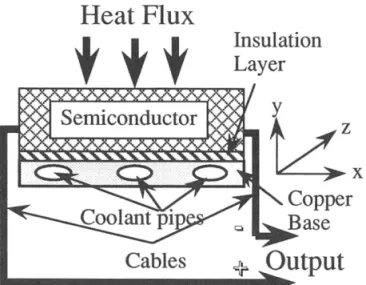
perpendicular to the direction of both of magnetic field and temperature gradient. This effect is called Nemst effect. The schematic structure of Nemst element is shown in Fig. 2.
60
Heat Flux
Cables
Insulation Layer
~ Output
Fig. 2 Schematic structure of Nemst element.
The generalized Ohm's law, heat flux density equation, the figure of merit for the thermoelectric element Zt(T) and Nemst element Zn(T), and their ratio are give
E = 11 J + S gradT + R HxJ + N HxgradT (1) q = STJ -KgardT + NTHxJ + LHxgradT (2) where J is current density, T temperature,
H magentic field, N Nemst coefficient,
11 electrical resistivity, S thermoelectric power, L Rigihi-Leduc coefficient,
Kthemal conductivity Z
1(T) = - sz
K1l ZN<T) = (N H)
K1l
2