Abstract
Works of literature as teaching materials have strengths and weaknesses. The vocabulary and grammar in them are often so difficult that the teachers spend too much time explaining them and classes tend to become teacher-centered. On the other hand, many researchers clarify that literature has valuable authenticity that cannot be seen in EFL textbooks, which greatly contributes to language development. The author of this paper considered the advantages and disadvantages of literature as educational materials and held a one-year English seminar using The Uncommon Reader, a modern British novel by Alan Bennett, as the main textbook. Intensive reading and translation activities were limited in the seminar. Instead, a new teaching approach was introduced and various kinds of tasks such as dictation, pronunciation practice and vocabulary quizzes helped the students to deepen their understanding of the passages they had just studied. In the last session of the seminar, I surveyed their attitude towards works of literature and my seminar management. The results confirmed that 1) literature is a potential teaching material that can promote students’
language discovery and broaden their understanding about different cultures and 2) tasks that students have to deal with by themselves promote learner autonomy.
1. Introduction
Recently the opportunity to use literature in Japanese university language classrooms has been lost. About 20 years ago, the main goals of English classes in Japanese universities were solely to improve students’ reading skills. As Yoshimura (2007) points out, however, people began having to communicate with English speakers more often and output skills like speaking and writing became more necessary. As a result, the aim of university EFL classes shifted to the development of communicative proficiency. Furthermore, preparation for various kinds of English tests of proficiency like TOEIC and TOEFL became the mainstream of language classrooms in Japan. Okumura (2009) thinks students’ needs and social demands were the cause of the transition from traditional classes based on reading activities and the Grammar Translation Method to those based on communication. Okumura supports this change and I also agree with it. However, at the same time, it is regrettable that works of literature are attracting less attention in EFL classrooms at the university level in Japan,
Junko Sugimura
Promoting L2 Learner Autonomy in the EFL
classroom using a Modern British Novel
especially since there are two great advantages in using the works, as many researchers have pointed out.
First, excellent works of literature enable students to continue language learning with passion. Collie and Slater (1990) enumerate four reasons why literature should be used in EFL classrooms. They think that literature is “valuable authentic material” and has the ability to give “cultural enrichment” and “language enrichment”. In addition to these three points, they conclude that literature can also cause “personal development” and can motivate students to learn independently. Widdowson (1977) also says that literature brings great advantages to language learning because of how freely students can interpret the literary texts. Divsar and Tahriri (2000) focus on stages of learner experience when works of literature are used in EFL classrooms. They state that a learner can follow three meaningful phases when literature is introduced as a teaching material; “the preliminary phase” where students learn new vocabulary and grammar to understand the content, “the content-cultural phase” where they deepen their understanding about the background or culture of the literary work, and
“the synthesis phase” where students can freely exchange views about the work through discussion. Due to these stratified stages of understanding that literature can provide, Divsar and Tahriri regard a literary text as “a potentially powerful tool”.
Secondly, many researchers appreciate the authenticity of literature. Langer (1997)
criticizes that unnatural passages in EFL textbooks deprive students of their interest and denounces the tedious passages that often cause students’ unwillingness to read further.
Dörney (2005) also supports the idea that works of literature boast great authenticity and can create “an overall positive motivation climate in the classroom”.
To confirm my belief that works of literature, like novels, poetry and plays, have high potential for EFL learners’ great achievement, I offered Japanese university students a yearlong English seminar using a modern British novel. In this seminar, I did not rely on the Grammar Translation Method, a conventional method that teachers in the past were likely to use when they selected works of literature as teaching materials. I used a modern British novel but adopted new classroom management in order to encourage student motivation and cultivate their autonomy. In this research paper, I would like to investigate how students feel about the English seminar with my new approach using a modern British novel as the main textbook. After that, I would like to consider how learner autonomy expanded and the potential power of literature as a teaching material in the EFL classroom at Japanese universities.
2. Method
2.1 Participants
The subjects of this study were third and forth-year students who enrolled in Advanced English Seminar in Language and Culture. After the course registration deadline, the total number of students who registered for the seminar was 43. Among them, 3 students received incomplete marks due to their excessive absences or not attending two required regular
examinations outlined in the seminar syllabus. At the end of the seminar, I assessed 40 students: 3 were fourth-year students and 37 were third-year students. 2 of the 40 students belonged to the Faculty of Letters, 9 were economics majors, and 32 were pursuing social studies.
2.2 Course Goals
The Advanced English Seminar in Language and Culture had two defined academic aims.
The first aim was to improve reading ability, which was masterfully constructed in the first and second-year English program. The second aim was to deepen the students’ understanding and perspectives about cultures and traditions different from their own. This seminar had five specific modules, which students were able to choose from: Linguistics, American Studies, British Studies, Representation and Culture, Symbol and Society. The seminar discussed in this paper followed the British Studies module, which focuses on improving reading abilities and broadening knowledge about British culture and society.
2.3 Teaching Material
I selected Alan Bennett’s The Uncommon Reader (2007) as a teaching material for this seminar for three reasons.
2.3.1 Audio CD by the Author
First, Alan Bennett’s The Uncommon Reader was complemented with an audio CD of the book, which was fortunately a reciting by the author himself. This was useful for the students’
language discovery. Since students were encouraged every week to take detailed dictation of the passages, which they had read closely prior to the listening exercise, the audio CD was indispensable. This audio CD, which I was able to purchase from BBC, brought an unexpected and pleasant side to the learning process.
In Malcolm Andrews’ book, Charles Dickens and His Performing Selves: Dickens and the Public Readings, Andrew (2008) delightfully describes Dickens’ career as a reciter and clarifies his elaborate preparations and passion for reading his elegant works to a public audience. The famous reading of Charles Dickens’ Victorian Era can also be seen today in modern times. American and British writers remain fond of giving public readings of their own work or work by other writers, past and present. For example, the modern American novelist, Paul Auster is a writer who loves to read aloud to a public audience. He had a radio program called the National Story Project, on which he read diverse personal experiences sent in by his listeners. This inspired him to publish the book, I thought My Father Was God:
And Other True Tales from NPR’s National Story Project. Alan Bennett’s voice was low and hoarse, unlike a voice actor, but his reading had warmth and depth. His CD helped the students experience the great British and North American tradition of listening to authors reading aloud.
2.3.2 Novel Plot
Secondly, the light plot of The Uncommon Reader enabled students to appreciate the novel.
Furthermore, even if students could not read through the novel, they could still fully enjoy the content. David Lodge (1994) discusses the art of fiction as “suspense”, citing the famous scene of Henry Knight’s critical moment from Thomas Hardy’s novel, A Pair of Blue Eyes.
At first, when death appeared improbable because it had never visited him before, Knight could think of no future, nor of anything connected with his past. He could only look sternly at Nature’s treacherous attempt to put an end to him, and strive to thwart her.
From the fact that the cliff formed the inner face of the segment of a hollow cylinder, having the sky for a top and the sea for a bottom, which enclosed the bay to the extent of nearly a semicircle, he could see the vertical face curving round on each side of him.
He looked far down the façade, and realized more thoroughly how it threatened him.
Grimness was in every feature, and to its very bowels the inimical shape was desolation.
By one of those familiar conjunctions of things wherewith the inanimate world baits the mind of man when he pauses in moments of suspense, opposite Knight’s eyes was an imbedded fossil, standing forth in low relief from the rock. It was a creature with eyes.
The eyes, dead and turned to stone, were even now regarding him. It was one of the early crustaceans called Trilobite. Separated by millions of years in their lives, Knight and this underling seemed to have met in their place of death. It was the single instance within reach of his vision of anything that had ever been alive and had had a body to save, as he himself had now.
(A Pair of Blue Eyes, p. 199-p. 200)
The thrilling and overly descriptive scene in which Henry Knight was hanging from a hill lasts for a couple of pages. Even after Henry Knight is saved, his dramatic romance with the heroine of the novel, Elfride Swancourt is also depicted in great detail. Such exciting plots and tactful development attract EFL learners and encourage them to read further. However, when these kinds of thick plotted novels are too long for students to possibly finish within a semester, it is essential for teachers to make more appropriate novel choices. A poor novel choice could lead to frustration among students, when they are unable to finish reading a whole body of literary work in which its plot twists and turns excitedly. Compared to exciting and compelling novels like A Pair of Blue Eyes, The Uncommon Reader does not contain any frantic scenes, violence, or overly complicated love romance. It is unlike other novels where readers can notice their value only when they read through them. Most of the novel is conversation between the Queen, her persons in waiting and equerries. Its plot gradually unfolds in a very well paced and natural way. Students can enjoy the Queen’s wit, an equerry’s jokes and other details of the novel at the turn of every page without any problem, even if they are not able to read it to the end.
2.3.3. Translation Version
The third reason for choosing The Uncommon Reader was the availability of the translated version. Some teachers try to find English texts that do not come with a Japanese version.
However, Japanese translations can be used effectively during a reading class to deepen a student’s understanding. In my seminar, because it was quite impossible for students to read through the novel, I decided to make the best use of the Japanese translation. I allowed students to read it in order to know the flow of the novel. At the same time, however, when preparing for a seminar, I instructed them to translate the assigned passages on their own and strongly discouraged the use of the Japanese version.
2.4 Class Procedure
Unlike a reading class based on the traditional Grammar Translation method, I introduced a new approach. Within the allotted 90-minutes period, 5 minutes at the beginning and end were used to take roll call and explain each week’s assignments. The remaining 80 minutes was divided into two parts. The first part was allotted for intensive reading of paragraphs.
I asked four or five students to translate a passage and followed up by explaining new vocabulary and incomprehensible grammar. In the second 40-minute part, I offered students various kinds of tasks, including pronunciation practice, oral reading, vocabulary quizzes, and dictation. In the pronunciation practice or oral reading task, I utilized a passage that had just been explained in the class and demonstrated the correct pronunciation of new words or encouraged students to read them aloud. In the same way, I made vocabulary quizzes based on the previously covered passages and instructed students to carefully dictate the passages.
3. Results
3.1 Questionnaire on Class Content and Teaching Method
The students were given a questionnaire on how they felt about the seminar into which a new approach was introduced. The questionnaire consisted of two parts. In the first part, I asked ten questions, five of which were related to general reading comprehension.
The remaining five questions discussed the contents of this seminar, which targeted the improvement of reading ability.
Only the first question was related to the students’ favorite types of literature, with 5 choices: novels, English newspapers, critiques, mysteries, and poetry. The rest of the questionnaire allowed students to choose their appropriate answer based on a 5-point Likert Scale, ranging from “I strongly agree (5)” to “I strongly disagree (1)”. Of these ten questions, I thought that Question 9 (“I was interested in the contents of The Uncommon Reader”)
and Question 10 (“I think it was effective for the seminar to be divided into two parts and for me to read the text closely in the first part and to carry out various kinds of tasks in the second part”), were most important. Therefore, in the second part of the questionnaire, I asked students to write in Japanese, their explanation for choosing their specific Likert Scale designation in questions 9 and 10.
The students were given the questionnaire on the second to last day of the seminar, because an 80-minute final test was scheduled for the last day. 38 students responded to the questionnaire.
3.2 Results of the First Part
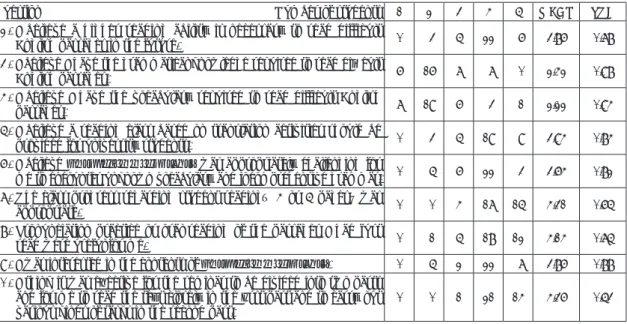
To the first question: “What is your favorite type of literature (novels, English newspapers, critiques, mysteries, or poetry)?” 21 students chose novels, 16 chose English newspapers, 3 liked critiques, 4 liked mysteries, and 5 preferred poetry. Four students chose more than one type of literature as their favorite, which explains why the total number of answers, 43, varies from the total number of respondents. Descriptive statistics of the remaining nine questions are shown in the following table.
3.3 Results of the Second Part
Because I thought that question 9 and question 10 were crucial, I asked the students to write the reason for their answers to, “Why did you think or not think The Uncommon Reader was interesting?” and “Why did you appreciate or not appreciate the seminar management?” in Japanese. The length of individual feedback on these two questions varied from three to four sentences to only one sentence, but all students wrote their thoughts. Due to space limitations, I cannot share all of the feedback here, but I would like to discuss the most common features.
Table 1 : Students’ thoughts about reading comprehension and their seminar evaluations.
1: I strongly disagree 2: I disagree 3: Neither agree nor disagree 4: I agree 5: I strongly agree
Question Number of students 1 2 3 4 5 MEAN STD
2. I believe a higher reading ability is necessary to read difficult
English passages in the future. 0 3 5 22 6 3.86 0.78
3. I believe I have the grammatical knowledge required to read difficult
English passages. 6 16 7 7 0 2.42 0.98
4. I believe I have the vocabulary required to read difficult English
passages. 7 19 6 3 1 2.22 0.94
5. I believe a reading class based on translation activities should be
provided for university students. 0 3 5 19 9 3.94 0.84
6. I believe The Uncommon Reader was appropriately challenging for
me to encounter unknown vocabulary and incomprehensive grammar. 0 5 6 22 3 3.64 0.82 7. The class progress regarding student reading ( 4 or 5 pages) was
appropriate. 0 0 4 17 15 4.31 0.65
8. Pronunciation practice or oral reading of the passages I had just
read were useful for me. 0 1 5 18 12 4.14 0.75
9. I was interested in the contents of The Uncommon Reader. 0 5 2 22 7 3.86 0.88 10. I think it was effective for the seminar to be divided into two parts
and for me to read the text closely in the first part and to carry out
various kinds of tasks in the second part. 0 0 1 21 14 4.36 0.53
3.3.1 Students’ written feedback regarding their answer to Question 9 (“I was interested in the contents of The Uncommon Reader”):
As shown in Table 1, many students felt that The Uncommon Reader was interesting. As a result, the majority of the written feedback was positive and 32 students described various types of appealing points within the novel. Here are some examples (translated to English by the author of this paper):
Student A: “I enjoyed reading the novel. I was able to get much knowledge about the British Royal family and British culture.”
Student B: “Reading the novel was totally fun, because I became familiar with class society in the UK.”
Student C: “I was mesmerized by British wit and jokes in The Uncommon Reader.”
Student D: “The conversation between the Queen and Sir Kevin was so funny that I became eager to read the novel further.”
Regardless of the vast majority of positive feedback, four students were relatively negative:
Student E: “The story has nothing to do with my daily life and was monotonous.”
Student F: “I never read novels, even in Japanese. If this novel were a detective one, I would want to know the rest of the story.”
Student G: “A lot of conversations in this novel are boring.”
Student H: “Regardless of sex, students would be much more interested in a love story than The Uncommon Reader.”
3.3.2 Students written feedback regarding their answer to Question 10 (“I think it was effective for the seminar to be divided into two parts and for me to read the text closely in the first part and to carry out various kinds of tasks in the second part”):
Surprisingly, 97% students appreciated the classroom management. In the seminar, the time wasn’t solely used for intensive reading. After students read selected paragraphs from The Uncommon Reader and listened to the teacher’s explanation about new vocabulary and incomprehensible grammar concepts, they were given various kinds of tasks based on the passages which they had just studied. Almost all students showed sympathetic responses to this learning procedure. Their written feedback went like this (translated to English the same way as above):
Student I: “All of the other classes I took in this university focused on intensive reading, which I found a bit boring. On the contrary, I was able to maintain my concentration through various kinds of tasks such as pronunciation exercise or reading aloud.”
Student J: “Dictation and vocabulary quizzes were useful in reviewing the passages I had just read.”
Student K: “I was able to easily master the meaning, spelling and correct pronunciation of new words by the tasks that were given in the latter part of the seminar.”
Student L: “Oral reading and dictation tasks enabled me to understand deeply the paragraphs I had just read.”
Student M: “I think not only intensive reading but also pronunciation practice and dictation are necessary to improve students’ overall English ability.”
4. Discussion
Concerning Question 1 (What is your favorite type of literature?), only 3 students chose the fifth choice, “poetry.” Although Hadaway (2001) points out that poetry is the best teaching material in EFL classrooms because of its repetition and rhymes, it seems that Japanese students are unfamiliar with poetry and indifferent to this genre. On the other hand, 21 out of 36 students made the first choice, “novels” as their favorite type of literature. This result shows that students tend to be fond of novels. Northeast (2006) researches reading habits of Japanese university students and clarifies that they love novels, next to manga and magazines. Northeast’s study is not the only one that shows positive results in this area. The result of my study also shows that English fiction has potential power to encourage Japanese students to read avidly.
Regarding Question 2 (I believe a higher reading ability is necessary to read difficult English passages in the future), 77% students admitted that an excellent English reading ability was required in order to understand difficult English writings smoothly. All of the respondents are third-year or forth-year university students. They are always required to read challenging English texts in classes related to their majors such as social sciences and economics. My estimations have found that students noticed how important a higher reading ability is through their everyday studies.
Next, I would like to discuss the results of Question 3 (I believe I have the grammatical knowledge required to read difficult English passages) and Question 4 (I believe I have the vocabulary required to read difficult English passages). The result for Question 4 shows that 27 out of 36 students thought that they did not possess enough vocabulary. On the other hand, students have little confidence in their knowledge about grammar. The results for Question 2 and Question 3 made it clear that students felt it hard to deal with difficult English words. Nation (2006) says that 98% coverage of text vocabulary is needed for unassisted comprehension. As such, a wide vocabulary is essential to improve a reading ability.
Therefore, teachers should introduce tasks in reading classes to widen students’ vocabulary.
Concerning Question 5 (I believe a reading class based on translation activities should be provided for university students), 25 of the 36 students expressed the necessity for such a reading class. From my perspective, the respondents belong to a relatively prestigious private university in Japan and they have already mastered basic English communication skills. As a result, I think they are eager to take higher-level classes in which students can study English culture and literature. As I mentioned earlier, I support the current shift in Japanese EFL
classrooms for more communicative ones. However, at the same time, classes that satisfy intellectual curiosity are required for students with high English ability.
Questions from 6 to 10 are about the contents about the seminar. Regarding Question 6 (I believe The Uncommon Reader was appropriately challenging for me to encounter unknown vocabulary and incomprehensive grammar), 69% of the students thought that The Uncommon Reader has appropriate difficulties for intensive reading. In fact, the novel contains important grammatical forms, which students at the intermediate or advanced level have to learn. For example, various kinds of participle construction are used in the novel.
Shutting up the van and driving away, Mr Hutchings reflected that a novel by Ivy Compton-Burnett would take some reading.
(The Uncommon Reader, p. 9)
Unbriefed on the subject of the glabrous playwright and novelist, the president looked wildly about for his minister of culture.
(The Uncommon Reader, p. 4)
She’d got quite good at reading and waving, the trick being to keep the book below the level of the window and to keep focused on it and not on the crowds.
(The Uncommon Reader, p. 32)
The first example is the most basic participle construction. The second example contains the passive voice, but omits the present particle “being” is omitted. The third is an absolute participle construction in which the subject differs from that of the main clause.
Many students feel that absolute participle construction is too difficult to comprehend. The Uncommon Reader, with its various kinds of participle constructions, became the best source for advanced grammar. Furthermore, the novel contains a lot of British English expressions such as “one” and “fortnight”. For example:
‘Oh, to the end. Once I start a book I finish it. That was the way one was brought up. Books, bread and butter, mashed potato—one finishes what’s on one’s plate. That’s always been my philosophy.’
(The Uncommon Reader, p. 11)
They were discussing a royal visit to Wales due to take place in a fortnight’s time. In the middle of being taken through her programme (a ride on a super-tram, a ukulele concert and a tour round a cheese factory), Her Majesty suddenly got up and went to the door.
(The Uncommon Reader, p. 36)
By selecting the modern British novel, I was able to show students the diversity of English expressions.
Concerning Question 7 (The class progress regarding student reading (4 or 5 pages) was appropriate), 88% students were satisfied with the seminar’s pace and advancement. On the first day of the first semester, I explained it would extremely difficult to read through the novel and I permitted students to use the translated Japanese version, allowing them to understand the flow of the novel. In utilizing the Japanese version, students were able to fully comprehend the whole story and enjoy the details of each page at a relatively slow pace, even if they did not read through the story in its entirety. Perhaps this is what accounted for their positive responses.
Regarding Question 8 (Pronunciation practice or oral reading of the passages I had just read were useful for me), 83% of the students enjoyed these kinds of vocal tasks. Takashi Saito’s best selling book selected masterpieces of Japanese literature like The Pillow Book and advocates oral reading of them to further appreciate. By introducing his approach in this seminar, students were able to not only fully appreciate the literary style, but also improve their speaking ability and learn the correct pronunciation of new words. Judging from the 83% positive reaction, I felt strongly about the importance of oral reading, using the passages students had just read.
Next, I would like to analyze the result of Question 9 (I was interested in the contents of The Uncommon Reader). 89% of the students expressed positive reactions in the questionnaire. Moreover, in their written feedback about the question, many agreed that the novel was the best resource for providing detailed knowledge of British culture and the British Royal Family. As Lazar (1993) claims, literature provides students with vivid cultural background information, unlike “the pseudo-narratives frequently found in a course book”.
Students were able to step outside their daily lives to experience and understand a new and exciting culture by reading The Uncommon Reader.
Finally, I would like to consider the results of Question 10 (I think it was effective for the seminar to be divided into two parts and for me to read the text closely in the first part and to carry out various kinds of tasks in the second part). What is most remarkable is that no students answered this question negatively. In the seminar, the first 40 minutes was allotted for intensive reading and the remaining time was for various kinds of tasks based on passages, which students had just studied. Almost all students regarded the management as very effective. The students’ written feedback, suggests three main reasons why they thought highly of the seminar management. Firstly, students admitted that various kinds of tasks like vocabulary quizzes deepened their understanding about the passages. Secondly, they thought that the two-part seminar management with a variety of tasks enabled them to learn independently, in comparison to 90 minutes classes filled with intensive reading and explanation by teachers. Since Benson (2001) defines EFL learner’s autonomy as “the capacity to control one’s own learning”, a lot of researchers like Dörney (2001) theorize that “learner autonomy” has become a crucial factor for successful language learning. They say student- centered classroom atmospheres, not teacher-centered ones, have great potential. Tasks were
assigned during the seminar, which required students to wrestle with themselves without help. These minor, yet demanding tasks, helped to cultivate student autonomy. Finally, many students thought that the seminar management made them concentrate on learning, because they dealt with different activities in the first half and latter half. Surprisingly, among the 36 students, 12 made high evaluations on this seminar for the same reason. They noted that these different activities encouraged them to concentrate with more depth than before. That almost 100% of the responses was affirmative is an absolute antithesis to the traditional teacher-centered language classroom based on the Grammar Translation Method.
5. Conclusion
In the seminar, whose main teaching resource was a modern British novel, I found several new discoveries and pedagogical ideas for the future. Judging from a linguistic point of view, I can conclude that literature is one of the best teaching resources. I noticed several kinds of important grammatical forms in the novel, which an intermediate or advanced learner must study. After the students carefully listened to the instructor’s detailed explanations they were able to deepen their knowledge about the grammar they had previously been unable to comprehend. Next, literature can provide students with diverse linguistic expressions. In particular, the main book used in this seminar was written by a modern British author. This allowed students to become accustomed to British expressions. Unfortunately, American English prevails in junior high school and high school classrooms in Japan, but English tests of proficiency such as TOEIC include British English. In these circumstances, it is tremendously beneficial for students to study British novels, which include many characteristics of British English and aspects of British culture.
At the same time, I fully realize that teachers had to figure out some way to raise efficiency in learning when they used works of literature in their classrooms. If teachers gave lessons based on the traditional Grammar Translation Method with all of the class time allotted only to intensive reading, students could not get much educational benefit. In some cases, the class could become teacher-centered and cause students to become passive towards learning.
Needless to say, when an incomprehensible grammatical form is introduced into a classroom for the first time, the teacher must take the initiative and explain it in detail to provide students with insight. However, it is clear that using only this teacher-centered approach has severe limitations. As I have shown, students were able to become autonomous and independent learners by being given tasks based on the passages they had just studied.
In the seminar, however, it is regrettable that I was unable to introduce extensive reading activities, although one of the seminar goals was the improvement of students’ reading ability.
As Krashen (1993) and Day and Bamford (1997) point out, extensive reading is indispensable in improving student reading ability. In the future, I would like to try another approach perhaps by combining an intensive reading activity using the original version of classic literature with extensive reading using a retold version.
*An earlier version of this paper was presented at the February meeting of the Study Group for Literature in Language Education, an SIG of the Japan Association of College English Teachers (JACET) Kansai Chapter, Doshisha University, 21 February 2015.
Works Cited
Andrews, M. (2006). Charles Dickens and His Performing Selves: Dickens and the Public Readings. Oxford: Oxford UP.
Auster, Paul (2002). I Thought My Father Was God: And Other True Tales from NPR’s National Story Project.
London: Picador.
Bennett, Alan (2007). The Uncommon Reader. London: Faber and Faber.
Benson, P. (2001) Teaching and Researching Autonomy in Language Learning. London: Longman.
Collie, J. & Slater, S. (1987). Literature in the Language Classroom: A Resource Book of Ideas and Activities.
Cambridge: Cambridge UP.
Day, R. & Bamford, J. (1998). Extensive Reading in the Second Language Classroom. Cambridge: Cambridge UP.
Divsar, H & Tahriri, A. (2009). Investigating the Effectiveness of an Integrated Approach to Teaching Literature in an EFL Context. Pan-Pacific Association of Applied Linguistics 13 (2), 105-116.
Dörney, Z. (1998). Ten Commandments for Motivating Language Learners: Results of an Empirical Study. Language Teaching Research 2 (3), 203-229.
Dörney, Z. (2005). The Psychology of the Language Learner: Individual Differences in Second Language Acquisition.
London: Routledge.
Hadaway, N. L., Vardel, S. M., and Young, T. A. (2001). Scaffolding Oral Language Development through Poetry for Students Learning English. The Reading Teacher, 54, 8, 796-806.
Hardy, Thomas (1873). A Pair of Blue Eyes. Oxford: Oxford UP.
Krashen, S. (2004). The Power of Reading—Insights from the Research. Englewood: Libraries Unlimited Inc.
Langer, J. A. (1997). Literacy acquisition through literature. Journal of Adolescent and Adult Literacy, 40, 8, 606-614.
Lazar, G. (1993). Literature and Language Teaching: A Guide for Teachers and Trainers. Cambridge: Cambridge UP.
Lodge, D. (1992). The Art of Fiction. London: Secker & Warburg.
Nation, I. S. P. (2006). How Large a Vocabulary is Needed for Reading and Listening? The Canadian Modern Language Review, 63 (1), 59-82.
Northeast, H. A Survey and Analysis of the Reading Habits of Post-Secondary Students in Japan. The Bulletin of Musashino Gakuin University and Musashino Junior College, 3, 97-108.
Okumura, M. (2009). Cultivating Students’ Imagination: A Practice Report upon Creative Reading of a Simplified Victorian Novel. Journal of Literature in Language Education, 2, 43-52.
Widdowson, H. G. (1977) Stylistics and the Teaching of Literature. London: Longman.
Yoshimura, T. (2007). Literature’s Role in the English Education: A Practical Report on the Use of Short Stories to Improve Reading and Writing. Journal of Literature in Language Education, 1, 62-70.
(2015 年 7 月17日掲載決定)