Case Report
Pos i t i ve Behavi oral Support t o a Pat i ent wi t h Traumat i c Brai n I nj ury and Hi s Fami l y f rom t he Acut e St age
Go URUMA,Keiji HASHIMOTO,Masako KOHNO,Nobuyoshi KAITO,Keisuke TAYA, Masahiro ABO,and Satoshi MIYANO
Department of Rehabilitation Medicine, The Jikei University School of Medicine Department of Neurosurgery, The Jikei University School of Medicine
ABSTRACT
The impairments caused by t raumatic brain injury (TBI)are sometimes too difficult to understand for patients and their families. Es pecially in the acute stage,there is often much discrepancy in the awareness of the impairment s among patients,their families and medical and rehabilitation staff. Such misunderstanding obst ructs introduction of chronic‑stage rehabilitation.
Positive behavioral support(PBS)provided to TBI patients and their families could improve their quality of life in the chronic stage. However,ther e has been no report concerning acute‑stage PBS (APBS). The patient was a 22‑year old male with acute‑stage TBI who was admitted with coma.
After recovery from coma,he had significant cognitive problems that included,for example, neurofatigue,disinhibition and attention disturbance. At first,there was much discrepancy in the understanding of his impairments among the pat ient,his family and staff. We provided both patient and family APBS from the beginning of the rehabilitation process. After APBS by our rehabilitation team,the discrepancy in understandi ng among the patient,family and staff was reduced. This case suggests that APBS could hel p patients achieve self‑awareness and gain trust from family,which could then allow for the appr opriate introduction of chronic‑stage rehabilita- tion. (Jikeikai Med J 2006;53:141‑5) Key words:traumatic brain injury,acute brain injury,rehabilitation,milieu therapy,psychosocial
education
INTRODUCTION
The problems related to physical and cognitive function caused by traumat ic brain injury(TBI)are sometimes too difficult to under stand for patients and their families . In the acut e stage,patients and families are usually very conf used by the sudden tragic accident. This caus es inappropriate support for TBI patients from their families and medical staff,
with the result that positive behavioral support(PBS) is needed . With these facts in mind,we provided acute‑stage positive behavi oral support(APBS)to a
TBI patient and his family,focusing on how to under- stand and cope with his neuropsychological dysfunc- tion.
CASE
A 22‑year‑old man was admitted to this hospital because of coma immediat ely after a boxing match.
The patient had been well till he was injured.
The neurological examination showed that his brain injury was severe:5 points on the Glasgow Coma Scale(GCS) and l evel II on the Rancho Los
Received for publication,April 28,2006
粳間 剛,橋本 圭司,巷野 昌子,海渡 信義,田屋 圭介,安保 雅博,宮野 佐年
Mailing address:Keiji HASHIMOTO,Department of Rehabilitation Medicine,The Jikei University School of Medicine,3‑25‑8,Nishi‑ Shimbashi,Minato‑ku,Tokyo 105‑8461,Japan.
E‑mail:keiman@jikei.ac.jp
141
Amigos Levels of Cognitive and Functioning Scale (LCFS). Examination also revealed flaccid motor dysfunction on the left side. Comput ed tomography showed a left acute subdur al hematoma with mass effect and diffuse cer ebral swelling (Fig.1).
Craniotomy and decompressive surgery were emer- gently performed,and barbiturate therapy was ad- ministered for the next 3 days.
On the fifth hospital day,we began the patientʼs rehabilitation through phys ical training. During the first three weeks,his cons ciousness progressively im- proved to 14 points on the GCS and to level VI on the LCFS. He became able t o speak fluently with cor- rect Japanese. During the next three weeks,his consciousness improved to l evel VII on the LCFS and also motor function on the left side had progressively improved. Functional Independence Meas ure and Functional Assessment Meas ure(FIM/FAM)showed that activities of daily livi ng (ADL)involving both motor function and social cogni tion improved progres- sively (Table 1). But in spite of this remarkable recovery,from the time the patient awoke from the coma,confusion and anxiet y in the family and patient began through lack of under standing of his neuropsy-
chological impairments. Results of neuropsy- chological examinations were as follows:Mini‑Men- tal State Examination,total score 25/30(Orientation, 7/10,Attention and Calculation 4/5,and recall 2/3);
Digit span test(correct number),forward 4 and back- ward 2;Word fluency(number cited),animals 4 and fruit 4;Trail Making Tes t,A 123 sec and B 164 sec;
and Frontal Assessment Battery,total score 16/18, (Word fluency:1/3). These results revealed frontal‑
lobe dysfunction,for example,neurofatigue,disinhibi- tion and attention disturbance.
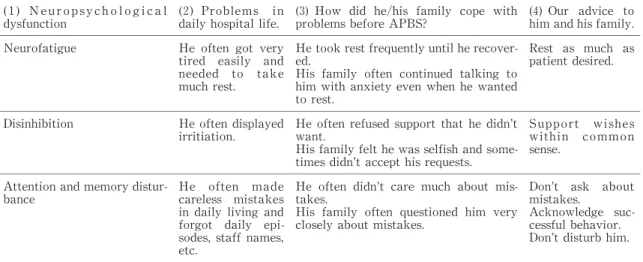
Strategy for positive behavioral support (PBS) (Table 2) First,we recognized 3 neuropsychological impair- ments and explained to the patient and his family what were the concrete pr oblems in his daily hospital life. (Table 2‑(1),(2)). Second,we interviewed both patient and family on how t hey coped with these problems (Table 2‑(3)). Thi rd, we provided both patient and family with st rategies of PBS to acquire coping skills with his neur opsychological impairment beginning in the acute stage( Table 2‑(4)).
After introduction of strategy for acute‑stage positive behavioral support (APBS)
After introduction of APBS,sufficient rest,a stress‑free environment,and a comf ortable milieu were provided wherein no one disturbed the patient in his daily life. In addition,t he Global Assessment of Functioning(GAF)was rat ed by the patient,his par- ents and staff. Results showed that discrepancy in the GAF score among the t hree that had been evident before our APBS was reduced after APBS(Table 3). On the 57th hospital day,we were able to successfully introduce him to another hos pital specializing in chronic‑stage rehabilitation.
DISCUSSION
In the acute stage,family members sometimes perceive the burden of a pat ientʼs impairments from TBI. However,rehabilitat ion programs focusing on family members of TBI pat ients are not often pro-
vided in many districts. We previously demonstrat- ed that a comprehensive and holistic rehabilitation program of chronic‑stage TBI focusing on PBS for patients and their families coul d improve QOL of both patient and family. In t his case,we experienced remarkable improvement in ADL and reduction in discrepancies in the evaluat ion among the patient,his family and staff. Results showed that trust among the three and the patientʼs self‑awareness improved.
We supposed that this desirable outcome was the result of the appropriate mi lieu that APBS pro- Fig.1. Image:CT Scan obtained immediately after admis-
sion shows a hyperdense lesion in patientʼs left subdural area with mass ef fect and diffuse brain swelling.
G.URUMA ,et al. Vol.53,No.3 142
vided ,for example,sufficient rest,a stress‑free environment,and coaching of the patient so that he did not make many mistakes . For acute‑stage TBI patients,these milieus are considered as most effec-
tive to treat neurofatigue,disinhibition,and attention disturbance. To achieve s uccessful rehabilitation,
careful support should be provided for these impair- ments. However,coordinating such support is diffi- Table 1. Neurophysiological state and activities of daily living of the patient
LCFS=Rancho Los Amigos Levels of Cognitive and Functioning Scale
hospital day 5 20 35 50 LCFS 2 6 6 7
FIM/FAM=Functional Independence Measure and Functional Assessment Measure
hospital day 5 20 35 50 FIM/FAM
Motor feeding 1 2 6 7
grooming 1 3 5 7
bathing 1 2 3 4
dressing upper body 1 3 5 7 dressing lower body 1 3 5 7
Toileting 1 1 4 7
Swallowing 1 5 6 7
bladder management 1 3 4 7 bowel management 1 3 4 7 bed,chair,wheelchair,transfer 1 1 4 7 toilet transfer 1 1 4 7 tub or shower transfer 1 1 4 7 car transfer 1 1 1 1 walking/wheelchair 1 1 5 7
stairs 1 1 5 6
community access 1 1 1 1
total score 16 32 66 97
communication comprehension 1 3 5 6 expression 1 2 5 6
reading 1 6 6 6
writing 1 5 6 6
speech intelligibility 1 7 7 7
total score 5 23 29 31
social cognition emotional status 1 6 6 6 problem solving 1 3 4 5
memory 1 2 3 5
adjustment to limitation 1 2 4 6 orientation 1 1 3 6
attention 1 2 3 5
safety judgement 1 1 4 6 employability 1 1 2 4 social integration 1 2 4 6
total score 9 20 33 49
total score 30 75 130 177
cult without educating patientsʼfamilies. For exam- ple,neurofatigue and disinhibition might look like clouding of consciousness ,lack of motivation,and selfishness to families. Thes e misunderstandings of the impairment would caus e families to provide in-
appropriate support to TBI patients during acute‑
stage hospitalization. Therefore,our strategy for PBS focused on family educat ion beginning in the acute stage.
In explaining our strategy for PBS,we must be careful not to worsen conf usion in families caused by the sudden tragic accident . Therefore,we simplified our advice using such phras es asʻgetting enough restʼ, ʻsupporting the wishes of the patientʼ,andʻeliminating disturbancesʼ. As a result ,the patient and his family became able to cope with hi s problems and provide an appropriate milieu to over come various kinds of neur- opsychological dysfunctions. This case suggests that APBS to patients and thei r families is effective to improve functional outcome and QOL.
CONCLUSION
In this case,we provided our strategy for PBS to the TBI patient and his fami ly beginning in the acute stage. As a result,he and his family acquired skills to cope with his neuropsychol ogical impairments. In addition,the discrepancy i n understanding of these impairments among the pat ient himself,his family and medical staff was reduced. Thi s case suggests that PBS from the acute s tage could help a patient gain self‑awareness and t rust from his family and would help to successfully introduce him to chronic‑
stage rehabilitation.
REFERENCES
1. Ben‑Yishay Y,Diller L. Cognitive remediation in trau- matic brain injury:update and issues. Arch Phys Med Rehabil 1993;74:204‑13.
2. Prigatano GP,Fordyce DJ. Zeiner HK,Roueche JR, Table 2. Our strategy of positive behavioral support for patient to acquire coping skills with his neuropsy-
chological impairments (1)N e u r o p s y c h o l o g i c a l dysfunction
(2)Problems in daily hos pital life.
(3)How did he/his family cope with problems before APBS?
(4)Our advice to him and hi s family.
Neurofatigue He often got very tired eas ily and needed t o take much rest.
He took rest frequently until he recover- ed.
His family often cont inued talking to him with anxiety even when he wanted to rest.
Rest as much as patient des ired.
Disinhibition He often di splayed irritiation.
He often refused suppor t that he didnʼt want.
His family felt he was selfish and some- times didnʼt accept his requests.
Support wi shes within common sense.
Attention and memory distur-
bance He ofcareless miten made stakes in daily l iving and forgot daily epi- sodes,staff names, etc.
He often didnʼt care much about mis- takes.
His family often ques tioned him very closely about mistakes.
Donʼt as k about mistakes.
Acknowledge suc- cessful behavior. Donʼt disturb him.
Table 3. Change in GAF scores before and after applying our strategy for APBS
Self‑rating GAF Family‑rating GAF Staff‑rating GAF (average) (average)
Before APBS 100 60 38.3
After APBS 100 70 57
GAF=Global Assessment of Functioning APBS=acute‑stage pos itive behavioral support
G.URUMA ,et al. Vol.53,No.3 144
Pepping M,Wood BC. Neuropsychological rehabilita- tion after closed head injury in young adult. J Neurol Neurosurg Psychiatry 1984;47:505‑13.
3. Gardner RM,Bird FL,Maguire H,Carreiro R,Abenaim N. Intensive positive suppor ts for adolescents with acquired brain injury. J Head Tr auma Rehabil 2003;
18:52‑74.
4. Ylvisaker M,Jacobs HE,Feeney T. Positive supports for people who experience behavi oral and cognitive disability after brain injury. J Head Tr auma Rehabil 2003;18:7‑32.
5. Gennarelli TA,Spielman GM,Langfitt TW,Gildenberg PL,Harrington T,Jane JA,et al. Influence of the type of intracranial lesion on out come from severe head injury. J Neurosurg 1982;56:26‑32.
6. The Center on Outcome Measurement in Brain Injury (COMBI). Level of Cognitive Functioning Scale (LCFS):http://www.tbims.org/combi/lcfs/lcfsrat. html.
7. Hall KM,Hamilton BB,Gordon WA,Zasler ND. Char-
acteristics and comparisons of functional independence measure,and functional as sessment measure. J Head Trauma Rehabil 1993;8:60‑74.
8. Hashimoto K,Nakamura T,Wada I,Yoshida K,Satoh S,Abo M,Seta H,Ohashi M. How gr eat is willingness to pay for recovery from sequel ae after severe traumatic brain injury in Japan? J Rehabi l Med 2006;38:20‑5.
9. Hashimoto K,Okamoto T,Watanabe S,Ohashi M.
Effectiveness of a comprehensive day treatment program for rehabilitation of patient s with acquired brain injury in Japan. J Rehabil Med 2006;38:141‑3.
10. Daniels‑Zide E,Ben‑Yishay Y. Therapeutic milieu day program. In:Christiansen AL,Uzzel l B,eds. Interna- tional Handbook of Neuropsch Rehab. New York:
Kleuwer/Plenum ;2000.p.183‑93.
11. Klonoff PS,Lamb DG,Henderson SW. Milieu‑based neurorehabilitation in pat ients with traumatic brain injury:outcome at up to 11 years post discharge. Arch Phys Med Rehabil 2000;81:1535‑7.