論 文
Pronunciation Teaching in Elementary English Education
AIBA Yoshiteru
要 旨
周知の通り2020年,日本では小学校での英語教育が大きく変わろうと している。それを目前に,スウェーデンに本社を置くグローバル企業
EF
EPI
が88カ国を対象に実施した世界最大英語能力ランキング(2018年)
で日本は
49
位,前年の37
位(80
カ国中)よりさらに後退した。また能力 レベルは「標準的」(2015年)から,「低い」(2016年〜2018年)へと後退 したままであった。文科省では「小学校外国語活動・外国語研修ガイド ブック」を作成し,音声面を中心としたコミュニケーション体験を推奨し ているが,実際に現場で指導にあたる教員の英語力の問題など課題は多い と考えられる。国際社会おいて日本人の英語力,とくにオーラル面を向上 させるには,これからはじまろうとしている小学校の英語教育において何 が必要であろうか。現在,勤務する大学で英米語学科の学生142
人の協力 のもとに行ったアンケート結果を踏まえつつ,脳科学の視点も取り入れな がら,音声学的な考察を試みた。キーワード:
世界英語能力ランキング,小学校初等英語教育,日本語脳,
英語脳,臨界期,発音記号
Introduction
Education First (EF) reported the 8th edition of the rankings of English skills which
has been conducting the tests for millions of adults all over the world, found the data from over one million people in 88 countries in 2017.
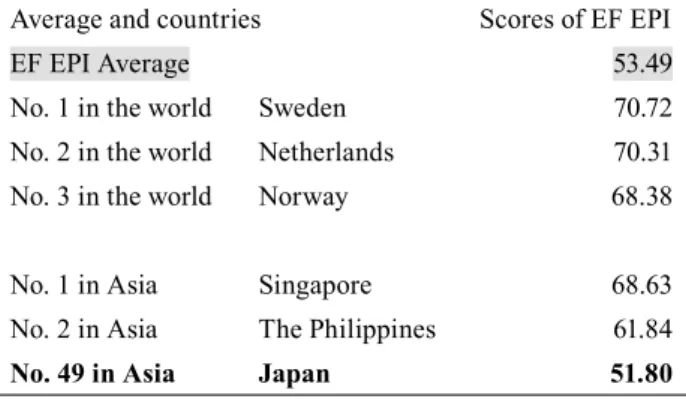
It showed that the 1st place was Sweden, 2nd place the Netherlands, 3rd place Norway, and 49th place was Japan as a result. In Asia, the 1st position was Singapore, 2nd position the Philippines, 3rd position Malaysia, and 11th position was Japan. But it is shocking rather than these rankings, Japan was stepped back as ‘low’ in the evaluation of the EF EPI 6th edition for the first time although it has been ‘standard’ since 2011, and again it remained as ‘low’ in the 7th and 8th editions. And it went back from the 35th (the 6th edition) to the 37th (the 7th edition), the 49 (the 8th edition) in the world rankings.
For holding Tokyo Olympic Games in 2020, the Ministry of Education, Culture, Sports, Science and Technology (the Ministry, later) under the policy, the facts of this term are there when we emphasize for the skills of English of Japanese people more and receive them more seriously. And in 2020, the English education in a Japanese primary school will be changed largely. Within this situation, to make their skills higher, what do we need? This paper will discuss from the points of views as the brain science, the primary school English education, the phonetic teaching (phonetics), the future premises of the English education in Japan.
Materials and Methods
The Difference of the English Skills in Japan and the World
Table 1 EF EPI SCORES (8th Edition) in Asia and the World
1Average and countries Scores of EF EPI
EF EPI Average 53.49
No. 1 in the world Sweden 70.72
No. 2 in the world Netherlands 70.31
No. 3 in the world Norway 68.38
No. 1 in Asia Singapore 68.63
No. 2 in Asia The Philippines 61.84
No. 49 in Asia Japan 51.80
The scores of English abilities of Japanese people were 51.80 points, and unfortunately, they didn’t reach the average scores of EF EPI 53.49. In the executive summary of EF EPI, it says briefly about the problems of the Japanese English education as below.
English learning of the needs of memorization is small compared to the math and science, they don’t emphasize on the correctness like those subjects. The English education in Korea, Japan, Hong Kong focuses on the grammatical rules rather than practical and communicative styles, so their grades are not so good. To realize the English skills higher, they have to change the directions of effective educational systems of communicative skills, increasing the conversational practices rather than grammar and vocabularies. (2017 EF EPI EF Scores of English Abilities, p. 23)
A Questionnaire about English from the 1st Year Students to the 4th Year Students
In English, there are 4 skills = (Listening, Speaking, Reading, Writing), before that though, the Japanese English education was that grammar and reading centered, due to their communicative skills don’t rise up. About the comments of EF, it’s a vital role to emphasize their communitive skills and effective education.
Now, what do the examinees, the university students think about their English abilities (4 skills)? I asked a questionnaire to the 142 students from the 1st year to the 4th year in the University where I am working for. With the cooperation of the students belonging to the Department of English in the Faculty of Foreign Studies, their major is English, and at least they have a certain confidence and interests of the language more than other students at other departments of their faculties.
Q1. In the 4 skills of English, what is the weakest one?
38 people 34 people 42 people 27 people
Writing Reading Speaking Listening
Figure 1.
Q2. In the 4 skills of English, what is the most favorite one?
Writing Reading Speaking Listening
Figure 2.
25 people
41 people 13 people
62 people
Q3. In the 4 skills of English, please put a number from 1 to 4 in which you want to improve.
Writing Reading Speaking Listening
Figure 3. Note. 1 to 4 points, point 2 to 3, 3 to 2 points, aggregate 4 in 1 point.
189 points 192 points
324 points 230 points
Q4. You have learned English through high school, have you ever received a pronunciation guidance by providing a special time?
No Yes
Figure 4.
107 people 36 people
Note . The people who answered ‘Yes’, the time of the instruction was at elementary school 13, junior high school 12, and high school 21 (Multiple answers allowed). Among the 28 people from native speakers of English, 5 people who responded, and learned the phonetic symbols, and others who learned about the difference between British and American pronunciation were 0.
Other 5 (English conversation school, from a Japanese, from
people with many opportunities to talk with foreigners at work,
etc.)
Q5. What do you think about accurate and beautiful English pronunciation? (Multiple answers allowed)
6 5 4 3 2 1