The Japanese Family System, " ie " and Economic Development
Yoshihiro Sakane
(Received on May ₆, ₂₀₁₉)
1. Introduction
In this chapter, I consider how the Japanese family system, "ie," (
「家」) encouraged economic development in Japan. As discussed in Chapter ₂, the Japanese "ie" system is a sole inheritance system in which only the eldest son inherits the household. In this chapter, I compare how sole inheritance has encouraged economic development in Japan, compared with the economic development of other regions where a divided inheritance system is used. During the second half of this chapter, I consider how Japanese farms operated based on the "ie" system are managed, from the perspective of the family life cycle of the farming family. The point at issue here is whether the scale of management expands or shrinks at each stage of the life cycle of the family.
In this introductory section, I talk about research trends on the Japanese "ie" system.
Volumes of research have been published on the Japanese family and "ie" system, mostly in the field of sociology. I select three points at issue from these papers related to the main thesis of this chapter and introduce them as research trends on the Japanese family system, "ie."
The first trend concerns the discussion of patriarchy. When discussing the "democ- ratization" and "modernization" of Japanese society following Japan's defeat in the war (discussed in Chapter ₁), the "ie" system is almost always described as "feudal" or "patri- archal" when it is criticized. However, research in recent years has stopped using these words. Although there have been significant changes to both awareness of the issues and to socioeconomic environments, recent research has also increasingly revealed how prob- lematic it is to describe the Japanese "ie" system as "patriarchal."
According to the "Encyclopedia of Sociology," a patriarchy is defined as, "a type of
family structure where males wield family authority, and control or rule other family mem-
bers." Under a patriarchal family, the eldest son generally inherits control over family
property and other family members by succession and is responsible for conducting ances- tral rituals. This control is expressed as absolute authority, and other family members individually defer and submit. This is within the scope sanctified by tradition, and the patriarch is free to wield power unless he is subject to tradition or some other authority stating otherwise (Mita et al., ₁₉₈₈). Whether or not the concept of patriarchy can be applied to the Japanese "ie" system is up for debate. According to Kaku Sechiyama, Max Weber's concept of patriarchy carries two characteristics as a typical example of traditional authority: (₁) the patriarch wields arbitrary authority without constraint (except from tradi- tion) and (₂) family members individually defer to the patriarch (Sechiyama,
₁₉₉₀).Whether or not patriarchal authority exists in actual farming families has been discussed in such fields as sociology, legal history, and Japanese history
₁).
Such debates did confirm that "ie" cannot be fully understood using the general con- cept of patriarchy. In other words, "ie" cannot be equated with patriarchies, and the con- cept of patriarchy cannot be used to describe "ie." Under the Japanese "ie" system, family members of the "ie" defer to the "ie" itself, which is dominant even over the family head.
This means that the Japanese "ie" system operates using a different logic than the patriar- chy described by Weber (Nakano,
₁₉₈₈, etc.). This is why fewer researchers todaydescribe the Japanese "ie" system as patriarchal.
The second trend is the "ie" as a management body. The two main points at issue have been emphasized with regard to this perspective. The first point is that the flexibil- ity of the Japanese "ie" system (in which someone not related by blood can inherit the "ie") allowed Japanese management bodies to continue to maintain stability. Traditional research has emphasized this point with regard to the management of merchant "ie" in urban areas. In other words, such research has emphasized as a characteristic of mer- chant "ie" management in Japan the point that merchant "ie" with no male heir (or with a male heir who is not qualified) have adopted heirs
₂)to maintain and expand the manage- ment of the merchant business.
The second point is that the logic of the "ie" came to establish the basic tone of orga- nization principles in Japan, and that this supported the modernization and economic suc-
₁) However, these discussions have focused on the past.
₂) The wives of adopted heirs were often the daughters of the head of the "ie", or sometimes were themselves adopted from other "ie". If the wife herself was adopted from another "ie", there would then be no blood relationship whatsoever from that point on.
cess of Japan. In discussing Japanese-style management in the field of management studies, familism was originally emphasized as the principle explaining Japanese-style management. Although the chief example of this is managerial paternalism as espoused by Hiroshi Hazama (Hazama, ₁₉₆₃), Tadashi Mito went even further than Hazama in using the logic of the "ie" to explain prewar and postwar Japanese-style management. Mito argued that Japanese companies are group-based organizations, while companies in Europe and the US are contract-based organizations. In a group-based organization, the individual participates in the organization in all aspects and without limitations and belongs to that organization completely and without restriction. Japanese companies share the logic of a contract-based organization (the logic of capital), but also operate under the powerful logic of a group-based organization (the logic of a "ie"). Because of this, Japanese companies prioritize the preservation and prosperity of the company, rather than the pursuit of profits.
Further, Mito stressed the fact that Japanese-style management served as the engine of modernization (Mito, ₁₉₉₄, etc.).
This was the major research at the time that considered the connection between the logic of the "ie" and economic development within the theory of Japanese-style manage- ment, from the perspective of the "ie" as a management body
₃).
The third trend is research on the "ie" system and agricultural economics. Takeo Wataya, one of the most prominent postwar agricultural economists, described the patriar- chal "ie" as a premodern production relationship that is not a modern human relationship, but that free human relations began to manifest as capitalism spread throughout agricul- tural communities (Wataya, ₁₉₇₉). In this way, it was common to understand Japanese farming families with the "ie" as their foundation using the logic that "ie" norms began to weaken among family members with the development of the capitalist economy, resulting in freer and more modern labor.
With regard to the main thesis of this chapter, I would like to point out here that I disagree with arguments that view the "ie" as a premodern concept and that understand the "ie" as something in opposition with capitalism. This logical understanding is seen not
₃) Of course, differences in the family/relative system create differences in company management.
Tamio Hattori's series of research on management in South Korean companies is one represen- tative example of this. Hattori sees the connection between the customs of paternity-based groups in South Korea and the management of South Korean companies as an issue, from the angle that the family/relative system confers traits on the development of company management and economic transactions of that ethnic group (Hattori, ₂₀₀₅, etc.).
only among agricultural economists but also in Mito (as discussed previously) and was likely the predominant view in the field of social science at that time. For example, Mito clearly sees the "ie" as a "mode of production belonging to a premodern and pre-capitalist society," and that the "ie" in this context is "inconsistent" with the development of capitalism (Mito, ₁₉₉₁, pg. ₆₂, pg. ₂₄₁). However, there is no need to logically understand capitalism and the "ie" as "inconsistent" in the first place, so I disagree with this point of view.
Below, I consider the relationship between the "ie" system and economic development from a different perspective than that described above.
2. Unmoving Farming Families
(1) The Fixed Nature of Japanese Farming Families
Japanese farming families were remarkably fixed in place, compared even with ethno- graphic cases throughout the rest of the world. This is due to the existence of the "ie"
system, where each farming family created a "ie" and stayed fixed in place genealogically.
Therefore, farming families with specific trade names continued to use these names for a long time. This means that the number of farming family households in a given village would neither increase nor decrease over a long period of time. Let us take a look at an example in Toyama Prefecture (富山県). Table ₁ shows changes in the number of house- holds in Toyama Prefecture by village. This table shows trends over ₁₃₀ years, from the second half of the Edo period to the high economic growth period after the war. For Japan, this ₁₃₀-year period was a significant change and includes modern economic devel- opment following the last days of the Tokugawa shogunate and Meiji Restoration, World War II, and then the subsequent period of high economic growth. This table shows that,
Table 1. Changes in the number of farming family households (Toyama Prefecture) unit: households
Settlement name A B C D E F G H
₁₈₃₈ ₁₀ ₂₀ ₉ ₆₅ ₄₂ ₁₃ ₁₄ ₁₃
₁₈₆₃ ₁₃ ₂₅ ₇ ₈₁ ₅₄ ₁₆ ₁₈ ₁₄
₁₉₇₀ ₁₀ ₂₃ ₁₂ ₇₇ ₅₆ ₁₅ ₁₄ ₁₉
Source: Watanabe (1978, page 49)
Note: The villages that were surveyed here were settlements in Toyama Prefecture, but the names of these settlements cannot be identified.
although there was a change of around ₂₀% in individual farming family circumstances and socio-economic conditions, most of the farming families continued on genealogically.
Such families likely reached their fourth or fifth generations during this period of time, and the fact that there was so little change to the number of households over this many years and generations is remarkable, even compared to ethnographic cases in other regions throughout the world.
This suggests that, in modern Japan, there was little change to the number of farming family homes due to the fact that the "ie" system served to keep farming families genea- logically fixed in one place. Table ₂ provides an overview of the number of farming fam- ily households and other information, from the early Meiji period to the prewar Showa period. It is clear that there were no major changes, with around ₅.₅ million farming family households, throughout the entire time period. Although the number of people engaged in farming decreased slightly, the cultivated acreage increased more than ₂₀%
from the early Meiji period to the Taisho period. Regardless, the number of farming fam- ily households changed only slightly over a period of ₇₀ years from the early Meiji period, showing that the "ie" system had the effect of keeping the number of farming family house- holds remarkably stable
₄).
Let us now consider the effect that the stable number of farming family households had on improving agricultural production. Table
₂ lists some pertinent information,including the yield per tan (反)
₅)and the rice production quantity per farming family household. Let us take a closer look. The yield per tan indicates land productivity, and this figure increased roughly ₁.₆ times from the early Meiji period to the Showa prewar period. This increase is especially noticeable from the middle Meiji period to the early Taisho period. This has traditionally been attributed to the spread of Meiji farming methods. Looking next at rice field area per farming family household shows an increase of around ₂₀% from the early Meiji period. This shows that, even though arable land continued to be destroyed as Japan underwent industrialization and urbanization from the Meiji period onward, even more land was cultivated and filled, resulting in an overall increase in cultivated acreage. The yield per tan increased as much as ₆₀%, while the rice
₄) The figures here indicate the number of farming family households throughout all of Japan, and represent a general trend that includes regional differences, such as a decrease in the Kinki region (近畿地方) and an increase in the Tohoku region (東北地方).
₅) One tan (反) is equal to ₉.₉₁₇₃₆ a (ares), or roughly ₁₀ a.
Table 2. Changes in the number of farming family households, number of people engaged in farming, cultivated acreage, and rice production quantity No. of farming family householdsNo. of people engaged in farming
Cultivated acreage Rice production quantityYield pertanPer farming family household Rice fieldsFieldsNo. of people engaged in farmingRice field areaField areaRice production quantity ₁,₀₀₀ households₁,₀₀₀ people₁₀₀cho₁₀₀cho₁,₀₀₀kokukokupeopletantankoku ₁₈₇₆ to₁₈₈₅₅,₄₉₇₁₄,₆₄₄₂₇,₃₀₃₁₉,₆₉₂₃₃,₇₂₀₁.₂₄₂.₆₆₄.₉₇₃.₅₈₆.₁₃ ₁₈₈₆ to₁₈₉₅₅,₄₅₂₁₄,₂₈₈₂₇,₉₄₃₂₀,₉₃₀₃₉,₄₅₆₁.₄₁₂.₆₂₅.₁₃₃.₈₄₇.₂₄ ₁₈₉₆ to₁₉₀₅₅,₄₉₀₁₄,₁₇₃₂₈,₄₂₄₂₃,₀₆₁₄₁,₇₇₅₁.₄₇₂.₅₈₅.₁₈₄.₂₀₇.₆₁ ₁₉₀₆ to₁₉₁₅₅,₅₁₉₁₄,₀₀₈₂₉,₄₅₂₂₅,₉₀₇₅₁,₁₄₈₁.₇₄₂.₅₄₅.₃₄₄.₆₉₉.₂₇ ₁₉₁₆ to₁₉₂₅₅,₅₄₅₁₃,₉₃₉₃₀,₇₂₂₂₈,₂₄₈₅₇,₉₉₄₁.₈₉₂.₅₁₅.₅₄₅.₀₉₁₀.₄₆ ₁₉₂₆ to₁₉₃₅₅,₆₀₅₁₃,₈₈₆₃₁,₉₅₁₂₇,₅₂₇₆₀,₀₁₆₁.₈₈₂.₄₈₅.₇₀₄.₉₁₁₀.₇₁ ₁₉₃₁ to₁₉₄₀₅,₅₈₂₁₃,₇₂₉₃₂,₁₃₈₂₈,₃₁₁₆₂,₅₁₀₁.₉₅₂.₄₆₅.₇₆₅.₀₇₁₁.₂₀ Source: Umemura et al., editors (1966). Note: Onecho (町) is equal to2.45 acres. Onetan (反) is equal to0.245 acres. Onekoku(石) is equal to330.69 pounds or150 kg.
field area per farming family household increased as much as ₂₀%, so the rice production quantity per farming family household increased ₁.₈ times, representing a significant amount of growth. The number of people engaged in farming decreased as much as ₁₀%
over this period of time, so the rice production quantity per person engaged in farming (i.e.
labor productivity) increased even more than the rice production quantity per farming fam- ily household, at a rate of roughly ₂ times over this period of time. Of course, the num- ber of farming family households would not stay the same if the population increased in a rural district, unless a number of people corresponding to that increase left their farms.
Two factors came into play here. First, the "ie" system had the effect of strongly pushing people out from agricultural communities. Second, the rapid development of commerce and industry in cities from the Meiji period onward had the effect of pulling labor power outside of agricultural communities. These mechanisms functioned remarkably well in modern Japan. In other words, they minimized the stagnation of surplus labor power in agricultural communities.
Let us now consider how this significant growth in labor productivity and the stable number of farming family households were involved. The important point here is that the cultivated acreage per farming family household increased. As mentioned earlier, the rice field area per farming family household increased as much as ₂₀%. The rice production quantity per farming family household increased significantly due to both the increase in the cultivated acreage per farming family household, and the increase in yield per tan.
The cultivated acreage per farming family household increased due to efforts by the gov- ernment and people to expand arable land, and also due to the stable number of farming family households. If the increase in the number of farming family households outpaced the expansion of arable land, the cultivated acreage per farming family household would decrease, which would in turn reduce the rice production quantity per farming family household. If this was not greater than the decrease in the number of people engaged in farming per farming family household, it would have been directly connected with a decrease in the rice production quantity per person engaged in farming (i.e. labor productivity). In other words, this trend of stability in the number of farming family households curbed reduction in labor productivity or was a major factor behind increasing the labor productivity connected with the expansion of arable land
₆). The importance of
₆) Refer to Hayami (₁₉₈₆) for information on the relationship between land productivity, land equip- ment ratio (land area per unit of labor), and land productivity.
this point will be revealed in the next section, in which we compare this phenomenon with that of the conditions in divided inheritance societies in which the number of farming fam- ily households often increased.
(2) Management Continuity
In Japan, it was important that the "ie" system served to ensure continuity with regard to farm management. The eldest son was the sole inheritor of a "ie," so all aspects of farm management inherited by the next generation were taken over by the eldest son.
There are five points worth mentioning here.
First and most importantly, this allowed all family property (such as farming land and mountain forests) to be inherited by the next generation without any reduction in size.
Tenanted land was also often inherited without change.
Second, the system of eldest son sole inheritance allowed the eldest son and his wife (the next generation) to exclusively inherit all forms of "capital" obtained and accumulated by previous generations, such as farming techniques, management knowledge, human rela- tions, and experience. Because these were stem families in which the eldest son and his wife would live together with the parents, they could be taught techniques and learn about management step by step until the parents passed away. Farm management was continu- ous under the "ie" system, and the inheritance process between generations went smoothly.
It is for this reason that the system of eldest son sole inheritance based on a stem family structure was so suitable and rational when it came to inheriting farm management.
Third, because arable land and other family property were always inherited by a sin- gle child or grandchild without being divided among multiple heirs, it was possible to make planned and long-term farming investments, such as using new techniques and improving land. In situations where the future is uncertain, a family would need to con- sider how to recover any invested capital, and this imposes various restrictions on long- term investments. A "ie" system where only the eldest son inherits property would likely provide an ideal environment for making planned long-term investments.
Fourth, under a "ie" system, there is a strong desire for the "ie" to continue to prosper,
and a very strong incentive to not only pass farm management and family property to the
next generation, but to increase family property and improve farm management for the ben-
efit of the child (or grandchild) who will inherit said property. These strong feelings dic-
tated the day-to-day behavior of farmers. This can be seen in such behaviors as attempting
to expand the amount of arable land or installing farming or irrigation equipment.
Fifth, a sense of diligent labor and morality spread during the Edo period among farmers hoping for a "ie" of continuous prosperity, and this had the effect of motivating farmers to improve agricultural production. Beginning in the mid-Edo period, common morality (such as diligence, frugality, honesty, filial piety, humility, and acceptance of one'
s position) took root in the lives of farmers. These farmers put these ideals of diligent labor and morality into practice in their daily lives in the form of self-discipline and self- improvement. This was supported by an intense desire on the part of these families to enjoy continuous prosperity and avoid ruin in the "ie." The motivation created through this sense of diligent labor and morality served to support the development of agricultural production in Japan.
In this way, the strong incentive to continue managing the farm and expand family property is a behavioral pattern that clearly shows the characteristics of a Japanese "ie,"
and there should be no doubt that it also served as a major driving force behind how farm management developed. This system of management inheritance, in which the next gen- eration inherits managed assets in whole without change, is not limited to farm manage- ment only. The same system can be seen in all merchant families, workshops, and sole proprietorships. For example, in addition to inheriting financial assets, real estate, and other family property, it was also important for a merchant family to pass intangible assets (such as reputation, trust, suppliers, and customers) to the next generation. As will be discussed in the next section, the "ie" was both a rational and important means for inherit- ing family property from one generation to the next. This will be made even clearer when we consider how this process was not as smooth in divided inheritance societies.
3. Divided Inheritance and Management Discontinuity
(1) Reduction of Management caused by Divided Inheritance
Let us first consider the state of farming family management in areas that use a sys-
tem of divided inheritance. As shown in Table ₁ in Chapter ₂, with the exception of Japan
and its system of eldest son sole inheritance, all other areas within Asia employed a system
of divided inheritance. The details of each system (including whether the heir was male
or female) vary by region and time. For example, in Korea beginning in the latter Yi
Dynasty and modern Okinawa/Amami, the eldest son was responsible for conducting ritu-
als, and therefore was given priority in inheritance; nonetheless, inheritance was still con- ducted under a divided inheritance system. Let us take a closer look at divided inheritance.
As an example, we will consider China, which has an inheritance system of equal division.
Let us begin with a specific example of divided inheritance. Muramatsu (₁₉₄₉) pro- vides an example of divided inheritance in China. This information is based on data from a survey conducted by the South Manchuria Railway Co., Ltd (南満洲鉄道株式会社). in
₁₉₃₆. The information shows divided inheritance for the Zhang family (張家) in Hebei
Province (河北省). The land was split equally among each male heir, and the size of the land clearly shrinks without exception each generation. For example, Chun Zhang from the first generation began with a large amount of land totaling ₃₀₀ mu (approximately ₂₀ ha). Due to the system of divided inheritance, however, each heir after the third genera- tion received a minuscule amount of land, with some heirs migrating elsewhere due to receiving hardly any land at all. This reduction in land ownership and the total area of managed farmland caused by divided inheritance was a serious issue here.
Uchida (₁₉₅₆) provides the most detailed coverage of the system of equal division inheritance used in China. According to Uchida (₁₉₅₆), equal division was conducted extremely thoroughly in China. This system was not merely applied to land alone. All family property including buildings, furniture, livestock, money, tools, food, fixtures, vehicles, wooden boxes, and even tenanted land and credit and debt was passed on equally to heirs. The Chinese system of divided inheritance is characterized by this insistence on the complete and equal division of property (Niida, ₁₉₆₂, page ₄₃₂). In cases where it would be difficult to divide property equally (or if dividing property equally would cause serious difficulties in the lives of heirs or in managing farms), families avoided dividing property equally without reason and instead employed various schemes so that property would ultimately and substantially be equally divided (Uchida, ₁₉₅₆).
However, this system of divided inheritance had a seriously negative effect on farm
management. In this system, wealth would be exponentially divided among heirs of each
generation, with the result of reducing the area of arable land per household with each
inheritance (unless cultivated acreage had increased in an amount corresponding to the
amount the population of the agricultural community increased). This reduction in arable
land per household must be seen as the primary issue with divided inheritance. Of
course, this issue of divided inheritance reducing the amount of arable land and the scale
of management each generation is common to all divided inheritance societies. This is an
issue to some extent in any society that uses a system of divided inheritance, regardless of whether property is divided equally or divided to male or female heirs, and even regard- less of regional differences.
(2) Divided Inheritance and Farm Management
Divided inheritance poses several issues for farm management. Having already dis- cussed the issue of how this causes reductions in the amount of owned agricultural land and a reduction in the scale of management, in this section I discuss two additional issues.
The first issue is that divided inheritance stops heirs from engaging in continuous farm management. Under divided inheritance, management is divided with each genera- tion, so farm assets, techniques, and experience accumulated by the previous generation are all divided among heirs, making it difficult for these heirs to inherit farm assets and techniques. This is simply not a rational system from the perspective of passing farm management from one generation to the next. This results in the opposite issue as the rational system of farm management inheritance based on the Japanese "ie" system. Agri- cultural production continues to be split in each generation, even for the central parts of the family mainly responsible for production. It is easy to see that this would have a significantly negative effect on improving overall agricultural productivity.
Previous research on this topic did not explicitly treat farm management discontinuity caused by divided inheritance as a serious factor hindering the development of farm management. In analyzing farm management in China and Korea (both of which are divided inheritance areas), research has not focused on how farm management discontinu- ity caused by divided inheritance served as a negative factor for the development of farm management. This is also true for research analyzing agriculture in current developing countries. Of course, research on developing countries has discussed the fact that divided inheritance reduces the scale of farm management for some time now. However, there has been no research explicitly analyzing farm management discontinuity caused by divided inheritance as a factor hindering the development of farm management in develop- ing countries. The issue of farm management discontinuity caused by divided inheritance must be taken more seriously as a factor hindering the development of agriculture in developing countries.
Of course, the issue of management discontinuity caused by divided inheritance can
be seen in areas outside of farm management. Property is divided up each generation in
merchant families, workshops, sole proprietorships, and other management bodies. In these bodies, tangible assets such as real estate are divided along with intangible commer- cial assets (such as trust, suppliers, and customers), so it is difficult for heirs to inherit assets in whole. This also poses a problem for passing technologies and skills from one generation to the next. This separation of property due to divided inheritance represents the complete opposite phenomenon compared with how business tycoons, financial con- glomerates, and family businesses in early modern and modern Japan attempted to ensure that property always stayed within the same family organization. We must therefore conclude that this division of property and management that occurs each generation due by divided inheritance served as a factor significantly hindering the development of com- merce and industry. It is a commonly held belief that the capital accumulated by mer- chants in modern Japan played a major role in establishing Japanese capitalism. How- ever, the opposite trend can be seen in a significant number of divided inheritance societies. In this way, a family or relative system has an important connection with both developing farm management and with accumulating capital and growing commerce and industry. However, very little research has stressed this point.
The second issue is how the division of the scale of farm management caused by divided inheritance (that is, the increase in the number of farming family households) affects improvements to agricultural productivity. This issue is especially noticeable in Southeast and South Asia during the
₁₉₆₀s through ₁₉₈₀s, during which populationsunderwent explosive growth.
Divided inheritance resulted in remarkable population increases in rural districts within areas of divided inheritance. Under these conditions, farmers could avoid reducing the amount of arable land in two situations: (₁) if it was possible to easily develop enough new arable land to handle the increase in population or (₂) if a labor market existed to provide enough opportunities outside of agriculture for the expanded population.
Although it was possible to avoid arable land fragmentation caused by population increase due to divided inheritance in the case of either (or both) of these situations, neither was an option in Southeast Asia or South Asia at that time. The labor force in rural districts in Southeast Asia and South Asia at that time was stagnant, and arable land fragmentation caused by divided inheritance was a serious issue.
Labor-intensive high-yielding varieties (HYV) of crops were therefore introduced in
Southeast Asia as a response to these conditions. This was the so-called "green revolu-
tion." Although the
"green revolution" significantly increased land productivity, thisincrease did not improve labor productivity as much as was expected. Hindering this was the reduced cultivated acreage per unit of labor following the explosive increase in popula- tion caused partly by divided inheritance.
Table ₃ shows the situation at this time. Let us compare this with conditions during the period from
₁₉₀₀ to ₁₉₂₀ in Japan, the prewar period in which labor productivityincreased the most. Land productivity underwent remarkable growth in both the Philip- pines and Indonesia, with annual growth from ₂.₈ to ₃.₀%. These figures are much higher than in Japan, which had an annual growth of ₁.₄%. However, the ratio of land per single unit of labor dropped dramatically in both countries during the period (from ₁.₄ to ₁.₅%
downward), which curbed increases in labor productivity. In Japan however, the ratio of land per unit of labor rose significantly (₁.₂% upward), which had the effect of significantly increasing labor productivity. As shown in Table ₂, in modern Japan, the increase in cul- tivated acreage caused by factors such as the stable number of farming family households and the cultivation of new land had a comparatively and significantly positive impact on the ratio of land per unit of labor. In contrast, the increase in population in Southeast Asia had a negative impact on the ratio of land per unit of labor and served as a serious factor curbing land productivity increases regardless of there being significant increases in land productivity
₇).
With this in mind, it is clear that the stable number of farming family households due to the existence of a "ie" system served as an extremely important factor in improving agricultural labor productivity in modern Japan. The "ie" system is therefore a specific factor that encouraged economic development.
Table 3. Productivity growth (annual rate)
unit: % Labor
productivity
Ratio of land per unit of labor
Land productivity
Philippines ₁.₆ -₁.₄ ₃.₀
Indonesia ₁.₃ -₁.₅ ₂.₈
Japan ₂.₆ ₁.₂ ₁.₄
Source: Watanabe (1989, page 78), Hayami (1986, page 91).
Note: Growth rate from 1960 to 1980 in the Philippines and Indonesia and from 1900 to 1920 in Japan.
₇) Refer to Hayami (₁₉₈₆) and Watanabe (₁₉₈₉) for more information.
(3) Responses to the Reduction of Farmland
I have already covered how the reduction in the amount of farmland for each genera- tion caused by divided inheritance posed an issue for farm management in areas with divided inheritance. However, there were some attempts made to restrict divided inheri- tance, as excessive division of farmland would put the foundation of farm management into danger. These attempts took the form of autonomous actions by farmers to ensure a minimum foundation for children inheriting farmland to be able to manage said land, through adjusting other property inherited by children who would not inherit farmland, such as providing monetary compensation. Let us take a closer look at these autonomous responses made by farmers in areas with divided inheritance.
As an example, let us consider farmland inheritance in South Korea. Tables ₄-₁ and
₄-₂ show the results of a survey conducted on farmland inheritance in four settlements in
Chungcheongnam-do (忠清南道) in ₁₉₈₇
₈). Table ₄-₁ shows that, of the ₁₀₈ farming fam- ily households surveyed, there were ₃₁ households with a single child who was the sole heir. Of the remaining ₇₇ households with multiple children, a single child was the heir for
₄₂ households, while inheritance was divided among multiple children in ₃₅households. Even in households with multiple children, a single child was the heir more often than multiple children. Table ₄-₂ shows the amount of farmland owned by heirs.
Most type II farming families (those with multiple children and a single heir) had only minuscule amounts of farmland, with ₅₅% having less than ₀.₅ ha
₉)and ₃₈% having ₀.₅ to
₁.₀ ha. This shows that there is a limit even when attempts are made to prevent further
reduction when dividing land. In contrast, heirs from type III farming families (those with
₈) This thesis was provided by Takenori Matsumoto. Because the original document was written in Korean, Mr. Matsumoto provided the author with an explanation of its content.
₉) One ha (hectare) is equal to ₂.₄₇₁₀₅ acres.
Table 4-1. Number of farming family households by type of inheritance
Type of inheritance No. of farming family households Type I (single child, single heir) ₃₁ Type II (multiple children, single heir) ₄₂ Type III (multiple children, multiple heirs) ₃₅
Total ₁₀₈
multiple children and multiple heirs) owned comparatively more land, with ₆₉% having ₁.₀ ha or more. The important point here is that these actions can be seen as an attempt by farmers to prevent further reduction in both the amount of farmland and the scale of man- agement once the family reached a point where no further reduction would be allowed, even if under a system of divided inheritance.
Although farmers responded autonomously to protect their property in this way, there was also a noteworthy attempt by the state to intervene in the customary practices of farm- ers to prevent the size of farmland from being reduced through inheritance. This occurred in postwar Taiwan. As a divided inheritance society, Taiwan made an attempt to legislatively prevent excessive reduction in the size of farmland caused by the system of equal inheritance in the ₁₉₇₀s. This was done as a response once the seriousness of this issue became clear. The legislative system created in response to this prohibited the divi- sion of farmland, encouraged the inheritance of farmland by a single heir, and placed restrictions on farmland heirs so that only those with actual skill could inherit farmland.
However, legal reforms up until the year ₂₀₀₀ discarded all restrictions and adjustments at the farmland ownership level. These legislative measures were likely revoked due to the strongly rooted custom of equal inheritance and the existence of long-held ideas in Taiwan.
In other words, the custom of equal inheritance thwarted opposing plans backed by the power of the state. Taiwan ultimately backed down from imposing rules on equal inheri- tance through legislative means (Huang, ₂₀₀₇).
There are two ways to prevent divided inheritance from reducing the amount of farm- land and the scale of management: (₁) prevent the separation of farmland at the ownership
Table 4-2. No. of farming family households of heirs by size of agricultural land owned
Size owned Type II Type III
Less than ₀.₅ ha ₂₃ ₅
₀.₅ to ₁.₀ ha ₁₆ ₆
₁.₀ to ₁.₅ ha ₂ ₁₃
₁.₅ to ₂.₀ ha ₅
₂.₀ ha or larger ₁ ₆
Total ₄₂ ₃₅
Average area owned ₀.₅₄₈ ha ₁.₂₉₈ ha
Source: Choi and Oh (1988).
level or (₂) prevent reduction in the scale of management through renting land even if farmland ownership is separated (Huang, ₂₀₀₇). However, both require a rational method for selecting a single person as an heir to manage farms.
In postwar Japan, the first of these methods was adopted. Amendments to the civil code following the war discarded family headship inheritance and adopted equal inheri- tance as a general rule. However, it is common knowledge that farmland ownership was actually passed on to a single child (often the eldest son) through such means as abandon- ing inheritance or agreeing to divide inherited property. Of course, this was due to Japan's traditional "ie" system. This made it possible in Japan for families to select a suc- cessor without generating any (or very little) friction.
In South Korea, both methods were used. There were practical limits on separating farmland ownership, and one method of handling this issue was to rent farmland that had been separated. In Japan, divided inheritance societies also existed in Kagoshima, Amami, and Okinawa. In these regions, attempts were made to rent farmland in order to prevent reducing the scale of management between generations. This can be seen as a type of response similar to the second method described above. This form of farmland rental seen in these regions is characterized by little or no rent paid by the tenant farmer and a simple procedure to return the farmland to the owner (Nakachi, ₁₉₉₄; Sugihara,
₁₉₉₄; Kawaguchi, ₁₉₉₅).
4. The Family Life Cycle and the Japanese “ie” System
(1) The Family Life Cycle and the Expansion and Shrinking of Farm Management
Akira Kawaguchi proposed understanding how farm management develops in divided
inheritance societies within the family life cycle of farming families (Kawaguchi, ₁₉₆₆). In
considering family structures and land ownership in Kagoshima Prefecture (鹿児島県),
Kawaguchi provided a simple reproduction model for farming families in divided inheri-
tance areas. This model begins when the young married couple is given a minuscule
piece of farmland from their parents and the household is split. The young couple
expands the scale of management under the stress of increased consumption as their fam-
ily grows. They first begin by expanding the scale of management primarily through
leased land, and then transition into doing so primarily through purchasing farmland. As
their children approach adolescence, the amounts of land that they own and that they man-
age both reach peak levels. At this point, their children begin getting married. This causes a reduction in labor power and forces them to begin dividing property. As the couple reaches middle age, they must build homes for their sons' families, so they use their savings and sell off land property. As the couple reaches old age, they are forced to loan out more land and reduce the scale of management. Finally, they are left only with the land property they need to retire. They divide their property among their youngest children and enter retirement. This is the final stage of the model. This creates a circu- lar cycle for each married couple, that begins when they are first married and ends when they retire, so that the cycle begins and ends at the same point. Unlike with stem family management based on a "ie" system, the cycle is not connected in succession.
Although there is little empirical research on how the scale of management expands and shrinks at each stage of the family life cycle, Toshio Tasaka has conducted research on Thailand that focuses on this point in his analysis. His results show that, in the case of Thailand, trends in land ownership and in the scale of management correspond com- paratively well with the family life cycle (Tasaka, ₁₉₉₁). This family life cycle theory is therefore quite valid when applied in general to divided inheritance societies.
(2) Fluidity of Farmland and Tenanted Land
If farm management conditions (owned, lent, and borrowed land) change according to the family life cycle, farm management must therefore significantly expand and shrink throughout the family life cycle, as farmland is bought and sold or lent and borrowed.
Divided inheritance societies are often dominated by small families, and so farmland and tenanted land must be fluid—especially in cases where the extensional expansion of arable land cannot be expected. Although it is difficult to obtain data to confirm how fluid farm- land and tenanted land were in such areas, in this section I will compare Japan with a divided inheritance society, while examining farmland purchases and sales as well as ten- anted land transfers in both regions.
It is difficult to gather data for comparison with regard to farmland fluidity. Accord- ing to estimates by prefecture based on land prices calculated by Kusuhiko Sakamoto, the annual arable land transfer rate
₁₀)for Japan is ₁.₂ to ₂.₂% (Sakamoto, ₁₉₅₈). According to nationwide estimates based on the number of purchases calculated by Yasuo Kondo, the
₁₀) This is the ratio of the total amount of arable land purchased and sold in one year, divided by the total market capitalization for arable land.
annual rate is around ₂.₅% (Kondo, ₁₉₄₂). These figures include frequent land transfers near urban areas, are likely much too high for examining farmland alone, and will need to be reduced accordingly. For Korea, Kazuo Hori calculated a land transfer rate from ₁₁ to
₁₆% between ₁₉₁₉ and ₁₉₂₆, based on land price—an extremely high rate in this case
(Hori, ₁₉₈₃). These figures likely include sales of land outside of farmland and will there- fore need to be reduced. Even so, it is clear that the rate is much higher than in Japan.
However, it is very likely that farmland was purchased not only by cultivating farmers but also by landowners and others. This is true both in Japan and Korea. For Japan, a sur- vey conducted for the years ₁₉₃₃ to ₁₉₃₅ found that the ratio of farmland area purchased in prefectures other than Hokkaido for use in farming/tenant farming by the purchaser was ₅₅ to ₅₆% (Ministry of Agriculture and Forestry Agricultural Affairs Bureau, ₁₉₃₇).
Although farmland transfers were not all the result of stages in the family life cycle, roughly half of those purchasing farmland were cultivating farmers.
China is generally seen as having very high farmland fluidity. In his survey of a settlement located in Hebei Province (河北省) from
₁₉₄₀ to ₁₉₄₁, Yukio Kumashirofound a high land transfer rate of
₅% per year. If we include land transfers due toinheritance, this figure rises to ₈% per year (Kumashiro, ₁₉₄₃). If we calculate the ratio of purchased land among the land owned by ₁₁₄ farming households in Hebei Province (河北省) based on ₁₉₃₇ survey data from Kazuya Yanagisawa, we arrive at a figure of
₃₀.₈% (Yanagisawa, ₂₀₀₀). This shows that farmland fluidity was high in this case.
Although no figures that correspond closer to Southeast Asia can be obtained at this time, we can refer to a survey on Thailand conducted by Toshio Tasaka (mentioned pre- viously), in which the ratio of owned land that was purchased was from ₄₀% to ₅₀% at the time of the survey (Tasaka, ₁₉₉₁). The ratio of purchased land is very high in Thai villages. This is due to the management scale expanding and shrinking throughout the family life cycle, as discussed above.
Let us now consider tenanted land fluidity. Data on this topic is even more difficult to obtain. One international comparison (covered in Chapter ₄) showed that tenant farm- ing periods are much longer in Japan than in China or Bangladesh. This means that, in comparing Japan with China and Bangladesh, tenanted land has lower fluidity in Japan and higher fluidity elsewhere. Research has generally shown that tenant farming periods are shorter and tenanted land has more fluidity in Southeast Asia and South Asia.
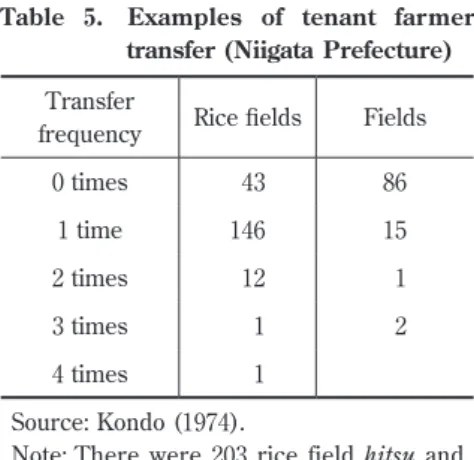
We do have some relevant data for Japan. A survey was conducted on tenant farmer
transfers for ₂₀₃ hitsu (筆) in a ₃₄.₅ cho (町) rice field and ₁₀₄ hitsu in a ₁₂.₇ cho field
₁₁)owned by a single landowner in Nakauonuma District (中魚沼 郡), Niigata Prefecture (新
潟県). This is shown in Table ₅. This table shows the number of rice field and fieldhitsu transferred between tenant farmers during a roughly ₅₀-year period from ₁₈₇₉ to
₁₉₂₇. There were no transfers at all for ₄₃ rice field hitsu and ₈₆ field hitsu, while there
was only a single transfer for ₁₄₆ rice field hitsu and ₁₅ field hitsu. With only ₁₇ hitsu transferred twice or more, this shows how low the tenanted land transfer rate is in Japan.
We can therefore confirm that Japan is characterized by low farmland and tenanted land fluidity when compared with divided inheritance societies. This point is also consis- tent with the fact that family property is not divided in Japan under the "ie" system. Fur- thermore, Japanese villages were known to have rules on transferring to tenanted land within the same village, and it has been suggested that social forces made it impossible for tenant farmers cultivating land to easily leave that land (Numata, ₂₀₀₁). This point, too, is consistent with the low fluidity of farmland and tenanted land in Japan.
(3) Chayanov’s Theory and the Japanese-style “ie”
Although this has yet to be discussed here, if we interpret the family life cycle in terms of the ratio of consumption power per unit of labor
₁₂), it is clear that the expansion
Table 5. Examples of tenant farmer transfer (Niigata Prefecture) Transfer
frequency Rice fields Fields
₀ times ₄₃ ₈₆
₁ time ₁₄₆ ₁₅
₂ times ₁₂ ₁
₃ times ₁ ₂
₄ times ₁ Source: Kondo (1974).
Note: There were 203 rice field hitsu and 104 field hitsu.
₁₁) One cho (町) is equal to ₀.₉₉₁₇₃₆ ha, or roughly one ha. A hitsu (筆) is a Japanese unit of measurement used to count sections of land. A single hitsu simply means a single section of land, without any fixed area.
₁₂) In other words, this is the ratio between consumption power and labor power. It is abbreviated as C/W below.
and shrinking of the scale of farm management throughout the family life cycle discussed previously is in agreement with Chayanov's theory. Makoto Numata and Ken'ichi Tomobe have both seen behavioral principles described by Chayanov reflected in farmer manage- ment in early modern and modern Japan (Numata, ₂₀₀₁; Tomobe, ₂₀₀₇). Let us take a look here at Chayanov's principle stating that the amount of agricultural production per unit of labor changes corresponding to C/W
₁₃); or, in other words, that both have a positive correlation on one another. This means that the scale of farm management expands and shrinks as C/W (representing the pressure of providing support) changes.
Most empirical proofs of Chayanov's principle were made prior to the war. In Japan, agricultural economics was split as its own field of study from agriculture, based on Euro- pean economics from the ₁₉₂₀s. It is at this time that Chayanov's theory was introduced to Japan (Isobe, ₁₉₉₀). Therefore, agricultural economists who were educated prior to the war accepted Chayanov's theory as a fundamental refinement of so-called agricultural economics. It is for this reason that a comparatively high number of empirical proofs of Chayanov's principle were made prior to the war.
When conducting an empirical proof of Chayanov's principle, one normally pools together as much farming family management data
₁₄)as possible at a certain point, and then conducts a cross-sectional analysis that examines the correspondence relationship between family members by age and the scale of management or harvest yield. This is the method that was generally used by prewar agricultural economists and so on. These agricultural economists would separate farming family management during the same period into several groups, and then place these in chronological order throughout the family life cycle, in order to observe Chayanov's principle. Chayanov's principle focused on the expansion and shrinking of the scale of management or harvest yield correspond- ing to the family life cycle, so this would need to be proven using data that shows farming family behavior in chronological order. However, obtaining such data was difficult.
However, Kishi (₁₉₄₇) has provided us with a valuable but sadly forgotten work useful for this topic. Kishi (₁₉₄₇) focused on the harvest register (稲刈覚帳) of the Sekiya household (関谷家) in Nasu District (那須郡), Tochigi Prefecture (栃木県), and provided a large amount of valuable data on how this household managed its farms starting in the
₁₃) This is abbreviated as P/W below.
₁₄) The ages of family members, and the scale of management or harvest yield are crucial pieces of data in proving Chayanov's principle.
Edo period. This work provided information on the family structure by age, ratio of con- sumption power versus labor power, unpolished rice yields, paddy field areas, and field areas over a period of ₇₀ years from ₁₈₇₄ to ₁₉₄₄. In this section, I use this data to verify the relationship between the C/W ratio and how this family managed its farms. The Sekiya household was a medium sized farming family with ₁.₂ cho of rice fields (including
₀.₃₃ cho of tenanted land), ₀.₇₉ cho of fields (including ₀.₀₂ cho of tenanted land), and ₄ cho
of mountain forests as of ₁₉₄₂.
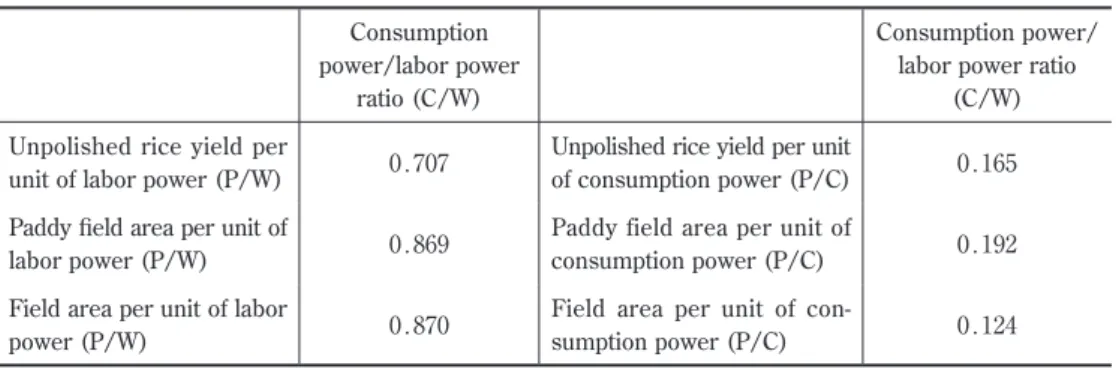
Table ₆ shows the correlation coefficients with the P/W variables (unpolished rice yield, paddy field area, and field area per unit of labor power) and C/W ratio for the Sekiya household. In addition, Table ₆ shows the correlation coefficients with the P/C variables (unpolished rice yield, paddy field area, and field area per unit of consumption power) and C/W ratio for the Sekiya household. This shows an extremely high correlation between support pressure C/W and P/W.
However, as described earlier, Japan is characterized by low farmland and tenanted land fluidity. How can this be considered consistent with this finding? The important point here is that there was not a large change in the management area versus the change in C/W ratio. The Sekiya household managed around ₁.₅ cho of land, and this only varied as much as four tan in the ₇₀ years since the start of the Meiji period. In other words, during this ₇₀-year period, the maximum size of land managed by the household was ₁.₇₆ cho in ₁₉₂₈, while the minimum size was ₁.₃₆ cho in ₁₈₇₆. Put simply, the maximum size and minimum size differed by only four tan. The four tan was enough for the family to respond to changes in the pressure of providing support over a period of ₇₀ years.
Let us now examine what this four tan of rice fields meant for the farm management
Table 6. Correlations (Sekiya household, 1875 to 1941) Consumption
power/labor power ratio (C/W)
Consumption power/
labor power ratio (C/W) Unpolished rice yield per
unit of labor power (P/W) ₀.₇₀₇ Unpolished rice yield per unit
of consumption power (P/C) ₀.₁₆₅ Paddy field area per unit of
labor power (P/W) ₀.₈₆₉ Paddy field area per unit of
consumption power (P/C) ₀.₁₉₂ Field area per unit of labor
power (P/W) ₀.₈₇₀ Field area per unit of con-
sumption power (P/C) ₀.₁₂₄
Source: Calculated from Kishi (1947).
of the Sekiya household. In the Sekiya household, five hitsu of rice fields served as the core rice field managed by the household. These hitsu were cultivated continuously from the beginning of the Bunka period (文化年間) to the Showa period (昭和期). The core rice field accounted for ₇₀ to ₈₀% of the entire crop yield beginning in the Meiji period (明
治期) and truly played a central role in how the Sekiya household managed its farms.The Sekiya household therefore managed its farms using both the core and other rice fields. Entries in the harvest register the start of the Bunka period onward list a total of
₄₂ hitsu of rice fields. Looking at the length of the cultivation periods in each rice field,
we can see that much of the rice fields outside of the core field had cultivation periods of less than ₁₀ years or even just a single year. Many of the rice fields outside of the core field were leased land. In other words, the Sekiya household responded to the pressure of providing support throughout the family life cycle by making use of rice fields outside of the core field which accounted for only around ₂₀% of the total land they managed.
The behavior shown in the Sekiya household can be seen as a characteristic of Japanese farming families under the "ie" system. In other words, the core rice field was also the central family property of the
“ie."Let us now take a look at another example showing the unique behavioral pattern of Japanese farming families, in which they have both a core rice field and rice fields outside of this core. Table ₇ summarizes the cultivation periods for each hitsu of cultivated rice field over a period of ₁₂₇ years from ₁₈₀₆ to ₁₉₃₇, for the Hoshi household (星家) located
Table 7. Cultivation period (Niigata/Hoshi household) No. of years cultivated No. of hitsu
₁₂₇ years ₁
₁₂₆ years ₁
₁₀₁ to ₁₂₀ years ₂
₅₁ to ₁₀₀ years ₇
₂₁ to ₅₀ years ₁₃
₁₁ to ₂₀ years ₁₀
₆ to ₁₀ years ₇
₂ to ₅ years ₁₃
₁ year ₁₉
Total ₇₃
Source: Aggregated from Attic Museum (1939).
in the village of Yunotani (湯之谷村) in Kitauonuma District (北魚沼郡), Niigata Prefec- ture (新潟県). This information was taken from the Hoshi household harvest register (稲
刈帳). The household had a total of ₇₃ hitsu of cultivated rice fields during this period, withonly two hitsu cultivated continuously for nearly ₁₃₀ years. Of the ₇₃ hitsu total, ₁₁ hitsu of rice fields were cultivated for at least ₆₆ years. This piece of land formed the core rice field for the Hoshi household. In contrast, there were ₁₉ hitsu of rice fields cultivated for only a single year, while rice fields cultivated for ₁₀ years or less account for more than half of the total. These rice fields outside of the core rice field show how rapidly these rice fields changed. The Hoshi household cultivated an average of ₁₃.₆ hitsu of land each year during the entire period. Of the
₁,₇₂₇ hitsu total of cultivated rice fields throughout the entireperiod, the core rice field of ₁₁ hitsu accounted for ₅₈% of that total. In terms of crop yield, the yield from the core rice field accounted for anywhere from ₇₀ to ₈₀% of the total. The area of each rice field and whether or not it was leased land is unknown, so we cannot com- pare the yield per tan of each rice field. However, a household would likely select those rice fields with the best location and the highest land productivity as the core rice field, and then the family would likely cultivate this core rice field themselves over the long term while using other rice fields outside of the core as short-term leased land.
Japanese farming families under the "ie" system would therefore expand their scale of farm management with the core rice field serving as the central family property and would use rice fields outside of this core to respond to changes in the pressure of providing sup- port throughout the family life cycle. This is the Japanese equivalent of Chayanov's principle. If we consider the fact that leased land did not significantly change the scale of management either way, then farming families would likely use supplementary work to adjust the pressure of providing support (Tomobe, ₂₀₀₇). We can see why this supple- mentary work was so important for Japanese farming families to maintain a subjective equilibrium. This was the standard behavioral pattern of autonomous Japanese farming families under the Japanese "ie" system.
The scale of farm management likely underwent much more expansion and shrinking in small families in divided inheritance societies than in Japan throughout the family life cycle discussed above. This is true also of the Russia that Chayanov studied, as land was redistributed by village communities there based on labor power within the household.
Let us now consider how the pressure of providing support could vary throughout the
family life cycle of a small family, compared with that of a stem family like in Japan. In
considering this topic here, I will apply the early modern family model
₁₅)demonstrated by Tomobe (₂₀₀₇) and convert ability into units of labor power/consumption power
₁₆), in order to calculate and compare the C/W balance for a small family and stem family. I will be brief here due to space constraints, but calculating the C/W balance for a small family and stem family shows a transition from ₁.₀ to ₃.₀ for small families and a transition from
₁.₇ to ₃.₀ for stem families. In a small family, the lowest value is ₁.₀ during the first year
of the family, while the highest value is ₃.₀ during the fourteenth year. In a stem family, the lowest value is ₁.₇ during the second year of the eldest son's family, while the highest value is ₃.₀ during the nineteenth year. In other words, a stem family experiences less change in the pressure of providing support, than a small family. This shows that this difference in the C/W balance is the result of differences in family structures caused by different types of inheritance. A stem family under the Japanese "ie" system experiences less change in the pressure of providing support compared with a small family in a divided inheritance society and is able to autonomously adjust to changes in this pressure throughout the relatively small family life cycle by making use of rice fields outside of the core and by engaging in supplementary work.
The only remaining issue here is to consider what role rice fields outside of the core field played in each farming family, and how this was adjusted. No progress has yet been made in clarifying the actual mechanisms behind this. This will therefore be left as a topic for the future.
Bibliography
Attic Museum, ed. Hoshike shozou shushicyou inekarichou (Hoshi Household Seed Register/Harvest Register). Attic Museum, ₁₉₃₉.
Choi, Yangbu and Oh, Naewon. "Nouka keizai no nouchi souzoku to shounou no soushutu (Farm- land Inheritance in Farming Family Economies and the Creation of Small Farming)." Agricultural Community Economics ₁₁(₁), ₁₉₈₈ [Korean language].
₁₅) In this model, a single cycle comprises ₂₃ years, with the period beginning when the married couple is ₂₂ and ₂₀ years old, and the parents are ₄₅ and ₄₃ years old. Beginning with the year following the first, six children are produced every four years, with these children leaving the family when they reach ₂₀ years of age.
₁₆) In this calculation, labor power is set to a value of " ₁ " for males and females from ₁₅ to ₆₀ years old, and " ₀ " for everyone else. Consumption power is set to a value of " ₁ " for all members of the household (males and females alike).