31
1 INTRODUCTION
According to the Advisory Committee on Immunization Practices (ACIP) in the United States, inactivated influenza vaccination is 30-70% effective in preventing hospitalization for pneumonia and influenza among elderly persons not living in nursing homes or chronic-care facilities. Annual vaccinations are recommended for those groups, as well as the residents of nursing homes and for those groups with high-risk medical conditions
1). The Japanese Ministry of Health, Labour and Welfare recommended a vaccination including the assistance though public funds, for a senior
citizens older than 65 years old from 2001, because they recognized the elderly to be a high-risk group for influenza.
Most observational studies about the effectiveness of influenza vaccines in community-dwelling elderly have been investigated by linkage to large scale databases
2-10). Because existing administrative databases cannot be used to evaluate the effectiveness of influenza vaccination in Japan, another approach to evaluate the effectiveness of an influenza vaccination is needed
11). All subjects should be followed equally thorough the influenza season to examine the effects of the influenza vaccination for
ORIGINAL
Effectiveness of Influenza vaccines in reducing risk of acute febrile illness among community-dwelling elderly, 2006-07
seasons: Population-based cohort study in Japan
Asae O
URA1,2), Hirofumi O
HNISHI2), Megumi H
ARA3), Fumio S
AKAUCHI2), Yasuhiro F
USHIKI2), Mitsuru M
ORI2)1) Research Fellow of the Japan Society for the Promotion of Science (JSPS Research Fellow),
2) Department of Public Health, Sapporo Medical University School of Medicine,
3) Department of Preventive Medicine, Faculty of Medicine, Saga University)
ABSTRACT
Background: Annual vaccinations are recommended for groups with high-risk medical conditions, as well as the residents of nursing homes. In general, little is known about the vaccine effectiveness of vaccines for Influenza-like illness (ILI) in community-dwelling elderly.
Methods: A population based cohort study was conducted during the 2006-2007 (06/07) influenza season to examine the effectiveness of an influenza vaccine among community-dwelling elderly. We selected 1,000 elderly citizens ranging from 65 to 74 years old randomly from a population registry of Sapporo in September 2006. Baseline survey for them was conducted in October or November 2006, and 542 (54.2%) subjects responded with an informed consent.
We excluded one person because he passed away before the follow-up survey. Thus, we analyzed 541 subjects. We followed-up the participants concerning acute febrile illnesses, hospitalizations, and so on every prior month from December 2006 to April 2007 though telephone interviews. The Chi-square test and Mann-Whitney U-test were used to compare vaccinated group to non-vaccinated group, and Cox’s hazard model was conducted to control for potential confounding factors.
Results: After adjusting for confounders, the vaccination decreased acute fevers higher than or equal to 37.5˚C (Hazard ratio (HR) =0.42, 95% confidence interval (CI)=(0.20, 0.90)) from December 2006 to March 2007, but was not associated with the risk of ILI (HR=1.25, 95%CI=(0.29, 5.37)).
Conclusion: An influenza vaccination may decrease an acute fever during an influenza epidemic season in community-dwelling elderly.
(Received April 20, 2009 and Accepted July 15, 2009) Key words: Influenza vaccine, Effectiveness, Influenza-like illness, Community-dwelling elderly
influenza-like illness (ILI) and high fever, as such studies have so far mostly been limited to elderly residents in nursing homes
12,13). In general, little is known about the vaccine effectiveness for ILI in community-dwelling elderly
14). In the previous cohort study in Saga, Japan
15), influenza vaccination decreased ILI significantly (OR=0.38; 95%CI=(0.17,0.85)) after adjusting for confounders. This present study was a population-based cohort study, conducted during the 06/07 season to examine the effectiveness of an influenza vaccine among community-dwelling elderly in Sapporo, Japan.
2 SUBJECTS AND METHODS
We selected 1,000 elderly citizens ranging from 65 to 74 years old randomly from a population registry of Sapporo City in September 2006. We sent them a letter with an explanation of the study and requesting for their participation. The eligibility criteria to participate in study were as follows; not being hospitalized, not being institutionalized, and having access to contact by telephone at least once a month. As a baseline survey in October or November 2006, we asked them to answer the self-administered questionnaire about baseline characteristics that might act as potential confounders including: a history of influenza vaccinations (this season(06/07), pre-season(05/06), and the season before last(04/05)), a diagnosis of influenza (this season(06/07), pre-season(05/06), and the season before last(04/05)), health condition by self report, health status (underlying disease etc), history of ILI, vaccination, smoking habits, exercise habits, going out to crowded areas, history of hospitalizations for pneumonia, day care or day service or short stay use, hand washing and gargling habits, and family constitution. Among the 1,000 elderly citizens, 542 (54.2%) subjects responded with a written informed consent. We excluded one person because he passed away before the follow-up survey. Thus, we followed-up and analyzed 541 subjects.
The survey period was defined as from 1 November 2006 to 31 March 2007. We performed a follow-up survey by telephone in December 2006, and in January, February, March, and April 2007 (five times in total).
Every month, we interviewed the elderly regarding ILI, acute febrile illnesses, hospitalizations, and death during the previous month by telephone. When an event occurred, we asked the elderly when the event did happen. ILI was defined that community-dwelling elderly have received a diagnosis at a hospital during the epidemic period in this study.
This study was approved by the Ethical Boards of Sapporo Medical University.
3 ANALYSIS
Statistical analyses were performed using the Statistical Package for Social Science (SPSS). The Chi- square test and Mann-Whitney U-test were used to compare vaccinated group and non-vaccinated group.
Cox’s hazard model was conducted to control for any confounding factors. The HR and their 95%CI were calculated for each factor based on the Cox’s hazard model coefficient and standard error. For each of the estimations, the HR was adjusted for gender, age, and underlying disease (one or more of the following criteria; high blood pressure, a cardiovascular disease, a respiratory system disease, diabetes, a cerebrovascular disease). A level of 0.05 was used as the critical level of significance.
4 RESULTS
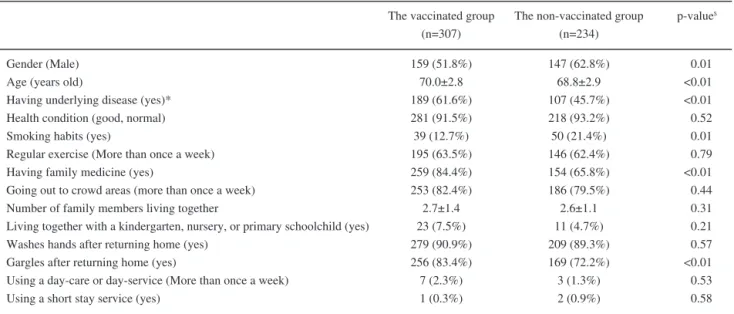
A total of 541 community-dwelling elderly were followed during the 06/07 influenza season. Participants included 306 (56.6%) males with a mean age (± standard deviation; SD) of 69.5 ±2.9 years. The rate of vaccination was 56.7%. Table 1 shows a comparison of the baseline variables between the vaccinated group and the non- vaccinated group. The vaccinated group was more likely to be female (p=0.01), older (p<0.01), to have underlying disease (p<0.01), to have never been a smoker (p=0.01), to have family medicine (p<0.01), and to gargle after returning home (p<0.01) than the non- vaccinated group.
Table 2 shows the ILI affection, and the vaccination situation in 2005/2006 (05/06) seasons. The vaccinated group in the 05/06 season was less likely to have an ILI in the 05/06 season (p<0.01), and more likely to vaccinate in the 06/07 season (p<0.01) than the non-vaccinated group in 05/06.
Table 3 illustrates the ILI affection and the vaccination situation in the 04/05 seasons. The vaccinated group in the 04/05 season was less likely to have an ILI in the 04/05 season (p=0.04), and more likely to vaccinate in the 06/07 season (p<0.01) than their counterparts.
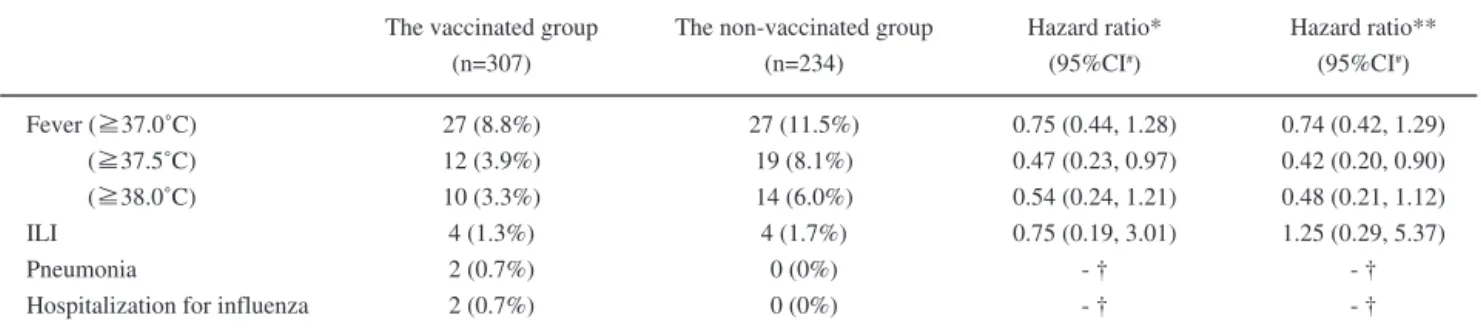
The effect of the vaccine for each event is shown in Table 4. When the patients vaccinated, the risk of fever higher than or equal to 37.5˚C for the latter was reduced compared with their counterparts (crude:
HR=0.47, 95%CI=(0.23, 0.97); adjusted: HR=0.42,
95%CI=(0.20, 0.90)). We compared the groups with and
without underlying diseases, and the factor of having an
underlying disease was not significant, although we did not show the data in the table.
Table 5 demonstrates the baseline characteristic in fevers higher than or equal to 37.5˚C. The group that had a fever higher than or equal to 37.5˚C were more likely to live together with a daughter (p=0.01), or kindergarten,
nursery, or primary schoolchild (p=0.04) than the group that didn’t have a fever higher than or equal to 37.5˚C.
Also, the group that had a fever higher than or equal to 37.5˚C were less likely to vaccinate in 05/06 (p=0.03) than their counterparts.
Table 2 Influenza-like illness (ILI) affection in the 05/06 seasons, and the vaccination situation in the 06/07 seasons; comparing the vaccinated group and non-vaccinated group in the 05/06 season
ILI in the 05/06 season Vaccination in the 06/07season
The vaccinated group in the 05/06 season
(n=282) 3 (1.1%) 263 (93.3%)
The non-vaccinated group in the 05/06 season
(n=259) 13 (5.0%) 44 (17.0%)
p-value$
<0.01
<0.01 number (%)
p-value$: Fisher’s exact test Table 1 Baseline characteristic
Gender (Male) Age (years old)
Having underlying disease (yes)*
Health condition (good, normal) Smoking habits (yes)
Regular exercise (More than once a week) Having family medicine (yes)
Going out to crowd areas (more than once a week) Number of family members living together
Living together with a kindergarten, nursery, or primary schoolchild (yes) Washes hands after returning home (yes)
Gargles after returning home (yes)
Using a day-care or day-service (More than once a week) Using a short stay service (yes)
The vaccinated group (n=307) 159 (51.8%)
70.0±2.8 189 (61.6%) 281 (91.5%) 39 (12.7%) 195 (63.5%) 259 (84.4%) 253 (82.4%) 2.7±1.4 23 (7.5%) 279 (90.9%) 256 (83.4%) 7 (2.3%) 1 (0.3%)
The non-vaccinated group (n=234) 147 (62.8%)
68.8±2.9 107 (45.7%) 218 (93.2%) 50 (21.4%) 146 (62.4%) 154 (65.8%) 186 (79.5%) 2.6±1.1 11 (4.7%) 209 (89.3%) 169 (72.2%) 3 (1.3%) 2 (0.9%)
p-value$
0.01
<0.01
<0.01 0.52 0.01 0.79
<0.01 0.44 0.31 0.21 0.57
<0.01 0.53 0.58 number (%), means ± SD
underlying disease *: one or more of the following criteria: high blood pressure, a cardiovascular disease, a respiratory system disease, diabetes, a cerebrovascular disease
p-value$: Fisher’s exact test, Mann-Whitney’s U test.
Table 3 Influenza-like illness (ILI) affection in the 04/05 seasons, and the vaccination situation in the 06/07 seasons; compared vaccinated group and non-vaccinated group in the 04/05 season
ILI in the 04/05 season Vaccinated in the 06/07season
The vaccinated group in the 04/05 season
(n=231) 4 (1.7%) 208 (90.0%)
The non-vaccinated group in the 04/05 season
(n=310) 16 (5.2%) 99 (31.9%)
p-value$
0.04
<0.01 number (%)
p-value$: Fisher’s exact test
5 DISCUSSION
In the baseline characteristics, the vaccinated group was more likely to never have been a smoker, and gargle after returning home. There is possibility that the vaccinated group had a healthier consciousness than their counterparts, and there may have also been selection bias. The vaccinated group may have taken the
recommendation of the vaccination more than the non- vaccinated group, because the vaccinated group was more likely to have an underling disease and family medicine.
In the present study, the vaccinated group in the 05/06 season was less likely to have an ILI in the 05/06 season (the vaccinated vs. the non-vaccinated: 1.1%
vs. 5.0%) and the vaccinated group in the 04/05 season was less likely to have an ILI in the 04/05 season (the
Table 4 Effect of the vaccine for each eventFever (≧37.0˚C) (≧37.5˚C) (≧38.0˚C) ILI
Pneumonia
Hospitalization for influenza
The vaccinated group (n=307) 27 (8.8%) 12 (3.9%) 10 (3.3%) 4 (1.3%) 2 (0.7%) 2 (0.7%)
The non-vaccinated group (n=234) 27 (11.5%)
19 (8.1%) 14 (6.0%) 4 (1.7%)
0 (0%) 0 (0%)
Hazard ratio**
(95%CI#) 0.74 (0.42, 1.29) 0.42 (0.20, 0.90) 0.48 (0.21, 1.12) 1.25 (0.29, 5.37)
- † - † number (%)
p-value$: Fisher’s exact test CI#: confidence interval
The vaccinated group vs. the non-vaccinated group Hazard ratio*: crude
Hazard ratio**: adjusted for sex, age, and underlying disease (one or more of the following criteria; high blood pressure, a cardiovascular diease, a respiratory system disease, diabetes, a cerebrovascular disease).
† : Could not be calculated.
Hazard ratio*
(95%CI#) 0.75 (0.44, 1.28) 0.47 (0.23, 0.97) 0.54 (0.24, 1.21) 0.75 (0.19, 3.01)
- † - †
Table 5 Baseline characteristic in fever higher than or equal to 37.5˚C
Gender (Male) Age (years old)
Having underlying disease* (yes) Health condition (good, normal) Smoking habits (yes)
Regular exercise (More than once a week) Going out to crowded areas (more than once a week) Number of family members living together
Living together with a daughter (including the justice) (yes)
Living together with a kindergarten, nursery, or primary schoolchild (yes) Washes hands after returning home (yes)
Gargles after returning home (yes)
Using a day-care or day-service (More than once a week) Using a short stay service (yes)
Vaccinated in the 05/06 (yes) Vaccinated in the 04/05 (yes)
More higher than or equal to 37.5˚C p-value$
0.36 0.58 0.85 0.29 0.45 0.34 1.00 0.14 0.01 0.04 0.76 0.27 - **
- **
0.03 0.27 number (%), means ± SD
underlying disease *: one or more of the following criteria: high blood pressure, a cardiovascular disease, a respiratory system disease, diabetes, a cerebrovascular disease
p-value$: Fisher’s exact test, Mann-Whitney’s U test.
**: Could not be calculated.
15 (48.4%) 69.2±3.1 18 (58.1%) 27 (87.1%) 3 (9.7%) 17 (54.8%) 25 (80.6%) 3.1±1.9 13 (41.9%)
5 (16.1%) 29 (93.5%) 22 (71.0%) 0 (0%) 0 (0%) 10 (32.3%) 10 (32.3%) Not having (n=510)
291 (57.1%) 69.5±2.9 278 (54.5%) 472 (92.5%) 86 (16.9%) 324 (63.5%) 414 (81.2%) 2.6±1.2 109 (21.4%)
29 (5.7%) 459 (90.0%) 403 (79.0%) 10 (2.0%)
3 (0.6%) 272 (53.3%) 221 (43.3%) Not having
(n=510)
vaccinated vs. the non-vaccinated: 1.7% vs. 5.2%) than their counterparts. Hara et al
16)reported vaccinated group were less likely to have ILI than non-vaccinated group. The result of the present study supported the result of the study
16), though year in an influenza season, the type of endemic influenza viruses, and area in Japan were different. However, there is a possibility of misclassification
11)or selection bias, because the vaccinated group may be likely to attend a hospital after they become sick. This study of effectiveness of an influenza vaccine in persons aged 65 years or over living in a community was limited
17-19), especially in the effectiveness for ILI
14, 20).
The vaccinated group in the 05/06 season was more likely to vaccinate in the 06/07 season than the non- vaccinated group in the 05/06 (the vaccinated vs. the non- vaccinated: 93.3% vs. 17.0%), and the vaccinated group in the 04/05 season was more likely to vaccinate in the 06/07 season (the vaccinated vs. the non-vaccinated:
90.0% vs. 31.9%) than their counterparts. If the community-dwelling elderly were vaccinated once, the elderly may be vaccinated again the next year. Therefore, it would be important for the Japanese Government to intervene to find ways to vaccinate for the elderly.
In this present cohort study among community- dwelling elderly, influenza vaccination reduced the risk of a fever higher than or equal to 37.5˚C during the epidemic period. The result of the present study supported the result of the previous cohort study in Saga
15). Critical point of high fever of this study (37.5˚C) was different from that of the previous study in Saga (38.5˚C)
16). Because there are no other reports, to our knowledge, regarding effectiveness of influenza vaccine reducing risk of acute febrile illness, future study is necessary to identify the critical point of high fever for vaccine effectiveness. In a follow-up survey over the telephone, it was difficult to perform an influenza judgment in the present study because the survey asked a self-report, however it is correct for judging the fever. A high fever from influenza is an important health hazard in elderly in a community.
Comparison between a high-risk condition group and a low-risk condition group are important in a general influenza study
21), and it was not significant in the present study. Although we compared risk of having ILI between a high-risk group and a low-risk group, it was not significantly different. No difference between them might occur from small sample size, relatively low response rate (54%), or low prevalence of pneumonia during this
influenza seasons in Japan compared with a report in Europe
22). Such variables do not capture the important difference in health status between vaccinated and unvaccinated individuals, and the adjustment for these variables alone does not remove the confounding factors.
In our future study, we will control for confounding with detailed medical record information.
In the present study, the group that had a fever higher than or equal to 37.5˚C was more likely to live together a daughter (p=0.01), or a kindergarten or nursery or a primary schoolchild (p=0.04) than the group that didn’t have a fever higher than or equal to 37.5˚C. There is possibility that a child brought the influenza virus into the house. ACIP
1)has recommended that health-care workers take vaccination against seasonal influenza. It is thought that prevention in the whole family is important.
Certain limitations in the present study should be disclosed. First, the present study may have had a selection bias because the response rate was 54.2%.
Second, the number of subjects was insufficient. Third, there was the possibility of misclassifications in the present study because the judgment of influenza was taken via a self-report, although we confined it to physician’s diagnosed ILI.
In conclusion, a population based cohort study was conducted during the 06/07 influenza season to examine the effectiveness of an influenza vaccine among 541 community-dwelling elderly, ranging from 65 to 74 years. After adjusting for confounders, the vaccination decreased acute fevers higher than or equal to 37.5˚C (HR
=0.42, 95% CI=(0.20, 0.90)) during the epidemic period.
Therefore influenza vaccinations may be decreased acute fevers during influenza epidemic periods in community- dwelling elderly.
Acknowledgments
Our special thanks go to the participants in the present study, which was in part supported by research grants provided by the Ministry of Health, Labor and Welfare.
References
1. Smith NM, Bresee JS, Shay DK, Uyeki TM, Cox NJ, Strikas RA. Prevention and control of influenza:
recommendations of the Advisory Committee on Immunization Practices (ACIP). MMWR Recomm Rep 2006; 55: 1-42.
2. Barker WH, Mullooly JP. Influenza vaccination of elderly persons. Reduction in pneumonia and influenza
hospitalization and deaths. JAMA 1980; 244: 2547-2549.
3. Mulloly JP, Bennet MD, Hornbrook MC, Backer WH, Williams WW, Patriarca PA, Rhodes PH. Influenza vaccination programs for elderly persons: cost-effectiveness in a health maintenance organization. Ann Intern Med 1994;
121: 947-952.
4. Nichol KL, Margolis KL, Wuorenma J, Von Sternberg T.
The efficacy and cost effectiveness of vaccination against influenza among elderly persons living in the community. N Engl J Med 1994; 331: 778-784.
5. Nichol KL, Wuorenma J, von Sternberg T. Benefits of influenza vaccination for low-, intermediate-, and high-risk senior citizens. Arch Intern Med 1998; 158: 1769-1776.
6. Nordin J, Mullooly J, Poblete S, Strikas R, Petrucci R, Wei F, Rush B, Safirstein B, Wheeler D, Nichol KL. Influenza vaccine effectiveness in preventing hospitalizations and deaths in persons 65 year or older in Minnesota, New York, and Oregon: data from 3 health plans. J Infect Dis 2001;
184: 665-670.
7. Davis JW, Lee E, Taira DA, Chung RS. Influenza vaccination, hospitalizations, and costs among members of a Medicare managed care plan. Med Care 2001; 39:
1273-1280.
8. Nichol KL, Nordin J, Mullooly J, Lask R, Fillbrandt K, Iwane M. Influenza vaccination and reduction in hospitalizations for cardiac disease and stroke among the elderly. N Engl J Med 2003; 348: 1322-1332.
9. Hak E, Nordin J, Wei F, Mullooly J, Poblete S, Strikas R, Nichol KL. Influence of high-risk medical conditions on the effectiveness of influenza vaccination among elderly members of 3 large managed-care organizations. Cli infec Dis 2002; 35: 370-377.
10. Voordouw BC, van der Linden PD, Simonian S, van der Lei J, Sturkenboom MC, Stricker BH. Influenza vaccination in community-dwelling elderly: impact on mortality and influenza-associated morbidity. Arch Intern Med 2003; 163:
1089-1094.
11. Ozasa K, Kawahito Y, Doi T, Watanabe Y, Washio M, Mori M, Kase T, Maeda A, Hirota Y. Retrospective assessment of influenza vaccine effectiveness among the non- institutionalized elderly population in Japan. Vaccine 2006;
24: 2537-2543.
12. Gross PA, Quinnan GV, Rodstein M, LaMontagne JR, Kalow RA, Saah AJ, Wallenstein S, Neufeld R, Denning C, Gaerlan P. Association of influenza immunization with reduction in mortality in an elderly population. A prospective study. Arch Intern Med 1988; 148: 562-565.
13. Monto AS, Hornbuckle K, Ohmit SE. Influenza vaccine effectiveness among elderly nursing home residents: a cohort study. Am J Epidemiol 2001; 154: 155-160
14. Govaert TM, Thijs CT, Masurel N, Sprenger MJ, Dinant GJ, Knottnerus JA. The efficacy of influenza vaccination in elderly individuals. A randomized double-blind placebo- controlled trial. JAMA 1994; 272: 1661-1665.
15. Hara M, Sakamoto T, Tanaka K. Effectiveness of influenza vaccination in preventing influenza-like illness among community-dwelling elderly: population based cohort study in Japan. Vaccine 2006; 24: 5545-5551.
16. Hara M, Sakamoto T, Tanaka K. Influenza vaccine effectiveness among elderly persons living in the community during the 2003-2004 season. Vaccine 2008; 26: 6477-6480.
17. Foster DA, Talsma A. Furumoto-Dawson A, Ohmit SE, Margulies JR, Arden NH, Monto AS. Influenza vaccine effectiveness in preventing hospitalization for pneumonia in the elderly. Am J Epidemiol 1992; 136: 296-307.
18. Crocetti E, Arniani S, Bordoni F, Maciocco G, Zappa M Buiatti E. Effectiveness of influenza vaccination in the elderly in a community in Italy. Eur J Epidemiol 2001; 17:
163-168.
19. Wang CS, Wang ST, Chou P. Efficacy and cost-effectiveness of influenza vaccination of the elderly in a densely populated and unvaccinated community. Vaccine 2002; 20:
2494-2499.
20. Vu T, Farish S, Jenkins M, Kelly H. A meta-analysis of effectiveness of influenza vaccine in persons aged 65 years and over living in the community. Vaccine 2002; 20:
1831-1836.
21. Mori M, Oura A, Ohnishi H, Washio M. Confounding in evaluating the effectiveness of influenza vaccine.Vaccine 2008; 26: 6459-6461.
22. Jackson ML, Nelson JC, Weiss NS, Neuzil KM, Barlow W, Jackson LA. Influenza vaccination and risk of community- acquired pneumonia in immunocompetent elderly people: a population-based, nested case-control study. Lancet 2008;
372: 398-405.
Correspondence:
Asae OURA
Department of Public Health, School of Medicine, Sapporo Medical University
Chuo-ku Minami-1 Nishi-17, Sapporo, Hokkaido, 060-8556, Japan phone number: +81-(0)11-611-2111
FAX number: +81-(0)11-641-8101 Email: [email protected]
2006-07 シーズンでの地域居住高齢者における
急性発熱疾患に対するインフルエンザワクチンの効果:
日本におけるコホート研究
大 浦 麻 絵
1),大 西 浩 史
1),原 め ぐ み
2),坂 内 文 男
1), 伏 木 康 弘
1),森 満
1)1)札幌医科大学医学部公衆衛生学
2)佐賀大学医学部社会医学
背景:毎年のワクチン接種は,療養所などの入所者と 同様に,医学的高リスク集団に対し推奨されている.し かしながら,地域居住高齢者におけるインフルエンザワ クチン効果についてはほとんど分かっていない.
方法:地域居住高齢者におけるインフルエンザワクチ ン効果を調べることを目的とし,2006-2007 年(06/07)
のインフルエンザ流行期にコホート研究を行った.2006 年 9 月に札幌市住民基本台帳から 65 〜 74 才の地域居住 高齢者 1,000 人を無作為に選出した.ベースライン調査 は 2006 年 10 月,11 月に行われ,542 人(54.2%)が研 究参加に同意をした.追跡開始前に 1 人死亡したため除 外 し,541 人 を 解 析 対 象 者 と し た.2006 年 12 月 か ら 2007 年 4 月まで毎月(計 5 回)電話による追跡調査を行 い,発熱,入院などの発生について尋ねた.カイ二乗検定,
Mann-Whitney の U 検定でワクチン接種群と非接種群の 比較を行い,Cox の比例ハザードモデルを用い交絡要因 を調節した Hazard Ratio(HR)を算出した.
結果:補正後,
ワ ク チ ン接種群
は非接種群
に比
べ て2006 年 12 月
か ら2007 年 4 月
ま で の間
の37.5 度以上
の発熱(HR = 0.42,95%信頼区間=(0.29,
5.37) )
においてリスクが低下
した.
しかしながら,
インフルエンザ
様疾患
とは関係
が無
かった(HR = 1.25 , 95 % CI =( 0.29 , 5.37 ) ) .
まとめ:インフルエンザワクチン接種は,地域居住高 齢者に対しインフルエンザ流行期の発熱を減少させるこ とが示唆された.