Introduction
There is no need, I am sure, to argue for the importance of writing in higher education.
It is at the core of the professional text-based literacies that university graduates are pre- sumed to possess, even as we move into a digitized, globalized twenty-first century. Yet the complex role of writing in learning and its relation to a broad concept of literacy as socio- cultural competence are still not widely acknowledged. In many quarters of the university, writing continues to be employed as a mere tool of assessment, that is, as a means of dem- onstrating content knowledge in the form of reports and term papers, exams and short an- swer tests. Here, writing is regarded as a fairly transparent medium for display of the knowledge that experts have poured into the minds of novices. At the same time ― and also absent from consideration, I believe ― is a recognition of the socially constituted, rhetorical nature of the written competency that disciplines demand of their students. These absences
― indeed, the absence of a more wide-ranging discussions of pedagogy ― are strangely prominent in English Studies, the presumed "home" of national Englishes, that is to say, lit- erature, composition, and occasionally linguistics. As eminent American literary critic Elaine Showalter writes in Teaching Literature (2003), "Among the more abstract sources of our present anxieties is our inability to articulate a shared vision of our goal that can pro- vide a sense of ongoing purpose and connection. Attention to pedagogy itself itself, and to learning theory, could offer a new direction for English studies for the new century"
(Showalter 24). Surveying the curricular history of writing in English departments and the current state of literary studies, one must concur with Showalter that a "shared vision" is (and for some time has been) lacking. And while the lack of consensus is not entirely to be lamented ― a plurality of visions may be indeed healthy ― the state of teaching is another matter. Showalter's call for attention to pedagogy and learning theory will sound hopelessly belated, not least to the composition specialists who co-habit English departments but also to their neighbours in Applied Linguistics, where a globally dispersed cohort of researchers and educators have arisen to challenge literature professionals' hold on the great books.
Writing in the English-Medium Literature Classroom:
The Why and the How
Christopher J. Armstrong
Article
The main aim of this paper is practical: to describe an academic course in modern American poetry taught in an EFL setting (Japan). The course places writing at the center of the curriculum in order to help foster students' identities as thoughtful readers of litera- ture and competent writers about it, and to get them to begin to work at a conceptual and rhetorical understanding of literary studies as a discipline. In order to do this, the course draws on and adapts Writing to Learn (WTL) and Writing in the Disciplines (WID) ap- proaches, both of which have been central to North American initiatives in Writing Across the Curriculum. The discussion of both WTL and WID frames a description of note-taking, structured journal writing and class discussion activities which aim to induct students into one of the discipline's major academic genres, the analytical essay.
Part one recasts the debate on literature in the language curriculum in terms of a more purely academic English-medium approach using WTL and WID, but does not neglect con- cerns raised by researchers and educators in language instruction, EAP and CLIL. Indeed, that students are language learners in an EFL context requires a consideration of the unique place that literature occupies in foreign language education ― it is, after all, part of the world of discourse that students are aiming to master. This entails not only a consideration of the cadre of professional instructors teaching literature (EFL instructors, linguists, trans- lators, literature specialists) and the approach adopted in the classroom, but also attention to the ways in which the study of literature can complement language learning, bringing specific benefits to English learners, as Widdowson pointed out long ago (Widdowson 81- 2). Yet while this essay is not primarily concerned with literature's use in or value to lan- guage study, it does return, in its concluding remarks, to questions of language education in light of the changes that are currently taking place in the growing global network of non- anglophone institutions where English Studies has found a home. Part two outlines initia- tives in WAC, including the role of WTL and WID as approaches to socio-literacy, namely, the process of thinking and writing within the socio-cultural space of the classroom and the discipline. Part two emphasizes how writing activities can promote conceptual understand- ing and practical realization of the rhetorical structure of the analytical essay while part three reports on the WTL component of an introductory course on American poetry, de- scribing a set of structured writing activities that build toward competence in the analytical essay.
1 Background: Writing Across the Curriculum
There has been considerable institutional commitment in anglophone universities in the UK and North America to the development of students' writing skills. This commitment in- volves a recognition of the importance of writing to the learning process. There has also
been attention to the rhetorical and socially constituted nature of disciplinary knowledge, giving rise to an approach known as Writing in the Disciplines. These two form the main strands of the Writing Across the Curriculum (WAC) movement, a hybrid of British and American influences, which has been a part of higher education pedagogy since the late 1970s and which continues to set the direction for educational reforms at universities and colleges. We can find statements about WAC on the websites of university-housed Writing Centres or Teaching and Learning Centers, such as this one from Georgia State University in the US:
Writing Across the Curriculum (WAC) is a pedagogical movement which holds that development of critical thinking skills, discipline specific knowledge, and formal aca- demic communication are fostered by the frequent incorporation of writing in the classroom. WAC promotes the following principles:
Writing advances learning in any subject area.
Writing development requires continuous effort.
Writing cannot be separated from the discipline in which it is practiced.
Writing is best taught by someone who combines disciplinary expertise and writ- ing experience. (Center)
In general, the principles set out above require little explanation. However, the impor- tance of disciplinary expertise in a community of practice is a key element distinguishing WAC from curricular initiatives designed by and for literary study in foreign language con- texts, where language professionals may be the main agents of language and content instruc- tion. Disciplinary expertise is not the same as what Applied Linguists and CLIL specialists call content knowledge. It entails specialist knowledge, an active research program, and en- gagement with the academic community. Likewise, Cremin and Locke point out, the impor- tance of active writers as teachers, arguing "young people's writer identities are strongly influenced by the ways in which their teachers identify as writers" (xvii). While typically (and lamentably) pedagogically unschooled ― accredited specialists in literature, cultural studies, and other humanities fields are crucial to the endeavour of helping students develop literacy within a community of practice, including identities as readers and writers. Literacy here is of course defined in a broad sense, broader than the mere ability to read and write;
rather it is, as Anne M. Johns defines it, "ways of knowing particular content, languages, and practices" (2). It refers to "strategies for understanding, discussing, organizing, and pro- ducing texts" in terms of "the social context in which a discourse is produced" (2). WAC theorists follow, in large measure, this notion of literacy, emphasizing not only the need for students to be able to write in their discipline but also an understanding of the ways in
which writing facilitates learning, linking to reading, active listening and speaking, and dis- cussion. Ideally, literacy is modeled (modeled by the practitioner) as well as taught as con- tent in order to instill a sense of what kinds of thinking the community values. It is acquired by students through their classroom learning (itself a community), using the conventions, forms and topics of importance in another (and largely unknown) community (a research community: literature, biology, physics, engineering). Thus, the classroom is a training ground for socio-literacy. What makes this notion of socio-literacy compelling for educationists is the argument that the habits and competencies gained in one sphere are to a significant degree transferrable to other spheres of social practice, that protocols of liter- acy in one field can scaffold a life-time's journey through various settings where both famil- iar and novel competencies are required. That is, a student's "socialization" within the academic discourse community of English literary studies provides one set of literacies and experiences to which others will accrue across the life of the individual. Of course, there are also specific benefits to a period of immersion in the literary community of practice, some of which will be mentioned below.
2 WAC Approaches: Writing to Learn and Writing in the Disciplines
Whether academic instruction takes place in a native English environment ― an anglo- phone university in the United States, for example, ― or in foreign language context, such as a Japanese university English Department ― the desired educational outcomes are, I want to suggest, the same. Ideally, instructors introduce subject knowledge and disciplinary con- cepts at the same time as they require, perhaps also instruct students in, a set of general aca- demic skills with the hope of fostering an understanding of approaches and themes that the community of researchers believe are important ― what Johns, already cited, calls socio- literacy. As a number of scholars have pointed out, writing can make an important contri- bution to reaching this goal. Discussing WTL and WID approaches, Lecourt summarizes the benefits as follows: "learning to write according to the disciplinary norms of a certain profession is inextricably linked to encouraging the type of thinking valued within that dis- cipline. Writing-to-Learn activities . . . have the ability to not only make disciplinary con- cepts more familiar to students but also to serve as preparation for more transactional writing about these concepts" (Lecourt 389).
What follows from here reviews "Writing to Learn" (WTL) and "Writing in the Dis- ciplines" (WID), the main approaches of the WAC movement, briefly explaining their de- velopment and applications before turning to a discussion of how to adapt them to an English-medium literature class in the foreign-language context. To be sure, one of the aims of the EFL American Literature course to be presented below is to satisfy a key post-
secondary educational requirement in literary studies ― the writing of essays. However, I want to insist that the requirement ― the end "product", which I hold to be of equal impor- tance to the "process" through which it is realized ― is not just an educational tick box, but rather can and should be valued, among other things, as one token of acquired expertise in the ongoing, life-long development of socio-literacy. It is also, and no less importantly, an exercise for students' personal and intellectual development, whether in a first or a second language. While knowledge of literary forms confers a certain amount of personal enrich- ment and cultural capital for learners, the familiarity with the norms and interests of a com- munity of practice (literary studies) is but one path through the larger field of social and professional experience.
Writing to Learn approaches came into favour in the 1970s and 80s after British educator James Britton and American researcher Janet Emig provided key insights into the impor- tance of writing in students' understanding and acquisition of knowledge. Placing what he called "expressive writing" as one of three functional forms alongside the "transactional" and the "creative," Britton argued for "the personal and psychological utility of writing in learn- ing settings," laying the groundwork for "the idea that cross-curricular writing programs could enhance student learning" (Bazerman et al., 58). In a 1977 paper entitled "Writing as a Mode of Learning," Emig argued for the importance of research on the writing process as integral to how learning takes place (Emig 122). As Bazeman et al. point out, the upshot of Emig's findings was that "Because writing is neurophysiologically integrative, connective, active, and available for immediate visual review . . . it represents a unique form of learning that deserves incremental and theoretical attention" (58).
Subsequent research addressed the relative value of journal writing alongside other activi- ties, such as note-taking, summary writing, and open-ended freewriting. And while some have pointed out that the learning gains from writing may reside solely in the amount of time required to work with the material, studies such as those by Newell and Winograd (1989) found that producing relatively finished and structured texts was superior in learn- ing benefit than note-taking, especially with regard to understanding of how original pas- sages are organised and with regard to recall of gist. Meanwhile, other studies confirmed the superiority of writing activities over mere studying and reading, suggesting that writing ac- tivities can be adapted to the acquisition of different kinds of information, and that "ana- lytic writing promotes more complex and thoughtful inquiry on a smaller amount of information" (Langer and Applebee 136). By the 1980s, Bazerman et al. tell us, the use of journals as instruments of writing to learn had won considerable favour among teachers of writing, culminating the celebratory The Journal Book (1987). As subsequent research en- gaged itself in demonstrating the specific benefits of the journal as part of an academic sub- ject curriculum, specific approaches to the journal have been documented in academic
subject areas such as engineering, nursing, history, philosophy art, music, and physics (Bazerman et al., 59-61).
More recent research points to the role of structured approaches in writing to learn activi- ties as holding the most benefit to students. MacDonald and Cooper (1992) demonstrated the superiority of academic (teacher-structured) journal writing over dialogic (student- structured). In fact, the authors found that those students who kept open-ended dialogic journals performed more poorly than those who did no journal writing at all, concluding that "left to their own devices students may fail to perceive the issues, perceive them in ways different from their professors, or remain at too low a level of abstraction (qtd. in Bazermann et al. 61). Amer (2013) reports that "explicit instruction of rhetorical structure of texts can be a pedagogically useful source for improving writing quality" (231). In sum then,"A general predisposition towards discovery writing as a general and unqualified good needs to be replaced with a more precise investigation of how specific kinds of activities sup- port specific forms of learning" (Bazerman et al., 62). The approach described below takes a structured approach to journal writing, partly on the above-stated grounds of cognitive benefit but also on the need for language learners to work within clearly defined expressive and organizational parameters: collocations in an academic register, specific discourse func- tions and larger rhetorical moves.
Yet if a significant portion of the research demonstrates that structured, strongly articu- lated forms of writing hold out the most promise for developing students' cognitive and rhe- torical skills, there has also been criticism of the how WAC programs induct students into the community of academic discourse. Donald Bartholomae, Donna Lecourt, and Patricia Bissell have addressed the contested nature of the academic discourse construct, influenced by advances in literary theory and cultural studies, calling for a critical pedagogy of WAC (Lecourt 391). Lecourt argues that "WAC focuses on accommodating students" to aca- demic discourse, continuing that "we seem to have forgotten the concern for alternative literacies and voices Other to the academy that permeates much of our discussion of writing courses in an English department" (390). These are valuable insights that can be applied in the EFL context, namely, with regard to the differing cultural assumptions and educational formation students bring to the study of literature and the pursuit of writing.
3 Teaching an English-Medium Literature Class
3.1 Course Description and Objectives
American Literature A is an elective course for students in second-, third- and fourth- years in the Department of World Englishes at Chukyo University. The 15 week course is a survey of American poetry in the twentieth century. The syllabus informs students that
the main aim of course is to explore how "American writers have used poetry to express the experience of modern life" (Armstrong, American Poetry) ― hopefully, an effective sum- mary of the course's goal of treating the creative use of language resources in poetry with an understanding of the cultural contexts within which these expressive acts took shape.
Indeed, as the syllabus states, the course is to significant degree a exploration of cultural his- tory through poetry: "Course objectives include (1) knowledge of American culture and so- ciety in the 20th century; (2) ability to read, analyze, discuss and write about poetry; (3) knowledge of the development of American poetry and its relation to the broader culture of the US." (Armstrong, "Syllabus." American Poetry). Given that the course is both introduc- tory and targeted at foreign-language learners, the issue of text selection is an important concern. While for many advocates of literature in the EFL classroom, learning benefits outweigh the challenges posed by authentic literary texts, the question of representing the canon is something that a literature specialist needs to consider. I would point out, however, that as a venture into cultural history, the course described here is already an act of decentering the American poetic canon. One way in which this occurs in the class ― quite naturally to reflect the Japanese context ― is to address the ways in which American writers have drawn on Asian as well as Japanese art forms in movements such as literary modern- ism. In general, however, the selection criteria do not radically depart from those that might figure in a course offered at an anglophone university. Poems are selected for accessibility, for brevity as well as representativeness, for specific pedagogical objectives as well as bio- graphical interest and cultural relevance.
Lectures and class activities are organized around three main approaches, introduced and practiced sequentially but, by the middle of the course intertwined in students' journal re- sponses and class discussions: Forms, Poets, Contexts. The formal approach of the course focuses attention on texts through a version of close reading, informed by stylistics and tra- ditional poetics. The biographical approach aims to familiarize students with the lives of the poets not merely for possible autobiographical reflections in the poems but also towards an understanding of the working lives of writers. The contextual approach calls attention to cultural history, to accounts of literary ideas and techniques, schools, etc., including literary criticism and reception as well as to the social, cultural and political contexts in which the poems are produced and to which they respond. The course evaluation consists of two tests (a short test on key terms and a mid-term exam on an assigned poem), a brief in-class pres- entation, a journal, and an analytical essay on a poem of the students' choosing. The journals represents the main component of the course with a 50% share of the final grade.
3.2 Concepts, Skills and Mid-Term Evaluation, Weeks 1-9
In the first class meeting, students are provided with a questionnaire about their back-
ground, interests, and contact information as well as a brief skills self-assessment. In addi- tion, students are asked to answer a few questions about their reading habits (frequency of reading, kinds of writing, knowledge of foreign or Japanese authors, etc.) while the final section of the questionnaire asks them to consider the function of literature: Why do we (in- deed all modern nations) have literatures and what is literature's purpose? Students are pro- vided with a selection of responses and asked to choose one, discuss with classmates, and write briefly about it. See Figure 1.
The responses to the prompt are reviewed in the second class meeting with the aim of ad- dressing some of the ways in which literature holds value both in terms of personal enrich- ment and social relevance. These ideas also serve as reference points as the course progresses, especially when discussing creative strategies (such as defamiliarization), aes- thetic doctrines (such as modernism) as well as the changing form and content of poetry and its relation to the events of the times.
The first lecture, also presented in the first class meeting, addresses the nature of poetic language in a preliminary fashion: How is poetry ― a major literary genre that is more or less universal across cultures ― different from other language genres, from fiction, of course, but also from such everyday genres as newspaper reports, magazine articles, and textbooks? Although much work in applied linguistics has concluded that literary discourse and the language of everyday life are not as distinct as once thought (Hall 10), poetry, as
3. Form a small group or work with a partner to discuss this question: What is the main purpose of literature (novels, short stories, poetry, drama)?
(a) to entertain the reader
(b) to communicate universal human truths
(c) to show us a different way of looking at the world
(d) to help us understand the minds of great and intelligent people (e) to make sense of the world
(f) to understand our nation and its culture
4. Using your answer in question 3, write one short paragraph below. Make sure your paragraph is organized around a main idea in the first sentence (topic sentence). Give reasons and examples to support your opinion. (Use the other side of the paper if you need to.) Example topic sentence: I think the purpose of literature is to show universal human truths.
Figure 1: Discussion Question and Writing Sample for Student Questionnaire
most would concede, holds a unique place among the language genres that make up the uni- verse of the written / spoken word. The components of sound and rhythm, the existence of formal rules for composition as well as the relative intensity of figurative language are high- lighted as features distinctive of and common to poetry. However, the preliminary lecture points out to students that the subjects, form, and language content of poetry change through time, the movement away and towards everyday usage constituting one of the course themes. The first session concludes with a discussion of some key terms for analyzing and discussing poetry and a brief exercise to check understanding of six key figures of speech (simile, metaphor, metonymy, synecdoche, personification and apostrophe), using relatively common everyday examples.
The first four weeks of the course focus on developing students' skills with formal analy- sis, during which time there is a short test on key terms and identification of the above six figures of speech in poems studied in class as well as one or two unseen excerpts. As the course proceeds, students settle into the task of making weekly entries on assigned poems, moving through imagism and onto modernism by the middle of the semester. While this phase of the course consists mostly of formal analysis, both biographical and contextual ap- proaches are introduced in order to provide glimpses into the ways in which writers' per- sonal experience and cultural contexts figure in the creation of the works. To take one example introduced at this stage, Paul Laurence Dunbar's "We Wear the Mask" is a poem that students typically read as universal in its theme of the public faces we adopt in social life; yet when Dunbar's identity as African American (the son of former slaves) is intro- duced along with a brief discussion of turn of the century Jim Crow laws and rules of eti- quette, the poem acquires an entirely new set of meanings. In this way, the importance of biography and context to illuminate textual meanings is made plain to students.
During this phase of the course and leading up to week 9, preparation for a mid-term test begins. All students are assigned the same poem, which they are required to research, ana- lyze, and discuss, preparing notes and an outline for a (minimum) two-paragraph written analysis, the sole task of the in-class mid-term. The aim of this assignment is to consolidate and assess students' ability to describe structure and linguistic features of a poetic text as well as support their interpretations of it around clearly stated claims using textual evidence.
Students are provided with a note paper that includes instructions, the text of the poem, and some focus questions. Students prepare an outline and notes on the paper, limited by space on both the printed and blank sides. A full 90 minute class period is devoted to the writing of the analytical response.
Three or more sessions are devoted to students' preparation for this writing task, begin- ning with unguided group discussions of the poem. These discussion sessions are not new.
By this point, students have been engaging in them since week two of the course. What has
changed is that the mid-term grade is at stake, and students will be for the first time held accountable for what they have been practicing in their journals and in their discussions.
During these sessions students are encouraged to ask questions of the instructor. A some- what piecemeal response ― more suggestive and prompting than explicit ― is made.
However, as the preparation progresses, points of form and meaning, biographical and criti- cal perspectives on the poem are introduced in brief lectures. In the week prior to the test, students receive a final short lecture synthesizing the formal, critical and biographical as- pects of the poem. This sequence ― of allowing relatively independent interpretation of the poem followed by gradual introduction of critical, biographical and cultural perspectives along with a more or less complete overview of the poem's structure and meaning ― has two main benefits: first, it allows students the freedom to develop their own readings of the poem, negotiate them with classmates, but also individually and collectively to adapt their readings to the given contexts and suggestions for interpretation provided by the instructor.
While discussing a number of important formal features of the poem, the final lecture be- fore the test offers at least two ways ― two interpretations, that is ― in which the poem could be understood. Second, and perhaps more importantly, this strategy places emphasis on the actual composition of the answer rather the search for a "correct" or original re- sponse. At this stage, students are informed about how the test answer will be assessed, namely, according to their use of clearly stated claims supported by textual evidence from the poem and from research and lectures.
The poem selected for the mid-term test is meant to satisfy part of the unit on modernism.
However, the selection ― Hart Crane's uncollected apprentice work "Forgetfulness" (1918)
― can hardly be considered representative of the poet's achievement as modernist poet in, say, "For the Marriage of Faustus and Helen, "At Melville's Tomb" or his epic The Bridge.
Here the selection is based on the some of the above stated criteria: accessibility and brevity, along with the poem's rich figurative language and other linguistic features. Important also is biographical relevance. The poem is organized around a theme that students find engag- ing: that of a young person finding his way in life and career amid personal (his sexuality) and familial (his own paternal rebellion, his parent's divorce) turmoil or as Lee Edelman puts it, "imaginative autonomy triumphing over external restraint" (50).
In sum, then, rather than being a "test" in the sense of a largely sight-unseen task, the mid- term is an assessment of the ability to do WTL work (to research, read closely interpret, to prepare effective notes) and express claims and organize the various structural moves in the writing of the paragraph-length journal entries. By the time of the mid-term test, students will have made entries on 4 or more poems in their journals. At this point, journals are col- lected and given an initial assessment.
3.3 The Journal
As indicated above, the journal is a key component of the course, and constitutes the pri- mary means by which WTL and WID activities and objectives are realized in the course.
However, the journal is not only a training ground for analytical competence; it forms the core of class activities and serves as a record of nearly all of students' work in the course.
The journal entries provide the basis for weekly discussions on assigned poems, including weekly entries and minutes of group discussions in class; class lecture notes; and notes, drafts, outlines for the mid-term test and the term essay. Accordingly, it is worth 50% of the final grade. Moreover, students' work on the poems is not confined to paragraph writing but also to such writing-to-learn tasks as annotation and note-taking. In addition to the required paragraph writing assignment each week, the following optional activities are suggested as aids to help students come to a practical and conceptual understanding of the poems:
1 Copying the poem into the journal by hand 2 Making a Japanese translation of the poem
3 Identifying difficult vocabulary, non-standard word order, other unusual construc- tions, etc.
4 Annotating textual features, including phonological features, patterns of rhyme, fig- ures of speech, etc.
5 Seeking out print or online sources of commentary, biographical information, his- torical background on the period / place in which the poem was published
6 Making preparatory notes and outlines for the mid-term test and end of term analyti- cal essay
Most all students complete one or more of the above activities for each of the assigned poems, which provides a basis for the paragraphs on structure and linguistics features, and on interpretation of the poem, including pattern of stress and rhyme, phonological patterns (alliteration, assonance and consonance), figures of speech, word connotation, historical al- lusions, etc.). To give students an idea of expectations for the journal entries, model para- graphs are distributed in the first class meeting, and excerpts from former students' notebooks are shown to the class, helping to illustrate items 1-6 above. Thus, through the journal students develop their conceptual understanding, analytical and transactional / ex- pressive skills as well as document their work in the class in lecture notes, minutes of discus- sions, and mid-term and essay research / planning.
3.4 The Analytical Essay, Weeks 9-15
The essay of literary analysis is an academic genre firmly established in North American
secondary and tertiary education. Its aim is, in large measure, to demonstrate competence in the close reading of literary texts. Fuss and Gleason define close reading as "the art of at- tending to the details of a text (its structure, diction, tone, syntax, sound, imagery, theme) often as a way to identify or understand its larger cultural historical or literary contexts"
(Fuss and Gleason xix). Among applied linguists, stylistics is the name for this mode of analysis, which Leech, noting the modern decline of rhetoric and composition, contends
"provides a more solid theoretical foundation and a deeper understanding of language"
(Leech 2). Since practices of close reading often assume native-speaker levels of compe- tence, recourse to stylistics in the EFL context not only overcomes the often impressionistic nature of literary close reading but also, as Widdowson points out, can meaningfully inform students engaged in the study of the language (81).
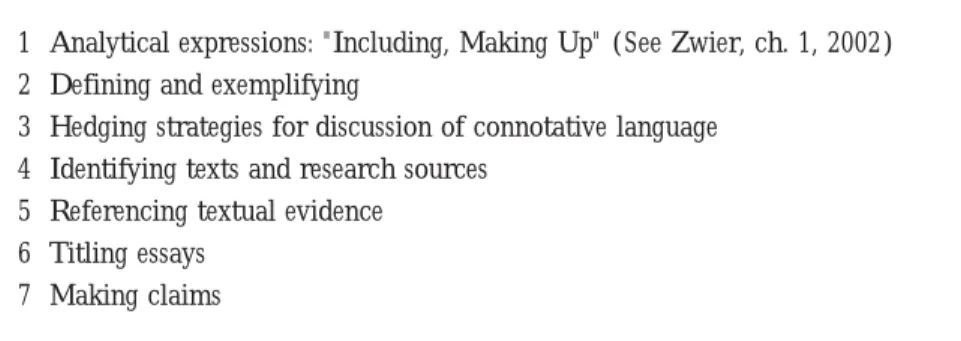
The final assignment in the course, a short analytical essay on a poem of the students' choice, follows directly from the activities of the journal and the mid-term. Indeed, students are encouraged to draw on paragraph journal entries to form the analytical core of the essay. What remains for students to do is to attempt the unique rhetorical structures of the essay title, the introduction, the thesis statement, and the concluding paragraphs as well as practice more extensively forms of documentation according to MLA reference style. The introduction of the assignment includes an annotated model essay which is reviewed in class. The model essay highlights a number of discourse functions (See Figure 2). Special emphasis is given to the structure of the introductory and concluding paragraphs and to the framing of a thesis statement. These three forms are modeled and ― given sufficient class time ― students' tentative thesis statements are collected via email and distributed for dis- cussion in groups, using a set of evaluative criteria. A portion of the following class meet- ings (20-30 minutes) is devoted to sequenced workshop sessions on the writing of the essay.
These sessions deal with a number of the discourse functions outlined above. Some are re- viewed again when essay drafts are returned to students.
Students submit a draft essay about four weeks prior to the final due date. This is assessed
1 Analytical expressions: "Including, Making Up" (See Zwier, ch. 1, 2002) 2 Defining and exemplifying
3 Hedging strategies for discussion of connotative language 4 Identifying texts and research sources
5 Referencing textual evidence 6 Titling essays
7 Making claims
Figure 2: Selected Discourse Functions in the Analytical Essay
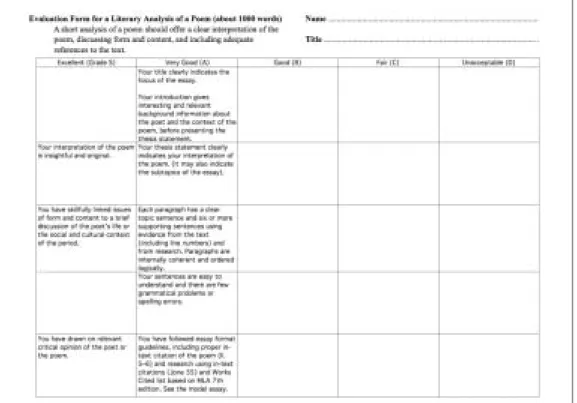
according to a rubric that allows for specific comments on the main sections of the essay, on the rhetorical moves and on the format requirements of the composition. See Figure 3.
As can be seen, the rubric indicates the main purpose of the analytical essay genre: "A short analysis of a poem should offer a clear interpretation of the poem, discussing form and content, and including adequate references to the text." It also identifies objectives for the main sections of the essay, indicating clearly how meeting these goals ― successfully making the rhetorical moves and satisfying the requirements of evidence, documentation, and style
― is linked to evaluation. One class session is devoted to reviewing common points for re- vision, during which time the need to provide clearly stated claims supported by textual evi- dence and research is reiterated.
Conclusion
This essay touches on a number of issues of concern in the foreign language teaching of literature, providing a pedagogical rationale for literary studies as a form of socio-literacy and outlining how Writing to Learn approaches developed with in the context of Writing
Figure 3: Rubric for a Short Analytical Essay on a Poem
Across the Curriculum can help bring students to a conceptual understanding of the literary analysis as part of a social practice. Central to this discussim is the value of literary study to personal enrichment, socialization, and cultural understanding, as English studies ex- pands in the 21st century. As a number of recent commentators have pointed out, English literary studies is in fairly good health, thanks in large measure to its migration beyond its traditional "homes" in the UK and North America ― much like global English today, which is arguably owned as much by non-native as by native speakers. James F. English in his book The Global Future of English (2012) calls English Studies "a discipline with a future":
English is becoming an ever more dominant language of a rapidly expanding global higher education system. Anglophone literature is becoming an ever more integrated element of the global media system. New literatures in English are emerging, both in- side and outside the horizon of metropolitan control. And the critical and methodo- logical tools of English as a discipline are shaping much of the scholarly and pedagogical activity of emerging fields in the "post disciplinary" humanities and social sciences. (ch. 1)
In English Studies Beyond the 'Center': Teaching Literature and the Future of Global English (2016), Myles Chilton takes note of English's argument and drawing on Asian, specifically, the Japanese contexts contends that teachers of literature have "fail[ed] to notice this global dimension [leaving] a vacuum into which EFL has proceeded unmolested, but also untu- tored" (Chilton, Introduction"). Citing English's call for more attention to what is taking place in the areas outside the "Center," Chilton insists that "It is partly due to [the] dissemi- nation of . . . Anglo-centric reading, critical and pedagogical habits [beyond their 'home' in Anglospheric realms] that the discipline now more than ever must be cognizant of develop- ments in institutions outside the traditionally Anglophone countries" (Chilton, "Introduc- tion"). This essay has argued for an approach to introductory literary studies that places writing at the center of the curriculum. Drawing on Writing to Learn and Writing in the Disciplines approaches, it has suggested ways in which writing activities can help foster stu- dents' identities as thoughtful readers and competent writers about literature. It also outlines ways in which students can come to a conceptual and rhetorical understanding of literary studies as a discipline, through a sequence of WTL activities leading toward completion of one of the discipline's major academic genres, the analytical essay.
Works Cited
Amer. M. Mosheer. "The Effect of Explicit Instruction in Expository Text Structure on the Writing
Performance of Arab EFL University Students." Arab World English Journal, vol. 4, no. 2, 2013, pp. 224-238.
Armstrong, Christopher J. American Poetry in the Twentieth Century, 25 July 2018, https://www.chukyoeibi.org/uslh/
Bartholomae, David. "Inventing the University." Journal of Basic Writing, vol. 5, no. 1, 1986, pp. 4-23.
Bazerman et al. Reference Guide to Writing Across the Curriculum. Parlour Press, 2005.
Bizzell, Patricia. "Hybrid Academic Discourses: What, Why, How." Composition Studies, vol. 27, no. 2, Fall 1999, pp. 8-21.
Chilton, Myles. English Studies Beyond the 'Center': Teaching Literature and the Future of Global English. Kindle ed., Routledge, 2016.
Cremin, Teresa and Terry Locke, editors. Writing Identity and the Teaching and Learning of Writing. Routledge, 2017.
Edelman, Lee. The Transmemberment of Song: Hart Crane's Anatomies of Rhetoric and Desire.
Stanford UP, 1987.
Emig, Janet. "Writing as a Mode of Learning." College Composition and Communication, Vol. 28, No. 2. May 1977, pp. 122-128.
English, James F. The Global Future of English Studies. Kindle ed. Blackwell, 2012.
Fuss, Diana and William A. Gleason, editors. The Pocket Instructor Literature: 101 Exercises for the College Classroom. Princeton UP, 2016.
Hall, Geoff. Literature in Language Education, second edition. Palgrave Macmillan, 2015.
Johns, Ann M. Text, Role, and Context: Developing Academic Literacies. Cambridge UP 1997.
Hyland, Ken. Teaching and Researching Writing. Second edition. Routledge, 2013.
Langer, Judith A. and Arthur N. Applebee. How Writing Shapes Thinking: A Study of Teaching and Learning. National Council of Teachers of English, 1987.
Lecourt, Donna. "WAC as Critical Pedagogy: The Third Stage?" JAC, vol. 16, no. 3, 1996, pp. 389- 405.
Russell, David R. Writing in the Academic Disciplines: A Curricular History, Second Edition.
Southern Illinois UP, 2002.
Showalter, Elaine. Teaching Literature. Blackwell, 2003.
Crane, Hart. "Forgetfulness." The Complete Poems of Hart Crane, edited by Marc Simon. Live Right, 2001, p. 146.
Widdowson, H.G. Stylistics and the Teaching of Literature. Longman, 1975.
"Writing Across the Curriculums." Center for Excellence in Teaching & Learning, Georgia State University, 2018,
http://cetl.gsu.edu/programs-grants-awards/writing-across-curriculum/
Zwier, Lawrence. Building Academic Vocabulary. U Michigan P, 2002.