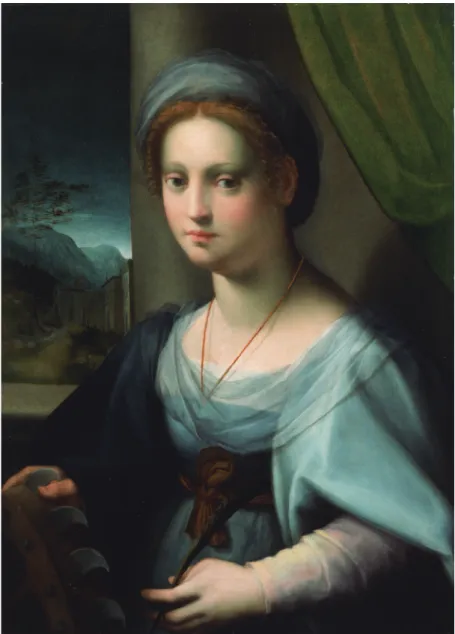
新収作品 : ドメニコ・プリーゴ《アレクサンドリ アの聖カタリナを装う婦人の肖像》
著者 渡辺 晋輔
雑誌名 国立西洋美術館報
巻 49
ページ 19‑21
発行年 2016‑03‑31
URL http://id.nii.ac.jp/1263/00000670/
19 ドメニコ・プリーゴ(本名ドメニコ・ディ・バルトロメオ・デッリ・
ウバルディーニ)[フィレンツェ、1492 –フィレンツェ、1527]
《アレクサンドリアの聖カタリナを装う婦人の肖像》
1520年代 油彩、板76.8 55.2 cm
Domenico Puligo (Domenico di Bartolomeo degli Ubaldini) [Florence 1492– Florence 1527]
Portrait of a Lady as Saint Catherine of Alexandria
1520s Oil on panel 76.8×55.2 cm P.2014–0003
来歴/Provenance: Presumably Amadeo dal Pozzo, inventory of 1634,
‘Un ritratto d’una Gentildona accomodata per una S. Catterina in mano di Domenco Puligo fiorentino. Sopra l’asso, coetaneo d’Andrea del Sarto, longo poco piu d’un raso largo tre quarti cornise dorata’. Probably purchased by the grandfather of one of the vendors in Berwickshire, before 1920, and thence by inheritance. Sold at Christie’s, London, 12 March 2013 (lot.no., 20).
文献/Literature: Christie’s London, Old Master & British Paintings, Evening Sale, Tuesday 3 December 2013, pp. 76–77.
fig. 2 ドメニコ・プリーゴ《ターバンを巻いた女
性》マンシー、ボール州立大学デイヴィッ ド・オウズリー美術館
Domenico Puligo, Lady in a Turban, Muncie, David Owsley Museum of Art – Ball State University
fig. 1 ドメニコ・プリーゴ《聖マグダラのマリア
に扮した女性像》1520–25年頃、オタワ、
カナダ・ナショナル・ギャラリー Domenico Puligo, Portrait of a Woman as the Magdalen, c. 1520–25, Ottawa, National Gallery of Canada
20
About the Artist
Domenico Puligo was a painter active in Florence in the first quarter of the 16th century. He came from a family of craftsmen; his grandfather was a goldsmith and his father had a forge. According to Puligo’s biography in Vasari’s Lives,1) he first apprenticed in the studio of Ridolfo Ghirlandaio. Ridolfo is said to have been a superb teacher who was able to discern and enhance a student’s strong points. During his studies Puligo himself seems to have discerned that his forte was in small-scale works for private patrons, and thus today the majority of his extant works are small-scale oils depicting the Madonna and Child or portraits. After his studies Puligo worked in the studio of Andrea del Sarto. According to Vasari, he was quite close to del Sarto, and del Sarto would give him advice on the execution of works. In 1525, Puligo registered with the Compagna di San Luca painters guild in Florence. Unfortunately, he died from the plague soon after in 1527.
Vasari did not rate Puligo very highly, and noted that since he enjoyed a social life, he did not apply himself diligently and hence did not rise to the first rank of painters. Later generations took up this evaluation and this has meant that Puligo has been largely overlooked, and his works have frequently appeared as attributed to del Sarto. In the 18th to 19th centuries many of Puligo’s works were taken to England mistaken for pieces by del Sarto. This situation changed in the latter half of the 20th century, when advances in the study of del Sarto meant that gradually attempts were made to position Puligo in the history of art. Finally an exhibition of his works was held in the Galleria Palatina in Florence in 2002. His life and arts were confirmed by comparisons with those of his contemporaries, and Elena Capretti published a catalogue raisonné of 75 作家について
ドメニコ・プリーゴは16世紀最初の四半世紀に活動したフィレンツェ の画家である。祖父は金工細工師、父は鍛冶屋と、職人の一族の出 であった。ヴァザーリの『芸術家列伝』に収録された「プリーゴ伝」註1)
によれば、彼ははじめリドルフォ・デル・ギルランダイオの工房で修業 した。リドルフォは優れた教師であり、弟子の素質を見抜いて長所を 伸ばしたという。プリーゴはこの修業時代に、個人向けの小規模の 作品を描くことに自らの適性を見出したのだろう、彼の作品は聖母像 や肖像画などの小さな油彩画がほとんどである。プリーゴはその後、
アンドレア・デル・サルトの工房で働いたようだ。ヴァザーリによれば ふたりはたいへん親しく、アンドレアは進んでプリーゴに助言を与え、
制作を助けたという。1525年にプリーゴは同地の聖ルカ画家組合に 登録されている。27年にペストにより歿した。
ヴァザーリのプリーゴに対する評価はあまり高くはなく、世俗の楽 しみにうつつを抜かし勤勉でなかったがゆえに一流の画家になり損 ねたと記している。この評価が尾を引いた結果、画家の存在はほぼ 無視されることとなったが、その作品はしばしばアンドレア・デル・サ ルトに帰属されて流通した。18–19世紀にはプリーゴ作品の多くがア ンドレアの作品としてイギリスに渡ったようである。状況が変わった のは20世紀半ば以降のことで、アンドレア・デル・サルト研究の進展 とともに、徐々にプリーゴを美術史上に位置づける試みがなされ始 めた。そしてようやく2002年にはフィレンツェのパラティーナ美術館 において展覧会が開催され、彼の作品を同時代の画家たちの作品と 比較しながら生涯と芸術が検証されたほか、カタログ中、エレーナ・
カプレッティによる巻頭論文の末尾には75点からなるプリーゴの作 品目録も収録された。註2)
作品について
本作品は2013年3月12日に行なわれたクリスティーズ・ロンドンの
オークションに出品されて、初めて存在が世に知られるようになった 作品である。それゆえカプレッティによる作品目録には収録されてい ない。ただし同オークションカタログによれば、1634年のアマデオ・
ダル・ポッツォの所蔵品目録に「プリーゴによる聖カタリナに扮した 女性像」が記載されており、本作品以外にこの図像の作品がないこ とから、これが本作品を指すと考えられる。
四分の三正面の女性の腰から上を描いた肖像画であり、ラファエ ロによる肖像画の形式を踏襲している。画中の女性は刃のついた車 輪と棕櫚の葉を持つことから、アレクサンドリアの聖カタリナに扮して いることがわかる。像主の名はカタリナだったのだろう。像の後ろに 円柱があり、その左には壁越しに聖堂のような建物が風景の中に見 え、右側には緑色のカーテンが斜めに下がっている。
カプレッティの作品目録には、この絵と性格の良く似た作品がふ たつ収録されている。ひとつはオタワのカナダ・ナショナル・ギャラ リーに所蔵される《聖マグダラのマリアに扮した女性像 》註3)(fig. 1)、
もうひとつはエルミタージュ美術館所蔵の《聖バルバラに扮した女 性像 》註4)だ。どちらも本作品と同様の構図の中に、似たような服を着 た女性が聖人の持物とともに描かれてある。またマンシーのボール 州立大学美術館にある《ターバンを巻いた女性 》註5)(fig. 2)は、像 の後ろの円柱をはさんで、壁越しの風景と緑のカーテンが描かれる 点が本作品と共通しており、カーテンの襞の付き方もほぼ同じであ
る。さらにフィレンツェのパラティーナ美術館所蔵の《聖母子と洗礼 者聖ヨハネ》註6)の聖母の姿勢や左に開口部のある設定は、本作品 に共通する。
プリーゴは構図の型を決め、注文主の希望に沿ってモティーフを 変更して作品を仕上げたことが知られている。本作品は上記の例と ともに、彼の制作方法を端的に見せるものと言えよう。本作品はまた、
様式の面でもプリーゴの特質をよく示している。ヴァザーリはプリー ゴが、あたかも霧がかかったかのように対象の奥行きを柔らかく表現 したと述べている。作品からは輪郭がおのずから消え、その優美な 作品は画家の生存中は高く評価されたというが、この言葉はまさに 本作品にも当てはまる。上記の関連諸作品はすべて1520年代の作 とされていることから、本作品の制作年も同じ頃に設定することが可
能であろう。 (渡辺晋輔)
註
1) G. Vasari, Vite, ed. G. Milanesi, Firenze 1878–1885, vol. 5, pp. 247–254.
2) カタログは以下。E. Capretti et al., Domenico Puligo (1492 –1527): un protagonist dimenticato della pittura fiorentina, catalogo della mostra,
Firenze 2002. カプレッティの巻頭論文と作品目録は以下。E. Capretti,
“Domenico Puligo, un protagonista ‘ritrovato’ dell’arte fiorentina del Cinquecento”, in Domenico Puligo (op. cit.), pp. 24 –53.
3) Capretti, op. cit., p. 48, n. 41; E. Capretti in D. Franklin (ed.), Leonardo da Vinci, Michelangelo, and the Renaissance in Florence, exh. cat., National Gallery of Canada, Ottawa 2005, pp. 171–172, n. 50.
4) Capretti, op. cit., p. 49, n. 50.
5) Capretti, op. cit., p. 47, n. 36; Capretti et al., op. cit., pp. 116–117, n. 24.
6) Capretti, op. cit., p. 46, n. 18; Capretti et al., op. cit., pp. 82–83, n. 9.
21 works by Puligo at the end of the exhibition catalogue.2)
About the Work
This work first became known to the art world when it appeared in a Christie’s, London, auction on 12 March 2013. As a result it is not included in Elena Capretti’s catalogue raisonné. However, according to the auction catalogue it was published in Amadeo dal Pozzo’s collection catalogue in 1634 as, “Un ritratto d’una Gentildona accomodata per una S.
Catterina in mano di Domenco Puligo fiorentino….” Given that there are no other known works of this iconography, this painting is thought to be the one published in 1634.
The painting portrays a woman seen from the hips up in a three- quarter-turned pose, a style based on Raphael’s portraits. The woman is accompanied by a knife-edged cart wheel and hemp palm branches that indicate that she is St. Catherine of Alexandria. It seems likely that the sitter was also named Catherine. There is a round pillar behind the figure and a chapel-like structure appears beyond walls amidst a landscape, while a green curtain hangs down from the right.
Capretti’s catalogue raisonné includes two paintings that closely resemble the character of this work, one the Portrait of a Woman as the Magdalen3) (fig. 1, National Gallery of Canada) and the second the Portrait of a Woman as St. Barbara4) (Hermitage Museum). Both works show the same composition as seen here, with the women dressed in similar clothes accompanied by the attributes of their respective saints.
Portrait of a Lady5) (fig. 2, David Owsley Museum of Art - Ball State University) shares the background features of a round column, landscape by a wall and green curtain, with the curtain’s drapery folds essentially the same as seen here. This work also shares the posture of the Madonna and the opening on the left seen in the Madonna and Child with St. John the Baptist6) today in the Galleria Palatina in Florence.
Clearly these works indicate that Puligo used a set composition and varied the motifs depicted in line with the wishes of each work’s particular commissioner. Thus we can say that this work, along with those described above, reveal one aspect of his working method. This work also fully indicates his stylistic characteristics. Vasari noted that Puligo softened the expression of the background of the figure as if it were veiled in mist. The outlines are missing from the work, and given that this lovely work was highly valued during the painter’s lifetime, we can say that Vasari’s comments apply also to this piece. Given that the above noted related works are all dated to the 1520s, we can suggest that this work was also painted around this same time. (Shinsuke Watanabe)
Notes
1) G. Vasari, Vite, ed. G. Milanesi, Florence 1878–1885, vol. 5, pp. 247–254.
2) See the catalogue in E. Capretti et al., Domenico Puligo (1492–1527):
Un protagonista dimenticato della pittura fiorentina, exh. cat., Florence, 2002. See Capretti’s essay and catalogue raisonné found in E. Capretti,
“Domenico Puligo, un protagonista ‘ritrovato’ dell’arte fiorentina del Cinquecento,” in Domenico Puligo (op. cit.), pp. 24–53.
3) Capretti, op. cit., p. 48, n. 41; E. Capretti in D. Franklin, ed., Leonardo da Vinci, Michelangelo, and the Renaissance in Florence, exh. cat., National Gallery of Canada, Ottawa, 2005, pp. 171–172, n. 50.
4) Capretti, op. cit., p. 49, n. 50.
5) Capretti, op. cit., p. 47, n. 36; Capretti et al., op. cit., pp. 116–117, n. 24.
6) Capretti, op. cit., p. 46, n. 18; Capretti et al., op. cit., pp. 82–83, n. 9.