• 検索結果がありません。

Role of type I- and type II-interferon in expression of melanoma differentia-tion-associated gene-5 in HSC-3 oral squamous carcinoma cells

N/A
N/A
Protected

Academic year: 2021

シェア "Role of type I- and type II-interferon in expression of melanoma differentia-tion-associated gene-5 in HSC-3 oral squamous carcinoma cells"

Copied!
8
0
0

読み込み中.... (全文を見る)

全文

(1)

Role of type I- and type II-interferon in expression of melanoma differentia- tion-associated gene-5 in HSC-3 oral squamous carcinoma cells

Takao K ON

1

, Tomoh M ATSUMIYA

2

, Ryo H AYAKARI

2

, Norihiko N ARITA

1

, Ryohei I TO

1

, Kosei K UBOTA

1

, Hirotaka S AKAKI

1

, Hidemi Y OSHIDA

2

, Tadaatsu I MAIZUMI

2

, Wataru K OBAYASHI

1

, and Hiroto K IMURA

1

1

Department of Dentistry and Oral Surgery, Hirosaki University Graduate School of Medicine, Hirosaki, Japan and

2

Department of Vascular Biology, Institute of Brain Science, Hirosaki University Graduate School of Medicine, Hirosaki, Japan

(Received 9 September 2013; and accepted 21 November 2013)

ABSTRACT

Melanoma differentiation-associated gene 5 (MDA-5) and retinoic acid-inducible gene-I (RIG-I) are members of DExH family of proteins, and known to play important roles in antiviral respons- es to induce type I interferons (IFNs). MDA-5 has been thought to sense RNA virus with long (>1 kb) double-stranded RNA. However, MDA-5 is also induced by type II IFN that is involved in acquired immunity, suggesting that role of MDA-5 remains to be elucidated. In addition, no study regarding MDA-5 in oral region has been performed. Here we investigated the role of MDA-5 in HCS-3 squamous carcinoma cells derived from oral epithelial cells. Treatment of HCS- 3 cells with IFN-α2b or IFN-γ significantly induced MDA-5 as well as RIG-I. IFN-α2b exerted anti-proliferative effect in HSC-3 cells while no such effect was observed in the cells treated with IFN-γ. MDA-5 is known to be associated with tumor cell growth in melanoma. However, overex- pression of MDA-5 did not alter the proliferation in HSC-3 cells, indicating that MDA-5 is unre- lated to the cell growth in this type of cells. We conclude that MDA-5 is induced by both type I- and type II-IFNs in HSC-3 cells, and this suggests MDA-5 may play a role in immune respons- es in oral cavity.

Interferons (IFNs) are cytokines that play a key role in antiviral activities, enhancement of innate and ac- quired immunity, and apoptosis (22). IFNs are di- vided into at least three distinct types: type I, II, and III (18). Type I IFNs are composed of various genes including IFN-α, -β, -ε, -κ, and -ω (18). In human, type I IFN is characterized as follows: type I IFN genes are clustered in one locus on chromosome 9 (1), are intronless (7), and bind to unique type I IFN receptor (2). Type I IFN is known to exert antiviral activities (23). Upon viral infection, viral compo- nents such as viral nucleic acids and viral proteins

are sensed by pattern recognition receptors (PRRs).

Subsequently, the recognition triggers activation of the antiviral signaling, leading to the production of type I IFN (12).

 IFN-γ is the unique type II IFN. Although all types of cells can induce at least one of the type I IFN upon viral infection, IFN-γ is produced by T cell in response to microbial infection (21). IFN-γ exerts its biological activities by binding to a specif- ic cell surface receptor, type II IFN receptor. In addi- tion to its anti-viral and anti-tumor properties, IFN-γ plays an essential role in definition of Th1/Th2 bal- ance. IFN-γ stimulates Th0 cells to differentiate into Th1 cells and to suppress Th2 differentiation (14).

 In 2004, retinoic acid-inducible gene-I (RIG-I) was shown to be a cytoplasmic RNA virus sensor (25). RIG-I is an RNA helicase, consisting of N-ter- minal caspase domain (CARD), a central DExD/H box RNA helicase domain, and a C-terminal regula- Address correspondence to: Tomoh Matsumiya, Depart-

ment of Vascular Biology, Institute of Brain Science, Hirosaki University Graduate School of Medicine, 5 Zaifu-cho, Hirosaki 036-8562, Japan

Tel/Fax: +81-172-39-5145

E-mail: [email protected]

(2)

USA). The specific primers were synthesized by Hokkaido System Science (Sapporo, Japan). Immob- ilon polyvinylidene fluoride (PVDF) membrane was from Millipore Japan (Tokyo, Japan). An anti- MDA-5 antibody was purchased from Immuno-Bio- logical Laboratories (Maebashi, Japan). Monoclonal mouse anti-RIG-I antibody was from Enzo Life Sci- ences (Miami, FL, USA). Rabbit anti-actin antibody was from Sigma-Aldrich (St. Louis, MO, USA). Bo- vine anti-rabbit or anti-mouse IgG coupled to horse- radish peroxidase (HRP) was from Santa Cruz Biotechnology (Santa Cruz, CA, USA).

Cell culture. HSC-3 cells, a human oral squamous carcinoma cell line (National Institute of Health Sci- ence, Tokyo, Japan), were cultured in DMEM con- taining 10% FBS, penicillin (100 U/mL), streptomycin (100 μg/mL), and gentamicin (80 μg/mL) in an at- mosphere of 95% air and 5% CO

2

at 37°C. HSC-3 cells were stimulated with a series of concentrations of IFN-α2b (0.008–5 ng/mL) and IFN-γ (0.04–25 ng/

mL) for up to 48 h.

RNA extraction and reverse transcription-quantita- tive polymerase chain reaction (RT-qPCR). Total RNA was isolated from the cells using Trizol reagent.

Single-stranded cDNA for a PCR template was syn- thesized from 1 μg total RNA using a primer oligo (dT)

12–18

and the Superscript II reverse transcriptase under the conditions indicated by the manufacturer.

A CFX96 real-time PCR detection system (Bio-Rad, Hercules, CA, USA) was used for the quantitative analyses of MDA-5, RIG-I, and 18S ribosomal RNA (rRNA). The sequences of the primers were as fol- lows: MDA-5-F (5’-GTTGAAAAGGCTGGCTGAA AAC-3’), MDA-5-R (5’-TCGATAACTCCTGAACC ACTG-3’), RIG-I-F (5’-GTGCAAAGCCTTGGCAT GT-3’), RIG-I-R (5’-TGGCTTGGGATGTGGTCTA CTC-3’), 18S rRNA-F (5’-ACTCAACACGGGAAA CCTCA-3’), and 18S rRNA-R (5’-AACCAGACAA ATCGCTCCAC-3’). The amplification reactions were performed with SsoFast EvaGreen Supermix (BioRad) according to the manufacturer’s specifica- tions. The amplification conditions were as follows:

heat for 30 s at 98°C, followed by heating consecu- tively at 98°C and 58°C for 5 s each for 40 cycles.

After amplification was completed, a melting curve was generated by slowly heating from 65°C to 95°C at 0.5°C increments with 5 s per step, with continu- ous monitoring of the fluorescence. The melting curves and quantitative analysis of the data were performed using a CFX manager (BioRad).

tory domain (16). Melanoma differentiation-associ- ated gene-5 (MDA-5) also has N-terminal tandem CARDs and the DExH box domain (10). Molecular analysis revealed that RIG-I and MDA-5 share structural and functional similarities (26). RIG-I and MDA-5 are both RNA virus sensors with distinct role: RIG-I recognizes relatively short double- stranded (ds) RNA and 5’ triphosphate-single-strand- ed (ss) RNA while MDA-5 senses long dsRNA (11).

Experimental evidence indicates that RNA viruses sensed by MDA-5 are limited (e.g. picornaviridae) whereas many other RNA viruses including Influen- za virus and Hepatitis C virus are sensed by RIG-I (16). Thus, most of the research working on RNA virus sensor has been focused on the function of RIG-I; however, the role of MDA-5 is incompletely understood. MDA-5 was originally reported as a growth suppressor of melanoma (10). We found a high level of MDA-5 expression in glomeruli of pa- tients with severe lupus nephritis or IgA nephropa- thy (9), and also in gastric mucosa infected with Helicobacter pylori (24). Of note, no significant RIG-I expression that was expected in the patient with severe lupus nephritis was observed. Collec- tively, MDA-5 may play multiple roles in addition to viral sensing. Following the viral RNA recogni- tion, MDA-5 mediates its signal to a downstream adaptor molecule, mitochondrial antiviral signaling protein (MAVS), resulting in induction of type I IFN (26). As the induced IFN enhances MDA-5 ex- pression (10), there must be a positive feedback loop in antiviral innate immune response.

 Oral cavity is one of the initial sites where patho- gens enter from the external environment; it is spec- ulated that the innate immune system is highly developed in oral mucosa. To date, however, there is no report about the presence or expression of MDA-5 in oral mucosa. Here, we report the expres- sion of MDA-5 in response to IFN in oral epithelial cell line.

MATERIAL AND METHODS

Reagents. Culture dishes and fetal calf serum (FBS) were from Asahi Techno Glass (Tokyo, Japan). Recom- binant human IFN-α2b was obtained from ProSpec- Tany TechnoGene (East Brunswick, NJ, USA).

Recombinant human IFN-γ was purchased from

Roche Diagnostics (Mannheim, Germany). Antibiot-

ic-antimycotic, FBS, oligo(dT)

12–18

, Superscript II,

and Trizol reagent were purchased from Invitrogen

(Carlsbad, CA, USA). Recombinant ribonuclease in-

hibitor Rnasin was from Promega (Madison, WI,

(3)

Statistics. Values are expressed as means S.D. (n = 3), and statistical significance was analyzed by Stu- dent’s t-test. The probability (P) values were based on two-tailed tests, and P < 0.05 was considered to be significant.

RESULTS

Expression of MDA-5 in response to type I and type II IFNs in HSC-3 cells

Since MDA-5 is reported to be induced by IFNs (10), we first confirmed the expression of MDA-5 in response to IFNs in HSC-3 oral epithelial cell line.

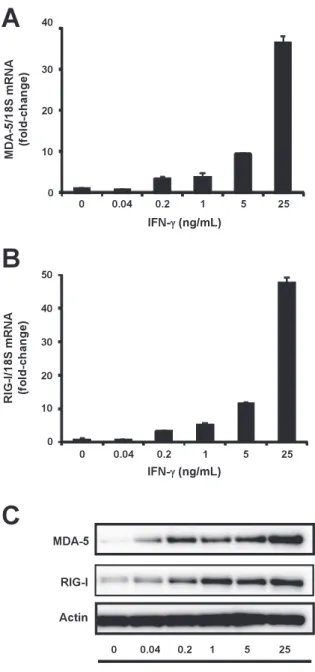
IFN-α2b is known to have the highest affinity to the type I IFN receptor in type I IFN family (19); in- deed, IFN-α2b is used as a therapeutic agent against certain types of malignant tumor such as leukemia (13) and melanoma (6). Therefore, we chose IFN- α2b as the type I IFN in this study. The expression of MDA-5 mRNA was upregulated by stimulation with either IFN-α2b or IFN-γ in a concentration- dependent manner. The expression of MDA-5 was induced by the treatment with 0.04 ng/mL IFN-α2b (Fig. 1A). The maximal effect of IFN-α2b was observed at 1 ng/mL. A similar pattern of RIG-I mRNA expression was observed in HSC-3 cells treated with IFN-α2b (Fig. 1B). Protein levels of MDA-5 and RIG-I in response to IFN-α2b were in agreement with those of the mRNA expressions (Fig. 1C). Fig. 2 shows concentration-dependent ef- fect of IFN-γ on MDA-5 and RIG-I expressions in HSC-3 cells. mRNA levels of both MDA-5 and RIG-I were started to increase by 0.2 ng/mL IFN-γ treatment in HSC-3 cells (Fig. 2 A, B). The protein levels of both MDA-5 and RIG-I were observed from the treatment with 0.04 ng/mL IFN-γ (Fig. 2C).

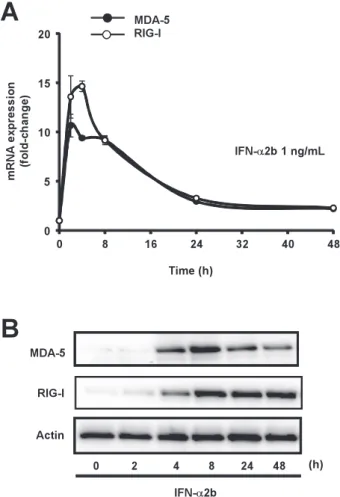
Kinetics of MDA-5 in response to IFNs in HSC-3 cells MDA-5 mRNA was rapidly induced and reached the maximal level 2 h after treatment of the cells with IFN-α2b (Fig. 3A). RIG-I mRNA was also rapidly induced and reached the maximal level 4 h after the stimulation (Fig. 3A). The time course of MDA-5 protein production lagged slightly behind that of the mRNA expression (Fig. 3B). RIG-I production was observed 4 h after the treatment with IFN-α2b, and the increased protein levels of RIG-I was found to prolong up to 48 h after the stimulation (Fig. 3B).

IFN-γ also induced mRNA expressions of MDA-5 and RIG-I in time-dependent manner, but with delayed kinetics compared to IFN-α2b (Fig. 4A).

Thereafter, mRNA expression of MDA-5 and RIG-I began to increase again after 24 h, and it was a ten- Western blot analysis. SDS-PAGE and western blot

analysis were performed as previously reported (15).

Briefly, after two washes with phosphate-buffered saline, pH 7.4 (PBS), the cells were lysed in hypo- tonic lysis buffer (10 mM Tris (pH 7.4), 100 mM NaCl, 1.5 mM MgCl

2

, 0.5% NP-40) containing 0.2%

protease inhibitors. The lysates were cleared by centrifugation at 12,000 rpm for 5 min at 4°C. Five micrograms of the cell lysate was subjected to elec- trophoresis on a 7.5% SDS-polyacrylamide gel. The proteins were then transferred to PVDF membranes, which were then blocked for 1 h at room tempera- ture in TBST buffer (20 mM Tris (pH 7.4), 150 mM NaCl, 0.1% Tween 20) containing 1% nonfat dry milk (blocking buffer). The membranes were incu- bated overnight at 4°C with one of the following primary antibodies: rabbit anti-MDA-5 (1 : 250 dilu- tion), mouse anti-RIG-I (1 : 10,000 dilution), or rabbit-β-actin (1 : 10,000 dilution). After five washes with TBST, the membranes were further incubated for 1 h at room temperature with HRP-conjugated secondary antibodies in blocking buffer. The washes were repeated using TBST, and then immunoreac- tive bands were visualized using the Luminata Forte Western HRP Substrate (Millipore).

Plasmid construction. To clone the full-length hu- man MDA-5 gene, we amplified cDNA isolated from HeLa cells treated with IFN-γ for 24 h. For amplification, we used Phusion DNA polymerase (Thermo Scientific, Pittsburgh, PA, USA) and spe- cific primers harboring a NotI site (shown in lower- case font) or a SalI site (shown in lowercase font), the sequences of which were as follows: MDA- NotI-F (5’-CTTgcggccgcGATGTCGAATGGGTATT CCACA-3’) and MDA-SalI-R (5’-TAGAgtcgacCTA ATCCTCATCACTAAAT-3’). The products were pu- rified, digested with NotI and SalI, and then cloned into a p3xFLAG-CMV7.1 expression vector (p3x FLAG-MDA).

Transfection. The day prior to transfection, HSC-3 cells were seeded at a density of 0.5 × 10

5

cells. The next day, the cells were transfected with p3xFLAG- MDA or control p3xFLAG-expression vectors using polyethylenimine (PEI)-Max (Polysciences, War- rington, PA, USA).

Microscopic analysis. Following stimulation with

IFNs or transfection with MDA-5, the cells were

monitored for up to 24 h under a phase-contrast mi-

croscopy (Ti-E; Nikon, Tokyo, Japan).

(4)

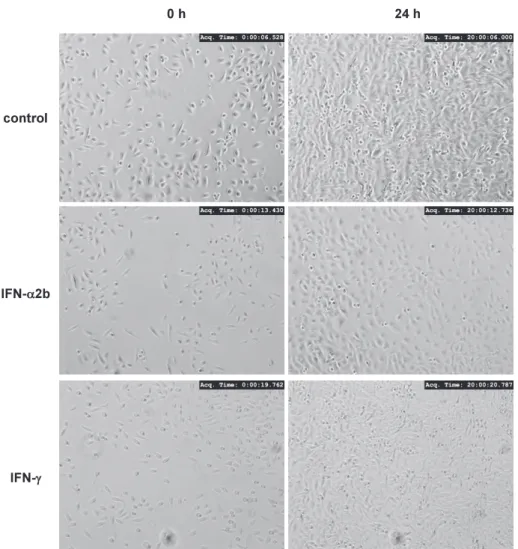
Effect of MDA-5 on cell proliferation in HSC-3 cells IFNs are known to regulate cell proliferation and to induce apoptosis; therefore they are used as anti-tu- mor agents (17). We initially examined the effect of IFNs on the cell growth on HSC-3 cells. As shown in Fig. 5, IFN-α2b exerted marked suppressive ac- dency to increase after 48 h (Fig. 4A). Prolongation

of both mRNA expressions was observed at least up to 72 h after the stimulation (data not shown). The levels of both proteins were enhanced at 8 h after the treatment of IFNs (Fig. 4B).

Fig. 1 IFN- α 2b induces the expression of MDA-5 and RIG-I in HSC-3 cells in concentration-dependent manner. HSC-3 cells were treated with various concentrations of IFN- α 2b for 4 h (A, B) or 8 h (C). Total RNA was extracted from the cells and the mRNA expressions of MDA-5 (A) and RIG-I (B) were examined by real-time RT-PCR analysis. (C) MDA- 5 and RIG-I proteins in cell lysates were detected by west- ern blot analysis.

Fig. 2 Concentration-dependent stimulation by IFN- γ of the

MDA-5 and RIG-I expression in HSC-3 cells. HSC-3 cells

were treated with IFN- γ (0-25 ng/mL) for 8 h (A, B) or 24 h

(C). Total RNA was extracted from the cells and the mRNA

expressions of MDA-5 (A) and RIG-I (B) were examined by

real-time RT-PCR analysis. (C) The cell lysate was subject-

ed to SDS-PAGE and visualized by immunostaining for

MDA-5, RIG-I, and Actin.

(5)

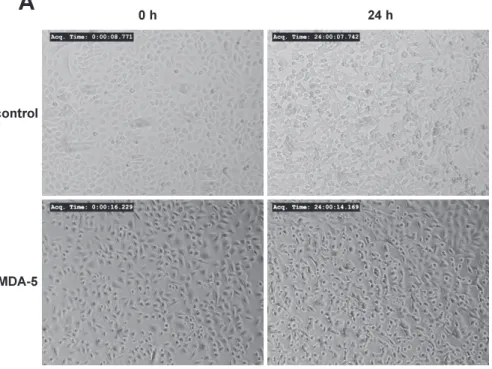
tivity in the growth of HCS-3 cells. In contrast, no such effect was observed in the cells treated with IFN-γ. Our results from the present study showed that both IFN-α2b and IFN-γ induce MDA-5; there- fore, we next investigated the effect of MDA-5 on the cell proliferation of HSC-3 cells. When the cells were transfected with control expression vector for 24 h, the cells grew almost normally with slight cy- totoxity probably due to the transfection (Fig. 6A).

Transfection of cells with MDA-5 expression con- struct did not alter the proliferation of HSC-3 cells (Fig. 6B). We note that overexpression of MDA-5 was confirmed by western blot (data not shown).

DISCUSSION

An earlier study has clearly shown that the expres- sion of MDA-5 is IFN-dependent (10). Type I- and

type II-IFN bind their specific cell surface receptors to activate individual intracellular signal transduction pathway. Type II IFN induces homodimerization of signal transducer and activator of transcription (STAT)1 to induce certain IFN-stimulated genes (ISGs), while type I IFN stimulates formation of complexes composed of STAT1, STAT2, and ISG factor 3 (ISGF3) (20). Therefore, these two types of IFNs have been known to have distinct functions in immune responses. In the present study, we first asked whether or not oral epithelial cell line can in- duce MDA-5 in response to IFNs. We found that both IFNs can induce the expression of MDA-5 as well as RIG-I. We further explored if either type I- or type II-IFN induces the expression of MDA-5 with similar kinetics. Our results showed that type II IFN induces the MDA-5 expression with delayed kinetics as compared with type I IFN. This result

Fig. 3 Time-course of the MDA-5 expression in HSC-3 cells in response to IFN- α 2b. HSC-3 cells were treated with 1 ng/

mL IFN- α 2b for up to 48 h. A. Total RNA extracted from the cells was subjected to quantitative RT-PCR for MDA-5 and RIG-I. B. MDA-5 and RIG-I proteins in cell lysates were ex- amined by western blot.

Fig. 4 Time-course mRNA expression of MDA-5 in HSC-3

cells stimulated with IFN- γ . HCS-3 cells were treated with

5 ng/mL IFN- γ for up to 48 h. A. mRNA expression of MDA-

5 and RIG-I were analyzed by real-time RT-PCR. B. The

protein levels of MDA-5 and RIG-I were analyzed by immu-

noblotting.

(6)

associated melanoma markers (4, 5). We also ob- served that the treatment of IFN-γ had no inhibitory effect on the growth of HSC-3 cells, whereas type I IFN significantly suppressed the tumor cell growth.

Our overexpression analysis of MDA-5 clearly indi- cated no association between MDA-5 and cell pro- liferation in HSC-3 cells. This result is inconsistent with the report in melanoma cells. From these ob- servations, uncharacterized molecule(s) must partici- pate in the inhibitory effect of type I-IFN on tumor cells growth of oral cancer cells.

 We conclude that both IFNs induce the expres- sion of MDA-5 in cultured oral cancer cells. It seemed that the induced MDA-5 is unrelated to the tumor cell proliferation. The expressed MDA-5 may be involved specifically in antiviral immune re- sponses in oral epithelial cells.

agreed with our previous observation that IFN-γ in- duced the expression of RIG-I in mesangial cells with relatively similar expression pattern (8). These observations allowed us to speculate that type I IFN may be associated with early MDA-5 expression while type II contributes the late MDA-5 expression.

 Overexpression of MDA-5 inhibits colony forma- tion of melanoma cells (10). Type I IFN have been used for treatment of melanoma to anticipate termi- nal differentiation (3). In these contexts, MDA-5 may function as a mediator of IFN-induced growth inhibition and/or apoptosis (10). Several early stud- ies reported that, in contrast to type I IFN, treatment of melanoma with IFN-γ results in biologically more aggressive phenotype including inhibition of mela- nin synthesis and enhancement of intercellular adhe- sion molecule-1 (ICAM-1) and very late antigen-2 (VLA-2), both of which are known as progression-

Fig. 5 Effects of IFNs on cell proliferation in HSC-3 cells. HSC-3 cells were grown with IFN- α 2b or IFN- γ for 24 h, and

then those images were captured under a phase-contrast microscopy. IFN- α 2b exerted marked suppressive activity in the

growth on HSC-3 cells. In contrast, no such effect was observed in the cells treated with IFN- γ .

(7)

Acknowledgements

This work was supported in part by Priority Research Grant for Young Scientists Designated by the Presi- dent of Hirosaki University (to TM), a KAKENHI Grants-in-Aid for Scientific Research 23590560 (to TM) and by a KAKENHI Grant-in-Aid for Young Scientists (B) 23792309 (to HS).

REFERENCES

Fig. 6 Effects of MDA-5 overexpression on cell proliferation in HSC-3 cells. HSC-3 cells were transfected with plasmid vec- tor encoding MDA-5 cDNA or control expression vector, then the cells were photographed under the phase-contrast micros- copy. A. Represented image in each condition. B. Four random fields were chosen through the microscope, and numbers of cells were counted. Data are shown as average numbers of cells per field. NS, not significant.

1. Diaz MO, Rubin CM, Harden A, Ziemin S, Larson RA, Le Beau MM and Rowley JD (1990) Deletions of interferon genes in acute lymphoblastic leukemia. N Engl J Med 322,

77–82.

2. Domanski P and Colamonici OR (1996) The type-I interfer- on receptor. The long and short of it. Cytokine Growth Fac- tor Rev 7, 143–151.

3. Fisher PB, Prignoli DR, Hermo H, Jr., Weinstein IB and Pestka S (1985) Effects of combined treatment with interfer- on and mezerein on melanogenesis and growth in human melanoma cells. J Interferon Res 5, 11–22.

4. Garbe C, Krasagakis K, Zouboulis CC, Schroder K, Kruger S, Stadler R and Orfanos CE (1990) Antitumor activities of in- terferon alpha, beta, and gamma and their combinations on human melanoma cells in vitro: changes of proliferation, melanin synthesis, and immunophenotype. J Invest Dermatol 95, 231S-237S.

5. Garbe C and Krasagakis K (1993) Effects of interferons and

(8)

cytokines on melanoma cells. J Invest Dermatol 100, 239S- 244S.

6. Hillner BE, Kirkwood JM, Atkins MB, Johnson ER and Smith TJ (1997) Economic analysis of adjuvant interferon al- fa-2b in high-risk melanoma based on projections from East- ern Cooperative Oncology Group 1684. J Clin Oncol 15, 2351–2358.

7. Hughes AL (1995) The evolution of the type I interferon gene family in mammals. J Mol Evol 41, 539–548.

8. Imaizumi T, Tanaka H, Tajima A, Tsuruga K, Oki E, Sashinami H, Matsumiya T, Yoshida H, Inoue I and Ito E (2010) Reti- noic acid-inducible gene-I (RIG-I) is induced by IFN- {gamma} in human mesangial cells in culture: possible involvement of RIG-I in the inflammation in lupus nephritis.

Lupus 19, 830–836.

9. Imaizumi T, Aizawa-Yashiro T, Tsuruga K, Tanaka H, Matsumiya T, Yoshida H, Tatsuta T, Xing F, Hayakari R and Satoh K (2012) Melanoma differentiation-associated gene 5 regulates the expression of a chemokine CXCL10 in human mesangial cells: implications for chronic inflammatory renal diseases. Tohoku J Exp Med 228, 17–26.

10. Kang DC, Gopalkrishnan RV, Wu Q, Jankowsky E, Pyle AM and Fisher PB (2002) mda-5: An interferon-inducible puta- tive RNA helicase with double-stranded RNA-dependent ATPase activity and melanoma growth-suppressive proper- ties. Proc Natl Acad Sci USA 99, 637–642.

11. Kato H, Takeuchi O, Sato S, Yoneyama M, Yamamoto M, Matsui K, Uematsu S, Jung A, Kawai T, Ishii KJ, Yamaguchi O, Otsu K, Tsujimura T, Koh CS, Reis e Sousa C, Matsuura Y, Fujita T and Akira S (2006) Differential roles of MDA5 and RIG-I helicases in the recognition of RNA viruses. Na- ture 441, 101–105.

12. Kawai T and Akira S (2010) The role of pattern-recognition receptors in innate immunity: update on Toll-like receptors.

Nat Immunol 11, 373–384.

13. Luchetti F, Gregorini A, Papa S, Burattini S, Canonico B, Valentini M and Falcieri E (1998) The K562 chronic myeloid leukemia cell line undergoes apoptosis in response to inter- feron-alpha. Haematologica 83, 974–980.

14. Maggi E, Parronchi P, Manetti R, Simonelli C, Piccinni MP, Rugiu FS, De Carli M, Ricci M and Romagnani S (1992) Reciprocal regulatory effects of IFN-gamma and IL-4 on the in vitro development of human Th1 and Th2 clones. J Immu- nol 148, 2142–2147.

15. Matsumiya T, Imaizumi T, Yoshida H, Satoh K, MK Topham

MK and Stafforini DM (2009) The levels of retinoic acid- inducible gene I are regulated by heat shock protein 90-alpha.

J Immunol 182, 2717–2725.

16. Matsumiya T and Stafforini DM (2010) Function and regula- tion of retinoic acid-inducible gene-I. Crit Rev Immunol 30, 489–513.

17. Ota K, Matsumiya T, Sakuraba H, Imaizumi T, Yoshida H, Kawaguchi S, Fukuda S and Satoh K (2010) Interferon- alpha2b induces p21cip1/waf1 degradation and cell prolifera- tion in HeLa cells. Cell Cycle 9, 131–139.

18. Pestka S, Krause CD and Walter MR (2004) Interferons, in- terferon-like cytokines, and their receptors. Immunol Rev 202, 8–32.

19. Pfeffer LM, Dinarello CA, Herberman RB, Williams BR, Borden EC, Bordens R, Walter MR, Nagabhushan TL, Trotta PP and Pestka S (1998) Biological properties of recombinant alpha-interferons: 40th anniversary of the discovery of inter- ferons. Cancer Res 58, 2489–2499.

20. Platanias LC (2005) Mechanisms of type-I- and type-II-inter- feron-mediated signalling. Nat Rev Immunol 5, 375–386.

21. Schroder K, Hertzog PJ, Ravasi T and Hume DA (2004) In- terferon-gamma: an overview of signals, mechanisms and functions. J Leukoc Biol 75, 163–189.

22. Sgorbissa A and Brancolini C (2012) IFNs, ISGylation and cancer: Cui prodest? Cytokine Growth Factor Rev 23, 307–

23. Taniguchi T, Mantei N, Schwarzstein M, Nagata S, Muramatsu 314.

M and Weissmann C (1980) Human leukocyte and fibroblast interferons are structurally related. Nature 285, 547–549.

24. Tatsuta T, Imaizumi T, Shimoyama T, Sawaya M, Kunikazu T, Matsumiya T, Yoshida H, Satoh K and Fukuda S (2012) Ex- pression of melanoma differentiation associated gene 5 is in- creased in human gastric mucosa infected with Helicobacter pylori. J Clin Pathol 65, 839–843.

25. Yoneyama M, Kikuchi M, Natsukawa T, Shinobu N, Imaizumi T, Miyagishi M, Taira K, Akira S and Fujita T (2004) The RNA helicase RIG-I has an essential function in double- stranded RNA-induced innate antiviral responses. Nat Immu- nol 5, 730–737.

26. Yoneyama M, Kikuchi M, Matsumoto K, Imaizumi T, Miyagishi M, Taira K, Foy E, Loo YM, Gale M, Jr., Akira S, Yonehara S, Kato A and Fujita T (2005) Shared and unique functions of the DExD/H-box helicases RIG-I, MDA5, and LGP2 in antiviral innate immunity. J Immunol 175, 2851–

2858.

Fig. 2 Concentration-dependent stimulation by IFN- γ  of the  MDA-5  and  RIG-I  expression  in  HSC-3  cells
Fig. 3 Time-course of the MDA-5 expression in HSC-3 cells  in response to IFN- α 2b. HSC-3 cells were treated with 1 ng/
Fig. 5 Effects  of  IFNs  on  cell  proliferation  in  HSC-3  cells.  HSC-3  cells  were  grown  with  IFN- α 2b  or  IFN- γ   for  24 h,  and  then  those  images  were  captured  under  a  phase-contrast  microscopy
Fig. 6 Effects of MDA-5 overexpression on cell proliferation in HSC-3 cells. HSC-3 cells were transfected with plasmid vec- vec-tor encoding MDA-5 cDNA or control expression vecvec-tor, then the cells were photographed under the phase-contrast  micros-copy

参照

関連したドキュメント