Effect of Autologous Blood Donation with Intraoperative Cell Salvage and Blood
Transfusion on the Requirements of Revision Total Hip Arthroplasty
Tomoko NAGANO, Koichi KINOSHITA, Yoshinari NAKAMURA, Masatoshi NAITO
Department of Orthopaedic Surgery, Faculty of Medicine, Fukuoka University
ABSTRACT
Background: Revision total hip arthroplasty (THA) is associated with increased blood
loss.
Patients and methods: We reviewed 32 patients who underwent revision THA to
identify modes of implant failure, use of autologous blood donation with/without intraoperative cell salvage, and allogeneic blood transfusion requirements.
Results: Five patients underwent revision THA for infection or fractures. None used
autologous blood donation and four required allogeneic blood transfusion.
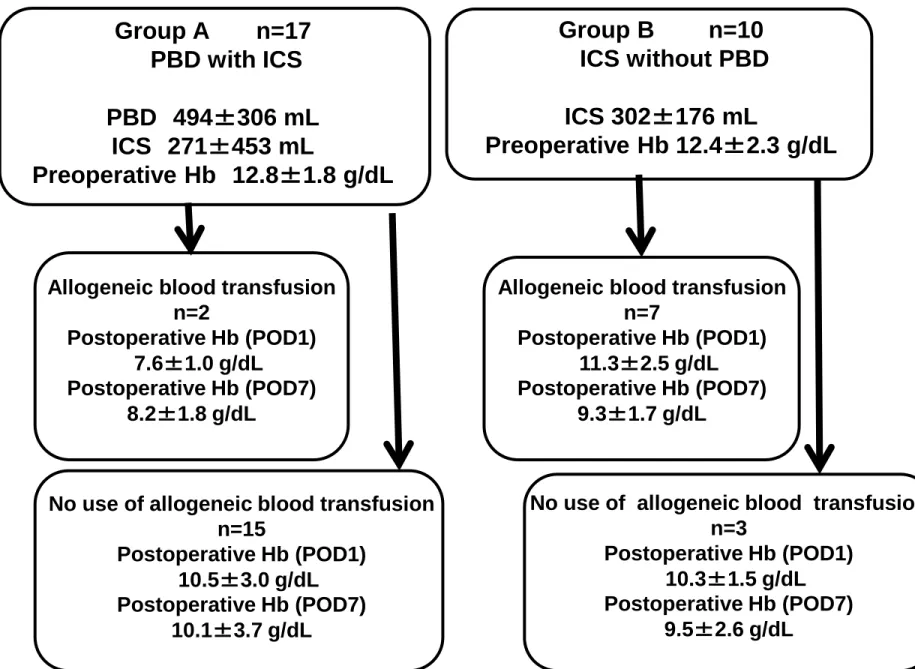
Twenty-seven patients underwent revision THA for aseptic loosening. In this group, 17 used autologous blood donation with intraoperative cell salvage, and the other 10 used intraoperative cell salvage without autologous blood donation. Allogeneic transfusion was required in only two of 17 patients of the former group, and in seven of 10 patients of the latter group (p=0.007). Use of autologous blood donation with intraoperative cell salvage led to lower allogeneic blood transfusion requirements.
Conclusions: These data show that use of autologous blood donation with
intraoperative cell salvage is clearly associated with decreased allogeneic blood
transfusion requirements for revision THA. Identification and treatment of patients at a
higher risk of allogeneic blood transfusion may guide probable allogeneic blood transfusion requirements, and is a safe, effective method of managing blood loss for revision THA.
Keywords Revision hip arthroplasty; Blood loss; Transfusion; Autologous blood
donation; Intraoperative cell salvage
Correspondence to: Tomoko Nagano, Department of Orthopaedic Surgery, Faculty of Medicine, Fukuoka University, 7-45-1, Nanakuma, Jonan-ku, Fukuoka, 814-0180, Japan
Tel: +81-92-801-1011 (3465) Fax: +81-92-864-9055
E-mail: [email protected]
INTRODUCTION
Patients undergoing revision total hip arthroplasty (THA) are at considerable risk of massive perioperative blood loss that necessitates allogeneic blood transfusion
1. Allogeneic blood transfusion carries the risk of disease transmission and immunologic reactions
2. Identification of patients that might require transfusion is desirable to improve blood use and more accurately identify which patients should receive
established perioperative blood conservation interventions. We examined the influence of variables such as age, sex, preoperative haemoglobin (Hb) concentration, modes of implant failure, use of autologous blood donation (ABD) and inoperative cell salvage (ICS), and allogeneic blood transfusion requirements following revision THA.
PATIENTS AND METHODS
A retrospective analysis was conducted on 32 patients who underwent elective revision THA in the Department of Orthopaedic Surgery, Faculty of Medicine, Fukuoka
University (Fukuoka, Japan) over a two-year period.
Several weeks before THA, patients deposited 200–400 mL of blood weekly as long as
their Hb level remained >11.0 g/dL. To prevent dizziness, nausea, and syncope caused
by hypovolemia, patients were given lactated Ringer’s solution after autologous blood
was collected. Patients were given iron supplementation in accordance with guidelines
set by our hospital. Patients with Hb <13.5 g/dL were given iron supplementation via
the intravenous route. Patients with Hb <12.5 g/dL were given iron supplementation via
oral and intravenous routes. Intravenous iron supplementation 40mg was given
immediately after autorogous blood collection. Oral iron supplementation 210mg per
day was given everyday from autorogous blood collection until surgery. After the
induction of general anaesthesia, procedures were carried out by two senior surgeons
using various surgical methods. The analysis focused on the modes of implant failure,
and included cases of revision THA for infection or fractures as well as early revisions
for dislocations secondary to malpositioning of implants. Intraoperative cell salvage
(ICS) was carried out using a continuous autotransfusion system (Electa®; Sorin, Milan,
Italy). Blood was retrieved from the operative field using a single dedicated suction
catheter. Collected blood was separated via centrifugation and red blood cells collected
in sterile bags for autotransfusion. Blood from ICS was transfused intraoperatively, and
autologous blood collected preoperatively was transfused immediately after surgery. In
accordance with guidelines set by our hospital, patients with Hb <7~8 g/dL should be
considered use of allogeneic transfusion. In this study, allogeneic transfusion was used
in consideration of each Hb level, amount of bleeding, anamnesis, blood pressure, and
the general state. Prophylactic anticoagulants such as edoxaban were administered postoperatively for 12 days to prevent deep-vein thrombosis. Drains were removed <24 h after surgery. Hb levels were measured just before preoperative donation of
autologous blood as well as 1 day and 7 days after surgery.
The electronic database of our hospital was searched. Variables such as preoperative and postoperative Hb concentrations, patient demographics (e.g., age, sex), type of revision surgery, mode of implant failure, use of ABD and ICS, and allogeneic blood transfusion requirements were recorded for each case.
Statistical analyses
Fisher’s contingency table analysis was used to test for differences in allogeneic blood transfusion requirements of patients who underwent revision THA for aseptic loosening between groups using ABD with ICS, and ICS without donation of autologous blood.
p<0.05 was considered significant.
RESULTS
Three patients underwent revision THA due to infection (Table 1). Types of components
that underwent revision were femoral component, acetabular component, and dual
components each. Seventy-six-y female and 58y female had many amounts of intraoperative bleeding. Seventy-four-y female had the anamnesis hemorrhage in the precedence surgery: extraction of implant and debridement. Furthermore, in this operation, her preoperative blood pressure dropped. All three patients could not take advantage of ABD and ICS, so they required allogeneic blood transfusion. Two patients underwent revision THA for fractures. Types of components revised were acetabular component, and dual components. Both patients could not take advantage of ABD. One patient required allogeneic blood transfusion despite using ICS. Another patient did not require allogeneic blood transfusion despite not using ICS because her blood loss was low upon revision THA of an acetabular component.
Twenty-seven patients underwent revision THA for aseptic loosening (Table 2). Group A (17 patients) used ABD with ICS, and group B (10 patients) used ICS without ABD.
Fibrin sealant made from autologous blood was sprayed at the component site in group A. The mean amount of autologous blood donated in group A was 494 mL (range: 200–
800 mL). The mean amount of ICS in group A was 271 mL (120–734 mL), and was 302 mL (126–460 mL) in group B. The allogeneic blood transfusion requirement of group A was 11.8%, whereas that of group B was 70.0%. Allogeneic blood transfusion
requirements of group A were significantly lower than those of group B (p=0.007) (Fig.
1).
DISCUSSION
ABD can be carried out in several ways: preoperative ABD, intraoperative blood salvage, and postoperative blood salvage
3–10. Preoperative ABD has been shown to reduce the absolute risk of allogeneic blood transfusion by 43.8%
11.
Preoperative ABD offers theoretical advantages, and should be targeted to males with a
Hb level 11.0–14.0 g/dL and to females with a level of 13.0–14.0 g/dL whose
anticipated perioperative blood loss is ≈1 L
8. The results of a recent Cochrane review on
perioperative cell salvage showed that re-transfusion of autologous blood reduced allogeneic blood transfusion requirements by 54% as compared with conventional drains in orthopaedic procedures
12. If high levels of blood loss are anticipated, preoperative blood donation may be considered, possibly combined with ICS
8. The results of a review by Mahadevan et al. showed greater blood loss in males, older patients, during revision surgery of cemented implants, and dual-component revision THAs
13. In the present study, use of ABD with ICS was clearly associated with
decreased allogeneic blood transfusion requirements for revision THA. However, ABD
cannot be employed for patients with anaemia, who are prone to infection, or
immediately before surgery. Additionally, preoperative ABD can present logistical problems, be time-consuming, and waste donated blood
14. In the present study, iron supplementation was used for patients with preoperative anaemia. There was no wastage of donated blood. Identification and perioperative treatment of patients at a higher risk of allogeneic blood transfusion may guide probable reduction of allogeneic blood transfusion requirements, and be a safe, effective method of managing blood loss for revision THA.
Acknowledgements
No benefits in any form have been received or will be received from a commercial party related directly or indirectly to the subject of this study.
REFERENCES
1. Sharma S, Cooper H, Ivory JP. An audit on the blood transfusion requirements for
revision hip arthroplasty. Ann R Coll Surg Engl 84: 269-272, 2002.
2. Weber WG, Slappendel R, Prins MH et al. Perioperative blood transfusions and
delayed wound healing after hip replacement surgery: effect on duration of
hosipitalisation. Anesth Analg 100: 1416-1421, 2005.
3. Toy PT, Strauss RG, Stehling LC, Sears R, Price TH, Rossi EC, Collins ML,
Crowley JP, Eisenstaedt RS, Goodnaugh LT. Predeposited autologous blood for
elective surgery. A national multicenter study. N Eng J Med 316:517-20, 1987.
4. Woolson ST, Marsh JS, Tanner JB. Transfusion of previously deposited autologous
blood for patients undergoing hip-replacement surgery. J Bone joint Surg Am
69:325-8, 1987.
5. Azuma T, Takahashi S, Kawamura A. Preoperative autologous blood donation in hip
surgeries. Transfus Sci 23:177-81, 2000.
6. Zarin J, Grosvenor D, Schurman D, Goodman S. Efficacy of intraoperative blood
collection and reinfusion in revision total hip arthroplasty. J Bone Joint Surg Am
85:2147-51, 2003.
7. Bridgens JP, Evans CR, Dobsen PM, Hamer AJ. Intraoperative red blood- cell
salvage in revision hip surgery. A case-matched study. J Bone Joint Surg Am
89:270-5, 2007.
8. R.Lemaire. Strategies for blood management in orthopaedic and trauma surgery. J
Bone Joint Surg Br 90-B:1128-36, 2008.
9. Lorentz A, Konermann W, Kellenbenz C, Heine T, Zimmermann G, Segiet W, Jani L.
Mannheim concept of preoperative autologous blood donation and perioperative
autologous blood transfusion in hip endoprosthesis surgery [in German]. Z Orthop Ihre Grenzgeb 38:311-17, 2000.
10. Kubota R, Nozawa M, Matsuda K, Maezawa K, Kim SG, Maeda K, Ikegami T,
Hayashi K, Nagayama M, Kaneko H. Combined preoperative autologous blood donation and intraoperative cell salvage for hip surgery. J Orthop Surg (Hong Kong)
17:288-90, 2009.
11. Henry DA, Carless PA, Moxey AJ. Pre-operative autologous donation for
minimising perioperative allogeneic blood transfusion. Cochrane Database Syst Rev
2:CD003602, 2002.
12. Carless PA,Henry DA, Moxey AJ. Cell salvage for minimising perioperative
allogeneic blood transfusion. Cochrane Database Syst Rev 4:CD001888, 2010.
13. Mahadevan D, Challand C, Keenan J. Revision total hip replacement: predictors of
blood loss, transfusion requirements, and length of hospitalisation. J Orthopaed
Traumatol 11:159-165, 2010.
14. Bierbaum BE, Callaghan JJ, Galante JO, Rubash HE, Tooms RE, Welch RB. An
analysis of blood management in patients having a total hip or knee arthroplasty. J
Bone Joint Surg Am 81:2-10, 1999.
Legends for Figures
Table 1 Allogeneic blood transfusion requirements upon revision total hip arthroplasty due to
infection or fracture
ICS – intraoperative cell salvage.
Table 2 Characteristics of cases of revision total hip arthroplasty due to aseptic loosening
Fig. 1 Haemoglobin concentration and allogeneic blood transfusion requirements upon revision
total hip arthroplasty due to aseptic loosening
Hb – haemoglobin; ICS – intraoperative cell salvage; PBD – preoperative blood donation; POD
– postoperative day.
Allogeneic blood transfusion requirements of groups that used autologous blood donation with
intraoperative cell salvage were significantly lower than those of groups that did not use
autologous blood donation (p=0.007).
Allogeneic blood transfusion n=7
Postoperative Hb (POD1) 11.3±2.5 g/dL Postoperative Hb (POD7)
9.3±1.7 g/dL Group A n=17
PBD with ICS
PBD 494±306 mL ICS 271±453 mL
Preoperative Hb 12.8 ± 1.8 g/dL
Allogeneic blood transfusion n=2
Postoperative Hb (POD1) 7.6±1.0 g/dL
Postoperative Hb (POD7) 8.2±1.8 g/dL
No use of allogeneic blood transfusion n=15
Postoperative Hb (POD1) 10.5±3.0 g/dL Postoperative Hb (POD7)
10.1±3.7 g/dL
No use of allogeneic blood transfusion n=3
Postoperative Hb (POD1) 10.3±1.5 g/dL Postoperative Hb (POD7)
9.5±2.6 g/dL Group B n=10 ICS without PBD
ICS 302±176 mL
Preoperative Hb 12.4±2.3 g/dL
Fig. 1 Haemoglobin concentrations and allogeneic blood transfusion
requirements upon revision total hip arthroplasty due to aseptic loosening
Table 1 Allogeneic blood transfusion requirements upon revision total hip arthroplasty due to infection or fracture
Age, sex 76 y, F 74 y, F 58 y, F 52 y, M 74 y, M
Mode of implant failure Infection Infection Infection Fracture Fracture
Weight (kg) 60 52 65 53 61
BMI (kg/m2) 28.5 23.7 26.9 17.1 26.2
Type of component revised Femoral Acetabular Dual Dual Acetabular
Operative time (min) 77 195 356 208 150
perioperaive blood loss (mL) 2260 495 1800 unkown 370
Preoperative haemoglobin concentration (g/dL) 9.6 9.9 11.2 11.6 13.6
haemoglobin concentration just before allogeneic transfusion (g/dL) 8.3 unkown 7.3 5.9 N/A
Postoperative haemoglobin concentration: POD1 (g/dL) 10.1 11.6 9.3 11.1 9.6
Postoperative haemoglobin concentration: POD7 (g/dL) 9.2 10.9 6.3 9.5 8.6
Transfusion RBC 2 units RBC 4 units RBC 4 units ICS 1103 mL*+ RBC 4 units None
Table 2 Characteristics of cases of revision total hip arthroplasty due to aseptic loosening
Grou p A Grou p B
Autologous blood donation with intraoperative cell salvage Intraoperative cell salvage without autologous blood donation
Number of cases (n) 17 10
Age (years) 64.2±18.8 67.3±19.7
Male:female 2:15 2:08
Weight (kg) 53.2±11.8 49.8±18.8
BMI (kg/m2) 22.3±6.6 21.8±7.1