KONAN UNIVERSITY
Are CUBE Students Irrational? Predictably : An Annotated Book Review
著者(英) Greg Rouault
journal or
publication title
Hirao School of Management review
volume 2
page range 66‑84
year 2012‑03‑30
URL http://doi.org/10.14990/00001644
Hirao
School of Management Review
本文情報
出版物タイトル: Hirao School of Management Review
巻: 第2巻
開始ページ: 66 終了ページ: 84
原稿種別: 論文(Article)
論文タイトル: Are CUBE Students Irrational? Predictably: An Annotated Book Review 著者: Greg Rouault
著者所属: 甲南大学マネジメント創造学部 講師
Hirao School of Management Review (2012), Vol.2, pp.66-84.
原稿種別:論文(Article)
66
Hirao School of Management Review 第2巻
Are CUBE Students Irrational?
Predictably: An Annotated Book Review
Greg Rouault
【Abstract】
In his New York Times bestseller, Predictably Irrational: The Hidden Forces that Shape Our Decisions, Dan Ariely introduces the field of behavioral economics as one in contrast with the rational economic model built on the premise of perfect reasoning. Through experiments designed to monitor, observe, and inquire into human behavior and decision making, Ariely is able to present results on what would seem to be rather irrational behavior. In chapters on themes such as relativity, supply and demand, free or zero cost, the cost of social norms, and free lunches, Ariely shows how these seemingly irrational actions and decisions are actually predictable. This book review looks at the constructs presented and compares and contrasts some of the specific content with survey data drawn from Hirao School of Management students at Konan University in Japan. The results show that CUBE students are somewhat irrational in their consumer decisions, but not in the same dramatic swings as found by Ariely in his studies. Brief discussion points summarize the implications for more rationally controlled consumer decisions and touch upon possible differences between young adult learners in Japan and their American counterparts, open for more qualitative investigations.
Keywords
behavioral economics, consumer behavior, decision making, irrationality, free, Cube students
Hirao School of Management, Konan University
67
1. Introduction
Given the choice, would you rather have a bandage removed rapidly, intensifying the pain over a short period of time or endure more moderate pain over a longer period as the bandage is removed slowly? Common folk wisdom suggests ripping the bandage off quickly on the premise of minimizing the duration of the painful experience. However, is that process designed out of consideration for the care giver or patient experiencing the pain? These are the questions, prompted by his own personal experience in therapy while recovering from third-degree burns that prompted Dan Ariely to look at human behavior beyond standard economic theory. In his book, Predictably Irrational: The Hidden Forces that Shape Our Decisions, Ariely (2009) presents the results and observations from several studies into the nuances of human behavior and decision making. This growing field of explorations termed as, behavioral economics is contrasted with the view in conventional economics of humans as rational profit maximizers where the value of all options is considered through perfect reasoning in choosing the best possible action. This paper begins as a book review of the content and constructs presented in some of the chapters of Predictably Irrational.
Following that, a replication of some of the experiments, with data collected from students at the Hirao School of Management at Konan University in Japan, outlines similarities and differences between results from Ariely’s samples of American university students and Japanese students. These results are analyzed to see if CUBE campus students are indeed irrational, and as Ariely’s title and basic premise suggest, predictably so.
2. Book Review Predictably Irrational: The Hidden Forces that Shape Our Decisions
In economics, the assumption is that people are rational in the decisions they make from among the available options and that market forces maintain things in balance. In Chapter 1, Ariely observes various examples of seemingly irrational behavior, yet the findings from experiments point out how the decisions are not random, but rather predictable. Relativity hinges upon our contextualized focus, not in absolute terms, but on the relative advantage of one thing over another. Furthermore, we “tend to focus on comparing things that are easily comparable – and avoid comparing things that cannot be compared easily” (Ariely, 2009, p. 8). Experiments conducted to show this predictable irrationality included introducing a decoy to capture this predetermined wiring in humans to compare between alternatives.
Chapters 2, 3, 5, and 15 cover the related economic themes of cost and price and the imprinting that can result from first impressions toward an anchor. These anchors provide evidence of long-term enduring principles of what we will pay in predictable, yet irrational, consumer responses
68
based on initial pricing, which Ariely names arbitrary coherence. From the introduction of lowly-valued black pearls into the high end jewelry market to the story of Tom Sawyer getting the fence painted, the idea that by making something difficult to attain will cause humans to covet it is introduced in Chapter 2. Ariely discovered that a price becomes anchored as a fixed point for comparison if and when we mentally contemplate buying the product or service at that price.
Ariely’s experiments showed that this first anchor predominates and that we retain it and even apply it habitually in future purchasing decisions and price level considerations that we believe are well-reasoned. Arbitrary coherence in consumer preferences, in sum, suggests that price points being determined by balance between supply and demand, as suggested in traditional economics, is largely a fallacy.
In The Cost of Zero Cost (Chapter 3), Ariely explores the irrational excitement around the emotional hot button of things offered for free. An experiment was set up offering students a chance to buy a premium chocolate for 15 cents or a standard chocolate for one cent. In the second phase each price was dropped by one cent. The findings that students flocked in greater numbers (69%, up from 27%) to the free, standard chocolate without any risk of loss over paying for the premium chocolate presents an interesting outcome in parallel with other irrational behaviors - this time in response to the price of free, or zero cost. This pain of paying is corroborated in the research presented by Anderson (2009, p. 59) where confronted by a price (even minimal ones) consumers are prone to consider the choices. However, at zero, whether free shipping from Amazon, the weekly print publication The Onion, or other examples of the penny gap, the absence of mental transaction costs brings the allure of free to a new level of irrationality, a point that Ariely threads through Chapters 4, 5, and 15.
In Chapter 4, The Cost of Social Norms, Ariely introduces the notion of market norms and social norms. Experiments are referenced to suggest that we live in two worlds, one characterized by relationships in the social domain and the other characterized by market exchanges. These studies showed that when tasks were introduced without the mention of money or any incentive, people actually worked harder than if they were paid ($5), and put the least effort if they were paid nominally (10 and 50 cents). However, giving gifts (valued at $5 or 50 cents) had no effect on the task performance between volunteers and recipients who clearly stayed within the norms of social exchange. In mixing the signals, however, the explicit mention of the value of the gift shifted participants into market norms and the reactions produced outcomes similar to those with cash offerings. Ariely cautions that market norms are not only about effort (as measured in his social science tests) but also self-reliance, helping, and individualism. Research using scrambled sentences
69
indicated that even the mention of money or salary in these exercises was sufficient to move individuals into a market perspective where they became more self-reliant, less willing to ask for help, and less willing to offer help to others bringing Ariely to conclude “just thinking about money makes us behave as most economists believe we behave - and less like the social animals we are” (p.
83). Although currency has its function and giving gifts is less rational or economically efficient than cash, Ariely points out that for greater intangible returns (e.g., motivation, fulfillment, pride, and reciprocity) corporations and educational institutions would be wise to focus on social norms and avoid violating these by tipping the equation into a transaction (see Pink, 2009, for similar findings into human motivation and rewards).
In Chapter 5, Ariely reports on experiments conducted to link the market rules of zero cost with social norms. Traditional economics sees a reduction in price affecting the first law of demand as more consumers can theoretically afford the item and may even buy multiple units, the second law of demand. Bypassing the presence of social norms, these two laws of demand suggest that at the reduced price of zero people would take more of an item they were offered than if they were asked to pay a nominal amount. The actual results showed that “when price is not a part of the exchange, we become less selfish maximizers and start caring more about the welfare of others” (p. 109) sacrificing our own desires for the benefit of the whole. The theory of demand is solid, except when dealing with a price of zero. As a result, when prices, or costs, or even fines, introduce a market norm to the condition, companies, as actuaries have always known, are likely to do the cost benefit analysis. Therefore, if environmental efforts are to be truly successful keeping them in the social domain and appealing to people to invest in effort rather than cash could produce more desirable outcomes. For social norms to operate, emotions must nevertheless be kept in check.
In the final chapter, Ariely revisits behavioral economics and wraps up with reflections on free lunches and beer. Sandwiched in between these recurring themes from the book, is a final study into human behavior which is peppered again with the wit the author often flashes that makes the book a delightful read with examples such as submitting research expenses of $1400 for beer to MIT and having peers believe his PhD in social sciences resulted in only finding work as a beer server.
Summaries from the study suggested that when ordering a free sample from among 4 types of beer sequentially (publicly) that American patrons may have given in to peer pressure and a sense of individuality by ordering a wider range of beers from the available alternatives than when ordering at the same time anonymously (privately), even if the declining choices in sequence left them with the option of something they didn’t really want or like. This held true as those who made their choices out loud were not as happy with their selection as those who ordered privately without
70
taking others’ orders into account.
If there is a criticism to be levied in the rationale presented by Ariely, it would come around the use of relative values and relative differences. In Chapter 3 (p. 59), Ariely presents the equation of relative price differences as a plus minus equation with premium chocolates in one case being 15 cents and 14 cents in the other, while standard chocolates are one cent or free. The absolute price difference is in fact constant at 14 cents. However, to equate relativity as simply plus minus versus one thing being 15 times more expensive (15 cents over the denominator of one) and the other being incalculable as a ratio (14 cents over zero) seems an uncharacteristic, irrational approach to number crunching. In the further explanation given in the appendix at the end of Chapter 3 (pp. 73-74), Ariely attempts to explain the difference between absolute value and relative value in terms of what is attained against what is given up. The error pervades, however, when he presents the computation of value as the expected taste minus the cost, both represented in standard pleasure and displeasure units. Ariely seems to correct himself when showing how the power of free counteracts rational cost-benefit analysis. But it should be noted that this in effect represents a change in relative difference, owing to the zero cost denominator, while maintaining and a constant difference in absolute value.
This criticism notwithstanding, business and academic leaders and the public in general can appreciate the value of the investigations into the social science of human behavior and the implications for practice the author presents. The lucid presentation of the research findings along with the in-text asides from the author make Predictably Irrational: The Hidden Forces that Shape Our Decisions a lilting read suitable for your bookshelf or as a gift – just maybe not to a romance partner or friend, as only reading the respective contents in Chapters 1 and 4 on the physical appearance of the wingman/wingwoman and romantic relations will make rationally clear.
3. Replication Study with Konan CUBE Students 3.1 Overview
While replicating the study of beer ordering behavior mentioned above would potentially hold a great deal of interest (and quite possibly boost participation rates), an alternate slate of inquiry into behavior from studies in certain chapters in the book was conducted with Konan CUBE students in the fall semester of 2010.
3.2 Subjects
CUBE students in four intact classes, chosen at random from undergraduate freshmen (n = 81)
71
and sophomores (n = 15) took part in the investigation. While no psychographic data was collected to compare participants against those from Ariely’s studies - largely students from MIT (Massachusetts Institute of Technology) and the community of college students from campuses in Boston - some similarities can be assumed in terms of education, social standing, age demographics, and general academic studies. At the same time, the cultural underpinnings for college-aged, undergraduate students in Japan must not be overlooked as contributing factors to differences in background knowledge, life experience, and behavioral orientation.
3.3 Procedure and Materials
Data was collected, not through observation in behavioral experiments of decisions in action, but on paper surveys asking students to anonymously mark their choice given a set of options. This approach through survey-based data is recognized as a limitation, although the merits include covering several responses to various decisions in a shorter time frame as a priority in this exploratory investigation. Near parallel forms A and B of the survey (Appendices 1 and 2) were used to capture decisions across the answer choices for paired questions Q1 and 9, Q2 and 10, Q3 and 11, Q4 and 11, Q6 and 14, and Q8 and 16. Sequencing of the questions varied between the two forms of the survey for Q4 and 11and conditions were altered in Q2, Q6, and Q8 on Surveys A and B to determine whether the decisions made by these subjects followed the orientation suggested by Ariely toward irrationality, independently of the choices given or the sequence of the anchors introduced.
3.4 Results
Table 1 shows the raw data counts for the number of participants choosing each of the available TV brand, size, and price point options in Q1 (Survey A and B). Under the theory of relativity, in the absence of a context for comparison, these alternatives are considered to be difficult to value, evaluate, and compare in order to determine a preference.
Table 1. Results of decision making – no relative context
Item Price Survey Aa (%) Survey Bb (%) Total (%)
a)32 inch Sony LED TV 89,000 ¥ 17 (40) 11 (24) 28 (31)
b)37 in Sharp LED TV 109,000 ¥ 16 (37) 21 (46) 37 (42)
c)42 inch Panasonic LED TV 189,000 ¥ 10 (23) 14 (30) 24 (27)
a n = 43, b n = 46
72
Predictably, according to behavioral economics, with the assumption that the alternatives are difficult to compare, moderately more people (42%) opted for the mid-point alternative than the one third that mathematical probabilities would suggest. These results are taken as the average from Survey A (37%), whose respondents nevertheless showed an even greater interest in the smallest, cheapest TV at 40%, and the higher frequency of choosing the mid-point in Survey B (46%).
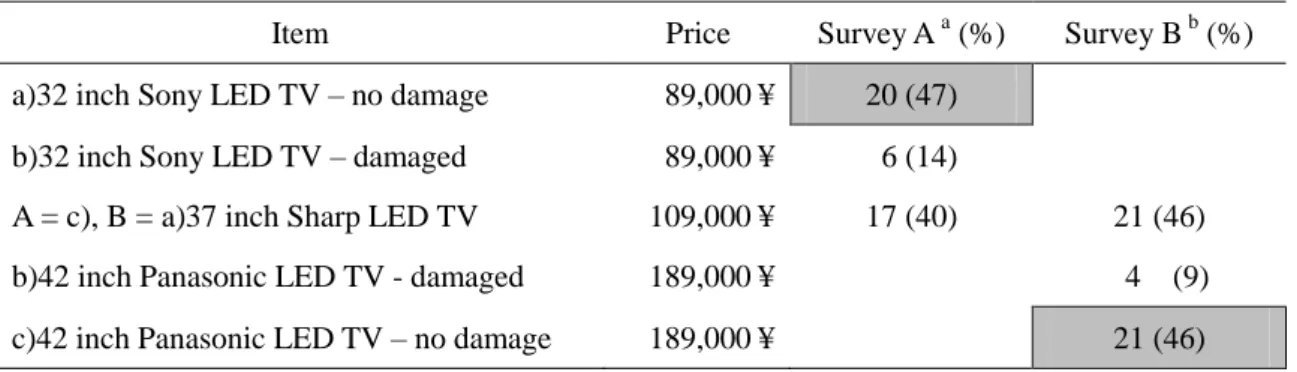
Table 2 shows the results for the parallel question Q9 when a decoy is introduced by having identical models, one damaged and one not, available at the same price. In theory, introducing a logically favorable alternative provides additional context for easier comparison between the two identical models. This then allows for an investigation into whether the choices in Q9 were irrationally motivated away from the initial alternative in Q1 by providing such decoy. Compared to the shaded results from Table 1, in Survey A, a 7% increase (3 students) chose the undamaged 32 inch Sony TV and 21 students surveyed, up from 14 (+16%) chose the undamaged 42 inch Panasonic TV in Survey B, indicating some degree of relative irrationality in decision making under the decoy condition. Possibly of some interest to investigate the usage or consumer behavior of Japanese university students more closely, but beyond the scope of this paper, 10 students in total in Table 2 were ok with selecting the damaged items at the same price as the identical model of TV without any damage.
Table 2. Results of decision making – with decoy for relative context
Item Price Survey A a (%) Survey B b (%)
a)32 inch Sony LED TV – no damage 89,000 ¥ 20 (47) b)32 inch Sony LED TV – damaged 89,000 ¥ 6 (14)
A = c), B = a)37 inch Sharp LED TV 109,000 ¥ 17 (40) 21 (46)
b)42 inch Panasonic LED TV - damaged 189,000 ¥ 4 (9)
c)42 inch Panasonic LED TV – no damage 189,000 ¥ 21 (46)
a n = 43, b n = 46
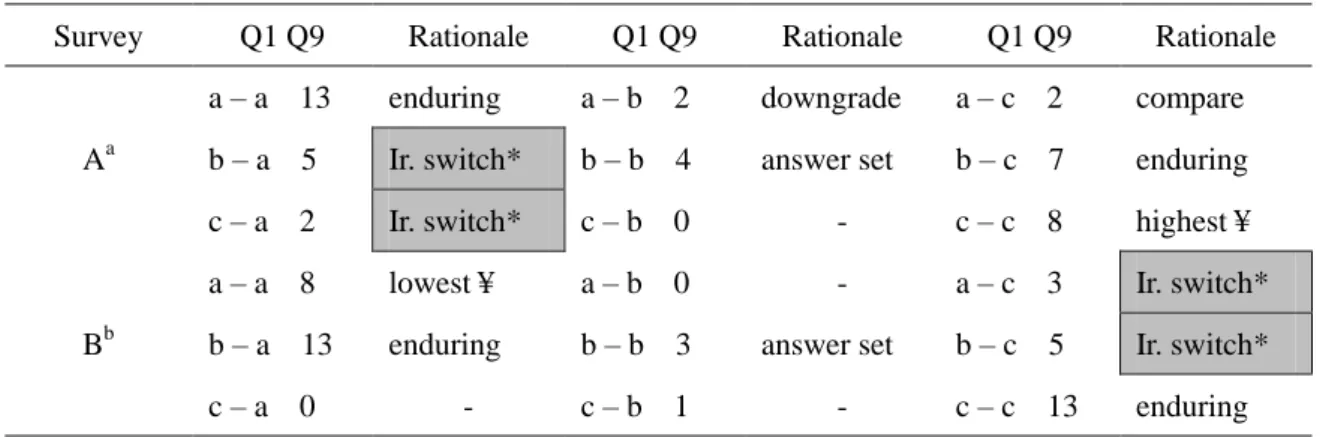
While raw counts may show the trend in decisions being made, Table 3 shows the matched frequency for each pair of answer choices possible for Q1 and Q9 broken down by survey form. The rationale column shows consistent, enduring decisions made by participants, as well as irrational switches in decision making (grey shading) motivated possibly by the decoy, as well as possible answer sets given by students simply providing parallel answers of (b) on both Q1and Q9. Since the
73
decoy also removed one price point alternative there are also cells that suggest some participants may have remained consistent in their decisions by choosing the highest price/size alternative or the TV at the lowest available price point.
Table 3. Rational and irrational decisions in Q1 and Q9 – with decoy for relative context
Survey Q1 Q9 Rationale Q1 Q9 Rationale Q1 Q9 Rationale
Aa
a – a 13 enduring a – b 2 downgrade a – c 2 compare b – a 5 Ir. switch* b – b 4 answer set b – c 7 enduring c – a 2 Ir. switch* c – b 0 - c – c 8 highest ¥
Bb
a – a 8 lowest ¥ a – b 0 - a – c 3 Ir. switch*
b – a 13 enduring b – b 3 answer set b – c 5 Ir. switch*
c – a 0 - c – b 1 - c – c 13 enduring
a n = 43, b n = 46
In Q2 of Survey A, Table 4 shows 25 people (57%) chose (a) the lower priced internet-only business magazine subscription and 19 (43%) opted for (b) the internet & print option at over double the price, In Survey B, to alter the initial choice trigger, print only (16 people, 35%) was set against internet & print (29 people, 64%). These results suggest that online access may be more salient to these digital age students and could skew otherwise rational decisions.
Table 4. Rational and irrational decisions in Q2 and Q10 – with decoy for relative context
Survey Q2 Q10 Rationale Q2 Q10 Rationale Q2 Q10 Rationale
Aa
a – a 19 enduring a – b 2 ?? a – c 4 Ir. switch*
b – a 0 - b – b 5 answer set b – c 14 enduring
Bb
a – a 8 enduring a – b 5 eco ?? a – c 3 Ir. switch*
b – a 2 Ir. switch* b – b 9 new option b – c 18 enduring
a n = 44, b n = 45
As shown in Table 4, of the 25 people who chose the internet-only option (a) in Q2 Survey A, 19 of those (a – a), or over 75%, maintained their decision in Q10, four were enticed to upgrade to the more inclusive internet & print option that they bypassed in Q2 (a – c), suggesting an irrational switch, and two actually chose the high priced, print-only option that was not available in Q2. Of the
74
19 respondents who initially chose internet & print (b) in Survey A, 14 (b – c) answered consistently.
Five may have provided an answer set (b = b) reply since choosing the previously unavailable print-only option at the same price as the inclusive internet & print options in Q2 and 10 seems out of place. In Survey B, 8 of the 16 continued to opt for the lower-priced print-only option (a - a) and 18 maintained interest in the inclusive internet & print subscription at the highest price point (b – c).
Three were attracted to switch to the inclusive internet & print option (a - c) under the decoy condition at the same price in Q10 that was available originally in Q2. Five, possibly green-minded consumers, moved up the price scale to opt for the new internet-only option in Q10 (a - b). When provided the easier for comparison decoy condition in Q10, 2 respondents moved away from it to choose print-only (b – a) as an irrational switch to an alternative that was originally available in the conditions that are harder to choose under in Q2. Nine selected the previously unavailable internet-only option (b – b), foregoing the added value of the print edition at the same price.
Question 11 looked at whether the appeal of a free breakfast on a honeymoon to Rome (Survey A) or Paris (Survey B) would decoy the respondents into irrational choices. Of the 95 survey responses, only 3 people showed the irrational shift away from their earlier choice in Q3 to the more favorable option against the decoy. The greatest number of respondents maintained their first choice, with Paris out ranking Rome two to one as the preferred spot.
Tversky and Kahneman (1981) showed that for an absolute difference of $5 on a $15 calculator, 68% of people would drive 20 minutes to buy it at $10. If the calculator were $125, only 29% would exert the same effort and incur the inconvenience to save $5. In Question 4 in Survey A, an absolute difference of 700 yen was introduced between the prices of the same pen at 2,500 ¥ and 1,800 ¥.
Question 12 in Survey A presented an equal difference of 700 yen between suits at 45,500 ¥ and 44,800 ¥. Survey B reversed the order of the questions to determine if sequencing influenced the pattern of decisions. In Survey A, with Q4 introducing savings for the pen, 90% of the respondents would take a 15 minute trip to save the 700 ¥, while only 68% (Q12) would do so to save on the suit, an irrational decision by nine people, but not as dramatic as the near 40% swing as found by Tversky and Kahneman in their calculator study. In Survey B, beginning with the smaller relative value difference on the suits in Q4, 75% would make the effort to save 700 yen, while in Q12 seven additional people (91%) would make the irrational decision to travel 15 minutes to save the same amount on only the pen. In both Survey A and B, 4 respondents (10% and 9% respectively) indicated that they would not take action to save 700 yen on either of the items.
Question 6 was used to determine if low (10 ¥ in Survey A) or high (90 ¥ in Survey B) initial values for extra overtime pay on a base wage of 800 ¥ would be established as anchors and thus vary
75
the reaction in Q14 toward acceptance of mid-range bonus pay for overtime hours (50 ¥ in both Survey A and B). In Survey A, half of the respondents (20 out of 40) answered they would accept both 10 ¥ and 50 ¥ bonus pay on top of a typical base rate of pay for part time work for university students of 800 ¥. In Survey B, 33 out of 43 respondents would accept the bonus pay of 90 ¥, but eight of these would not accept the extra bonus rate of 50 ¥. In Survey A, 19 people would opt to not work on National Holidays at 810 ¥/hour, but then seven of these found 850 ¥ an acceptable threshold. An equal 18% percent of participants (7/40 in Survey A and 8/43 in Survey B) modified their choice in response to the low initial anchor and the high initial anchor. The scale for looking into these results varies with the experiment Ariely introduced where participants bid for remuneration to listen again to high pitched sounds – a decision crafted because no existing market price or known way to value listening to high pitched sounds exists. In Ariely’s study, those with a low initial anchor of 10 cents arrived at an average bid of 33 cents to listen to the annoying sounds again, while those with the 90 cent initial reward averaged out expecting 73 cents. Questions 5 and 13 in the surveys (Appendix 1 and 2) looked at anchors set through bidding or the intent to purchase and these will be taken up in further research into CUBE students’ decisions through replications of Ariely’s studies.
Questions 8 and 16 presented a survey-based replication of one of Ariely’s behavioral studies into the comparison of a nominal price and zero price of free. Question 8 provided the results comparing students opting for premium Godiva chocolates at 20 ¥ with Japan-based Morinaga chocolates for 1 ¥ (Survey B – Q8) and the same premium chocolate and price with standard Morinaga chocolates for free (Survey A – Q8). Table 5 shows a modest 6% shift (or more accurately) higher rate in the split between the separate samples of decision makers choosing free over the nominal price. This is far below the dramatic 42% shift from nominal (27%) to free (69%) reported by Ariely in Chapter 3.
Table 5. Power of free in Question 8
Survey Nominal Cost - Premium Free/Penny cost - Standard Aa Godiva 20 ¥ 22 (54%) Morinaga free 19 (46%) Bb Godiva 20 ¥ 25 (60%) Morinaga for 1 ¥ 17 (40%)
a n = 41, b n = 42
Question 16 was the same in both survey formats and also allowed for observation of the power of free (1000 ¥ book coupon for free) compared with the rationality of paying 700 yen for a 2000
76
¥ book coupon for a net saving of 1300 ¥. In this case, 69% of the respondents chose the free book coupon while only 31% opted for the risk of paying 700 yen in advance for an item at double the redemption value. Although no percentages are given, these results parallel those from Ariely with mall shoppers in Boston on Amazon gift certificates of similar value, although book coupons in Japan are generally understood to have no expiry date risk.
Table 6 combines the results from Questions 8 and 16. As shown in columns 2 and 4, an almost identical number of students chose the free book coupon in Q16 regardless of whether they were premium chocolate buyers at the nominal price, free standard chocolate takers, or those opting for the standard chocolate at the penny cost. For the nominal payers, only 8 of 22 (36%) and 10 of 25 (40%) in Surveys A and B respectively choose the more financially rational 2000 ¥ coupon at a cost of 700 yen. Of the subjects taking the free standard chocolate, 5 of 19 (26%) chose to pay 700 yen to get the larger value and better net return coupon. Of the respondents willing to pay 1 yen for the standard chocolate over 20 yen for the premium one, only 3 students (18%) made the seemingly more rational choice of paying 700 yen to get a 2000 ¥ book coupon that can be used at any time in the future.
Table 6. Nominal, free, & penny chocolates with free 1000¥ and 700¥ for 2000¥ coupons
Survey – Questions 8 and 16 20¥ & free 20¥ & 700¥ free/1¥&free free/1¥&700¥
Aa 14 8 free 14 free 5
Bb 15 10 1¥ 14 1¥ 3
a n = 41, b n = 42
3.5 Discussion
The questions in this replication study examining predictable irrationality show that Konan University students in the Hirao School of Management on the CUBE Campus initially demonstrated a slight tendency overall to pick the middle option of possibly difficult to compare TV brands, sizes and prices points (Table1). However the middle value was not consistently the option with the highest frequency with the smallest, cheapest TV in Survey A having been selected most frequently. This may suggest that some nature of the decision for these consumers does allow them to actually compare the options and select a preference away from the predictable, but irrational convention of choosing the middle option. This decision making may also reflect the cultural norms where many university students in Japan still live at home or stay in very small rooms or apartments.
Smaller TVs are more viable and their utility is able to be compared favorably over more expensive,
77
larger TV sets owing to the consumer awareness of their needs in the living space available.
In measures of relativity, when an inferior decoy is introduced, this condition is seen to not only create a simpler comparison by making option A seem more favorable than option –A, but is also believed to make A look better overall than non-decoyed option B. In a study using photos of physical attractiveness and distorted physical attractiveness, Ariely found that 75% of students selected undistorted option A over option B when distorted decoy –A was available. However, the data was reversed when the same option B was decoyed with –B, with results showing B to be more favorable than the more difficult to compare with undistorted, non-decoyed option A, previously preferred by other respondents. Results from Question 9 (Table 1 & Table 2 shading) indicate that a total of 10 students (11%) were influenced to select the undamaged decoyed alternative. While further qualitative investigations might prove interesting, it is also worth noting that an equal number of 10 students chose the damaged decoy. The reasons for this might be telling for either the behavior of consumers or limitations in the English survey in a foreign language context.
The ability to compare and thus rationalize decisions towards preferences or perceived needs and/or the value of the option, as in pure economic theory, may also have been a factor with these Japanese students opting for functionality and utility according to their digital literacy and comfort level with technology in print or internet magazines in Q2 and 10. Possibly the culturally favored or accepted je ne sais quoi of a honeymoon in Paris over one in Rome for Japanese subjects may have mitigated against the more dramatic irrational shifts that Ariely found in his studies, where in the case of Q3 and 11 data had to be a similarly surveyed response of potential behavior not an observation of actual behavior (since even MIT researchers do not have budgets to fund international honeymoons).
Extrapolating from Ariely’s term of arbitrary coherence for prices and adding the potential for anchors to be set, Questions 4 and 12 examined if the students would make an effort to save 700
¥ (about an hour’s wage at a part-time job) on a 2500 ¥ pen or 45,500 ¥ suit. While an equal 90%
would make the effort for the pen, a small variance 68% to 75% for the suit was seen when the cheaper pen was introduced first in Q4 Survey A and the more expensive suit was the anchor point in Q4 of Survey B. Again this variance is not so large to confirm the tendencies Ariely is pointing out with his provocative title. However, in all, nearly 20% of the CUBE respondents (16 out of 84) did show an irrational response to seeking to save 700 ¥ on the lower base priced pen than the same absolute value of 700 ¥ on the higher priced suit.
Working around the hourly wage of 800 yen no notable differences were seen in responses to working on a National holiday for a mid-range wage increase between respondents at a low initial
78
anchor (+10¥ = +1.25%) and those at a high initial anchor (+90¥ = +11.25%). Further investigation into the nature of the part-time worker psyche, the expected work duties scheduled on National holidays, and the accepted value of wages (where a quarter of the students surveyed would not work on these holidays at any of these wage ranges) are warranted to determine how much economics or behavioral economics is factoring in.
Ariely states that “free leads us to make a bad decision” (p. 58). The data from Q8 and 16 suggests that CUBE students can be seen to be the most vulnerable to irrational decisions under the power of free. Although no difference existed between the nominal cost of 20 ¥ and the 1 ¥ penny cost on chocolates, at a cost of 700 ¥, for a 2000 ¥ book coupon, with no effort factor assumed, a number of students (57 = 69%) bypassed the 1300 ¥ net return (about 125% of the hourly wage these students might earn in a part-time job) for the free one at 1000 ¥. These results do run parallel with findings reported by Ariely and would seem to suggest that numbers are truly an international language and the sound of free resonates cross-culturally.
4. Addressing Irrationality for Consumer Decision Making
The field of behavioral economics and its exploration into the rationality and quirks in human behavior can be seen to have great appeal with recent works such as Freakonomics, (Levitt &
Dubner, 2006), The Tipping Point (Gladwell, 2002), in the growth of Starbucks and high end coffee shops, the open source phenomenon, and the book reviewed here Predictably Irrational. Ariely sees studies into behavioral economics as an exploration of what influences our decisions in daily life.
The outcomes from these studies (and the goal of the book) point out how systematic certain mistakes are and provide insight into how they might be avoided.
In terms of relativity, suggestions include controlling the circles around us such that by moving in smaller circles of comparison we can take conscious steps to boost our relative position and avoid triggers pushing us beyond our means. Ariely also suggests moving our focus from narrow to broad, meaning beyond the immediately locally available relative alternative to wider options. In this way, as consumers who are always wanting more, we can get a better handle on our decisions with an effective way to break the cycle of relativity.
Ariely showed that what consumers are willing to pay can easily be manipulated and is not purely reflective of their preferences at market demand and supply. On the basis of anchoring, suggested retail prices, promotions, and product launches, can be seen to influence willingness to pay. This challenges the notion in economics that supply and demand are truly independent forces and tips causality to the supply side variables. Understanding our sensitivity to past prices and
79
decisions and our orientation toward maintaining coherence with these may allow consumers to overcome possibly unfortunate initial anchors to make better gut decisions than the ones arrived at through apparently, rational, thoughtful, calculated (highly-influenced) processes.
5. Closing
Although the title of this paper might seem quite harsh and potentially volatile, the studies into consumer behavior replicated in this review confirm that students at the CUBE Campus of Konan University can be somewhat predictably irrational in their decisions, but not uniquely and not as significantly as the behavior of Ariely’s subjects in a similar context.
References
Anderson, C. (2009). Free: The future of a radical price. London: Random House Business Books.
Ariely, D. (2009). Predictably irrational: The hidden forces that shape our decisions. New York:
Harper Collins.
Gladwell, M. (2002). The tipping point: How little things can make a big difference. New York:
Back Bay Books.
Levitt, S. D., & Dubner, S. J. (2006). Freakonomics. New York: Harpertorch.
Pink, D. H. (2009). Drive: The surprising truth about what motivates us. New York: Riverhead Books.
Tversky, A., & Kahneman, D. (1981). The framing of decisions and the psychology of choice.
Science, 211(4481), 453-458.
80
Appendix 1: Survey format A
1. Which one would you select
a) 32 inch Sony LED TV 89,000 yen
b) 37 inch Sharp LED TV 109,000 yen
c) 42 inch Panasonic LED TV 189,000 yen
2. Which one would you select
a) 1-year internet-only weekly business magazine subscription 5,000 yen b) 1-year internet & print weekly business magazine subscription 11,000 yen
3. Which one would you select a) honeymoon in Paris
b) honeymoon in Rome (Roma)
4. You are in a shop and you see a pen you want for 2,500 yen. But then you see an advertisement from another store 15 minutes away that has the same pen for 1,800 yen. Would you take the 15 minute trip to save 700 yen?
5a) Write the last 2 numbers of your student number: __ __ - make this _ _ 0 0 ¥ b) Would you pay this much to buy and get each of these items? Circle YES or NO
- a bottle of wine scoring 86/100 points (medium score) YES NO Max:_______
- a bottle of wine scoring 92/100 points (high score) YES NO Max:_______
- a cordless wireless trackball and game controller YES NO Max:_______
- a wireless keyboard and mouse YES NO Max:_______
- a popular book on art and graphic design YES NO Max:_______
- 450g of Godiva chocolate YES NO Max:_______
c) What is the max. you would pay to buy each of these? Write the number (max9900¥) ↑.
6. You have a part-time job that pays 800 yen per hour.
a) In 2011, if you work a National holiday you will be paid an extra 10¥/hr = 810¥
- Will you want to work on National Holidays in 2011 for 810¥/hr? YES NO
81
7. If they paid you 1000¥, would you listen to your teacher read poetry for 10 min? YES NO a) What is the minimum you would accept to listen to a short poem? Min: ______
b) What is the minimum you would accept to listen to a medium poem? Min: ______
c What is the minimum you would accept to listen to a long poem? Min: ______
8. Would you choose a) one Godiva chocolate for 20¥ or b) one Morinaga chocolate for free?
9. Which one would you select
a) 32 inch Sony LED TV with no marks or damage 89,000 yen b) 32 inch Sony LED TV with a few scratches and some damage 89,000 yen
c) 37 inch Sharp LED TV 109,000 yen
10. Which one would you select
a) 1-year internet-only weekly business magazine subscription 5,000 yen b) 1-year print-only weekly business magazine subscription 11,000 yen c) 1-year internet & print weekly business magazine subscription 11,000 yen
11. Which one would you select
a) honeymoon in Paris with free breakfast
b) honeymoon in Rome (Roma) without free breakfast c) honeymoon in Rome (Roma) with free breakfast
12. You are looking for a suit and ensemble for job hunting and you find one that you like for 45,500 yen. You hear another shop 15 minutes away has the same suit and ensemble for 44,800 yen. Would you take the 15 minute trip to save 700 yen?
13a) Write the last 2 numbers of your student number: __ __ - make it __ __ 0 0 ¥
13b) In an “auction” where only the person bidding the highest can get the item, would you be willing to bid this much to try and get each of these things? Circle YES or NO
- a bottle of wine scoring 86/100 points (medium score) YES NO Max:_______
- a bottle of wine scoring 92/100 points (high score) YES NO Max:_______
- a wireless trackball and video game controller YES NO Max:_______
- a wireless keyboard and mouse YES NO Max:_______
- a popular book on art, photography, & graphic design YES NO Max:_______
82
- 450g of Godiva chocolate YES NO Max:_______
13c) What is the maximum¥ you would bid for each of these? Write the number (max9900¥) ↑
14. Remember your part-time job paying 800¥/hr? And an extra 10 ¥ on holidays in 2011?
a) In 2012 if you work a National holiday you will be paid an extra 50¥/hr=850¥
- Will you want to work on National Holidays in 2012 for 850¥/hr? YES NO
15. Circle which one you would choose if you had 3 small Morinaga chocolates & you could a) give away one small Morinaga chocolate and get a small Kit Kat
b) give away two small Morinaga chocolates and get a large Kit Kat
16. Which would you choose a) 1000¥ book coupon for free b) 2000¥ book coupon for 700¥?
Appendix 2: Survey format B
1. Which one would you select
a) 32 inch Sony LED TV 89,000 yen
b) 37 inch Sharp LED TV 109,000 yen
c) 42 inch Panasonic LED TV 189,000 yen
2. Which one would you select
a) 1-year print-only weekly business magazine subscription 5,000 yen b) 1-year internet and print business magazine subscription 11,000 yen
3. Which one would you select a) honeymoon in Paris
b) honeymoon in Rome (Roma)
4. You are looking for a suit and ensemble for job hunting and you find one that you like for 45,500 yen. You hear the price at another shop 15 minutes away has the same suit and ensemble for 44,800 yen. Would you take the 15 minute trip to save 700¥? YES NO
83
5a) Write the last 2 numbers of your student number: __ __ - make this into __ __ 0 0 ¥
b) In an “auction,” only the person bidding the highest can get the item. Would you be willing to bid this much for a chance to try and get these things? Circle YES or NO
- a bottle of wine scoring 86/100 points (medium score) YES NO Max:_______
- a bottle of wine scoring 92/100 points (high score) YES NO Max:_______
- a cordless wireless trackball and game controller YES NO Max:_______
- a wireless keyboard and mouse YES NO Max:_______
- a popular book on art and graphic design YES NO Max:_______
- 450g of Godiva chocolate YES NO Max:_______
c) What is the max. you would bid for a chance at each of these? Write here ↑ (max 9900¥)
6. You have a part-time job that pays 800 yen per hour.
a) In 2011, if you work a National holiday you will be paid an extra 90¥/hr = 890¥
- Will you want to work on National Holidays in 2011 for 890¥/hr? YES NO
7. Would you pay 1000¥ to listen to your teacher read poetry for 10 min? YES NO a) What is the maximum you would pay to listen to your T read a short poem? Max: ______
b) What is the maximum you would pay to listen to your T read a medium poem? Max: _____
c) What is the maximum you would pay to listen to your T read a long poem? Max: ______
8. Would you choose a) one Godiva chocolate for 20¥ or b) one Morinaga chocolate for 1¥?
9. Which one would you select
a) 37 inch Sharp LED TV 109,000 yen
b) 42 inch Panasonic LED TV with a few scratches and some damage 189,000 yen c) 42 inch Panasonic LED TV with no marks or damage 189,000 yen
10. Which one would you select
a) 1-year print-only weekly business magazine subscription 5,000 yen b) 1-year internet-only weekly business magazine subscription 11,000 yen c) 1-year internet and print business magazine subscription 11,000 yen
84
11. Which one would you select
a) honeymoon in Paris with breakfast b) honeymoon in Paris with no breakfast c) honeymoon in Rome (Roma) with breakfast
12. You are in a shop and you see a pen you want for 2,500 yen. But then you see an advertisement from another store 15 minutes away that has the same pen for 1,800 yen. Would you take the 15 minute trip to save 700 yen?
13a) Write the last 2 numbers of your student number: __ __ - make this _ _ 0 0 ¥ b) Now you are shopping, would you pay this much to buy and get these items? YES NO
- a bottle of wine scoring 86/100 points (medium score) YES NO Max:_______
- a bottle of wine scoring 92/100 points (high score) YES NO Max:_______
- a cordless wireless trackball and game controller YES NO Max:_______
- a wireless keyboard and mouse YES NO Max:_______
- a popular book on art and graphic design YES NO Max:_______
- 450g of Godiva chocolate YES NO Max:_______
c) What is the maximum you would pay to buy each of these? Write the number (max 9900¥)↑.
14. Remember your part-time job paying 800¥/hr? And an extra 90¥on holidays in 2011.
a) In 2012 if you work a National holiday you will be paid an extra 50¥/hr=850¥
- Will you want to work on National Holidays in 2012? YES NO
15. Which would you choose if you had 3 small Morinaga chocolates and you could a) give away one small Morinaga chocolate and get a large Kit Kat
b) give away nothing and get a small Kit Kat for free
16. Which would you choose a) 1000¥ book coupon for free b) 2000¥ book coupon for 700¥?