Initial activities of a radiation emergency medical assistance team to Fukushima from Nagasaki
Naoki Matsuda
a,c,*, Kouji Yoshida
b,c, Kanami Nakashima
b,c, Satoshi Iwatake
b, Naoko Morita
c, Takashi Ohba
d, Takeshi Yusa
d, Atsushi Kumagai
b,d, Akira Ohtsuru
b,da
Center for Frontier Life Sciences,
bHospital of Medicine and Dentistry,
cGraduate School of Biomedical Sciences, Nagasaki University. 1-12-4, Sakamoto, Nagasaki 852-8523, Japan.
d
Fukushima Medical University, Hikarigaoka, Fukushima 960-1295, Japan.
* Corresponding author Naoki Matsuda
Professor
Division of Radiation Biology and Protection Center for Frontier Life Sciences
Nagasaki University
1-12-4, Sakamoto, Nagasaki 852-8523, Japan Tel : +81-95-819-7163
Fax : +81-95-819-7153.
E-mail : [email protected]
Abstract
As an urgent response to serious radiological accidents in the Fukushima Daiichi nuclear power plant, the radiation emergency medical assistance team (REMAT) from Nagasaki University landed at Fukushima on March 14, 2011, two days after the initiation of radiation crisis by the hydrogen explosion at Unit-1 reactor. During a succession of unexpected disasters, REMAT members were involved in various activities for six days, such as setting the base for radiological triage at the Fukushima Medical University, considerations for administration of stable iodine, and risk communication with health care workers. This report briefly describes what happened around REMAT members and radiation doses measured during their activities.
Keywords: Fukushima Daiichi nuclear power plant, radiation emergency medical assistance,
environmental radiation dose, individual exposure dose
Introduction
Based on the lessons learned from the critical accident at the JCO uranium-conversion plant in Tokai village on September 30, 1999, a radiation emergency medical response system has been established to treat radiation-exposed or radioactive-contaminated patients effectively. The National Institute of Radiological Sciences (NIRS) and Hiroshima University are designated as tertiary radiation emergency hospitals for advanced care of serious injury in eastern and western region of Japan, respectively. Additionally, 36 hospitals including Nagasaki University in 19 prefectures are also designated as secondary hospitals to provide medical care for radiation-injured patients in each local region. After the complete loss of electricity in the Fukushima Daiichi nuclear power plant of Tokyo Electric Power Company (TEPCO) due to the Tsunami attack on March 11, 2011, a first radiation emergency medical assistance team (REMAT) was sent to Fukushima from NIRS on March 12 when the hydrogen explosion at Unit-1 reactor occurred, followed by a second team from Hiroshima on March 13. The five REMAT members in Nagasaki were called out on March 13 and they immediately moved to NIRS. Just after the hydrogen explosion at Unit-3 reactor on March 14, the Nagasaki REMAT together with additional members from Hiroshima and the Nuclear Safety Research Association landed at a riverside park near the Fukushima prefectural office after an hour flight by helicopter from the Chiba base of the Self Defense Force (SDF) nearby NIRS. They then joined a medical assistance unit of the disaster countermeasures office in Fukushima city that locates approximately 60km west of the nuclear power plant and 1,200km east from Nagasaki (Fig.1).
External contamination levels of people
Early report from the people monitoring teams in coastal area of Fukushima, so called
Hama-dori where the nuclear power plant locates, clearly indicated that the initial action
level for whole-body decontamination at 10kcpm by using a hand held GM-survey meter
was not practical because most people evacuated from Hama-dori exhibited contaminations
higher than the level. Therefore, the disaster countermeasures office of Fukushima raised
the action level to 100kcpm on March 14. This level, corresponding to 400Bq/cm
2according to the Japanese Industrial Standards, was later approved by the Nuclear Safety
Commission of Japan on the basis that 100kcpm by using a particular, and also popular, GM-survey meter (TGS-136, Hitachi-Aloka Medical, Ltd., Tokyo, Japan) results in 1µSv/h at 10cm far from the contaminated surface (Nuclear Safety Commission of Japan, 2011;
National Institute of Advanced Industrial Science and Technology, 2011). In any case, the radioactive contamination as much as 100kcpm in environments was out of consideration for most of radiation safety officers because it is hardly seen even in the radiation control area. However, that was the case. The wind to the western direction from the Fukushima Daiichi carried a substantial amount of radioactivity due to an explosion at the suppression chamber of Unit-2 reactor early in the morning on March 15, which may have affected the integrity of its primary containment vessel. The rain and snow in the late afternoon made fallout of radionuclides, resulting in heavy surface contaminations as high as 10kcpm on heads and outwears of people in Fukushima city. The external radiation dose measured by a CsI(Tl) scintillation detector (Field Radiation Meter PDR-201, Hitachi-Aloka Medical) inside a vehicle was approximately 16.4µSv/h to the upward direction where radioactive rain and snow fell on the roof. In contract, ambient dose at the balcony of the 4th floor of the Fukushima prefectural office building declined to 1.6µSv/h.
An ion-chamber radiation monitor (451B-DE-SI, FLUKE-Biomedical, WA) in Fukushima Medical University (FMU) detected a striking elevation of outdoor dose from 1µSv/h to approximately 8µSv/h (Fig.2). The surface contamination level of the ground and the snowfall in FMU was 20kcpm and 40kcpm, respectively. As of February 31, 2012, the external contamination higher than 100kcpm was found in 102 out of 245,464 people according to the official announcement (Fukushima prefecture, 2012).
Setting the base for radiological triage at FMU
In addition to the hydrogen explosion at reactors of Unit-1, 2, 3, a fire occurred at Unit 4 in which all fuel assemblies had been removed from the reactor for the periodic inspection.
During a succession of unpredicted disasters, emergency workers in Fukushima Daiichi
were assumed to be exposed to very high external radiation dose in the worst case. Thus
FMU added a role of the base site for radiological triage to its original function as a
secondary radiation emergency medical center. The chemical, biological, radiological and
nuclear (CBRN) task force of the SDF, Japan Atomic Energy Agency, and Nagasaki University REMAT gathered at FMU and assembled a temporal radiation emergency triage/medial care team. Fortunately, only one worker was transported by helicopter from the Fukushima Daiichi in a first week but no severe injury was found, except for an irremovable contamination at 50kcpm on his face.
Administration of stable iodine
According to a guideline for radiation emergency preparedness, the administration of stable iodine to the younger people for protecting them from thyroid exposure by inhaled radioactive iodine is to be decided and ordered by the Nuclear Safety Commission of Japan.
However, complete chaos in transmission of information and relatively unorganized evacuation made this scenario impossible. In Hama-dori, stable iodine tablets were already distributed to the evacuators. At the FMU early bird meeting on March 17, a discussion was begun regarding administration of stable iodine to all the children in Fukushima prefecture. However, there was no information available from either the broadcast or the Internet, on risk assessment of radioactive iodine inhalation. As a clue, air sampling outside the building in FMU was performed for estimation of airborne radioactivity. The results by an HPGe-semiconductor detector (Camberra, CN) showed the radioactivity ranging from 8.8x10
-6Bq/cm
3airborne. The equivalent dose of 1-year old infant thyroid was roughly estimated as 0.06mSv/24h outdoor, which was lower enough than the intervention level (IAEA, 1994; WHO 1999; IAEA, 2001). Furthermore, thyroid doses of children in the day care center near FMU monitored by a NaI(Tl) scintillation detector (TCS-172B, Hitachi-Aloka Medical) were very similar to the background level.
For these reasons, hasty decision was avoided before the official order came. As a result, it seems that unnecessary administrations of stable iodine tablets to children have not been made.
Risk communication with health care workers
On March 18, one week has passed by after the earthquake and Tsunami attack, with great
difficulties such as water supply shutdown, insufficient foodstuff, and strong fear of
invisible radiation among Fukushima residents including medical staffs. Risk communication was a possible way to help them understand the current radiation situation correctly and therefore not personalize risks. The lectures by REMAT members on radiation from various viewpoints with frank discussions were given to over 200 people of health care workers and their families in the FMU auditorium, which was also released outbound through U-stream network. Risk communications should be continued in any ways and forms incorporating updated information as well as the basics of radiation.
Radioactivity in environmental samples and individual exposed doses
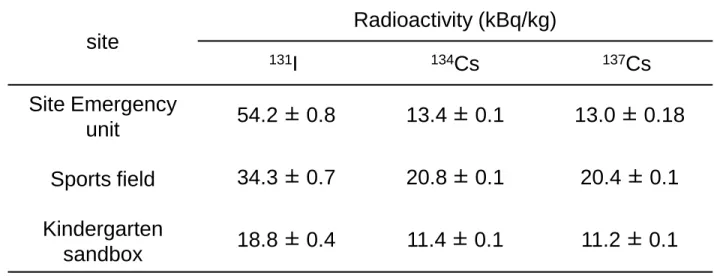
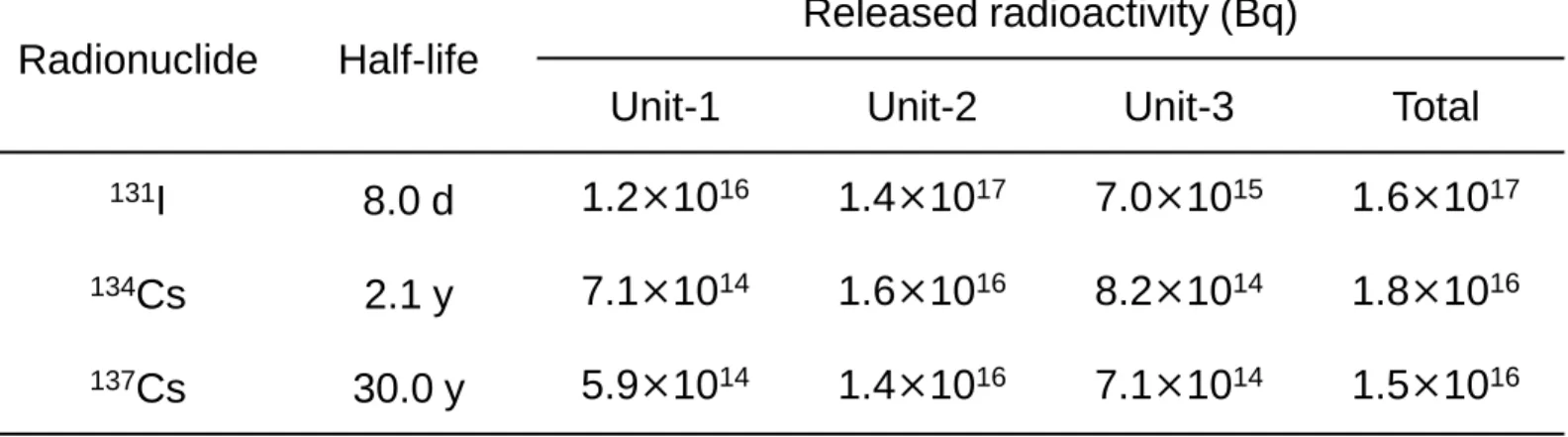
On March 19, soil samples were collected from various sites in FMU for radiation measurement by an HPGe-semiconductor detector. Several radionuclides derived from nuclear reactors were detected including I-131, Cs-134, and Cs-137 at concentrations higher than 10kBq/kg (Table 1). Among them, the concentration of I-131 was higher than radioactive cesium regardless of its shorter half-life (8.02d) than Cs-134 (2.07y) and Cs-137 (30.04y). Concentrations of Cs-134 and Cs-137 were in the similar level. These results, in part, would reflect differences in the amount of released radioactivity from three reactors (Japanese Government, 2011), reporting that total discharge of I-131 was approximately ten times higher than Cs-134 and Cs-137 (Table 2) . Although the concentrations were not higher than those three nuclides, Te-129m, Te129, Te-132 and I-132 were also detected in the same sample. A comparison of this ground contamination level with other places in Fukushima, Chernobyl, and Semipalatinsk test sites has been reported previously (Taira et al., 2012).
Table 3 summarizes surface contamination on clothes of REMAT members, which were measured on March 22, 2011 in Nagasaki. Certain amount of radioactivity was supposed to be transferred and diluted to the environments on the way back to Nagasaki such as the floor and the surface of a passenger seat of trains and an airplane. However, significant contaminations still remained on shoe soles, trousers, and outwears.
Individual exposure dose of each REMAT member is shown in Table 4. Total external
doses in four or five days in Fukushima were within the range of 31.0µSv to 52.0µSv, as
measured by solid-state dosimeters (PDM-101, Hitachi-Aloka Medical). Internal
radioactivity was measured in Nagasaki using a whole body counter (Fuji Electric, Tokyo, Japan) equipped with multiple NaI(Tl) detectors. Committed effective doses were then calculated according to a scenario of the acute inhalation on March 14 or on March 19.
Multiple incorporations of I-131, Cs-134, and Cs-137 were observed in all of the subjects, and the committed effective doses for the highest case were 50.0µSv, 2.9µSv and 2.0µSv, respectively. Similar to the results of soil samples, the contribution of I-131 to the total dose dominated those of Cs-134 and Cs-137. The sum of external effective dose and internal committed effective dose ranged between 51.0 to 85.9µSv. The individual dose evaluation of prolonged exposure by repeated visit to Fukushima is shown in a previous report (Yoshida et al., 2012).
Conclusion
It was so fortunate that the worst case in the nuclear power plant did not occur and no victim from the radiation accident has been reported. However, a heavy contamination of the environment will remain for many years in a wide area in eastern Japan (Kinoshita et al., 2011; Tagami et al., 2011). The fear of health risk by radiation at low doses is widely spread especially among parents of small children. In order to understand the updated radiological status of environment and people in Japan, the accurate and continuous radiation measurements should be steadily executed.
Acknowledgement
Authors are grateful to Professor Fumio Shishido, Dr. Arifumi Hasegawa, Dr. Yasuhiko Tsukada, Dr. Hisashi Sato, Dr. Makoto Miyazaki, and staffs in Department of Radiological Technology for the tremendous efforts they made throughout the initial and continuing activities.
References
Fukushima Prefecture, 2012. Results of radiation emergency screening test for body surface contamination. http://wwwcms.pref.fukushima.jp/.
IAEA, 1994. Intervention criteria in a nuclear or radiation emergency. IAEA SS 109,
Vienna.
IAEA, 2001. IAEA/WHO technical committee meeting to assess and review the international safety standards for intervention in emergency exposure situations involving radioactive iodine, Vienna.
Japanese Government, 2011. Attachment IV-2 of “Report of Japanese Government to the IAEA Ministerial Conference on Nuclear Safety – The Accident at TEPCO's Fukushima Nuclear Power Plant”, Tokyo.
Kinoshita, N., Sueki, K., Sasa, K., Kitagawa, J., Ikarashi, S., Nishimura, T., Wong, Y-S., Satou, Y., Handa, K., Takahashi, T., Sato, M., Yamagata, T., 2011. Assessment of individual radionuclide distributions from the Fukushima nuclear accident covering central-east Japan. PNAS 108, 19526–19529.
National Institute of Advanced Industrial Science and Technology, 2011. Conversion from
“counts per minute” (measured value) to Bq/cm
2and µSv/h under a condition described in the note below. http://www.aist.go.jp/aist_j/rad-accur/pdf/case_study_1_table_e.pdf.
Nuclear Safety Commission of Japan, 2011 (at 14:40 on March 19). Action level for decontamination of body surface.
http://www.nsc.go.jp/senmon/shidai/hibakubun/hibakubun028/ssiryo3-1.pdf.
Tagami, K., Uchida S., Uchihori, Y., Ishii, N., Kitamura, H., Shirakawa, T., 2011. Specific activity and activity ratios of radionuclides in soil collected about 20km from the Fukushima Daiichi Nuclear Power Plant: Radionuclide release to the south and southwest. Sci. Total Env. 409, 4885-4888.
Taira, Y., Takahashi, J., Gutevitc, A., Kazlovsky, A., Kudo, T., Matsuda, N., Yamashita, S., Takamura, N., 2012. Environmental contamination and external radiation dose rates from radionuclides released from the Fukushima Nuclear Power Plant. Radiat. Prot.
Dosim. in press.
Yoshida, K., Hashiguchi, K., Taira, Y., Matsuda, N., Yamashita, S., Takamura, N., 2012.
Importance of personal dose equivalent evaluation in Fukushima in overcoming social panic. Radiat. Prot. Dosim. in press. (doi:10.1093/rpd/ncr466)
WHO, 1999. Guidelines for iodine prophylaxis following nuclear accidents update 1999,
Geneva.
Figure Legend
Fig.1 Map of Japan and Fukushima. Fukushima locates approximately 1200km northeast from Nagasaki. The distance between the Fukushima Daiichi nuclear power plant and Fukushima Medical University is 60km.
Fig.2 Trend of outdoor ambient dose in Fukushima Medical University from March 13 to
March 18, 2011.
Fig.1 N.Matsuda
Fukushima
Chiba (NIRS) Tokyo
Hiroshima
Nagasaki
Pacific ocean Fukushima
Prefectural Office FMU
Koriyama
Iitate
Iwaki
Fukushima Daiichi
500km 50km
Fig.2 N.Matsuda
Date
A m bi en t dos e rat e (μS v/ h )
2011.3.15 16:55 2011.3.16 10:30
site
Radioactivity (kBq/kg)
131
I
134Cs
137Cs
Site Emergency
unit 54.2 ± 0.8 13.4 ± 0.1 13.0 ± 0.18 Sports field 34.3 ± 0.7 20.8 ± 0.1 20.4 ± 0.1 Kindergarten
sandbox 18.8 ± 0.4 11.4 ± 0.1 11.2 ± 0.1 Table 1. Radioactivity in soil samples collected in Fukushima Medical University on March 19, 2011.
Table 1
N. Matsuda
Radionuclide Half-life
Released radioactivity (Bq)
Unit-1 Unit-2 Unit-3 Total
131
I 8.0 d 1.2 × 10
161.4 × 10
177.0 × 10
151.6 × 10
17134
Cs 2.1 y 7.1 × 10
141.6 × 10
168.2 × 10
141.8 × 10
16137
Cs 30.0 y 5.9 × 10
141.4 × 10
167.1 × 10
141.5 × 10
16Table 2. Estimated radioactivity discharged to the air from three reactors, from
Attachment IV-2 of “Report of Japanese Goverment to the IAEA Ministerial Conference on Nuclear Safety – The Accident at TEPCO's Fukushima Nuclear Power Plant”, June 2011.
Table 2
N. Matsuda
subject
Outer Sweater Shirts Trousers Shoes Hat Bag
Max.
contami- nation (cpm)
Location
Max.
contami- nation (cpm)
Location
Max.
contami- nation (cpm)
Location
Max.
contami- nation (cpm)
Location
Max.
contami- nation (cpm)
Location
Max.
contami- nation (cpm)
A 450 collar 130 back - - 700 hem 3,500 240 130
B 1,700 body 140 chest 130 body 1,000 hem 5,900 - 200
C - - 250 back 300 cuff 5,430 hem 7,100 - -
D 110 cuff 200 back 520 cuff 500 hem 14,700 - 300
E 650 arm 100 back 180 cuff 1,800 hem 9,500 - 500
Table 3. Surface contamination on clothes of five members of REMAT from Nagasaki. Maximum contamination and its location is shown as net cpm by a GM-survey meter.
Table 3
N. Matsuda
subject
External
exposure Internal exposure Total
exposure and Effective
dose (µSv) Effective
dose (µSv)
Committed effective dose (µSv)
131