Effects of Prewriting Tasks in Japanese High School English Writing Textbooks
著者 Kobayakawa Mayumi
journal or
publication title
Journal of Shizuoka University Education
volume 10
page range 99‑113
year 2014‑03‑31
出版者 Shizuoka University. Educational Development Center
URL http://doi.org/10.14945/00007832
Effects of Prewriting Tasks in Japanese High School English Writing Textbooks
NIAYllMI KOBAYAICAWA
(ShiZuOka universi幌 Education Devcloplnent CenterD
Abstract
Focusing on the contents of preu.riting activities conducted prior to creating English compositions, this study examined and verified the effects of each activity on the resulting composition and also the types of effects that can be demonstrated depending on differences in the setting (or sequence) oftasks. The study observed the effectiveness of setting (arranging) tasks in the
following sequence: (a) Japanese-English traaslation prior to English composition and (b) outline creation prior to English composition formats. However, no effect was found for guided writing. The results revealed significant main effects on the compositional factors of Content Organization, Vocabulary, and Language use. However, no significant main effect was observed for Mechanics, such as spelling, punctuation, and capitalization; their effectiveness did not increase by writing more than one composition. This study suggests that, for these compositional factors, certain types of
post-composition instruction (feedback such as mistake correction) are needed during preliminary and subsequent compositions.
1, Introduction
The results of Kobayakawa's textbook analysis (201I,2012) showed that all 23 English writing textbooks published in Japan that were approved by the Ministy of Education, Culture, Sports, Science and Technology (MEXT) contained the phrase "draft[ing] a text based on the outcome of prewriting activities" (Hyland,2003, pp. 114-115). An analysis of these prewriting tasks in which students draft a text on the basis of the outcome of prewriting activities (number of tasks:
196) was conducted by Kobayakawa (2012) who showed that a wide range oftasks, including guided writing (number of tasks: 62), Japanese-English translation (number of tasks: 27), and outline creation (number oftasks: 77), was frequently employed.
Hedge (2005), while describing prewriting activities. states that "before putting pen to paper, the skilled writer in real life considers two important questions: (a) what is the purpose of this piece of writing? and (b) who am I writing this for?" (p. 52). Therefore, the importance of understanding the context and content of a text needs to be emphasized. Hedge also indicates that some pieces of writing require a great deal of preparation, while other pieces can be written more ot less spontaneously. As evinced by the description "emphasis should also be placed on the process of
―
‑99 ‑―
writing" MEXT, 1999, 3 Treatment of the Contents, [2]), step-by-step instructions are needed to emphasize the process that leads to the creation ofgood English compositions. For this, analyzing the manner in which prewriting tasks in textbooks are determined and arranged prior to the creation of English compositions is important. Accordingly, this study examined which of these tasks were effective for creating good English compositions.
In addition, this study focuses on prewriting tasks for examining adaptations. Materials adaptation refers to the process through which materials are changed for the purpose 6f improving them or making them more suitable for a particular type of leamer. Adaptations include reducing, adding' omitting, modifring, or supplementing materials. Most teachers adapt materials every time they use a textbook in order to maximize the value of that book for a particular t5pe of leamer.
Retrospective evaluation of textbooks will help in these adaptation processes (Ellis, 1997).
Empirical research concerning guided process writing reveals that this guidance has a positive influence on the quality and volume of ttre writing produced (Sano, 1996; Watanabe, 1997).
These sfudies suggest the use of content such as the following for process rndting guidanc e: making a vocabulary list of the words you need to write about your topic, organizing the anangement of
ideas, rereading, and composition reading with classmates. Such content comprehensively deals with
tasks that draw attention to the planning, revision, aad editing stages ofthe writing process. However, research focus was applied to the specific content of this guidance, and it does not elucidate which types of guidance contributed most to improving the quality and volume of the writing produced.
Although some reseatch has been conducted on the effect of guidance with respect to the revision and editing stages, little focus has been given to the results of guidance at the planning stage (e.g., creation of outlines), which is the first stage in the writing process.
Beyond making a vocabulary list ofwords needed to write about your topic, organizing the arrangement of ideas, and individual studmt brainstonning, discussing ideas with other students can also be considered as concrete guidance for the composition planning stage. However, it is unclear
which of these guidance tasks influence the resulting composition. In addition, few studies have attempted to examine which of these tasks were effective and led to the creation of good English compositions.
This study examines which prewriting activities are effective and thus lead to the creation of good English compositions and the types of influence that different prewdting activities have on students' English compositions. Classroom writing activities need to be organized in order to reflect the writing processes of good writers. sfudents must be encouraged to go through a process of prewriting, composing or drafting, revising, and editing. By focusing on the individual content of prewriting activities conducted prior to writing English compositions, this study examines how each
―
‑ 100 ‑―
task affects the consequent composition and the tlpes of effects that can be observed depending on differences in the setting or sequence of tasks. The main purpose of this study is to survey different approaches to prewriting activities assigned to students in English classes.
Accordingly, the specific research question of the present study was as follows: How do differences in prewriting tasks included in textbooks affect students'English compositions?
2. Method
2.1 Materials
The results of Kobayakawa's textbook analysis (2012) revealed that guided writing, Japanese-English translation, and the creation of outlines had been included as prewriting tasks.
Thus, the present study employed these tlree categories; the resulting groups were as follows.
Experimental groups:
1. Preliminary composition +Guided writing (Group G)---5u6sequent composition
2. Preliminary composition--+Japanese-English translation (Group T)--+gu6sequent composition 3. Preliminary composition-+Creation of outlines (Group O)-Subsequent composition
Control group:
Preliminary composition +N/A-+Subsequent composition
In order to verifu the effects of actual tasks included in textbooks, all the tasks used in this study-including guided writing, Japanese-English hanslation, the creation of outlines, and English compositions-were taken from two writing textbooks: Prominence English Writing (Tokyo Shoseki) and Mainstream Writing Course (Zoshindo).
2.2 Participants
From a group of 61 frst- and second-year students of a vocational college (nursing science deparfinent), this research targeted 55 students. The study excluded a total of six students who were either absent from classes or were outliers (four students) because they received either the lowest score (l point) or high scores in the proficiency test. The students involved in this study had no prior training in writing English compositions and had not used a writing textbook in high school.
Moreover, they had not received instructions on writing English compositions during their English classes at the vocational college.
2.3 Procedures
This study was conducted over tlree weekJong sessions. Table 1 outlines the procedures of
- 101 -
research.
Tablc l
PЮ οιグ″ asゲ R 蒻 ふ
Note. Group G = Guided writing; Group T = Japanese-English translation; Group O : Creation of
outlines.
First Session
During the first session, a proficiency test was conducted (TOEIC Bridge test, reading section [vocabulary and grammax: 30 questions; reading: 20 questions] combined with National Center Test for University Admissions, and questions based on rea:ranging words into the correct order [18 questions] = total of 68 questions). This proficiency test was designed to assess the learners'basic knowledge of English grammar and word usage. The time allotted for this test was 50 minutes. In order to make the analysis more accurate and reliable, items that hindered the reliability of the test were excluded. As a result, the total number of items used were 63 (o : .86); the result was
M:23.12 ponts, SD = 8.25, Max:54, Min= 10. Descriptive statistics are shown in Table 2.
Table 2
Descriptive Statistics for the Proficiency Test
Skewness Kurtosis
Full
Ⅳ
Schedule Group C I Group T I Group O I Control Group lst Scssion
Ⅳ ay n,2010)
Proiciency te飢 (TOEIC B五 dge test rcattg se∝ lon+N面 onal Centcr Tcst for Universけ A価 ssions,questions bascd on tcarrangtt words into thc corrcct orde→
2nd Session (May 18,2010)
Preliminary composition (English composition):
The Use of Mobile Phones (20 min) 3rd Scssion
KJunC l,2010) O WCCkSl江 ery
lttIITJ Japanese-English I Creati° n of outlines
translation
N/A
Collection of all printouts
Subsequent composhion cngliSh COmpos五 on) The Use ofMobile Phoncs 20 mi⇒
.86 59 63 10 54 23.12 825 1.27 2.72
Based on the results of the proficiency test, this study separated the students into four homogeneous groups: Guided writing (Group G): 15 students; Japaneso-English translation (Group T) : 14 students; Creation of outlines (Group O) : 15 students; and Control group = 15 students (Total = 59 students). A one-way analysis of variance (ANOVA) was used to check whether there
‑ 102 ‑
惚 ν
SD
И ″
v/ere significant differences within the groups. However, no significant differences were found among the four groups, F' (3 ,55) : 0.029, p : .993.
Following this, 4 students who were outliers were excluded from this study because they received high scores in the proficiancy test. As a result, the number of students in the four groups was as follows: Guided writing (Group G) : 14 students; Japanese-English translation (Group T) :
13 students; Creation of outlines (Group O) = i5 students; and Control group = 13 students (Total = 55 students). A one-way ANOVA was used to check whether there were significant differences within the groups. However, no significant differences were found among the four groups, .F (3, 51)
: 0.867, p : .464. The average score in the proficiency test for each group was as follows: Guided writing : 20.79; Japanese-English translation : 21.31; Creation of outlines = 23.67; and Control group : 20.38.
Second Session
The same topic was used for both the preliminary composition (second session) and the subsequent composition (third session). In the second session, the participants were instructed to write a composition in English on "The use of mobile phones" in approximately 80 words within a
time limit of 20 minutes, and they were prohibited from using dictionaries. Although this task set a
criterion of 80 words for writing compositions, in the event that they could not write the prescribed number of words, the number of words that they were able to write within the specified time limit
was used as data.
Third Session
Prewriting activities-guided writing, Japanese-English translation, or creation of outlines-were conducted in this session depending on the experimental group. The materials employed for these activities are given below. The time assigned for these activities was 30 minutes, and the participants were instructed to write a report dwing the next 20 minutes.
In Prewriting Task 1, students began writing on a topic by asking questions. The question-answer task (i.e., the guided writing task) might have offered them more guidance than the outline creation tasks.
Prewriting Task 2 was a fill-in-the-b1ank with translations task (i.e., translation task). This task required students to translate parts of Japanese sentences into English by inserting appropriate words or writing partial idioms in the blanks. Recent writing textbooks expect students to skillfully link the functions rather than merely edit grammar, as was tlre case in previous textbooks. The problem, therefore, does not involve a short sentence out of context but a group of five or six
-103-
Japalese sentences that are to be hanslated into English.
In Prewriting Task 3, the outline creation task was used to help the students determine whether their composition was clearly organized. In school English classes, students were often encouraged to make a formal outline before writing their compositions. However, creating an outline in advance leads to the assumption that students know what they are going to write about, which is
not always the case. The oufline creation task in this study is limited solely to organizing the structure of a paragraph, such as a topic sentence, support sentence, and concluding sentence. A
requirement of this task is that it should not include activities such as making a vocabulary of the words that the sfudent needs in order to write about a topic or mapping.
Prewriting Task 1
1. Guided Writing (Group G)
Glossary Boxを 参考 に して ,質 問に英語で答 えま しょう。携帯電話 を持 つていない人は ,持 つて
いる と仮定 して答 えま しょう。
また ,携 帯電話 とは 自分 に とつて何 なのか ,考 えてみま しょ う。
l ln what way do you use your cellphonethe most?
(ど の よ うに携帯電話 を使用す ることが最 も多いですか ?)
2.What h面 on on your ccll phone dO you ind thc most convenient?
(携 帯電話で最 も便利 な機能 は何だ と思いますか ?)
3 How would you feelifyou lett your cell phonc at home and had tO spend thc whole day wnout
lt?
(も しも携帯電話 を家に置 き忘れて ,そ の 日は携帯電話 な しで過 ごさなければな らない とした ら
,どう思いますか ?)
4 Do youthi■ く you can l市
e、vithout your cell phonc?
(あ なたは携帯電話 な しで生活す ることができると思いますか ?) 5 men doyouth抽 k you shOuld nOt use your cell pllonc?
(ど のよ うな時は ,携 帯電話 を使 ってはいけない と思いますか ?)
I Suggested Answers I
l. I mostly use my cell phone to exchange e-mails.
2. The most convenient function is the dictionaries in it.
4.I do notthink l can l市 e withOut i l 5. I should not use it in public places.
13.I wouH teluneasy forthe wh01e day.
Note. All suggested answers were derived from teachers' manuals for writing textbooks.
―
‑ 104 ‑
bHing Task 2
2.Japancsc Englsh Transl on(GrOup Tl
I Glossaw Boxを 参 考 に して空 所 を埋 め ̲文 を宇 成 させ tlン ■ う ^ │
I GlossattBoxを 参考 に して空所 を埋 め ,文 を完成 させ ま しょ う。
Using ccll phones 携帯電話 の使用
Introduction
① 〈 賛成〉 I agree with using ccllular phones
(Elf) I disagree with using cellular phones.
② (賛 成〉・ You can talk hely宙 ■ your hends w ncvcr yclu lib.
You can reserve the ticket.
' You can search for the necessary informafion.
(Ef'I) ' You may cause a malflmction for pacemaker users.
' You will annoy others on the train.
. Your private information can be stolen.
l③ ・ I SuggCtt thtt you shmld use the old― stylc ixcdtlephones i
l o I Suggestthttyoushouldusc ccllularphOncsatthcrightplacedthcrightthe.│
Note. All suggested answers were derived from teachers' manuals for writing textbooks.
① 賛成 反 対
携 帯電話の使用 には賛成 です。
I( )uSmg ccll phones
携 帯電話 の使 用 に は反対 です。
I( )uSmg cell
phones
Body
② 賛成の理由 反 対 の理 由
友人 と好 きな ときに話せ る。
You can tallc tteely with yO■ lr iicnds
( )
チケ ッ トが予約できる。
You can( )
必 要 な情報 が調 べ られ る。
Yclu can( )the
necessary information
ペ ー ス メーカー の使用者 に悪影 響 を及 ぼ しかね な い。
You m2ty( )a malfmction for
paccmakcr uscrs
電 車 で他 人 に迷 惑 をか け る。
Yo■ lw■ 1( )On
the trah
個 人情報 が盗 まれ る可能性 が あ る。
Your priv・ atc inform cln( ).
Conclusion
③ 結 論
昔なが らの固定電話 を使 えばよい と思 う。
I( )yOu should usc thc old― sけ le flXed tclcphoncs 適 当な場所 ,適 当な ときに使 うよ うにすれ ば良い と思 う。
I( )yOu shOuld usc ccll phoncs at( )at iC五 ghttime.
― ‑ 105 ‑―
Prewrihg T赦 3
3.Creation of Outlines(Group O)
Introducuon ① :賛 成か反対かを示そ う。
Body ② :具 体的な例を挙げて ,そ の理由を支持しよう。
Cmclusion ③ :携 帯電話 と うま くつ きあ うための提案 を考えよ う。
I Suggested Answers I
「 introduまお Iδ :う
̀ジ
g」 iぉ しЬ
『
滉 ilular3hon31itti"¬ 葛層
i lsラ̀i漏
こ 百 thLふ 3轟 お I'iヨ l yeS,yOu havc never used i h trahs Or buses lf you have uscd■ in■ose places,your answ∝ is no l PerSOnal軌 I agree wlth ushg ce■ ular phones Thc hvention of thc tclcphonc was a remarkable l l,Vent in thc history ofcommunic on,but beおК celhlar pboncs came血 o use,people hadtO stay l l試 partiCular placcs to use lephOncs. │
IBody ② :Supposc you havc an appomtmentto mcct mth your iend atsomc place and g∝ lost on lthe Way hthtt casc,ifyou both have cellular phoncs,you can malcc a callto lcarn the Hght way.■
│liS Sad that ccllular phones,if uscd ttely h ttains or buses,might cause ttouble Besides,1
l eleCtromagncdc naves emttedmightbehealthriskstousers andotherpcOplc l
l conclusion ③ :Tよ ing all thLgs mto considcration,I suggestthatushg cellularphoncs shouldbe l [里 Note. 整整聟⊇ All placeS壁 919■ 1聖 Y望 呼 p塾 堅興 e̲… …… ̲̲̲̲… ………―一―一―一―
│susgested answers were derived from teachers' manuals for writing textbooks.
This study used a standardized Glossary Box within the materials for the three groups and prohibited the students from using dictionaries. The researcher did not provide the control group with a Glossary Box, but included it in this study for experiment groups to engage them in prewriting tasks. Because the Glossary Box had been included in the textbooks as a hint, this study added it to the printouts of prewriting tasks, which were distributed to experiment groups. Following these prewriting activities, all the printouts were collected, and the students were then instructed to write their reports. While writing their compositions, students cannot observe the prewriting task or the Glossary Box. In order to test the effectiveness of these prewriting tasks, the suggested answers were not handed out to the participants before writing their subsequent compositions.
‑ 106 ‑―
Glossaw Boxを 参考に して ,「 携帯電話の使用」について英語でメモをとりま しょう。 │
【 動詞】 【 名詞】
agree with-
affroy answer cause
disagree with-
exchange Ieave listen to,-
live reply to,'
reserve search for-
send steal talk with-
ttrink
use
〜 に賛成 である 迷惑 をかける
〜 に答 える 影響 を及 ぼす
〜に反対 である 交換す る 置 き忘れ る
〜 を聴 く 生活す る
〜 に返事 をす る 予約す る
〜 を調べ る 送 る 盗む
〜 と話す
〜 と思 う
〜 を使 う
camera cell phone
electromagnetic wave e-mail
dictionary game machine information malfunction music
fixed telephone friend
pacemaker place
private information public phone public place ticket
カ メラ 携 帯電話 電磁波 Eメ ール 辞書 ゲーム機 情報
機能不全 ,誤 作動 音楽
固定電話 友 だち
ペースメーカー 場所
個人 情報 公衆電話 公共の場所 チケ ッ ト
2.4 Evaluation of English Compositions
. In analytic scoring, scripts are rated on several aspects of wdting m criteria rather than
giving a single score. One of the best-known and most widely used analytical scales in ESL was ffeated by Jacobs, Zinkgraf, Wormuth, Hartfiel, and Hughey (1981). The scale ofJacobs et al. scores scripts on five aspects of writing: Content, Organizatior', Vocabulary Language use, and Mechanics.
The five aspects are differentially weighted in order to emphasize first the aspect of Content (30 points) and next Language use (25 points), with Organization and Vocabulary weighted equally (20 points) and Mechanics receiving very little emphasis (5 points). This scaie has been adopted by numerous collegeJevel wdting programs and is accomparfed by training materials and sample compositions so that users can quickly leam how to apply this scale.
This study used a modified version ofJacobs et al.'s ( 1981) ESL Composition Profile, which Mizumoto (2008) changed to a 10-stage model in line with Yamanishi (2004,2005), as a scale for analltically evaluating the English compositions. The modified ESL Composition Profile analytically evaluates from the perspectives of Content, Organization, Vocabulary, Language use, and Mechanics.
Two evaluators with a background in English language teaching evaluated one-third ofboth
the preliminary and subsequent compositions. The degree of reliability between these evaluators for each aaalytical evaluation scale is shown in Table 3. Any differences that occrtrred in t]rese evaluations were reconciled following a discussion between both the evaluators. Following this, a
single evaluator evaluated the remaining two-third of both the preliminary and subsequent compositions.
― ‑ 107 ‑―
Table 3
D̀g″ ιヽミι ttα bj′ 妙 らο
"ι ι″″
̀,レ ο haル クゎ /s
Evaluation Scale Content Organization Vocabulary Language use Mechanics Preliminary Composition
Subsequent Composition
.96 .96
87
.88
.93
93
.91 .94
9 7 9 9
2.5 Data Analysis
A two-way ANOVA was used to examine the relationships between the following two factors: group (i.e., guided writing, translation, outline, and control groups) and English composition (i.e., preliminary and subsequent compositions). sPSS, software version 17.0E, was used for data analysis.
3. Results and Discussion
For investigating whether any disparities were found in the average values among the prewriting groups and between the preliminary and subsequent compositions, this study conducted a two-way ANOVA in the form of group (4: guided writing, translation, outline, and control groups) x English composition (2: preliminary and subsequent compositions). Group factors refer to factors among examinees, while compositional factors refer to those related to each examinee.
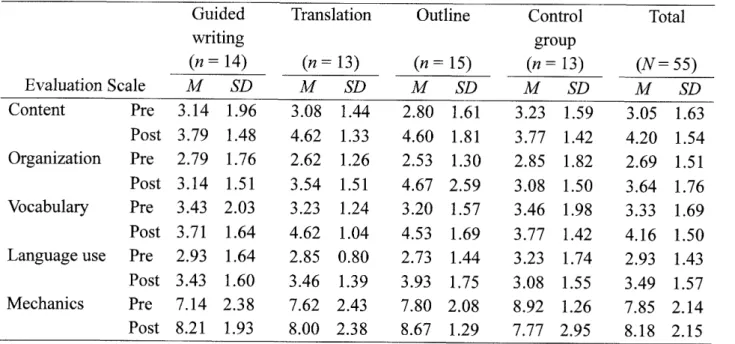
Table 4 shows the descriptive statistics of the groups and English compositions analysis.
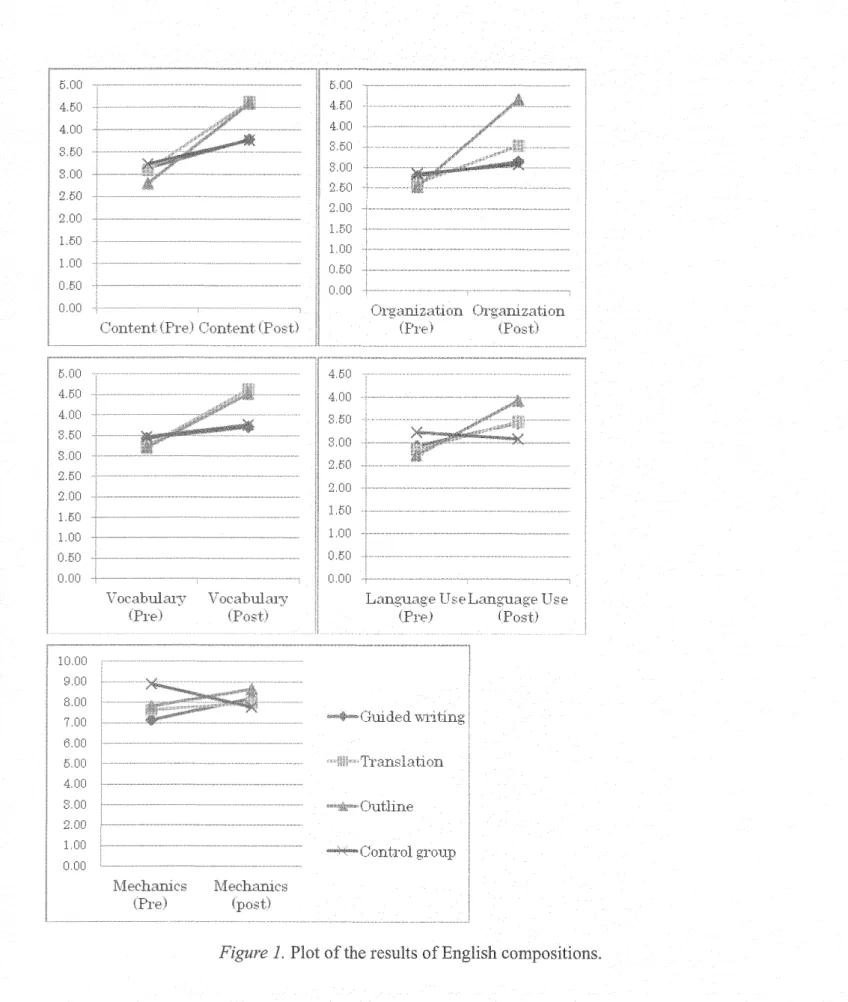
Figure I shows the mean scores for each variable: groups and English compositions. Table 5 shows the results of the two-way ANOVA.
Table 4
Means and Standard Deviations for English Compositions
Guided Translation Outline
writing
(n= 14) (n: t3) (n: ls)
Control grOup
(″ =13)
Total
aV=55)
Evaluation Scalc ν SD ν SD ν SD ν SD
ν"
Content Pre 314 1.96 Post 3.79 1.48 0rganizttim Pre 2.79 1.76 Post 3.14 1.51 Vocabulary Pre 3.43 203
Post 3.71 1.64 Language usc Pre 2.93 1.64
Post 3.43 160 Mechanics Pre 7.14 2.38 Post 8.21 1.93
3.08 1.44 4.62 133 2.62 1.26 3.54 1.51 3.23 1.24 462 1.04 2.85 0.80 3.46 139 7.62 243 800 238
2.80 1.61 460 1.81 2.53 130 467 2.59 3.20 157 4.53 1.69 273 1.44 393 1.75 780 2.08
8.67 1.29
323 1.59 3.77 1.42 2.85 1.82 3.08 1.50 3.46 1.98 3.77 1.42 3.23 1.74 3.08 1.55 892 1.26 7.77 2.95
3.05 1.63 4.20 1.54 2.69 1.51 364 1.76 3.33 169 4.16 1.50 293 1.43 349 1.57 7.85 214
818 215
― ‑ 108 ‑―
500 450 400 350 300 250 200 150 100 050 000
500 450
4110
850 800
2511
200
1511
100 050 000
Organization Olganization
(Fre) {Post)
(〕
cntent(Pl・ eナ content(Pos0
500
4う 0
411 850 311 250 200 150 100 050 000
450 400 350 300 250 200 150 100 050
1100
liocabulary Yocabuluy
iPre) (Posti
1000 900 800 700 601 500 400 800 200 100
0011
― rTtuded■ ■ lltlllg
響 Translat■ on
讐 Ol・ tline
一
Contl・ol理 ,ouP
λ lechancs
(Pre'
ヽ【 ecl■ ancs 6os0
Figure l. Plot of the results of English compositions.
Previous studies on the setting of prewriting activities (e.g., Aso, 2006; Dykstra & Paulston, 1967; Finocchiaro & Brumfit, 1983; Komuro, 2001; Midorikawa, 1994; Raimes, 1983) suggest that guided writing influences Content, Japanese-English translation alfects Vocabulary, Language use
Languagle Use Language tlse
‑ 109 ‑
(Plゃ