Hyperbolic Seiferters for Lens Surgeries
Mario Eudave-MUN~ OZ, Katura MIYAZAKI and Kimihiko MOTEGI
(Accepted November 14, 2012)
HYPERBOLIC SEIFERTERS FOR LENS SURGERIES MARIO EUDAVE-MU ˜NOZ, KATURA MIYAZAKI, AND KIMIHIKO MOTEGI
Dedicated to Masahiko Suzuki on the occasion of his 60th birthday
Abstract. A pair (K, m) of a knot K in S3and an integer m is a Seifert surgery if the result K(m) of m–Dehn surgery on K has a Seifert fibration which may contain an exceptional fiber of index 0. The Seifert Surgery Network is a 1–dimensional complex whose vertices correspond to Seifert surgeries; its edges correspond to single twistings along ‘seiferters’ or ‘annular pairs of seiferters’. If a Seifert surgery (K, m) on a torus knot has a hyperbolic seiferter c (resp. a hyperbolic annular pair of seiferters c, c′), then twistings (K, m) along c (resp. an annulus cobounded by c and c′) produce infinitely many Seifert surgeries on hyperbolic knots. Thus we call such a Seifert surgery a “spreader”. We gave a list of spreaders in [4]. In the present note, we give yet other infinite families of spreaders.
1. Introduction
A pair (K, m) of a knot K in S3 and an integer m is a Seifert surgery if the result K(m) of m–Dehn surgery on K has a Seifert fibration; we allow the fibration to be degenerate, i.e. it contains an exceptional fiber of index 0 as a degenerate fiber. As shown in [2, Proposition 2.8] if K(m) admits a Seifert fibration with fiber of index zero, then it is a lens space or a connected sum of two lens spaces. For any nontrivial torus knot Tp,q, the Seifert surgery (Tp,q, pq) is such an example.
In [2] we define relationships among Seifert surgeries, and draw a global picture of Seifert surgeries. To do this we have introduced seiferters and the Seifert Surgery Network, a 1–dimensional complex whose vertices correspond to all Seifert surgeries.
Definition 1.1 (seiferter). A knot c in S3− N(K) is called a seiferter for a Seifert surgery
(K, m) if c enjoys the following two properties. (1) c is unknotted in S3.
(2) c becomes a fiber in a Seifert fibration of K(m).
Since the exteriors of torus knots are Seifert fiber spaces, for any integer m, (Tp,q, m) is a Seifert surgery. Let sp, sq be exceptional fibers in a Seifert fibration of the exterior of Tp,q with indices
|p|, |q|, respectively, and cµ a meridian of Tp,q; see Figure 1.1. Then sp and sq remain exceptional fibers in Tp,q(m) for any m. Note that cµ is isotopic in Tp,q(m) to the core of the filled solid torus, which is a fiber of index |pq − m| and in particular a degenerate fiber in Tp,q(pq). Hence, the trivial knots sp, sq, cµ are seiferters for (Tp,q, m) for any integer m, and called basic seiferters for (Tp,q, m).
s s c q p m Tp,q
Figure 1.1. Basic Seiferters
Note that a subcomplex T formed on Seifert surgeries on torus knots and basic seiferters is
connected [2, Proposition 8.3]. Among vertices inT , infinitely many, but not every one, are known to have seiferters other than basic ones. So it is natural to ask:
Which (Tp,q, m) has a seiferter other than basic ones?
In particular we are interested in a hyperbolic seiferter c for (Tp,q, m), i.e. S3− Tp,q∪ c admits a complete, hyperbolic metric of finite volume. Once we have a Seifert surgery (Tp,q, m) with a hyperbolic seiferter c, then p–twist along c yields another Seifert surgery (Kp, mp), where Kp and
mpare the images of K and m respectively. We remark that (the image of) c is also a seiferter for (Kp, mp) (Proposition 2.6 in [2]) and that except at most four values of p, Kp is a hyperbolic knot (Proposition 5.11 in [2]). Thus we call a Seifert surgery (Tp,q, m) a spreader if it has a hyperbolic, seiferter or annular pair of seiferters. For the definition of annular pair of seiferters, see [2, 2.3].
In [4], we investigate spreaders and obtain a list of them as shown below.
Theorem 1.2 ([4]). The following Seifert surgeries on torus knots are spreaders in the Seifert
Surgery Network.
(1) (O, m), where O is the trivial knot. (2) (Tp,2, m), where |p| ≥ 3.
(3) (T2n±1,n, n(2n± 1) − 1) (n ≥ 2) and their mirror images. (4) (Tp,q, pq), where Tp,q is a nontrivial torus knot.
Remark 1.3. Furthermore, (O, m) has infinitely many hyperbolic seiferters as well as infinitely
many basic seiferters for each integer m [2, Theorem 6.21]. Concerning (Tp,q, pq), if |p + q| and
|p − q| are both greater than one, then it has at least two hyperbolic seiferters [4, Proposition 6.1].
In the present note, we give yet other infinite families of spreaders. Theorem 1.4. Suppose that n̸∈ {−3, −2, −1, 0, 1, 2}.
(1) A lens surgery (Tn,n+1, n(n + 1)− 1) has at least two distinct hyperbolic seiferters. (2) A lens surgery (Tn,n+1, n(n + 1) + 1) has at least two distinct hyperbolic seiferters. Remark 1.5. If n = −2, −1, 0, 1, then (Tn,n+1, n(n + 1)± 1) are lens surgeries on a trivial knot
O and each of them has infinitely many hyperbolic seiferters (Remark 1.3). If n = −3, 2, then
(Tn,n+1, n(n + 1)± 1) = (T2,3, 5) or (T2,3, 7). It follows from [3] that (T2,3, 7) has at least two
hyperbolic seiferters. In [4], we give a hyperbolic seiferter for (T2,3, 5).
2. A family of Seifert surgeries
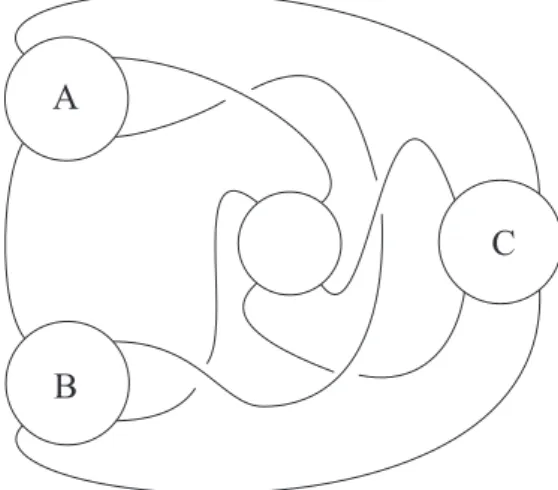
Let Q(A, B, C) be the tangle of Figure 2.1, where A, B, C are rational tangles; it is also denoted by Q(α1
β1,
α2
β2,
α3
β3) if A, B, C correspond to rational numbers
α1
β1,
α2
β2,
α3
β3, respectively. This tangle
was studied by the first author in [6] to produce an infinite family of Seifert surgeries on hyperbolic knots.
A
B
C
Figure 2.1. Tangle Q(A, B, C), where A, B, C are rational tangles. Then [6, Lemmas 6.1 and 6.2] shows:
Proposition 2.1 ([6]). (1) Q1= Q(n1,p+1p ,n+1−1 ) has the following properties.
(i) Q1+ R(∞) is a trivial knot for any integers n, p.
(ii) Q1+ R(−1) is the Montesinos link M(−2n+1n ,−p+1p ,n+1n ).
(2) Q2= Q( 1
n+1,−p+1p ,−1n ) has the following properties. (i) Q2+ R(∞) is a trivial knot for any integers n, p.
(ii) Q2+ R(−1) is the Montesinos link M(−2n−1n+1 ,−3p+1p ,n−1n )
A B C A B C
Let us denote by K(x, y, z) the covering knot of the trivializable tangle Q(x, y, z). Let γ be the covering slope corresponding to (−1)–untangle surgery on Q(x, y, z)+R(∞). Then Proposition 2.1
shows that K(n1,p+1p ,n+1−1 )(γ) is a Seifert fiber space S2( n
2n−1, p
p−1,−n−1n ), K(n+11 ,−p+1p ,−1n )(γ) is a Seifert fiber space S2( n+1
2n+1,
p
3p−1,n−1−n).
Most of K(n1,p+1p ,n+1−1 ) and K(n+11 ,−p+1p ,−1n ) are hyperbolic knots as shown in [6]. More precisely we have:
Proposition 2.2. The knots K(n1,p+1p ,n+1−1 ) and K(n+11 ,−p+1p ,−1n ) are hyperbolic knots if|n| > 2
and |p| > 1. Proof.
We begin by observing:
Claim 2.3. (1) For some slope u, K(1
n, p+1
p ,n+1−1 )(u) contains a unique incompressible torus
F (up to isotopy); the core of the attached solid torus intersects F minimally in two points.
(2) For some slope u, K(n+11 ,−p+1p ,−1n )(u) contains a unique incompressible torus F (up to
isotopy); the core of the attached solid torus intersects F minimally in two points. Proof of Claim 2.3. (1) Figure 2.3 shows that Q1+ R(−2) is a sum of the Montesinos tangles
M (2nn−1,p+1−p) and M (−2, n − 1). A B C A B C A B C
Figure 2.3. Q1+ R(−2) is a sum of the Montesinos tangles M(2nn−1,p+1−p ) and
M (−2, n − 1).
The assumption|n| > 2, |p| > 1 assures that Montesinos tangles M( n
2n−1,p+1−p) and M (−2, n−1) are nontrivial. Let us compare a Seifert fibrations of M1 with that of M2 on ∂M1 = ∂M2. Note
that M1 has a unique Seifert fibration (up to isotopy) and M2 has also a unique Seifert fibration (up to isotopy) except when n = 3 [10]. A component of π−1(α) given in Figure 2.4(i) is a regular fiber on ∂M1. On the other hand, a component of π−1(β) Figure 2.4(ii) is a regular fiber on ∂M2;
M2 has a Seifert fibration over the disk. Note that if n = 3, then M2 = D2(12,−12) has also
a Seifert fibration over the M¨obius band, for which a component of π−1(β′) Figure 2.4(iii) is a regular fiber on ∂M2. Then we see that the Seifert fibration of M1 does not coincide that of M2
on ∂M1 = ∂M2. Hence for the slope u corresponding to R(−2), K(n1,p+1p ,n+1−1 )(u) has a unique
torus decomposition (up to isotopy) with decomposing pieces D2(−2n+1
n ,
p+1
A B C A B C A B
(i) (ii) (iii)
a
b
b’
Figure 2.4. Seifert fibrations of M1= D2(1n,p+1p ) and M2= D2(12,n−1−1) do not
match on their boundaries.
Note that a spanning arc (dotted arc in Figure 2.3) connecting the strings of the filling tangle intersects the decomposing sphere in one point. This arc can be isotoped to lie in the disks that decomposes each of the Montesinos tangles into a sum of trivial tangles. A lift of this arc is a core of the filled solid torus in K(n1,p+1p ,n+1−1 )(u). Then by Example 1.4 of [5], the intersection between the torus F and the core of the filled solid torus consists of two points and it is minimal.
(2) To prove (2) we consider Q2+ R(0). Figure 2.5 shows that Q2+ R(0) is a sum of the Montesinos tangles M (n+1−n,−2p+1p ) and M (−2, n). The assumption |n| > 2, |p| > 1 implies that each Montesinos tangle is nontrivial and has a unique Seifert fibration up to isotopy [10]. Apply the same argument as in (1) to complete the proof.
A B C A B C
Figure 2.5. Q2+ R(0) is a sum of the Montesinos tangles M (n+1−n ,−2p+1p ) and M (−2, n).
□(Claim 2.3) For simplicity, we write K = K(n1,p+1p ,n+1−1 ) or K(n+11 ,−p+1p ,−1n ). Suppose for a contradiction that K is not hyperbolic. Then it would be a torus knot or a satellite knot. If a result of a surgery on a torus knot contains an incompressible torus, then the surgery is longitudinal and the torus is non-separating. Since K(u) is a 3–manifold containing a separating incompressible torus
Assume next that K is a satellite knot with a nontrivial companion knot k which is a torus knot or a hyperbolic knot; K is contained in a tubular neighborhood V of k. Claim 2.3 shows that
K(u) has a unique incompressible torus (∂M1 = ∂M2), which is separating, and the core of the
filled solid torus cannot be made disjoint from the incompressible torus. Hence, ∂V is compressible in K(u). This implies that K is a 0 or 1–bridge braid in V [7] and it wraps w ≥ 2 times in V .
Then K(u) = k( u
w2) [8]. (Since k(wu2) contains a separating incompressible torus, k is not a torus
knot.) It follows from [9] that K(u) = k(wu2) cannot be toroidal, because w2≥ 4, a contradiction.
□(Proposition 2.2) Following [6], we obtain a surgery description of the covering knot K(x, y, z). By an ambient isotopy of S3we move Q(∞, ∞, 0) + R(∞) to the position in Figure 2.6(i); during this isotopy the
tangles A, B, C are fixed. We let C′ be the rational tangle obtained from C by π2–rotation about a line perpendicular to the projection plane, and define the tangle Q′(A, B, C′) to be Q(A, B, C). Note that Q(x, y, z) = Q′(x, y,−1
z); in particular, Q(∞, ∞, 0) = Q′(∞, ∞, ∞). After a further isotopy, we obtain Figure 2.6(ii). Note that κa, κb, κc, κ in Figure 2.6 are spanning arcs of the
∞–tangles A, B, C′, R(∞), respectively.
A
B
A
B
(i)
(ii)
C
’=
C’
kc ka ka kb k k b k kc Q’( ,8 8, 8)+R( )8 Q’( ,8 8, 8)+R( )8C
l l Figure 2.6In the two–fold branched cover of S3 along the trivial knot Q′(∞, ∞, ∞) + R(∞), we denote the preimages of κa, κb, κc, κ by a, b, c, k, respectively. We see from Figure 2.6(ii) that the 4– component link a∪ b ∪ c ∪ k is as illustrated in Figure 2.7. Furthermore, the preimages of latitudes
of ∞–tangles A, B, C′ are preferred longitudes of a, b, c, respectively. Note that each of a, b, c, k is the covering knot of some trivializable tangle. For example, a is the covering knot of the tangle obtained from Q′(A,∞, ∞) + R(∞) by removing the tangle A and k is the covering knot of Q′(∞, ∞, ∞). Therefore, x–, y–, (−1
z)–untangle surgeries along κa, κb, κc correspond to (−x)–, (−y)–, 1
z–surgeries on a, b, c. Thus surgeries on a, b and c given in Figure 2.7(i) (resp. (ii)) convert
k in Figure 2.7(i) (resp. (ii)) into the covering knot K(n1,p+1p ,n+1−1 ) (resp. K(n+11 ,−p+1p ,−1n )); see [6, Proposition 6.3]). Note that the preimage of the latitude λ of R(∞) in Figure 2.6(ii) gives
in particular, (−1)–untangle surgery on κ corresponds to (−1)–surgery on k. We thus have a
“surgery description” of the Seifert surgery (K(x, y, z), γ) as follows. For a link k1∪ · · · ∪ kn in
S3 and r
i a slope on ∂N (ki), (k1, . . . , kn; r1. . . . , rn) denotes an n–tuple of surgeries on k1, . . . , kn along r1, . . . , rn, respectively.
Proposition 2.4. (1) The Seifert surgery (K(n1,p+1p ,n+1−1 ), γ) is obtained from (k,−1) by
a triple of surgeries (a, b, c; −1
n,− p+1
p ,−n − 1) as in Figure 2.7(i).
(2) The Seifert surgery (K(n+11 ,−p+1p ,−1n ), γ) is obtained from (k,−1) by a triple of surgeries
(a, b, c; −n+11 ,p−1p ,−n) as in Figure 2.7(ii).
--n-1 a b c k a b c n+1 1 k 1 1 -(i) (ii) n 1 p p+1 p p-1 -n Figure 2.7
Figure 2.8 shows that 1–twist along k converts a∪ b ∪ c to a union of fibers in a Hopf fibration of k(−1) ∼= S3. We thus have the following.
Proposition 2.5 ([1]). The knots a, b, c are seiferters for the Seifert surgery (k,−1); more
pre-cisely, they become fibers in a Hopf fibration of k(−1) ∼= S3, simultaneously.
In [1], we studied Seifert surgeries on covering knots K(x, y, z) and located them in the Seifert Surgery Network.
3. Proof of Theorem 1.4
Let us consider the Seifert surgery (K, γ) = (K(1n,p+1p ,− 1n+1), γ). By Proposition 2.4(1) the Seifert surgery (K, γ) is obtained from (k,−1) after the surgeries on a, b, c given in Figure 3.1(i).
Figure 3.1(ii) gives the surgery description of (K, γ) after n–twist along the seiferter a, where the images of a, b, c, k are denoted by a, b, c, k′, respectively. Note that a, b, c remain seiferters for the Seifert surgery (k′, n−1). Figure 3.1(ii) indicates that (K, γ) is obtained from (k′, n−1) by the pair of surgeries (b, c;−p+1p ,−1). In Figure 3.1(ii), k′ is a (1, n) cable of the solid torus S3− intN(c),
and a is the core of the solid torus. Hence, performing the (−1)–surgery (i.e. 1–twist) on c given in Figure 3.1(ii) converts k′ = T1,n to k′′ = T1+n,n = Tn,n+1, and the surgery coefficient n− 1 on k′ to n− 1 + n2 = n(n + 1)− 1. See Figure 3.1(iii). It follows that (K, γ) is obtained from
(Tn,n+1, n(n + 1)− 1) by (−1
p)–surgery (i..e. p–twist) on b. To make precise, denote the seiferter
b in Figure 3.1(iii) by bn,1.
Let us prove that bn,1 is a hyperbolic seiferter for (Tn,n+1, n(n + 1)− 1) for any integer n ̸∈
{0, ±1, ±2}. Assume that n ̸∈ {0, ±1, ±2}. Then K(n1, p+1
p ,−n+11 ) is a hyperbolic knot for an arbitrary integer p ̸= 0, ±1 by Proposition 2.2. Note that K(1
n, p+1
a b c k a b c a b c 1-twist along k a b c k
Figure 2.8. a, b, c are fibers in (k,−1) simultaneously.
-1 n-twist along a 1-twist along c --n-1 a b c a b c n-1 1 k
(i) (ii) (iii)
k’ -n-twist p+1 p n 1 8 -p+1p 1-twist b n-1+n k’’ -1p n-twist 2
Figure 3.1. Seiferters for (Tn,n+1, n(n + 1)− 1)
Suppose for a contradiction that S3− T
n,n+1∪ bn,1 (n ̸∈ {0, ±1, ±2}) is not hyperbolic. Then Corollary 3.14 in [2] implies that bn,1is a basic seiferter or there is a solid torus V containing Tn,n+1 in its interior and bn,1is a nontrivial cable of S3−intV . In the former case, any knot obtained from
Tn,n+1by twisting along bn,1is a torus knot. In the latter case, all but at most finitely many knots obtained from Tn,n+1 by twisting along bn,1are satellite knots. This is a contradiction. Hence bn,1 is a hyperbolic seiferter for the lens surgery (Tn,n+1, n(n + 1)− 1).
Assume that k̸∈ {−3, −2, −1, 0, 1, 2}. If we put n = k, then we have a lens surgery (Tn,n+1, n(n+ 1)− 1) = (Tk,k+1, k(k + 1)− 1) for which bk,1 is a hyperbolic seiferter. Similarly, if we put
n =−k − 1, then we have a lens surgery (Tn,n+1, n(n + 1)− 1) = (T−k−1,−k, (−k − 1)(−k) − 1) = (Tk,k+1, k(k + 1)− 1) for which b−k−1,1 is a seiferter. Since −k − 1 ̸∈ {−3, −2, −1, 0, 1, 2}, b−k−1,1 is a hyperbolic seiferter for (T−k−1,−k, (−k − 1)(−k) − 1) = (Tk,k+1, k(k + 1)− 1). This shows that the lens surgery (Tn,n+1, n(n + 1) − 1) has two hyperbolic seiferters bn,1 and b−n−1,1 if
n ̸∈ {−3, −2, −1, 0, 1, 2}. Actually the claim below shows that bn,1 and b−n−1,1 are distinct and thus we have (1).
Claim 3.1. Two links Tn,n+1∪ bn,1 and Tn,n+1∪ b−n−1,1 are not isotopic in S3.
Proof. It is easy to see that the linking number lk(Tn,n+1, bn,1) is n− 1. If Tn,n+1∪ bn,1 and
Tn,n+1∪ b−n−1,1 are isotopic in S3, then we have |lk(Tn,n+1, bn,1)| = |lk(Tn,n+1, b−n−1,1)|, and hence |n − 1| = |(−n − 1) − 1| = | − n − 2|. This is impossible. □(Claim 3.1)
To prove (2), let us then consider the Seifert surgery (K(n+11 ,−p+1p ,−1n ), γ).
By Proposition 2.4(1) the Seifert surgery (K, γ) is obtained from (k,−1) after the surgeries on
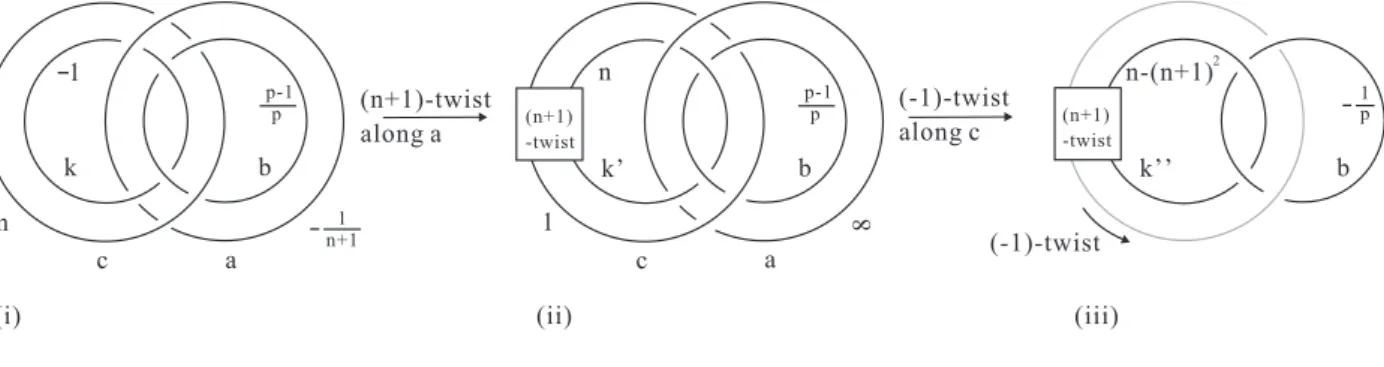
a, b, c given in Figure 3.2(i). Figure 3.2(ii) gives the surgery description of (K, γ) after (n+1)–twist
along the seiferter a, where the images of a, b, c, k are denoted by a, b, c, k′, respectively. Note that
a, b, c remain seiferters for the Seifert surgery (k′, n). Figure 3.2(ii) indicates that (K, γ) is obtained from (k′, n) by the pair of surgeries (b, c;p−1p , 1). In Figure 3.2(ii), k′ is a (1, n + 1) cable of the solid torus S3− intN(c), and a is the core of the solid torus. Hence, performing the 1–surgery (i.e.
(−1)–twist) on c given in Figure 3.2(ii) converts k′ = T
1,n+1 to k′′= T1−(n+1),n+1 = T−n,n+1, and the surgery coefficient n on k′ to n− (n + 1)2 = −n(n + 1) − 1. See Figure 3.2(iii). It follows
that (K, γ) is obtained from (T−n,n+1,−n(n + 1) − 1) by (−1p)–surgery (i..e. p–twist) on b. To make precise, denote the seiferter b in Figure 3.2(iii) by bn+1,−1. Taking the mirror image of
T−n,n+1∪ bn+1,−1, we obtain a lens surgery (Tn,n+1, n(n + 1) + 1) with a seiferter bn+1,−1 which is the mirror image of bn+1,−1.
1 (n+1)-twist along a (-1)-twist along c -n a b c a b c n 1 k
(i) (ii) (iii)
k’ -(n+1) -twist p-1 p n+1 1 8 (-1)-twist b n-(n+1) k’’ -1p 2 p-1 p (n+1) -twist
Figure 3.2. Seiferers for (T−n,n+1,−n(n + 1) − 1)
First we show that bn+1,−1 is a hyperbolic seiferter for (T−n,n+1,−n(n + 1) − 1) for any integer n ̸∈ {0, ±1, ±2}. Assume that n ̸∈ {0, ±1, ±2}. Then K( 1
n+1,−p+1p ,−1n ) is a hyperbolic knot for an arbitrary integer p̸= 0, ±1 by Proposition 2.2. Note that K( 1
n+1,−p+1p ,−1n ) is a knot obtained from T−n,n+1 by p–twist along bn+1,−1; see Figure 3.1.
Suppose for a contradiction that S3− T
−n,n+1 ∪ bn+1,−1 (n ̸∈ {0, ±1, ±2}) is not hyperbolic. Then as in the proof of (1), a knot obtained from T−n,n+1 by twisting along bn+1,−1 is a torus knot or a satellite knot for all but at most finitely many exceptions. This contradicts the above. Thus bn+1,−1 is a hyperbolic seiferter for the lens surgery (T−n,n+1,−n(n + 1) − 1).
Assume that k̸∈ {−3, −2, −1, 0, 1, 2}. If we put n = k, then we have a lens surgery (T−n,n+1,−n(n+
1)− 1) = (T−k,k+1,−k(k + 1) − 1) for which bk+1,−1 is a seiferter. Similarly, if we put n =−k − 1, then we have a lens surgery (T−n,n+1,−n(n+1)−1) = (Tk+1,−k, (k+1)(−k)−1) = (T−k,k+1,−k(k+ 1)− 1) for which b(−k−1)+1,−1 = b−k,−1 is a seiferter. Since −k − 1 ̸∈ {−3, −2, −1, 0, 1, 2},
1)− 1). This shows that the lens surgery (T−n,n+1,−n(n + 1) − 1) has two hyperbolic seiferters
bn+1,−1 and b−n,−1 if n̸∈ {−3, −2, −1, 0, 1, 2}.
Claim 3.2. Two links T−n,n+1∪ bn+1,−1 and T−n,n+1∪ b−n,−1 are not isotopic in S3.
Proof. If T−n,n+1∪bn+1,−1and T−n,n+1∪b−n,−1are isotopic in S3, then we have|lk(T−n,n+1, bn+1,−1)| =
|lk(T−n,n+1, b−n,−1)|. Since lk(T−n,n+1, bn+1,−1) =−(n + 1) − 1 = −n − 2, we have | − n − 2| =
| − (−n − 1) − 2| = |n − 1|. This is impossible. □(Claim 3.2)
□(Theorem 1.4)
References
[1] A. Deruelle, M. Eudave-Mu˜noz, K. Miyazaki and K. Motegi; Networking Seifert Surgeries on Knots IV: Seiferters and branched coverings, to appear in Contemp. Math. Amer. Math. Soc..
[2] A. Deruelle, K. Miyazaki and K. Motegi; Networking Seifert Surgeries on Knots, Mem. Amer. Math. Soc. 217 (2012), no. 1021, viii+130.
[3] A. Deruelle, K. Miyazaki and K. Motegi; Neighbors of Seifert surgeries on a trefoil knot in the Seifert Surgery Network, preprint.
[4] A. Deruelle, K. Miyazaki and K. Motegi; Networking Seifert Surgeries on Knots III, preprint.
[5] M. Eudave-Mu˜noz; 4–punctured tori in the exterior of knots, J. Knot Theory Ramifications 6 (1997), 659–676. [6] M. Eudave-Mu˜noz; On hyperbolic knots with Seifert fibered Dehn surgeries, Topology Appl. 121 (2002), 119–
141.
[7] D. Gabai; Surgery on knots in solid tori, Topology 28 (1989) 1–6.
[8] C.McA. Gordon; Dehn surgery and satellite knots, Trans. Amer. Math. Soc. 275 (1983) 687–708.
[9] C. McA. Gordon and J. Luecke; Dehn surgeries on knots creating essential tori, I, Comm. Anal. Geom. 4 (1995) 597–644.
[10] W. Jaco; Lectures on three manifold topology, CBMS Regional Conference Series in Math. vol. 43, Amer. Math. Soc., 1980.
[11] W. Jaco and P. Shalen; Seifert fibered spaces in 3-manifolds, Mem. Amer. Math. Soc. 21 (1979), no. 220, viii+192.
[12] K. Johannson; Homotopy equivalences of 3-manifolds with boundaries, Lect. Notes in Math. vol. 761, Springer-Verlag, 1979.
Instituto de Matematicas, Universidad Nacional Aut´onoma de M´exico, Circuito Exterior, Ciudad Universitaria 04510 M´exico DF, Mexico and CIMAT, Guanajuato, Mexico
E-mail address: [email protected]
Faculty of Engineering, Tokyo Denki University, Tokyo 120–8551, Japan E-mail address: [email protected]
Department of Mathematics, Nihon University, Tokyo 156–8550, Japan E-mail address: [email protected]